Nineteenth-century Britain witnessed a natural experiment with potential to change the lives of women: the 1870 Married Women's Property Act. The act gave women married after 1870 the right to own and control certain forms of property and thus provided them with the opportunity to change their investment portfolios and shift wealth-holding to forms of property that they could both own and control. For this reason contemporary reformers hailed the act as a major achievement of the women's movement; however, there still exists a debate among modern scholars about whether women benefited from the act. Feminist historians have long regarded the act as a milestone in the emancipation of women. A few argue that the act deserves a place “in the pantheon of historical events” and praise its impact on the lives of women.1
Shammas, “Re-Assessing the Married Women's Property Act.”
Others note, however, that even after the act other factors in combination with the law likely limited the ability of women to control their economic lives on an equal footing with men.
2 Davidoff, Best Circles, p. 95; and Holcombe, Wives and Victorian Ladies. Scholars who have contributed to the debate include Basch, Eyes; Branca, Silent Sisterhood; Davidoff, “Family”; Davidoff and Hall, Family Fortunes; Davidoff and Westover, Our Work; Erikson, Women; Geddes and Lueck “Gains”; Holcombe, Victorian Ladies, and Wives; Kerber, Women, Toward an Intellectual History, and No Constitutional Right; Lewis, Women; Morris, “Men”; Salmon, Women and the Law, and Women and Property; Shammas, “Re-Assessing the Married Women's Property Act”; Shanley, Feminism; Siegal, “Home”; and Staves, Married Women's Separate Property.
That married women received property rights at all, in a male-governed society where men controlled much of the property and women had no right to vote in Parliamentary elections, has consumed the curiosity of all the major contributors to the study of married women's property legislation on both sides of the Atlantic Ocean. As with all major legal changes, and as the work of the scholars involved in the discussion of the married women's property legislation indicates, the motivations behind the passage of the act were complicated. A few influential groups who served as a driving force behind the passage of the British Act have been studied extensively by historians: The British feminist movement by Lee Holcombe and Norma Basch; parliamentarians by Mary Lyndon Shanley, Basch, and Ben Griffin; separated couples and the separate estates of upper-middle-class women by R. J. Morris.3
See Holcombe, Wives; Basch, Eyes; Shanley, Feminism; Morris, “Men,” p. 176; Shammas, “Re-Assessing the Married Women's Property Act”; and Griffin, “Class.”
Recently, legal historians began to scrutinize the act more carefully in order to contextualize the 1870 intervention by linking developments in the law on married women's property with bankruptcy law. These scholars have focused on the loopholes that the relatively better off were able to use to safeguard their daughters' property from male predators. For example, a study of Parliamentary debates and Chancery Court cases argues that the passage of the British Act had more to do with controlling fraud committed by married couples (who colluded to defeat the law of debt) than the rights of married women.4
In the case of U.S. property rights legislation, Richard Chused makes a similar argument about the Oregon Law: When a husband was unable to make family consumption payments, the wife's separate property became liable for familial debt.
5 Chused, “Late Nineteenth Century Married Women's Property Law.”
In addition, the factors that may have influenced the passage of the U.S. Married Women's Property Acts have been discussed by a number of historians, whose arguments also have pointed to the economic requirements of an increasingly commercial and market-based economy.6
See Basch, “Invisible Women” and Eyes; Chused, “Married Women's Property Law”; Degler, At Odds; Rabkin, Fathers; Shammas, “Re-Assessing the Married Women's Property Act”; and Shammas et al., Inheritance.
More recently, economists entered the conversation, arguing that the expansion of markets caused the change in the U.S. property rights legislation, and that the need to lower transaction costs and improve economic efficiency served as catalysts for the change in the law.
7 See Geddes and Lueck, “Gains”; and Gignesi, “Relinquishing Control.”
Rick Geddes and Dean Lueck and Amy Gignesi, however, also acknowledge the possibility of a third factor, one that has been suggested by historians of U.S. women's legal history: Many of the States in the United States may have passed married women's property acts to enable married women to
protect their property and provide for their families in the incidence of a husband's bankruptcy; in effect, to “cushion the blows of a market economy and aid bankrupt men.”
8 The quote is from Shammas, “Re-Assessing the Married Women's Property Act,” p. 24. See Geddes and Lueck, “Gains”; and Gignesi, “Relinquishing Control.” In Concealed Under Petticoats, Lazarou argues that the Texas married women's property legislation was passed to enable families to live off of a women's separate estate in difficult economic times. Also see Henretta et al., America's History; Warbasse, Changing Legal Rights, chapter 4; Chused, “Married Women's Property Law,” pp. 1400–04; Salmon, Women and the Law; and Shammas et al., Inheritance.
Last, some scholars have examined the economic impact of women's property rights legislation in countries other than Britain. For example, Kris Inwood and Sarah Van Sligtenhorst study the 1872 and 1884 Canadian women's property legislation, and examine patterns of property-holding in an Ontario town before and after the legislation.9
Inwood and Van Sligtenhorst, “Social Consequences.”
They find that whereas married women increased their property holdings after the law was passed, single and widowed women benefited most from the legislative change.
10 For other studies on Canadian married women's property legislation, see Hamilton, “Property Rights”; Inwood, “Impact”; and Inwood and Ingram, “Property Ownership.”
Moreover, a study of the wealth-holding patterns of women in the United States in the years surrounding the U.S. Married Women's Property Laws finds that more change in female wealth-holding occurred as a result of the legislation “than had transpired in the previous two hundred years of American history.”
11 Shammas, Re-Assessing the Married Women's Property Act,” p. 21.
Although the literature in the field indicates that the impact of married women's property legislation is important to both women's history and legal history, there has, however, been no work to establish the economic importance of the British Married Women's Property Act. Specifically, while gaining legal rights did not mean attaining equality, economic theory suggests that the extension of such rights should have had a substantial impact on the investment decisions of women.
Analyzing the economic impact of the Married Women's Property Act, while controlling for other factors that may impact wealth-holding, provides a unique opportunity to examine whether and how individuals respond to and benefit from changes in the law. It seems plausible to expect that, before 1870, the law with regard to married women's property produced a suboptimal outcome because it constrained the forms in which women were able to own and control their wealth. After the act, however, women adjusted their investment portfolios in a way that reflected relative rates of financial (and psychic) returns. Thus women married after 1870 were able to achieve an unconstrained portfolio allocation that was superior to the earlier constrained allocation.
I use data collected from inheritance tax records and census returns drawn from the period surrounding the passage of the act. The act, which was not retroactive, gave women married after 1870 the right to own and control personal property. Thus, I focus on wealth-holding data to determine whether the experimental group, the women married after 1870, capitalized on their new property-owning status by investing more of their wealth in forms of personal property than the control group, the women married before 1870.
I examine changes in the investment portfolios of women married after the act, the quantitative significance of such changes when compared with the investment portfolios of women married before the act, and the determinants of the change in the portfolios. I use data on a variety of factors, including bequest and life cycle effects, in addition to the change in property law to empirically test the hypothesis that the 1870 act altered the portfolio allocations of married women.
WOMEN'S PROPERTY RIGHTS BEFORE AND AFTER THE ACT
From the early thirteenth century until 1870, English Common law held that most of the property that a wife had owned as a feme sole came under the control of the husband at the time of marriage.12
Baker, Introduction, p. 552.
Specifically a married woman's “personal property vested in the husband absolutely, since there could be no estates in chattels, and therefore he could dispose of it absolutely.”
13 Thus, a woman, on marrying, relinquished her personal property—moveable property such as money, stocks, furniture, and livestock—to her husband's ownership; by law he was permitted to dispose of it at will at any time in the marriage and could even will it away at death.
14 Shammas et al., Inheritance, p. 3.
, considered a sub-category of personal property and described as any clothing, jewelry, and other items “limited to necessaries and personal ornaments appropriate to her degree” could be sold or given away by the husband at any time during the marriage, but could not be willed away by the husband.
15 Baker, Introduction, p. 552.
Unlike other personal property items that were not paraphernalia, the wife's paraphernalia legally reverted back to her control in widowhood. A married woman's real property, however,
vested in the husband only during coverture, although if she died first he was entitled to be tenant by the curtesy for the rest of his own life. During the marriage the husband and wife were seised in right of the wife. This meant that the husband had seisin and took the profits; but he did not acquire his wife's inheritance, and if he granted away his wife's land it could be reverted hack after his death by the widow or her heir.16
Thus, a wife retained legal ownership of her real property—immovable property such as housing and land, but she could not manage or control it; she could not sell her real property, rent it, or mortgage it without her husband's consent.17
The wife also had no right to rents from her real property; the husband had those rights. The husband, however, could not dispose of the wife's real property without her consent: As a
feme covert, the wife's legal identity came under the cover of her husband; by law she could not make a contract or leave property by will.
18 Staves, Married Women's Separate Property.
Known as the doctrine of coverture, the common law distinction provided the husband with legal power to assume “profitable guardianship … over the wife and over her property.”
19 Suppose, for example, a woman entering marriage before 1870 brought an inheritance of a cottage from her father's will, as well as clothing and jewelry, a bed, and kitchen items such as a brass pan and kettle. Under common law doctrine, her husband obtained managerial rights over the real property as well as ownership rights of any rents that accrued. In addition, he legally could dispose of all of the personal property items at any time during the marriage; but upon death, the husband could will away only the items that were not the wife's real property and her paraphernalia: the bed, brass pan, and kettle. For women who married before the act (or the parents of those women), investing in real property, such as a cottage, was a less risky investment compared to an investment in personal property. The possibility of expropriation made women's investments in items other than real property relatively more risky and, therefore, more expensive investments.20
The going price accounts for the risk faced by the general population, but does not include the added risk faced by the specific group of women studied here. Unlike the general population of male investors the women studied here faced the added risk of having their personal property taken away. Not all women faced such a risk; those who could afford marriage settlements or trusts had a legal way to protect their personal property investments.
Women married after 1870 gained the right to own and control most forms of personal property. The 1870 act gave a married woman rights over her earnings in any trade or occupation carried on separately from her husband.21
In addition she gained the right to control her personal property if held in savings bank accounts, public stock and funds, shares in joint stock companies, or shares in industrial, provident, or friendly societies. She gained the right to personal property and sums of money under £200 left to her in wills, as well as the right to control the rent from any freehold and copyhold property left to her in wills.
The act substantially reduced the risk of having personal property taken away by the husband, his parents, or his creditors. Even in a marriage where the husband, at the time of marriage, promised not to dispose of any of the wife's personal property, before the act the wife or her parents still had an incentive to invest more in real property. Remember, the husband's parents or creditors could take the wife's personal property away. The act provided women with the opportunity to change their investment portfolios and shift wealth-holding from forms of real property to forms of personal property, which they could both own and control.
It should be noted that in 1882 an amended version of the 1870 act, the Married Women's Property Act of 1882, was passed. The act of 1882 gave women married after 1 January 1883 the right to all property that they possessed or were entitled to at the time of marriage and also all property that they acquired or became entitled to after marriage. It would be ideal to do a comparative study of the portfolio allocations of women married after 1870 but before 1883 and the women married after 1 January 1883; however, the data are not available. The Death Duty Registers after 1903 do not survive, and those before 1903 capture very few women who married after 1882. Most of the women married after 1 January 1883 died after 1903. In order to avoid any confusion between the effects of the 1870 and 1882 legislation, I exclude from the analysis the few women found in the 1903 Death Duty Registers who were married after 1 January 1883. Thus, the women in the sample studied here who died between 1901 and 1903 married before 1883. The data used here, then, provides an opportunity to examine whether the 1870 act affected the economic lives of women.
An examination of the impact of the act or other factors on the portfolio allocation decision of women may help to sharpen the way in which the act has been depicted in the past. My hypothesis is that, although the possible implications of the law differ for women of different socio-economic classes, before the act the law constrained the portfolio choice of at least some groups of married women. Admittedly, the act could not affect women who lacked all access to property. Working-class women owned little property and most of what they earned was spent on subsistence purchases such as rent and food, not on savings or stocks.22
In “Britain,” p. 12, Floud asserts that it is unlikely that the act affected “the reality of working class lives; there the decreasing opportunities for employment for married women combined with a birth rate which remained high until the end of the century, produced both economic dependence of women upon men and often its corollary in terms of suffering and sacrifice.”
Nevertheless, another set of women often received small legacies and sometimes were free to spend or invest them as they saw fit, even though they lacked the resources to establish trusts of the sort identified by Morris and Shanley.
23 In their studies of the social, political, and economic motivations behind the passage of the act both Shanley, in Feminism, and Morris, in “Men,” acknowledge the different implications of the law for upper-middle-class women's property: they doubt that the economic lives of upper-middle-class women were greatly impacted by the act; the property of upper-middle-class women had long been protected by marriage settlements and trusts created on their behalf—a practice modeled on the aristocracy.
Families of shopkeepers such as butchers, brewers, and bakers arguably provide a useful example and accordingly receive special attention.
24 For studies of nineteenth-century income distribution and the middle class see Baxter, National Income; Branca, Silent Sisterhood; Colquhoun, Treatise; Earle, Making; Horwitz, “Mess”; Lindert and Williamson, “Reinterpreting Britain's Social Tables”; Morris “Middle Class and British Towns,” “In Search,” “Middle-class Culture,” and “Men”; and Williamson, Did British Capitalism?.
I structured my sample, therefore, to contain information on wives of shopkeepers and on shopkeeping women. Although shopkeeping women may have had additional (or different) risk factors compared to women of other classes and men in general, their behavior should reveal the effect of the act.
25 Women shopkeepers did not face the same risk as the general population of investors. As explained in note 20 the going price accounts for the risk faced by the general population, but does not include the added risk faced by these particular women. Unlike men (whose money made up the majority of investments), these women faced the added risk of having their personal property taken away: wives of shopkeepers and shopkeeping women were unique in that they were unlike working-class women because they owned some property; however, the majority of shopkeepers were not able to protect their property with marriage settlements or trusts as did upper-middle-class and upper-class women.
To determine whether the act or other factors affected the investment decisions of women in the shopkeeping class, I examine data on the portfolio allocations of women who were married in the years surrounding the act, analyze the differences in the investment portfolios, and empirically test the hypothesis that the act impacted their portfolio allocations.
A SAMPLE OF SHOPKEEPERS
To study the wealth-holding patterns of the shopkeeping class, I collected data on wealth-holding from the Death Duty and Succession Duty Registers for England and Wales, which run from 1796 to 1903.26
Public Record Office [hereafter PRO], Kew, Richmond, Surrey TW9 4DU, United Kingdom: Death Duty, Succession Duty, and Estate Duty Registers [hereafter DDR], Class IR26, Volumes for last names beginning with C or D: 1850-1903; Residuary Accounts, Class IR19, Boxes 95-226. Unfortunately, the post-1903 registers do not survive.
The Death Duty and Succession Duty Registers (hereafter registers) consist of handwritten entries in 8,000 volumes covering all duties levied on a deceased person's estate.
27 English, “Probate Valuations” and “Wealth”; Rubenstein, “Occupations”; and Collinge, “Probate Valuations.”
Whether or not a will was written the registers cover all estates worth over £20 from 1796 to 1881, and subsequently all those over £100. For tax collection purposes it was necessary for Inland Revenue officers to determine whether a bequest was absolute, conditional, or an annuity in order to distinguish between property that was a woman's legal property to bequeath and the property that merely “passed through them” as bequeathed by their husbands or fathers. This allows me to distinguish the woman's property regardless of whether she wrote a will.
Most registers provide information on occupation, address, spouse's name, children's names, and number of children. In the majority of entries the information regarding property generally is categorized as either real or personal property; moreover, the registers are the only source from which it is possible to deduce net values of personal estates for most of the nineteenth century. From 1853, when the succession duty was introduced, they included a valuation, previously unobtainable, of all land, settled or unsettled. One or two reliable local men, who were known as appraisers, typically compiled the information on the property in the deceased person's estate.28
For additional discussions about the household inventory procedures, see Erikson, Women; Scott, Prerogative Court; Cox, Affection and Wills; West, Village Records; and the sources identified in the previous note.
Inheritance tax rates did not vary with the kind of property bequeathed. Rather, the rates were based on consanguinity, or the relationship of the legatee to the deceased. For example, spouses and children of the deceased paid no tax, sisters and brothers of the deceased paid a 3 percent tax, and nonblood relations paid a 10 percent tax. I use these data to examine portfolio allocations (the ratio of real to personal property held) for the women married in the years surrounding the act.
I examine trends in wealth-holding and portfolio allocations by comparing the wealth-holding of three groups of shopkeeping women; those who died in the years 1860, 1890, and 1901–1903. I refer to this group, which consists of 1,238 women, as the main sample. The women from the main sample who were married before 1870 and who died in 1860, 1890, or between 1901 and 1903 are referred to as the pre-1870 cohort. The women from the main sample who were married after 1870 and who died between 1901 and 1903 are the post-1870 cohort. One of my goals is to compare the portfolio allocations of women in the two cohorts defined by their marriage date.
In addition, I examine the influence of socio-economic factors and other factors (including the act of 1870) on the portfolio choices of women married in the years surrounding the act. I collected the data on socioeconomic factors from the census; to do this I linked the information from the registers to the census manuscripts. Specifically, I created a subsample of the main sample from the data on the women who died between 1901 and 1903 (from both pre-1870 and post-1870 cohorts) by attempting to link the 641 women dying between 1901 and 1903 to the 1891 census.29
At the time that the data was collected the information from the 1901 Census was not yet available to the public.
This effort, the first attempt to link Death Duty Registers to the census, establishes a linkage for 214 of these women.
30 See Rubenstein, “Occupations”; English, “Probate Valuations,” and “Wealth”; and Collinge “Probate Valuations.” Finding a shopkeeper in the register does not guarantee that the person will be found easily in the census. People moved. Without the address finding a person who moved—even if she moved to a house on the next street—involves scrolling through hundreds of feet of microfilm. The Family Record Centre recently compiled an alphabetical index to the census, which simplified the census linking procedure for some names. Yet with common names such as Elizabeth Cooke and Emma Dickinson, linking names—even with the use of the index—required verifying that I had the correct Emma Dickinson. To verify names I used the index to check that the spouse and children listed in the death duty register matched those listed in the census return.
I refer to these data as the
census-linked sample. In the remainder of this section I describe in detail the data collection procedure.
To obtain information about wealth-holding and portfolio choice, I collected data for the main sample from the registers for the years 1860, 1890, and 1901–1903. There are no indexes to the registers. I compiled the data by consulting each individual entry in the registers containing last names beginning with C or D. Because the register entries as a whole capture the wealth at death of individuals whose economic and social positions practically run the gamut from princes to paupers, I did not collect wealth-holding information on every individual in the registers. Rather, as noted previously, I searched for particular occupations. Again, to control for the large income range of registrants captured in the pages of the registers and also to keep the focus of the study on the group most likely to be affected by the act, I focus on shopkeepers.
The data from the main sample on registrants dying in 1860 and 1890 captures general portfolio choice information, such as average real and personal property holdings, for married women shopkeepers and wives of shopkeepers who were married before 1870. The data for the portion of the main sample collected on registrants dying in the years 1901–1903 captures similar information, but, as noted, for two cohorts of women: the pre-1870 cohort, those in the shopkeeping class who were married before 1870 who died between 1901 and 1903, and the post-1870 cohort, those in the shop-keeping class who were married after 1870 who died between 1901 and 1903. In total I collected information on the portfolio allocation of 1,238 individuals: 310 who died in 1860, 287 who died in 1890, and 641 who died in 1901–1903. Of the 641 who died in 1901–1903, 123 were married before 1870 and 518 were married after 1870.
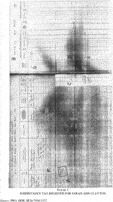
To illustrate the data collection procedure for the main sample of 1,238, consider the example of Sarah Ann Clayton, a provision dealer:31
PRO, DDR, IR26/7938/3372.
A typical register entry, such as the one for Sarah Ann Clayton, is shown in
Figure 1. From the register it is possible to know that Sarah died intestate on 27 October 1901 (A and B in
Figure 1) and left £10 worth of personal property (C in
Figure 1). In addition Sarah left real property worth a net value of £342 (D in
Figure 1), and she had £150 worth of debts at the time of her death (E in
Figure 1).
FIGURE 1 INHERITANCE TAX REGISTER FOR SARAH ANN CLAYTON
Again, for tax collection purposes it was necessary for Inland Revenue officers to distinguish between property over which individuals had legal ownership and therefore could devise by will, and property in which individuals had only a life interest and therefore could not devise by will. In Sarah's case the property that she could not devise by will included any property that her husband Samuel left her for life only; personal property with a net value of £439 (F in Figure 1), and miscellaneous “residue” worth £50 (G in Figure 1). The distinction between a wife who has “legal ownership” over property and one who has only a “life interest” in property is crucial for the study of portfolio choice, because any woman who has legal ownership over some property has a degree of decision-making power with regard to the property; she may sell or will this property away in widowhood. From the Inland Revenue distinction I was able to obtain an estimate of the property that Sarah owned separate from Samuel. I used this procedure to collect portfolio allocation data for the 310 individuals who died in 1860, the 287 who died in 1890, and the 641 who died in 1901–1903.
Next, I used the data collected on the two cohorts of registrants who died in the years 1901–1903 to create the census-linked sample: First, I obtained information on socio-economic factors, such as information on household composition, by attempting to link each of the 641 registers for those dying in 1901–1903 to the manuscripts of the 1891 census. The census links provide additional information on socio-economic factors: From the census I obtained the ages of the couple and their children, which children were living at home at the time of the census, how many servants the family had, whether they had boarders or other family living at the house at the time of the census, and often the number of years married. In the sections that follow I provide a discussion of the potential importance of socio-economic factors. The census-linked sample used in the study of the portfolio allocation of registrants who died in the years 1901–1903 contains census and portfolio allocation information on 214 out of the original 641 registers collected. The information on these 214 households is complete. The majority of the sample group lived in and around Leeds, London, and Liverpool, and worked in 21 of the main occupations representative of the shop-keeping class.32
The sample includes 48 licensed victuallers, 27 grocers, 24 merchants, 21 innkeepers, 17 butchers and 17 tailors, 11 bakers, 9 shopkeepers/provision dealers, 6 chemists, and at least one each in the following remaining occupations: auctioneer, bookseller, confectioner, dairyman, furniture dealer, florist, glass merchant, manufacturer, pawnbroker, shoedealer, stationer, and upholsterer.
WEALTH-HOLDING AND PORTFOLIO CHOICE
A first indicator of the responsiveness of women to the change in property law may be the wealth-holding and portfolio allocations of women married in the years surrounding the passage of the act.33
For a study of the wealth-holding patterns of women in the United States in response to changes in U.S. Married Women's Property Laws, see Shammas, “Re-Assessing the Married Women's Property Act.” For studies of Canadian married women's property laws, see Hamilton, “Property Rights”; and Inwood and Ingram, “Impact.”
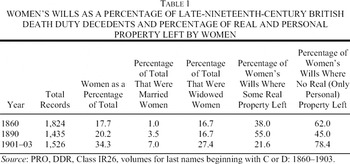
shows the proportion of estates subject to duty that belonged to women, the percentage of women's wills where real property was left, and the percentage of women's wills where no real (only personal) property was left. Women's wills in the death duty registers, as a percentage of the total wills, increased from 17.7 percent in 1860 to 34.3 percent at the turn of the century. Note that the greatest percentage increase in women's wills occurred in the last decade of the century, from 1890 to 1903. As the act did not apply retroactively, the effect on wealth-holding as seen in wills and death duty records would not be evident until the experimental group, the women who married after the act was passed, began to die. The impact of the act, therefore, may be seen in the wills of women who died at the turn of the century.
The impact also is evident in the comparison of women's real and personal property holdings. Between 1860 and 1890 the percentage of women married before 1870 holding any real property increased from 38 percent to 55 percent. As a way of understanding the increase in holdings of real property over the period, consider the following: Shopkeepers had two forms of property from which to choose, real or personal, and they took care to hold and bequeath forms of property that would remain in the family line generations after they had been buried. Parents holding real property who had daughters who married before 1870 left some of it to their daughters, knowing that in widowhood, the property reverted back to the daughter, whereas personal property became the husband's, to do with what he wished.34
Baker, Introduction, p. 552. Again, most marriages probably were good ones; however, parents could not guarantee in advance whether their daughters would have secure marriages. As a result it seems plausible that parents were likely to err on the side of protecting their daughters and their property. See Shammas, Salmon, and Dahlin, Inheritance; Staves, Married Women's Separate Property; and Anderson, “Social Implications.”
Shopkeepers with daughters made the types of investments that most certainly would remain in a daughter's legal ownership and therefore provide for and pass to grandchildren. Wealth-holding patterns, therefore, reflect the desire of parents, daughters, and married women to hold property in the form of the asset over which married women had ownership rights.
35 The property held by a woman married before 1870 likely was either inherited from her parents, some other relative or friend, or her deceased husband; however, her control over the property depended on the way in which the property was left to her. If she was given absolute control over the property, then she had the ability to change the form in which the property was held. The wealth at death data give the type and value of property held at death, but unfortunately do not give specific information about who actually made the decision about the form in which the property would be held.
It seems plausible that property legislation had an effect on the kind of property holding and inheritance decisions such women made. For the generation of women dying in the first decade of the twentieth century the percentage of women holding only personal property rose from 45.0 percent to 78.4 percent.
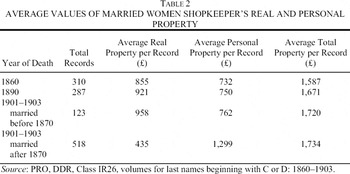
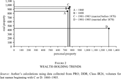
Even more striking, however, is the shift in average values of women's real and personal property holdings. The average values of real and personal property holdings from the sample of 1,238 women are listed in Table 2 and shown in Figure 2. The sample of women who died in 1860 (at ages close to the national average) held, on average, £855 and £732 worth of real and personal property at death (marked A in Figure 2). The sample of women married before 1870 who died in 1890 (at ages close to the national average) held real and personal property in approximately the same ratio; the average values of real and personal property held by this group at death were £921 and £750 (marked B in Figure 2). The sample of women married before 1870 who died between 1901 and 1903 (at ages above the national average) also chose a similar portfolio allocation and held real and personal property in approximately the same ratio: £958 and £762 (marked C in Figure 2). These results indicate a clear trend in portfolio choice for the women in the sample married before 1870 regardless of whether they died in 1860, 1890, or 1901–1903, and regardless of their age at death.
FIGURE 2 WEALTH-HOLDING TRENDS
Because the act did not apply retroactively its effect would not be evident until the women who married after 1870 began to die. In fact, register entries for women who married after 1870 and who died at the turn of the century (at ages close to the national average and also at ages close to the women who died in 1860 and 1890) suggest a different portfolio allocation. Average real property holdings of the women married after the act fell to £435, whereas average personal property holdings increased to £1,299 (marked D in Figure 2). The increased proportion of personal property supports the hypothesis that greater long-term security for personal property encouraged women to hold more of their assets in that form, and less as real property. With the passage of the act, “propertied and wage-earning women … [were] in a position to make some decisions about their and their family's own consumption, investments, and wealth transmission.”36
Shammas, “Re-Assessing the Married Women's Property Act,” p. 23.
Although other factors still must be considered, the general trend in portfolio allocation throughout the latter half of the nineteenth century and subsequent change at the turn of the century support the hypothesis that women responded to the act.
MODELING WEALTH-HOLDING AND PORTFOLIO CHOICE
It is possible that factors other than the act may have led to the change in portfolio allocation. Here I examine whether the hypothesized impact of the act on the change in portfolio allocation is robust when other possible influences, such as life-cycle motives, bequest motives, prices, and other factors are considered. For example, some of the main findings in economics with regard to wealth-holding have pointed to bequest or life-cycle motives.37
For a general interpretation of the bequest motive, see Di Matteo, “Determinants”; Bernheim, Shleifer, and Summers, “Strategic Bequest Motive”; and Sundstrom and David, “Old-Age Security Motives.” Other important studies include Henretta, “Families”; Ransom and Sutch, “Life Cycle Transition”; Nugent, “Old-Age Security Motive”; and Modigliani, “Role.”
An individual is said to have a bequest motive if he accumulates assets during working years in order to provide his children with an inheritance. The individual is said to have a life cycle motive if she accumulates assets during her employment in the labor market in order to finance her consumption during retirement, or any period of reduced labor market earnings.
Bequest Motive
For a nineteenth-century shopkeeping couple, the rationale for a bequest motive might have been as benevolent as a concern for the welfare of their children, or as businesslike as providing an incentive (the proceeds from the sale of the business or the business itself) for their children to care for them in old age.38
Bernheim, Shleifer, and Summers, “Strategic Bequest Motive”; Ransom and Sutch, “Life-Cycle Transition”; Sundstrom and David, “Old-Age Security Motives”; and Di Matteo, “Determinants.”
One explanation of bequest saving offered by Livio Di Matteo is that young couples starting a family tend to invest much of their wealth in a home or real estate (or, for nineteenth-century shopkeepers, a business that included living space above it), which would result in less of their wealth being invested in financial assets.
39 Di Matteo, “Determinants,” p. 924.
Thus “individuals could invest in their children and expect old age support from them, reducing the amount held in other assets, or they could rely more on markets by investing in financial assets.”
40 Thus, studies of bequest savings have used the total number of children to measure the extent of the bequest motive, citing a positive relationship between total wealth and the number of children as evidence of bequest savings, particularly if impartible settlements were not the norm.
41 An impartible settlement is one in which one principle heir is favored to the exclusion of all other claimants. For a discussion of impartible settlements and life-cycle savings, see Hurd, “Savings”; Gagan, “Indivisibility,” p. 129; Di Matteo and George, “Patterns,” pp. 26–27; and Di Matteo, “Determinants,” p. 915 note 36.
In terms of the impact of the presence of children on the portfolio allocation, the number and gender of the children living inside the home and working in the labor market also may have had an effect. Because the hypothesis being tested here is that the act enabled women married after 1870 to alter their portfolio allocations and transfer property from forms of real property (which they could own but not control) to forms of personal property (which they could own and control), I define the portfolio allocation as the ratio of real property to personal property. Thus, an increase in the ratio indicates increases in real property holdings relative to personal property, while a decrease in the ratio indicates increases in personal property holdings relative to real property.
The portfolio allocation will show evidence of bequest saving in a number of possible ways: In the case of partible inheritance, where all of the children receive an equal share of the inheritance, much of the portfolio allocation may be held in forms of property that are easily divisible—personal property such as stocks and savings.42
Of the 214 decedents studied in the census-linked sample, only seven of the estates where the decedent was testate could be classified as impartible [PRO DDR class IR26]. Most of the testators studied here stated in their wills that they would like the proceeds from the estate “to be divided equally among all the testator's children.”
In this case, then, evidence of bequest saving exists if more children decreased the ratio of real to personal property. Or it may also be the case that the estate was divided equally between all of the children, but the real estate and business was left to one child, while other forms of personal property were divided between the remaining children. In such a case both forms of property would be expected to have a prominent role in the portfolio makeup.
Life Cycle Motive
It also is possible that the portfolio allocation of shopkeepers was affected by a life-cycle saving motive.43
Davies, “Uncertain Lifetime.” Also see Ando and Modigliani, “Life Cycle Hypothesis”; Kotlikoff, “Intergenerational Transfers”; Di Matteo, “Determinants”; Modigliani, “Role”; Di Matteo and George, “Patterns”; Kessler and Masson, “Bequest”; Kearl and Pope, “Life Cycle”; and Menchik and David, “Income Distribution.”
For a nineteenth-century shopkeeping couple the rationale for a life-cycle motive would have been to accumulate assets during their years running the shop in order to finance consumption during retirement.
Specifically, a shopkeeping couple may build up their investments in real estate and business property early in their lives, with a plan to live off the income stream from the rents, or convert the real property to personal property at retirement in order to provide themselves with an annuity that would support them in retirement. The portfolio allocation, then, could show evidence of life-cycle saving if there is a direct (living off the rent from the real property) or concave relationship (converting the real to personal property) between age and the ratio of real to personal property.
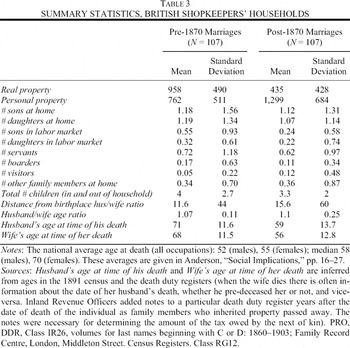
Because age typically is used to measure the life cycle, one important feature of the age data presented in Table 3 should be noted: The average age at death of the first cohort, those married before 1870, was 71 (males) and 68 (females). The second cohort, those married after 1870, had an average age at death of 59 (males) and 56 (females).44
National averages at the time were 52 (males) and 55 (females) [Anderson, “Social Implications,” pp. 16–27]. Because shopkeepers generally had better housing and standards of living than the working classes, who numbered two-thirds of the total population, it does not seem unusual that shopkeepers would have average ages at death higher than the working class and the population as a whole.
The age at death of the pre-1870 cohort is older than the post-1870 cohort because the pre-1870 cohort
had to live longer in order to have died at the turn of the century (and thus be captured in the death duty registers for the years 1900–1903).
45 Even with the age difference, however, the pre-1870 cohort dying in 1900 is similar, in terms of the summary statistics, to the 1860 and 1890 cohorts who were dying at ages more similar to the national average.
I address the possibility that the difference in age between the two cohorts may affect the differences in portfolio allocation by including age and age-squared in the estimation of the portfolio allocation. The estimation method is described in the next section.
The preceding discussion of bequest and life-cycle motives provides justification for including the following variables in a model of portfolio choice: the total number of children (living inside or outside the home), the number of sons living at home, the number of daughters living at home, the number of sons working in the labor market, the number of daughters working in the labor market, age, and age-squared.
Other Socio-Economic Characteristics
In addition to controlling for life-cycle and bequest motives in a test of whether the act affected the portfolio allocation of women, one also must control for other socio-economic factors that may have had an impact. The choice of the remaining variables and the method used to model the impact of the act on total portfolio allocation follows Di Matteo and Clayne Pope, who outline a determinants approach and categorize the data into choice and non-choice variables with the remaining variation in wealth-holding and portfolio decisions being a function of random forces.46
See Pope, “Households,” pp. 152–58; and Di Matteo, “Determinants,” pp. 916–17.
Di Matteo describes choice variables as “socio-economic characteristics that an individual could attempt to alter.”
47 Di Matteo, “Determinants,” p. 917.
In the case of nineteenth-century shopkeepers the choice variables might include present place of residence and its distance from the birthplace of the individual, bearing children, whether or not sons and daughters living in the household engage in labor market work, the age ratio of the husband and wife, and the number of additional family members and also non-family members in the household, such as boarders.
48 For a discussion of the importance of birthplace and migration to wealth, see Pope, “Households,” which argues that households can counter the effects of a bad birthplace by moving to a new town or region. With regard to this study the distance from birthplace may have an effect on portfolio allocation for the following reason: Consider a wife who had family living close to her and her husband. She had an additional support network and possibly a place to stay should she decide to leave her husband. Furthermore, her family might be able to keep an eye on her and her property; therefore, the presence of family nearby should benefit wives by increasing their ability to hold forms of property that might otherwise have been risky to hold even after the act was passed. Moreover, because women married after 1870 still held about 25 percent of their property in the form of real property, it should be clear that proximity to family still mattered, even to husbands and wives married after 1870.
Nonchoice variables are fixed characteristics that an individual would not be able to alter, such as age, the rate of return to specific assets, and the passage of the Married Women's Property Act of 1870.
Family members other than children living in the household, as well as non-family members, such as boarders, also may have impacted the portfolio allocation. Extended family in the household may reduce or increase total wealth, depending on what they contribute to or demand from the household in the way of watching younger children, helping with household chores (in lieu of the household hiring an extra servant), or working in the family business. Boarders should have a positive impact on total wealth, because boarders pay for their room and board. Boarders and extended family who contribute income to the household may have a positive impact on the amount of wealth invested in personal property—because the additional income may enable the household to purchase more items for the household, or invest more in savings or stocks.
Last, the relative age of the husband and wife may impact the portfolio allocation. One would expect to find that the decision-making power of a wife in a couple whose spouses have similar ages should be greater than in a marriage where the wife is much younger than the husband. Thus we should expect to find that, for a couple who are about the same age, the wife should have greater control over her property decisions than in a marriage where the wife is much younger than the husband.
Table 3 provides summary statistics that offer a broader picture of the household makeup of British shopkeepers. From looking at variables in Table 3, it is possible to see that, aside from the differences mentioned previously with regard to age, the household makeup of the pre-1870 cohort is almost indistinguishable from the household makeup from the post-1870 cohort. Most families had about three or four children, zero or one servant, and about the same likelihood of having other family members, such as grandparents or siblings, living in their home. Both cohorts were more likely to have sons working in the labor market than daughters, and it was more common for husbands to live farther from their birthplace than wives.
THE IMPACT OF THE ACT ON PORTFOLIO ALLOCATION
The preceding discussion implies that a test of whether the act or other factors impacted the demand for a specific portfolio allocation may be modeled as a function of socio-economic variables that include the act (a dummy variable equal to zero if the marriage took place before 1870 and one otherwise), total number of children living inside or outside the household, number of sons living in the household, number of daughters living in the household, number of sons living in the household who engage in labor market work, number of daughters living in the household who engage in labor market work, the number of other family members (who are not children) living in the household, the number of non-family members (boarders) in the household, the ratio of the husband and wife's distance from birthplace, the age of the wife at death, and the age ratio of the husband and wife.
The hypothesis outlined earlier is that before the act the law constrained the portfolio choice of married women, and it was not until after 1870 that married women had the freedom to invest, own, and control personal property. The hypothesis here is that, all else constant, the act reduced the riskiness of personal property investments for women in the shopkeeping class who married after 1870, and thus, the implicit price of personal property purchased by these women.49
Please refer to the argument in notes 20 and 25.
As a result the act provided women with the opportunity to change their investment portfolios and shift wealth from forms of real property to forms of personal property, which they could both own and control.
An empirical model of portfolio choice that examines whether women married after the act changed their portfolio decision needs to account for the investment choice described above, while controlling for factors discussed earlier, such as life-cycle and bequest motives, socioeconomic factors, and relative prices: A woman about to be married has property that she may choose to invest in forms of real or personal property, where the prices of real and personal property include some implicit rate of return.50
Combs, “Cui Bono?” provides a discussion of the literature that focuses on the returns to the kinds of investment choices that shopkeepers made. The findings indicate that the post-1870 cohort had no return-driven incentive to shift their wealth-holding from forms of real to forms of personal property investments. In “Determinants,” p. 917 and note 43, Di Matteo notes that “if financial assets are risky investments, relative to other assets, and individuals are risk averse, then as wealth increases, one would expect to see more financial asset holding … and if the proportion of wealth held in financial assets increases as wealth increases, then there is decreasing relative risk aversion.” Also see Siegel and Hoban, “Measuring Risk Aversion”; Bellante and Saba, “Human Capital”; and Friend and Blume, “Demand.”
Women maximize utility in purchases of real and personal property given a budget constraint and other socio-economic factors that may impact the portfolio allocation decision.
Again, I define the portfolio allocation as the ratio of real property to personal property, and because it is a limited dependent variable, I estimated a weighted tobit regression for the ratio. The estimation is log linear so the coefficients may be interpreted as percentages. The estimation procedure follows Di Matteo, who estimates a model of wealth and asset holding that does not contain variables for the rate of return to specific assets or risk, but instead uses the level of wealth as a proxy for risk.51
See Di Matteo, “Determinants,” p. 917 and note 43; Siegel and Hoban, “Measuring Risk Aversion”; Bellante and Saba, “Human Capital”; Friend and Blume, “Demand.”
To avoid simultaneity problems, I estimated a separate wealth regression using weighted least squares, and then used the fitted values from the separate regression as the wealth variable in the portfolio allocation regression.
52 As Di Matteo notes in “Determinants,” p. 919, note 48, “A simultaneity problem exists when wealth is a function of many of the variables in the specific asset equations and yet is included as an independent variable in those equations. Without instrumenting, wealth would be correlated with the disturbance term resulting in inconsistent estimates.” I regressed wealth on all of the independent variables used in the wealth regression in Table 4 and a dummy variable indicating whether or not the individual was a testate (that is, left a will), and the number of court cases in the county.
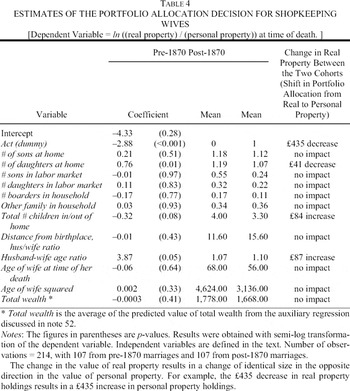
All independent variables used are listed in
Table 4, which presents the results from the estimation.
The Act of 1870
The coefficients have the expected sign and suggest that the 1870 Married Women's Property Act had a substantial effect on the shift in women's portfolio allocation from real to personal property. For women marrying after the passage of the act the effect on the portfolio allocation was a transfer of £435 from investments in real property to investments in personal property. More specifically, given the average total wealth of the pre-1870 cohort, the results suggest that if the members of the cohort had married after the passage of the act, they would have held personal property worth £1,197 and real property worth £523, compared to actual holdings of £958 and £762.
Total Number of Children
The sign on the number of children coefficient indicates that as the number of children increased, wives held more property in the form of personal, and less in the form of real property. The result suggests that women with many children held more personal property than real property, possibly because personal property, in the form of stocks and savings, was easier to split up among a large number of children, compared to land or real estate. The coefficient for the total number of children, which is significant at a 92 percent confidence interval, supports the bequest motive. Specifically the results indicate that for every additional child, the effect on the ratio of real to personal property is a decrease of 32 percent. However, given that the average difference in the total number of children between the two cohorts is –0.70 children, the result translates into an increase in the ratio of real to personal property of 22.4 percent. For the average family in the pre-1870 cohort the change corresponds to an increase in real property and a decrease in personal property of £84.
Number of Daughters Living at Home
The sign on the coefficient for the number of daughters living in the home indicates that as the number of daughters at home increased, wives held more property in forms of real, and less property in forms of personal property. The result supports the bequest motive described by Di Matteo in the sense that, wives may have been investing in their daughters (by providing a large enough home in which the daughters could reside while also expecting old age support from the daughters).53
Di Matteo, “Determinants,” p. 924. In addition, to determine whether the influence of the presence of daughters in the household was influenced by the passage of the act, I tested whether an interaction effect existed between the number of daughters and the passage of the act. To do this I estimated the model used above but also included an interaction term; a variable that multiplies a dummy for the passage of the act with the number of daughters at home. The coefficient for the interaction term was 0.20 and it was not significant at any reasonable level of significance (p-value = 0.61). In addition the results with regard to the original set of coefficients did not change.
The coefficient for the number of daughters living at home is significant at a 99 percent confidence interval and indicates that for every additional daughter living at home, the effect on the ratio of real to personal property is an increase of 76 percent. Given that the average difference in the number of daughters living at home between the two cohorts is –0.12; however, the result translates into a decrease in the ratio of real to personal property of 9.12 percent. For the average family in the pre-1870 cohort the change corresponds to a decrease in real property and an increase in personal property of £41.
Age Ratio of the Husband and Wife
The sign on the coefficient for the husband-wife age ratio indicates that the older the husband relative to the wife, the greater the likelihood that the wife held more property in forms of real, and less property in forms of personal property. The coefficient for the age ratio is significant at a 95 percent confidence interval and indicates that for every one unit increase in the age ratio, the effect on the ratio of real to personal property is an increase of 387 percent. Given that the average difference in the age ratio between the two cohorts is only 0.03; however, the result translates into a increase in the ratio of real to personal property of 11.6 percent. Therefore, for the average family in the pre-1870 cohort the change corresponds to an increase in real property and a decrease in personal property of £87. Perhaps younger wives had less control over property if they were married to older husbands. The result supports the idea that women took care to invest in forms of property that remained their legal property, that could not be expropriated easily, and therefore could be passed on to children.
Other Variables
Aside from the variables discussed above, the results indicate that the other control variables have no impact on portfolio allocation. Last, although it is clear that the total number of children, the number of daughters living at home, and the age ratio of the husband and wife do affect the ratio of real to personal property, the magnitudes of effect caused by the variables are small compared to the magnitude of effect caused by the act.
As an additional test concerning the effect of the act I ask whether the two sets of data for the pre- and post-1870 marriages contain substantially different regression coefficients for the same theoretical equation used above but not including the act variable. If there is no change in the coefficients in each of the two groups, one can infer that something else (other than household demographics) caused the observed change in portfolio allocation--the Married Women's Property Act. Answering the question requires the straightforward application of the Chow test.54
A test of the null hypothesis that the slope coefficients are the same in the two samples, before and after the passage of the act indicates that the two sets of regression coefficients are equivalent.
55 Because the calculated F-statistic, 0.4523, is less than the critical F-value [14, 186] (a number between 1.83 and 1.75), I am unable to reject the null that the two sets of regression coefficients are equivalent.
Now that it has been determined that the slope coefficients are statistically the same, observe that most of the difference between the two separate regressions (with the act variable omitted) is found in the constant terms: the pre-1870 marriage cohort has a constant term equal to –9.6, whereas the post-1870 marriage cohort has a constant term equal to –7.8. The result further suggests that the act served as a catalyst for the change in portfolio allocation.
One final piece of evidence supporting the hypothesis that the act played a crucial role may be seen, again, in the trends evident in the data in Table 2 and Figure 2. Consider, for example, that the change in the ratio of real to personal property for the cohort married after 1870 had been caused by something other than the act, such as changes in relative prices or even nonfinancial returns. If this was the case then both groups—the control group, or women married before the act who died between 1901 and 1903, and the experimental group, women married after the act who died between 1901 and 1903—would have faced the same environmental, social, and price-related changes, and therefore should have reacted in the same way, and thus made similar investment decisions. From the wealth-holding trends evident in Table 2 and Figure 2, however, it is clear that the group married before 1870 who died between 1901 and 1903 and the women married after 1870 who died between 1901 and 1903 did not make similar investment decisions.
CONCLUSION
The 1870 Married Women's Property Act reduced the risk of having personal property items taken away by the husband and provided married women with a “measure of legal independence” and the opportunity to make choices about their wealth-holding. They seized the opportunity. Married women used their newly acquired legal independence to gain a measure of economic independence; women married after the act transferred their wealth into forms of property that they could own and control. The results presented here indicate that the findings about the impact of the 1870 act are robust when other possible influences on portfolio allocation are considered: the act had the greatest impact on the investment portfolio decisions of women married after 1870.
It is clear from the results presented here, however, that gaining the right to hold property did not, at least initially, enable women to increase their total wealth. Yet the fact that women responded to the law and shifted their wealth-holding to property they could control while married has implications for future research on families and households, particularly research that focuses on issues of older-age security and inheritance, as well as household bargaining (both marital bargaining and intergenerational), and the distribution of resources within the family. Moreover, we must remember that this article only examines the impact of the 1870 act on the property decisions made by women married before 1883; the year that the 1882 Married Women's Property Act went into effect. If data could be collected on the impact of the 1882 act, it seems reasonable to expect that this later and more comprehensive act should, as Holcombe suggests, have an even larger impact on the economic lives of women, and in particular, their total wealth. Studies of married women's property rights extend to questions about investment decisions, the legal and economic lives of married women, and even late-twentieth-century property law debates.
The term “measure of legal independence” was obtained from Floud, “Britain,” v. 2, p. 12. This research was supported by the Earhart Foundation and by the University of Iowa scholarship in memory of Jane Weiss. I have benefited from comments from Rick Geddes, C. Knick Harley, Beth Ingram, Kris Inwood, Linda Kerber, Deirdre N. McCloskey, Bart Moore, George Neumann, Gene Savin, Troy Tassier, and Chuck Whiteman, as well as the comments of attendees at the 2001 Eastern Economic Association Meetings, and three anonymous referees. The usual caveat applies.