The Antarctic Ice Sheet, covering an estimated 12×106 km2, constitutes the most extensive glacial microbial habitat on the planet, with estimates of cell-derived organic carbon of a similar order of magnitude to the open ocean (Priscu et al. Reference Priscu, Tulaczyk, Studinger, Kennicutt, Christner, Foreman, Vincent and Laybourn-Parry2008). Wet-based conditions beneath >50% of the ice sheet (Pattyn Reference Pattyn2010) permit the survival and active metabolism of micro-organisms across a range of hydrological environments, including subglacial lakes (Priscu et al. Reference Priscu, Adams, Lyons, Voytek, Mogk, Brown, McKay, Takacs, Welch, Wolf, Kirshtein and Avci1999), intermittently flowing rivers, water-saturated subglacial tills and associated brines (Karl et al. Reference Karl, Bird, Björkman, Houlihan, Shackelford and Tupas1999; Priscu et al. Reference Priscu, Tulaczyk, Studinger, Kennicutt, Christner, Foreman, Vincent and Laybourn-Parry2008). Beyond these relatively shallow basal habitats, geophysical data indicate the presence of extensive sedimentary basins containing drapes of sediments up to 14 km in thickness (Ferraccioli et al. Reference Ferraccioli, Armadillo, Jordan, Bozzo and Corr2009). Even where frozen conditions prevail at the ice sheet bed, geothermal heating (30–50° C/km (Maule et al. Reference Maule, Purucker, Olsen and Mosegaard2005)) enables sediments to remain thawed at depth, with the potential to support microbial activity.
The above inferences designate the Antarctic Ice Sheet as a potentially important biogeochemical reactor in the Earth System. As in other subglacial environments, micro-organisms mediate and accelerate chemical weathering processes beneath the continent (Lanoil et al. Reference Lanoil, Skidmore, Priscu, Han, Foo, Vogel, Tulaczyk, Engelhardt, Cary, Murray and McDonald2009, Mikucki et al. Reference Mikucki, Pearson, Johnston, Turchyn, Farquhar, Schrag, Anbar, Priscu and Lee2009), driving the ice sheet bed towards anoxia via the consumption of dissolved oxygen during the microbial oxidation of sulphide minerals and organic carbon (Wadham et al. Reference Wadham, Tranter, Skidmore, Hodson, Priscu, Lyons, Sharp, Wynn and Jackson2010). Sustained microbial activity and associated rock-weathering also stimulate the release of nutrients (e.g. Si, N, P, DOC, Fe) to meltwaters, where the latter are ultimately exported in runoff and icebergs to the iron-limited Southern Ocean. This may have an important impact on Southern Ocean marine primary productivity, influencing global climate by regulating concentrations of atmospheric CO2 (Sigman & Boyle Reference Sigman and Boyle2000). The present authors hypothesise that the activity of micro-organisms beneath the Antarctic Ice Sheet is likely to have impacts well beyond the ice margin, via (1) the release of nutrients from subglacial runoff and icebergs to the Southern Ocean (Raiswell et al. Reference Raiswell, Tranter, Benning, Siegert, De'ath, Huybrechts and Payne2006, Reference Raiswell, Benning, Tranter and Tulaczyk2008; Statham et al. Reference Statham, Skidmore and Tranter2008; Lancelot et al. Reference Lancelot, de Montety, Goosse, Becquevort, Schoemann, Pasquer and Vancoppenolle2009; Raiswell Reference Raiswell2011); and (2) the production of methane under anoxic conditions in sedimentary basins, with the potential for release to the atmosphere during deglaciation (Wadham et al. Reference Wadham, Arndt, Tulaczyk, Stibal, Tranter, Telling, Lis, Lawson, Ridgwell, Dubnick, Sharp, Anesio and Butler2012). The goal of this paper is to review the current understanding of the role of the Antarctic Ice Sheet in global biogeochemical cycles.
1. Biogeochemical processes beneath Antarctica
We separate our review of the current understanding of biogeochemical processes beneath the ice sheet into (a) shallow processes that encapsulate the zone located close to the ice-bed interface and including the subglacial till layer, subglacial lakes and intermittent channels that form during subglacial lake drainage; and (b) processes that operate within deep sedimentary basins located beneath the subglacial till layer.
1.1. Shallow processes at the ice-bed interface
The dominant biogeochemical reaction in shallow sediments beneath the Antarctic Ice Sheet is almost certainly sulphide oxidation (Skidmore et al. Reference Skidmore, Tranter, Tulaczyk and Lanoil2010; Wadham et al. Reference Wadham, Tranter, Skidmore, Hodson, Priscu, Lyons, Sharp, Wynn and Jackson2010). This is likely to be linked to carbonate dissolution, initially because of the rapid dissolution kinetics of carbonates with respect to silicates (Equation 1). Sulphide oxidation consumes oxygen, driving down the partial pressure of oxygen, pO2, and REDOX potential (Eh) of the water.
 $$\eqalign{&4FeS_{2} (s) + 16Ca_{1-x} (Mg_{x})CO_{3} (s) + 15O_{2} (aq) + 14H_{2}O (l) \leftrightarrow\cr
&pyrite\cr
&16(1-x) Ca^{2+} (aq) + 16x Mg^{2+} (aq) + 16 HCO_{3}^{-} (aq) \cr
&+ 8SO_{4}^{2-} (aq) + 4Fe(OH)_{3} (s)\cr
&ferric (oxyhydr)oxides}$$
Sulphide oxidation becomes coupled to silicate dissolution over time (Equation 2) as either carbonate minerals become depleted in the subglacial flour and/or carbonate saturation increases (Skidmore et al. Reference Skidmore, Tranter, Tulaczyk and Lanoil2010; Wadham et al. Reference Wadham, Tranter, Skidmore, Hodson, Priscu, Lyons, Sharp, Wynn and Jackson2010)
$$\eqalign{&4FeS_{2} (s) + 16Na_{1-x}KAlSi_{3}O (s) + 15O_{2} (aq) + 86H_{2}O (l) \leftrightarrow\cr
&pyrite\ alkali\ feldspar\cr
&16(1-x) Na^{+} (aq) + 16x K^{+} (aq) + 8Al_{2}Si_{2}O_{5}(OH)_{4} (s) \cr
&\hskip10+ 32H_{4}SiO_{4} (aq) + 8SO_{4}^{2-} (aq) + 4Fe(OH)_{3} (s)\cr
&kaoliniteferric\ (oxyhydr)oxides}$$Oxidising agents other than oxygen are present in relatively high concentrations at the ice sheet bed. These include Fe(III), as shown in Equation 3, consumed during the microbial oxidation of sulphide minerals under anoxic conditions. The Fe(III) is found in abundant supply in subglacial sediments, where the average ratio of Fe2O3:FeO in crustal rocks is ∼1:1 by weight, ranging from 1:1.1 for igneous rocks to 1:0·7 for shales (Garrels et al. Reference Garrels and Mackenzie1971). The ferric iron required by Equation 3 is produced by the oxidation of pyrite with oxygen (Equation 4). As the pH and Eh fall, Fe(III) takes over as the dominant electron acceptor in sulphide oxidation (Equation 3). At this point, oxygen is only involved for oxidation of the Fe(II) iron back to Fe(III) (Equation 4). There is likely to be some spatial decoupling of these reactions in a subglacial till layer, with the Fe(III) being generated close to the subglacial sediment interface in more oxic environments and transported to the anoxic sediment sub-surface by diffusion (Tranter et al. Reference Tranter, Sharp, Lamb, Brown, Hubbard and Willis2002).
 $$\eqalign{&FeS_{2} (s) + 14 Fe^{3+} (aq) + 8H_{2}O (l) \leftrightarrow 15Fe^{2+} (aq) \cr
&+ 2SO_{4}^{2- }(aq) + 16H^{+} (aq)}$$
 $$\eqalign{&14Fe^{2+}(aq) +7/2 O_{2}(aq) +14H^{+}(aq) \leftrightarrow 14Fe^{3+}(aq)+ 7H_{2}O(l)}$$
The oxidation of sulphide minerals and Fe(II)/Mn(II) phases, which are ubiquitous in silicate rocks, drives the oxygen content of the meltwater towards zero. Any organic matter (OM) present in the subglacial debris or overridden sediment and soils helps this process (Equation 5). This stimulates the evolution of anoxic conditions at the ice sheet bed, making these environments candidates for processes such as sulphate reduction (Wadham et al. Reference Wadham, Bottrell, Tranter and Raiswell2004) and methanogenesis (Boyd et al. Reference Boyd, Skidmore, Mitchell, Bakermans and Peters2010; Wadham et al. Reference Wadham, Arndt, Tulaczyk, Stibal, Tranter, Telling, Lis, Lawson, Ridgwell, Dubnick, Sharp, Anesio and Butler2012).
 $$\eqalign{&C_{org} (s) + O_{2} (aq) + H_{2}O (l) \leftrightarrow CO_{2} (aq) \cr
&+ H_{2}O (l) \leftrightarrow H^{+} (aq) + HCO_{3}^{-} (aq)}$$
In principle, these types of reactions also occur in environments which drain waters flowing into and away from subglacial lakes.
1.2. Deep processes in sedimentary basins
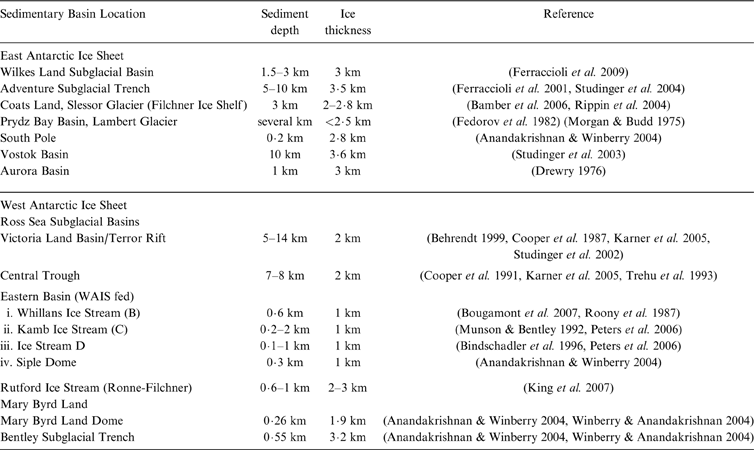
Geophysical data indicates the presence of extensive sedimentary basins beneath the Antarctic Ice Sheet (Ferraccioli et al. Reference Ferraccioli, Armadillo, Jordan, Bozzo and Corr2009). A summary of the thickness of sediment in these basins is presented in Table 1, and indicates that several of these basins have drapes of sediment several km in thickness. While many basins are located around the Antarctic periphery (e.g. Wilkes Land Subglacial basin, Ross Sea Basins, Prydz Bay Basin, Ronne-Filchner basins), they penetrate several 100–1000 km into the Antarctic interior (Studinger et al. Reference Studinger, Karner, Bell, Levin, Raymond and Tikku2003; Anandakrishnan & Winberry Reference Anandakrishnan and Winberry2004; Ferraccioli et al. Reference Ferraccioli, Armadillo, Jordan, Bozzo and Corr2009). The inferred origin of these sediments is overridden marine sediment (King et al. Reference King, Woodward and Smith2007), glaci-marine sediment (Roony et al. Reference Roony, Blankenship, Bentley and McKenzie1987; Hambrey & McKelvey Reference Hambrey and McKelvey2000) or crustal sedimentary infill (Ferraccioli et al. Reference Ferraccioli, Armadillo, Jordan, Bozzo and Corr2009). The potential for these deeper sediments to support microbial activity has received little consideration in the literature to date. Of greatest relevance to global biogeochemical cycling is the fate of organic carbon (OC) sequestered within these basins from other biomes (e.g. marine sediments) following ice sheet growth >30 Ma ago.
Summary of characteristics of sedimentary basins in East and West Antarctica as inferred from geophysical surveys.
Considering the marine origin of many of the sedimentary basins beneath the Antarctic Ice Sheet, one might expect similar biogeochemical processes to prevail as in sub-sea floor sediments around the Antarctic periphery. Marine core records from the Antarctic continental shelf display relatively high OC contents (mean 1%, range: 0·1–9%; see Fig. 1) including organic rich horizons from the late Cretaceous (Florindo et al. Reference Florindo, Bohaty, Erwin, Richter, Roberts, Whalen and Whitehead2003). Lower concentrations of organic carbon are found in rock material cored from the Antarctic margin (mean in Cape Roberts Core CRP3=0·3%), but surface OM concentrations in rock (0·5%) (Kettler Reference Kettler2001) are in line with those found in circum-Antarctic ODP cores. The total amount of organic carbon (TOC) present in marine sedimentary basins has been estimated at around 21 Pg (Wadham et al. Reference Wadham, Arndt, Tulaczyk, Stibal, Tranter, Telling, Lis, Lawson, Ridgwell, Dubnick, Sharp, Anesio and Butler2012), which vastly exceeds the magnitude of soil OC stocks in northern permafrost regions (Tarnocai et al. Reference Tarnocai, Canadell, Schuur, Kuhry, Mazhitova and Zimov2009) and parallels the order of magnitude estimates made for reactive carbon in ocean sediments (assuming a 10% reactive OC content for ASBs) (Houghton Reference Houghton2007). It is also considerably higher than the estimated amount of organic carbon buried by northern hemisphere ice sheets during glacial periods (c. 420–610 Pg C; (Wadham et al. Reference Wadham, Tranter, Tulaczyk and Sharp2008).
Down core variations in Total Organic Carbon content (TOC) of sediments for ODP cores recovered from around the Antarctic periphery, for (a) continental shelf sites, (b) continental slope and deep ocean sites. See legend for core and ODP leg details.
The fate of organic carbon buried in sedimentary basins beneath the Antarctic Ice Sheet is likely to parallel that in sub-sea floor sediments around Antarctica, though with several key differences. It is unlikely that basal meltwater recharges very far into the sediment column beneath the ice sheet, with previous work showing that meltwater penetrates about 100 m into tills (McIntosh & Walter Reference McIntosh and Walter2005). Hence, the deeper parts of the sedimentary basins are essentially hydrologically isolated from the shallow near ice-bed interface microbial habitats. Assuming a largely marine/glaci-marine origin for sediments in the deep basins, the chemistry of pore-waters at the time of glacial inception would be dominated by high sulphate concentrations in the upper sediment profile (up to 150 m; Claypool 2003). The shape of the sulphate profile would reflect a balance between sulphate input via diffusion from seawaters and the removal of sulphate by sulphate reduction (SR) and the anaerobic oxidation of methane (AOM) coupled to sulphate reduction (Equations 6 and 7).
 $$SO^{2-}_{4} + 2CH_2O \rightarrow 2HCO^-_3 + H_2S^-$$
 $$SO^{2-}_{4} + CH_4 \rightarrow HCO^-_3 + HS^{-} + H_2O$$
Following ice sheet inception, the marine sulphate pool might be expected to diminish to zero over time, with progressive removal by SR and AOM and the replacement of marine waters with fresh glacial meltwaters at the sediment surface. It has been estimated that the time taken to reduce the sulphate pool to zero by AOM alone is 16 kyr, which is short relative to the duration of glaciation in Antarctica (Wadham et al. Reference Wadham, Arndt, Tulaczyk, Stibal, Tranter, Telling, Lis, Lawson, Ridgwell, Dubnick, Sharp, Anesio and Butler2012). Beneath this upper SR/AOM zone, the dominant degradation process for organic matter is likely to be methanogenesis under anoxic conditions, following either the acetate or CO2/H2 pathways (Equations 8 and 9). Both pathways have been shown to prevail in long-term incubation experiments of subglacial sediments under anaerobic conditions (Stibal et al. Reference Stibal, Wadham, Lis, Telling, Pancost, Dubnick, Sharp, Lawson, Butler, Hasan, Tranter and Anesio2012).
 $$CH_3CHOOH \rightarrow CH_4 + CO_2$$
 $$CH_2 +4H_2 \rightarrow CH_4 + 2H_2O$$
An absence of sedimentation processes at the base of the ice sheet precludes the addition of fresh organic matter, and limits processes of fluid flow that are normally driven by sediment compaction in sub-sea floor sediments. Hence, rates of organic matter degradation in deep sediments are probably very low, and similar to other parts of the deep biosphere where organic carbon persists in sediments of Ma age. For example, rates of 0·2×10–15 mol CH4 g–1 hr–1 are reported in 1·6 Ma old sediments from Hydrate Ridge, Cascadia margin (Colwell et al. Reference Colwell, Boyd, Delwiche, Reed, Phelps and Newby2008), which is two orders of magnitude lower than some of the lower methanogenesis rates calculated for shallow sub-glacial environments (Boyd et al. Reference Boyd, Skidmore, Mitchell, Bakermans and Peters2010; Stibal et al. Reference Stibal, Wadham, Lis, Telling, Pancost, Dubnick, Sharp, Lawson, Butler, Hasan, Tranter and Anesio2012; Wadham et al. Reference Wadham, Arndt, Tulaczyk, Stibal, Tranter, Telling, Lis, Lawson, Ridgwell, Dubnick, Sharp, Anesio and Butler2012). Rates such as these would result in very slow accumulation of methane over time in deep sediments, unless deeper thermogenic sources of methane supplement the biogenic component, as occurs across a range of terrestrial and marine systems (Etiope & Klusman Reference Etiope and Klusman2002). The latter is quite probable, particularly in West Antarctica, where geothermal anomalies and active volcanism have been inferred (Blankenship et al. Reference Blankenship, Bell, Hodge, Brozena, Behrendt and Finn1993; Behrendt et al. Reference Behrendt, Finn, Blankenship and Bell1998).
2. Export mechanisms for biogenic gases and nutrients and wider impacts
2.1. Nutrient export to the Southern Ocean
Subglacial runoff is assessed as a mechanism for exporting particulate-bound and dissolved nutrients into near-field Antarctic continental shelf environments. This mechanism contrasts with the far field export of nutrients to surface Southern Ocean waters, and particularly nanoparticulate iron (Raiswell et al. Reference Raiswell, Tranter, Benning, Siegert, De'ath, Huybrechts and Payne2006), which largely occurs via the melting of icebergs and release of iceberg rafted debris (IRD). Both of these nutrient release mechanisms may have the potential to impact ocean primary productivity, via the release of elements that are life-limiting in the Southern Ocean.
Marine primary production of the Southern Ocean has an important influence on climate, as it has an important impact upon concentrations of atmospheric CO2 (Sigman & Boyle Reference Sigman and Boyle2000). In the modern Southern Ocean, primary production accounts for 5–10% of total global oceanic primary production, exhibiting higher values in the northern part of the Southern Ocean, north of the Antarctic polar front (Moore & Abbott Reference Moore and Abbott2000; Arrigo et al. Reference Arrigo, van Dijken and Bushinsky2008). The distribution of marine primary production is inferred from satellite imagery of chlorophyll combined with modelled phytoplankton growth (Behrenfeld & Falkowski Reference Behrenfeld and Falkowski1997; Arrigo et al. Reference Arrigo, van Dijken and Bushinsky2008). The main limiting factors for primary production in the Southern Ocean are light and nutrients (Boyd Reference Boyd2002). The lack of light prevents phytoplankton growth during the austral winter, causing large observed seasonal variations in primary production. Nutrient limitation in the Southern Ocean is typical of high-nitrogen-low-chlorophyll (HNLC) regions, characterised by unusually high concentrations of nitrate and phosphate and low concentrations of phytoplankton. In HNLC regions, iron has been hypothesised to be the main limiting nutrient, preventing phytoplankton from using additional nutrients such as N, P etc. (Martin Reference Martin1990). Several iron release experiments have validated the iron-limitation hypothesis in the Southern Ocean (e.g., (Boyd et al. Reference Boyd, Watson, Law, Abraham, Trull, Murdoch, Bakker, Bowie, Buesseler, Chang, Charette, Croot, Downing, Frew, Gall, Hadfield, Hall, Harvey, Jameson, LaRoche, Liddicoat, Ling, Maldonado, McKay, Nodder, Pickmere, Pridmore, Rintoul, Safi, Sutton, Strzepek, Tanneberger, Turner, Waite and Zeldis2000; Coale et al. Reference Coale, Johnson, Chavez, Buesseler, Barber, Brzezinski, Cochlan, Millero, Falkowski, Bauer, Wanninkhof, Kudela, Altabet, Hales, Takahashi, Landry, Bidigare, Wang, Chase, Strutton, Friederich, Gorbunov, Lance, Hilting, Hiscock, Demarest, Hiscock, Sullivan, Tanner, R. Gordon, Hunter, Elrod, Fitzwater, Jones, Tozzi, Koblizek, Roberts, Herndon, Brewster, Ladizinsky, Smith, Cooper, Timothy, Brown, Selph, Sheridan, Twining and Johnson2004), showing a significant increase in primary production and decreases in surface ocean nitrate and phosphate concentrations coincident with iron release to the surface waters. Since the Southern Ocean is far from major atmospheric dust sources, the iron supply to surface ocean waters in the region is smaller than that to other oceans. Hence, additional inputs from iceberg and glacial meltwater could have a potentially significant impact. In addition, silicic acid might also limit primary production in the Southern Ocean, via its effect on the growth characteristics of silacious diatoms which dominate the phytoplankton populations of polar regions (Coale et al. Reference Coale, Johnson, Chavez, Buesseler, Barber, Brzezinski, Cochlan, Millero, Falkowski, Bauer, Wanninkhof, Kudela, Altabet, Hales, Takahashi, Landry, Bidigare, Wang, Chase, Strutton, Friederich, Gorbunov, Lance, Hilting, Hiscock, Demarest, Hiscock, Sullivan, Tanner, R. Gordon, Hunter, Elrod, Fitzwater, Jones, Tozzi, Koblizek, Roberts, Herndon, Brewster, Ladizinsky, Smith, Cooper, Timothy, Brown, Selph, Sheridan, Twining and Johnson2004). Higher primary production in Spring and Summer at the ice edge around Antarctica has been hypothesised to be due to the input of glacial meltwaters, which contain iron and other micro-nutrients (Dierssen et al. Reference Dierssen, Smith and Vernet2002; Statham et al. Reference Statham, Skidmore and Tranter2008).
2.1.1. Dissolved nutrient export
In contrast to the Greenland Ice Sheet, runoff from the Antarctic Ice Sheet derives entirely from basal melting, generated by geothermal and frictional heating of the ice sheet base, which is exaggerated beneath ice streams and may reach production rates of >10 mm a–1 (Joughin et al. Reference Joughin, Tulaczyk, MacAyeal and Engelhardt2004). Basal melting may be present over ∼55% of the ice sheet bed (Pattyn Reference Pattyn2010); however, only basal meltwater produced beneath ice streams around the Antarctic periphery (∼20% of the ice area) is likely to have a clear path to the margin and result in meltwater and associated solute export (Wadham et al. Reference Wadham, Tranter, Skidmore, Hodson, Priscu, Lyons, Sharp, Wynn and Jackson2010). The potential subglacial meltwater export from the ice sheet has been estimated at c. 65 km km3 a–1 (Pattyn Reference Pattyn2010). Estimated volumes of subglacial runoff may increase considerably during glacial periods, when ice thicknesses increase and the proportion of the bed exhibiting basal melting is thought to rise (S. Tulaczyk pers. comm. 2010). Evidence for the release of this meltwater from the Antarctic margin can be found from a range of sources. Land-based and sub-marine geomorphological data indicate the presence of palaeo-channels and other hydrological features indicative of the occurrence of outburst floods (Lowe & Anderson Reference Lowe and Anderson2003; Sugden et al. Reference Sugden, Bentley and Ó Cofaigh2006), while sand/clay deposits in ice-marginal core records are consistent with the presence of sediment-laden meltwater plumes originating beneath the ice sheet (Lowe & Anderson Reference Lowe and Anderson2002). Observations from the ice margin certainly suggest that a portion of subglacial meltwater release from the land-terminating sector of the ice sheet could occur via outburst events (Goodwin Reference Goodwin1988), which is consistent with the known rapid drainage of subglacial lakes upstream in the ice sheet interior (Wingham et al. Reference Wingham, Siegert, Shepherd and Muir2006; Fricker et al. Reference Fricker, Scambos, Bindschadler and Padman2007). Several lines of evidence also support the continuous release of subglacial meltwaters from the ice sheet margin. Persistent low salinity waters are recorded around the Antarctic margin after the disappearance of sea ice, which is consistent with the export of dilute glacial meltwaters from the ice sheet (Dierssen et al. Reference Dierssen, Smith and Vernet2002). In the Amundsen Sea area, elevated dissolved iron concentrations in surface ocean waters in the Pine Island Polyna have also been linked with accelerated melting of the ice sheet and release of dissolved iron from basal melting (Gerringa et al. Reference Gerringa, Alderkamp, Laan, Thuróczy, De Baar, Mills, van Dijken, van Haren, Arrigo and Arrigo2012). Sub-marine groundwater discharge has also recently been measured from the East Antarctic coast, at rates that were two orders of magnitude higher than rates reported for mid latitude sites (Uemura et al. Reference Uemura, Taniguchi and Shibuya2011). The source of this water has been hypothesised to be the subglacial regions of the neighboring outlets glaciers.
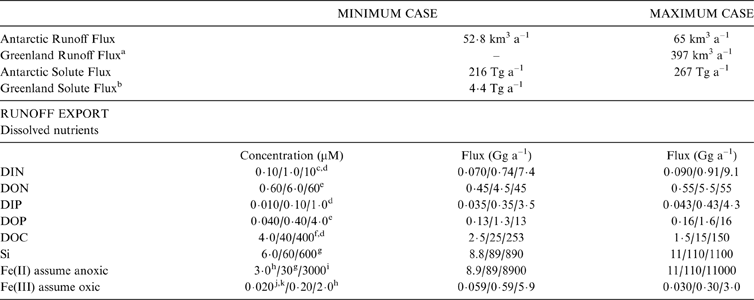
The above estimates of Antarctic runoff equate to <20% of the annual runoff from the Greenland Ice Sheet (c. 390 km3 a–1 (Hanna et al. Reference Hanna, Huybrechts, Steffen, Cappelen, Huff, Shuman, Irvine-Fynn, Wise and Griffiths2008) (Table 2). While this represents a relatively small proportion of the total runoff flux from ice sheets, the solute fluxes associated with Antarctic runoff are likely to be more substantial, due to the high concentrations of ions recorded in basal meltwater (Skidmore et al. Reference Skidmore, Tranter, Tulaczyk and Lanoil2010). Outburst event runoff from Casey Station in Antarctica (Goodwin Reference Goodwin1988) and pore-waters from sediment cores recovered from the Bindschadler and Kamb Ice Stream which drain to the Ross Sea (Skidmore et al. Reference Skidmore, Tranter, Tulaczyk and Lanoil2010) indicate mM concentrations of dissolved ions. This contrasts with runoff from valley glaciers where μM concentrations are typically observed. These two sub-Antarctic meltwaters are of the type Na–HCO3––Cl–SO42– and Na–SO42––Ca–Mg–HCO3– respectively, which compare with the Ca–HCO3––SO42––Mg composition observed in most glacial runoff types (Skidmore et al. Reference Skidmore, Tranter, Tulaczyk and Lanoil2010). These chemistries fit well with the hypothesis that sub-ice stream meltwaters exhibit enhanced silicate dissolution as they attain saturation with respect to calcite, and accentuated concentrations of silicate-derived ions (Na+, K+, Si) evolve with prolonged contact with subglacial sediments (Wadham et al. Reference Wadham, Tranter, Skidmore, Hodson, Priscu, Lyons, Sharp, Wynn and Jackson2010).
Summary of potential dissolved nutrient concentrations and fluxes associated with Antarctic subglacialmeltwater export (approximate order of magnitude concentration values are employed for flux calculations)
Notes: a – (Hanna et al. Reference Hanna, Huybrechts, Steffen, Cappelen, Huff, Shuman, Irvine-Fynn, Wise and Griffiths2008) for Greenland (Pattyn Reference Pattyn2010); b – Calculated from the product of mean concentrations of total dissolved solids measured on Leverett Glacier, SW Greenland in 2009, 2010 (c. 11 mg/L) (Wadham, unpublished data) and the estimated total discharge from the Greenland Ice Sheeta; c – Hodson et al. Reference Hodson, Mumford, Kohler and Wynn2005; d – (Mikucki et al. Reference Mikucki, Foreman, Sattler, Lyons and Priscu2004); e – DON and DOP concentrations were calculated from DOC concentrations using the Redfield Ratio of 106:16:1 (Redfield Reference Redfield and Daniel1934); f – concentrations from Barker et al. Reference Barker, Sharp, Fitzsimons and Turner2006, Bhatia et al. Reference Bhatia, Das, Longnecker, Charette and Kujawinski2010; g – representative Si and Fe concentrations reported in deep groundwaters in glacial till analysed on 0·45 μm filtered samples (Gosselin et al. Reference Gosselin, Harvey and Frost2001, Kim et al. Reference Kim, Nriagu and Haack2002); h – dissolved Fe concentrations (including nanoparticles and colloids) reported in runoff from Lower Wright Glacier after filtration through a 0·45 μm filter, McMurdo Dry Valleys (Green et al. Reference Green, Stage, Preston, Wagers, Shacat and Newell2005); i – (Mikucki et al. Reference Mikucki, Pearson, Johnston, Turchyn, Farquhar, Schrag, Anbar, Priscu and Lee2009), dissolved Fe measured in Blood Falls, McMurdo Dry Valleys after filtration through a 0·2 μm filter (i.e. including nanoparticles and colloids); j – Maximum dissolved iron concentrations after filtration of pure glacier icemelt through 0·2 μm filter (Raiswell et al. Reference Raiswell, Benning, Tranter and Tulaczyk2008); k – Fe concentrations reported in Greenland runoff following filtration through 0·4 μm filter (Statham et al. Reference Statham, Skidmore and Tranter2008).
As a result of the elevated concentrations of solute in Antarctic basal meltwaters, annual crustal solute fluxes of 72–130×103 Tg a–1 have been estimated (Wadham et al. Reference Wadham, Tranter, Skidmore, Hodson, Priscu, Lyons, Sharp, Wynn and Jackson2010), which is a similar order to some of the planet's largest rivers (Gaillardet et al. Reference Gaillardet, Dupré, Louvat and Allègre1999). These fluxes are also one to two orders of magnitude higher than estimated total solute fluxes from the Greenland Ice Sheet (4·4×103 a–1; Table 2), despite the considerably higher water flux from Greenland. This demonstrates the potential importance of enhanced chemical weathering in long residence time drainage systems beneath the Antarctic Ice Sheet, giving rise to elevated solute concentrations relative to those in runoff from northern hemisphere ice masses. In the latter case, a proportionally smaller slow-flowing subglacial contribution to runoff is diluted by high volumes of surface-derived meltwater routed efficiently via channels at the ice sheet bed, minimizing solute acquisition.
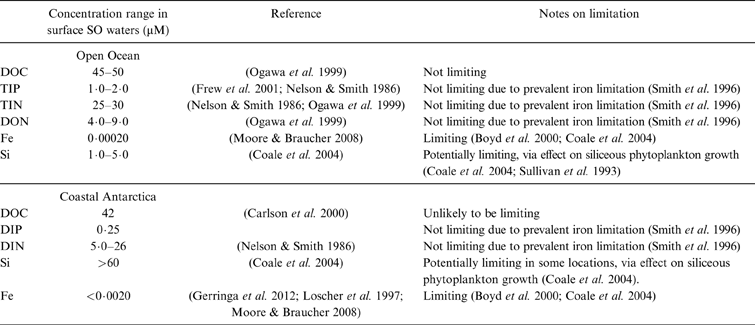
Likewise, the export of runoff from the Antarctic Ice Sheet should be accompanied by the release of nutrients, constituting a previously neglected source of DOC, N, P, Si and Fe to the coastal ocean. Elevated concentrations of elements released during the enhanced dissolution of silicate minerals in Antarctic subglacial sediments, for example, dissolved Si, NH4+ from feldspars and K+ from biotite (Wadham et al. Reference Wadham, Tranter, Skidmore, Hodson, Priscu, Lyons, Sharp, Wynn and Jackson2010), are likely to be released in Antarctic runoff. Supplementing these crustal nutrient fluxes, one might expect to find contributions from microbial-derived nutrients, such as dissolved organic carbon and nitrogen. Estimates of the annual export of key nutrients from the Antarctic Ice Sheet to the near-coastal ocean are provided in Table 2. The water fluxes (65 km3 a–1) published in Pattyn (Reference Pattyn2010) are employed for the present day by numerical modelling by this group to yield minimum fluxes (52·8 km3 a–1). In the latter case, meltwater beneath the ice sheet is generated using the GLIMMER model which is fully described by Rutt et al. (Reference Rutt, Hagdorn, Hulton and Payne2009). The routing model is described by Le Brocq et al. (Reference Le Brocq, Payne, Siegert and Alley2009), using the steady state model. Meltwaters are supplied from the ice sheet to the coastal cells around the ice sheet perimeter, using a flow routing scheme that apportions the flow downstream based on the surrounding local slope angle. The slopes are derived from the basal topography provided by the BEDMAP dataset (Lythe & Vaughan Reference Lythe and Vaughan2001). The total subglacial meltwater output from the Antarctic Ice Sheet calculated using this method is 52·8 km3 a–1, which is similar to the 65 km3 a–1 estimated by Pattyn (Reference Pattyn2010). We focus our calculations on the major dissolved nutrient species: Si, dissolved inorganic and organic nitrogen (DIN, DON), dissolved inorganic and organic phosphorus (DIP and DOP) and total dissolved iron (including colloids and nanoparticles). Since there is considerable uncertainty in the concentration of these elements in exported runoff, we select maximum, minimum and intermediate estimates of concentrations based upon measured concentrations in glacial runoff from northern hemisphere ice masses and discrete measurements in Antarctica (Table 2). The typical concentrations of the same nutrients in Southern Ocean coastal and open ocean waters are also noted for comparison (Table 3). In general, concentrations of nutrients in glacial runoff are comparable to those in coastal ocean waters, with the exception of dissolved Fe and Si, which are potentially orders of magnitude higher in glacial runoff. This latter point is critical, given the known Fe and Si limitation in Southern Ocean waters (Sullivan et al. Reference Sullivan, Arrigo, McClain, Comiso and Firestone1993; Fung et al. Reference Fung, Meyn, Tegen, Doney, John and Bishop2000; Coale et al. Reference Coale, Johnson, Chavez, Buesseler, Barber, Brzezinski, Cochlan, Millero, Falkowski, Bauer, Wanninkhof, Kudela, Altabet, Hales, Takahashi, Landry, Bidigare, Wang, Chase, Strutton, Friederich, Gorbunov, Lance, Hilting, Hiscock, Demarest, Hiscock, Sullivan, Tanner, R. Gordon, Hunter, Elrod, Fitzwater, Jones, Tozzi, Koblizek, Roberts, Herndon, Brewster, Ladizinsky, Smith, Cooper, Timothy, Brown, Selph, Sheridan, Twining and Johnson2004). The detailed source and fluxes of dissolved nutrients in Antarctic runoff is discussed as follows.
Summary of typical concentrations of nutrients dissolved in coastal Antarctic and Southern Ocean (SO) waters
Subglacial meltwaters are now thought to be important sources of labile DOC to downstream coastal waters (Hood et al. Reference Hood, Fellman, Spencer, Hernes, Edwards, D'Amore and Scott2009). While typical DOC concentrations are generally low, e.g. 60–700 μM (Lafreniere & Sharp Reference Lafreniere and Sharp2004; Bhatia et al. Reference Bhatia, Das, Longnecker, Charette and Kujawinski2010), high contributions from microbial-derived proteinacious-type substances make these waters highly bioavailable to marine micro-organisms (Lafreniere & Sharp Reference Lafreniere and Sharp2004; Barker et al. Reference Barker, Sharp, Fitzsimons and Turner2006; Hood et al. Reference Hood, Fellman, Spencer, Hernes, Edwards, D'Amore and Scott2009; Bhatia et al. Reference Bhatia, Das, Longnecker, Charette and Kujawinski2010). One might expect meltwaters from beneath Antarctica to display similar DOC concentrations to other subglacial meltwater types, since cell concentrations in sub-ice stream and subglacial sediments are estimated at 104–105 cells g–1 (Lanoil et al. Reference Lanoil, Skidmore, Priscu, Han, Foo, Vogel, Tulaczyk, Engelhardt, Cary, Murray and McDonald2009; Mikucki et al. Reference Mikucki, Pearson, Johnston, Turchyn, Farquhar, Schrag, Anbar, Priscu and Lee2009) and suggest an active subglacial microbial ecosystem. In support of this are DOC concentrations of 420 μM in Blood Falls, a hyper-saline subglacial outflow draining from Taylor Glacier, Antarctica (Mikucki et al. Reference Mikucki, Pearson, Johnston, Turchyn, Farquhar, Schrag, Anbar, Priscu and Lee2009) and 86–160 μM for the predicted DOC composition of Lake Vostok (Christner et al. Reference Christner, Royston-Bishop, Foreman, Arnold, Tranter, Welch, Berry Lyons, Tsapin, Studinger and Priscu2006). Correspondingly, concentrations of DON and DOP would be acquired by meltwaters during the microbial cycling of organic matter, and may comprise a significant proportion of total nitrogen and phosphorus in runoff (Hodson et al. Reference Hodson, Mumford, Kohler and Wynn2005). While the fluxes of these dissolved nutrients are small (<10%) relative to suspended sediment and iceberg rafted debris sources (Table 2), the organic phases in theory may dominate the nitrogen and phosphorus fluxes (e.g. DOP and DON account for >80% of estimated dissolved N and P loads). N, P and DOC are generally not thought to be limiting in much of the Southern Ocean, but high fluxes of these elements could stimulate productivity locally where other elements are not limiting (e.g. Fe and Si).
Of greatest relevance for Southern Ocean primary productivity is the export of dissolved ferrous iron, Fe(II), and ferric iron, Fe(III), species (Table 2). There is high potential for the development of anoxic conditions beneath the ice sheet, with the oxidation of sulphide minerals and organic carbon rapidly stripping any dissolved oxygen supplied from basal melt-waters (Equations 4 and 5; Wadham et al. Reference Wadham, Tranter, Tulaczyk and Sharp2008). In addition, anoxic microbial processes are likely to generate Fe(II), using Fe(III) as the terminal electron acceptor in the cycling of sulphur compounds and organic carbon (Bottrell et al. Reference Bottrell, Parkes, Cragg and Raiswell2000; Wadham et al. Reference Wadham, Bottrell, Tranter and Raiswell2004; Mikucki et al. Reference Mikucki, Pearson, Johnston, Turchyn, Farquhar, Schrag, Anbar, Priscu and Lee2009). This maximises the potential dissolved Fe export in runoff by ensuring continued supply of Fe(II) to meltwaters, while high solubility is maintained by persistent anoxic conditions at the ice sheet bed. For example, concentrations of >3 mM total dissolved Fe (with 97% as Fe(II)) have been reported in runoff from Blood Falls in the McMurdo Dry Valleys (Mikucki et al. Reference Mikucki, Pearson, Johnston, Turchyn, Farquhar, Schrag, Anbar, Priscu and Lee2009). The impact of nutrient supply from Antarctic runoff on coastal ocean productivity has yet to be evaluated, but mounting observational evidence suggests that it could be an important factor in explaining coastal productivity in Antarctica. For example, high primary productivity at the ice edge is reported from around Antarctica (Arrigo et al. Reference Arrigo, van Dijken and Bushinsky2008) and 70% of phytoplankton blooms around the Antarctic Peninsula are coincident with salinity depletion, and hence meltwater input from the ice sheet (Dierssen et al. Reference Dierssen, Smith and Vernet2002). Recently, phytoplankton blooms in the Amundsen Sea area (Pine Island Polyna) have been attributed to iron export from melting glaciers (Alderkamp et al. Reference Alderkamp, Mills, van Dijken, Laan, Thuróczy, Gerringa, de Baar, Payne, Visser, Buma, Arrigo and Arrigo2012; Gerringa et al. Reference Gerringa, Alderkamp, Laan, Thuróczy, De Baar, Mills, van Dijken, van Haren, Arrigo and Arrigo2012).
For dissolved iron, we generate two scenarios in order to estimate the magnitude of Fe release to the Southern Ocean via runoff. Our “anoxic” flux scenario assumes that melt-waters are anoxic and all iron released is ferrous iron, since waters beneath the ice sheet are likely to be anoxic. Our “oxic” flux scenario assumes that there will be rapid oxidation of iron from Fe(II) to Fe(III) in the marine environment. The iron oxyhydroxide, ferrihydrite, would be formed immediately upon meltwater introduction to sub-ice shelf waters, and then rapidly scavenged to particulate matter in suspension (Raiswell Reference Raiswell2011). A portion of this ferrihydrite remains potentially bioavailable to marine organisms (Raiswell et al. Reference Raiswell, Benning, Tranter and Tulaczyk2008; Raiswell Reference Raiswell2011). Table 2 shows that in the anoxic scenario, there is potential to add high concentrations (mM) of reduced, bioavailable Fe into the near-coastal ocean, with fluxes of a similar order of magnitude (9–11,000 Gg Fe a–1) to both potential Fe release from IRD (60–120 Gg Fe a–1; Raiswell et al. Reference Raiswell, Benning, Tranter and Tulaczyk2008) and aeolian Fe inputs (10–130 Gg Fe a–1; Raiswell et al. Reference Raiswell, Benning, Tranter and Tulaczyk2008; Table 2). Our estimated dissolved Fe fluxes in the anoxic scenario are also considerably higher than the potential release of dissolved Fe (i.e. unassociated with iceberg rafted debris) to the Southern Ocean by melting icebergs (1–5 gG Fe a–1; Raiswell et al. Reference Raiswell, Benning, Tranter and Tulaczyk2008) and sea ice (0·3 Gg Fe a–1; Edwards & Sedwick Reference Edwards and Sedwick2001). The latter is traditionally assumed to drive the enhanced primary productivity at the receding ice edge in Antarctic during summer (Moore & Abbott Reference Moore and Abbott2000). Conversely, in our oxic flux scenario, the amount of dissolved Fe released (as Fe(III)) is several orders of magnitude smaller. In reality, the anoxic case is most likely, but rapid oxidation of Fe(II) beneath the ice shelves, and associated scavenging to particulate material, has the potential to reduce the total direct iron fluxes to the coastal ocean. We conjecture in this case that previous estimates of dissolved Fe flux to the ocean in meltwater, relying on a predominantly Fe(III) export as in our oxic flux scenario, may represent highly conservative estimates of this iron input (e.g. 0·03 gG Fe a–1; Statham et al. Reference Statham, Skidmore and Tranter2008). In both the oxic and anoxic cases, however, icebergs are likely to dominate the supply of bioavailable Fe to the far-field Southern Ocean, with meltwater likely becoming more relevant in coastal locations (Tables 2 and 4).
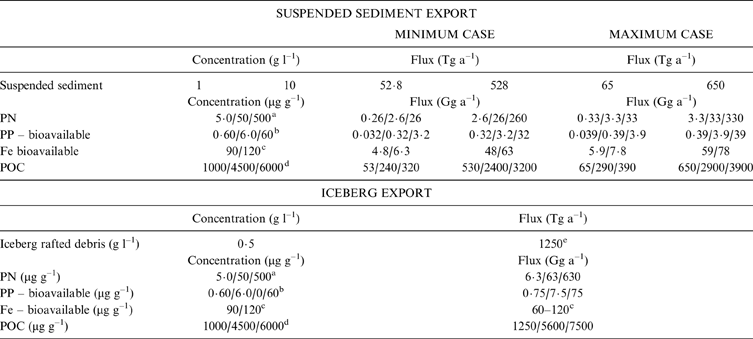
Summary of potential nutrient fluxes associated with suspended sediment and iceberg rafted debris (IRD) exported from Antarctica.
Notes: PN=particulate nitrogen, PP=particulate phosphorus, POC=particulate organic carbon. a – derived using conservative concentrations for N present in sedimentary rocks, igneous rocks and Precambrian basement rocks to generate maximum, minimum and intermediate values of 500, 5 and 50 μg g–1 (Holloway & Dahlgren Reference Holloway and Dahlgren2002); b – Föllmi et al. Reference Föllmi, Hosein, Arn and Steinmann2009, Hodson et al. Reference Hodson, Mumford and Lister2004; c – Raiswell et al. Reference Raiswell, Benning, Tranter and Tulaczyk2008 – assuming bioavailable Fe concentrations in iceberg rafted debris (IRD) and suspended sediment of 0·009 and 0·012%; e – from Raiswell et al. Reference Raiswell, Benning, Tranter and Tulaczyk2008, assuming a water flux from icebergs of 2000 km3 a–1; d – POC – we use the global bedrock mean for our intermediate OC concentration (0·45%). We derive minimum and maximum concentrations using the mean percentage OC content present in igneous (0·1%) and sedimentary (0·6%) rocks respectively (Holland Reference Holland1978).
In addition to the dissolved iron export, the export of dissolved Si is of potential relevance, given the hypothesised limitation of this element in silaceous diatoms within parts of the Southern Ocean (Sullivan et al. Reference Sullivan, Arrigo, McClain, Comiso and Firestone1993; Coale et al. Reference Coale, Johnson, Chavez, Buesseler, Barber, Brzezinski, Cochlan, Millero, Falkowski, Bauer, Wanninkhof, Kudela, Altabet, Hales, Takahashi, Landry, Bidigare, Wang, Chase, Strutton, Friederich, Gorbunov, Lance, Hilting, Hiscock, Demarest, Hiscock, Sullivan, Tanner, R. Gordon, Hunter, Elrod, Fitzwater, Jones, Tozzi, Koblizek, Roberts, Herndon, Brewster, Ladizinsky, Smith, Cooper, Timothy, Brown, Selph, Sheridan, Twining and Johnson2004). Concentrations of dissolved Si in runoff could be similar to or higher than the concentration of Si in coastal ocean water, given the observed enhancement of silicate dissolution in long residence time subglacial meltwaters (Wadham et al. Reference Wadham, Tranter, Skidmore, Hodson, Priscu, Lyons, Sharp, Wynn and Jackson2010; Tables 2 & 3), where the latter exceed open Southern Ocean waters by an order of magnitude (Coale et al. Reference Coale, Johnson, Chavez, Buesseler, Barber, Brzezinski, Cochlan, Millero, Falkowski, Bauer, Wanninkhof, Kudela, Altabet, Hales, Takahashi, Landry, Bidigare, Wang, Chase, Strutton, Friederich, Gorbunov, Lance, Hilting, Hiscock, Demarest, Hiscock, Sullivan, Tanner, R. Gordon, Hunter, Elrod, Fitzwater, Jones, Tozzi, Koblizek, Roberts, Herndon, Brewster, Ladizinsky, Smith, Cooper, Timothy, Brown, Selph, Sheridan, Twining and Johnson2004). The concept that these elevated Si concentrations in continental shelf waters around Antarctica could be partially sourced from ice sheet runoff has yet to be fully considered. If the latter is the case, ice sheet fluxes of Si to coastal ocean waters around Antarctica could be an important control upon variations in both the productivity and distribution of siliceous phytoplankton in the Southern Ocean (Coale et al. Reference Coale, Johnson, Chavez, Buesseler, Barber, Brzezinski, Cochlan, Millero, Falkowski, Bauer, Wanninkhof, Kudela, Altabet, Hales, Takahashi, Landry, Bidigare, Wang, Chase, Strutton, Friederich, Gorbunov, Lance, Hilting, Hiscock, Demarest, Hiscock, Sullivan, Tanner, R. Gordon, Hunter, Elrod, Fitzwater, Jones, Tozzi, Koblizek, Roberts, Herndon, Brewster, Ladizinsky, Smith, Cooper, Timothy, Brown, Selph, Sheridan, Twining and Johnson2004).
2.1.2. Nutrient export associated with suspended sediment
In northern hemisphere glaciers and ice sheets, erosion rates can be high and in excess of the global average (Hodson et al. Reference Hodson, Tranter, Dowdeswell, Gurnell, Hagen and Whillams1997; Cowton et al. Reference Cowton, Nienow, Bartholomew, Sole and Mair2012) with erosional products removed and transported in runoff as suspended sediment. Included in this suspended material are important nutrients derived either from the parent rock material (e.g. P from weathering of apatite (Föllmi et al. Reference Föllmi, Hosein, Arn and Steinmann2009), N from micas and K-feldspars (Holloway & Dahlgren Reference Holloway and Dahlgren2002), or from microbial cells bound to sediment (e.g. organic carbon, P and N). Rates of glacial erosion in Antarctica are poorly constrained. Maximum rates are estimated at 0·6 mm a–1 in ice stream tributaries, but this upstream erosion is partly offset by deposition further downstream (Bougamont & Tulaczyk Reference Bougamont and Tulaczyk2003). More recent work indicates that such high erosion rates are incompatible with the preservation of sedimentary basins beneath the ice sheet and that lower erosion rates must be present over a large proportion of these basins in order for sediments to still be present after 30 Ma of glaciation (Bamber et al. Reference Bamber, Ferraccioli, Joughin, Shepherd, Rippin, Siegert and Vaughan2006). Erosion rates of 0·04 mm a–1 have been calculated for Slessor Glacier in East Antarctica (Bamber et al. Reference Bamber, Ferraccioli, Joughin, Shepherd, Rippin, Siegert and Vaughan2006), and rates as low as 0·001 mm a–1 for the Lambert basin (East Antarctica) (Jamieson et al. Reference Jamieson, Hulton, Sugden, Payne, Taylor, Florindo, Harwood and Wilson2005). Little is known of the suspended sediment concentrations in the runoff that exits the ice sheet over the grounding line, either continuously or via outburst events, although sub-marine ice marginal core records do provide evidence for sediment-laden meltwater plumes released from the margin (Lowe & Anderson Reference Lowe and Anderson2002). Suspended sediment concentrations (SSC) in glacial runoff from northern hemisphere ice masses are typically of the order of 1–10 g l–1 (Hodson & Ferguson Reference Hodson and Ferguson1999; Bartholomew et al. Reference Bartholomew, Nienow, Sole, Mair, Cowton, Palmer and Wadham2011). In order to calculate nutrient fluxes of suspended sediment, we employ suspended sediment concentrations of 1 and 10 g l–1 to derive end member nutrient fluxes associated with sediment suspended in Antarctic runoff.
The export of suspended sediment (SS) in runoff from the Antarctic margin is of greatest relevance for the elements Si, P, organic carbon (OC) and Fe (Table 4), although fluxes are slightly lower than those from IRD as a result of smaller overall sediment fluxes (1259 Tg a–1 for IRD compared with 53–650 Tg a–1 for SS). It is notable, however, that while both the SS and IRD-derived fluxes of N, P and OC dominate the total fluxes of these elements, the smaller dissolved component is likely to represent the more labile form of export. This is particularly relevant given the known dominance of the organic dissolved form of P and N in subglacial runoff (Hodson et al. Reference Hodson, Mumford, Kohler and Wynn2005), and the hypothesised labile character of subglacial DOC (Hood et al. Reference Hood, Fellman, Spencer, Hernes, Edwards, D'Amore and Scott2009). The release of nanoparticulate iron to the Southern Ocean via iceberg-rafted debris (IRD) has recently received considerable attention in the literature as a potential source of Fe to ocean waters (Raiswell et al. Reference Raiswell, Tranter, Benning, Siegert, De'ath, Huybrechts and Payne2006; Raiswell Reference Raiswell2011). Near-field contributions of Fe associated with suspended sediments in subglacial runoff, however, have yet to be considered. Our calculations indicate that the potential Fe flux associated with SS in runoff are most likely lower than those associated with IRD, but could become significant if high SS concentrations are observed (e.g. 10 g l–1) (Table 4). This has relevance for supplying iron-rich sediments to the continental shelf, where it may be cycled to more bioavailable forms of iron over time. Although these glacial sedimentary sources of iron have received little attention in the literature to date, continental shelf sediments around Antarctica have been highlighted for their potential in stimulating coastal Southern Ocean primary production (Tagliabue et al. Reference Tagliabue, Bopp and Aumont2009).
2.1.3. Nutrient export in icebergs
While the export of nutrients in runoff as dissolved and sediment-bound phases has the potential to fertilise the near-coastal ocean, the release of nutrients associated with iceberg rafted debris around Antarctica might be expected to stimulate ocean primary production far beyond the ice margin (Raiswell et al. Reference Raiswell, Tranter, Benning, Siegert, De'ath, Huybrechts and Payne2006, Reference Raiswell, Benning, Tranter and Tulaczyk2008, Reference Raiswell, Benning, Davidson, Tranter and Tulaczyk2009). Modelled freshwater release from icebergs, and thereby the potential for Fe nutrient release to parts of the Southern Ocean, is distributed over a very large geographical area reaching latitudes as far north as 40°S (Martin & Adcroft Reference Martin and Adcroft2010). Further, the impact of nutrient release from icebergs is observed to increase surface enrichment in iron up to a radius of 20 km (Lin et al. Reference Lin, Rauschenberg, Hexel, Shaw, Twining and Smith2011; Shaw et al. Reference Shaw, Raiswell, Hexel, Vu, Moore, Dudgeon, Smith and Smith2011).
The debris content of icebergs has been the focus of much attention. Of particular interest is the export of iron oxyhydroxide nanoparticles in icebergs, which are associated with basal sediments and are derived from the subglacial weathering of reactive iron bearing phases such as sulphides, carbonates, olivines and pyroxenes (Raiswell et al. Reference Raiswell, Tranter, Benning, Siegert, De'ath, Huybrechts and Payne2006). These iron nanoparticles are transported to the ocean entombed in ice, minimising their loss during transit and preserving their reactivity (Raiswell Reference Raiswell2011). The release of this Fe-rich material occurs over time as the basal portion of icebergs melt into the ocean. As shown by previous work (Raiswell et al. Reference Raiswell, Tranter, Benning, Siegert, De'ath, Huybrechts and Payne2006, Reference Raiswell, Benning, Tranter and Tulaczyk2008) and reproduced in Table 4, the potential flux of Fe to the Southern Ocean in icebergs is 7–9 times the calculated Fe input from aeolian dust. Direct measurements of the waters around icebergs indicate that the concentration of iron released is highly variable, with values ranging between 4–600 nM (Lin et al. Reference Lin, Rauschenberg, Hexel, Shaw, Twining and Smith2011). This will depend on the amount and composition of the debris that the iceberg is transporting. (Shaw et al. Reference Shaw, Raiswell, Hexel, Vu, Moore, Dudgeon, Smith and Smith2011) calculate the potential bioavailable flux of iron from icebergs to be in the range of 40–400 Gg Fe a–1, which is comparable to the flux calculated in Raiswell et al. (Reference Raiswell, Benning, Tranter and Tulaczyk2008) and presented in Table 4.
Another significant nutrient input associated with icebergs is dissolved inorganic nitrogen, with increased dissolved nitrate concentrations in the surface waters surrounding icebergs up to a distance of 1 km (Vernet et al. Reference Vernet, Sines, Chakos, Cefarelli, Ekern and Smith2011). This enhanced DIN is thought to be derived from meltwater input, as there are no associated increases in silica and phosphate, which would be expected if this water was being drawn up due to turbulent mixing surrounding the iceberg. Vernet et al. (Reference Vernet, Sines, Chakos, Cefarelli, Ekern and Smith2011) estimate that icebergs may contain up to seven times the concentration of surface water nitrate. However, since the Southern Ocean is not limited by this nutrient, we would not expect this to have a major impact on productivity.
2.2. Deep production and release of biogenic gases
The production and accumulation of methane in deep sedimentary basins beneath the Antarctic Ice Sheet has only recently been evaluated. Previous work on northern hemisphere ice sheets has shown active methanogenesis in subglacial sediments containing organic carbon from overridden ecosystems (Boyd et al. Reference Boyd, Skidmore, Mitchell, Bakermans and Peters2010; Stibal et al. Reference Stibal, Wadham, Lis, Telling, Pancost, Dubnick, Sharp, Lawson, Butler, Hasan, Tranter and Anesio2012), and it has been suggested that similar processes permitted the conversion of organic carbon sequestered beneath the Laurentide Ice Sheet to methane during glacial periods (Weitemeyer & Buffett Reference Weitemeyer and Buffett2006; Wadham et al. Reference Wadham, Tranter, Tulaczyk and Sharp2008). This methane would be stored as hydrate at pressure and temperature conditions beneath the ice, but released rapidly during destabilisation events coincident with deglaciation (Weitemeyer & Buffett Reference Weitemeyer and Buffett2006).
Similar arguments have now been applied to sub-Antarctic sedimentary basins. There is abundant evidence from offshore drill records around Antarctica to suggest that methane is widespread in sub-sea floor sediments (Lonsdale Reference Lonsdale1990; Kelly et al. Reference Kelly, Ditchfield, Doubleday and Marshall1995; Barker Reference Barker, Camerlenghi and Acton1999; Bohrmann et al. Reference Bohrmann, Chin, Petersen, Sahling, Schwartz-Schampera, Greinert, Lammers, Rehder, Daehlmann, Wallmann, Dijkstra and Schenke1999; Bellanca et al. Reference Bellanca, Aghib, Neri and Sabatino2005; Claypool 2003). While rates of production may be low within these ancient sediments, several factors could amplify the potential accumulation of methane in sedimentary basins beneath an ice sheet. First, the West and East Antarctic Ice Sheets are believed to have been at approximately their present extents for 1 Ma and ∼30 Ma respectively (DeConto & Pollard Reference DeConto and Pollard2003; Huybers & Denton Reference Huybers and Denton2008; Pollard & DeConto Reference Pollard and DeConto2009), providing a long duration for methane accumulation in sediments. Secondly, frozen basal conditions over 50% of the ice sheet (Pattyn Reference Pattyn2010) provide an effective ‘seal’ to methane diffusional loss from the sediment surface enabling higher pore-water concentrations to accumulate over time. Thirdly, the sulphate pool in the near-surface zone reduces to zero over time as sulphate is removed by SR and AOM. AOM is a major sink for methane in other parts of the deep biosphere and ensures low concentrations of methane in the upper portion (e.g. 150 m) of the sediment column (Reeburgh Reference Reeburgh, Whalen, Alperin, Murrell and Kelly1993). In the absence of this sink beneath the ice sheet, methane should be able to accumulate throughout the entire sediment column. If sufficient methane were able to accumulate such that saturation is attained within the hydrate stability zone for methane, the sustained high pressure/low temperature conditions beneath the ice might be expected to stabilise this methane and minimise its loss via diffusion. Temperatures and pressures within sediments beneath the West and East Antarctic Ice Sheets favour methane hydrate formation down to 300 m and 700 m respectively. Numerical modelling indicates the potential for the accumulation of methane in sub-Antarctic subglacial sedimentary basins in concentrations sufficient to form methane hydrate over millions of years. The total sub-Antarctic methane hydrate inventory could be of the order of 70–390 Pg C in East Antarctica and some tens of Pg C in West Antarctica. In the latter case, model results show that most hydrate accumulation is likely to arise from thermogenic methane production, generated in areas of high geothermal heat flux (Blankenship et al. Reference Blankenship, Bell, Hodge, Brozena, Behrendt and Finn1993; Behrendt et al. Reference Behrendt, Finn, Blankenship and Bell1998). These are substantial accumulations of methane hydrate comparable in magnitude to recent estimates for Arctic permafrost (Tarnocai et al. Reference Tarnocai, Canadell, Schuur, Kuhry, Mazhitova and Zimov2009) and Arctic Ocean reserves (Houghton Reference Houghton2007). The fate of any methane hydrate beneath the ice sheet is uncertain. Like any methane hydrate inventory, there is sensitivity to in situ pressure and temperature conditions. If pressures decrease such as during deglaciation, parts of the hydrate reserve may become de-stabilised via the effect of retreating ice on the overburden pressure. An example might be during previous collapses of the West Antarctic Ice Sheet. The impact of methane release to the atmosphere is unknown, and will be affected by where hydrate reserves are located geographically and the rate and pattern of ice sheet retreat (Wadham et al. Reference Wadham, Arndt, Tulaczyk, Stibal, Tranter, Telling, Lis, Lawson, Ridgwell, Dubnick, Sharp, Anesio and Butler2012).
3. Summary and wider impacts on global biogeochemical cycles
The above discussion intimates that the Antarctic Ice Sheet could play a stronger role in regulating global biogeochemical cycles, and particularly of carbon, than has been previously recognised. This results from the recent discovery that the basal regions of the ice sheet are biologically active, and hydrological processes and ice sheet dynamics provide mechanisms for nutrients to be exported in runoff and icebergs, and for biogenic gases to be released from deep sedimentary basins during periods of ice sheet thinning. The potential impacts of these processes are summarised in a conceptual model, with a particular focus on Fe export (Fig. 2). It is evident that the impacts divide into near-field (regional) effects and far-field (global) effects. Near-field impacts are dominated by the release of nutrients dissolved in runoff and associated with suspended sediments released from the ice sheet margin. This release has the potential to stimulate coastal productivity around Antarctica, and is supported by evidence for spatially correlated phytoplankton blooms and freshwater inputs (Dierssen et al. Reference Dierssen, Smith and Vernet2002). If meltwaters added to the ocean are anoxic and Fe is present as Fe(II), it is clear from Figure 2 that this source of Fe (9–11000 Gg Fe) could exceed other potential sources from suspended sediment (c. 5–80 Gg Fe) and IRD (90–120 Gg Fe). Far-field fertilisation of the Southern Ocean might be governed by the further release of nanoparticulate Fe to surface ocean waters via bottom melting of icebergs. The absolute magnitude of the impact of the two processes on Southern Ocean productivity still remains to be fully evaluated in a numerical modelling study. A single modelling study has considered the impact of Fe from icebergs on Southern Ocean productivity (Lancelot et al. Reference Lancelot, de Montety, Goosse, Becquevort, Schoemann, Pasquer and Vancoppenolle2009), but included only the dissolved Fe component in icebergs (1·6 Gg Fe as cited in Lancelot et al. (Reference Lancelot, de Montety, Goosse, Becquevort, Schoemann, Pasquer and Vancoppenolle2009), compared with 60–120 Gg Fe estimated for iceberg inputs by Raiswell et al. (Reference Raiswell, Benning, Tranter and Tulaczyk2008) by including nanoparticulate Fe). This study demonstrated some impact of iceberg Fe fluxes on Southern Ocean productivity. Given that our estimated dissolved Fe fluxes in subglacial runoff are potentially much higher (Table 2) than the modelled iceberg dissolved Fe fluxes in Lancelot et al. (Reference Lancelot, de Montety, Goosse, Becquevort, Schoemann, Pasquer and Vancoppenolle2009), we might expect the former to have a significant effect on coastal productivity in Antarctica.
Conceptual model of major nutrient and gas export mechanisms from the Antarctic Ice Sheet, highlighting the relative magnitude of glacial Fe inputs (via subglacial meltwater and iceberg rafted debris, IRD) to the Southern Ocean (where arrows are scaled to the magnitude of the potential fluxes: see Tables 2 and 4).
Perhaps the least poorly constrained of processes discussed in this manuscript is the potential for methane hydrate to accumulate in deep sedimentary basins beneath the ice sheet. Subglacial sedimentary basins in Antarctica may represent a globally significant reserve of organic carbon (>20,000 Pg C) sequestered from marine and other sediments during ice sheet growth, and numerical modelling shows the potential for accumulation of significant methane hydrate within subglacial sediments over Ma timescales (Wadham et al. Reference Wadham, Arndt, Tulaczyk, Stibal, Tranter, Telling, Lis, Lawson, Ridgwell, Dubnick, Sharp, Anesio and Butler2012). Depending on the magnitude of the inventory of methane hydrate beneath the ice sheet, the effects of methane hydrate destabilisation and associated gas release to the atmosphere has potential global consequences (Wadham et al. Reference Wadham, Arndt, Tulaczyk, Stibal, Tranter, Telling, Lis, Lawson, Ridgwell, Dubnick, Sharp, Anesio and Butler2012), as has been documented for similar processes beneath northern hemisphere ice sheets (Weitemeyer & Buffett Reference Weitemeyer and Buffett2006; Wadham et al. Reference Wadham, Tranter, Tulaczyk and Sharp2008). It is concluded that the export of nutrients and biogenic gases from deep and shallow subglacial Antarctic environments could designate Antarctica as an important component of the Earth's carbon cycle, and highlight the importance of evaluating these potential impacts further via global and regional-scale biogeochemical modelling.
4. Acknowledgements
We acknowledge support from the following sources: Phillip Leverhulme Prize and a Leverhulme Research Fellowship to J. L. Wadham and Leverhulme grant F/00182/BY to Tranter, the latter providing support to R. De'ath as PDRA; A. Ridgwell is supported by a Royal Society Fellowship and F. Monteiro by Marie Curie Intra European Fellowship within the 7th European Community Framework Programme and NERC Fellowship NE/J019062/1; this research used data provided by the Ocean Drilling Program (ODP); ODP is sponsored by the U.S. National Science Foundation (NSF) and participating countries under management of Joint Oceanographic Institutions (JOI), Inc.