


Introduction
Scholarship on clientelism has become increasingly focused on vote brokers, local intermediaries who mobilize voters on behalf of a politician or a political party (Mares and Young Reference Mares and Young2016; Stokes et al. Reference Stokes, Dunning, Nazareno and Brusco2013). In choosing to use brokers to mobilize voters, politicians face a dilemma: the universe of brokers whose services they may call upon is often large, but the amount of resources available to allocate to brokers is finite. Consequently, a fundamental component of electoral mobilization via brokers consists of resolving the selection problem. Politicians must choose the level of investment, if any, that they will make in each broker’s political machine.
Naturally, politicians faced with the task of choosing among brokers would like to differentiate among them based on differences in intrinsic ability in mobilizing voters. Indeed, politicians should channel most resources into the hands of high-ability brokers, as doing so offers the greatest electoral return on their investment. Yet allocating resources to high-ability brokers is more easily said than done. Myriad factors determine broker ability, including but not limited to family connections, intelligence, drive, and community stature. These factors typically cannot all be observed by politicians. So instead of selecting on ability directly, politicians may do so indirectly, inferring differences in ability from differences in readily observed performance metrics.
In this way, the selection problem is potentially resolvable through learning. Across election cycles, politicians may learn about brokers’ ability by comparing observed performance in mobilizing voters to benchmarks based upon prior beliefs about ability. The information gleaned from this process is then used to reallocate resources to brokers assessed as having the highest ability.
The notion of broker selection via learning is a crucial if implicit component of much contemporary research on voter mobilization through brokers. Theoretical frameworks and empirical studies consistent with this notion have been developed for countries as varied as Argentina (Szwarcberg Reference Szwarcberg2015), Liberia (Bowles, Larreguy, and Liu Reference Bowles, Larreguy and LiuForthcoming), Mexico (Larreguy Reference Larreguy2013; Larreguy, Marshall, and Querubín Reference Larreguy, Marshall and Querubin2016), and Senegal (Gottlieb and Larreguy Reference Gottlieb and Larreguy2020; Koter Reference Koter2013). Indeed, it could be argued that the long-term existence of vote brokerage hinges on the smooth operation of the learning mechanism: mobilizing voters via brokers would be an unattractive electoral strategy were it not possible for politicians to discriminate between brokers with high and low ability.
The importance of learning notwithstanding, existing research offers no direct evidence that it plays a systematic role in the interactions between politicians and brokers. The current article fills this gap in the literature. It does so by concentrating on politician-broker interactions during the pre-secret ballot era in mid-twentieth-century Brazil. This was a period during which the nature of electoral technology made measuring broker performance a straightforward task. Drawing upon materials contained in the personal archives of Gustavo Capanema, a powerful and long-serving legislator from the state of Minas Gerais, the article offers direct evidence that learning about broker ability guides the allocation of politicians’ campaign resources. Specifically, the article makes use of detailed tables constructed by Capanema over multiple election cycles to show how learning about the efficacy of local vote brokers guided expenditures on municipal machines.
The data reveal that Capanema allocated funds to the municipal machines of brokers in accord with the degree to which they exceeded (or fell below) expectations for vote mobilization in previous elections. The article is able to demonstrate this explicitly, as Capanema left a documentary record of both his expected votes (given deals with brokers) as well as the votes he actually received across municipalities in Minas Gerais. In terms of raw spending, I estimate that for every vote above (below) Capanema’s expected amount for a given municipal machine, he allocated the equivalent of US$1.84 (in 1990 dollars) more (less) to the machine in the subsequent election. Moreover, the study finds evidence of a rational and proportionate belief updating process. Capanema’s expenditure decisions reacted more strongly to deviations from expectations for machines that did not have previous records of success in mobilizing the vote for him than for those that did have such a record.
The evidence that campaign expenditures flowed to more competent brokers implies that money was utilized efficiently, and thus likely to have an appreciable effect on votes. To ascertain whether this was the case, the article employs a first differences estimator to examine the impact of changes in spending on brokers on changes in votes. It finds that the returns to spending on brokers were indeed high. One vote cost approximately US$14 (in 1990 dollars). This is a level of electoral productivity in spending that is orders of magnitude higher than that indicated by records of vote buying in nineteenth-century Britain or contemporary studies of electoral expenditures in the US. Importantly, the effect of spending on brokers cannot be explained away by antecedent trends: placebo regressions reveal no relationship between prior changes in Capanema’s votes and subsequent changes in spending.
The high returns to spending on brokers in the Brazilian case is somewhat surprising, as the country’s political parties are often characterized as weak (cf. Mainwaring Reference Mainwaring1999). Strong parties can be instrumental in motivating broker performance, as they offer relatively stable career paths along which successful brokers can advance (Stokes et al. Reference Stokes, Dunning, Nazareno and Brusco2013; Szwarcberg Reference Szwarcberg2015). Yet the findings of the article demonstrate that employing brokers can be an effective electoral strategy even in settings of party weakness, provided two conditions are met. First, as described in previous work, there must be reliable performance measures by which to gauge success. In the pre-secret ballot era in Brazil, vote counts at the municipal-level could be used for this purpose, since voters in many areas could not vote for a given candidate unless his ballots were allocated to them by a local broker. Second, repeated interactions must take place between brokers and politicians, both of whom must have reasonably long time horizons. Such interactions simultaneously make it possible for politicians to learn about brokers’ abilities and for brokers to build reputations for effectiveness. In this way, brokers remain accountable to politicians in spite of the absence of carrots and sticks generated by strong party organizations.
The remainder of this article is organized as follows. The subsequent section situates the article’s contribution with respect to the literature on agency relationships between brokers and politicians. Section 3 provides contextual detail on electoral technology and political practices in rural Brazil during the timeframe of this study. Section 4 offers background information on Gustavo Capanema and describes the archival materials that are the basis of the data utilized in the paper. Section 5 develops a theoretical model of campaign spending in broker-mediated elections that generates expectations about how payments to brokers evolve over a politician’s career. Section 6 empirically evaluates the expectations of the model using the data on deviations from expectations and the targeting of expenditures. Section 7 analyzes the electoral returns to spending on brokers. Section 8 discusses how Capanema’s preferences over voting systems were consistent with his mastery of vote brokerage under the pre-secret ballot system. The final section concludes.
Brokers and Politicians
Two strands of inquiry characterize the scholarship on vote brokerage. One strand analyzes brokers’ relationships with voters. This work seeks to explain the modalities by which brokers are able to persuade voters to turn out and/or vote for the politicians they have endorsed. Factors such as the quality of information about voter preferences and norms (Finan and Schechter Reference Finan and Schechter2012), the economic vulnerability of citizens (Nichter Reference Nichter2018), brokers’ capacity for problem solving (Auerbach and Thachil Reference Auerbach and Thachil2018), access to state resources (Mares and Young Reference Mares and Young2018), and embeddedness in social networks (Duarte et al. Reference Duarte, Finan, Larreguy and Schechter2019) have all been emphasized as key determinants of brokers’ influence over voters. Moreover, a growing body of studies offers concrete evidence that brokers exert considerable electoral relevance in a variety of contemporary democracies (cf. De Kadt and Larreguy Reference De Kadt, Daniel and Larreguy2018; Larreguy, Montiel Olea, and Querubín Reference Larreguy, Olea and Querubin2017).
A second strand concentrates on brokers’ relationships with their patrons—that is, the politicians and/or political parties who utilize their services. This scholarship studies agency problems that emerge when politicians rely on brokers to bring out the vote on their behalf. The central question motivating this research is how politicians can use electoral resources effectively when contracting out voter outreach to intermediaries who they can neither fully observe nor control.
There are two challenges that confront politicians who employ brokers. The first is hidden actions: Politicians cannot directly observe the myriad activities brokers execute on their behalf during a campaign. Instead, they at best observe indirect indicators of these efforts, such as electoral returns in the locales where brokers are located. Such information asymmetries naturally lead to moral hazard dilemmas. Brokers may betray their patrons, pocketing resources meant for voters or switching their electoral allegiances from one politician or party to another (Aspinall Reference Aspinall2014; Novaes Reference Novaes2018).
The second challenge is hidden types: Brokers vary greatly in their intrinsic ability to mobilize voters, but these abilities are similarly hidden from direct inspection by politicians (cf. Stokes et al. Reference Stokes, Dunning, Nazareno and Brusco2013). The existence of such variation may be consequential for electoral outcomes. In particular, if one conceptualizes ability in efficiency terms, then given a fixed level of investment in brokers’ machines, some brokers will systematically outperform others in delivering the vote. This implies that patrons have a strong incentive to learn about brokers’ abilities and to make their investments in brokers’ machines contingent on such learning.
Given the simultaneous existence of hidden actions and hidden types, how can patrons employ their resources to extract maximal electoral advantage from brokers? One strategy is to allocate resources to brokers based on comprehensive contracts. This means that brokers receive some specified benefit (such as monetary payment or a government job) after an election based on the electoral returns for their patron (Gingerich and Medina Reference Gingerich and Medina2013; Rueda Reference Rueda2015). Although intuitively appealing, a comprehensive contracts framework does not reflect the empirical dynamics of brokerage in various settings. A classic example is when the broker is a local politician or party boss who seeks money from the patron to contest a down-ballot race occurring on the same date as the patron’s election. In such contexts, postelection payments are clearly useless. More generally, a comprehensive contracts approach is of dubious utility when brokers demand and/or require financing before elections to cover the costs of voter mobilization.
An alternative strategy is to employ incomplete contracts. This means that resources are allocated to brokers ex-ante, before the election. In theory, nothing prevents the broker from pocketing the patron’s resources for his own benefit. However, such opportunism may be shortsighted: since patrons can freely allocate their resources across brokers, brokers who fail to employ the resources at their disposal to mobilize voters for the patron are unlikely to be employed by him again in the future. From this perspective, concern about one’s reputation for mobilizing voters and, ipso facto, access to resources in the future, may keep brokers accountable to their patrons. As will be described below, the incomplete contracts framework provides a good fit with the historical reality of mid-twentieth-century Brazil, a setting where brokers explicitly demanded payments from patrons before elections.
In order for such up-front payments to brokers to be effective in enlarging vote tallies for patrons, it must be the case that patrons can learn about brokers’ relative capacities to mobilize voters. Indeed, according to the theory it is precisely the fact that patrons engage in learning of this type that leads brokers to exert effort on their behalf. This raises a crucial empirical question: In practice, are patrons able to collect data containing sufficient information on brokers to allow them to discern brokers’ relative abilities and select among them accordingly? If so, buying off brokers through the use of incomplete contracts may be a viable strategy for mobilizing voters. If not, such a strategy is doomed to failure.
A variety of studies claim that politicians can in fact accomplish this. In particular, it has been argued that patrons can learn about broker effectiveness by employing metrics such as citizen participation in rallies (Szwarcberg Reference Szwarcberg2015) or, more commonly, aggregate voting behavior at polling stations or other electoral jurisdictions (Bowles, Larreguy, and Liu Reference Bowles, Larreguy and LiuForthcoming; Gottlieb and Larreguy Reference Gottlieb and Larreguy2020; Larreguy Reference Larreguy2013; Larreguy, Marshall, and Querubín Reference Larreguy, Marshall and Querubin2016). Yet the empirical case is far from settled.
Although suggestive, the extant evidence that politicians actually learn about brokers using these metrics is indirect and subject to debate. Factors such as exogenous changes in the size of polling stations and the overlap between brokers’ territories and electoral precincts are ingeniously employed in the aforementioned articles to show that electoral outcomes differ systematically as a function of the degree to which broker ability and effort can be monitored. However, the extent to which these differences are the result of learning is difficult to discern, since the data upon which they rely contain neither measures of politicians’ beliefs nor direct measures of exchanges with brokers. Among these studies, Gottlieb and Larreguy (Reference Gottlieb and Larreguy2020), which exploits over time variation in the village-level targeting of public goods in Senegal, comes closest to clinching the case for learning. Yet this article similarly does not include data on politicians’ beliefs or their engagement with brokers. Thus, while there is a body of work that is broadly consistent with learning, an explicit empirical demonstration that learning drives broker selection has yet to be made.
The empirical bar for establishing the case for selection via learning is high. The incomplete contracts framework presumes—as its foundational premise—that the choices of political principals depend on an iterative learning process. As such, a rigorous investigation of broker selection demands empirical analyses that are dynamic in nature. It is not sufficient to show that one broker is favored to another based on some set of attributes or the satisfaction of particular performance thresholds. Rather, to make the case for an ability-based selection process, one must be able to show that the employment and compensation of brokers by their patrons evolves over time as a function of what the latter learn about the abilities of the former. This requires data of a specific kind. At a minimum, one must be able to track the following: (1) a patron’s initial beliefs about the abilities of a set of brokers, (2) any newly observed performance metrics that would lead to an updating of these beliefs, and (3) changes in the nature of exchange between the patron and brokers that occur subsequent to the observation of the performance metrics. To the best of my knowledge, the current study is the first to bring to bear a dataset that satisfies the above criteria. Consequently, it is unique in providing direct and systematic evidence that the accountability of brokers to politicians can be maintained via a process of reputation building.
Elections in Rural Brazil before the Secret Vote
Electoral technologies structure the interactions between politicians, brokers, and voters. One of the most relevant dimensions of electoral technology for these interactions is the presence or absence of the effective secret vote. As it so happens, the effective secret vote came late to Brazil. Although early nods to vote secrecy in Brazilian electoral law are encountered in documents such as the Saraiva Law of 1881, the Rosa e Silva Law of 1904, and the Electoral Code of 1932, in practical terms the vote did not become secret until the country began implementing the Australian Ballot (AB) in the mid-twentieth century. Even then, the adoption of the AB was a staggered and uneven process. Rural areas in the hinterland did not fully adopt the AB until 1970.
In spite of the absence of a fully secret ballot, Brazil featured a competitive multiparty democracy in the years prior to, and contemporaneous with, the adoption of the AB. In this period, referred to as Brazil’s Second Republic (1945–1964), elections primarily relied upon the so-called cédula avulsa system. In the system, ballots were specific to the candidate running for a given elected office. Candidates were responsible for printing their ballots at their own expense, and they also bore the costs of having their ballots distributed to voters via local intermediaries.Footnote 1
The cédula avulsa had important implications for how brokers could monitor voters and for how politicians could monitor brokers. With respect to the former, it is widely recognized that the cédula avulsa provided de jure but not de facto vote secrecy (Kinzo Reference Kinzo1980; Nicolau Reference Nicolau2012). Although voters privately inserted their ballots into an official envelope at the polling station, the public distribution of ballots combined with broker control over the transportation of voters on election day made votes effectively visible. By carefully guarding voters’ routes to the polls, brokers could ensure that the voters they mobilized would receive only the ballots of the candidates they supported (often stuffed together in an envelope if multiple offices were at play) (Carvalho Reference Carvalho1958; Lipson Reference Lipson1956). Consequently, brokers could gauge who voted for their recommended candidates as a function of who had accepted their ballots and been transported to the polls.
More directly relevant for broker selection, the cédula avulsa shaped the monitoring of brokers. Indeed, it made the mobilization efforts and capabilities of brokers fairly transparent to the politicians for whom they worked. During this era, brokers were mostly local notables embedded within the political and familial power structures of the municipalities to which they belonged. The influence of these individuals—who were often mayors—derived from control over municipal government, local party directorates, and large agricultural estates.Footnote 2 Since brokers were embedded in specific municipalities and since voters in rural areas could not vote for a politician unless they received the politician’s ballot from a broker or a representative of a broker’s machine, politicians could easily assess the performance of brokers.Footnote 3 They simply examined their vote tallies across municipalities.
In rural municipalities where a politician did not have the local machine of a broker distributing his ballots, he knew well how many votes to expect: zero (or close to it). In those municipalities where a politician had made a deal with a broker and had sent shipments of his ballots for the broker to distribute, he could assess performance by comparing municipal vote tallies with the total amount resources he invested locally in voter mobilization. With clear performance markers applying to a range of geographically distinct brokers across election cycles, politicians were empowered to use their campaign expenditures efficiently, shifting resources away from brokers showing poor marginal returns to those exhibiting a better return on investment. By contrast, in an AB system—with a single uniform ballot for all candidates—municipal vote counts are significantly less dependent on the actions of brokers and less informative about brokers’ relative mobilization capabilities.Footnote 4
Besides ballot technology, there are other features of Brazil’s electoral system that played a role in structuring exchanges between politicians and brokers. Then as now, the country employed open-list proportional representation in statewide districts for legislative offices such as federal deputy. As a consequence, many candidates—including those from the same party—would contest legislative office within a state in any given electoral cycle. Thus, even those brokers committed to supporting a co-partisan had a large set of politicians they could potentially support. Local-level party branches—headed by brokers—typically had no default candidate that they automatically rallied behind. The plethora of choice went in the other direction as well. Legislative candidates in large states such as Minas Gerais had hundreds of different municipalities whose brokers might be among the set that they would ultimately cultivate.Footnote 5
Compromises between brokers and politicians often emerged from a mutual feeling out process: State-level politicians or their campaign workers would put out feelers to detect which brokers were open to a compromise; brokers in need of cash or investments in their municipalities might also seek out politicians able to provide these. After contact was made, politicians would elicit a broker’s support by making commitments to provide local public works in the municipality controlled by the broker, by providing personal favors such as a job for a relative, or by making direct monetary payments. The brokers, in turn, would pledge specific numbers of votes that they would mobilize in the upcoming election on behalf of the politician. If a deal was consummated, a shipment of ballots would be sent by truck or plane to the broker to distribute among his voters.
As the subsequent section will describe, brokers typically demanded their payments up-front. One of the reasons for this is that payments had to cover the substantial voter mobilization costs faced by brokers. These included expenditures on transportation (trucks, gasoline) and labor (ward heelers). Another reason is that monetary payments often financed electoral partnerships called dobradinhas; in these cases, the payments were expenditures made by the state-level candidate (the patron) to a local candidate (the broker) to pay for vote mobilization efforts benefitting both campaigns.
Under the cédula avulsa, the well-organized and well-financed politician potentially had an advantage: such an individual could cobble together enough votes to win a legislative seat by sealing a variety of such bargains with different brokers located across municipalities within his state. Not surprisingly, critics of the cédula avulsa often fixated on its potential to magnify the electoral returns to money. For instance, in a speech to the Chamber of Deputies, Antônio Feliciano, federal deputy for São Paulo, argued that the cédula avulsa “lends itself to the heavy handed influence of economic power and governmental power” (Diário do Congresso Nacional I, June 27, 1962, 3603). Its effects were strongest, he claimed, in interior municipalities and rural areas, where vote brokers (cabos eleitorais) “lead groups of voters, establish the approximate number of voters they control, and execute a transaction with the wealthy candidates” (ibid). As a consequence, many wealthy candidates “do not even leave the [state] capitals, limiting themselves to sending to the interior their agents and the money” (ibid).
The Electoral Universe of Gustavo Capanema
Gustavo Capanema was a highly influential legislator from the state of Minas Gerais. Three aspects of his biography are helpful in contextualizing his interactions with brokers. First, his political career was extremely long lasting. Capanama entered politics as a municipal councilman in 1927 and exited as a senator in 1979. Much of this time was spent in the Chamber of Deputies. He served as federal deputy for Minas Gerais from 1946 to 1970, winning reelection six times in succession before finishing his career in the Senate. Second, all indications suggest that Capanema was a well-resourced politician. Descended from Brazilian nobility (his great grandfather was a baron), Capanema held several official posts prior to his service as deputy that commanded considerable economic resources: Secretary of the Interior of Minas Gerais (1930–1933), Intervenor (appointed governor) of Minas Gerais (1933–1934), and, most importantly, Minister of Education and Public Health (1934–1945). Thus, although his personal patrimony is not known, his ability to bring material resources to bear during elections would have been substantial. Finally, Capanema was a committed partisan. Throughout the Second Republic, Capanema represented his state as a founding member of the Right-leaning, rural-based Social Democratic Party (PSD). From 1951 to 1956, he led the legislative agenda of the PSD as the majority leader in the Chamber of Deputies—among the most important political positions in Brazil.
Capanema’s election papers provide a frank and unparalleled view of how the system of negotiating and purchasing the support of rural vote brokers operated.Footnote 6 The papers contain thousands of pages of letters, telegrams, and notes capturing interactions between Capanema, local vote brokers in Minas Gerais, and Capanema’s campaign staff. Moreover, they contain detailed records of campaign expenditures and Capanema’s vote tallies across municipalities. The documents span three different electoral cycles—1954, 1958, and 1962—all of which relied upon the cédula avulsa. Footnote 7 Taken together, the papers permit not only an understanding of what campaign strategy in the pre-secret ballot era looked like at any given point in time, but also how it evolved across election cycles.
Three observations about these documents are crucial for the purposes of this article. First, the unit of exchange between Capanema and his brokers was often a direct, upfront (i.e., pre-electoral) monetary payment in exchange for mobilizing votes. This was especially the case in the 1958 and 1962 electoral cycles. These monetary exchanges were primarily dedicated to winning the allegiances of mayors, mayoral candidates, and/or PSD municipal directorate presidents. For instance, in the weeks leading up to the 1958 elections, Capanema received a letter from a campaign worker dated September 24, 1958, describing opportunities in six municipalities where mayors and other local notables were open to an exchange with the candidate. The specific numbers of votes controlled by brokers in each municipality were outlined (these ranged from 200 to 600), as were requests for financial payments necessary to reach an agreement.
The notes describing the municipality of São João Batista do Gloria illustrate these dynamics:
The Mayor Sebastião Costa e Silva and Mr. Rafael de Simoni, who run the PSD in Gloria, guarantee 200 votes. The parties there have formed a coalition and there is only one candidate for mayor. Mr. Sebastião Costa e Silva requests a financial contribution (uma ajuda financeira), if that is possible. If you are favorably inclined, send the check via Banco Itaú, to the branch in São João Batista do Gloria (GC L. 1957.11.16, I-43; emphasis in original).
In the left margin of the document, Capanema scribbled “20.000” next to the entry for São João Batista do Gloria, indicating a payment of 20,000 cruzeiros (roughly $700 US in 1990 dollars).Footnote 8
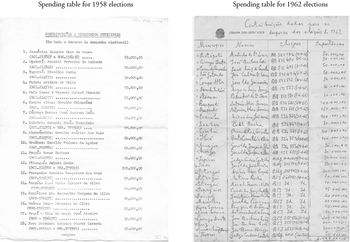
For both the 1958 and 1962 elections, Capanema created tables that recorded his various payments to brokers across the state of Minas Gerais. The first page of these tables is presented in Figure 1. The tables include the name of the municipality represented by a given broker, the individual to whom money was sent, the amount allocated, and the corresponding check numbers. They are the basis of the broker spending data utilized in this paper.
Tables Recording Capanema’s Municipal-Level Expenditures on Brokers, 1958 and 1962

In most cases (as in the example given above), the payments appear to be dobradinhas in which Capanema provided up front financial support to a PSD mayoral candidate or local PSD party directorate to pay for voter transportation and the concomitant distribution of his ballots. For example, in a letter dated August 30, 1958, a campaign worker informed Capanema that he had recently had a conversation with Mariano Silva, the PSD candidate for mayor in the municipality of Formiga. The worker emphasized that Silva could bring out the vote for Capanema, but this required Capanema to make Silva “some offer to cover the costs of the campaign he faces in Formiga” (GC L 1957.11.16, I-13). Voter transport was a considerable component of such costs. On the eve of the 1962 elections, Capanema’s broker in the municipality of Dores do Indaiá worriedly wrote that “the transport of voters is demanding of us a financial sacrifice greater than all of our expectations” (GC L 1957.11.16, XV-144). With such high transport costs, it was obviously necessary for Capanema to pay his brokers up-front.Footnote 9
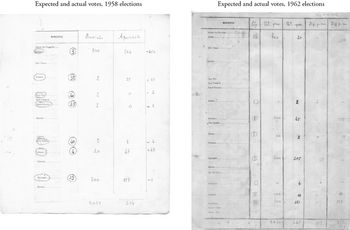
The second observation that emerges from studying the papers is that Capanema was meticulous in his efforts to assess broker competence and the returns on his municipal-level investments. For each of the three elections investigated here, Capanema created tables that recorded for each municipality the number of votes he expected to receive, the number of votes he actually received, and the deviation between the votes he expected and those he received. These tables were annotated with numbered markers that cross-referenced hand-written notes describing his arrangements in the municipalities and any shipments of ballots that were made to them. Figure 2 displays the first pages of these tables for the 1958 and 1962 elections.
Tables Recording Capanema’s Expected and Actual Votes, 1958 and 1962
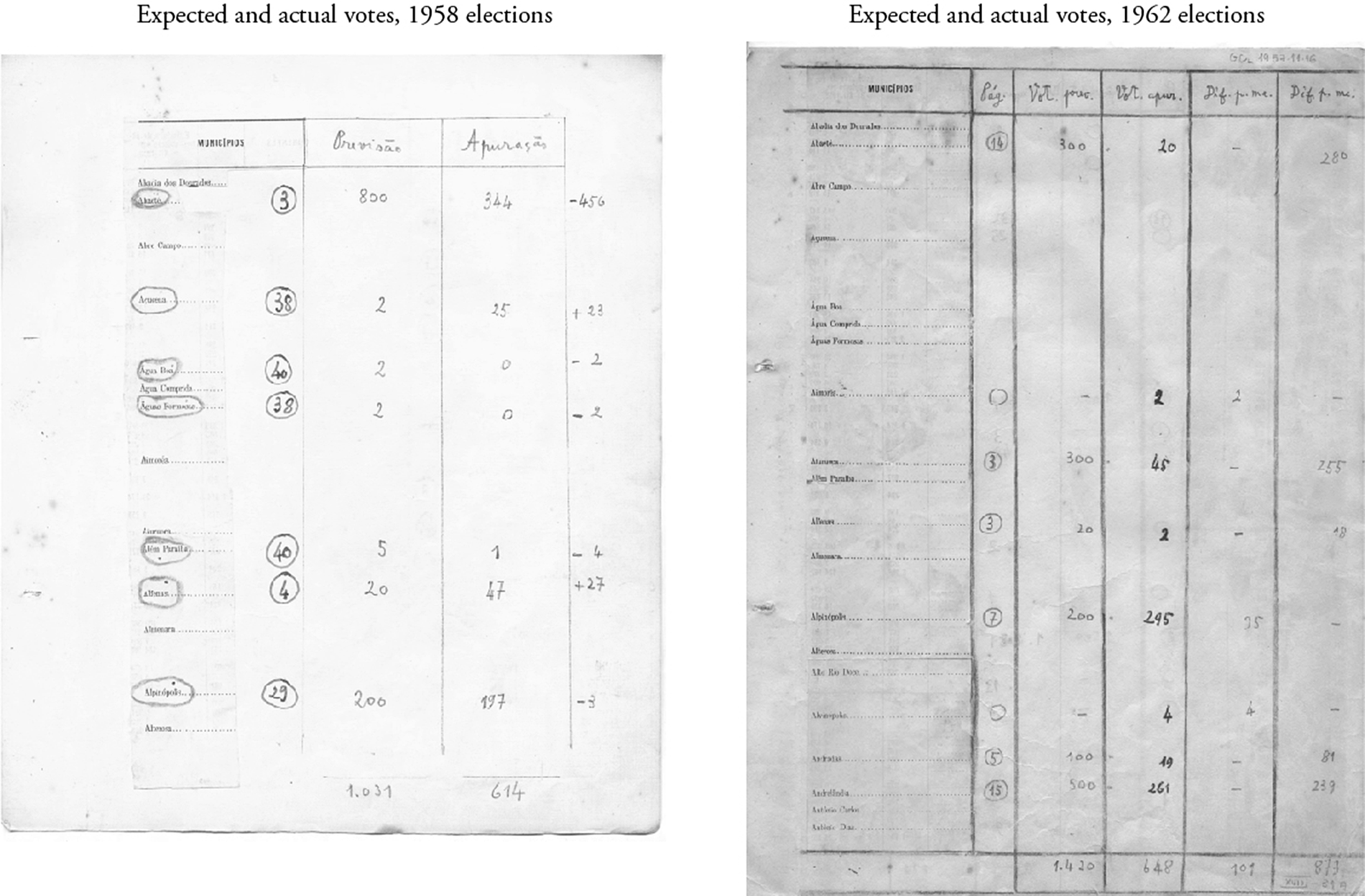
In producing these documents, Capanema equipped himself with a rich body of information suitable for guiding decision making about how to allocate campaign resources. Particularly remarkable is the fact that they capture Capanema’s expectations about vote totals, taking into account his investments in the municipal-level machines of brokers. Since he repeatedly prepared documents comparing these expectations with the actual votes he received, it seems reasonable to surmise that the documents served as an aid for learning about the abilities of brokers to mobilize votes. Once gained, it would only be natural for such knowledge to play a role in determining where he would invest scarce electoral resources in the future.
A final observation about the Capanema papers is that they reveal a strong preoccupation among brokers with their performance in delivering votes for Capanema. It was customary for brokers to telegram or write to Capanema immediately after the vote returns in their municipalities had been tallied. Successful brokers beamed with pride in their letters and emphasized the pivotal role of their efforts in the vote tally; the unsuccessful commonly invoked the duplicity of Capanema’s rivals to explain their failures. Yet there is little evidence of immediate postelection punishments or benefits being meted out as a consequence of performance differentials. In this sense, the archival record is noteworthy for what it does not contain: no threats of job loss for poorly performing brokers, no promises of advancement within the PSD for high performing brokers, and, in general, scant evidence of quid pro quos where items of value were granted or withheld conditional on the satisfaction of a given performance threshold. As a consequence, the notion that the accountability of brokers was based primarily on concerns about reputation has reasonable face validity.
A preliminary examination of the overlap between Capanema’s vote totals and his spending allocations underlines the electoral relevance of vote brokerage.Footnote 10 In the 1958 and 1962 elections, Capanema made payments to brokers in 30 and 53 different municipalities, respectively. In these municipalities, he received an average of 278 votes in 1958 and 246 votes in 1962. By contrast, in the municipalities where brokers did not receive payments Capanema received an average of only 20 votes in 1958 and nine votes in 1962 (Online Appendix Table A1). Changes in spending and votes tell a similar story. In the municipalities where Capanema increased his spending on brokers from 1958 to 1962, his average vote total increased by 121 votes. This compares with an average decrease of 146 votes in the municipalities where he decreased spending and an average decrease of five votes in the municipalities with no change in spending (Online Appendix Table A2). Not surprisingly, the municipalities where brokers received payments from Capanema contributed an outsized share of his total votes. Said municipalities produced 45% of Capanema’s total votes in 1958 and a remarkable 71% of his votes in 1962. This is in spite of the fact that all combined these municipalities contained only 4% of the registered voters in Minas Gerais in 1958 and only 8% in 1962 (Online Appendix Figure A5).
Campaign Spending in Broker-Mediated Elections
I capture the dynamics of campaign spending in broker-mediated elections through the use of a multiperiod principal-agent model with incomplete contracts. Building off the canonical work of Holmström (Reference Holmström1982), the model characterizes the electoral learning process of politicians, thereby generating expectations about how payments to brokers evolve over a politician’s career. The principal is a politician, denoted by P. He employs two agents, i and j, both of whom are vote brokers. P runs for election in consecutive electoral cycles, allocating resources to the brokers before each election in order to maximize his votes. The brokers are situated in unique electoral jurisdictions and are solely responsible for mobilizing votes on behalf of P in their jurisdictions. (In what follows, subscripts will be used to index agents and superscripts to index time periods.)
There are two periods, $$ t\in \left\{1,2\right\} $$. Before the game begins, Nature chooses the intrinsic ability of the vote brokers, denoted by θi and θj, respectively. Ability is not directly observable: neither P nor the brokers themselves are privy to the values of these quantities. Yet it is common knowledge that θi and θj are independently drawn from a common density with support [0, +∞) and mean μ > 0. Consequently, actions taken in period 1 are chosen in a context of symmetric information.
At the beginning of period 1, P offers the brokers up-front payments, $$ {w}_i^1\ge 0 $$ and
 $$ {w}_j^1\ge 0 $$, in order to finance efforts to mobilize votes on his behalf. The payments are total project expenditures that cover both the expenses incurred by brokers in mobilizing voters (organizing transportation to the polls, renting spaces for entertainment, buying food and drink) as well as their take-home pay. Take-home pay is a fraction
 $$ \tau \in \left[0,1\right] $$ of the total payment made to a broker, implying that brokers earn more money from larger vote mobilization projects. Take-home pay can be conceptualized as money for personal consumption or for the broker’s own political campaign (as in the case of a dobradinha). Payments to brokers must obey a budget constraint, with their sum not exceeding the total campaign war chest,
 $$ \pi $$. The campaign war chest is a use-it-or-lose-it asset: Any amount not spent by P in period 1 cannot be carried over to period 2. Given the payments they receive, the brokers then privately and simultaneously select a level of effort to exert,
 $$ {a}_i^1 $$ and
 $$ {a}_j^1 $$, in mobilizing votes on P’s behalf. Subsequently, the election is held and the votes mobilized by the brokers,
 $$ {V}_i^1 $$ and
 $$ {V}_j^1 $$, are publicly observed.
In period 2, P again offers the brokers up-front payments, this time conditioning those payments on the information revealed by the jurisdiction-level vote totals in the previous election. (Again, the sum of payments cannot exceed  $$ \pi $$.) The brokers then choose their effort levels, the election is held, and votes are mobilized by the brokers. Subsequently, the game ends.
The politician is solely concerned with maximizing his vote totals. In period t his utility is 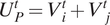 $$ {U}_P^t={V}_i^t+{V}_j^t $$, where the number of votes mobilized by broker
 $$ z\in \left\{i,j\right\} $$ in the period is
 $$ {V}_z^t=\ln \left(1+\left(1-\tau \right){w}_z^t\right)\left({\theta}_z+\beta {a}_z^t\right)+{\epsilon}_z^t. $$
The parameter  $$ \beta >0 $$ reflects the electoral technology in use in the polity.
According to Equation 1, spending on brokers exhibits decreasing marginal returns, with the returns to spending being higher the greater the levels of a broker’s ability and effort. More specifically, the equation implies that for any amount of money funneled to a broker’s vote-mobilization machine, higher levels of effort can substitute for lower levels of ability and vice versa. Importantly, the nature of electoral technology mediates the relationship between broker effort and votes. In line with the discussion in previous section, β is higher in electoral systems (such as Brazil’s old cédula avulsa system) where brokers’ control over ballot allocation ties a candidate’s votes directly to their actions than it is in contemporary secret ballot settings where voters can easily vote for a candidate without the intervention of a broker. The noise term  $$ {\epsilon}_z^t $$ is an unobservable random shock with mean 0. Such shocks are pure white noise: They are uncorrelated across periods for a given broker and across brokers within a given period. Their presence makes it impossible to perfectly deduce the ability and effort of brokers from vote totals.
The brokers seek to maximize their profits from vote brokerage. Said profits are equal to the difference between the take-home component of the payment received by a broker and the costs associated with exerting effort to mobilize votes for P. Accordingly, the utility of broker z in period t is
 $$ {\displaystyle \begin{array}{ccc}{U}_z^t=\tau {w}_z^t-\alpha \frac{{\left({a}_z^t\right)}^2}{2},& & \end{array}} $$
where the parameter  $$ \alpha >0 $$ reflects the marginal costs of exerting effort to mobilize votes. Brokers discount future utility according to the rate
 $$ \delta \in \left(0,1\right) $$.
Proposition 1 In the perfect Bayesian equilibrium of the campaign spending and brokerage game, P begins period 1 by providing both brokers with an up-front payment that evenly splits the budget between them,  $$ {w}_i^{1\ast }={w}_j^{1\ast }=\pi \divslash 2 $$. The brokers then exert an identical level of effort equal to
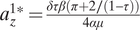 $$ {a}_z^{1\ast }=\frac{\delta \tau \beta \left(\pi +2\divslash \left(1-\tau \right)\right)}{4\alpha \mu} $$for
 $$ z=i,j. $$In period 2, P provides up-front payments that are increasing in the brokers’ relative expected abilities, which are calculated based on the period 1 vote totals and the level of effort that P surmises was exerted in period 1,
 $$ {w}_i^{2\ast }=r\left(\pi +2\divslash \left(1-\tau \right)\right)-1\divslash \left(1-\tau \right) $$and
 $$ {w}_j^{2\ast }=-r\left(\pi +2\divslash \left(1-\tau \right)\right)+1\divslash \left(1-\tau \right)+\pi, $$where
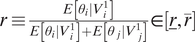 $$ r\equiv \frac{E\left[{\theta}_i|{V}_i^1\right]}{E\left[{\theta}_i|{V}_i^1\right]+E\left[{\theta}_j|{V}_j^1\right]}\in \left[\underset{\_}{r},\overline{r}\right] $$. (For extreme values of
 $$ r, $$i.e.,
 $$ r<\underset{\_}{r} $$or
 $$ r>\overline{r} $$, the entire budget is allocated to one broker.) Finally, with no shadow of the future, the brokers exert no effort on mobilizing votes in period 2,
 $$ {a}_z^{2\ast }=0 $$for
 $$ z=i,j. $$
Proof. See the Online Appendix.
The equilibrium captures important features of politician–broker exchange that are consistent with Capanema’s recorded interactions with local intermediaries described in the previous section. First, accountability of brokers to politicians is possible in spite of the fact that payments to brokers, by necessity or custom, typically occur prior to elections rather than subsequent to them after returns have been observed. The prospect of receiving future up-front campaign payments keeps brokers on their toes, since they are keenly aware that vote mobilization in the present holds important consequences for how P will assess their abilities. P’s assessment of ability is critical, since it determines how he will divvy up campaign resources among brokers in the future.Footnote 11 Second, for up-front contracts to work, politicians need to be meticulous observers of talent, keeping a careful eye on how brokers’ vote production squares with the amount of resources invested in their machines. P’s second-round payment allocation reflects learning of precisely this kind. Given the observed votes mobilized by the two brokers, and comparing this figure with the votes expected given his investment in their machines and what he knows a priori about their ability, P chooses an allocation that chases ability. Specifically, using the information conveyed by the previously observed vote totals, he reallocates funds among the brokers in a manner that dedicates more resources to the broker he believes is of relatively high ability and less to the broker he believes is of lower ability.
Remarks. The logic outlined above is not an artifact of the two-period specification of the model. Indeed, it is common in models of career concerns with incomplete contracts to employ a two-period setting to capture the core dynamics of exchange between principals and agents (cf. Persson and Tabellini Reference Persson and Tabellini2000). As shown in canonical treatments of these models, the infinite-horizon case simply generalizes the intuition of the two-period case: agents engage in costly effort in earlier periods to convince the principal that they are of a higher type, thereby improving their compensation in subsequent periods (Bolton and Dewatripont Reference Bolton and Dewatripont2005; Holmström Reference Holmström1982).
Deviations from Expectations. The framework lends itself to a consideration of how performance shocks affect the allocation of campaign spending. In period 1, prior to observing the election results but after choosing the first allocation of resources, the vote total P expects to receive from each broker is
 $$ {\displaystyle \begin{array}{ccc}E\left[{V}^{1\ast}\right]=\ln \left(1+\left(1-\tau \right)\frac{\pi }{2}\right)\left(\mu +\beta {a}^{1\ast}\right).& & \end{array}} $$
Now suppose the vote totals actually observed deviate symmetrically from those expected by an amount d  $$ >0 $$ such that
 $$ {V}_i^1-E\left[{V}^{1\ast}\right]=d $$ and
 $$ {V}_j^1-E\left[{V}^{1\ast}\right]=-d $$. In this scenario,
 $$ i $$ overperforms expectations by
 $$ d $$, and
 $$ j $$ underperforms them by the same amount. P’s updated beliefs about the brokers’ abilities are
 $$ E\left[{\theta}_i|{V}_i^1\right]=\mu +d\divslash \ln \left(1+\left(1-\tau \right)\pi \divslash 2\right) $$ and
 $$ E\left[{\theta}_j|{V}_j^1\right]=\mu -d\divslash \ln \left(1+\left(1-\tau \right)\pi \divslash 2\right) $$. Given P’s updated beliefs, he recalibrates payments in period 2 accordingly. As shown in the Online Appendix, the equilibrium difference in payments allocated to the brokers in period 2 is equal to
 $$ {\displaystyle \begin{array}{ccc}{w}_i^{2\ast }-{w}_j^{2\ast }=\frac{d\left(\pi +\frac{2}{1-\tau}\right)}{\mu \ln \left(1+\left(1-\tau \right)\frac{\pi }{2}\right)}.& & \end{array}} $$
The above leads directly to the following proposition, which outlines empirically observable implications of the model to be tested in the subsequent section of the paper.
Proposition 2 Part 1. A deviation in vote totals from those expected in the initial electoral contest leads to a reallocation of payments in the subsequent contest favoring (disfavoring) the over-(under-)performing broker. Part 2. The impact of such a deviation on the allocation of payments is decreasing in the level of the prior belief about brokers’ ability.
The first part of the proposition reflects the optimal recalibration of campaign spending. Electoral payments to brokers in future elections increase with positive deviations from expected performance in current elections and decrease with negative deviations. This is the essence of accountability in an incomplete contract setting. By comparing actual broker performance to benchmarks based on previous investment in local machines, politicians will redirect their spending to the individuals they believe offer the highest marginal returns.
The second part of the proposition reflects reputational conditionality. For brokers for whom the politician has favorable priors about talent, the elasticity of future payments to current deviations from expected performance is smaller than for brokers for whom the politician has unfavorable priors about talent. Intuitively, politicians will be loath to redirect funds away from proven brokers based on one bad election showing.Footnote 12
Electoral Returns to Wealth. The model can also be utilized to consider the electoral returns to wealth. Note that P’s total expected vote tally in period 1 is simply  $$ 2E\left[{V}^{1\ast}\right] $$, where
 $$ E\left[{V}^{1\ast}\right] $$ is defined as in Equation 3. As shown in the Online Appendix, differentiating
 $$ E\left[{V}^{1\ast}\right] $$ with respect to
 $$ \pi $$ and then differentiating again with respect to
 $$ \beta $$ and
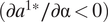
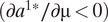
 $$ \delta $$, one finds that the nature of electoral technology and broker time horizons both mediate the (positive) returns to greater wealth (i.e., larger campaign war chests). In particular, electoral technologies that increase the elasticity of vote tallies to broker effort increase the returns to wealth. This implies that, as critics of the cédula avulsa argued, wealthier candidates were likely to enjoy a particularly strong electoral advantage under this system. The returns to wealth are also increasing in the weight brokers place on future exchanges with P, suggesting that politicians deeply embedded in the politics of their states were best positioned to exploit greater wealth. Finally, the degree to which electoral technology affects the returns to wealth depends on brokers’ time horizons, with electoral technology more strongly augmenting the returns to wealth if brokers are future oriented. In this way, the framework implies that it was politicians like Capanema—resource rich and politically long-lived—who benefited the most from the cédula avulsa.
Empirical Dynamics of Spending on Brokers
In order to evaluate the theoretical expectations articulated in Proposition 2, this article employs a hand-coded dataset that joins the archival data on spending and vote expectations with detailed electoral and demographic information on Brazilian municipalities. Data on electoral outcomes come from the tables included in the Capanema papers as well as publications of the state of Minas Gerais and Brazil’s Superior Electoral Court.Footnote 13 Demographic information on municipalities is based on the Brazilian Census of 1960.
The outcome of interest is the change in the spending allocated to a local political machine in a given municipality from 1958 to 1962. This change is measured in two ways. First, I use the change in the proportion of total spending allocated to a given municipal machine. Second, I use the change in the raw spending allocated to a given municipal machine.Footnote 14
I model the change in spending as a function of the deviation between the actual votes received by Capanema in 1958 and the amount he anticipated in that election. According to the formal model, brokers who overperformed expectations in 1958 should experience an increase in spending, whereas those who underperformed expectations should experience a decrease. I also consider the possibility that the effect of the deviation from expectations in 1958 might be conditioned on a broker’s previous record of performance. In particular, I estimate interactive models in which the effect of the deviation from expectations is conditioned on Capanema’s vote total in 1954, which I employ here as a proxy for Capanema’s initial belief about broker ability. My expectation is that spending on brokers with a record of past success (high vote counts) should be less affected by the one-time deviation in 1958 than for brokers without a past record of success (low vote counts).
The study’s estimating equations have the following functional forms:
 $$ {\displaystyle \begin{array}{ccc}\begin{array}{c}{Y}_i=\alpha +\tau {D}_i^{58}+\gamma {X}_i+e\left(\mathrm{noninteractive}\ \mathrm{model}\right)\\ {}{Y}_i=\alpha +\tau {D}_i^{58}+\psi {V}_i^{54}+\phi \left({D}_i^{58}\cdot {V}_i^{54}\right)+\gamma {X}_i+e,\\ {}\left(\mathrm{interactive}\ \mathrm{model}\right)\end{array}& & \end{array}} $$
where $$ {Y}_i $$ is the change in spending in municipality
 $$ i $$ from 1958 to 1962,
 $$ {D}_i^{58} $$ is the deviation between actual and expected votes in
 $$ i $$ in 1958,
 $$ {V}_i^{54} $$ is the number of votes received by Capanema in
 $$ i $$ in 1954,
 $$ {X}_i $$ is a set of political and demographic covariates for
 $$ i $$, and
 $$ e $$ is a normally distributed error term. Note that part 1 of Proposition 2 implies that
 $$ \tau >0, $$ whereas part 2 of the proposition implies that
 $$ \phi <0. $$
Identification of the effects of deviations from expectations requires that the covariate set include the factors that affect said deviations and are also potentially correlated with overtime changes in spending. To that end, all models condition on two core control variables: Capanema’s votes in 1958 and the (logarithm) of the number of registered voters in 1960. This reflects the fact that deviations from expectations may be larger in municipalities with high support for Capanema and large numbers of voters, respectively, and that spending trends could also be shaped by these variables. In addition to estimating models with these core variables, I also estimate models with a limited set of political and demographic characteristics as well as models with a full covariate set including a wide range of preexisting political conditions and indicators of socioeconomic development.Footnote 15 All models were estimated using ordinary least squares. (Descriptive statistics are presented in Table A3 in the Online Appendix).
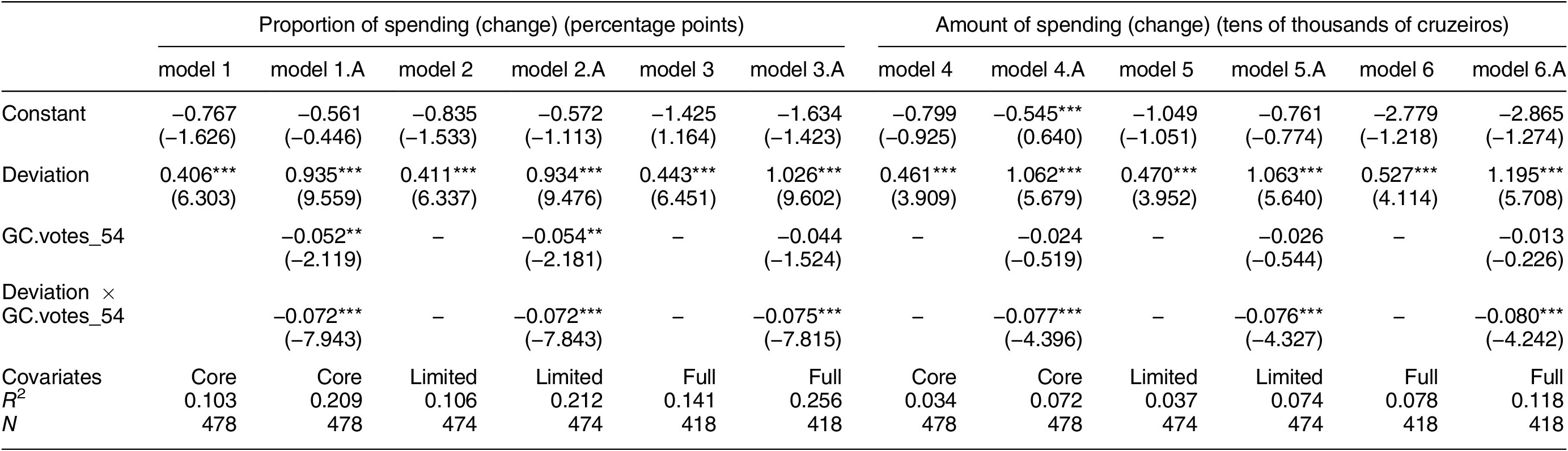
Table 1 presents the results of the analysis. Consistent with the formal model, a deviation from expected vote totals in 1958 had a positive effect on changes in the targeting of resources from 1958 to 1962. Municipal machines that overperformed expectations in 1958 were rewarded with more resources in 1962; those that underperformed expectations were punished with fewer. This finding was statistically significant by any conventional standard. Moreover, it was robust to changes in the covariate set and to measuring the change in spending using proportions or raw amounts. Employing the noninteractive model with a full covariate set (model 3), one finds that for every one hundred votes in excess of the expected vote total in 1958, the percentage of the campaign budget allocated to a given municipal machine in 1962 increased by 0.4. This is a nontrivial change, equal to about 0.4 standard deviations of the outcome. Examining the same specification applied to raw spending (model 6), one finds that for every one hundred votes in excess of the expected vote total in 1958, the allocation in 1962 increased by an inflation-adjusted amount of 5,267 cruzeiros (about US$184 in 1990 dollars).
Effect of Deviations from Expected Vote Totals on Capanema’s Allocation of Campaign Resources, 1958–1962

Note: The t-statistics are in parentheses; deviation and vote counts are scaled as hundreds of votes. *p < 0.10, **p < 0.05, ***p < 0.01.
Also consistent with the theoretical framework, the interactive models revealed that the effect of a deviation from expectations was conditioned on past vote performance. In municipalities where the local machine had a little or no record of bringing out the vote for Capanema in 1954, changes in spending were tightly aligned to deviations from expected performance in 1958. However, in municipalities where the local machine had a strong record of bringing out the vote for Capanema in 1954, the elasticity of changes in spending to deviations from expectations in 1958 was much weaker. This can be seen by inspecting the coefficient on the interaction between the deviation from expectations in 1958 and Capanema’s vote total in 1954, which is uniformly negative and statistically significant by any conventional standard.
Discretizing the Moderating Variable. To verify that the results for the interactive models were not an artifact of extrapolation outside of the support of the data, the moderating variable—Capanema’s vote total in 1954—was transformed into a binary variable based on two alternative thresholds for defining high versus low support (100 votes and 250 votes). The interactive models were then estimated using each version of these binary moderators (see Table A4 in the Online Appendix). Consistent with the findings above, the relationship between the deviation from expectations and the change in spending is more muted in municipalities where Capanema enjoyed high support in 1954 than where he had low support. In fact, the effect of a (positive) one hundred vote deviation from expectations was close to zero for municipalities that fielded more than 250 votes for Capanema in 1954, whereas for those below this threshold the effect of said deviation was roughly double that estimated for the full sample.
Ruling Out Alternatives. An alternative interpretation of the findings is that Capanema’s electoral spending reflects learning about the degree to which voters in a municipality are favorably disposed to him as a candidate, as opposed to learning about the efficacy of the municipality’s broker. In this account, Capanema was simply trying to funnel resources to locations where he was already popular. Although concerns about this alternative should be assuaged by the fact that the analysis conditions on Capanema’s vote total in 1958, I nevertheless performed a series of additional empirical checks to rule it out more completely.
One empirical implication of the alternative hypothesis is the following: once one conditions on measures of support for Capanema based on past electoral results (the only systematic measures of popularity he had access to), the influence of the deviation variable should go to zero. To test this, I estimated a series of regressions in which the effect of deviations from expectations was estimated jointly with a host of variables that capture past levels and trends of citizens’ preferences for Capanema. In addition to Capanema’s total votes in 1958, the estimations condition on the change in his total votes from 1954 to 1958, his vote share in 1958, the change in his vote share from 1954 to 1958, his share of the total PSD vote in 1958, and the change in his share of the PSD vote from 1954 to 1958. The estimations also included a model where all these variables were included simultaneously.
The results are presented in Tables A5–A6 of the Online Appendix. As is evident in the tables, the influence of deviations from expectations on changes in spending remained positive and statistically significant (at any conventional standard) when conditioning on any of these variables separately as well as when conditioning on all of them simultaneously. The robust influence of deviations from expectations is not consistent with the alternative interpretation that Capanema’s spending decisions simply reflected an attempt to target his spending where he was already popular.
Another implication of the alternative hypothesis is that the effect of deviations from expectations should be the same in municipalities where Capanema did not previously engage with brokers as in the municipalities where he did. By contrast, the learning-about-brokers mechanism implies that learning should be concentrated where brokers were working for Capanema, not necessarily everywhere in the state.
To test this, I estimated the effect of deviations across four different subsamples: municipalities whose brokers were in contact with Capanema during the 1958 campaign versus municipalities with no contact as well as municipalities whose brokers received spending from Capanema in the 1958 campaign versus municipalities without broker spending.Footnote 16
The results of the analysis are presented in Tables A7–A10 in the Online Appendix. In the two subsamples indicating engagement with brokers by Capanema (contact, spending), deviations from expectations is a strong and statistically significant driver of changes in spending. Moreover, Capanema’s vote total in 1954 conditions the effect of deviations in the same statistically significant manner as in the previous analysis. The absolute values of the coefficients on the key model terms are larger than in the full sample, as are the  $$ {R}^2 $$ values.
By contrast, in the two subsamples indicating no engagement with brokers by Capanema (no contact, no spending), deviations from expectations have no statistically significant effect on spending (either directly or as an interaction) and the  $$ {R}^2 $$ values of the models are much lower than in the engagement subsamples. Thus, the geographical nature of spending patterns is consistent with a learning-about-brokers mechanism but not with a learning-about-popularity mechanism.
All told, the empirical dynamics of targeted spending on brokers is consistent with an incomplete contracts framework where up-front payments to brokers fluctuate as a function of past performance. Not only does it appear that Capanema updated his priors about brokers’ abilities, redistributing his spending accordingly, but he also seems to have updated said priors in a reasonable way—reacting more to deviations in cases where there was not a prior record of good performance than in cases where there was such a record. In employing municipal-level vote counts as a performance metric, Capanema was able to use what he learned about brokers’ abilities to make his spending on local machines progressively more efficient over time. This would suggest that the electoral returns to spending for politicians like Capanema were likely to be quite high.
Electoral Returns to Spending
In order to estimate the electoral returns to spending on brokers, I employ a first differences estimator. The outcome of interest is the difference in Capanema’s votes in a given municipality in the elections of 1962 versus those of 1958. The explanatory variable is the difference in the raw spending (corrected for inflation) on a given municipal machine over the same period. The virtue of the first differences estimator is that it provides an unbiased estimate of the effect of spending even if municipalities with different levels of spending have different propensities to vote for Capanema based on unobservable and temporally fixed characteristics.
As the first difference estimator (with two periods) is conceptually equivalent to differences-in-differences, the key identifying assumption it makes is the common trend assumption. This holds that for any two levels of spending, municipalities with the higher level of spending would have had the same average change in votes as municipalities with the lower level of spending had the former experienced the same level of spending as the latter. To enhance the plausibility of this assumption, it is customary to condition on factors that might simultaneously contribute to both overtime changes in spending and overtime changes in Capanema’s votes.
To that end, in addition to presenting results without covariates, I present results that incorporate covariates that may contribute to both types of trends. In the core specification, I condition on the history of Capanema’s electoral support prior to the 1962 election (i.e., his raw votes in 1954 and 1958), the history of PSD control of the municipality (indicators for PSD mayor elected in 1954 and 1958, respectively), as well as the logarithm of the number of registered voters. In the limited specification, I add additional measures of the history of electoral support for Capanema and the PSD as well as the literacy rate.Footnote 17 Finally, in the full specification, I further add the entire set of socioeconomic covariates described in footnote 15. All models were estimated using ordinary least squares.Footnote 18
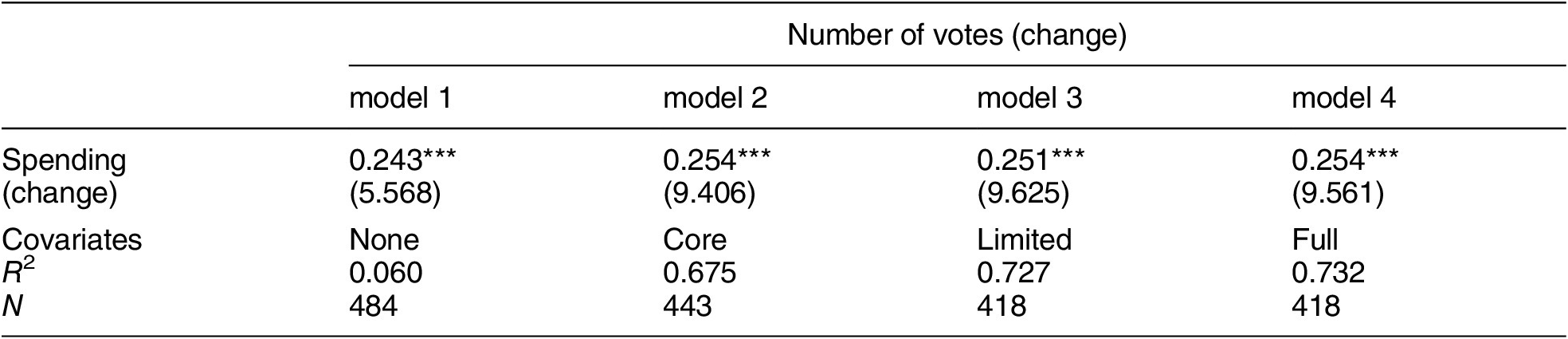
Table 2 presents the results of the analysis. The estimates of the returns to spending on brokers were positive, statistically significant by any conventional standard, and highly stable across different specifications of the covariate set. Substantively, they reveal that for each increment of 10,000 cruzeiros allocated to brokers, Capanema could expect to receive about 24 to 25 additional votes. Based on an exchange rate of 129 cruzeiros per dollar in 1958, this implies that by allocating funds to brokers, Capanema was able to obtain a return of one vote for roughly every three dollars spent (equivalent to about US$14 per vote in 1990 dollars).Footnote 19
Effect of Spending on Brokers on Votes
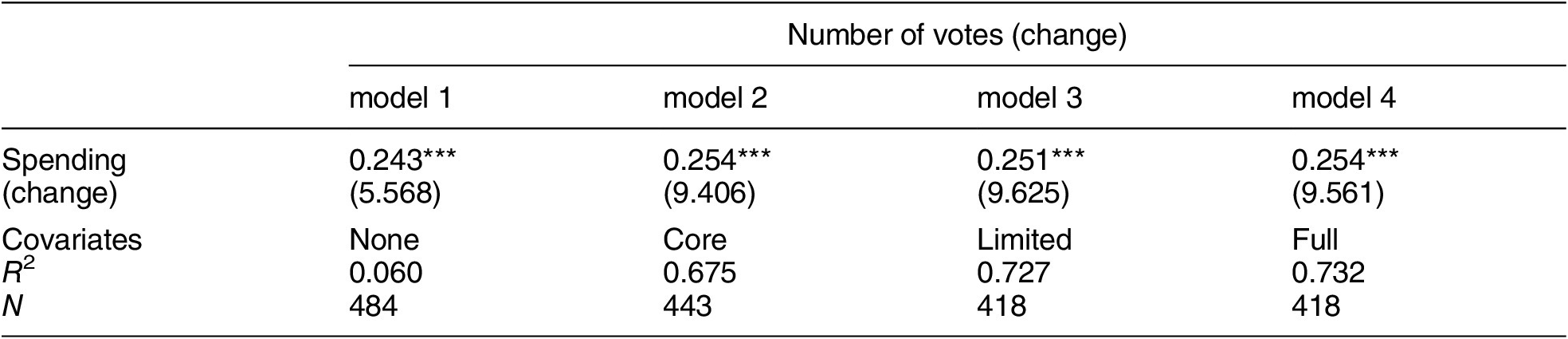
Note: The t-statistics in are in parentheses, vote counts are scaled as hundreds of votes, and spending is scaled as tens of thousands of cruzeiros. *p < 0.10, **p < 0.05, ***p < 0.01.
This is a high level of productivity of electoral expenditures. To provide a basis of comparison, Kam (Reference Kam2017) reports an average price of £4.14 paid per vote in the 1868 parliamentary elections in the United Kingdom, the last to take place before the introduction of the secret ballot in that country. This amount would be approximately equal to £164 in 1990—or US$292 per vote—indicating a rate of return on expenditures 20 times below that enjoyed by Capanema in Brazil. In the contemporary US, estimates of the returns to door-to-door canvassing (one of the most effective means of mobilizing voters) indicate a cost per vote of US$47 (Green and Gerber Reference Green and Gerber2015); evidence on general campaign expenditures indicates a cost of US$145 per vote (Bombardini and Trebbi Reference Bombardini and Trebbi2011). Thus, Capanema’s spending on brokers appeared to be highly effective, both relative to what is known about the costs of vote buying under public voting in other settings as well as relative to the returns to modern campaign tactics under the secret ballot.
Placebo Regressions. A potential objection to the above analysis could be based on the concern that the municipalities where Capanema decided to increase expenditures were already trending politically in a different fashion—prior to the changes in spending—than those municipalities where he decided to reduce spending. If this were in fact the case, the estimates of the first differences estimator could erroneously attribute a causal effect to expenditures on brokers based on these preexisting trends.
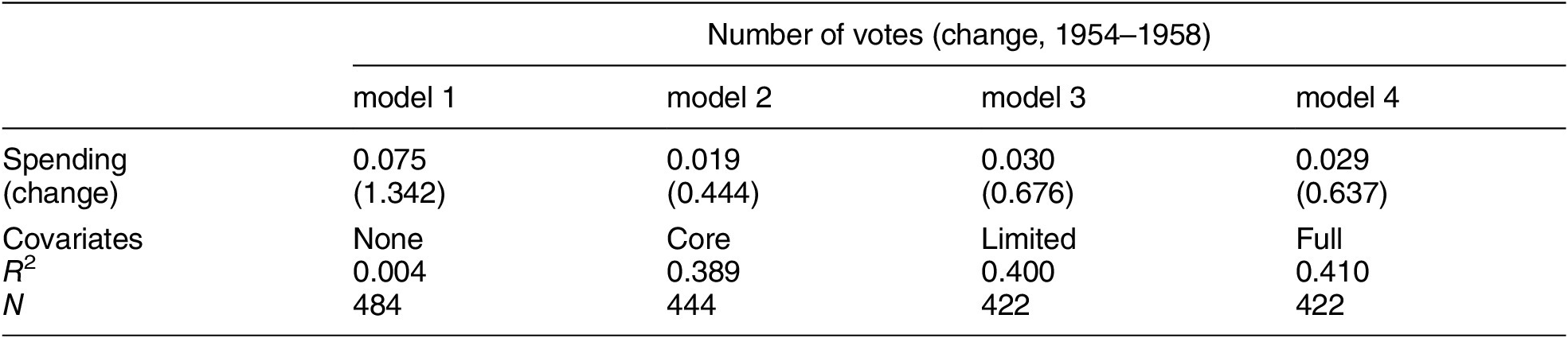
Fortunately, the availability of data from 1954 makes it possible to evaluate whether such a violation of the common trend assumption is at play. To conduct such an evaluation, I ran placebo regressions, regressing Capanema’s change in votes from 1954 to 1958 on the change in spending from 1958 to 1962. Changes in spending in the latter election cycle cannot possibly cause changes in votes in the former. Should a statistically significant relationship emerge, this would indicate the presence of pretreatment trends (i.e., prior to the recalibration of spending) that may be confounding the estimates of the effect of spending in the first differences analysis. I estimated the regression models with varied covariate sets as in the previous analyses.Footnote 20
The results of the placebo regressions are presented in Table 3. In none of the estimations was the relationship between prior vote trends and (changes in) expenditures on brokers statistically different from zero. As a result, it appears unlikely that the study’s estimates of the effects of spending are an artifact of preexisting political trends.
Placebo Regressions of Prior Vote Trends on Spending

Note: The t-statistics are in parentheses, vote counts are scaled as hundreds of votes, and spending is scaled as tens of thousands of cruzeiros. *p < 0.10, **p < 0.05, ***p < 0.01.
Subsample Analyses. To verify that the spending results were not driven by municipalities that Capanema did not target for spending in either election, I reran the analyses limiting the sample only to municipalities that experienced nonzero changes in spending from 1958 to 1962.Footnote 21 The subsample analyses are presented in Online Appendix Tables A11–A12. For these municipalities, the marginal effect of greater spending was positive, statistically significant, and of nearly identical magnitude to the effect for the full sample. Moreover, placebo regressions conducted on this sample revealed an absence of preexisting political trends across spending levels, again lending credence to the common trend assumption.
Preferences for Voting Systems
The article’s theoretical framework emphasizes that politicians like Capanema, with substantial personal resources and long careers, stood to lose the most from the substitution of the cédula avulsa by the AB. Moreover, the previous sections provide evidence of Capanema’s ability to take maximal electoral advantage of the opportunities for learning provided by the cédula avulsa. All this implies that Capanema should have fought tooth and nail to maintain the old voting system that he had mastered so well. The historical record bears this out.
On the floor of the Chamber of Deputies, Capanema was a critic of proposals to scrap the cédula avulsa in favor of the AB. Consistent with the arguments of many opponents of the AB in Brazil at the time, he claimed that the proposed ballot’s complicated format would disenfranchise less educated voters with limited literacy skills.Footnote 22 Moreover, he argued that the cédula avulsa was a boon for party unity, characterizing the process of receiving a ballot from a party broker as one in which “the voter manifests his discipline, his fidelity and his patriotism” (Boletim Eleitoral, June 1955, 544). On a personal level, Capanema even admitted publicly that he probably would not have been reelected in 1954 were it not for the cédula avulsa (ibid., 542).
Capanema’s private behavior similarly revealed an aversion to the AB. As described in the Online Appendix, he led a surreptitious plot to limit the implementation of the AB in Minas Gerais during the 1966 legislative elections, the first to take place under Brazil’s newly formed military regime. In particular, Capanema worked behind the scenes to modify the enactment of a military decree outlining the use of the AB in specific municipalities. Consistent with the formal model and his own public statements, the fact that Capanema would take his anti-AB efforts to such lengths speaks to a belief that his electoral prospects were tied to the cédula avulsa.
Conclusion
Political Science scholarship has only begun to study the labor market for brokers. Among the key claims emerging from this work is the notion that broker selection is structured by politicians’ learning: politicians invest in certain brokers (and not others) based on signals about ability generated by aggregate electoral results in jurisdictions under the brokers’ control. Drawing upon a hand-coded dataset based on the personal archives of Gustavo Capanema, a powerful mid-twentieth-century congressman from Minas Gerais, Brazil, the current paper provides the most explicit test to date of this learning hypothesis. Consistent with the hypothesis, the paper demonstrates that resource flows to brokers were tightly aligned with signals about ability. Local machines with vote counts that exceeded expectations in one election were rewarded with more resources in the next. Similarly, machines with vote counts that fell below expectations were punished with fewer resources in subsequent elections.
The nature of electoral technology in Brazil during the period studied here bolstered the role of learning in holding brokers accountable to politicians. Since the country’s candidate-printed ballot system made it extremely difficult for a rural-based politician to receive votes in a municipality without the help of a local broker, the broker performance metric utilized was both simple and informative: the politician’s municipal vote count. As this metric was highly responsive to both broker ability and effort, it was possible to hold brokers accountable to politicians primarily through reputational mechanisms. Brokers faithfully pursued the electoral interests of their patrons because they sought to establish a reputation for effectiveness that would allow them to secure more patronage in the future.
Due to the informativeness and low logistical costs associated with using municipal vote counts to assess broker ability, mobilizing large masses of voters though brokers under the candidate printed ballot system was almost certainly easier to achieve than doing so in the contemporary era under the secret ballot. That being said, it would be a mistake to conclude that the absence of ballot secrecy is a necessary condition for the modality of accountability identified in these pages. To the contrary, contemporary investigations of brokerage in Mexico, Liberia, and Senegal would imply that politician learning based on aggregate electoral results is neither unique to Brazil nor to the pre-secret ballot era.
Rather, the main implication of electoral technology would appear to lie with the efficiency of electoral expenditures on brokers. By all indications, the reputational dynamics identified in the paper led to an efficient use of electoral expenditures. Spending on brokers provided considerable electoral returns, higher on a per dollar basis than previous measures of the returns to vote buying under the open ballot and the most effective voter outreach strategies in the contemporary US. This may explain why a wealthy and well-connected politician like Capanema was so opposed to the secret ballot.
In sum, this paper establishes two key points about the dynamics of vote brokerage. First, politicians can utilize micro-level electoral data to learn about differences in ability among brokers and to guide decisions about how to invest scarce campaign resources. Second, the fact that politicians allocate resources contingent upon such learning can keep brokers accountable to their patrons even in settings where formal means of discipline are lacking. The important role of reputation-based accountability may explain why brokerage is such a potent means of mobilizing voters across space and time in spite of wide ranging variation in party strength.
Supplementary Materials
To view supplementary material for this article, please visit http://dx.doi.org/10.1017/S0003055420000568.
Replication files are available at the American Political Science Review Dataverse: https://doi.org/10.7910/DVN/QIWQWL.






Comments
No Comments have been published for this article.