An effective disaster medical workforce must possess appropriate competencies, which include the specific knowledge, skills, attitudes, behaviors, and personal characteristics that contribute to individual and team performance.Reference Spencer and Spencer 1 In earlier research involving focus groups of emergency medical response leaders,Reference King, North and Larkin 2 the authors identified and categorized attributes of effective disaster responders and leaders, resulting in 10 categories of attributes. A follow-up study surveyed a broader group of emergency medical leaders and respondersReference King, Larkin and Fowler 3 and yielded the same 10 categories that resulted from the focus group study. In contrast to existing competency frameworks,Reference Subbarao, Lyznicki and Hsu 4 - Reference Walsh, Subbarao and Gebbie 6 which focus on knowledge and skills, these categories also include innate worker attributes and characteristics identified as important to disaster responder and leader effectiveness.
The 10 categories are the following: adaptable/flexible (willing and able to modify one’s approach to achieve desired results), calm/cool (able to remain calm, logical, and level-headed in adverse conditions), character (exhibits useful traits consistently, such as determination, reliability, courage, and humility), cognition (clear mental, cognitive, and perceptual processing on the job), communication (willing and able to communicate with diverse people from varied backgrounds and organizations), general knowledge (overall knowledge and skills; education, training, and experience not specific to disasters but useful in a disaster response setting, including medical knowledge and skills; and professional knowledge and skills from nonmedical fields relevant to disaster settings), ICS knowledge and skills (knowledge of Incident Command System and one’s role, understanding the disaster environment and the job to be done), performs role (carries out one’s assigned role and related functions properly in response to a disaster), problem-solving/decision-making (decisive, weighs options, makes timely and effective decisions), and teamwork/interpersonal skills (able to work effectively with others at all levels). A full description of these attributes can be found in an earlier article.Reference King, North and Larkin 2
In the aforementioned research that identified the 10 categories,Reference King, North and Larkin 2 , Reference King, Larkin and Fowler 3 the relative importance of the attributes was not addressed. Knowing the relative importance would be helpful in setting priorities for personnel recruitment, selection, and training. In the present study, experienced emergency medical response personnel were asked to rank order the attributes of disaster medical responders and leaders according to their relative contribution to effective performance. The separate rankings would allow the leader and responder attribute priorities to be compared.
METHODS
The University of Texas Southwestern Medical Center Institutional Review Board determined that this survey research was exempt from full institutional review board review. Practicing emergency medical response personnel (N=220) voluntarily participated in an anonymous survey to rank order 10 previously identified categories of attributes of effective disaster response leaders and responders.Reference King, North and Larkin 2 , Reference King, Larkin and Fowler 3 The ranking activity was completed by 145 participants attending the February 2009 EMS State of the Science: A Gathering of Eagles, 7 an annual meeting of international emergency response leaders and responders. An additional 75 emergency and disaster medical response personnel completed the ranking survey during several other events in 2009 also attended by 1 of the authors: meetings of the World Congress on Disaster and Emergency Medicine in Victoria, British Columbia, Canada 8 ; the Caribbean Emergency Medicine Congress, Barbados 9 ; and the Integrated Medical, Public Health, Preparedness and Response Training Summit in Dallas, Texas. 10 Additionally, several emergency medical response personnel were surveyed at an Urban Search and Rescue drill in California and at the Presidential Inauguration of Barack Obama in Washington, DC. The specific numbers of participants recruited at each of these events are not available.
Participants were given a brief description of each of the 10 previously defined attributes and asked to rank order their importance in contributing to the effectiveness of disaster personnel. Participants were instructed to assign numbers 1 to 10 to the categories (1=most important, 10=least important) while using each number only once. Separate rankings were completed for attributes of “leaders” and “responders.” Additional data collected included gender, professional discipline, and the number and type of disasters they had directly participated in. SAS 9.4 (Cary, NC) for Windows was used for data analysis. Paired t tests were used to compare participant rankings of attributes of responders vs. leaders. The α level of significance was set at .05, and Bonferroni adjustments were made for multiple comparisons.
RESULTS
A total of 220 surveys were completed, 79 (36%) by physicians, 108 (49%) by medics (paramedics or emergency medical technicians), 18 (8%) by nurses, and 12 (5%) by various other professionals. The sample was 70% male. Two-thirds (67%) of the participants reported having participated in at least 1 disaster response within the last 4 years. The types of events in which participants had responded included hurricanes, tornadoes, floods, ice and snow storms, fires, chemical plant explosions and other hazmat events, train wrecks, bus crashes, and mass attacks.
Table 1 lists the ranked attributes of effective disaster leaders and responders. For leaders, the highest-ranked attribute was problem-solving/decision-making, and for responders it was teamwork/interpersonal skills. Two personal characteristics, calm/cool and adaptable/flexible, were ranked among the top 5 in both lists. Skills in communication and teamwork/interpersonal also were ranked in the top 5 in both lists. Performs role appears in the top 5 for responders only, whereas problem-solving/decision-making is ranked in the top 5 for leaders only.
Essential Attributes of Effective Disaster Leaders and Responders Ranked in Order of Importance a

Abbreviation: ICS, Incident Command System.
a 1=most important.
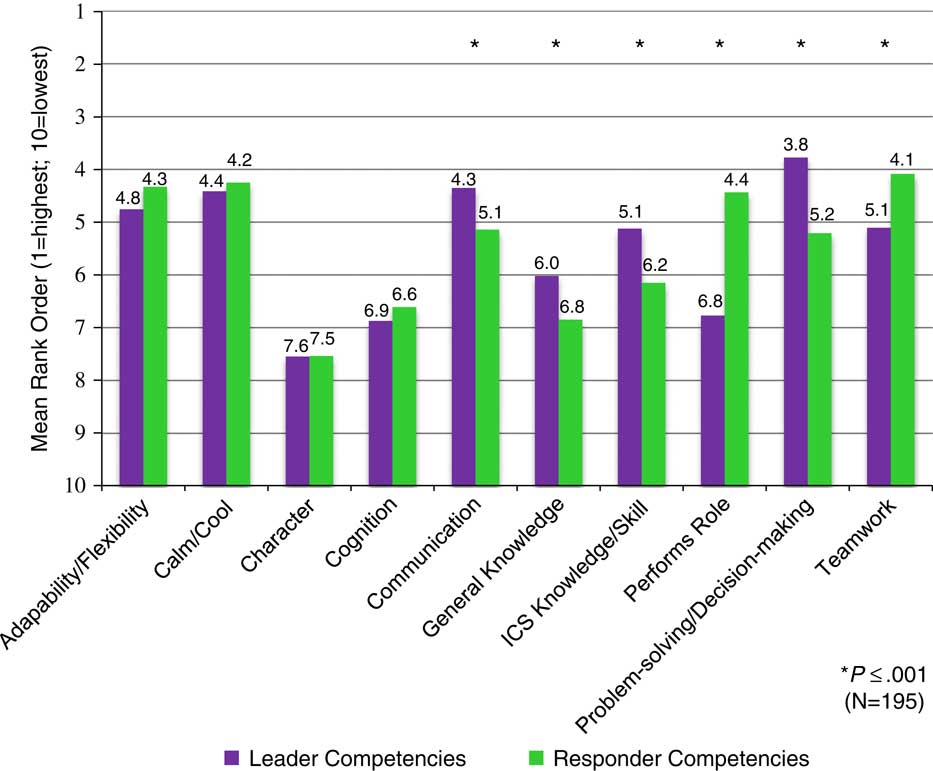
Figure 1 compares means of the 10 categories of attributes that participants ranked for leaders and for responders. The following differences in rankings were statistically significant: 4 categories, communication skills, general knowledge, ICS knowledge and skills, and problem solving/decision making, were ranked higher for leaders than for responders. Two categories, performs role and teamwork/interpersonal skills, were ranked higher for responders than for leaders.
Comparison of Mean Rankings of Leader and Responder Competencies Abbreviation: ICS, incident command system.

DISCUSSION
The purpose of this study was to determine the relative importance of 10 attribute categories considered essential to the effective performance of disaster medical responders and leaders. The 10 attributes were originally identified in our earlier studies using focus groupsReference King, North and Larkin 2 and a surveyReference King, Larkin and Fowler 3 of emergency medical responders and leaders.
In the present study, the participants who volunteered to complete the ranking task were primarily emergency medical responders or leaders attending conferences or training events; thus, sampling bias is a limitation of this study. Further, the primary data in this study are ratings reflecting the opinions of the participants, and we did not study the relationship between the attributes and actual performance of disaster medical responders; consequently, criterion validity should also be considered a limitation. Readers should keep these limitations in mind when generalizing the findings of this study.
The findings suggest different orders of importance of these attributes for leaders versus responders. Problem-solving/decision-making was highest ranked for leaders, and teamwork/interpersonal skills was highest ranked for responders. Three other categories of attributes were ranked in the top 5 for both leaders and responders: calm/cool, adaptable/flexible, and communication skills. Performs role was also ranked in the top 5, but for responders only. These top-ranked categories represent general skills, personal characteristics, and performance.
Considering that much of disaster medical training emphasizes elements of Incident Command System knowledge and specific disaster medical response concepts and procedures, such as triage, personal protective equipment, and decontamination,Reference Subbarao, Lyznicki and Hsu 4 , Reference Walsh, Subbarao and Gebbie 6 it is notable that ICS knowledge/skills was not ranked among the top 5 attributes for either leaders or responders in this study. Although there is no doubt that ICS and disaster medical knowledge and skills are essential in a competent disaster medical workforce, a number of general skills and personal characteristics were deemed more important by the experienced emergency medical practitioners surveyed. Yet in competency frameworks and training programs for disaster response, general skills and personal characteristics are often not included or not emphasized.Reference King, North and Larkin 2 - Reference Subbarao, Lyznicki and Hsu 4 , Reference Walsh, Subbarao and Gebbie 6 ICS and disaster medical concepts, principles, procedures, and skills are rightly regarded as essential core topics to address through training. Other competencies, however, such as adaptability, calm response to stress, strong interpersonal and communication skills, self-directedness, and ethical behaviorReference Spencer and Spencer 1 , Reference Larkin and Arnold 11 are also essential; it is important to assess workers on these attributes and to develop their competency in these areas through training and guided experiential learning.Reference Spencer and Spencer 1 A more robust competency framework that includes such attributes can better guide personnel recruitment, selection, and development. For example, an Army recruitment advertisement for firefighters 12 lists “helpful skills,” including ability to remain calm under stress, willingness to risk injury to help others, and ability to think and act decisively. Potential candidates who read this advertisement may take these attributes into account in deciding for themselves whether they are a fit for that role. Additionally, these helpful skills can be assessed in interviews with applicants. For those who may already have been selected for the role but lack certain helpful skills, targeted training may be appropriate. For example, a willingness to take risks to help others could be developed through experiential training that builds confidence in one’s ability to succeed despite known risks or through awareness training that helps trainees better understand and appreciate the positive difference they can make in people’s lives through their service.
Our understanding of the characteristics of effective disaster medical practitioners continues to grow. The attributes of effective leaders and responders presented here, ranked in order of perceived importance, reflect the insights and opinions of emergency medical practitioners based on their experience.
Competency frameworks should reflect a full range of responder and leader attributes, including personal skills, characteristics, and behaviors, that contribute to an effective disaster medical response. The rankings of attributes presented in this study may be helpful in prioritizing the development and use of limited training resources for disaster medical responders and leaders. It may be useful to repeat the rankings exercise with a sample of leaders and responders limited to those with extensive disaster medical experience, as opposed to our sample of emergency medical personnel. Criterion validity should be investigated through further research designed to measure the extent to which possession of these attributes relates to, or predicts, the actual performance of medical responders in disasters.
In conclusion, a more robust competency framework is needed to guide effective disaster medical response workforce development processes, including recruitment, selection, training, and management. Conferences should be organized to facilitate focused discussions on how these processes can be adapted to take into account the full range of attributes determined to be helpful or essential to effective performance, including the abilities to solve problems, work cooperatively with others, remain calm under stress, communicate effectively, adapt, and carry out assigned roles.