Most alliance theories suggest that states facing common enemies or threats tend to align in order to aggregate their capabilities and resources (Waltz, Reference Waltz1979; Walt, Reference Walt1987; Schroeder, Reference Schroeder1989; Friedberg, Reference Friedberg2005). In this vein, Victor Cha (Reference Cha1999, Reference Cha2000) and Ralph Cossa (Reference Cossa1999) contended that Japan and the Republic of Korea (ROK) had been entangled in a state of ‘quasi-alliance’ or ‘virtual alliance’ in the face of common enemies or threats, such as North Korea and China. Nevertheless, the actual case studies of Japan–ROK alignment rest uneasily with the realist assumption that states form an alliance as a balance against an emerging great power or external threats. When tested against two serious security crises that took place in Japan and South Korea in 2010, the strategic and tactical interactions between the two countries have been, at best, marginal, raising questions about the future prospects of their security cooperation.
So far, the dynamics of alliances and alignments in East Asia have been analyzed mostly from the perspectives of great power politics, which highlighted the reactive or, at best, ambivalent nature of middle powers. This is understandable, but still runs the risk of missing the distinct preferences, identities, and norms of middle powers that illustrate the anomaly of Japan–ROK security ties. Since they are not just the pawns of great powers and are more independent actors than small powers, this article argues that the middle powers have subscribed to a specific set of standards governing their acts of security and perpetuating their identity as middle powers.
Often, the behaviour of middle powers has been described in the IR literature in terms of ‘middlepowermanship’ (Cox, Reference Cox1989), ‘middle power diplomacy’ (Pratt, Reference Pratt1990; Soeya, Reference Soeya2005), or ‘middle power activism’ (Ravenhill, Reference Ravenhill1998; Choi, Reference Choi2009), highlighting their interests in humanitarianism, multilateralism, biodiversity, etc. However, their approaches toward hard security issues, especially alliance behaviours vis-à-vis other middle or great powers, has received less theoretical attention. Given that China's rise has caused a security dilemma (Lee, Reference Lee2005) or offered opportunities for alliances and alignments (Kang, Reference Kang2003), Northeast Asia is a valuable testing ground for the security orientations of middle powers and their impact on great power dynamics.
Indeed, the United States and China could be described as the two great powers perpetuating the currently divisive, but still relatively stable security landscape in Northeast Asia (Friedberg, Reference Friedberg2005; Rangsimaporn, Reference Rangsimaporn2006). Sandwiched between the two great powers, what strategies would the middle powers take to maximize their security? If the weakening of the US military presence reached a point of irreversible decline of US influence in Northeast Asia, what impact does it have on the security behaviour of the two middle powers? We have three rival theories: realism, liberalism, and constructivism. The realist school, especially those subscribing to the balance of threat theory, predicts that states form alliances against external threats (Walt, Reference Walt1987). However, Japan and South Korea, sharing an alliance partner, as well as enemies, did not enter into a formal alliance and ended up maintaining a ‘virtual alliance’ (Cossa, Reference Cossa1999). Cha (Reference Cha1999, Reference Cha2000) explained this anomaly by stressing that the security commitment of a common alliance partner, the United States, is more important than external threats, but still predicted that the decline of US commitment and the fear of abandonment would force Japan and South Korea to strengthen their alignment, if not to form an alliance. However, a steadily decreasing number of US troops and the planned decoupling of a US–ROK combined command structure did not result in a significant strengthening of Japan–ROK alignment. Despite a defence budget cut, announced in January 2012, the United States is unlikely to reduce its military presence in East Asia in the foreseeable future in order to balance China's growing military power (Agence France Presse, 27 January 2012). Defence Secretary Leon Panetta said in June 2012 that the Asia-Pacific will become the US's new military focus with about 60% of the fleet, including six aircraft carriers, to be assigned there (Associated Press, 2 June 2012). The liberal school elucidates the middle powers’ efforts to create regional security mechanisms to socialize China in spite of many obstacles to institutionalization (Terada, Reference Terada2010; Hundt and Kim, Reference Hundt and Kim2011). Nevertheless, the mainstream liberal thinkers regard the US's continued leadership as vital for the region's security, in spite of its relatively declining influences (Nye, Reference Nye1995; Calder and Ye, Reference Calder and Ye2010). Meanwhile, constructivists highlight antagonism resulting from Japan's colonial rule, nationalist confrontations surrounding the disputed Dokdo/Takeshima islets and school textbooks, and the rightist actions, including the issue of the Yasukuni Shrine, as some of the obstacles to the formation of a common identity (Rozman, Reference Rozman2007; Eckert et al., Reference Eckert, Lee, Ick Lew, Robinson and Wagner1990). The diplomatic dispute between South Korea and Japan over President Lee Myung-bak's visit to the disputed islets in August 2012 clearly demonstrated the difficulties facing the two neighbouring states, to the extent that the United States called on them to solve the problem peacefully (Agence France Presse, 24 August 2012).
This article will give some insight into these questions, especially why Japan and South Korea are reluctant to enter into a bilateral alliance in spite of the presence of a common alliance partner, as well as shared external threats, and suggest an alternative way to explain the behavioural patterns and standards of Japan and South Korea. First, this article will critically review the realist theories of alliances focusing on Cha's (Reference Cha1999, Reference Cha2000) notion of ‘quasi-allies’. Second, this article will portray the security identities of Japan and South Korea as middle powers jockeying for alliances and alignments in both bilateral and multilateral ways in Northeast Asia. It will use the concept of identity norms to illustrate the repeated subscription of middle power norms by Japan and South Korea in their relations with great powers (Son, Reference Son2007). These norms, namely dependency and activism, play both constitutive and prescriptive roles in producing and reproducing Japan and South Korea as middle powers, thereby dubbed identity norms (Finnemore and Sikkink, Reference Finnemore and Sikkink1998). Third, this article will analyze the historical, structural, and ideational tenets of security dependency that Japan and South Korea have practiced. In particular, it will analyze the attitudes and behaviours of Japan and South Korea toward alliances and alignments in connection with the territorial disputes over the Senkaku/Diaoyu Islands in the wake of a collision between a Chinese fishing boat and a Japan Coast Guard (JCG) boat and the North Korean bombardment of the South Korean island of Yeonpyeong in 2010. The two incidents provide an interesting prism through which we can analyze the attitudes and behaviours of the two middle powers toward alliances and alignments. Finally, this article will give some thoughts on middle power activism by elucidating the regional integrationist efforts of Japan and South Korea to enmesh China in viable security mechanisms.
All in all, this article argues the two middle power norms of dependency and activism constitute and reproduce Japan and South Korea as bona fide middle powers. This means that middle powers can be distinguished not only by their relative capabilities and position in the international system, but also by the behavioural norms to which they subscribe. In this way, this article provides an alternative explanation to the constructivist emphasis on the historical and territorial disputes as the main obstacles to the enhanced security relationship between Japan and South Korea. This article argues that, due to the identity norms of a middle power, Japan and South Korea are reluctant to form a bilateral alliance between themselves, and their efforts to socialize with China do not necessarily contradict their security relationships with the United States.
The United States and its ‘quasi-allies’
Japan and South Korea share a common alliance partner, thus forging a ‘quasi-alliance’ under the stewardship of the United States (Cha, Reference Cha1999, Reference Cha2000). The presence of a common alliance partner served not only as a deterrent against external threats or a hedge against an undesirable multilateral security order (Park, Reference Park2011), but also worked as the cork in the Japanese and South Korean bottles of militarism (Hook et al., Reference Hook, Gilson, Hughes and Dobson2005). Even though it sought to boost the security of its sea lines of communication (SLOC) since the Cold War years, Japan had made little effort to build overseas military bases mainly due to its constitutional constraints and anti-militarism. Largely, Japan depended on the US Pacific Fleet to secure its SLOC whilst the Self-Defence Forces (SDF) formed only a ‘sub-set of the US strategy in the Pacific’ (Sajima and Tachikawa, Reference Sajima and Tachikawa2009: 93). South Korea also had no choice but to rely on the US military because the state perceived severe external threats from North Korea, whilst its militarist and adventurist initiatives against North Korea or internal balancing in the form of developing nuclear weapons had been repeatedly thwarted by the United States (Oberdorfer, Reference Oberdorfer1997).
To explain the patterns of alignment between Japan and South Korea in relation to the fluctuations of the US's security commitments during the Cold War, Cha (Reference Cha2000: 261) uses the notion of a ‘quasi-alliance (two states that remain non-allied but share a third power as a common ally)’. His main arguments are (1) the US's security commitments matter more than external threats, and (2) when the United States pulls out from East Asia, Japan, and South Korea will strengthen their alignment or form an alliance (Cha, Reference Cha1999, Reference Cha2000).
This article questions the scope of Japan–ROK alignment and highlights power differentials which, in the event of the US's lowered security commitment, drive Japan and South Korea to seek a form of alignment with China preferably through multilateral security mechanisms. In other words, the possibility of forming a Japan–South Korea alliance is low whether the United States remains as a hegemonic power or withdraws from Northeast Asia. In the classical literature on the balance of power in Europe, two or more states aggregated their power to prevent the dominance by a single power (Schroeder, Reference Schroeder1989). By contrast, hegemony or empire has been commonplace in the lexicon of East Asia's international politics (Zhang, Reference Zhang2001; Kang, Reference Kang2003).
In this vein, the notion of the ‘quasi-alliance’ is valid only when its designer, the United States, remains as a great power in East Asia. Cha (Reference Cha2000: 275) notes that Japan offered a package of economic assistance worth $123 million in 1969 to South Korea for the construction of the Pohang Iron and Steel Company, arguing that it was a symbol of bilateral cooperation in the face of US disengagement policies, contained in President Nixon's Guam Doctrine. However, it revealed only the fact that the Japan–ROK alignment had been largely economic with marginal relevance to the formation of a bilateral alliance. In fact, the decline of patron commitment, perceived by South Korea in a chain of incidents in the late 1960s, including North Korea's assassination attempt of President Park Chung-hee in January 1968, drove South Korea to put priority on adopting self-help measures, including the inauguration of the 2.5-milling-strong reservist forces and the acceleration of the clandestine development of nuclear weapons, rather than strengthening its alignment with Japan (Oberdorfer, Reference Oberdorfer1997).
Despite its usefulness as a theory of cooperation, Cha's (Reference Cha2000) propositions were conceived to analyze the patterns of security behaviour by the three states with asymmetrical power during the Cold War. First, the post-Cold War era made it difficult to generalize the perceived threats and opportunities from China and North Korea simply as ‘adversary threats’, as did by Cha (Reference Cha2000: 270). Furthermore, the idea itself was conceived during the two-bloc rivalry of the Cold War and has limited relevance to the post-Cold War era, as acknowledged by Cha himself (Reference Cha1999: 207).
Second, Cha (Reference Cha1999, Reference Cha2000) is not clear in specifying whether Japan and South Korea will form an alliance or just strengthen their alignment when they face symmetrical abandonment by the United States. In his book, Cha (Reference Cha1999: 49) clearly mentions the possibility of ‘alliance formation’, in case quasi-allies ‘experience high threat levels and weak commitments by the common ally’. In his article, however, Cha (Reference Cha2000) focuses on the cases of Japan–South Korea cooperation, often in the fields of political and economic affairs, using the term, ‘alignment’, and apparently toning down the possibility of alliance formation. In fact, this inconsistency is a reflection of the difficulties in predicting both theoretically and empirically the possibility of alliance formation between the two middle powers.
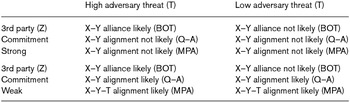
Third, the rise of a new great power in East Asia and the empirical difficulties of alliance formation between the middle powers raises a hurdle for the actual application of Cha's (Reference Cha1999, Reference Cha2000) framework to the future patterns of Japan–ROK alignment. For instance, Cha (Reference Cha2000: 285) reveals wishful thinking that a phased raising of abandonment fears by the United States, not ‘full and immediate disengagement’, would lead to a strengthened alignment between Japan and South Korea. Although he recognizes that neither Japan nor South Korea would see alignment with the other as substituting for the United States, because of the insufficient power aggregation, Cha (Reference Cha1999, Reference Cha2000) completely ruled out the possibility of Japan or South Korea aligning with China or working to create East Asian security mechanisms, citing sunk costs in the existing alliances and the absence of alternative security mechanisms in East Asia. In this way, Cha (Reference Cha1999, Reference Cha2000) does not pay attention to the identity status of the middle powers and their possible identity shift vis-à-vis China. Cha (Reference Cha1999, Reference Cha2000) focuses mainly on a critique of Walt's (Reference Walt1987) balance of threat (BOT) theory and the dynamic of two states (X, Y) with their stronger alliance partner (Z), as illustrated in Table 1.
Balance of threat (BOT), quasi-alliance (Q-A) and middle power alignment (MPA)
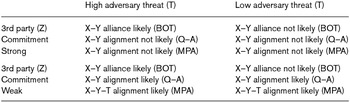
Note: Z, T: structural powers; X, Y: middle powers.
Source: modified from Cha (Reference Cha2000: 270).
In Cha's (Reference Cha1999, Reference Cha2000) theorization, state identities are given and there is little possibility that the adversarial great power (T) could offer the opportunities of alignment to middle powers seeking to reformulate their identities vis-à-vis the former adversary. If we look at the cases of many middle powers in Europe, Canada, or Australia, however, security dependency on a great power or security mechanisms created by a great power is commonplace as a result of their identity shifts vis-à-vis the former adversary. Although these security arrangements take the form of bilateralism or multilateralism, the nature of cooperation is asymmetrical and tantamount to security dependency. In this way, we cannot rule out the possibility of X-Y-T alignment in Northeast Asia under certain circumstances.
This X-Y-T alignment is not just the output of a great power's hegemony, but a joint ideational and institutional project between great and middle powers. Indeed, middle powers play significant roles in international politics in terms of disseminating international and regional norms (Ullman, Reference Ullman1983; Buzan, Reference Buzan1991; Pratt, Reference Pratt1990; Soeya, Reference Soeya2005). Compensating for their material insufficiency, middle powers resort to diplomatic skills or soft power to promote foreign policy initiatives at a multilateral level, which forms the core underpinnings of middle power activism (Ungerer, Reference Ungerer2007). Middle powers, which have a high degree of civil society penetration in a foreign policy-making process, tend to carve out a niche for themselves, such as specific agenda-building and promotion, distinct from great powers (Soeya, Reference Soeya2005). This form of activism, expressed in anti-landmine campaigns or East Asian region-building initiatives as a challenge against the national interests of a great power, takes place in the hostile or benign neglect of a great power (Price, Reference Price1998; Choi, Reference Choi2009).
‘Identity norms’ of middle powers
Then why do middle powers subscribe to these two behavioural norms? This article argues that the norms of dependency and activism are closely related to the status-driven identities of middle powers. Identity matters far more than often assumed in terms of security orientations (Kowert, Reference Kowert1998/9). Security identities are constructed and maintained through reiterated practices and policies subscribing to a set of identity-forming and identity-driven norms, or identity norms, defined as ‘standards of appropriate behaviour for in-group actors vis-à-vis an out-group’ (Son, Reference Son2007: 490).
Contemplating the Cold War distribution of power, Keohane (Reference Keohane1969: 296) referred to the United States and the Soviet Union as ‘system-defining’ powers; the United Kingdom, France, West Germany, Japan, China, and India as ‘system-influencing’; Canada, Sweden, Pakistan, Brazil, Argentina as ‘system-affecting; and the rest as ‘system-ineffectual’. More than 40 years after Keohane's classification, we can now see the shifting hierarchies with the Soviet Union (Russia) dropping from the league of ‘system-defining’ powers and China and Brazil moving one level up the hierarchy, respectively. Whilst Japan probably retains its status as one of the ‘system-influencing’ states, South Korea may belong to the group of ‘system-affecting’ states. By some definitions, in fact, Japan's economic weight and potential military capability could elevate it to the status of a great power (Haass, Reference Haass2007). Nevertheless, Japan is a ‘special case’, given its ‘Peace Constitution’, anti-militarism, and the US–Japan alliance, all of which have constrained Japan's power status and influenced the state to act rather as a middle power in global and regional affairs. In this article, Japan and South Korea will be put together under the rubric of middle powers, partly because Japan and South Korea looked dwarfed by their neighbouring powers of large population and territorial sizes, such as China and Russia holding permanent membership of the UN Security Council (Soeya, Reference Soeya2005; Rozman, Reference Rozman2007).
Security dependency, as one of the identity norms, has been deeply entrenched in these societies, which persistently reproduce these states as middle powers. Since these norms exercise great influences in a given society, any violation of these norms causes a serious trauma. Look at what happened within Japanese society when Prime Minister Yukio Hatoyama inadvertently loosened a strong alliance spirit with the United States in a controversy over the relocation of the US Marine Corps Station Futenma in Okinawa, or in South Korean society when President Roh Moo-hyun discussed South Korea's new role as a ‘balancer’ between the United States and China. Institutionalized identity norms, such as a military alliance, make more powerful claims on behaviour than causal beliefs (Herman, Reference Herman and Katzenstein1996: 285). However, security dependency is just one of middle power security norms. Activism constitutes a medium-sized state as a full-fledged middle power, just as Canada and Australia played key roles in the promotion of human and non-conventional security through the use of skilled diplomacy (Ravenhill, Reference Ravenhill1998; Cooper et al., Reference Cooper, Higgott and Nossal1993). A middle power runs the risk of degenerating into a small power, if it resorts only to dependency without playing an activist role in international politics. The following sections will shed light on the emergence and internalization of dependency and activism as the reiterated security practices of Japan and South Korea.
Dependency
The idea of dependency is conceived and internalized as a norm amidst the interplay of structural transformation and the reiterated foreign and security policy practices of middle powers. At the onset of the Cold War, the United States played a presiding role in creating a multilateral security arrangement in Western Europe and designing a hub and spokes system in East Asia, both of whom have shown durability and resilience even after the end of the Cold War (Hemmer and Katzenstein, Reference Hemmer and Katzenstein2002). Regaining sovereignty after the US-led occupation, Japan signed the Security Treaty with the United States in 1951. From the Japanese perspective, the treaty served to defend a largely demilitarized state against any outside attacks through the provision of military bases to the United States. In spite of the widespread protest by citizens and students opposing Japan's remilitarization, the two states revised the 1951 treaty, which looked like a military base agreement, in favour of an alliance pact, dubbed the Treaty of Mutual Cooperation and Security, in 1960 (Forsberg, Reference Forsberg2000). Although it emerged as the world's No. 2 economic power in 1968, Japan fell short of practicing the security norms of great powers (Kang, Reference Kang2003). Japan's security identity had been one of a ‘peace state’, a ‘reluctant ally’, or ‘cheque-book diplomat’, whilst the reorientation and restructuring of the Japanese state remained a national task at the turn of the twenty-first century (Ozawa, Reference Ozawa1994).
The history of Korea's security dependency on great powers is much longer. For nearly a millennium, Korean kingdoms belonged to a tributary system in which it forged a complex web of relations with successive Chinese empires covering security, trade, and the introduction of science and technology (Eckert et al., Reference Eckert, Lee, Ick Lew, Robinson and Wagner1990). The norm of security dependency has been deeply entrenched to the extent that, after the end of Japan's colonial rule, both North and South Korea had to form asymmetrical security arrangements with the great powers of the period: the United States, the Soviet Union, and China. In 1953, South Korea signed the Mutual Defence Treaty with the United States, because the Syngman Rhee government desperately pursued unequivocal security guarantees from the US administration to prevent the recurrence of the Korean War. After the end of the Cold War, South Korea has risen to the status of a middle power, increasingly turning its attention to making proactive roles in the creation of multilateral security and economic structures in East Asia (Rozman, Reference Rozman2007).
The US's security design in East Asia has been thoroughly documented by many scholars and specialists with various future scenarios in mind (Calder, Reference Calder2009; Ikenberry and Inoguchi, Reference Ikenberry and Takashi2003; Yoshihara and Perry, Reference Yoshihara and Perry2003; Cossa, Reference Cossa1999). One of the main alliance strategies of the United States as a maritime power has been an encirclement of the rival continental powers, whether it be the Soviet Union or China. Nevertheless, the United States has gradually reduced the number of its troops from Japan and South Korea since the end of the Cold War. In his East Asia Strategy Initiative, Joseph Nye (Reference Nye1995), assistant secretary of defence in the Clinton administration, strongly advocated the prerogatives of maintaining an estimated 100,000 US troops in East Asia, including 36,000 in South Korea and 47,000 in Japan, as one of pillars for the US's post-Cold War security strategies. However, the number of US troops stationed in South Korea decreased to 28,500 during the early 2000s, partly because of the US's wars in Iraq and Afghanistan, while the Second Infantry Division, stationed at the inter-Korean border as a ‘trip-wire’, will be relocated to Pyeongtaek, south of Seoul, by 2016 (Chosun Ilbo, 14 December 2010). The United States embarked on a US$8 billion project to enlarge its existing military bases in Guam to accept thousands of marines from Okinawa and other forward-based installations facing local enmity (The Telegraph, 25 October 2010).
In contrast, China has been building a number of security, political, economic, and transportation networks with its neighbouring states (Holslag, Reference Holslag2010). China and Russia have been the main designers of the Shanghai Cooperation Organization (SCO), a multilateral security organization established in 2001. The SCO, which also groups Kazakhstan, Tajikistan, Kyrgyzstan, and Uzbekistan, aims to promote political, military, and economic cooperation, especially in the areas of terrorism, separatism, and extremism (Rangsimaporn, Reference Rangsimaporn2006: 491). China has strengthened security cooperation with the Association of Southeast Asian Nations (ASEAN) in the areas of non-traditional security, such as piracy, smuggling, human trafficking, and terrorism, with potential for developing it into an entire East Asian security framework involving Japan and South Korea (Arase, Reference Arase2010). Since Northeast Asia is still an area devoid of multilateral security arrangements, China is expected to strengthen its efforts to reduce the influences of the US's alliances with Japan and South Korea and boost its own security by both bilateral and multilateral means. One of China's options could be the establishment of a Northeast Asian version of the SCO, which could contribute to addressing territorial disputes and other issues of mutual concern (Son, Reference Son, Seliger and Pascha2011). This section will illustrate how the region's middle powers responded to external threats.
Case 1: Senkaku/Diaoyu dispute
The Japanese-controlled Senkaku Islands, claimed also by China and Taiwan under the name of Diaoyu, are a group of uninhabited islets in the East China Sea. The territorial dispute has assumed a new dimension on 7 September 2010 when a Chinese trawler, the Minjinyu 5179, collided with the JCG patrol boats near the islands. After the collision, the JCG members boarded the Chinese vessel and arrested all sailors, including the skipper Zhan Qixiong, on suspicion of ‘obstructing public duties’ (Asahi Shimbun, 9 September 2010). As the Japanese government ignored China's repeated demands for the release of the skipper and extended his detention for another ten days, the Chinese government suspended minister-level meetings, cancelled bilateral negotiations on the increase of air routes, and ordered a freeze on the number of Chinese tourists to Japan (Jiji Press, 20 September 2010). The most notable action that caused big repercussions in Japan was the restrictions in the exports of rare earth minerals, crucial to the production of a wide range of electronic products, including mobile phones and television sets (Sankei Shimbun, 24 September 2010). After a 17-day detention, the Japanese government released the skipper, perceived as an example of China's muscle flexing and diplomatic victory and Japan's ‘weak-kneed’ handling and humiliation (Yomiuri Shimbun, 29 September 2010).
Furthermore, China, which increased the dispatch of patrol boats to the seas off Senkaku islands, planned to permanently deploy large fishery patrol boats to challenge Japan's control of the islands off Okinawa Prefecture (Asahi Shimbun, 20 December 2010). This step is in line with China's territorial claims that the South China Sea represents ‘core national interest’ on a par with the issues of Taiwan and Tibet (Asahi Shimbun, 20 December 2010). What has been the response of the Japanese government to an increasing military presence of China in the South China Sea?
Alliance behaviour
Perceiving external threats from China, Japan has taken two alliance-related steps: securing a US commitment to the defence of Japan, including the Senkaku Islands, and organizing a joint exercise with the United States. During his visit to Washington DC two weeks after the incident, Japanese Foreign Minister Seiji Maehara sought to secure the US's confirmation in his meeting with Secretary of State Hillary Clinton that the Senkaku Islands are subject to Article 5 of the bilateral security treaty (Kyodo News, 25 September 2010). Under the article, the United States is authorized to protect Japan in the event of an armed attack ‘in the territories under the administration of Japan’. Even though she made a commitment to the defence of its ally, Secretary Clinton also encouraged Japan to hold dialogue with China to resolve the issue (Kyodo News, 25 September 2010). When they met on the sidelines of the ASEAN summit in Hanoi, Secretary of Defence Robert Gates and Defence Minister Toshimi Kitazawa also reaffirmed the previous agreement between Clinton and Maehara that the Senkaku Islands are covered by the security treaty (Kyodo News, 12 October 2010).
In parallel with the diplomatic actions, Japan and the United States organized the largest-ever military exercise off Okinawa on 3–10 December 2010. According to Japan's Ministry of Defence, 34,100 Japanese personnel, 40 vessels, and 250 aircraft from Japan's Ground, Maritime, and Air SDFs took part, along with 10,400 troops, 20 ships, and 150 aircraft from the US military (Ministry of Defence, 2010). Though regarded officially as a show of force following North Korea's attack on Yeonpyeong Island, the joint exercise, including the US aircraft carrier George Washington, was rather seen in Japan, China, and Taiwan as a military drill aimed at countering China's increasing naval presence and simulating the retake of the Senkaku Islands in the event of China's ‘illegal’ occupation (Sankei Shimbun, 3 October 2010; Taipei Times, 4 October 2010). Since it came just after the US–ROK exercise in the Yellow Sea, China protested the drill immediately, saying ‘At present, there are already enough of these kinds of military exercises’ (Associated Press, 3 December 2010).
Self-help
On 17 December 2010, just two months after the collision, the Japanese cabinet revised the National Defence Program Guidelines (NDPG), comparable to the US Quadrennial Defence Review, to make a sweeping overhaul of the Cold War era defence strategy (Ministry of Defence, 2012). The new NDPG replaced the ‘basic defence’ concept, designed to maintain the minimum defence capability for deterrence, with a new one, called ‘dynamic defence capability’, aiming to enhance the mobility and flexibility of the SDF. Among the most eye-catching changes have been the reduction of heavy armoured and artillery forces pointed north toward Russia and the establishment of more mobile units capable of moving quickly by air to defend the southern islands. More specially, the NDPG envisioned an ‘effective deterrence and response (e.g. ensuring security in the sea and airspace surrounding Japan, responding to an attack on Japan's offshore islands)’ (Ministry of Defence, 2012). Major newspapers paid attention to the relocation of troops to these ‘outlaying islands’ to fill the ‘defence vacuum’ created by the gradual decline of the US's military presence (Asahi Shimbun, 10 December 2010). In December 2011, the Ministry of Defence allocated around one billion yen for site acquisition to deploy a coastal monitoring team of the Ground Self-Defence Force on Yonaguni, Japan's westernmost island (Ryukyu Shimpo, 25 December 2011). In addition to the strengthening of the US–Japan alliance, the new NDPG stressed Japan's need to expand defence cooperation with those countries it shares ‘democratic values’, such as South Korea, Australia, and India. The NDPG has identified the imminent and potential threats to the ‘regional and global community’ in the form of China's military modernization, North Korea's nuclear and missile issues, and Russia's robust military activities. This is in line with the Quadrilateral Security Dialogue, held since 2007 among the United States, Japan, Australia, and India at the initiative of then Prime Minister Shinzo Abe, regarded as a policy of soft containment of China (Brewster, Reference Brewster2010). A Chinese Foreign Ministry spokesman immediately reacted to the publication of the NDPG, noting ‘A certain country has no right to act as a representative of the international community and make irresponsible remarks on China's development’ (Xinhuanet, 17 December 2010).
Case 2: Yeonpyeong Island incident
On 23 November 2010, North Korea fired a total of about 170 artillery shells in two waves into South Korean territory, including about 80 that struck the Yeonpyeong, an island of 1,700 residents, killing two marines and two civilians (Chosun Ilbo, 24 November 2010). In retaliation, South Korean forces responded with about 80 shells of their own, inflicting unspecified damages to two North Korean bases in Mudo and Kaemori. The attack, regarded as the first of its kind since the Korean War, left 18 others wounded and scores of civilian houses gutted. On the morning of the incident, South Korea had carried out live-fire exercises on their territorial waters off the Yeonpyeong and Baengnyeong Islands despite the North's warning that it would not sit back. In fact, a series of South Korea's independent and joint military exercises with the United States had previously taken place in that area as part of retaliatory actions against North Korea in the wake of the sinking of a corvette, the Cheonan, in March, which claimed the lives of 46 sailors. South Korea accused the North of torpedoing the vessel, while the North denied the allegation. The attack also took place at a delicate moment after North Korea offered a tour of a secret uranium enrichment facility on 12 November to a group of Western scientists, including Siegfried Hecker, former director of the Los Alamos National Laboratory, and North Korean leader Kim Jong-il anointed his youngest son, Jong-un, as his heir apparent by promoting him to a four-star general on 27 September.
Alliance behaviour
Compared with the collision incident off the Senkaku/Diaoyu Islands, the exchange of artillery fire secured immediate attention from the United States because of its serious implications to South Korea's security. However, South Korea's alliance behaviour which followed the incident was almost identical: securing a US commitment to the defence of South Korea and organizing a joint military exercise with the United States.
The USA Today (23 November 2010) and the Associate Press (23 November 2010) detailed how the Obama administration responded to the attack by North Korea. At 3:55 a.m., President Obama was awakened by a phone call from National Security Advisor Tom Donilon. The White House issued a statement condemning the attack at 4:33 a.m. At 10 a.m., Secretary of Defence Robert Gates phoned South Korean Defence Minister Kim Tae-young to express sympathy for the deaths of the marines and appreciated ‘the restraint’ shown by the South Korean government. Gates told Kim that the United States viewed the attacks as a violation of the Armistice Agreement that ended the Korean War. Sharpe and Kim discussed the implementation of joint actions, including an increase in the intelligence, surveillance, and reconnaissance (ISR) assets (Chosun Ilbo, 24 November 2010). Convened at 4 p.m. at the situation room at the White House were about 20 national security staff, including Gates, Clinton, Adm. Mike Mullen, chairman of the Joint Chiefs of Staff, UN Ambassador Susan Rice, and James Clapper, director of National Intelligence. President Obama emphasized his ‘unshakable’ support for South Korea. However, the United States did not take immediate military options in order to head off any escalation, which could lead to a war with a country armed with crude nuclear weapons and a huge standing army.
Moreover, in spite of the repeated warnings and expressions of concern from North Korea, the United States and South Korea conducted a four-day joint exercise from 28 November in the West Sea near the incident site. The US aircraft carrier, George Washington, which carries 75 warplanes and has a crew of over 6,000, and four other US warships joined the largest-ever joint exercises, while South Korea deployed three destroyers, frigates, and anti-submarine aircraft (Joongang Ilbo, 29 November 2010).
Self-help
Immediately after the incident, the South Korean armed forces imposed the highest level alert for local provocations, called ‘jindogae hana’ (Yonhap News, 23 November 2010). President Lee Myung-bak convened a meeting of security-related ministers to discuss countermeasures. In a following meeting of security and economic ministers on 25 November, South Korea vowed to revise its rules of engagement in the event of a military clash and to increase military forces on the islands, scrapping an earlier plan to scale down the military presence on the islands near the border. President Lee pledged to take tough counteractions for any future aggression in a nationally televised speech on 29 November. ‘I feel deeply responsible for failing to protect my people's lives and property’, Lee said, adding ‘endurance and tolerance will spawn nothing but more serious provocations’ in an apparent reference of President Kim's Sunshine Policy of engaging the North. On 4 December, President Lee replaced Defence Minister Kim Tae-young with Kim Kwan-jin, a retired four-star general who committed to tough actions against any future acts of aggression, including aerial bombings on the North Korean targets, in a parliamentary hearing (Hankook Ilbo, 4 December 2010).
On 20 December, South Korea conducted an independent, live-fire drill off Yeonpyeong Island, with North Korea again vowing to retaliate. Although it aimed to fire all left-over ammunition from the 23 November drill, which was suspended by North Korea's artillery attacks, the resumption of live-fire exercises raised military tension in East Asia. Despite a 90-minute display of firepower, however, North Korea did not launch an attack. At that time, the South Korea military had been placed into a combat-ready mode, with about ten warships deployed and F-15K fighters hovering in the West Sea (Hankook Ilbo, 20 December 2010). Later in the day, North Korea's military command issued a statement, saying it did not feel any need to retaliate against ‘every despicable military provocation’ (Hankyoreh, 20 December 2010).
In both incidents, Japan and South Korea had secured the US's commitment to the defence of their territories and adopted a range of self-help measures. However, did the two states move towards strengthening alignment on a bilateral basis? Less than one hour after North Korea initiated its artillery fire at 2:34 p.m., the Japanese government set up a liaison office at 3:20 p.m. at the Crisis Management Centre in the Prime Minister's Official Residence. In the evening, Prime Minister Naoto Kan organized a meeting of ministers, including Chief Cabinet Secretary Yoshito Sengoku and Defence Minister Kitazawa, and instructed them to collect information on North Korea's follow-up actions and keep in close contact with South Korea and the United States (Asahi Shimbun, 23 November 2010). Sengoku contacted South Korean Ambassador to Tokyo Kwon Chul-hyun to collect information. The Japanese government raised the possibility that the United States might request the Japanese SDFs to offer some kind of assistance in case the US Forces Japan would be mobilized to the Korean Peninsula (Asahi Shimbun, 23 November 2010). Japan's response to the Yeonpyeong incident clearly showed that the Japanese government was not ready to make any bilateral commitment to the defence of South Korea, whilst considering only the possibility of rear-area support for the US forces. Shortly after the incident, Prime Minister Kan made controversial remarks to reporters: ‘I learned it from (television) news’ (Sankei Shimbun, 23 November 2010). The remarks prompted criticism from newspapers and ordinary citizens as an example of the Japanese government's lax security preparedness and indifference to the security of South Korea.
In contrast, the incident demonstrated the US's strong security commitment to the defence of South Korea. Whilst making commitment to South Korea on a bilateral basis, the United States made efforts to strengthen alignment between Japan and South Korea. In a show of solidarity, the United States organized a trilateral meeting with Japan and South Korea in Washington DC to reconfirm their pledge not to enter into dialogue with North Korea unless Pyongyang stops provocations and shows its commitment to denuclearization (Korea Herald, 7 December 2010). Adm. Mullen visited Seoul and Tokyo to call for a ‘strong trilateral alliance’ (Reuters, 8 December 2010). In a meeting with Defence Minister Kitazawa, Adm. Mullen said that the United States and Japan needed to support South Korea when facing external threats from the North and raised the possibility of conducting the joint US–Japan–ROK military exercise.
In fact, the military exchange between Japan and South Korea has made slow progress. In July 2010, the SDF observers took part in a joint US–ROK military exercise, the first of its kind in terms of trilateral cooperation. In November, a group of South Korean military observers participated in the joint US–Japan exercise. Japan has been more proactive in promoting alignment with South Korea than the other way round. In other words, Japan moved to balance China by strengthening alignment with South Korea in the way that the balance-of-power theory directs a state to align with a weaker power to balance a greater power (Waltz, Reference Waltz1979: 127; Walt, Reference Walt1985: 6). Timed with President Lee's visit to Japan in early 2011, Japan sought to establish a joint declaration on comprehensive cooperation with South Korea, including the signing of the Acquisition and Cross-Servicing Agreement (ACSA), which provides a basic framework for cooperation in military logistic matters, especially in the times of UN Peacekeeping Operations and large-scale disaster relief activities, and the General Security of Military Information Agreement (GSOMIA), which would facilitate the exchange of military secrets, but to no avail (Washington Post, 11 January 2011). In June 2011, South Korea again cancelled its plan to sign the GSOMIA, just one hour before a signing ceremony in Tokyo, facing strong criticism from political circles and the public (Yonhap News, 29 June 2012).
However, Japan's acts of balancing appeared an interim action at a time when China had overtaken Japan as the world's second largest economy in 2010. The gap between China and Japan is expected to widen over time, because there is a possibility of China emerging as the largest economy as early as 2020 by overtaking the United States (Agence France Presse, 20 January 2010), whilst Japan is headed towards an aging society with a shrinking population. Therefore, Japan's future strategies of alliances and alignments depend much on the consolidation of China's influences in East Asia and South Korea's willingness to strengthen bilateral alignment.
In sum, a number of regional and domestic variables for security dependency are as follows. First, a great power, like the United States, maintains a much larger ability of power projection as an alliance partner than a middle power, whether it stays put or reduces security commitment. Second, power aggregation between two middle powers constitutes no significant deterrent especially against an antagonistic great power like China. Third, the differences in such variables as the size of power and geographical proximity create temporarily incongruent security orientations even between middle powers (Ross, Reference Ross2006). In spite of Japan's overtures, South Korea is against any idea of organizing an anti-Chinese alliance or military exercise, given that China has been South Korea's No. 1 trading partner and one of the key parties concerned deeply with the future process of Korean reunification. Fourth, the idea of strengthening alignment between neighbouring middle powers faces domestic resistance because of a cycle of historical enmity and territorial disputes. Given the constitutional restrictions and the public's anti-militarism, Japan also shuns any possibility of military entanglement in a conflict on the Korean Peninsula and prefers to confine its military role to rear-area support for the US forces. In this vein, middle power alignment runs the higher risks of abandonment or partial entrapment than one between great and middle powers because of the limited desires and capabilities of middle powers.
Activism
Along with security dependency, the norm of activism is an inalienable standard of diplomatic and security behaviour of a middle power. In fact, both small and middle powers are prone to embark on an act of hedging between great powers during a period of power shift, as the ASEAN states did between the United States and China (Goh, Reference Goh2007/8). Especially, the ASEAN is a grouping of relatively small states seeking to strengthen their sub-regional cooperation and alignment. United, these small states were able to achieve the international status and privilege of a middle power. This section looks at two cases – ASEAN Plus Three and Trilateral Summit – that clearly demonstrate the middle powers’ efforts to socialize China.
ASEAN Plus Three
At the turn of the twenty-first century, both Japanese and South Korean leaders adopted proactive diplomatic initiatives of hedging to secure some leeway from dependency on the United States and to socialize China in multilateral security mechanisms. The ASEAN integration process, which started with the leadership role of such leaders as Mahathir Mohammad of Malaysia and Lee Kuan Yew of Singapore was invigorated with the involvement of China, Japan, and South Korea in the framework of the ASEAN Plus Three.
As a smaller middle power, South Korea has been more proactive in promoting regional integrationist projects, such as the ASEAN Plus Three, than Japan (Hund, Reference Hund2003). On top of maintaining a working alliance with the United States, the Kim Dae-jung and Roh Moo-hyun administrations of South Korea sought to accommodate China's role and influences in East Asia and disseminate the spirit of community amongst East Asian states (Kim, Reference Kim2006; Rozman, Reference Rozman2007). South Korea, led by President Kim, played a proactive role by promoting the East Asian Vision Group and the East Asian Study Group (Hundt and Kim, Reference Hundt and Kim2011).
In a slightly different way, Japan has pursued what is called ‘open regionalism’ (Terada, Reference Terada2010). Prime Minister Junichiro Koizumi spearheaded the process of creating the East Asian Summit, also called the ASEAN Plus Six, by inviting Australia, New Zealand, and India to the existing ASEAN Plus Three format. Under his own catchphrase of ‘fraternal’ diplomacy, Prime Minister Hatoyama sought to create an East Asian community overcoming historical, political, and economic discrepancies, whilst maintaining the US–Japan alliance (Hatoyama, Reference Hatoyama2009). In the wake of the Asian financial crisis of 1997–1998, Japan also pushed ahead with regional institution building for East Asian monetary and financial cooperation (Lee, Reference Lee2012). These are in line with the norm of activism employed by a middle power to compensate its loss of autonomy through the promotion of multilateral solutions to security issues (Cooper et al., Reference Cooper, Higgott and Nossal1993).
Trilateral summit
On the sidelines of the ASEAN process, China, Japan, and South Korea organized trilateral summits from 1999. In 2008, the trilateral process formally divorced from the ASEAN Plus Three and adopted its own identity and momentum (Rathus, Reference Rathus2010). In particular, South Korea has been proactive in this trilateral format by hosting the first trilateral meeting of foreign ministers on Jeju Island in June 2007, which led to an agreement on the rotational, trilateral summit from the following year. During the first summit in Fukuoka, Japan in 2008, the three states signed the Joint Statement for Tripartite Partnership by adopting the operating principles of ‘openness, transparency, mutual trust, common interest and respect for our diverse cultures’ (People's Daily, 14 December 2008). In the third summit in 2010, the three states agreed to establish a secretariat in Seoul and signed the ‘Trilateral Cooperative Vision 2020’, a blueprint for future cooperation (Korea Times, 29 May 2010).
South Korea has been more proactive than Japan in promoting the three-way cooperation. In the wake of the Senkaku/Diaoyu incident, South Korea made strenuous diplomatic efforts to bridge the estranged relationship between China and Japan, because bilateral relations were chilled to the extent that China refused to meet Japan at the level of ministers and higher. Due to the lukewarm responses from China and Japan, it had appeared impossible to organize a three-way summit in Hanoi on 29 October 2010 on the sidelines of the ASEAN Plus Three summit and the East Asian Summit. Nevertheless, South Korean diplomats repeatedly persuaded their Chinese and Japanese counterparts to organize a summit meeting amongst President Lee, Prime Minister Wen Jiabao, and Prime Minister Kan, which helped the two states to alleviate tension (Hankook Ilbo, 30 October 2010).
In fact, President Lee faced difficulties in cultivating security ties with China, especially after the two countries were unable to reach any consensus on what had caused the sinking of the Cheonan and the Yeonpyeong Island exchange of fire. This quagmire led Chosun Ilbo (21 December 2010), an advocate of a strong alliance with the United States, to stress in an editorial the necessity of finding a breakthrough in South Korea's stalemated diplomacy with China by, for example, sending a clear signal that South Korea is not one of the states encircling China. Nevertheless, South Korea found it hard to improve diplomatic ties with China after it turned down China's offer to address the inter-Korean tension by organizing an emergency meeting of chief envoys to the six-party talks (Hankyoreh, 28 November 2010).
With the improvement of diplomatic ties with China unlikely in the immediate future, the South Korean Ministry of Foreign Affairs and Trade augmented the China-related budget, organization and staff (Yonhap News, 10 December 2010). First, the ministry increased its China project budget for the fiscal year 2011 by 6.7 times to 3 billion won. Second, the ministry reorganized and strengthened the China desk into two sections. Third, the ministry will operate two taskforces: one will be charged with monitoring and analyzing China's internal and external relations and the other with mediating anti-Korean sentiment in China. Fourth, the ministry will upgrade the strategic dialogue from vice minister level to minister level, whilst forming an advisory committee on China policy.
In the beginning of the Lee administration, South Korea and China elevated their bilateral relations from a comprehensive and cooperative partnership to a ‘strategic and cooperative partnership’, regarded as the second highest-level relationship next to a military alliance. In November 2008, the Naval and Air Force units of South Korea and China opened a military hotline, the first of its kind for China (Yonhap News, 24 November 2008). The opening of a hotline symbolized the upgrading the China-ROK military relationship from the stage of military exchange to that of military cooperation. The memorandum of understanding, signed between the two states, stressed the improvement of mutual understanding and trust, the strengthening of defence security cooperation, and the prevention of frictions between the Navies and Air Forces resulting from misunderstanding.
Compared with the Lee administration, the Roh administration had been more ambitious in improving military relations with China. In 2005, Defence Minister Yoon Kwang-ung said, ‘We need to upgrade the level of the ROK–China military exchange to that of the ROK–Japan and think about ways to bring stability to the Korean Peninsula with the help of China’ (Chosun Ilbo, 4 April 2005). In March 2005, South Korea and China organized a meeting of defence ministers after a hiatus of four years and agreed to hold working-level meetings between military authorities twice a year.
In the meantime, Japanese prime minister played important roles in accelerating the process of regionalist cooperation among China, Japan, and South Korea. In 1999, Prime Minister Keizo Obuchi proposed an informal breakfast meeting among the leaders of the three countries on the sidelines of the ASEAN process. In 2008, the convening of the Trilateral Summit, independent from the ASEAN process, was also proposed by Prime Minister Taro Aso, timed with the spread of a financial crisis from the United States to the rest of the world. Yukio Hatoyama, an advocate of an East Asian community, proposed in 2009 that the three states start to study the establishment of a trilateral free trade agreement (FTA). Given Japan's recalcitrance over introducing free trade because of the strong agricultural lobby, Hatoyama's initiative gave added momentum to the trilateral process. The initiative led to the official start of trilateral FTA negotiations following an agreement in the 4th trilateral summit in Beijing in 2012 (China Daily, 13 May 2012). In sum, South Korea and Japan, to a lesser extent, have been proactive in building both trilateral and multilateral cooperation frameworks vis-à-vis China.
Conclusion
The Japan–ROK alignment has been a particularly hard case for the IR theorists whose theoretical underpinnings are based on the notions of external threats and egoistic state actors. This is so because the states sharing an alliance partner, as well as enemies, were supposed to enter into an alliance. By introducing the notions of middle power security norms, this article elucidated the attitudes and behaviours of Japan and South Korea toward alliances and alignments especially at a time of intensive debate over a power shift in East Asia.
With the process of Japan–ROK alignment making very tedious progress, a gradual decline in US influences in East Asia would generate the dynamics of competition and cooperation with an increasing level of complexity and uncertainty. As a way of filling the potential power vacuum, the US government and the Japanese government, to a lesser extent, envisioned the strengthening of the Japan–ROK alignment. Nevertheless, this article argued that Japan and South Korea are unlikely to enter into a sort of counter alliance against China. Especially, this article highlighted South Korea's recalcitrance over forming anything like an anti-Chinese alliance. Influenced by South Korea's strategies of alignment and the consolidation of China's great power status in East Asia, Japan will take more proactive steps to enmesh China in multilateral security frameworks within East Asia. In the end, Japan is a middle power which requires the presence of a great power or a security mechanism involving a great power for the maximization of its own security.
An innovative contribution of this article is to provide an analysis for the common behavioural features of Japan and South Korea from an alternative constructivist perspective, emphasizing the identity norms of ‘dependency’ and ‘activism’. This article argues that the diplomatic behaviours of Japan and South Korean make sense as those of middle powers sandwiched between the two great powers of the United States and China: they attempt to institutionalize dependency on the United States, on the one hand, and to actively engage China, on the other. This argument would also provide a new insight into the existing dichotomous juxtaposition of realist and liberal explanations of security alignment vs. engagement. Due to the identity norms of a middle power, Japan and South Korea are reluctant to seek a bilateral alliance relationship between themselves, and their engagement policies with China do not necessarily contradict their security relationships with the United States.
All in all, this article highlighted that the security orientations of middle powers have some commonalities in terms of putting a priority on an alliance with a great power, whilst proactively working to compensate the loss of autonomy by seeking a new form of alignment with an emerging great power. Although this article illustrated the cases of Japan and South Korea, the reiterated patterns of security behaviour or identity norms of the middle powers could be applied to other cases of alliances and alignments. Of course, there will be variations amongst middle powers because of the presence of other variables, such as the actual size of economy and population, geographical proximity with a great power, or the level of historical affinity or enmity. Therefore, this article noted that, in the face of the decline of US commitment, South Korea, as a smaller middle power geographically located closer to China, is likely to move first to explore a form of alignment with China, forcing Japan to choose between joining China-led East Asian regionalist initiatives or isolation. Japan is also likely to strengthen three-way security cooperation with China and South Korea, rather than simply a two-way cooperation with South Korea, because it would come to terms with the reality that an alignment with South Korea in the absence of a strong commitment of the United States could not result in an optimal level of power aggregation. Furthermore, Japan cannot afford to stay away from a new process of alignment taking place in its vicinity.
For too long, the United States has been a balancer and power broker in East Asia. With the emergence of China as a new great power, the East Asian states will be forced to devise ways to strengthen their security via both bilateral and multilateral means. Insofar as the United States retains its influences in East Asia, however, the possibilities of Japan and South Korea forming an alliance or moving hastily into the Chinese sphere of influence appear misplaced. Since the strengthening of bilateral ties between Japan and South Korea exhibits limitations and the consolidation of a trilateral alignment amongst the United States, Japan, and South Korea appears as an anti-Chinese alliance, this article highlighted the possibility that the middle powers would work more proactively to strengthen their diplomatic and integrationist efforts to accommodate China preferably via multilateral channels, whilst maintaining their bilateral alliances with the United States.
About the Author
Key-young Son is Humanities Korea (HK) Professor at the Asiatic Research Institute, Korea University. He was Visiting Associate Professor at Tohoku University, Japan, and lecturer at the University of Sheffield, Britain. His research interests are mainly in identities and norms, political economy, and security in East Asia. His recent work includes ‘Harmony, the Supremacy of Human Agency and East Asia's Mega-Discourses for Governance’, Chinese Journal of International Politics, 5(4) (2012): 395–42; ‘From a Garrison State to a Humanitarian Power?: Security Identities, Constitutive Norms and South Korea's Overseas Troop Dispatches’, The Korean Journal of Defense Analysis, 23(4) (2011): 557–73; ‘Entrenching “Identity Norms” of Tolerance and Engagement: Lessons from Rapprochement between North and South Korea’, Review of International Studies, 33(3) (2007): 489–509; and South Korean Engagement Policies and North Korea: Identities, Norms and the Sunshine Policy (New York: Routledge, 2006).