Implications
The first major practical contribution of this study is the estrus scoring system, which may help the breeders to select the right animals for artificial insemination (AI) campaign. Although this strategy offers the opportunity to select the future genetics for the enterprise, it also reduces maintenance cost, labor and support animal welfare.
Introduction
The natural reproductive and growth cycle in Angora goat management is not sufficient for the current surfeit demand of mohair production. Reproductive technologies such as estrus synchronization or the induction of estrus are valuable management tools to increase litter size, pregnancy, kidding rate and thereby to increase the production units in Angora goats. Above all, for the successful AI campaign, when using synchronized breeding, it is essential to have a high estrus response (Zeleke et al., Reference Zeleke, Greyling, Schwallbach, Muller and Erasmus2005).
Various studies have been performed regarding the hormonal manipulation of the reproductive cycle of Angora goats, particularly estrus synchronization. Application of intravaginal sponges containing progestagens followed by timed AI is one of the most commonly preferred treatments for estrus synchronization in small ruminants. However, there are different estrus lengths and patterns reported in Angora goats (Ginther and Kot, Reference Greyling and Van Niekerk1994; De Castro et al., Reference De Castro, Rubianes, Menchaca and Rivero1999; Schwarz and Wierzchoś, Reference Schwarz and Wierzchoś2000; Rubianes and Menchaca, Reference Rubianes and Menchaca2003).
Apart from the synchronization method, there are different doses and timing of PMSG (100 to 1000 IU) administration (Jainudeen et al., Reference Jainudeen, Wahid and Hafez2000, Nasr et al., Reference Nasr, Haddad and Al-Karablieh2002, Whitley and Jackson, Reference Whitley and Jackson2004). Sponges are usually inserted for 12 to 14 days and are used together with a different dose of PMSG, at the time of sponge withdrawal or 48 h before the sponge removal. Pregnant mare’s serum gonadotropin has both FSH and LH-like properties. In order to obtain an efficient treatment, the adequate level of gonadotropic hormones are required to be present in circulation to trigger the preovulatory events (Abecia et al., Reference Abecia, Forcada and González-Bulnes2012). Administration of PMSG provides the increase of endogenous gonadotropins with ‘exogenous’ FSH activity (Powell et al., Reference Powell, Kaps, Lamberson and Keisler1996), owing to the FSH-like property of this hormone. During the breeding season, it increases the ovulation rates resulting in increased number of offspring. Hence, the use of PMSG hormone requires a certain attention to avoid the excess number of offspring and to prevent the formation of PMSG antibodies as well. In sheep, doses are varying from 250 to 750 IU (Boland et al., Reference Boland, Crosby and Gordon1981), in various breed, age and season; whereas in goat, doses up to 1000 IU are usually required (Amoah and Gelaye, Reference Amoah and Gelaye1990). However, the effect of PMSG may be influenced by many factors such as the timing and the dose of administration (Timurkan and Yildiz, Reference Timurkan and Yildiz2005), environment or the season (Zeleke et al., Reference Zeleke, Greyling, Schwallbach, Muller and Erasmus2005).
As mentioned above, these variables have an effect on various behavioral signs as well, which can be utilized for estrus determination in goats, for instance; courtship behavior, vaginal discharge, vulvar edema, urination, mounting behavior and tail wagging. The link between the manifestation of these diverse behavioral estrus signs and planned AI is not yet settled. In any case, it is realized that the link between the time of ovulation and behavioral estrus signs is much more variable than what was expected before. Recently, the impact of various insemination protocols with respect to estrus-associated attributes on pregnancy rate has been examined in cows (Roelofs et al., Reference Roelofs, Van Eerdenburg, Soede and Kemp2005); however, ovulation time was not evaluated in this study. To decide the best time for insemination with respect to ovulation, indicators of ovulation time are required.
The main reasons of alteration of insemination timing in terms of ovulation include the use of different estrus detection methods and their efficiency, the precise time of ovulation and the timing of insemination. However, estrus behavioral scoring was not taken into consideration to determine the right time of insemination in Angora goat up to now. This study aims to evaluate the effect of different PMSG doses on estrus behavioral score, the accurate timing of estrus behavior detection, the success of timed AI and pregnancy rate in Angora goat. In addition, the effect of PMSG dose on does’ ability to show estrus signs adequately and the relationship between these signs and timed AI success were evaluated by the pregnancy rate.
Material and methods
Treatment schedule
The experiment was conducted at Ayaş province, Ankara, Turkey. Animals were kept under the traditional Angora goat (extensive) grazing system. Three treatment groups were housed at Ayaş, in Ankara 39°57′22.9″ N longitude and 32°23′46.8″ E latitude and at an altitude of 910 m above sea level. In total, 260 Angora does which were healthy, at least primiparous, of 2 to 4 years of age and an average 40 kg in weight were used in this study. Goats were allocated randomly into three groups. All animals were injected with 150 µg prostaglandin F2Α (d-cloprostenol Gestavet; Hipra, Ankara, Turkey) and received an intravaginal sponge (30 mg fluorogestone acetate (FGA), Chronogest®, white sponges; Hipra) for 11 days. Different doses of PMSG (freeze-dried equine serum gonadotropin Oviser; Hipra) were injected (300 IU – group 1; 400 IU – group 2 and 500 IU – group 3) intramuscularly 24 h before sponge removal (Stelletta et al., Reference Stelletta, Tekin, Tirpan, Alemdar, Cil, Stelletta, Olgac, Inanc and Daskin2017).
Semen assessment
Semen was collected via artificial vagina from four Angora bucks with proven fertility (2 to 4 years of age) on the day of AI and diluted with TRIS base extenders (Tris 3.63 g, citric acid 1.82 g, glucose 0.5 g and double distilled water 100 ml, pH 6.8). Motility and concentration (Thoma Slide, Neubauer, Germany) were evaluated with a phase contrast light microscope before insemination. Semen was diluted to a final concentration of 800×106 spermatozoa/ml and loaded into 0.25 ml straws.
Estrus behavior scoring
Twenty-four hours after the sponge removal, females were exposed to a teaser buck to detect estrus; behavioral and physiological changes were recorded according to the following criteria.
Behavioral signs
Tail wagging: with the presence of a teaser buck, the wagging movement of the does’ tails were observed and scored as: 0=no movement; 1=rapid wagging.
Standing: immobilization of the does when teaser buck mounted was observed and assessed as: 0=does reject the mount attempt of the teaser buck; 1= standing (doe stands firmly when buck attempts to mount).
Courtship behavior: according to does’ interaction with teaser buck, courting behavior of the does’ were scored as: 0=no behavior (when the does avoid interaction); 1=strong attention.
Urination: observation of the urination reflex when does interact with teaser buck, was graded as: 0=no observed urination; 1=urination.
Physiological signs
Vaginal discharge: at the time of estrus detection if no discharge was evident, a sterile cotton swab was inserted into the vagina to a depth of 2 to 4 cm and then was rolled gently within the vulva before being removed. According to the color, consistency and quantity of the discharge, three levels of scoring were used: 0=dry (no discharge); 1=slight; 2=flowing.
Vulvar hyperemia: vulva lips were compared with a simple color chart of three grades: 0= dirty white (anemic); 1= pink (peri-hyperemic) and 2= red (hyperemic).
Vulvar edema: gloved thumb and forefinger (fovea digitalis) were used to feel the texture of the vulva lips and then subjectively scored as: 0=no edema; 1=slightly swollen; 2=swollen.
Artificial insemination
The does were restrained at the breeding stand and inseminated intracervically with diluted fresh semen including 800×106 spermatozoa/ml. Semen was deposited at either the first cervical ring, or if the catheter was freely moved further, deposition was done to further regions of cervix up to corpus uteri. Inseminations were performed 43 to 45 h after sponge removal independent from the estrus signs, using an insemination catheter and a speculum.
Pregnancy diagnosis
Pregnancy rates were determined by trans-rectal ultrasonography (US) using a real-time B-Mode ultrasound with a linear-array 10 MHz trans-rectal probe (Tringa Linear VET, Esaote SpA, Genoa, Italy) on day 35 following AI. The US monitoring was done by placing the probe into rectum with an external trans-rectal probe attachment. Amniotic vesicle in the US image was accepted as the indication of pregnancy. Animals which were positive for pregnancy were stated in the tables as 1, whereas non-pregnant animals were stated as 0.
Statistical analysis
Onset and duration of estrus were analyzed using χ 2 test. In 2×2 contingency tables, Fisher’s exact test was used when any cells had an expected count <5; in other cases, Pearson χ 2 test was used. In all analysis, P<0.05 was considered statistically significant. All statistical analyses were performed using SPSS for Windows 14.1.
Results
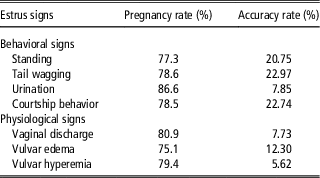
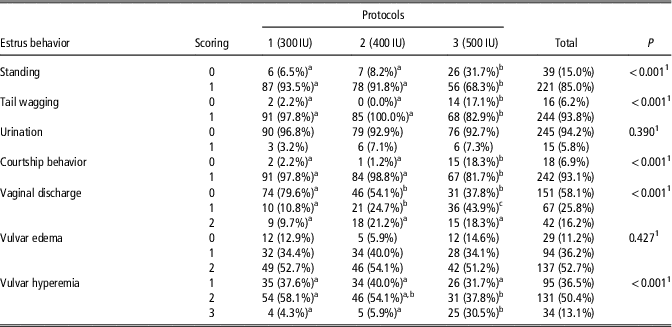
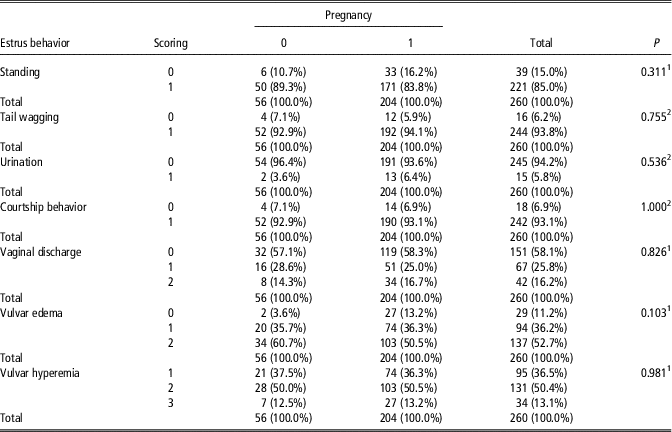
The onset of estrus after sponge removal was observed in 95.4% (248/260) of the synchronized does. According to the results obtained, the most accurate indicators of estrus, resulting in pregnancy, were tail wagging and courtship behavior followed by the standing signs (Table 1). Standing, tail wagging, courtship behavior, vaginal discharge and vaginal hyperemia were different (P<0.001) between PMSG groups (Table 2). Independently from the PMSG groups, regarding the pregnancy rates, estrus signs were not significantly different. However, standing and vulvar edema showed higher significance than other estrus signs (Table 3). In this study, we obtained 78.5% pregnancy rate (204/260) regardless of the different dosage of PMSG groups. The lowest pregnancy rate was observed in group 400 IU (P<0.05) (Table 4).
The relationship between the pregnancy rate and estrus signs in Angora goat

The relationship between the three PSMG doses in terms of estrus signs in Angora goat
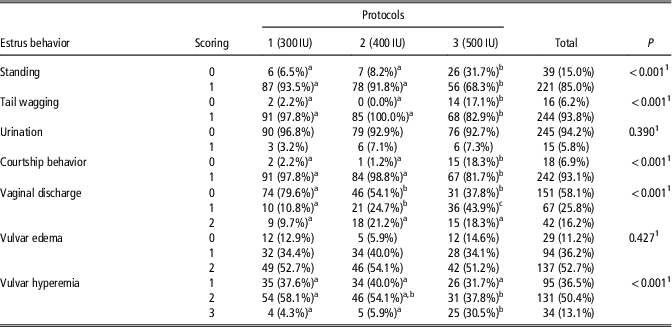
a,bDifferent superscripts within the same column demonstrate significant differences (P<0.001).
1 Pearson χ 2 test.
The relationship between the pregnancy results and the estrus signs in Angora goat
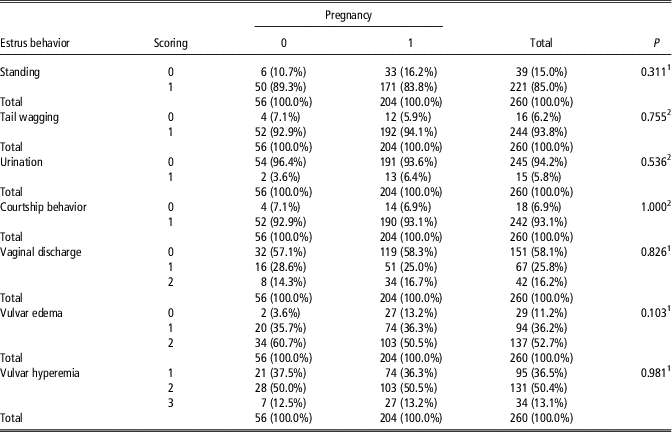
1 Pearson χ 2 test.
2 Fisher’s exact test.
The relationship between the PMSG doses and pregnancy rates in Angora goat

a,bDifferent superscripts within the same column demonstrate significant differences (P<0.05).
1 Pearson χ 2 test.
Discussion
In this study, we administered three different PMSG doses, following 11-day progestagen treatment. The overall pregnancy rate was 78.5% (Table 3) with the synchronization protocol we performed. Comparing with the other studies on different species, breed and using different PMSG doses, Zeleke et al. (Reference Zeleke, Greyling, Schwallbach, Muller and Erasmus2005), Ozer and Dogruer (Reference Ozer and Dogruer2011) and Romano (Reference Romano2004) found similar pregnancy rates of 72.3%, 72.7% and 63.6%, respectively; however, Motlomelo et al. (Reference Motlomelo, Greyling and Schwalbach2002) obtained 53%. According to Zeleke et al. (Reference Zeleke, Greyling, Schwallbach, Muller and Erasmus2005), the use of different intravaginal progestagens medroxyprogesterone acetate (MAP) or FGA, the injection of different doses of PMSG, days and the administration of PMSG in different seasons do not differ significantly; however, they insist on subcutaneous injection as their favored route compared with intramuscular.
Consistent use of PMSG during the whole female life or within the same year usually results in active immunization against PMSG (measured by the percentage of plasma PMSG binding), which decreases the efficacy of ovarian stimulation during the non-breeding season (Baril et al., Reference Baril, Leboeuf and Saumande1992).
When other articles are considered, there is no study that evaluates the effect of PMSG dose on recording the estrus behavior signs and timed AI with fertility results. Our results indicate that 300 IU PMSG dose is sufficient to inseminate at a fixed time (43 to 45 h after sponge removal) and to record the estrus behavior using a teaser male, 24 h after sponge removal. When 400 IU PMSG is administered to the does, estrus signs can be visible 24 h before the insemination. However, the lowest pregnancy results obtained with 400 IU PMSG dose indicate that ovulation might have occurred later than our planned insemination period. The half-life of PMSG is 40 to 125 h, yet it is 2 to 3 h for FSH. Due to this difference, we think that surplus FSH that was formed with a higher dose of PMSG might have blocked the LH peak and delayed ovulation, thus fixed time insemination was implemented earlier than required. With 500 IU PMSG dose, the total rate of estrus detection decreased between these periods, although the timing for insemination which was 43 to 45 h after the sponge removal was accurate according to the pregnancy results obtained. This might be caused in view of the fact that surplus amount of FSH moves the visible estrus signs to an earlier time, while delaying the LH peak due to excess amount of FSH, and thus the proper time for insemination may still be caught with our fixed time.
Even though there was an exception in estrus response, differences were observed among the PMSG groups according to pregnancy rates (Table 4). The reason for that might be due to either individual differences between animals or their previous synchronization history. The estrus response percentages were different from the responses declared in various literature (Ak et al., Reference Ak, Ozturkler, Kasikci, Horoz, Kilicarslan and Ileri1998; Muna et al., Reference Muna, Ahmed, Makawi and Jubara1998; Romano, Reference Romano2004; Lehloenya et al., Reference Lehloenya, Greyling and Schwalbach2005; Zeleke et al., Reference Zeleke, Greyling, Schwallbach, Muller and Erasmus2005; Kulaksız et al., Reference Kulaksız, Ucar and Daskin2013). The highest estrus responses (100%) have been reported by Romano (Reference Romano2004) and Ak et al. (Reference Ak, Ozturkler, Kasikci, Horoz, Kilicarslan and Ileri1998). Romano (Reference Romano2004) synchronized Nubian does with controlled internal drug release, FGA and MAP (13 days intravaginal progestagen without PMSG), and goats were intracervically inseminated with fresh or cooled semen at 12 and 24 h after onset of estrus. In the current study, estrus response obtained was different from these researchers’ findings. The differences in our results could be because of the timing of sponge administration and PMSG doses or due to breed variations, the effect of geographical conditions on estrus response or the treatments that an individual animal had previously received. According to Baril et al. (Reference Baril, Remy, Vallet and Beckers1993), the low pregnancy rate observed in some herds after estrus synchronization can be related to the high proportion of goats with a late occurrence of estrus.
Table 1 presents the relationship between pregnancy rates and estrus signs. Differences were observed between the PMSG groups in terms of standing, tail wagging, courtship behavior, vaginal discharge and vaginal hyperemia (P<0.001). However, the differences in urination and vulvar edema were not different between the PMSG groups (P>0.05) (Table 2). Most reliable estrus signs resulting with pregnancy were tail wagging and courtship behavior followed by the standing signs. Greyling and Van Niekerk (Reference Ginther and Kot1990) found out that the time of PMSG administration had no effect on estrus response; however, PMSG-treated animals exhibited shorter estrus intervals compared with intramuscular (P<0.01) and subcutaneous (P<0.05) routes. This might be related to the preovulatory LH effects of PMSG, and likewise, our results had no effect on overall estrus response. The percentage of tail wagging accuracy was highest (22.97%) among the estrus scoring system. However, the highest pregnancy rate was obtained with urination behavior, which had the lowest estrus accuracy percentage. So far, there have been no reports regarding the correlation between estrus behavioral scores and pregnancy rates in goats.
In conclusion, this study suggests that different doses of PMSG (300, 400 and 500 IU) injections following an 11-day treatment with intravaginal sponges can be used to synchronize estrus efficiently in Angora goats during the breeding season. Better results can be obtained in terms of both estrus detection accuracy and pregnancy rates when 300 IU PMSG are administered. Higher PMSG doses (400 to 500 IU) delayed ovulation; and in addition, 500 IU dose shortened the estrus behavior duration. Even though different doses of PMSG displayed similar effects on estrus synchronization and pregnancy rates, we concluded that tail wagging, courtship behavior and standing heat are the most reliable estrus signs for AI in Angora goat.
The obtained results indicate that estrus-scoring system may be a potential tool for estrus detection; however, further studies are needed regarding the estrus-scoring systems and the development of video-monitoring system throughout the entire estrus period of reproductive cycles for extensive goat production systems.
Acknowledgments
This study was financed under the project supported by the Scientific and Technological Research Council of Turkey (TUBITAK) (Project No: 214O034).
Declaration of interest
The authors declared that there is no conflict of interest regarding to publication of this article. The terms of this arrangement have been reviewed and approved by Ankara University Animal testing ethical committee in accordance with its policy on objectivity in research.
Ethics statement
This study was approved by the Ankara University Animal testing ethical committee and all experiments were conducted according to ethical principles and laws.
Software and data repository resources
None of the data were deposited in an official repository.