Introduction
Lepidopteran stem borers are considered to be important pests of cereal crops in sub-Saharan Africa (Harris & Nwanze, Reference Harris and Nwanze1992; Van den Berg & Rebe, Reference Van den Berg, Rebe, Van den Berg and Uys2001; Kfir et al., Reference Kfir, Overholt, Khan and Polaszek2002). The stem borer species Busseola fusca (Fuller) (Lepidoptera: Noctuidae), Chilo partellus (Swinhoe) (Lepidoptera: Pyralidae) and Sesamia calamistis (Hampson) (Lepidoptera: Noctuidae) are the most widespread and damaging to maize in South Africa and other African countries (Walker & Hodson, Reference Walker and Hodson1976). Recent reports also list B. fusca as a pest of sugar cane (Assefa et al., Reference Assefa, Conlong, Van den Berg and Mitchell2010, Reference Assefa, Conlong, Van den Berg and Martin2015). Depending on the altitude stem borers may occur as single species or communities of mixed species attacking maize plants in the same field (Van den Berg et al., Reference Van den Berg, Van Rensburg and Pringle1991; Tefera, Reference Tefera2004; Ong'amo et al., Reference Ong'amo, Le Ru, Dupas, Moyal, Calatayud and Silvain2006; Krüger et al., Reference Krüger, Van Den Berg and Van Hamburg2008). In Kenya, the composition of stemborer communities varies with altitude with B. fusca being the predominant species in the highlands characterised by low temperatures (Guofa et al., Reference Guofa, Overholt and Mochiah2001; Ong'amo et al., Reference Ong'amo, Le Ru, Dupas, Moyal, Calatayud and Silvain2006). Busseola fusca usually also dominates the stem borer complex in high altitude regions in South Africa (Van Rensburg & Bate, Reference Van Rensburg and Bate1987; Mwalusepo et al., Reference Mwalusepo, Tonnang, Massawe, Okuku, Khadioli, Johansson, Calatayud and Le Ru2015) and has previously been reported to exhibit ecological preferences that differ between regions (Sezonlin et al., Reference Sezonlin, Dupas, Le Ru, Faure, Le Gall and Silvain2006) and was described to be absent from the coastal areas of Eastern Africa (Harris & Nwanze, Reference Harris and Nwanze1992). A recent review, however, indicated that B. fusca occurs in all agro-ecological zones of eastern and Southern Africa, though it is only predominant above 1500 m a.s.l. (Calatayud et al., Reference Calatayud, Le Ru, Van Den Berg and Schulthess2014). It was suggested that this species is unable to tolerate mean temperatures above 25°C, but this was not so in other regions of Africa where it occurs at lower altitudes, indicating the ability of this pest to adapt to low-lying and warmer areas (Moyal, Reference Moyal1995; Krüger et al., Reference Krüger, Van Den Berg and Van Hamburg2008).
Climate determines the distribution and abundance of most insect species (Sutherst, Reference Sutherst, Mooney and Hobbs2000), with temperature the most crucial abiotic factor directly driving life processes (Sithole, Reference Sithole1987; Lactin et al., Reference Lactin, Holliday, Johnson and Craigen1995; Roy et al., Reference Roy, Brodeur and Cloutier2003; Dangles et al., Reference Dangles, Carpio, Barragan, Zeddam and Silvain2008; Khadioli et al., Reference Khadioli, Tonnang, Ong'amo, Achia, Kipchirchir, Kroschel and Le Ru2014a , Reference Khadioli, Tonnang, Muchugu, Ong'amo, Achia, Kipchirchir, Kroschel and Le Ru b ). Temperature also influences resource utilisation, intra- and inter-specific interactions and limits their geographic distribution (Howe Reference Howe1967; Bale et al., Reference Bale, Masters, Hodkinson, Awmack, Bezemer, Brown, Butterfield, Buse, Coulson, Farrar, Good, Harrington, Hartley, Jones, Lindroth, Press, Symrnioudis, Watt and Whittaker2002; Hodkinson Reference Hodkinson2005; Damos & Savopoulou-Soultani Reference Damos and Savopoulou-Soultani2012; Ntiri et al., Reference Ntiri, Calatayud, Van den Berg, Schulthess and Le Ru2016). Development and reproduction occurs within a specific temperature range and is best performed at an optimum temperature (Begon et al., Reference Begon, Towsend and Harper2006). Determining the effect of temperature on development and reproduction of insects species will assist in prediction of the duration of life cycles and when seasonal emergence will occur as changes in climate occur (Angilletta & Dunham, Reference Angilletta and Dunham2003; Kingsolver & Huey, Reference Kingsolver and Huey2008).
Studies of insect development at constant temperatures can provide a basis for prediction of phenological and seasonal development in the natural environment (Mironidis, Reference Mironidis2014) which can be used in pest forecasting, management and risk analysis as well as accurate scheduling of control measures (McFarland et al., Reference Mcfarland, Mccann, Kline, Goodenough and McKinion1992; Shanower et al., Reference Shanower, Schultess and Bosque-Perez1993; Calvo & Molina, Reference Calvo and Molina2005). Pest management practices, predictions regarding species distribution and pest status as well as the understanding of species interactions can be improved by increased understanding of the conditions that slow down or accelerate development (Wilson & Barnett, Reference Wilson and Barnett1983; Higley & Peterson, Reference Higley, Peterson, Pedigo and Buntin1994; Waldstein & Reissig, Reference Waldstein and Reissig2001).
The effect of regional climate differences on the ecology of B. fusca is evident from the differences in moth flight patterns and pest status of this species between the eastern and western maize production regions of South Africa (Van Rensburg et al., Reference Van Rensburg, Walters and Giliomee1985, Reference Van Rensburg, Van Rensburg, Giliomee and Walters1987). The second generation moth flight of B. fusca commences earlier in the cooler eastern Highveld region and larvae subsequently also go into diapause earlier than in the warmer western regions, where the first generation moth flight commences approximately 2–3 weeks later. Several studies have been done on the developmental and reproductive parameters of B. fusca (Smithers, Reference Smithers1960; Harris, Reference Harris1962; Usua, Reference Usua1968; Unnithan, Reference Unnithan1987; Khadioli et al., Reference Khadioli, Tonnang, Ong'amo, Achia, Kipchirchir, Kroschel and Le Ru2014a ), but data are insufficient to determine this species’ climatic preferences under different conditions. This study was conducted to determine the development rate of B. fusca larvae at different constant temperatures, to determine the number of degree-days (°D) required for each stage to complete its development and to determine reproductive success at the different temperature regimes.
Material and methods
Busseola fusca stock colony
Stem borer larvae were collected from maize fields at four sites viz. Brits (S25°23′22.7″E27°34′40.4″), Orkney (S26°56′59.7″E26°53′49.6″) and Potchefstroom (S26°46′58.4″E27°08′17.1″) (North–West province) as well as at the Vaalharts irrigation scheme (S27°44′43.6″E24°47′02.5″) (Northern Cape province), South Africa. These larvae were reared in plastic containers (40 × 20 × 15 cm3) with aerated lids on conventional (non-Bt) maize stems which were replaced at four day intervals. They were kept in a rearing room at 26 ± 1°C, 70 ± 10% relative humidity (RH) and 14L:10D photoperiod until pupation. Male and female pupae were separated and kept individually in small plastic bottles (52 mm high and 30 mm in diameter) in the same rearing room as the larvae. Pupae were observed daily until moths emerged.
Fecundity and longevity of female moths
After moth emergence, single male–female pairs were confined to oviposition chambers. Male and female moths from the four different localities were randomly assigned to these containers. There were 30 oviposition chambers per temperature regime. The temperature regimes used were 15, 20, 26 and 30 ± 1°C, while humidity and photoperiod were maintained as described above.
The oviposition chambers and methods used are according to those described by Kruger et al. (Reference Kruger, Van Rensburg and Van den Berg2012). A plastic bottle (22 cm high and 10 cm in diameter) was cut open at the top and filled with small crusher stones up to a height of 5 cm. A single maize stem, 18 cm in length and 25–30 mm in diameter with bases of leaves intact was placed in an upright position inside each bottle with the stem inserted 3–4 cm into the crusher stones. Water was added up to a three-quarter level of the height of the stones to provide humidity and to keep the stems fresh. The containers were covered with a fine gauze mesh to prevent escape of moths. The stems were observed daily for egg batches and stems were replaced when needed. The temperature and RH at each regime was recorded at 30-min intervals using iButtons® from Coldchain Thermo Dynamics (Fairbridge technologies).
The pre- and post-oviposition periods, days without oviposition, longevity and fertility, number of egg batches oviposited and the total number of eggs per female were determined. Eggs were counted and then placed in a small plastic container (52 mm high and 30 mm in diameter) with a steel mesh infused lid. These containers with eggs were kept in glass desiccators (150 mm diameter) in which RH were maintained at 70 ± 5% using a potassium hydroxide solution according to the method of Solomon (Reference Solomon1951). The eggs were observed daily until larvae hatched. To determine fertility, the number of eggs that developed to the black head stage was counted and expressed as a percentage of the total number of eggs per female. Eggs that did not develop were regarded as infertile. Larvae that developed to the black head stage were regarded dead if they had not hatched 3 weeks after oviposition.
Temperature-dependent egg development
The egg batches from the stock colony were removed from maize plants within 12 h after oviposition by cutting off the piece of leaf sheath to which the egg batches were attached. Approximately 50 eggs were used per temperature regime. The eggs were kept as described above. The number of days until hatching was recorded until 5 days after the first larvae hatched. The desiccators were kept inside incubators maintained at 15, 18, 20, 26 and 30 ± 1°C with a 14L:10D photoperiod. The temperature and RH in each desiccator was recorded at 30-min intervals as described above.
Temperature-dependent larval and pupal development
Larval and pupal development was studied under the same conditions of constant temperature and photoperiod as described above for eggs. Eggs were collected from moths from the stock colony, transferred into small plastic containers inside desiccators and maintained as described above. After hatching, 15 neonate larvae (F 1) were placed in the whorl of a single maize seedling inside a plastic test tube (115 mm high × 29 mm in diameter), which was then closed with a steel mesh infused lid. There were 15–20 test tubes containing 15 larvae each per temperature regime. A piece of filter paper (4 cm2) was placed on the bottom of each test tube to absorb excessive wetness inside the test tube. The test tubes were cleaned daily.
The whorl tissue was checked daily for the presence of larval head capsules and exuviae. Head capsules and exuviae were then removed to allow accurate monitoring of moulting to the second instar. Upon moulting to the second instar, larvae were transferred individually to test tubes containing a section of a maize plant consisting of a compact roll of young unfolded leaves, cut from above the growing tip. Daily observations of the larvae were made and moulting as well as survival recorded. Food was replaced every second day. From the fifth instar onwards larvae were fed with piece of maize stem cut from the base of the whorl. Later instar larvae were fed with stem pieces of older plants. To allow checking of larvae inside the stem, stems were cut longitudinally and kept together with an elastic band. The temperature and RH in the maize stem at each temperature regime was recorded at 30-min intervals with i-buttons placed inside the stem and kept together with an elastic band.
When pupation occurred, pupae were removed from plant tissue and put into clean test tubes. Test tubes were then placed in a large plastic container with an aerated lid and a small water bowl to keep RH at a level of 75 ± 10% at the respective temperatures. Pupae were checked daily until the emergence of moths. The number of days to moth emergence was recorded and temperature and RH in each container recorded as described above.
Statistical analysis
The effect of temperature on pre-, post- and oviposition period, longevity of female moths and egg production were analysed by means of one-way ANOVAs using STATISTICA 12 (Statsoft, Inc. 2013), followed by Tukey's HSD test (P = 0.05).
The relationship between temperature (x) and development rate (y) was determined by using a simple linear regression analysis. The lower threshold temperature (t) and number of degree-days (k) required to complete development for each of the stages, as well as their standard errors were calculated using the equations of Campbell et al. (Reference Campbell, Frazer, Gilbert, Gutierrez and Mackauer1974). The lower threshold temperature was estimated by setting y = 0 and solving × for the regression equation, y = a + bx, where y = 1/days, x = temperature, a = intercept and b = slope. The lower temperature threshold was calculated as t = −a/b and the thermal constant for development in number of degree-days (°D) as k = 1/b. The standard error of the means were calculated as: SE of t = ȳ/b
 $\sqrt {(s^2} /N\bar y^2)$
+ [SE of b/b]2 and standard error of the day degrees as: SE of k = (SE of b)/b
2. The mean degree-days (°D) for the development of the egg, larval and pupal stage were estimated using the equation of Jackson & Elliot (Reference Jackson and Elliot1988): °D = T(c–T
min), where T is the number of days taken to complete development at a constant temperature (c) and T
min is the minimum temperature for development. The thermal constant was used and the mean number of °D required for development of each life stage at the set constant temperatures were compared. The effect of temperature on development was analysed by means of one-way ANOVA using STATISTICA 12 (Statsoft Inc. 2013), followed by Tukey's HSD test (P = 0.05).
Results
Reproduction
Although temperature had a significant effect on fecundity of B. fusca moths (table 1), moths laid eggs at all the temperatures evaluated during this study. There was, however, a significant difference between the total number of eggs laid at the different temperatures (F 3,121 = 12.02; P < 0.001). The total number of eggs laid at 30°C was significantly lower and approximately a third of those laid at 15, 20 and 26°C (table 1).
Mean fecundity and longevity (±SE) of Busseola fusca moths at constant temperatures.

Values in brackets represent the range in days.
Means in each column followed by the same letter are not significantly different (Tukey's HSD, P = 0.05).
Pre-oviposition and oviposition periods were inversely related to temperature (table 1). The pre-oviposition (F 3,121 = 8.68; P < 0.001) and oviposition (F 3,121 = 29.06; P < 0.001) periods were significantly longer at 15°C than at 30°C, with no significant difference between the duration of these two reproductive periods between 20 and 26°C. The post-oviposition period (F 3,121 = 10.72; P < 0.001) was the longest at 15°C and similar at 20, 26 and 30°C. Moths died within a day of their last oviposition at 20, 26 and 30°C, but lived between 2 and 3 days after oviposition at 15°C (table 1). Longevity of female moths differed significantly between the different temperatures (F 3,121 = 59.6, P < 0.001) and was significantly longer at 15°C.
Moths laid significantly more eggs per day at 26°C compared with 15, 20 and 30°C (F 3,121 = 10.5; P < 0.001). The mean number of eggs laid per day at 20°C was also significantly higher than at 15°C (table 1). The minimum number of eggs laid per female per day was significantly lower at 15°C compared with 26 and 30°C (F 3.121 = 6.6; P < 0.001). The minimum number of eggs laid daily per moth at 15°C was very low (4.0) (table 1).
The percentage infertile eggs at all temperatures were high and differed significantly (F 3,121 = 21.79, P < 0.001) (table 2). Since no fertile eggs were recorded at 30°C, fertility was compared between the 15, 20 and 26°C treatments only. Differences existed in percentage fertility (F 2.90 = 3.91; P > 0.01). The highest percentage fertility was at 20°C. There was also a significant difference in the number (F 2,90 = 9.25; P < 0.001) and percentage (F 2,90 = 11.64; P < 0.001) of eggs with larvae in the black head stage that failed to hatch between the four temperatures evaluated.
Fertility (±SE) of Busseola fusca eggs at constant temperatures.

Means in each column followed by the same letter are not significantly different (Tukey's HSD, P = 0.05).
Development of different life stages
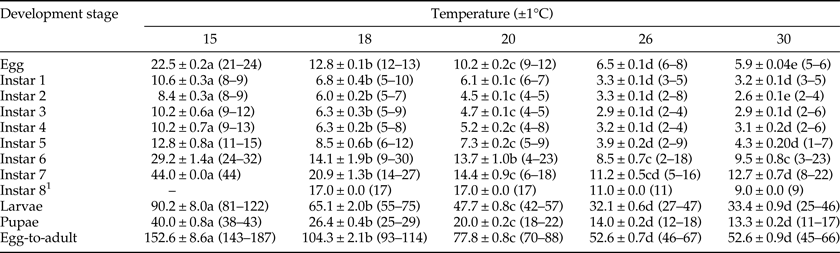
Busseola fusca completed development at all temperatures between 15 and 30°C (table 3). Development time for eggs and larval instars one to five was inversely related to temperature from 15 to 26°C, with development for all life stages being significantly delayed at 15°C. Incubation time for eggs significantly decreased from 22.5 days at 15°C to 5.9 days at 30°C (F 4,102 = 938.3; P < 0.001). Busseola fusca larvae completed their life cycle the slowest at 15°C (90.2 days) and the quickest at 26°C (31.2 days) (table 3). Total development took 152.6 days at 15°C and 52.6 days at 26 and 30°C. In general, development time decreased as temperature increased. However, at 30°C, duration of development for fifth instar larvae onwards, as well as total larval development time increased (table 3). The upper threshold temperature for larval development is therefore between 26 and 30°C.
Mean development time (days ± SE) of different life stages of Busseola fusca at constant temperatures. The range of days to complete a single stage is shown in brackets.

Means within the same row followed by the same letter do not differ significantly at P = 0.05 (Tukey's HSD).
1 Data not included in ANOVA analysis due to small sample size.
All larvae went through six instars, 70 of these went through seven instars and four larvae reached an eighth instar before pupation. The longest development time spent in an instar was 32 days (at 15°C) (table 3).
There was a significant difference in development time at 15, 18, 20 and 26°C for first to fifth instar larvae [(first instar: F 4,125 = 271.2; P < 0.001), (second instar: F 4,125 = 133.5; P < 0.001), (third instar: F 4,125 = 203.4; P < 0.001), (fourth instar: F 4,125 = 122.6; P < 0.001) and (fifth instar: F 4,125 = 102.1; P < 0.001)] (table 3). Development was significantly longer at 15°C compared with the other temperatures. Sixth instar larvae developed at a similar rate at 18 and 20°C, which was significantly longer than at 26 and 30°C (F 4,125 = 23.7; P < 0.001). Development time of sixth instar larvae accounted for 22–32% of the total larval development period and 14–19% of the total development period. The duration of development time for larval instar six and onwards (instars 6 to 8, where applicable) accounted for 48–59% of the total and 80–96% of the larval development period, respectively.
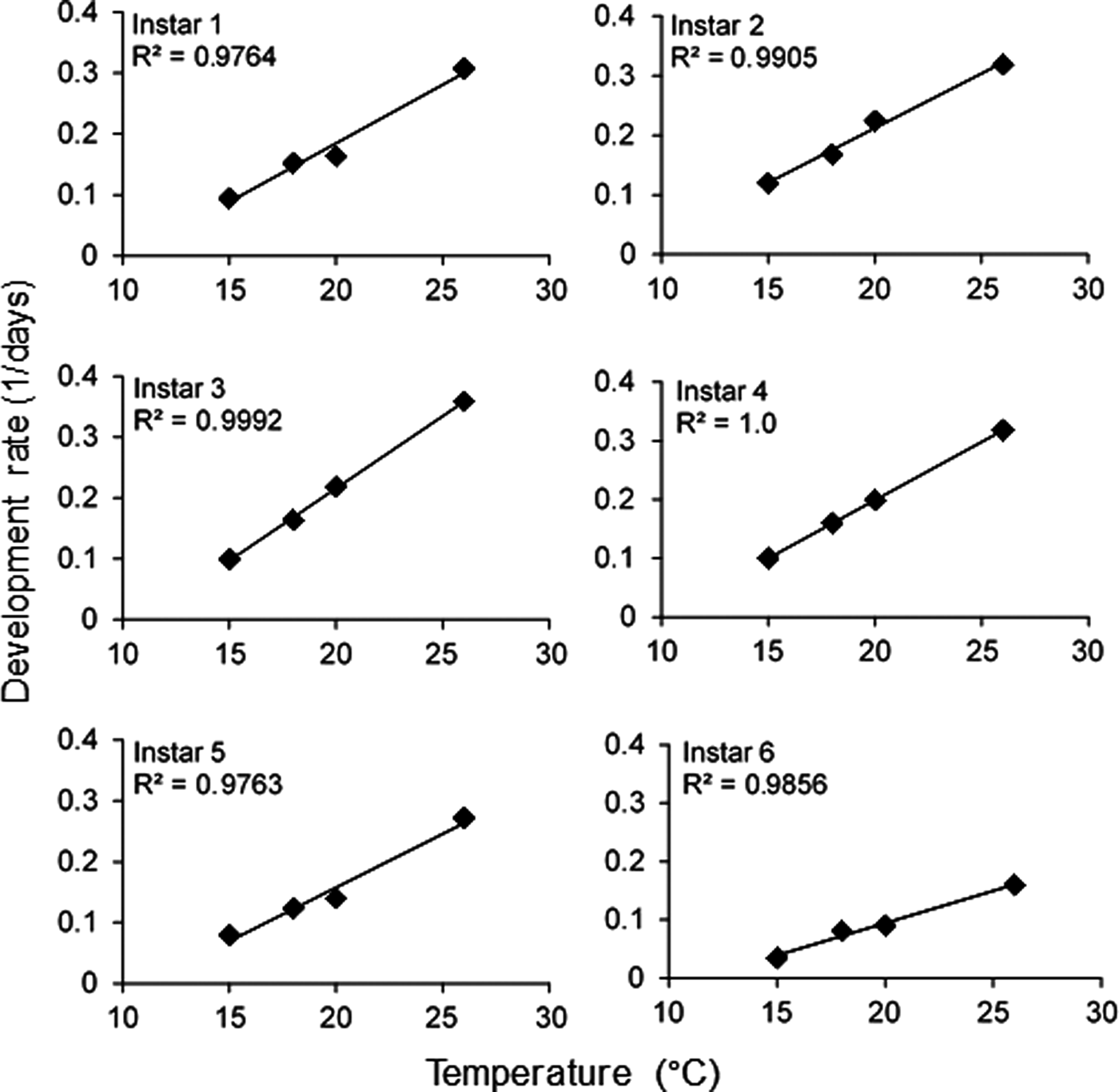
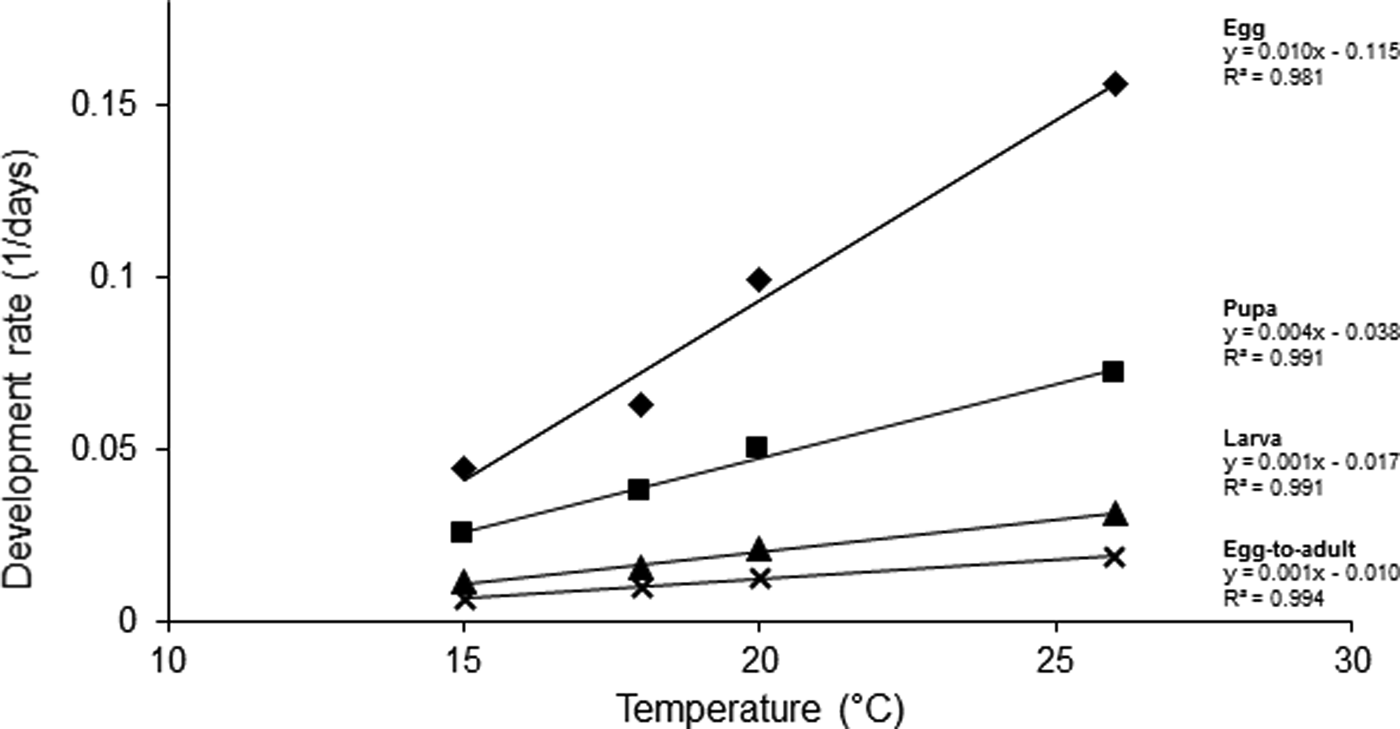
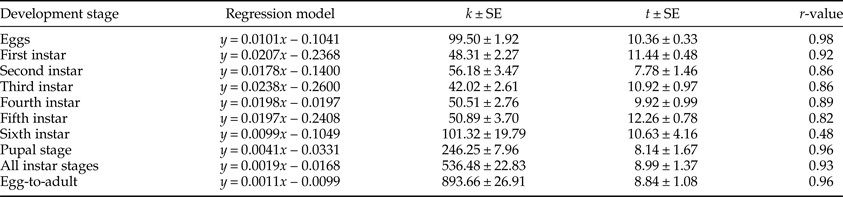
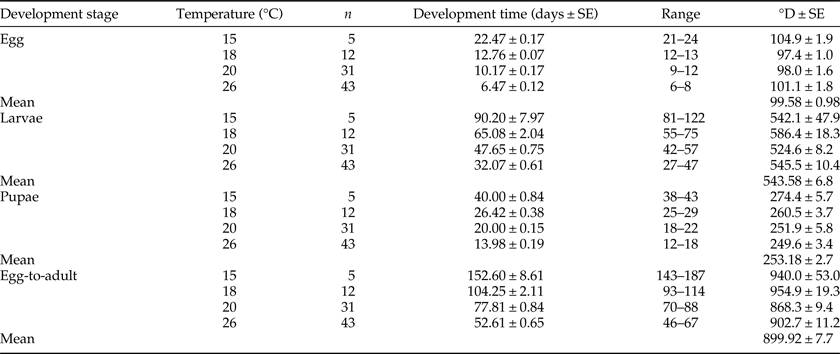
The relationship between temperature and developmental rate of B. fusca was linear between 15 and 26°C and more rapid development was observed with increasing temperatures (figs 1 and 2). The highest temperature of 30°C was excluded from the least square linear regression analyses, since it did not fit the linear portion of the graph. The correlation (r-value) between temperature and development rate ranged between 0.93 and 0.96 for eggs, total larval development, pupae and egg-to-adult development (table 4). Linear regression equations describing these relationships and estimates of the lower temperature threshold (t) and the number of degree-days (°D) for each life stage are summarized in table 4. Busseola fusca required thermal constants (k) of 99.5, 536.5, 246.3 and 893.7°D for completion of the egg, larval, pupal and egg-to-adult development, respectively (table 4), which is comparable with the mean degree-days estimated as determined in this study (table 5). The number of degree-days estimated to complete the life cycle of B. fusca at 15, 18, 20 and 26°C were also similar (table 5). Based on linear regression analyses of development rate at all temperatures a minimum temperature threshold between 8 and 11°C was estimated depending on the development stage.
The relationship between Busseola fusca larval development rates and rearing temperature.

The relationship between Busseola fusca development rates for all life stages and rearing temperature.

Linear regression equations describing the relationship between development rate (1/days) and temperature (15–26°C) and the thermal requirements of different developmental stages of Busseola fusca.

t, estimated lower temperature threshold; k, estimated thermal requirement in degree-days.
Mean development time in days and degree-days (°D) for Busseola fusca at constant temperatures from 15 to 26°C.

Degree-days were calculated using the lower threshold temperature for development determined for each developmental stage (eggs = 10.36°C, larvae = 8.99°C, pupae = 8.14°C and egg-to-adult = 8.84°C).
Discussion
Reproduction
The reproductive parameters of female B. fusca moths were significantly affected by temperature, with oviposition commencing sooner at temperatures higher than 15°C. The pre- and post-oviposition periods between 20 and 30°C were long (2.5–1.7 and 0.6–0.9 days, respectively), presumably because energy is used for physiological processes rather than reproductive effort. Although female moths lived longer at 15°C, the number of days without oviposition was also higher than at higher temperatures. Most of the larvae that developed to the black head stage at 15°C were unable to hatch. Fitness of these larvae was therefore negatively affected at a constant temperature of 15°C. Hatching success of larvae increased with increasing temperature between 15 and 26°C. Although not too cold for oviposition, a constant temperature of 15°C was shown to have a negative effect on fertility. The lower threshold temperature for B. fusca reproduction is therefore higher than 15°C. Goebel (Reference Goebel2006) reported that a temperature of 15°C was also to too low for Chilo sacchariphagus Strand (Lepidoptera: Crambidae) mating and oviposition, with no mating and egg laying occurring at 15°C.
Fecundity usually increases as temperature increases, between a lower and upper threshold, up to the optimum point (Milonas & Savopoulou-Soultani, Reference Milonas and Savopoulou-Soultani2000). In this study, fewer eggs were laid at 30°C compared with 26°C, with all eggs infertile at this higher temperature as well as reduced adult lifespan. The moths laid approximately 300–400 eggs at temperatures between 15 and 26°C. This was more than the average of 243–299 eggs between 18 and 25°C reported by Khadioli et al. (Reference Khadioli, Tonnang, Ong'amo, Achia, Kipchirchir, Kroschel and Le Ru2014a ), but in accordance with other studies reporting an average of 374 or 400 eggs per female (Harris, Reference Harris1962; Kruger et al., Reference Kruger, Van Rensburg and Van den Berg2012). However, Unnithan (Reference Unnithan1987) reported a high average fecundity 855 eggs under laboratory conditions. In this study, the highest number of eggs laid by a single moth was 976. Although B. fusca moths can lay many eggs and the potential offspring may be many, the realised offspring may be few. Depending on the prevailing temperature, not all eggs will be fertilised resulting in reduced fertility and subsequent low larval numbers. However, the more eggs are laid, the higher the probability that some of the offspring survives and reproduce (Speight et al., Reference Speight, Hunter and Watt2008). This is because oviposition behaviour also involves sexual behaviour, including calling and mating during scotophase, with oviposition occurring in the dark over a period of several days (Calatayud et al., Reference Calatayud, Guénégo, Le Ru, Silvain and Frérot2007). Successful oviposition behaviour ensures better survival of the offspring.
Longevity of female moths decreased as the temperature increased (14.9–5.2 days). Khadioli et al. (Reference Khadioli, Tonnang, Ong'amo, Achia, Kipchirchir, Kroschel and Le Ru2014a ) reported similar results for female moth longevity ranging from 12.4 to 4.7 days from 15 to 30°C at a 12L:12D photoperiod. Unnithan (Reference Unnithan1987) reported an average longevity of 7.47 days for female moths of B. fusca reared in a laboratory. Similar results were recorded for Sesamia nonagrioides moths at different temperatures (15–30°C) and 16L:8D photoperiod with longevity declining from 7.6 to 3.9 days as the temperature increased (Fantinou et al., Reference Fantinou, Perdikis and Zota2004). Chilo partellus longevity is also reported to be negatively affected by higher temperatures (22–30°C) (Tamiru et al., Reference Tamiru, Getu, Jembere and Bruce2012). Longevity of S. calamistis moths ranged from 6.7–9.9 days between 15 and 30°C at a 12D:12L photoperiod (Khadioli et al., Reference Khadioli, Tonnang, Ong'amo, Achia, Kipchirchir, Kroschel and Le Ru2014a ). Night temperatures during spring and summer in South Africa are usually not high and will not be a limiting factor for oviposition. The lifespan of female B. fusca moths may, however, be inhibited by high temperatures exceeding 30°C that may prevail during daytime in South Africa.
Busseola fusca have two to three distinctive generations per annum in South Africa, with moth numbers being significantly higher during the second moth flight in summer (Van Rensburg et al., Reference Van Rensburg, Walters and Giliomee1985). There exists a temperature and rainfall gradient from east to west in the maize production area of South Africa which influences the development and pest incidence on maize (Van Rensburg et al., Reference Van Rensburg, Walters and Giliomee1985). The number of B. fusca moths captured in light traps increases significantly over this gradient from east to west especially during the second generation flight (Van Rensburg et al., Reference Van Rensburg, Walters and Giliomee1985). The first generation moth flight commences earlier in the eastern cooler Highveld region than in the west. This causes larvae to enter diapause earlier in the eastern areas than in the west (Walters, Reference Walters1979), often resulting in no third generation moth flight in the cooler eastern regions (Van Rensburg et al., Reference Van Rensburg, Walters and Giliomee1985). The pattern in Southwestern Nigeria is the opposite since spring rains start earlier in the east than in the western parts of the country (Usua, Reference Usua1968).
Knowledge on thermal limits for B. fusca reproduction and understanding their response to changes in temperature can contribute to modelling of climate requirements of B. fusca in different regions and assist in prediction of pest outbreaks. Development studies such as those described in this study provide information on the optimal and lethal temperatures for specific species. The effect of fluctuating temperatures on B. fusca reproduction and development is, however, not known.
Development
The most favourable temperature range for B. fusca development was between 26 and 30°C, which concurs with previous studies (Usua, Reference Usua1968; Khadioli et al., Reference Khadioli, Tonnang, Ong'amo, Achia, Kipchirchir, Kroschel and Le Ru2014a ). Busseola fusca eggs, larvae and pupae did develop at a constant temperature of 15°C, although very slowly. These results again agree with Khadioli et al. (Reference Khadioli, Tonnang, Ong'amo, Achia, Kipchirchir, Kroschel and Le Ru2014a ), but differ from Usua (Reference Usua1968), who reported a developmental threshold of 22°C Usua (Reference Usua1968) also reported temperatures of 32°C and above as lethal to B. fusca and Khadioli et al. (Reference Khadioli, Tonnang, Ong'amo, Achia, Kipchirchir, Kroschel and Le Ru2014a ) noted no development above 30°C.
Development time of eggs accounted for between 11 and 15% of the total development period at the temperatures tested. Development time of later instar B. fusca larvae (sixth instar onwards) accounted for 80% and more of the total larval development period, regardless of the temperature.
A recent study conducted in Kenya on the development of B. fusca at different temperatures, reported total development from 223.85 to 62.74 days at 15–28°C, respectively (Khadioli et al., Reference Khadioli, Tonnang, Ong'amo, Achia, Kipchirchir, Kroschel and Le Ru2014a ) and that development time at 30°C increased to 81.26 days (Khadioli et al., Reference Khadioli, Tonnang, Ong'amo, Achia, Kipchirchir, Kroschel and Le Ru2014a ). The Kenyan B. fusca population therefore had a longer development time than the South African population used in the present study. Differences in RH used in different studies may also account for some of the observed differences in results. For example, Usua (Reference Usua1968) reported that the incubation period of eggs decreased with increasing RH. At 80% RH and higher the incubation period was 5–6 days to hatching, at 70% RH, 6–7 days and 60% RH, 7–8 days (Usua, Reference Usua1968). Unnithan (Reference Unnithan1987), also using a Kenyan B. fusca population, reported larval to adult development time of 40.8 days, with an egg stage of between 5 and 6 days at 23–27°C. Thus, complete development took between 45.8 and 46.8 days.
RH is an important factor influencing the biology and development of insects (Gullan & Cranston, Reference Gullan and Cranston2005). For example, low RH can cause development rate to slow down (Gullan & Cranston, Reference Gullan and Cranston2005). Although RH is often reported in temperature-dependent development studies for insects, it reflects only the RH inside of the incubator or rearing room. The actual temperature inside the container or exact position inside a plant, for example inside a stem where stem borers feed, is often not recorded as was done in the present study. In this study, the RH inside stems where the stem borer larvae were reared was always 100%. The possibility of desiccation where larvae occur inside stems under field conditions where low humidity may prevail is therefore not possible, except during the dry off-season phase of the crop or towards the end of the season when maize stems desiccate. Desiccation of B. fusca larvae inside maize stems where 100% humidity occurs during the active vegetative and reproductive growth stages of plants is therefore highly unlikely.
The larval stage of B. fusca reared on maize stems at temperatures between 26 and 30°C in the current study lasted on average 32.1 and 33.4 days, respectively. However, Ratnadass et al. (Reference Ratnadass, Traore, Sylla and Diarra2001) reported 47 days at 25 ± 1°C and Onyango & Ochieng’-Odero (Reference Onyango and Ochieng’-Odero1994) an average of 46 days at temperatures between 25 and 30°C. Khadioli et al. (Reference Khadioli, Tonnang, Ong'amo, Achia, Kipchirchir, Kroschel and Le Ru2014a ) reported the duration of the larval stage to range from 50.7 at 25 to 58.1 at 30°C. All these B. fusca populations were from temperate regions and were reared on artificial diet compared with the South African B. fusca population used in this study and which originated from a high altitude area (1400 m a.s.l.) with sub-zero night temperatures during winter. The fact that larvae in this study were reared on maize tissue and not artificial diet may also have contributed to the observed differences. The average development time of B. fusca eggs in this study (6.5 and 5.9 days) and pupal development time (14.0 and 13.3 days), respectively at 26 and 30°C are similar, however, to previous studies. For example, Unnithan (Reference Unnithan1987) reported eggs of B. fusca to take between 5 and 6 days at 23–27°C before hatch while Onyango and Ochieng’-Odero (Reference Onyango and Ochieng’-Odero1994) reported 6 and 14 days, respectively, for egg and pupal development at 26–30°C. A recent study in which B. fusca larvae was reared on artificial diet reported the average development time for eggs and pupae as 7.2 and 14.7 at 25°C and 6.5 and 16.6 at 30°C (Khadioli et al., Reference Khadioli, Tonnang, Ong'amo, Achia, Kipchirchir, Kroschel and Le Ru2014a ). The diet of larvae, therefore does not seem to affect development time of the pupae.
The number of degree-days needed by B. fusca to complete the different life stages was 99.58, 543.58, 253.18 and 899.92°D, with lower temperature thresholds of 10.36, 8.99, 8.14 and 8.84°C for eggs, larvae, pupae and egg-to-adult, respectively. The minimum threshold temperature for the larval stage was lower than for the egg stage. Eggs will therefore hatch at temperatures which are also suitable for larval development. The lower temperature threshold for overall development (i.e. egg to adult) of B. fusca in South Africa is below 10°C, which helps to explain its distribution beyond tropical regions as well as at higher altitudes. Variation in temperature thresholds is an important determinant in the distribution of insects (Cammell & Knight, Reference Cammell and Knight1992; Marco et al., Reference Marco, Taberner and Castañera1997). If a specific development stage cannot develop a certain temperature, then the distribution of the species is likely to be restricted by the temperature threshold of that stage (Cammell & Knight, Reference Cammell and Knight1992). Outside of the growing season, winter conditions can also limit insect distribution (Bale, Reference Bale2002). The strategy employed by B. fusca to survive winter is to enter a period of diapause as larvae (Kfir, Reference Kfir1991; Kfir et al., Reference Kfir, Overholt, Khan and Polaszek2002). Interestingly, this is not included by photoperiod or temperature, but rather food quality (Usua, Reference Usua1973). The faster developmental rate of B. fusca in South Africa compared with Kenya (Khadioli et al., Reference Khadioli, Tonnang, Ong'amo, Achia, Kipchirchir, Kroschel and Le Ru2014a , Reference Khadioli, Tonnang, Muchugu, Ong'amo, Achia, Kipchirchir, Kroschel and Le Ru b ), Mali (Ratnadass et al., Reference Ratnadass, Traore, Sylla and Diarra2001) and Nigeria (Usua, Reference Usua1968) means that this population can potentially complete two to three generations per annum before entering diapause. This information can be used for prediction and modelling purposes incorporated with other biotic and also abiotic factors. Future studies need to also consider the effect of fluctuating temperatures on the development and reproduction of B. fusca, however, to improve the accuracy of such models.
Climate change is expected to impact insect–plant interactions. Predicted scenarios caused by climate change in tropical biomes suggest that herbivory rates might increase by 2–4-fold in a world of increasing CO2 and drought, and the frequency of insect outbreaks are expected to be higher (Coley, Reference Coley1998), with negative consequences to plant growth and development (Cornelissen, Reference Cornelissen2011). Mwalusepo et al. (Reference Mwalusepo, Tonnang, Massawe, Okuku, Khadioli, Johansson, Calatayud and Le Ru2015) confirmed temperature to be amongst others, a key factor explaining the distribution of stem borers. For example, they concluded that both C. partellus and B. fusca will show an increase in the number of pest generations across all altitudes and that by 2055 damage by both species will increase in most productive maize zones in Tanzania and Kenya. Although not calculated for the South African maize producing area, taking into account the faster development of B. fusca in South Africa compared to populations from east Africa, a similar increase in number of generations and possible expansion in distribution area might occur.
Acknowledgements
The Unit for Environmental Sciences and Management is hereby acknowledged for financial and infrastructure support. The technical assistance of Mr Moses Phetoe is highly appreciated.