

DISCUSSION POINTS
• Spent-battery collection, transportation, and recycling processes face economic barriers.
• Several methods for recycling LIBs have been demonstrated, and some are in commercial use, but none is ideal for all battery types and volumes.
• For a long-lived product like a vehicle battery, what will happen at the product’s EOL is often not a major design consideration.
Benefits of recycling
Reduction of resource use
There are concerns about the physical availability of the required mineral resources. Electric vehicles (EVs) are often promoted because of their ability to wean society from its dependence on petroleum, which is an increasingly scarce resource. However, for EVs to be a plausible alternative, their use cannot entail switching dependence to another scarce resource. Therefore, considerable attention has been paid first to lithium and subsequently to cobalt and, to a lesser extent, nickel. Recently, the U.S. Department of the Interior published a draft list of critical minerals for national security and the economy. This list includes lithium, cobalt, manganese, and graphite, all used in lithium-ion batteries (LIBs).1
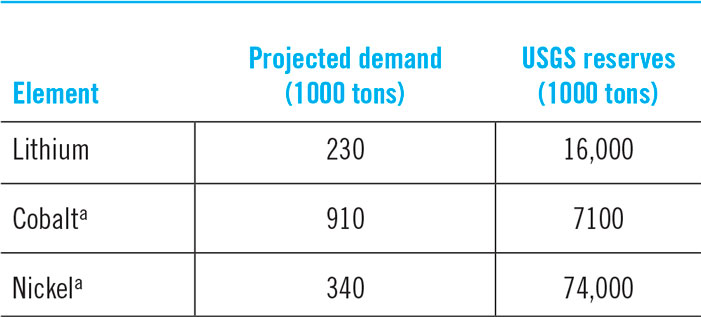
Estimation of the quantity of material that will be required is complicated and uncertain. There are three markets that are expected to use LIBs: consumer electronics, EVs, and stationary power storage. The electronics market is mature, and demand projections are relatively reliable, but EV and utility/home markets are highly speculative. Batteries for EVs are expected to dominate the demand. Construction of scenarios can help provide illustrative possible future battery material demands. We used a scenario for extremely rapid and high market penetration of EVs in the U.S. and then worldwide to get an upper bound of demand for lithium, cobalt, nickel, and other materials out to the year 2050, by which time alternative propulsion technology is likely followed.Reference Gaines and Nelson2 To get a more realistic estimate, we also took more detailed projected battery demand using cathode chemistry out to 2025Reference Pillot3 and calculated the quantities required for the main constituent elements. In both cases, the result was the same. World reserves of lithium and nickel are adequate; initial reports of a lithium shortage were based on producers being unable to handle an essentially instantaneous mass-market penetration of vehicles with large batteries.Reference Tahil4 However, the supply of cobalt is a real concern, with batteries alone potentially using over 10% of world reserves. Recycling could reduce the severity of this potential shortage in the long term, and reserves may increase as the price rises. The results of the 2025 demand projection are compared to U.S. Geological Survey (USGS) reserve estimates in Table 1.

Recycling as a source of raw materials
One of the first motivations given for recycling is to reduce depletion of raw materials, especially if they are scarce and/or imported from potentially unreliable or undesirable sources. However, the expected long lifetime and extended growth period of LIBs for automotive propulsion mean that end-of-life (EOL) recycling cannot contribute significantly to raw material needs for at least 10 years after initial market penetration. Furthermore, if demand for these batteries is growing rapidly during that period, the fraction of demand that can be satisfied with recovered material will be small. Figure 1 shows a projection of U.S. lithium demand out to 2050, based on an optimistic scenario for penetration of EVs,Reference Gaines and Nelson8 extrapolated to 2090 assuming that growth will slow down. It also shows how much material would be recovered if all the lithium in the batteries were recycled after 10 years. Finally, it shows the difference between the two curves, which represents how much virgin material would be required if all the materials were recovered and used to make new batteries. The need for virgin material peaks around 2035 and then starts to decline because the growth in total material demand has slowed. If rapid growth continued, supply from the recycled material could never catch up. It is not until over 20 years after recycling begins (30 years after product introduction) that recycling supplies over 10% of raw material demand. Actual recovery is likely to be much less than the 100% assumed for the illustration. If battery lifetime is increased by a second use, this delay is extended further. Eventually, recycling can supply most raw material needs, but only after demand flattens out. So recycling can contribute to supply, but that is a long-range plan for automotive LIBs. In contrast, the lifetime of batteries in consumer electronic devices is only about 3 years, so recovered materials from this sector could make a bigger impact sooner. However, to achieve that impact, the batteries would need to be collected, transported, and processed. These topics are addressed below.
Impact of material recovery on demand for virgin material.

There is another factor that impacts material availability. The analysis above looked only at recovery of batteries at their EOL. However, there is always some scrap material generated during the initial production process, from trimmings, ends of runs, off-specification product, etc. If that is as much as 10%, then 10% of current material is available for recycling immediately, reducing the net demand for virgin material by 10% immediately. Recovery of home scrap can make an immediate impact on virgin material demand. Demand is, of course, smaller if processing losses are smaller.
The discussion so far applies to any material, and lithium in EV batteries was used as the example. When we consider cobalt from LIBs, the situation is somewhat less discouraging because the cathode formulations are being changed from predominantly lithium cobalt oxide or LCO (LiCoO2) to nickel-rich NMCs (LiNixMnyCoz, where x + y + z = 1 and x can be as large as 0.8), which means that when the material is recovered from old batteries with a higher Co content, a higher percentage of the Co needed for the new batteries can be provided. In addition to technical performance considerations, the impetus for reducing cobalt use comes from its high and volatile price and its sourcing from Congo, where not all production practices are responsible. One businessman suggested that if LIBs are not given a second life for utility storage (for which alternatives using less scarce materials are available), the Co can be reused as soon as possible.Reference Reaugh9
Reduction of raw material costs
The rising cost of raw materials for batteries, especially cobalt, is a significant driver for finding alternative sources. Materials make up over half of the cell costs (Fig. 2). Even though the potential is limited in the short term, recovered materials could be a stable, lower-cost source that serves to moderate the rise and variation of material prices. The recent price history for cobalt and nickel, the cathode constituents that make the largest contribution to battery raw material costs, is shown in Figs. 3 and 4.
Breakdown of battery cost components for the plug-in hybrid with 40-mile electric range (data from Ref. Reference Gallagher and Nelson10).

Recent cobalt prices (data from Ref. 12).

Recent nickel prices (data from Ref. 12).

The relative prices of Co and Ni make it clear why manufacturers want to displace Co with Ni. Cobalt currently costs almost 6 times as much per tonne ($80,000 versus $14,000) as nickel, and although the prices of both have risen, that of cobalt quadrupled in two years, while that of nickel only rose 70%.11 Cobalt is produced almost entirely as a minor byproduct of copper and nickel production, so rapid price rises do not stimulate major increases in production. The price of lithium is less of an issue because lithium is light and only a small mass is needed, so the cost per battery is relatively low, ranging from 10 to 25% of the cobalt cost at current prices (depending on cathode Co content). No viable substitute has been proven, although research using sodium and other materials is active. Lithium carbonate (the main precursor for lithium products) is not a major commodity and is not traded on any international exchange. Buyers negotiate individually with sellers, so there is a lack of reliable, up-to-date price information on the web. The price of battery-grade lithium carbonate was stable at around $7000/tonne for several years but rose to almost $14,000/tonne in 2017.13
Reduction of impacts from battery production
Life-cycle analysis tracks all the energy and material inputs and outputs for producing a given product, from materials in-the-ground until final disposition. It can help quantify the benefits of recycling and identify where process improvements or material substitutions could have the most leverage. Our previous work has looked at battery production and recycling in some detail.Reference Dunn, Gaines, Barnes, Sullivan and Wang14 As expected, we found that the use of recycled materials can reduce the energy use and emissions from production of lithium-ion cells. The biggest reductions in energy use come from recovery of the metals, whose initial extraction from low-concentration ores is very energy-intensive. Several of the battery components (cobalt, nickel, and copper) are generally produced from sulfide ores, so their initial production not only is energy-intensive but also results in significant SOx emissions. All of the recycling processes considered recover these materials, so, as shown in Fig. 5, production of batteries using recovered materials results in a large emission reduction. Current battery recycling processes are discussed below.
Emission reductions from recycling processes.

Recycling processes
While recycling may be needed to support the environmental, economic, and resource sustainability of LIBs, commercial recycling is still in its nascent stage. Each recycling process has its own set of pros and cons that affects its commercial feasibility, technical viability, and environmental benefits. To understand process technology, a basic physical understanding of the product to be recycled is helpful.
Brief description of a Li-ion battery
A typical LIB cell consists of a positive electrode (cathode), negative electrode (anode), separator, and electrolyte. The positive electrode is aluminum foil coated with cathode powder, an inorganic lithium intercalation compound, typically a Li-transition metal oxide like LCO. The negative electrode consists of copper foil coated with graphite, possibly with some silicon added. Both electrodes are held together by a polymeric binder such as polyvinylidene fluoride (PVDF) and a conductive material like carbon black may also be added.Reference Nelson, Gallagher, Bloom and Dees15 The separator is a thin, porous plastic film (generally polyethylene or polypropylene) that prevents contact between the two electrodes and facilitates the flow of ions. The electrolyte consists of a lithium salt (usually LiPF6) dissolved in an aprotic organic solvent, generally a combination of ethylene carbonate (EC) and dimethyl carbonate (DMC). When the cell is charged, lithium ions move from the cathode through the electrolyte, penetrating across the separator to the anode, enabling the cell to store energy. During discharge, the lithium ions travel back and re-intercalate into the cathode material, producing energy.
Compared to an easily dismantled Pb-acid battery, a LIB cell is highly compact. A typical cell is constructed by winding, stacking, or folding together strips of cathode, separator, and anode and packing them tightly into a casing (steel or aluminum and plastic). LIB cells are available in cylindrical, prismatic, and pouch forms. The cells are assembled into modules and then into packs, along with battery management circuitry and possibly thermal control features; these add complexity and additional potential for material recovery during recycling. The technology is still evolving, and many different chemistry options are available, especially for the cathode. Moreover, manufacturers do not share their varied proprietary designs and formulations. The variability and uncertainty of composition and form pose a major challenge to recycling. Some typical compositions available today are shown in Table 2.
Typical LIB cell composition.16

NMC: lithium nickel manganese cobalt oxide; LCO: lithium cobalt oxide; NCA: lithium nickel cobalt aluminum oxide; LMO: lithium manganese oxide; LFP: lithium ferrous phosphate.
Recycling process comparison
Several methods for recycling LIBs have been demonstrated, and some are in commercial use, but none is ideal for all battery types and volumes. Pyrometallurgical recycling (smelting) of LIBs recovers valuable transition metals but leaves both the lithium and the aluminum in the slag, which makes them difficult to recover. All of the organics and the aluminum are oxidized to supply process heat and reduce the transition metals. No valuable product can be recovered from lithium iron phosphate (LFP) cathodes. In addition, a large capital expenditure is necessary for an economical industrial-scale smelting plant; much of the cost is due to the gas treatment to prevent release of fluorine compounds and harmful organics. The main advantage of smelting is its ability to handle batteries of mixed cathode compositions, but the elements must eventually be separated out by leaching before reuse. These cathode elements, especially cobalt and nickel, are valuable products, and the process is operating commercially. Recyclers currently pay for high-cobalt feeds; they will charge to accept material with reduced cobalt content.
Hydrometallurgical processing (leaching) and direct recovery are both potentially economical on a smaller scale and operate at lower temperature and therefore would not require as large an investment. The copper and aluminum foils are easily recoverable as pure metals, although they must be separated from each other. The main interest for hydrometallurgy is in recovery of the transition metals and lithium from the cathodeReference Lee and Rhee17,Reference Gratz, Sa, Apelian and Wang41,Reference Heelan, Gratz, Zheng, Wang, Chen, Apelian and Wang42 ; direct recycling goes one step further and seeks to recover cathode materials with still-useful morphology.Reference Shi, Chen and Chen18–Reference Sloop20 This process is especially attractive for LFP and LMO cathodes, being the only method so far devised to actually recover any significant value from them. Electrolyte and anode materials could also be recovered.
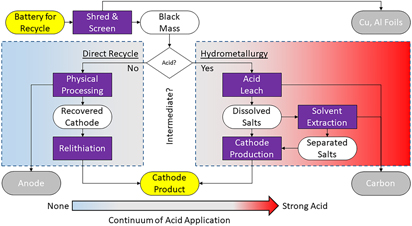
Detailed unit process analysis reveals that hydrometallurgy and direct recycling are actually very similar processes, with the key difference being the presence or absence of acid (or base) in the material processing stream. Acid is used to separate the cathode components from each other, with lower pH expected to enable more separation. Thus, the lithium can be separated from the transition metal oxides, which can in turn be separated from each other by solvent extraction, or precipitated and reused to make new cathodes. Since cathode production is the major value-added step in production, it would be desirable to recover usable cathode material. If no acid is present, the cathode structure may be maintained and potentially reused in new cells. Thus, we suggest a continuum of processes from hydrometallurgy, with strong acid, to direct recycling with none, as shown schematically in Fig. 6.
Continuum of battery recycling processes.

Table 3 summarizes the advantages and disadvantages of the different process types. Research needs for process optimization are summarized in a companion paper, “Lithium-Ion Battery Recycling Processes: Research towards a Sustainable Course”.Reference Gaines21 Insertion of recovered materials at later process steps reduces energy and emission impacts further, and the more the materials that can be recovered, the greater the reduction. So direct recycling results in the lowest impacts. This is illustrated in Fig. 5, which showed how sulfur oxide emissions are reduced if the LCO cathode is produced by recycling.
Pros and cons of battery recycling processes.

Material identification
To utilize the recycling technologies that produce the most valuable products and have the least environmental impact, it will be necessary to separate LIBs into streams with similar chemical compositions. To separate types, they must be identifiable. Therefore, the Battery Recycling Committee of the Society of Automotive Engineers (SAE) developed a label that it recommends be placed on EV battery packs or modules to enable separate processing of different battery types.22 It could also be placed on small consumer cells. The label could be read by humans or by machines. It identifies the battery type (Pb-acid, Ni-MH, or Li-ion), provides additional information about the composition, and supplies information about the manufacturer and the date of manufacture. An example is shown in Fig. 7. This label is consistent with that developed by the Battery Association of Japan.23 In addition to facilitating economical recycling, labels can also enhance safety. There have been numerous instances of fires and explosions at secondary lead smelters,Reference Binks24 caused by LIBs (now available in Pb-acid look-alike 12-V formats for starting, lighting, and ignition [SLI] use) that were sent to the smelters with conventional 12-V Pb-acid batteries, either by accident or to avoid disposal fees. This hazard provides an incentive for secondary lead companies to encourage routing of LIBs to appropriate recycling facilities. Small consumer batteries are also reported to be causing fires at municipal solid waste facilities,25,Reference McCarthy26 so efforts to recycle those in addition to automotive batteries is likely to increase. This recycling would have an immediate impact on material availability, since the life span of electronics batteries is much shorter than that of vehicle batteries. The cobalt content of recovered batteries would also be enhanced, since LCO dominates electronics battery cathode formulations.
Sample of SAE-recommended battery label (based on SAE J2984, Ref. 22).

Recyclers of LIBs would also benefit from not receiving Pb-acid batteries, receipt of which would require their dealing with hazardous material regulations concerning lead. Recognizing the importance of keeping different types of batteries separate, the SAE Battery Recycling Committee also published Document J3071, “Automotive Battery Recycling Identification and Cross-Contamination Prevention”,27 recommending practices that can help.
Design for recycling
When new battery materials and designs are developed, the primary concern is performance. Next is how efficiently manufacturing can be achieved. Especially for something as long-lived as a vehicle battery, what will happen at the product’s EOL is often not a major design consideration. However, some design features make recycling feasible, while others render it more difficult. In their document “2014 Recommended Practice for Recycling of xEV Electrochemical Energy Storage Systems,” the Battery Recycling Working Group of the United States Advanced Battery Consortium (USABC), spearheaded by representatives of U.S. auto manufacturers, recommended that early actions be taken to enable EV battery recycling. They stated, “With all of the varying cost and environmental issues associated with recycling, it should be clear that recyclability must be considered early in the product engineering design/development process. This idea directs the design engineer to adapt to a new mindset of designing for disassembly and recycling”.28 Numerous design principles were described; however, actual practice has not yet produced easily recyclable batteries.
Even if a sufficient supply of batteries can be guaranteed to arrive at a recycling facility at a reasonable cost, there are several reasons why recycling of LIBs is more difficult than recycling other products. Several design features hinder recycling. First of all, the cells contain many different materials in a complex geometry. The cells are grouped together into modules, which are in turn grouped together into a battery pack, which also includes a complex electronic battery management system, and likely a cooling system as well. Cell size and shape, which may be cylindrical, prismatic, or pouch, differ from manufacturer to manufacturer, as do module and pack design. Ideally, recycling could be made much simpler if all the packs and modules were similar, enabling construction of automated disassembly lines to separate the input stream into objects of a size suitable for further processing. Unfortunately, the trend is to unique and proprietary designs that differ by manufacturer and even by model for a given manufacturer. Similarly, standardization of cell designs would facilitate sorting and possibly enable cell disassembly instead of size reduction.
Furthermore, the materials in each cell are not standardized and they are still evolving; one recycler reported receiving cells with sixteen different cathode formulations.Reference Coy29 Although it appears that high-nickel cathodes may eventually predominate worldwide, even these will have unique formulations that have different relative proportions, with different particle structures and dopants. These differences matter more for recycling processes that recover high-value products rather than just metal content.
The more the components in a product, the harder it is to recycle. We can compare the materials in a Pb-acid battery, which achieves almost 100% recycling in first-world countries, to those in a typical LIB with LCO cathode (Fig. 8). Almost 70% of the mass of a Pb-acid cell is lead or lead oxide, recyclable at a relatively low temperature. The plastic is easily separated out for recycling, and the acid can be recycled as well, although it has a low value.
Comparison of Pb-acid and LIB cell composition.

In contrast to Pb-acid batteries, LIBs are composed of many more materials, some of which are thin films to which small particles have been adhered using binder compounds. The cathode particles are any one of the many different lithium metal oxides, singly or in complex layered structures. If the cells or modules are to be smelted, this mixture can be used as feed with no further treatment, recovering copper and the transition metals in the cathode (represented by LCO in Fig. 8) as a mixed alloy. But if recovery of additional materials is desired, pyrometallurgy is not the best option. Even if only one cathode type can be delivered to the recycler, the cathode must be separated from the other components for further processing. Getting the active-material particles separated from each other and the foils on which they are spread is made more difficult by the presence of binders that are designed specially to hold them together. Many of the recycling process variants proposed include a step in which the active-material powder recovered after shredding (black mass) is heated to drive off the binder and any vestiges of the electrolyte. However, different types of binders are available and this step may be avoidable. The standard binder is PVDF, which is not soluble in water and therefore is usually mixed with NMP (N-methyl-2-pyrrolidone) solvent during processing. Use of a water-soluble binder such as SBR (styrene butadiene rubber, thickened with sodium carboxyl methylcellulose) could avoid the use of both a fluorine-containing binder and an expensive solvent.30 This approach alleviates concern about the fate of the fluorine (from the PVDF), and no solvent recovery is required. Recycling is facilitated because the binder dissolves in water, liberating the small particles. This is an example not of product design for recycle, but process design for recycle. It is also an example of substituting for materials that pose potential difficulties.
Another design element that can be modified to facilitate or hinder recycling is joining methods. One European automaker remarked at a 2011 meeting in Belgium that it would no longer use nuts and bolts to fasten its battery pack together, but would weld the parts together instead; this is an example of design that hinders disassembly. Similarly, holding cells in place using a potting compound hinders recycling, as does the use of thermosetting compounds over thermoplastics. However, the first consideration will always be making sure that the product function is maintained, even if recyclability is hampered.
Impediments to recycling
Material collection issues
No batteries will actually be recycled into new batteries or other useful products if they don’t arrive at a recycling facility. While in some sense this is a trivial problem, actually making it happen is another matter. Small electronic devices and laptop computers, as well as many power tools, are powered by LIBs, and the lifetime of these batteries is about three years. In 2015, approximately 350 million personal computers and tablets (some having more than one cell) and about 2 billion cell phones were sold,Reference Pillot3 so in 2018, we can expect that over 2.4 billion small consumer cells will be available to be collected and recycled. In addition, there is a considerable backlog of small cells from previous years. Some of these are still in devices, like old cell phones in people’s drawers or old computers in somebody’s basement. Some have made it to electronics manufacturers, where they were separated from the devices but then just stored in a corner for the lack of a convenient outlet. In other cases, there is no simple way to disassemble the device, and the battery follows it to final disposition. There are companies and organizations that do collect batteries and the devices that contain them, but the U.S. has not set up a comprehensive system. The European Union, which has a Battery Directive,31 is doing better, but not all members have reached the mandated collection targets, and working systems for efficient recycling lag further. So the biggest current sources for batteries to be recycled are not being exploited efficiently. Manufacturing scrap is available for recycling with essentially no time delay; much of that material is being used in experimental and pilot-scale facilities.
Removal of batteries from vehicles
At the end of a typical vehicle’s life, the owner brings the vehicle to a dealer or dismantler and is given a small amount of money. The dealer may have a company-specific procedure for removing the EV battery pack or may send the vehicle to a dismantler. The dismantler does two things: (i) removes select parts from the vehicle for resale if there is demand and (ii) depollutes the vehicle by removing the fluids and other potentially hazardous materials such as mercury switches and 12-V starter batteries. The remainder of the vehicle, known as the hulk, is then sold and shipped to a shredder that recovers the metals. This process is profitable at every step in the chain but has the potential to fail when an EV enters the system. The first issue is that removing the traction battery from an EV takes training and time, adding cost. The second issue is that the battery may not have a positive value and may even cost money to recycle. The third issue is the safety of the person removing the battery and those handling it after removal. The added costs of training, labor, and proper handling may make the vehicle a liability to its owner.
A dismantler will not pay for a vehicle that has a negative value. If the vehicle is, in fact, a financial liability to the last owner, it is likely that non-ideal actions, such as abandonment, stockpiling, and improper treatment, will increase. There is a need to provide incentive to the EOL vehicle owner, or—more likely—to the dismantler, to be sure that vehicles end up in the dismantling process. Options that have been proposed include leasing the battery, having a deposit or core charge on the battery, or making the manufacturer responsible for funding EOL treatment. All of these options will ultimately result in a cost to the vehicle owner. The best solution is to reduce the cost of treating EOL EV batteries so they have a positive (or at least neutral) net value. To do this, more cost-effective battery handling and recycling processes are needed.
Transportation costs and logistics
Once enough batteries are gathered, they will require transportation to a facility where the actual material recycling will occur. Transportation must be safe and within regulatory constraints. Safety has already been a major concern, and regulations are problematic. Shipments of LIBs must display a special label (Fig. 9). Air shipment is not permitted, and U.S. rail shippers may no longer accept used batteries.
Department of Transportation label for LIB.

The high energy density of LIB cells, coupled with the presence of flammable organic electrolytes, poses the risk of “thermal runaway,” or rapid heating and self-ignition due to exothermic chemical reactions.Reference Webster32 Hence, transport of LIB packs or cells in bulk quantity is regulated to prevent fires. Since LIBs are categorized as Class 9 miscellaneous hazardous materials for transportation purposes, there are clearly defined shipping, packaging, documentation, and labeling standards for moving them domestically or internationally.Reference Mikolajczak, Kahn, White and Long33 These standards significantly increase transportation cost. High shipping costs could favor small, local pretreatment or recycling plants. Different bodies define transportation requirements differently, depending on the mode. For example, the Pipeline and Hazardous Materials Safety Administration within the U.S. Department of Transportation regulates LIB transport in the U.S. Globally, the International Civil Aviation Organization, International Air Transport Association, and International Maritime Dangerous Goods provide guidelines. In the EU, the regulatory bodies are ADRFootnote * for road and RIDFootnote † for rail transportation. Transportation requirements can include the following34:
(i) Requirements for specific packaging (e.g., thermal insulation, leak-proof inner packaging, drop-tested fibreboard box).
(ii) Provision of labels or marking on the outer packaging.
(iii) Instructions for accompanying documentation.
(iv) Restrictions on weight or numbers of batteries/cells.
In Europe, for all modes of transport, all batteries must comply with the UN Manual of Tests and Criteria Part III.34 For road transport, two ADR packing instructions are noteworthy: P908 for damaged or defective batteries and P909 for spent batteries returned for disposal or recycling.34 When transporting batteries rated ≤100 W h (per battery) for disposal and recycling, the weight restriction per package is 30 kg. For batteries rated >100 W h (per battery), no weight limitation is currently specified, though UN-approved packaging is required. As EV battery packs begin to enter the waste stream, more stringent safety requirements are expected. The variance of standards across geographies and modes can complicate international movement of used LIBs and may increase their EOL management costs or restrict their recycling to local areas. Waste management laws need to be harmonized with battery shipment regulations. The EU Battery Directive already states that waste batteries shipped overseas for recycling should adhere to waste shipment regulations.31
Policy and regulatory issues
Health and safety
Safety hazards underlying the standards include fire risk and workplace exposure to metals and fluorides during battery disassembly, shredding, and smelting. Gas cleanup may be needed for recycling facilities. Moreover, if the cells are damaged, lithium metal may deposit on the anode and react violently if exposed to moisture. Some procedures may require an inert or controlled environment. No known regulation provides specific guidelines for removing, discharging, disassembling, and storing used LIBs. The recent “regulation on the recycling and reuse of traction batteries from New Energy Vehicles (NEVs)” in China appears to be a unique first step in this direction.35 Workplace environmental, health, and safety standards may be required for U.S. LIB recycling facilities, as many of the LIB constituents are classified as hazardous chemicals by the Occupational Safety and Health Administration.Reference Vimmerstedt, Ring and Hammel36 The increased costs due to the regulations and standards could pose a barrier to commercialization of LIB recycling. There will be a need to balance between cost efficiency, environmental sustainability, and worker health and safety.
European Union
The European Union mandates that product manufacturers are responsible for collection and recycling of spent LIBs. The hope is that they will plan for battery EOL and possibly incorporate design for recycling into their manufacturing plans. The EU Battery Directive31 covers all battery types, including LIBs, and regulates their disposal. It mandates Extended Producer Responsibility (EPR), stipulating that battery producers, or third parties acting on their behalf, bear the cost of collecting, storing, treating, and recycling waste batteries. The Directive mandated a minimum collection rate of 45% for all spent portable batteries in the EU by year 2016. Most member nations have achieved this goal.Reference Bielewski37 Another EU regulation, the EOL vehicle (ELV) directive, requires that automakers take responsibility for collection and EOL management of scrap vehicles and their components.38 By definition, the EPR scheme applies to vehicle components such as batteries returned with scrapped vehicles. Currently, the ELV directive provides generic guidelines for dismantling, storing, and handling traction batteries; these guidelines were formulated for Pb-acid batteries, but do not address issues specific to managing LIBs.Reference Richa, Babbitt and Gaustad39 There is a need to include such provisions and to harmonize them with the Battery Directive.
The Directive mandates a minimum recycling efficiency of 50% by weight for batteries, with energy recovery not counted. Since it does not set recovery efficiencies for specific materials within the battery, recyclers have the flexibility to recover materials on the basis of economics or ease of recovery, as long as they achieve the targets. As a result, metals for which recycling infrastructure and processes already exist and which have high market value (Co, Ni), are preferentially recycled,Reference Wang, Gaustad, Babbitt and Richa40,Reference Gratz, Sa, Apelian and Wang41 rather than those with high environmental impact or criticality, scarcity, or supply concerns (although Co is in both categories). All commercial operations recover Co to remain profitable.Reference Heelan, Gratz, Zheng, Wang, Chen, Apelian and Wang42 Economic feasibility of Li and Mn recovery is still a question, but several processes can recover them.Reference Heelan, Gratz, Zheng, Wang, Chen, Apelian and Wang42–Reference Dewulf, van der Vorst, Denturck, van Langenhove, Ghyoot, Tytgat and Vandeputte44 High costs of recycling infrastructure and operations may deter the recycling of LIB chemistries without cobalt, such as LMO and LFP.Reference Wang, Gaustad, Babbitt and Richa40,Reference Richa, Babbitt, Gaustad and Wang45 Market-based incentives and rebate systems could encourage spent-battery collection and advance the recovery of materials from reduced-cobalt LIBs. Technological improvements are required to improve process efficiencies, and policy support for collection could generate sufficient material to enable economies of scale for recycling facilities.Reference Wang, Gaustad, Babbitt and Richa40 Currently, the annual capacity of commercial facilities ranges from 110 T (Recupyl) to 7000 T (Umicore).
China
China has recently issued a provisional regulation on the recycling and reuse of traction batteries from New Energy Vehicles (specifically including LIBs) to go into effect in August 2018.35 It mandates strict guidelines across the entire battery lifecycle, including design, manufacture, sale, maintenance, collection and transport, and finally, reuse and recycle. It is a very forward-looking policy that makes car manufacturers (or importers) responsible for the collection, sorting, storage, and transportation of the batteries. One of the unique requirements is establishment of a tracking mechanism for batteries, wherein each battery will have an identification code to be uploaded into a tracking system by battery and vehicle manufacturers, car dealers, and reuse companies and shared with dismantlers and recyclers. The regulation also promotes the design for disassembly and recycling by battery and car manufacturers and requires them to share information on dismantling and storage with stakeholders across the EOL value chain. Car manufacturers must develop a take-back network for spent batteries wherein they can use market-based mechanisms (buy-back, new-for-old, subsidies) to encourage EV users to return their spent car batteries.
United States
No federal policy exists in the U.S. to promote the recycling of LIBs. Older battery technologies are regulated at the federal level under the Mercury-Containing and Rechargeable Battery Management Act [Battery Act] of 1996.46 This law defines mercury-based, nickel-cadmium, and small Pb-acid batteries as hazardous waste under Regulation 40 CFR 273, Standards for Universal Waste Management. The Battery Act stipulates ease of removal, chemistry labeling, safe disposal/recycling, and a consistent nationwide set of rules for collection, storage, and transport. LIBs are not toxic or hazardous under the USEPA Universal Waste Rule and thus are not covered under the Battery Act, even though they are classified as Class 9 substances by the Department of Transportation because of their fire hazard. While LIBs do not contain lead, mercury, or cadmium, LIB metals can still gradually leach into the ground and water bodies if not safely discarded.Reference Vimmerstedt, Ring and Hammel36,Reference Kang, Chen and Ogunseitan47 As a result, the State of California stipulates Total Threshold Leaching Concentration limits for cobalt, nickel, and copper,48 and a study by Kang et al.Reference Kang, Chen and Ogunseitan47 found LIBs obtained from electronics to exceed these regulatory limits. The risk of metal leaching can be minimized in safely managed landfills where the waste is isolated from the environment, but a strong policy framework and/or economic incentives would minimize LIB disposal in landfills and thus prevent loss of metals that can be recovered via recycling.
The U.S. also lacks a federal policy for spent-LIB collection and management. While eight U.S. states have waste management regulations and EPR mechanisms for rechargeable batteries, only three state laws explicitly incorporate LIBs—California’s Rechargeable Battery Recycling Act of 2006,49 New York State’s Rechargeable Battery Law,50 and Minnesota’s Rechargeable Battery and Products Law of 1994.51 These states enable a free system for return of spent rechargeable batteries and ban their disposal in landfills. However, the penalties for non-compliance are either negligible or absent. California and Minnesota have no penalty. While the New York law states that violators are subject to a civil penalty, the fines are nominal and rarely enforced, since catching violators is time-consuming.
Only Minnesota has set collection targets (of 90%) for waste rechargeable batteries, but these are not mandatory. While Minnesota law requires EV and battery manufacturers to co-manage waste batteries, the New York and California laws, and voluntary collection schemes in the U.S., such as Call2Recycle, are limited to small consumer batteries. For example, the Call2Recycle program only collects rechargeable batteries under 11 pounds,52 and New York State collects only those under 25 pounds.Reference Richa, Babbitt, Gaustad and Wang45 The assumption was apparently made that EV batteries would come back in the same ways that Pb-acid SLI batteries do. A bill, “AB-2832 Recycling and Reuse: Lithium-Ion Batteries,” was introduced in the California Assembly in February 201853 with a specific focus on EV LIBs. The proposed law aims to establish a proper disposal mechanism for EV LIBs with no cost to EV owners. It requires the California Department of Toxic Substances Control to work with other state agencies to identify ways to reuse and recycle EV LIBs and promulgates the establishment of a grant program for developing EOL avenues. Battery manufacturers would be eligible for such a funding program. Another California bill, “AB-2407 Recycling: Lithium-Ion Vehicle Batteries: Advisory Group,” was introduced in February 2018 and later amended54; it proposes to establish an advisory group by April 2019 to provide policy recommendations by April 2020 to ensure that 90% of the discarded EV LIBs in the state are recycled safely and economically. The state Secretary of Environmental Protection would convene a “Lithium-Ion Car Battery Recycling Advisory Group” and would appoint members representing different stakeholders. These bills, if successfully enacted, would pave the path for high collection rates of automobile LIBs in California.
Conclusions
Although there are excellent reasons to recycle LIBs, numerous hurdles hinder actual implementation on a large scale. There are policy gaps that serve as barriers to recycling of LIBs. These gaps exist along the entire value chain of battery design and manufacturing, as well as at EOL. Spent-battery collection, transportation, and recycling processes also face economic barriers. Additionally, policies meant to prevent landfill disposal of LIBs in the U.S. are weak. Effective policy mechanisms, and possibly incentives, are needed to encourage battery collection, recycling process improvement, infrastructure development, and recycling cost reduction.
To improve overall recycling efficiencies of LIBs, both recycling process efficiency and collection rate have to be improved. Apart from developing improved recycling technologies, recycling process efficiency would also require consideration of battery EOL during the design and manufacturing phase itself. There is no incentive for the end-users to return batteries for collection, and the result is poor collection rates of LIBs. Collection rate is mostly an issue for consumer-electronics batteries and may be less of a concern for EV LIBs. Owing to poor collection, lack of economies of scale for their recycling can be a hindrance to commercialization of recycling of low-cobalt-containing LIBs.Reference Wang, Gaustad, Babbitt and Richa40 Since LIBs are not considered hazardous by the USEPA, their disposal and collection is not strictly regulated, in contrast to waste management laws for older battery technologies (e.g., the Battery Act in the U.S.). Although the Department of the Interior’s critical minerals list includes lithium, cobalt, manganese, and graphite, their critical nature and scarcity do not result in the promotion of LIB recycling, which is a major policy gap. Beyond re-evaluating and strengthening existing EPR mechanisms, Table 4 shows several industry and government measures that could promote recycling of LIB materials.Reference Richa, Babbitt and Gaustad39,Reference Wang, Gaustad, Babbitt and Richa40,Reference Harland55,Reference Gaines56 Concerted efforts by stakeholders could enable a viable recycling system for automotive LIBs to be ready by the time many of them go out of service.
Possible mechanisms to enable LIB recycling.

Acknowledgments
The authors wish to thank the DOE Office of Energy Storage for support and the battery recyclers and Argonne staff who provided information and helpful comments during the preparation of this work. Special thanks to Qiang Dai, who made many of the graphs, and Jarod Kelly, who made the continuum figure.
This work was sponsored primarily by the U.S. Department of Energy’s Office of Vehicle Technologies. The submitted article was created by UChicago Argonne, LLC, Operator of Argonne National Laboratory (“Argonne”). Argonne, a U.S. Department of Energy Office of Science laboratory, is operated under Contract No. DE-AC02-06CH11357. The U.S. Government retains for itself, and others acting on its behalf, a paid-up nonexclusive, irrevocable worldwide license in said article to reproduce, prepare derivative works, distribute copies to the public, and perform publicly and display publicly, by or on behalf of the Government.
The views expressed in the article do not necessarily represent the views of the U.S. Department of Energy or the U.S. Government.