Implications
Availability of DNA sequence information has facilitated characterization of the behavior of molecular networks at multiple points of growth, development and disease. Although the scientific method has allowed us to amass substantial amounts of information at the tissue and cow level in the peripartal period, major gaps in knowledge of the molecular adaptations during this crucial life stage of the dairy cow remain. This review is focused on the use of transcriptomics and bioinformatics to study function of liver, adipose and mammary tissue during the peripartal period and how those data relate to animal-level measures of metabolism. Work on mRNA expression of candidate genes important for metabolic/functional adaptations in tissues is discussed. Network and pathway analysis of high-throughput transcriptomics data due to peripartal plane of nutrition in both health and disease are also explored. The potential for targeting nuclear receptors/transcription regulators in tissues via nutrition is evaluated. Lastly, perspectives for the peripartal cow as a model for systems biology are presented.
Introduction
Achieving homeostasis during the transition from late pregnancy to lactation represents a monumental task in modern high-producing dairy cows. Changes in the direction and magnitude of various pathways of long-chain fatty acid (LCFA), glucose, and amino acid metabolism in periparturient cows have been well described during the last 25 to 30 years (reviews by McNamara, Reference McNamara1991; Bauchart, Reference Bauchart1993; Grummer, Reference Grummer1995; Drackley, Reference Drackley1999; Chilliard et al., Reference Chilliard, Ferlay, Faulconnier, Bonnet, Rouel and Bocquier2000; Drackley et al., Reference Drackley, Donkin and Reynolds2006). Despite the extensive body of work accumulated, however, the mechanisms underlying metabolic adaptations in liver (e.g. Rhoads et al., Reference Rhoads, Kim, Leury, Baumgard, Segoale, Frank, Bauman and Boisclair2004; Andersen et al., Reference Andersen, Ridder and Larsen2008) and adipose (e.g. Rhoads et al., Reference Rhoads, Kim, Leury, Baumgard, Segoale, Frank, Bauman and Boisclair2004; Sumner and McNamara, Reference Sumner and McNamara2007; Smith et al., Reference Smith, Butler and Overton2009) during this physiological stage remain actively studied. More importantly, it is now recognized that adipose tissue through the synthesis and secretion of a wide variety of proteins could influence metabolism of tissues including liver (reviews by Chilliard et al., Reference Chilliard, Delavaud and Bonnet2005; Drackley et al., Reference Drackley, Dann, Douglas, Janovick Guretzky, Litherland, Underwood and Loor2005; Vernon, Reference Vernon2005).
Development of high-throughput sequencing and transcriptomics technologies has dramatically accelerated the rate at which biological and genetic information can be gathered. Genomics encompasses the study of all the genes of a cell, or tissue, at the DNA (genotype), mRNA (transcriptome) or protein (proteome) levels. Microarray technology, in particular, is a powerful tool for the simultaneous analysis of the expression of thousands of genes in tissues, organs or cells. DNA sequence information encoding RNA for specific genes is physically printed onto microarray ‘chips,’ thus allowing measurement of the abundance of each RNA molecule in a biological sample. Together with whole-animal level information, large-scale DNA and mRNA information are increasing our understanding of mechanisms of genetic regulation in agricultural species. Functional genomics is generally defined as the study of the transcriptome (Schoolnik, Reference Schoolnik2002). The transcriptome (i.e. mRNA) encodes genetic information about a protein and changes in its expression exert a major influence on physiological conditions.
Over the last 15 to 20 years, the liver has been the organ most studied in terms of defining changes in mRNA expression of genes encoding proteins that participate in various aspects of liver lipoprotein assembly (Gruffat et al., Reference Gruffat, Durand, Chilliard, Williams and Bauchart1997; Bremmer et al., Reference Bremmer, Bertics, Besong and Grummer2000; Bernabucci et al., Reference Bernabucci, Ronchi, Basiricò, Pirazzi, Rueca, Lacetera and Nardone2004), growth hormone (GH) signaling (Radcliff et al., Reference Radcliff, McCormack, Crooker and Lucy2003; Rhoads et al., Reference Rhoads, Kim, Leury, Baumgard, Segoale, Frank, Bauman and Boisclair2004), ureagenesis and gluconeogenesis (Greenfield et al., Reference Greenfield, Cecava and Donkin2000; Hartwell et al., Reference Hartwell, Cecava and Donkin2001). Owing to the expense and infrastructure required, few studies have used microarray technology to more fully evaluate the ruminant peripartal transcriptome in liver (Loor et al., Reference Loor, Dann, Everts, Oliveira, Green, Janovick-Guretzky, Rodriguez-Zas, Lewin and Drackley2005a, Reference Loor, Bionaz, Janovick-Guretzky, Everts, Oliveira, Green, Litherland, Rodriguez-Zas, Lewin and Drackley2006 and 2007), adipose (Janovick et al., Reference Janovick, Loor, Ji, Everts, Lewin, Rodriguez-Zas and Drackley2009; Sumner et al., Reference Sumner, Schachtschneider, Hutjens, Youngquist, Duncan, Rocco, Miller, Vierck and McNamara2009a), mammary (Finucane et al., Reference Finucane, McFadden, Bond, Kennelly and Zhao2008; Ollier et al., Reference Ollier, Leroux, De la Foye, Bernard, Rouel and Chilliard2009; M. Bionaz, S. L. Rodriguez-Zas, R. E. Everts, H. A. Lewin, W. L. Hurley and J. J. Loor, unpublished results) and also neutrophils (Madsen et al., Reference Madsen, Chang, Hickey, Rosa, Coussens and Burton2004; Wang et al., Reference Wang, Puntenney, Burton and Forsberg2009). Using a candidate gene approach or large-scale transcriptomics, work in genomics of peripartal adaptations to date has provided insights into physiological functions of key tissues. In the following sections, recent studies evaluating mRNA on a focused or high-throughput scale will be discussed.
Genetically imposed nutrient prioritization: consequences for adipose, liver, immune cells and animal productivity
In early post partal dairy cows, a series of biological mechanisms bring about the prioritization for milk production at the cost of body reserves (Bauman and Currie, Reference Bauman and Currie1980; Chilliard, Reference Chilliard1999; Ingvartsen, Reference Ingvartsen2006; Leroy et al., Reference Leroy, Vanholder, Van Knegsel, Garcia-Ispierto and Bols2008). Drastically reduced insulin concentrations and alterations in cellular response elements cause a reduction in lipogenesis to extremely low rates. Recent transcriptomics analysis has shown a clear reduction in most of the control elements and enzymes regulating lipogenesis (Janovick et al., Reference Janovick, Loor, Ji, Everts, Lewin, Rodriguez-Zas and Drackley2009; Sumner et al., Reference Sumner, Schachtschneider, Hutjens, Youngquist, Duncan, Rocco, Miller, Vierck and McNamara2009a). In addition, lipid mobilization increases to supply fatty acids to the udder and other organs. Adipose tissue of high-yielding dairy cows has an increased sensitivity to lipolytic stimuli (e.g. low insulin, high catecholamines or high glucocorticoid concentrations; McNamara and Hillers, Reference McNamara and Hillers1989). The classic phosphorylation scheme is a large part of the regulation of HSL activity. However, recent work suggests that there may be some upregulation of mRNA expression of lipolytic genes (e.g. β-adrenergic receptors, hormone-sensitive lipase; Sumner and McNamara, Reference Sumner and McNamara2007).
The non-esterified fatty acids (NEFA) released from adipose travel primarily to liver and must be fully-oxidized to CO2, converted to ketone bodies, or esterified into TAG either for delivery into blood as very low density lipoproteins (VLDL) or storage as cytosolic lipid droplets (Drackley, Reference Drackley1999). Because ruminants have inherently low rates of VLDL synthesis and secretion (Pullen et al., Reference Pullen, Liesman and Emery1990), accumulation of TAG in liver cells as well as extensive output of ketone bodies such as β-hydroxybutyrate (BHBA) into the circulation likely afflict all dairy cows (Reynolds et al., Reference Reynolds, Aikman, Lupoli, Humphries and Beever2003). The metabolic load placed on the peripartal cow liver is exacerbated by the decrease in feed intake and negative energy balance, which can occur as early as 10 days before parturition (Allen et al., Reference Allen, Bradford and Harvatine2005).
In addition to triggering lipolysis, hypoinsulinemia promotes gluconeogenesis (up to 4 kg glucose each day; e.g. Drackley et al., Reference Drackley, Overton and Douglas2001; Reynolds et al., Reference Reynolds, Aikman, Lupoli, Humphries and Beever2003) and uncouples the GH – insulin like growth factor 1 (IGF-I) axis in liver due to downregulation of GH1A transcript abundance (Lucy, Reference Lucy2007). As IGF-I production in liver is suppressed, the negative feedback of IGF-I is removed at the level of the hypothalamus/pituitary gland, and GH concentrations increase. High GH concentrations not only stimulate milk production but also enhance and sustain gluconeogenesis in liver and lipolysis in adipocytes (Etherton and Bauman, Reference Etherton and Bauman1998). The resulting high blood NEFA and GH concentrations antagonize insulin actions, place additional stress on liver function, and create a further state of peripheral insulin resistance (Lucy, Reference Lucy2007; Pires et al., Reference Pires, Pescara, Brickner, Silva Del Rio, Cunha and Grummer2008). Under the above scenarios, even more glucose is conserved and made available to the mammary gland for lactose synthesis. Hyperinsulinemic-euglycemic clamp work with peripartal cows (e.g. Bauman and Griinari, Reference Bauman and Griinari2003; Rhoads et al., Reference Rhoads, Kim, Leury, Baumgard, Segoale, Frank, Bauman and Boisclair2004) has shown that enhancing insulin sensitivity in adipose tissue can prevent excessive adipose lipolysis (i.e. lower blood NEFA).
Elevated NEFA concentrations have been negatively correlated with pancreatic function (evaluated via glucose tolerance tests) in early post partal cows (Bossaert et al., Reference Bossaert, Leroy, De Vliegher and Opsomer2008). Although observations in vitro suggested that blood neutrophil phagocytic capacity was marginally affected by NEFA concentrations similar to those observed after parturition (i.e. 1 to 2 mM), there was evidence of reduced cell viability and greater necrosis (Scalia et al., Reference Scalia, Lacetera, Bernabucci, Demeyere, Duchateau and Burvenich2006). Data showed that when challenged with high levels of NEFA, neutrophils had a marked increase in oxidative burst activity, which in turn appears detrimental to their viability. An additional response associated with lipolysis around parturition is the marked shift in concentration and profiles of LCFA both in blood NEFA and liver tissue phospholipids (Douglas et al., Reference Douglas, Rehage, Beaulieu, Bahaa and Drackley2007; Ballou et al., Reference Ballou, Gomes, Juchem and DePeters2009). It has been proposed that alterations in immune cell plasma membrane fatty acid content also could affect inflammatory responses and how the cow responds to pathogens (Sordillo et al., Reference Sordillo, Contreras and Aitken2009) or metabolic disorders after parturition. As argued in the following sections, prepartal lipid supplementation may be one useful nutritional strategy to prepare tissues to face the metabolic demands after parturition. However, the molecular targets of LCFA must be first identified and their mechanisms clearly studied before practical recommendations can be made.
Candidate gene expression analysis of enzymes and transcription regulators and their links to metabolism in liver of peripartal cows
Lipoprotein and cholesterol metabolism
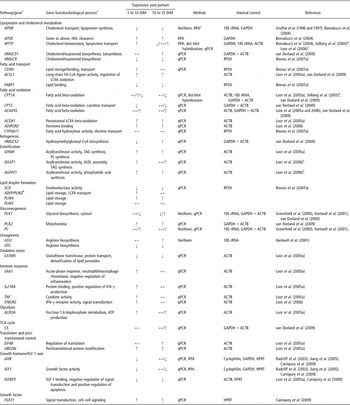
A number of studies over the last 10 to 15 years have used a focused approach to study subsets of genes that appear central to metabolic adaptations in liver (Table 1). The reviews of Bauchart (Reference Bauchart1993) and Gruffat et al. (Reference Gruffat, Durand, Graulet and Bauchart1996) outlined data indicating the potential role of apolipoprotein B (APOB) in the development of fatty liver after parturition. This apolipoprotein is the major protein of the VLDL particles and lipoproteins that result from their catabolism by the lipolytic cascade (intermediate density lipoproteins and low density lipoproteins, LDL; Bauchart, Reference Bauchart1993). The work of Gruffat et al. (Reference Gruffat, Durand, Graulet and Bauchart1996 and Reference Gruffat, Durand, Chilliard, Williams and Bauchart1997) showed that despite a lack of change in APOB mRNA, the liver concentration of APOB protein was ca. 25% lower after parturition (1, 2 and 4 weeks) relative to the prepartal period. However, it was noteworthy that APOB mRNA was numerically lower after parturition and that effect was later confirmed by Bernabucci et al. (Reference Bernabucci, Ronchi, Basiricò, Pirazzi, Rueca, Lacetera and Nardone2004). From these studies it was evident that reductions of APOB mRNA or protein were associated with increased liver concentration of TAG and reduced concentration of VLDL in blood for at least the first 3 to 4 weeks post partum. Thus, the potential for a functional link between reduced APOB and peripartal liver lipidosis was established. This apoprotein remains an important player of intracellular lipid metabolism in peripartal cows (Figure 1).
Relative expression of genes associated with pathways of lipid, carbohydrate and nitrogen metabolism as well as immune response, translation and growth factors in liver during the peri-partal period

RPA = ribonuclease protection assay.
Arrows denote upregulation, downregulation or no change in expression compared with the pre partum period.
†Gene symbol and function according to the National Center for Biotechnology Information (NCBI).
‡No pre partum value reported, but no change between 2 and 14 DIM.
§Expression greater in cows fed ad libitum energy pre partum and consuming ca. 150% of the energy requirements v. cows consuming ca. 80% of the requirements pre partum.
∥Treatment × time effect such that cows consuming ca. 150% of energy requirements during the dry period had greater mRNA abundance on day 1 post partum v. day −14 or 14.
¶Time effect P = 0.11.
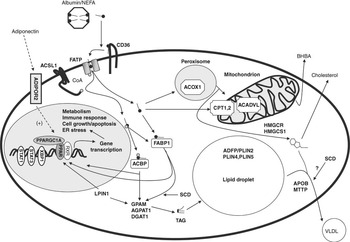
Putative model of long-chain fatty acid (NEFA) uptake, intracellular metabolism, and transcriptional adaptations in peripartal liver (modified from Bionaz et al., Reference Bionaz, Drackley, Dann and Loor2007a). The central role of PPARα in coordinating metabolic adaptations to dietary fatty acids or fasting in non-ruminants is well established. However, recent data suggest that PPARδ also may play a role in liver glucose and lipoprotein metbolism (e.g. Sanderson et al., Reference Sanderson, Degenhardt, Koppen, Kalkhoven, Desvergne, Müller and Kersten2009 and Reference Sanderson, Boekschoten, Desvergne, Müller and Kersten2010).

Additional mRNA expression work has evaluated other proteins associated with lipoprotein metabolism including microsomal triglyceride transfer protein (MTTP) and apolipoprotein E (APOE; Bremmer et al., Reference Bremmer, Bertics, Besong and Grummer2000; Bernabucci et al., Reference Bernabucci, Ronchi, Basiricò, Pirazzi, Rueca, Lacetera and Nardone2004) as well as the cytosolic enzymes 3-hydroxy-3-methylglutaryl-Coenzyme A synthase 1 (HMGCS1; van Dorland et al., Reference van Dorland, Richter, Morel, Doherr, Castro and Bruckmaier2009) and 3-hydroxy-3-methylglutaryl-Coenzyme A reductase (HMGCR; Bionaz et al., Reference Bionaz, Drackley, Dann and Loor2007a), which control the synthesis of cholesterol in liver. Results indicate that at parturition there is an increase in MTTP coupled with a reduction in HMGCR and unchanged HMGCS1 relative to pre partum levels. These responses are for the most part reversed by the 2nd week post partum and persist through the first month of lactation, particularly for HMGCS1 which corresponds to some extent to the pattern of blood cholesterol around those times (e.g. Bernabucci et al., Reference Bernabucci, Ronchi, Basiricò, Pirazzi, Rueca, Lacetera and Nardone2004; Bertoni et al., Reference Bertoni, Trevisi, Han and Bionaz2008). Greater pre-partal blood cholesterol levels through saturated fat supplementation were associated with lower liver TAG during the 2nd week post partum (Andersen et al., Reference Andersen, Ridder and Larsen2008), which implies that this type of nutritional management might be beneficial for peripartal cows. It is recognized, however, that the effects of pre-partal supplemental lipid have not been consistent across studies (e.g. Grum et al., Reference Grum, Drackley, Younker, LaCount and Veenhuizen1996; Douglas et al., Reference Douglas, Rehage, Beaulieu, Bahaa and Drackley2007; Andersen et al., Reference Andersen, Ridder and Larsen2008; Ballou et al., Reference Ballou, Gomes, Juchem and DePeters2009; Carriquiry et al., Reference Carriquiry, Weber, Fahrenkrug and Crooker2009), likely due to a combination of factors including the genetic ability of the cow to utilize the lipid, makeup of the dietary components of the basal diet (e.g. level of effective fiber, level of starch), level/type of lipid supplementation and/or length of the prepartal feeding period. A thorough evaluation of those factors was beyond the scope of this review, but will have to be performed in the future if lipid supplementation is to be of practical value to target certain molecules in the tissue’s transcriptome (see discussion below).
Fatty acid oxidation and esterification
Evaluation of in vivo pathways of fatty acid oxidation and esterification in liver (e.g. Grum et al., Reference Grum, Drackley, Younker, LaCount and Veenhuizen1996; Van Den Top et al., Reference Van den Top, Geelen, Wensing, Wentink, Van ‘t Klooster and Beynen1996) received substantial attention during the last 15 to 20 years. Those studies revealed important roles of the peroxisomal oxidation pathway as well as the enzymes acyl-CoA:sn-glycerol-3-phosphate 1-O-acyltransferase (AGPAT) or glycerol-3-phosphate acyltransferase, mitochondrial (GPAM), both which have the same EC number (2.3.1.15), diacylglycerol O-acyltransferase (DGAT) and phosphatidate phosphatase (PPAP) on the adaptations of the liver during the peripartum period. More than 50% of total fatty acid oxidation rates in liver were due to peroxisomal oxidation and this increased to >60% of total oxidative capacity within 2 to 4 weeks post partum (Grum et al., Reference Grum, Drackley, Younker, LaCount and Veenhuizen1996). In addition, it was recognized that activity of GPAT/AGPAT, PPAP and DGAT all increased from late pregnancy through the 1st week post partum and was also affected by the pre-partal dietary energy level (Van Den Top et al., Reference Van den Top, Geelen, Wensing, Wentink, Van ‘t Klooster and Beynen1996).
A difficulty in trying to reconcile enzyme activity assays conducted several years ago with more current mRNA and protein expression data is the recognition that several of the proteins associated with liver lipid metabolism can exist as different isoforms, each encoded by a unique mRNA. Examples include the glycerol-phosphate acyltransferases AGPAT (AGPAT1 is liver-specific, AGPAT6 is mammary specific; Bionaz and Loor, Reference Bionaz and Loor2008a) and GPAM (the mitochondrial isoform). Novel enzymes with PPAP activity (lipins, LPIN) have also been identified and found to play important roles in DAG formation as well as transcription regulation (Finck et al., Reference Finck, Gropler, Chen, Leone, Croce, Harris, Lawrence and Kelly2006; Reue and Zhang, Reference Reue and Zhang2008). Thus, reconciling mRNA expression data and activity for specific isoforms in the future will require reevaluation with more specific assays targeting the particular enzyme.
Data are currently available for the peripartal mRNA expression of genes encoding enzymes associated with mitochondrial (carnitine palmitoyl transferase-1A (liver), CPT1A, CPT2 and acyl-CoA dehydrogenase, very long-chain, ACADVL) or peroxisomal (acyl-CoA oxidase 1, palmitoyl, ACOX1) beta-oxidation (Table 1). Work from rodent studies showing that adiponectin from adipose tissue and a functional liver-specific adiponectin receptor (ADIPOR2) are involved in hepatic fatty acid oxidation (e.g. Yamauchi et al., Reference Yamauchi, Kamon, Ito, Tsuchida, Yokomizo, Kita, Sugiyama, Miyagishi, Hara, Tsunoda, Murakami, Ohteki, Uchida, Takekawa, Waki, Tsuno, Shibata, Terauchi, Froguel, Tobe, Koyasu, Taira, Kitamura, Shimizu, Nagai and Kadowaki2003 and Reference Yamauchi, Nio, Maki, Kobayashi, Takazawa, Iwabu, Okada-Iwabu, Kawamoto, Kubota, Kubota, Ito, Kamon, Tsuchida, Kumagai, Kozono, Hada, Ogata, Tokuyama, Tsunoda, Ide, Murakami, Awazawa, Takamoto, Froguel, Hara, Tobe, Nagai, Ueki and Kadowaki2007) also sparked interest on evaluating ADIPOR2 in peripartal cows fed different levels of dietary energy pre partum (Loor et al., Reference Loor, Bionaz, Janovick-Guretzky, Everts, Oliveira, Green, Litherland, Rodriguez-Zas, Lewin and Drackley2006). The temporal increase in liver ADIPOR2, if it translated into more protein, would be one adaptation to allow for adiponectin’s action ((via nuclear receptors (NR), e.g. peroxisome proliferator-activated receptors (PPAR)) to stimulate LCFA oxidation. This intriguing possibility remains to be shown.
Data for CPT1A mRNA expression has been inconsistent, that is, some studies report increased mRNA (statistical or numerical; Loor et al., Reference Loor, Dann, Everts, Oliveira, Green, Janovick-Guretzky, Rodriguez-Zas, Lewin and Drackley2005a; Bionaz et al., Reference Bionaz, Drackley, Dann and Loor2007a), decreased (van Dorland et al., Reference van Dorland, Richter, Morel, Doherr, Castro and Bruckmaier2009) or no change (Selberg et al., Reference Selberg, Staples, Luchini and Badinga2005). Expression pattern of ACADVL, which catalyzes the first step of mitochondrial oxidation (e.g. Drackley, Reference Drackley1999), was also found to increase or remain unchanged after calving. There is only one report of ACOX1 mRNA expression in peripartal cows showing an increase after parturition. Previous work with peripartal cows showed numerical increases in liver CPT1 activity at the onset of lactation and through 14 day post-calving relative to the dry period (Dann and Drackley, Reference Dann and Drackley2005). The biological effect of moderate increases in CPT1 activity cannot be underestimated as a 46% increase in its activity due to overexpression of its mRNA in rodents was sufficient to reduce liver TAG accumulation and enhance palmitate oxidation (Stefanovic-Racic et al., Reference Stefanovic-Racic, Perdomo, Mantell, Sipula, Brown and O’Doherty2008). Thus, activity and mRNA data available for enzymes of mictochondrial and peroxisomal oxidation point at a concerted action at two levels of regulation in allowing hepatocytes to cope with the sudden influx of NEFA. We have postulated that ligand-dependent NR such as PPARα (PPARA), PPARγ coactivator 1α (PPARGC1A) and/or hepatocyte nuclear factor 4-α (HNF4A) mediate these coordinated responses (Loor et al., Reference Loor, Everts, Bionaz, Dann, Morin, Oliveira, Rodriguez-Zas, Drackley and Lewin2007b).
Fatty acid uptake, intracellular activation and channeling
More recent work has focused on a wider spectrum of genes encoding for enzymes associated with cellular LCFA uptake (CD36 molecule (thrombospondin receptor, CD36)), intracellular LCFA activation (Acyl-CoA synthase ligase, ACSL isoforms) and intracellular LCFA channeling (Fatty acid binding protein, FABP isoforms). Our laboratory (Bionaz et al., Reference Bionaz, Drackley, Dann and Loor2007a) has used a more holistic approach (Figure 1) to study liver peripartal adaptations, that is, a focus has been on evaluating the concerted changes in mRNA expression of genes associated with fatty acid uptake, cholesterol synthesis, fatty acid oxidation and fatty acid esterification (i.e. TAG formation) as well as transcription regulators (Table 2). Those studies have been useful in establishing the more abundant FABP and ACSL isoforms and how their expression profiles change over the transition period. From a transcriptional standpoint (i.e. messenger RNA), an isoform can refer to a protein variant produced as a result of different genes. Even if isoform proteins are highly similar and have a conserved functional domain, both the specific cellular localization as well as differences in affinity for substrates can play an important role in determining the fate of fatty acids, for example, esterification v. β-oxidation. This has been shown for ACSL and FABP isoforms mostly in rodents (Coleman et al., Reference Coleman, Lewin, Van Horn and Gonzalez-Baró2002; Furuhashi and Hotamisligil, Reference Furuhashi and Hotamisligil2008).
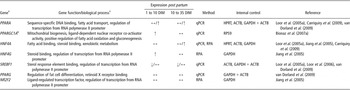
Relative expression of transcription regulators of metabolic pathways in liver during the peri-partal period

RPA = ribonuclease protection assay.
Arrows denote upregulation, downregulation or no change in expression compared with the pre partum period.
†Gene symbol and function according to the National Center for Biotechnology Information (NCBI).
‡Time effect P = 0.14.
Divergent tissue expression patterns are also suggestive of functional specificity, as has been highlighted for FABP, GPAT, AGPAT and LPIN isoforms (Furuhashi and Hotamisligil, Reference Furuhashi and Hotamisligil2008; Takeuchi and Reue, Reference Takeuchi and Reue2009). Isoforms of LPIN and AGPAT have been characterized recently and, for both, diverse biological functions among the different isoforms have been suggested (Takeuchi and Reue, Reference Takeuchi and Reue2009). Regulation of the abovementioned gene families occurs almost exclusively at the gene expression level. Furthermore, some of the ACSL, FABP and AGPAT isoforms are under the control of PPAR in several tissues. In addition, PPARGC1A appears to regulate expression of LPIN1 (Finck et al., Reference Finck, Gropler, Chen, Leone, Croce, Harris, Lawrence and Kelly2006; Reue and Zhang, Reference Reue and Zhang2008). Thus, measurement of isoform mRNA expression in liver tissue will provide valid information to aid in generating hypotheses for more detailed functional studies.
Acyl-CoA synthetase activates fatty acids through an ATP-requiring process before entry into different intracellular metabolic pathways. During the process of LCFA entry into cells (Figure 1), FABP also play a key role in channeling LCFA into different metabolic pathways. In fact, FABP are among the most abundant intracellular proteins in liver (ca. 5% of total cytosolic protein; McArthur et al., Reference McArthur, Atshaves, Frolov, Foxworth, Kier and Schroeder1999) and effectively allow rapid diffusion and selective channeling of LCFA toward specific organelles for metabolism (McArthur et al., Reference McArthur, Atshaves, Frolov, Foxworth, Kier and Schroeder1999). They also bind LCFA CoAs, as shown for the liver-specific FABP (Schroeder et al., Reference Schroeder, Petrescu, Huang, Atshaves, McIntosh, Martin, Hostetler, Vespa, Landrock, Landrock, Payne and Kier2008). Some isoforms of ACSL (ACSL3, 4) and FABP (FABP5) are among several proteins related to lipid metabolism that are found associated with intracellular lipid droplets (LD) in liver cells (Sato et al., Reference Sato, Fukasawa, Yamakawa, Natsume, Suzuki, Shoji, Aizaki, Miyamura and Nishijima2006). Both ACSL and FABP have been well characterized in mice, rats and humans but no data were available for the bovines until recently (Bionaz et al., Reference Bionaz, Drackley, Dann and Loor2007a; Bionaz and Loor, Reference Bionaz and Loor2008a).
Our evaluation of mRNA expression of ACSL and FABP in peripartal liver (Bionaz et al., Reference Bionaz, Drackley, Dann and Loor2007a) revealed for the first time that FABP1, ACSL1 and ACSL5 are the most predominant isoforms, with FABP1 accounting for ca. 89% of total isoforms and ACSL1 and ACSL5 for ca. 6% and ca. 4% of total isoforms when expressed as a percentage of total ACSL1-6 and FABP1-6 mRNA. In cows fed diets to meet or exceed energy requirements during the dry period, however, data also showed that both FABP1 and ACSL5 decreased between −14 and 1 days relative to parturition followed by an increase (ca. 3-fold) by day 14 but still not to prepartal levels (Table 1). In contrast, ACSL1 expression increased to peak values from −14 to 1 day after which it remained elevated by day 14 relative to parturition (Table 1).
It is possible that the marked decrease in FABP1 mRNA, if it also occurred at the protein level, on day 1 post partum is one of the factors precluding additional amounts of intracellular LCFA from being channeled toward β-oxidation. However, the marked increase (ca. 3-fold) in expression of FABP1 between calving and 14 day post partum, which coincided with a reduction in serum NEFA and an increase of in vitro liver tissue palmitate metabolism (Bionaz et al., Reference Bionaz, Drackley, Dann and Loor2007a), was indicative of a link between NEFA and downstream activation of PPARα because in rodent liver it was shown that the amount of FABP1 protein is correlated with transactivation of the NR in response to LCFA as well as chemical ligands (Wolfrum et al., Reference Wolfrum, Borrmann, Borchers and Spener2001). Thus, just as in rodents, FABP1 in peripartal liver could act as a cytosolic gateway for PPARα activation (Wolfrum et al., Reference Wolfrum, Borrmann, Borchers and Spener2001). In an analogous manner, FABP4, which is the most abundant isoform in non-ruminant/ruminant adipose tissue (Janovick et al., Reference Janovick, Loor, Ji, Everts, Lewin, Rodriguez-Zas and Drackley2009; Sumner et al., Reference Sumner, Shachtschneider, Hutchins, Youngquist, Duncan, Rocco, Miller, Vierck, McNamara and Lowe2009b), has also been shown to bind exogenous LCFA and translocate to the nucleus (via an unknown mechanism) and interact with PPARγ (Adida and Spener, Reference Adida and Spener2006), the main PPAR isoform in mammalian adipose tissue. Thus, it could be possible that NEFA generated during basal or hormone-stimulated lipolysis (or from uptake via lipoprotein lipase action on circulating lipoproteins) in adipose tissue bind to FABP4, which then can interact with PPARγ and activate a transcriptional cascade allowing for pre-adipocyte differentiation and lipid filling (see discussion below).
A greater amount of ACSL1 alone might be insufficient to prevent incoming LCFA from being esterified into TAG, a response typically observed after parturition as a result of greater activity of GPAT/AGPAT, PPAP and DGAT (e.g. Grummer, Reference Grummer1995; Gruffat et al., Reference Gruffat, Durand, Graulet and Bauchart1996; Van Den Top et al., Reference Van den Top, Geelen, Wensing, Wentink, Van ‘t Klooster and Beynen1996; Drackley, Reference Drackley1999). Recent mRNA expression data (Table 1) for the most part agree with results of enzyme activities, but it should be noted that the relative expression of the above genes for the most part has been restricted to a few studies and none involving pre-partal lipid supplementation. Thus, it is possible that expression patterns may be different depending on the type and amount of lipid supplementation.
Cytosolic lipid droplet formation in hepatic cells
Perilipin (PLIN) and mouse adipose differentiation-related protein (ADFP or PLIN2) were two of the first proteins experimentally shown to associate with the cytosolic LD surface (Brasaemle, Reference Brasaemle2007). Lipid droplets store neutral lipids (TAG primarily) in their core, and under continuous supply of LCFA the nascent lipid droplets (e.g. Dalen et al., Reference Dalen, Ulven, Arntsen, Solaas and Nebb2006) continue growing until they reach a final size that depends on the cell type and typically ranges between 1 and 20 mm (Goodman, Reference Goodman2008). Other proteins commonly associated with intracellular LD include ACSL, GPAT, AGPAT and DGAT (Goodman, Reference Goodman2008).
In adipose tissue, PLIN are essential for both droplet formation as well as basal and hormone-stimulated lipolysis (Brasaemle, Reference Brasaemle2007). Adipophilin (ADFP/PLIN2) and the perilipin gene are both part of the perilipin family. However, it is believed that PLIN4 (formerly S3-12) and PLIN5 (formerly OXPAT/MLDP) are exchangeable cytosolic LD proteins that facilitate rapid protein association with the earliest deposits of neutral lipids. Thus, they appear essential for efficient lipid packaging and the stabilization of nascent LD (Brasaemle, Reference Brasaemle2007). In contrast, the integral LD proteins PLIN1 and ADFP/PLIN2 may serve more critical roles in managing the turnover of neutral lipid stores to facilitate the regulated release of LCFA and cholesterol in response to changes in the metabolic state (Brasaemle, Reference Brasaemle2007).
The ADFP/PLIN2 protein associates with smaller neutral LDs located within most tissues, but rarely in adipose cells, which express PLIN1 (Brasaemle, Reference Brasaemle2007). The presence of ADFP/PLIN2 might be more relevant in liver, where it is expressed at high levels and PLIN1 is not normally expressed (Brasaemle, Reference Brasaemle2007). Data from our laboratory (Bionaz et al., Reference Bionaz, Drackley, Dann and Loor2007a) uncovered for the first time an increase in both ADFP/PLIN2 and PLIN4 by 1 day post partum coupled with a sustained increase of PLIN4 through 14 day post partum (Table 1). These responses corresponded with typical increases in blood NEFA (e.g. Loor et al., Reference Loor, Bionaz, Janovick-Guretzky, Everts, Oliveira, Green, Litherland, Rodriguez-Zas, Lewin and Drackley2006; van Dorland et al., Reference van Dorland, Richter, Morel, Doherr, Castro and Bruckmaier2009) and net uptake of NEFA by liver after parturition (Reynolds et al., Reference Reynolds, Aikman, Lupoli, Humphries and Beever2003). Thus, increases in mRNA and activity (e.g. Van Den Top et al., Reference Van den Top, Geelen, Wensing, Wentink, Van ‘t Klooster and Beynen1996) of GPAM, DGAT1 and AGPAT1, but reduced APOB mRNA and protein all would provide enough substrates for sustained LD formation via ADFP/PLIN2 and PLIN4. The net result of such coordinated action of these genes/proteins would account for accumulation of TAG-filled LD in liver tissue rather than export of TAG in VLDL.
The classical model of VLDL-TAG synthesis in non-ruminants underscores the importance of TAG hydrolase (i.e. carboxylesterase 1) and/or arylacetamide deacetylase for lipolyis of cytosolic LD so that LCFA become available to DGAT2 within the endoplasmic reticulum (ER) membrane for synthesis of TAG, which can then be used by MTTP and APOB for synthesis of mature VLDL-TAG (Gibbons et al., Reference Gibbons, Wiggins, Brown and Hebbachi2004). In the presence of insulin (i.e. absorptive state), LD accumulate in the cytosol and mature VLDL-TAG are not synthesized. Thus, in the peripartal period characterized by a state of pseudo insulin resistance, it is unlikely that insulin plays a role in VLDL-TAG synthesis/secretion. It remains to be determined if the upregulation of ADFP and/or PLIN4 after calving plays any role in channeling LCFA toward the formation of cytosolic LD. In addition, it is not known whether DGAT2 is expressed in peripartal liver or whether it plays a role in VLDL-TAG synthesis. It would appear that DGAT2 is either not expressed or inactive in peripartal liver, which would agree with the normal accumulation of TAG observed (e.g. Grummer, Reference Grummer1995; Drackley et al., Reference Drackley, Donkin and Reynolds2006).
Gluconeogenesis and ureagenesis
Assessment of net liver metabolite fluxes in peripartal cows reinforced the fact that rates of gluconeogenesis (from amino acids, lactate, glycerol or propionate) and ureagenesis increase markedly at the onset and throughout the first 33 days post partum (Reynolds et al., Reference Reynolds, Aikman, Lupoli, Humphries and Beever2003). It has long been recognized that LCFA oxidation stimulates gluconeogenesis in a variety of species (e.g. Williamson et al., Reference Williamson, Kreisberg and Felts1966). Gene expression studies in peripartal cows have focused on phosphoenolpyruvate carboxykinase 1 (soluble) (PCK1), PCK2 (mitochondrial isoform) and pyruvate carboxylase (PC) (Greenfield et al., Reference Greenfield, Cecava and Donkin2000; Hartwell et al., Reference Hartwell, Cecava and Donkin2001; Loor et al., Reference Loor, Bionaz, Janovick-Guretzky, Everts, Oliveira, Green, Litherland, Rodriguez-Zas, Lewin and Drackley2006; van Dorland et al., Reference van Dorland, Richter, Morel, Doherr, Castro and Bruckmaier2009). Similarly, adaptations in ureagenesis in the peripartal period have been assessed through argininosuccinate synthetase 1 (ASS1) and ornithine carbamoyltransferase (OTC) mRNA expression (Hartwell et al., Reference Hartwell, Cecava and Donkin2001). Except for a recent study (van Dorland et al., Reference van Dorland, Richter, Morel, Doherr, Castro and Bruckmaier2009), results from earlier studies (Greenfield et al., Reference Greenfield, Cecava and Donkin2000; Hartwell et al., Reference Hartwell, Cecava and Donkin2001) provided evidence of greater mRNA as early as 1 day post partum for PC but not until 28 days for PCK1. In a similar manner, expression of ASS1 was greater at 28 days post partum than late pre partum, whereas OTC expression remained lower than pre partal levels.
Judging from the net fluxes of urea and ammonia during the transition period (Reynolds et al., Reference Reynolds, Aikman, Lupoli, Humphries and Beever2003), the observed mRNA responses are suggestive of transcriptional control of ASS1 and OTC as being of lower importance than perhaps the availability of ammonia for urea cycle activity. Expression of OTC (not ASS1) appears to be under the control of both HNF4A and CCAAT/enhancer binding protein (C/EBP), beta (CEBPB) at least in rodents (Wakabayashi, Reference Wakabayashi1998). The nuclear receptor subfamily two, group F, member two (NR2F2) can also compete for DNA elements where HNF4A binds to activate transcription of OTC, that is, at least in vitro NR2F2 can suppress the promoter activity of OTC even if HNF4A is activated (Wakabayashi, Reference Wakabayashi1998). Expression of HNF4A has been reported to increase by 10 to 35 days in milk (DIM) relative to pre partum levels (Loor et al., Reference Loor, Dann, Everts, Oliveira, Green, Janovick-Guretzky, Rodriguez-Zas, Lewin and Drackley2005a; Carriquiry et al., Reference Carriquiry, Weber, Fahrenkrug and Crooker2009), but NR2F2 remains unchanged around parturition (Jiang et al., Reference Jiang, Lucy, Crooker and Beal2005). Thus, repression of the OTC promoter by NR2F2 against HNF4A is not expected to be of physiological relevance in peripartal liver. It is possible, however, that OTC is regulated by bovine CEBPB, which has been identified as one of several transcription regulators in peripartal liver (see section below).
It would appear that the observed differences in fluxes of gluconeogenic substrates and products between pre- and early post partum (Reynolds et al., Reference Reynolds, Aikman, Lupoli, Humphries and Beever2003) could be attributed at least in part to greater transcription of PC, which would allow for greater metabolism of lactate and amino acids. The reason for the lag in PCK1 mRNA upregulation is not readily apparent. Expression of PCK1 is stimulated in the fasted state by glucagon and glucocorticoids, acting through cyclic AMP (cAMP), which in vitro led to a 10-fold increase in transcription within 20 min (Yang et al., Reference Yang, Reshef, Cassuto, Aleman and Hanson2009). Insulin rapidly inhibits transcription (ca. 50% decrease in PCK1 mRNA levels within 30 min). In contrast, the activity of the enzyme changes far less rapidly, with a 2-fold increase in hepatic PCK1 activity observed 3 h after Bt2cAMP administration (Yang et al., Reference Yang, Reshef, Cassuto, Aleman and Hanson2009). Based on these results, it is now more apparent that regulation of PCK1 might occur at the level of mRNA processing or post-translational modifications of the enzyme (Yang et al., Reference Yang, Reshef, Cassuto, Aleman and Hanson2009). A wide number of transcription regulators (e.g. PPARA, PPARGC1A, HNF4A) have binding sites on the rat PCK1 promoter (Yang et al., Reference Yang, Reshef, Cassuto, Aleman and Hanson2009), and it is likely that the same is also true for the bovine gene.
Stress and immune response
Among genes known to be associated with aspects of oxidative stress response, the only one reported to date in peripartal cows is a marked reduction in glutathione S-transferase mu 5 (GSTM5), which encodes a protein involved in the detoxification of electrophilic compounds, including products of oxidative stress, by catalyzing their conjugation with glutathione (Loor et al., Reference Loor, Dann, Everts, Oliveira, Green, Janovick-Guretzky, Rodriguez-Zas, Lewin and Drackley2005a). In cows fed to meet prepartal energy requirements, expression of GSTM5 decreased by 1 day post partum and remained downregulated through the first 2 weeks post partum (Loor et al., Reference Loor, Dann, Everts, Oliveira, Green, Janovick-Guretzky, Rodriguez-Zas, Lewin and Drackley2005a), a period that is characterized by increased oxidative stress (Bernabucci et al., Reference Bernabucci, Ronchi, Lacetera and Nardone2005) as well as immunosuppression (Overton and Waldron, Reference Overton and Waldron2004). A recent study has provided evidence of a role for FABP1 in cellular antioxidant defense mechanisms potentially through binding of LCFA peroxidation products (Yan et al., Reference Yan, Gong, She, Wang, Roberts and Burczynski2009). Through binding of polyunsaturated (PUFA) LCFA, FABP1 can modulate the availability of these fatty acids to intracellular oxidative pathways and thus control the amount of reactive oxygen species (ROS) released within the cell. The fact that FABP1 mRNA decreases markedly after parturition (Table 1), at least in those studies reported to date, could not only hamper the channeling of LCFA toward oxidation but also the scavenging of ROS.
Genes encoding serum amyloid A1 (SAA1), tumor necrosis factor-α (TNF) and IFN-γ-related proteins (IL27RA, IFNGR2) were found to be upregulated after parturition compared with pre partum or 2 weeks post partum in cows fed to meet prepartal energy requirements (Loor et al., Reference Loor, Dann, Everts, Oliveira, Green, Janovick-Guretzky, Rodriguez-Zas, Lewin and Drackley2005a). Those responses would be typical of a pro-inflammatory state after calving as shown by metabolic profiles in blood (e.g. Bionaz et al., Reference Bionaz, Trevisi, Calamari, Librandi, Ferrari and Bertoni2007c; Bertoni et al., Reference Bertoni, Trevisi, Han and Bionaz2008). It was proposed (Loor et al., Reference Loor, Dann, Everts, Oliveira, Green, Janovick-Guretzky, Rodriguez-Zas, Lewin and Drackley2005a) that a local inflammatory effect of TNF in liver would contribute to lipidosis, an effect that has been recently observed in lactating cows injected with recombinant bovine TNF (Bradford et al., Reference Bradford, Mamedova, Minton, Drouillard and Johnson2009).
Transcription regulators: NR and transcription factors in the liver
Physiological context
Mammals have evolved both short/rapid-acting and long/slower mechanisms to control metabolism (Desvergne et al., Reference Desvergne, Michalik and Wahli2006). Rapid allosteric control and post-translational modification activate/deactivate enzymes or alter protein stability within seconds to minutes (Desvergne et al., Reference Desvergne, Michalik and Wahli2006). Most effective for longer-lasting control (hours to days) is transcriptional regulation through cell surface receptors or NR. NR form a transcription factor family of at least 48 members in humans (Chawla et al., Reference Chawla, Repa, Evans and Mangelsdorf2001). Genome-scale approaches have been used recently to determine the transcriptional regulatory circuitry among NR in human and rodent hepatocytes (e.g. Odom et al., Reference Odom, Dowell, Jacobsen, Nekludova, Rolfe, Danford, Gifford, Fraenkel, Bell and Young2006). Results show that these regulators form a highly interconnected core circuitry in human hepatocytes, with autoregulation among liver-enriched NR and transcription factors being a prominent feature (Odom et al., Reference Odom, Dowell, Jacobsen, Nekludova, Rolfe, Danford, Gifford, Fraenkel, Bell and Young2006). The complexity of NR transcriptional networks is underscored by the sheer number of target genes that are connected by liver-enriched NR and transcription regulators, that is, 800 to >4.000 genes (Odom et al., Reference Odom, Dowell, Jacobsen, Nekludova, Rolfe, Danford, Gifford, Fraenkel, Bell and Young2006).
From a physiological standpoint, at least in non-ruminants, it is fascinating that some of the NR family members are responsive to nanomolar range concentrations (i.e. ‘high-affinity’) of activating ligands (e.g. hormones), and another group senses their ligands (e.g. LCFA, retinoic acid (RA), prostaglandins (PGJ2)) at micromolar range (i.e. ‘low-affinity’), whereas for the remaining receptors (e.g. hepatocyte nuclear factor 4, HNF4) a natural ligand has not been characterized (Chawla et al., Reference Chawla, Repa, Evans and Mangelsdorf2001; Desvergne et al., Reference Desvergne, Michalik and Wahli2006). The low-affinity receptors for dietary lipids and their derivatives all form and function as heterodimers with retinoid-X-receptor (RXR; Figure 1). Hepatocyte nuclear factor four is a member of the superfamily of NR and is expressed in the liver, kidney, intestine and pancreas, where it controls the expression of NR (e.g. HNF1), enzymes and proteins involved in lipoprotein and lipid metabolism, carbohydrate metabolism, blood coagulation and others (Odom et al., Reference Odom, Zizlsperger, Gordon, Bell, Rinaldi, Murray, Volkert, Schreiber, Rolfe, Gifford, Fraenkel, Bell and Young2004; Desvergne et al., Reference Desvergne, Michalik and Wahli2006).
Once the ligand binds (e.g. LCFA, fibrates, thiazolidinediones (TZD)) to the ligand-binding domain in the PPAR, at least in non-ruminants, the PPAR/RXR complex is activated and binds to a specific DNA sequence (PPAR response element, PPRE) in the promoter region of specific target genes (Figure 1). The consensus sequence is a direct repeat of a hexanucleotide (AGGTCA) separated by a single nucleotide (i.e. DR-1). In contrast to PPAR, transcriptional activation of HNF4 is mediated by its binding as a homodimer to DR-1 promoter sequences of target genes. Interestingly, HNF4 binding to DR-1 sequences may be competed out by PPAR/RXR complexes, RA receptor/RXR and NR2F2 (Odom et al., Reference Odom, Zizlsperger, Gordon, Bell, Rinaldi, Murray, Volkert, Schreiber, Rolfe, Gifford, Fraenkel, Bell and Young2004; Sheena et al., Reference Sheena, Hertz, Nousbeck, Berman, Magenheim and Bar-Tana2005). Transcriptional modulation by HNF-4 may further be mediated by its physical interaction with other transcription factors (e.g. HNF1, NR2F2). What appears evident for most NR, at least in non-ruminants, is the fact that multiple co-activators (e.g. PPARGC1A) or co-repressors interact to enhance or repress target gene activation. Thus, evaluation of those molecules in studies of bovine peripartal metabolic adaptations appears justified in order to obtain a more mechanistic understanding on regulation of NR activity.
PPAR and hepatic metabolism
Particularly well studied in rodents, PPARα and PPARγ serve as master regulators of hepatic fatty acid oxidation and adipose tissue insulin sensitivity (e.g. Mandard et al., Reference Mandard, Müller and Kersten2004; Desvergne et al., Reference Desvergne, Michalik and Wahli2006). The pivotal role of PPARα in preventing liver TAG accumulation has been clearly shown in non-ruminants (e.g. George and Liddle, Reference George and Liddle2008; Seo et al., Reference Seo, Kim, Jo, Choi, Baik, Park, Kim, Byun, Bak, Lee, Kim and Yeon2008). Likewise, PPARγ plays an important role in regulating adipose metabolism of glucose and LCFA and reduces inflammation (Hauner, Reference Hauner2002; Stienstra et al., Reference Stienstra, Mandard, Patsouris, Maass, Kersten and Müller2007). Recent evidence has uncovered that PPARδ (PPARD) also could serve as an LCFA sensor in non-ruminant liver and help to coordinate glucose and lipoprotein metabolism (Sanderson et al., Reference Sanderson, Degenhardt, Koppen, Kalkhoven, Desvergne, Müller and Kersten2009 and Reference Sanderson, Boekschoten, Desvergne, Müller and Kersten2010). In contrast to the tremendous body of literature in non-ruminants, very little work has been conducted to define the specific effects or mechanisms of PPARα in ruminant liver. The work by Cappon et al. (Reference Cappon, Liu, Frame and Hurtt2002) was the first to directly test the effect of a PPARα agonist (Wy-14,643). Lactating goats received 40 mg/kg body weight (BW) of gelatin capsules containing Wy-14,643 or empty capsules (control) for 14 consecutive days. This selected dose was ca. 10-fold higher than the one eliciting (2 to 6 mg orally/kg per day) maximum hepatic LCFA oxidation activity in rats (Biegel et al., Reference Biegel, Hurtt, Frame, Applegate, O’Connor and Cook1992). Goats treated with the PPARα agonist had ca. 200% greater rates of hepatic peroxisomal β-oxidation activity (Cappon et al., Reference Cappon, Liu, Frame and Hurtt2002). Serum cholesterol was ca. 25% lower due to Wy-14,643 and likely reflected the well-defined hypolipidemic effect of PPARα agonists (Mandard et al., Reference Mandard, Müller and Kersten2004). This study provided initial evidence of PPARα responsiveness in ruminant liver and also as underscored the potential for it to enhance LCFA oxidation rates.
In an initial study characterizing longitudinal transcript profiles in liver of cows fed to meet pre-partal energy recommendations (Loor et al., Reference Loor, Dann, Everts, Oliveira, Green, Janovick-Guretzky, Rodriguez-Zas, Lewin and Drackley2005a), we observed that PPARA mRNA was upregulated after calving (1 and 14 DIM; Table 1), but recent studies reported no effect on PPARA mRNA after parturition (van Dorland et al., Reference van Dorland, Richter, Morel, Doherr, Castro and Bruckmaier2009; Carriquiry et al., Reference Carriquiry, Weber, Fahrenkrug and Crooker2009). It is important to note, however, that activation of this NR in non-ruminants via known pharmaceutical ligands (e.g. Wy-14,643) or LCFA often does not alter PPARA mRNA (e.g. Knight et al., Reference Knight, Hebbachi, Hauton, Brown, Wiggins, Patel and Gibbons2005; Dalen et al., Reference Dalen, Ulven, Arntsen, Solaas and Nebb2006; Badman et al., Reference Badman, Pissios, Kennedy, Koukos, Flier and Maratos-Flier2007) but causes marked upregulation of its target genes in liver, for example, ACOX1, CPT1A or fibroblast growth factor 21 (FGF21). Recent studies have shown upregulation of these PPAR targets in cows not only during the early post partal period (Table 1) but also during nutritionally induced clinical ketosis early post partum (Loor et al., Reference Loor, Everts, Bionaz, Dann, Morin, Oliveira, Rodriguez-Zas, Drackley and Lewin2007b).
Although there are no data, to our knowledge, with PPARα agonists in peripartal cows, work from our group revealed modest to substantial upregulation of the non-ruminant putative PPARα targets ACSL1, CPT1A, ACADVL, CYP4A11 and ACOX1 in liver from Holstein calves receiving 62.5 mg/kg BW of the PPARα agonist clofibrate for a 5-day period (Litherland et al., Reference Litherland, Bionaz, Wallace, Loor and Drackley2010). These results were similar to those observed in pigs (Cheon et al., Reference Cheon, Nara, Band, Beever, Wallig and Nakamura2005). Further, mRNA expression of the PPARα-targets correlated with greater conversion of palmitate to CO2in vitro (Litherland et al., Reference Litherland, Bionaz, Wallace, Loor and Drackley2010). Fasting and starvation are associated with upregulation of PPARA and its transcriptional network in non-ruminants (e.g. Mandard et al., Reference Mandard, Müller and Kersten2004; Badman et al., Reference Badman, Pissios, Kennedy, Koukos, Flier and Maratos-Flier2007b), and in cows induced to develop ketosis early post partum we observed (Loor et al., Reference Loor, Everts, Bionaz, Dann, Morin, Oliveira, Rodriguez-Zas, Drackley and Lewin2007b) upregulation of PPARA, its co-activators PPARGC1A and LPIN1, the NR PPARD, HNF4A and NR4A1 (Nurr77), as well as some of the known PPARα targets including ACOX1 and angiopoietin-like 4 (ANGPTL4). Recent evidence showed a potential role of PPARD in hepatic adaptations to fasting and/or elevated blood NEFA (Sanderson et al., Reference Sanderson, Degenhardt, Koppen, Kalkhoven, Desvergne, Müller and Kersten2009). Thus, it may also serve as an important NR in peripartal bovine liver. Overall, the transcriptomics data available to date (Tables 1 and 2) seem to agree with the well-defined hepatic adaptations (e.g. enhanced ketogenesis, fatty acid oxidation, ureagenesis; Reynolds et al., Reference Reynolds, Aikman, Lupoli, Humphries and Beever2003) that allow the liver to cope with the metabolic demands after parturition.
Lipogenic transcription factors and NR in hepatocytes
Expression of the lipogenic transcription regulator sterol regulatory element binding transcription factor 1 (SREBF1) has received some attention in peripartal studies (Table 2) because of the well-established role of this protein in the regulation of hepatic lipogenesis in rodents (Desvergne et al., Reference Desvergne, Michalik and Wahli2006). Similarly, there is one study reporting the mRNA profile of PPARG, which is a classical adipogenic protein that regulates pre-adipocyte differentiation in rodents (Desvergne et al., Reference Desvergne, Michalik and Wahli2006). It is unlikely, however, that these transcription regulators play a role in bovine liver as they do in rodents because ruminant liver is unable to conduct lipogenesis, that is, synthesis of fatty acids de novo, to a quantitative extent (Bell, Reference Bell1979). Instead, the small activity and mRNA of lipogenic enzymes in liver (acetyl-CoA carboxylase, fatty acid synthase; Murondoti et al., Reference Murondoti, Jorritsma, Beynen, Wensing and Geelen2004; Bernard et al., Reference Bernard, Bonnet, Leroux, Shingfield and Chilliard2009) is more likely to serve as a gauge to alter the pool of cytosolic malonyl-CoA as a means to regulate fatty acid oxidation and ketogenesis (Drackley and Andersen, Reference Drackley and Andersen2006).
We have observed a marked and sustained downregulation of hepatic SREBF1 after parturition (Loor et al., Reference Loor, Dann, Everts, Oliveira, Green, Janovick-Guretzky, Rodriguez-Zas, Lewin and Drackley2005a and Reference Loor, Bionaz, Janovick-Guretzky, Everts, Oliveira, Green, Litherland, Rodriguez-Zas, Lewin and Drackley2006), and this pattern correlates (Table 1) with that of stearoyl-CoA desaturase (SCD; Bionaz et al., Reference Bionaz, Drackley, Dann and Loor2007a), which in rodent liver is a well-established SREBF1 target gene (Desvergne et al., Reference Desvergne, Michalik and Wahli2006). Despite the 5-fold decrease in SCD mRNA between −14- and 1-day post partum in cows fed to meet pre-partal energy requirements, oleic acid concentration in liver tissue TAG increases moderately from late pre partum (−45 or −7 days) through 1 day post partum, remaining stable though 21 days post partum, and then decreases gradually (Rukkwamsuk et al., Reference Rukkwamsuk, Geelen, Kruip and Wensing2000; Douglas et al., Reference Douglas, Rehage, Beaulieu, Bahaa and Drackley2007). Expression of SCD increased by ca. 3-fold between 1 day and 14 days post partum (Bionaz et al., Reference Bionaz, Drackley, Dann and Loor2007a). It is tempting to speculate that a primary function of SREBF1 in peripartal liver is to regulate transcription of SCD. Expression of SCD in turn might play a role in providing endogenous oleic acid for TAG synthesis and VLDL secretion (Figure 1), partly because knocking out hepatic SCD in rodents (Xu et al., Reference Xu, Wilcox, Nguyen, Voorbach, Smith, Brodjian, Suhar, Reilly, Jacobson, Collins, Landschulz and Surowy2007) reduced liver DAG, TAG and cholesterol ester in the short term (4 days) and serum VLDL-TAG in the longer term (14 days). In addition, liver-specific SCD knockout mice have lower liver TAG than controls even when fed high-carbohydrate diets (Miyazaki et al., Reference Miyazaki, Flowers, Sampath, Chu, Otzelberger, Liu and Ntambi2007).
Candidate gene expression analysis in mammary tissue of peripartal cows
Expression of metabolic enzymes
Focused studies of mammary transcriptomics adaptations during the peripartal period have assessed expression of glucose transporters (solute carrier family 2A and 5A; Zhao and Keating, Reference Zhao and Keating2007), aspects of milk fat synthesis regulation (Bionaz and Loor, Reference Bionaz and Loor2008b), lipid transporters (Mani et al., Reference Mani, Sorensen, Sejrsen, Bruckmaier and Albrecht2009) and also expression of antioxidant and inflammatory genes (Aitken et al., Reference Aitken, Karcher, Rezamand, Gandy, VandeHaar, Capuco and Sordillo2009). The expression of SLC2A1, SLC2A8, SLC2A12, SLC5A1 and SLC5A2 mRNA increased from ca. 5-fold to several hundred-fold between late pregnancy to early lactation, suggesting that these transporters may be regulated by lactogenic hormones and have roles in milk synthesis (Zhao and Keating, Reference Zhao and Keating2007).
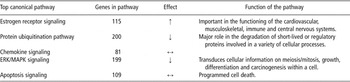
Our group was the first to conduct a comprehensive analysis of 45 genes associated with several aspects of mammary lipid metabolism during the course of lactation. The onset of lactation was characterized by dramatic upregulation in expression of genes associated with fatty acid (FA) uptake from blood (e.g. LPL, CD36) and intracellular transport/channeling (e.g. FABP3) (Bionaz and Loor, Reference Bionaz and Loor2008a and Reference Bionaz and Loor2008b). These adaptations were mirrored in milk FA profiles, showing that mammary uptake relative to de novo synthesis predominated in early lactation. Although of lower magnitude, lactation also induced upregulation of mRNA of genes involved in activation of FA (e.g. ACSL1, ACSS2), de novo synthesis (e.g. ACACA, FASN), desaturation (e.g. SCD, FADS1), synthesis of TAG (e.g. AGPAT6, GPAM), lipid droplet formation (e.g. BTN1A1, XDH) and ketone body utilization (e.g. BDH1, OXCT1). Temporal expression of genes with well-defined roles in mammary lipid metabolism peaked at 60 days post partum and to some extent followed the lactation curve. These transcriptomics adaptations corresponded with results from classical studies conducted at the University of Illinois on lipogenesis in the bovine mammary gland across the lactation cycle (Mellenberger et al., Reference Mellenberger, Bauman and Nelson1973).
Based on previous work (Loor and Herbein, Reference Loor and Herbein2003; Loor et al., Reference Loor, Doreau, Chardigny, Ollier, Sebedio and Chilliard2005b), we could deduce a central role in endogenous oleic acid synthesis via SCD for mammary TAG synthesis. However, there was no statistical correlation between expression patterns of genes involved in desaturation and (Δ5, Δ6, Δ9) desaturase indexes, rendering their use to infer temporal enzyme expression/activity meaningless. Furthermore, expression data highlighted the importance of ketone body utilization, mitochondrial biogenesis and PPARγ activity (PPARGC1A) and lipid droplet formation (BTN1A1, XDH, ADFP) in the global scheme of milk fat synthesis and secretion. Novel findings included a likely role for PPARG, LASS2, INSIG1, SREBF2 and OSBP in regulating lipid synthesis and mammary intracellular equilibrium between cholesterol and sphingolipids. The work of Mani et al. (Reference Mani, Sorensen, Sejrsen, Bruckmaier and Albrecht2009) expanded on the longitudinal expression of several members of the ATP-binding cassette transporter family (ABCA1, ABCA7, ABCG1). The expression of ABCA1 and ABCA7 was greater during the dry period compared with lactation, and was inversely associated with blood cholesterol levels suggesting that mammary uptake of blood cholesterol occurs partly via these transporters (Mani et al., Reference Mani, Sorensen, Sejrsen, Bruckmaier and Albrecht2009). The expression profile of ABCA7 and Niemann–Pick disease, type C1 (NPC1) may reflect a role of these transporters in the clearance of apoptotic cells and the intracellular redistribution of cholesterol (Mani et al., Reference Mani, Sorensen, Sejrsen, Bruckmaier and Albrecht2009).
The complexity of mammary molecular adaptations over time (e.g. mouse mammary gland; Rudolph et al., Reference Rudolph, Neville and Anderson2007) was underscored by this first gene network analysis as well as the apparent interrelationships that must coordinate the overall process of milk fat synthesis and secretion. Results challenged the proposal (Harvatine and Bauman, Reference Harvatine and Bauman2006) that SREBF1 is central for milk fat synthesis regulation and highlight a pivotal role for a concerted action among PPARG, PPARGC1A and INSIG1. However, it should be underscored that bovine SREBF1 in concert with PPARG (and potentially carbohydrate responsive element binding protein, ChREBP; Graugnard et al., Reference Graugnard, Berger, Faulkner and Loor2009) likely play a role in bovine (beef and dairy cattle) adipogenesis/lipogenesis in adipose tissue as discussed below.
Candidate gene analysis in adipose tissue of peripartal cows
Expression of metabolic enzymes and adipokines
In addition to its fundamental role as an energy storage depot, adipose tissue is now known to be a highly active endocrine organ capable of expressing and releasing cytokines and initiating an inflammatory or immune response, as well as influencing metabolism in other tissues (Vernon, Reference Vernon2005). Adipose tissue response elements associated with lipolysis include the β-adrenergic receptor subtypes (ADRB1, ADRB2, ADRB3) and the expression and activation of hormone-sensitive lipase (LIPE) and PLIN1 (Brasaemle, Reference Brasaemle2007; Sumner and McNamara, Reference Sumner and McNamara2007). Adipokines like adiponectin (ADIPOQ), leptin (LEP) and visfatin (NAMPT) play important roles in insulin sensitivity, glucose homeostasis and lipid metabolism in non-ruminants (Marra and Bertolani, Reference Marra and Bertolani2009) and likely in ruminants (Chilliard et al., Reference Chilliard, Delavaud and Bonnet2005).
Recent work with peripartal adipose tissue attempted to establish longitudinal mRNA expression of ADRB isoforms as well as PLIN1 and LIPE (Sumner and McNamara, Reference Sumner and McNamara2007). All ADRB isoforms increased to different extents after parturition (i.e. 30, 90 or 270 v. −30 DIM). Similarly, both PLIN1 and LIPE increased after parturition, namely at 90 v. −30 DIM. Those results showed that increased lipolysis is mediated, at least in part, by increases in the expression of the β-adrenergic receptor subtypes and the expression of LIPE (Sumner and McNamara, Reference Sumner and McNamara2007). This work was recently confirmed in another study (Sumner et al., Reference Sumner, Schachtschneider, Hutjens, Youngquist, Duncan, Rocco, Miller, Vierck and McNamara2009a), but the increases in the message were modest, suggesting that a major element of direct control of lipolysis is through increased norepinephrine binding to ADRB and the downstream phosphorylation cascade.
In a similar manner, the work of Lemor et al. (Reference Lemor, Hosseini, Sauerwein and Mielenz2009) revealed a lack of change in ADIPOQ mRNA, but a significant decrease in mRNA of ADIPOR1, ADIPOR2 and NAMPT in adipose tissue harvested from cows at ca. 21 days post partum relative to pre partal levels. Authors speculated that lower post-partal insulin sensitivity was related to reduced adiponectin receptor mRNA abundance (Lemor et al., Reference Lemor, Hosseini, Sauerwein and Mielenz2009). Large-scale adipose tissue transcriptomics (discussed below) indicated that expression of both ADIPOQ and LEP, among several other metabolic genes (Table 5), was upregulated at ca. 2 weeks from parturition by overfeeding dietary energy during the dry period (Janovick et al., Reference Janovick, Loor, Ji, Everts, Lewin, Rodriguez-Zas and Drackley2009). More importantly, LEP mRNA in response to overfeeding energy corresponded with greater blood LEP concentration (ca. 4 v. 2.4 ng/dl), providing some of the first evidence that transcriptomics can be useful when evaluating the response of proteins secreted by adipose tissue.
High-throughput transcriptomics of tissues from peripartal cows
A systems biology approach
The biological complexity of agricultural animals unavoidably requires a systems biology approach, that is, a way to systematically study the complex interactions in biological systems using a method of integration instead of reduction (Loor and Cohick, Reference Loor and Cohick2009). One of the goals of systems biology is to discover new emergent properties that may arise from examining the interactions between all components of a system to arrive at an integrated view of how the organism functions (Bruggeman and Westerhoff, Reference Bruggeman and Westerhoff2007). Work in model organisms during the past 15 years has shown the applicability of high-throughput methods to discern regulatory and metabolic networks (Feist and Palsson, Reference Feist and Palsson2008). Currently available data on candidate genes in tissues of peripartal cows have provided greater depth of the underlying molecular adaptations that coordinate tissue function. However, the challenge for the near future will be to integrate high-throughput transcriptomics data on peripartal tissues in the context of the key metabolic pathways and resultant changes at the level of the whole animal.
Bioinformatics
Bioinformatics involves the use of mathematics and biochemistry to solve biological problems at the molecular level (Feist and Palsson, Reference Feist and Palsson2008). The core principle of bioinformatics is utilizing computer resources to solve problems on scales of magnitude far too great for human discernment. A bioinformatics approach, for example, through the use of gene ontology (GO) analysis or pathway/network analysis, will allow one to discern the biological functions in tissues at specific points of development or under a particular nutritional management (e.g. Figures 2 to 5). One of the aims of the GO Consortium is to provide a controlled vocabulary that can be used to describe any organism. However, it is intuitive that many functions, processes and components are not common to all life forms. Annotation with respect to the biological context of livestock would be an important undertaking. The development of an animal trait ontology is essential for annotating genes/proteins to biological functions (Hughes et al., Reference Hughes, Bao, Hu, Honavar and Reecy2008).
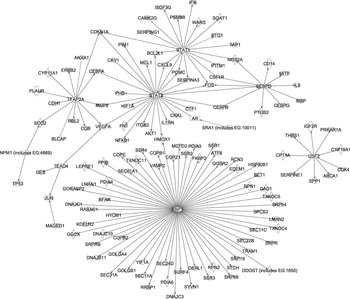
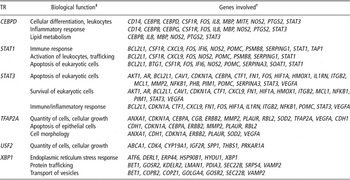
Networks uncovered between nine transcription factors (XBP1, STAT1, STAT3, USF2, TFAP2A, CEBPD, TED4, NPM1 and SRA1) and genes in liver from cows fed to meet pre-partal energy requirements or were restricted or overfed energy during the pre-partal period. The combined data set from Loor et al. (Reference Loor, Dann, Everts, Oliveira, Green, Janovick-Guretzky, Rodriguez-Zas, Lewin and Drackley2005a and Reference Loor, Bionaz, Janovick-Guretzky, Everts, Oliveira, Green, Litherland, Rodriguez-Zas, Lewin and Drackley2006) were re-analyzed using ANOVA and Mixed models and pathway and network analysis on 4790 differentially expressed genes (FDR ⩽ 0.05, diet × time) conducted using Ingenuity Pathway Analysis.

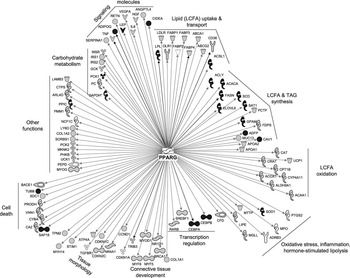
Central role of PPARγ in subcutaneous adipose tissue. Shown are genes that were upregulated (black background), downregulated (white background) or not affected (gray background) when cows were overfed dietary energy (ca. 160% of energy requirements) v. control (Janovick et al., Reference Janovick, Loor, Ji, Everts, Lewin, Rodriguez-Zas and Drackley2009). A total of 102 genes on our microarray platform (Loor et al., Reference Loor, Bionaz, Rodriguez-Zas, Dann, Janovick-Guretzky, Everts, Oliveira, Lewin and Drackley2007a) are known target genes of PPARγ at least in non-ruminants. Genes were grouped according to the main biological process they are associated with.

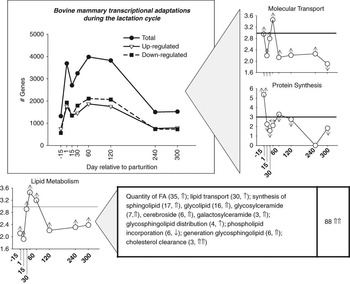
Longitudinal changes in mRNA expression in bovine mammary tissue across the lactation cycle (M. Bionaz, S. L. Rodriguez-Zas, R. E. Everts, H. A. Lewin, W. L. Hurley and J. J. Loor, unpublished results). Shown also are three of the most affected molecular functions (from Ingenuity Pathway Analysis) as well as the sub-functions within lipid metabolism with the number of affected genes and the overall effect on each function.

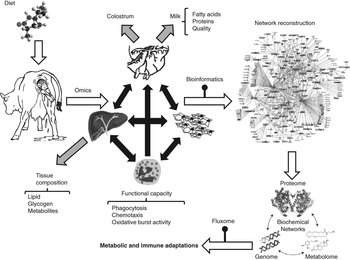
The peri-partal cow as a model for systems biology. Integration of omics data from key tissues such as liver, mammary and adipose as well as immune cells (i.e. neutrophils) with functional measures of metabolism and/or health will allow for a holistic evaluation of peri-partal adaptations in health and disease.

The discussion below is focused on recent transcriptomics studies of tissues during the peripartal period and beyond. An important goal is to highlight some of the discoveries made through the use of pathway, network and GO analysis that have helped characterize novel features of the biological adaptations during the peripartal period. Attempts to link high-throughput data with candidate genes and metabolism are made when possible. Lastly, an evaluation of potential marker genes was conducted on data from the author’s laboratory to highlight additional applications of the bioinformatics approach.
Peripartal liver transcriptomics
Temporal gene expression patterns due to level of dietary energy pre partum
In the first studies of their kind, a cDNA microarray was used to characterize hepatic gene expression patterns in dairy cows fed control or different levels of energy pre partum (Loor et al., Reference Loor, Dann, Everts, Oliveira, Green, Janovick-Guretzky, Rodriguez-Zas, Lewin and Drackley2005a and Reference Loor, Bionaz, Janovick-Guretzky, Everts, Oliveira, Green, Litherland, Rodriguez-Zas, Lewin and Drackley2006). Combined analysis of both data sets using a mixed model ANOVA identified a total of 4.790 genes at a false discovery rate (FDR) adjusted P < 0.05 that had a diet × time effect (Bionaz et al., Reference Bionaz, Drackley, Rodriguez-Zas, Dann, Janovick Guretzky, Everts, Oliveira, Lewin and Loor2007b). Using k-means clustering of expression data (fold-change) of those genes relative to −65 DIM (i.e. before cows went on treatments), a total of 13 distinct expression patterns for those genes were discerned. Among those clusters with patterns that were most unique to cows fed control, there were ca. 340 genes that had marked upregulation on day 14 post partum. Several of those genes are associated with prolactin signaling, platelet-derived growth factor (PDGF) signaling or JAK/STAT signaling pathways, which have important roles in aspects of cell proliferation and immune response potentially mediated by cytokines or growth factors.
These transcriptomics data may help explain the increase in liver tissue mass that has been observed between late pre partum and the first 3 weeks post partum (Reynolds et al., Reference Reynolds, Dürst, Lupoli, Humphries and Beever2004) in lactating cows v. non-pregnant/non-lactating cows (Andrew et al., Reference Andrew, Waldo and Erdman1994), or in cows during the course of lactation (Gibb et al., Reference Gibb, Ivings, Dhanoa and Sutton1992). Indirect measurements indicated that liver tissue mass during the lactation cycle (Gibb et al., Reference Gibb, Ivings, Dhanoa and Sutton1992) is partly driven by increased hypertrophy (Baldwin et al., Reference Baldwin, McLeod and Capuco2004) of hepatocytes probably to cope with the metabolic demands of the mammary gland. From the above transcriptomics studies, we have identified several transcription regulators, their target genes and the molecular functions that they affect (see discussion below). Those represent potential markers that could be targeted via management or nutritional means in the future. Among those uncovered (Figure 2; Table 4), STAT1 and STAT3, in particular, appear to be important for biological functions associated with control of cellular apoptosis and survival, as well as activation/inhibition of the immune/inflammatory response. These transcription regulators could play a role in the observed increases of liver mass between late pre partum and early lactation.
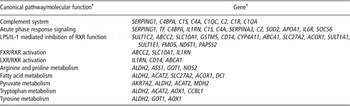
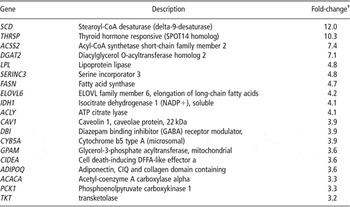
More in-depth cluster analysis of the responses for cows fed control v. excess energy revealed 10 unique clusters of expression of which at least two might have unique implications from a metabolic and health standpoint (Table 3). We observed that in these two clusters (data not shown) the overall pattern of expression for ca. 350 genes was a gradual downregulation through at least 14 days post partum. Control cows maintained a relatively stable expression pattern over the same time frame. Pathway analysis of these clusters indicated that the downregulated genes are associated with the complement system, acute-phase response, fatty acid metabolism and amino acid metabolism. Thus, overfeeding of dietary energy pre partum not only resulted in sharply decreasing energy balance between the last week pre partum and the first week post partum, higher liver TAG post partum, and higher blood NEFA and BHBA around and after parturition, but it also appeared to have affected the immune-related pathways in liver (Loor et al., Reference Loor, Bionaz, Janovick-Guretzky, Everts, Oliveira, Green, Litherland, Rodriguez-Zas, Lewin and Drackley2006).
Canonical pathway analysis of differentially expressed genes from 2 clusters with sustained down-regulation in expression in liver at −30, −14, 1, and 14 days v. 65 days relative to parturition in cows fed ad-libitum energy (ca. 160% of energy requirements) compared with controls

†From IPA Knowledge Base; LPS = lipopolysacharide; RXR = retinoid X receptor; FXR = farnesoid X receptor; LXR = liver X receptor.
Experimental diets were fed during a ca. 60-day dry period. The original data from Loor et al. (Reference Loor, Dann, Everts, Oliveira, Green, Janovick-Guretzky, Rodriguez-Zas, Lewin and Drackley2005a and Reference Loor, Bionaz, Janovick-Guretzky, Everts, Oliveira, Green, Litherland, Rodriguez-Zas, Lewin and Drackley2006) were re-analyzed using Ingenuity Pathway Analysis®.
†Current HUGO nomenclature (National Center for Biotechnology Information, NCBI).
The exact molecular and physiological mechanisms for the above responses clearly will require further studies. However, available data from non-ruminants as well as blood profiles of metabolic indicators of liver function and stress (e.g. Bernabucci et al., Reference Bernabucci, Ronchi, Lacetera and Nardone2005; Bionaz et al., Reference Bionaz, Trevisi, Calamari, Librandi, Ferrari and Bertoni2007c; Bertoni et al., Reference Bertoni, Trevisi, Han and Bionaz2008; Trevisi et al., Reference Trevisi, Amadori, Bakudila and Bertoni2009) can provide some insights into the meaning behind transcriptomics adaptations. The complement system comprises more than 30 fluid-phase and cell-associated proteins that act in synergy when needed, to promote inflammation and damage invaders such as microbes or foreign cells (review by Wagner and Frank, Reference Wagner and Frank2010). Because of this capacity for tissue damage, there are many regulatory proteins that control complement activation and thereby downregulate complement-mediated damage. The end result would be an expected augmentation of the antibody response of the cells, for example, hepatocytes.
Among the ones affected by overfeeding dietary energy pre partum (Table 3) were C1Q, C1R, C1S, C4A and C2, which together encompass the classical and lectin pathways of complement activation triggered in part by microorganisms, C-reactive protein (i.e. a positive acute-phase protein), polyanionic molecules and/or apoptotic bodies (Wagner and Frank, Reference Wagner and Frank2010). Some of these complement proteins also play a role in the acute phase response signaling pathway. This pathway is characterized by the rapid appearance of a number of (mostly) glycosylated plasma proteins synthesized primarily in liver and is considered a key cascade of events initiated to prevent tissue damage and to activate repair processes (Moshage, Reference Moshage1997). Previous work has examined the profile of several positive (i.e. whose concentration increases) and negative (whose concentration decreases) acute-phase proteins and related to those liver function indexes during the transition period in ‘normal’ cows (Bionaz et al., Reference Bionaz, Trevisi, Calamari, Librandi, Ferrari and Bertoni2007c; Bertoni et al., Reference Bertoni, Trevisi, Han and Bionaz2008) or cows challenged with a pro-inflammatory insult (Trevisi et al., Reference Trevisi, Amadori, Bakudila and Bertoni2009).
The fact that several genes (IL6R, IL1RN, SERPINA3, SERPING1) encoding proteins involved in the acute-phase response as well as intracellular hepatic transport (ABCC2, ABCA1), conjugating (SULT1C2, SULT1A1, SULT1E1), metabolizing (GSTM5) and biosynthetic enzymes (CYP4A11) were downregulated during the transition period in response to overfeeding energy (Table 3) suggests that the liver from these cows would have been at higher risk of pathogenic insults as well as oxidative stress damage (e.g. SOD2, GSTM5). There is evidence that overconditioned cows during the pre partal period through parturition have greater concentrations of ROS both pre- and post partum as well as lower plasma SOD activity (Bernabucci et al., Reference Bernabucci, Ronchi, Lacetera and Nardone2005). Overall, the transcriptomics data seem to support the observations that overweight or energy-overfed cows, which typically experience greater NEFA and BHBA (Bernabucci et al., Reference Bernabucci, Ronchi, Lacetera and Nardone2005; Loor et al., Reference Loor, Bionaz, Janovick-Guretzky, Everts, Oliveira, Green, Litherland, Rodriguez-Zas, Lewin and Drackley2006), are particularly sensitive to oxidative stress (Bernabucci et al., Reference Bernabucci, Ronchi, Lacetera and Nardone2005). It is important to note that several of the above genes are also regulated by additional transcription regulators including PPARα, which is a well-defined activator of CYP4A11 in murine (Savas et al., Reference Savas, Machemer, Hsu, Gaynor, Lasker, Tukey and Johnson2009) as well as calf liver (Litherland et al., Reference Litherland, Bionaz, Wallace, Loor and Drackley2010).
The reaction catalyzed by CYP4A11 could be crucial in liver because a major function of this Ω-hydroxylase enzyme is to contribute to the degradation of excess free CFA resulting from excessive lipolysis as well as lipid mediators of inflammation such as leukotrienes and prostanoids (Savas et al., Reference Savas, Machemer, Hsu, Gaynor, Lasker, Tukey and Johnson2009). In fact, the overall process of LCFA degradation via the family 4 P450 Ω-hydroxylases would encompass peroxisomal oxidation during which the activity of ACOX1 is pivotal. Peroxisomal oxidation of LCFA during the transition period is quantitatively important (Grum et al., Reference Grum, Drackley, Younker, LaCount and Veenhuizen1996) and it is likely driven by both the influx of LCFA (Reynolds et al., Reference Reynolds, Aikman, Lupoli, Humphries and Beever2003) as well as greater transcription of ACOX1 (Loor et al., Reference Loor, Dann, Everts, Oliveira, Green, Janovick-Guretzky, Rodriguez-Zas, Lewin and Drackley2005a), which also seems to be a bovine PPARα target (Litherland et al., Reference Litherland, Bionaz, Wallace, Loor and Drackley2010). Because several hormones likely regulate gene transcription, for example, GH dampens the PPARα-induced activation of murine liver CYP4A11 (Savas et al., Reference Savas, Machemer, Hsu, Gaynor, Lasker, Tukey and Johnson2009), it would be important in the future to evaluate their role in peripartal hepatic transcriptomics adaptations. It remains to be determined if GH signaling would play a role in dampening expression of key genes in bovine liver around parturition because GHR1A expression and binding of GH to GHR1A is downregulated soon after parturition, but returns to pre partum levels by 17 DIM (Radcliff et al., Reference Radcliff, McCormack, Crooker and Lucy2003; Table 1). The lack of change in liver CPY4A11 expression post partum (at least in cows fed to meet pre-partal energy requirements) seems to support an inhibitory role of GH on PPARα target gene activation. Further studies with different nutritional protocols should help clarify these relationships.
Transcription regulator network analysis due to pre partal plane of energy and physiological state
As has been clearly established in non-ruminants (e.g. Desvergne et al., Reference Desvergne, Michalik and Wahli2006), it appears likely that long-term liver adaptations to a new physiological state and/or whole-body energy status might be driven by transcription regulators such as PPAR (e.g. Loor et al., Reference Loor, Dann, Everts, Oliveira, Green, Janovick-Guretzky, Rodriguez-Zas, Lewin and Drackley2005a; van Dorland et al., Reference van Dorland, Richter, Morel, Doherr, Castro and Bruckmaier2009; Table 1). The identity of additional molecules other than PPAR and a few more evaluated to date (Table 1) and their putative targets in bovine liver remain unknown. We recently used bioinformatics to aid in the discovery of transcription regulators affected by physiological adaptations from late pregnancy to lactation and/or pre-partal dietary energy level (Figure 2; Loor et al., Reference Loor, Dann, Everts, Oliveira, Green, Janovick-Guretzky, Rodriguez-Zas, Lewin and Drackley2005a and Reference Loor, Bionaz, Janovick-Guretzky, Everts, Oliveira, Green, Litherland, Rodriguez-Zas, Lewin and Drackley2006). Another important aim was to uncover networks encompassing transcription regulators and their putative downstream target genes.
Among the 4790 genes with a time × diet interaction (FDR < 0.05), there were 3.54 with ⩾1.5-fold expression in at least one time point v. −5 days that were used for further analysis (Loor et al., Reference Loor, Bionaz, Rodriguez-Zas, Dann, Janovick-Guretzky, Everts, Oliveira, Lewin and Drackley2007a). Among those genes with ⩾1.5-fold expression, Ingenuity Pathway Analysis® uncovered 317 genes classified as transcription regulators. Twenty-seven of the 317 had expression levels ⩾2-fold between groups in at least 1 time point during the dry period (−30 or −14 days) or lactation (1, 14, 28 or 49 days). Temporal expression of 9 of the 24 transcription regulators was affected by overfeeding energy (6 ↑ e.g. SRA1, STAT1; 3 ↓ e.g. XBP1, KLF15), and expression of 19 of the 24 was affected by restricted energy (8 ↑ e.g. XBP1, STAT3; 11 ↓ e.g. ELF2, BRDW1). Ten of these transcription regulators generated networks incorporating 98 differentially expressed genes (Figure 2), with cellular growth, immune response and ER stress as the most enriched biological functions (Table 4).
Subset of enriched biological functions in liver among genes affected by a subset of six TR (Figure 2). A total of 27 TR TR with ⩾ 2-fold difference in at least 1 time point during the dry period or early lactation (i.e. −30, −14, 1, 14, 28 or 49 days relative to parturition) between cows fed control (Con), ad libitum energy (ca. 160% of the energy requirements, over), or restricted energy (ca. 80% of the energy requirement, under)

TR = transcription regulators.
Experimental diets were fed during a ca. 60-day dry period. The original data from Loor et al. (Reference Loor, Dann, Everts, Oliveira, Green, Janovick-Guretzky, Rodriguez-Zas, Lewin and Drackley2005a and Reference Loor, Bionaz, Janovick-Guretzky, Everts, Oliveira, Green, Litherland, Rodriguez-Zas, Lewin and Drackley2006) were re-analyzed using Ingenuity Pathway Analysis®.
†See Figure 2 for entire list of target genes.
‡According to Ingenuity Pathway Analysis.
The largest numbers of differentially expressed genes (39) that could be linked to one of the 27 transcription regulators with expression levels ⩾2-fold between groups in at least 1 time point during the dry period (−30 or −14 days) or lactation (1, 14, 28 or 49 days) appear to be targets of bovine XBP1 (Figure 2). This gene encodes a transcription factor identified as a key regulator of the mammalian unfolded protein response (UPR) or ER stress response (Glimcher and Lee, Reference Glimcher and Lee2009). The UPR is activated by environmental stressors such as protein overload that require increased ER capacity (Ron and Walter, Reference Ron and Walter2007). XBP1 is activated by a posttranscriptional modification of its mRNA via inositol requiring enzyme 1 (IRE1), an ER localizing proximal sensor of ER stress that is a Ser/Thr protein kinase and endoribonuclease (Ron and Walter, Reference Ron and Walter2007). Despite a recent link between upregulation of hepatic XBP1 and enhanced lipogenesis in mice (Glimcher and Lee, Reference Glimcher and Lee2009), it is unlikely that XBP1 plays the same role in bovine liver, which has been shown to have little lipogenic capacity (Bell, Reference Bell1979).
Expression of XBP1 was affected differently by the level of dietary energy pre partum, that is, downregulated by overfeeding energy but upregulated with restricted energy; thus, because of the importance of protein folding in basic tissue functions, it may represent an important marker of liver function. Activation of XBP1 is associated with upregulation of a broad spectrum of UPR-related genes involved in protein folding, redox metabolism, ER-associated degradation and protein quality control (Acosta-Alvear et al., Reference Acosta-Alvear, Zhou, Blais, Tsikitis, Lents, Arias, Lennon, Kluger and Dynlacht2007). Deficiency of XBP1 and the ensuing ER stress have been linked with enhanced sensitivity to bacterial-induced or TNF-α-induced inflammation (Glimcher and Lee, Reference Glimcher and Lee2009). The marked inhibition of protein degradation (i.e. ubiquitination) that we observed in cows with ketosis early post partum (Table 6) seems to suggest that XBP1 serves an important regulatory role in these basic processes around parturition when metabolic activity of the liver is markedly increased (Reynolds et al., Reference Reynolds, Aikman, Lupoli, Humphries and Beever2003).
Peripartal adipose tissue transcriptomics
Temporal gene expression patterns due to level of dietary energy pre partum
In a recent study from our group involving microarrays and qPCR (Janovick et al., Reference Janovick, Loor, Ji, Everts, Lewin, Rodriguez-Zas and Drackley2009), we evaluated global transcriptional changes in subcutaneous adipose tissue of cows receiving during the dry period a control high-straw diet to meet but not greatly exceed 100% of NRC requirements (2001) or a high-grain diet to achieve energy intakes in excess of ca. 150% of NRC requirements. Subcutaneous biopsies were obtained at −14, 1 and 14 DIM from the tail–head area. ANOVA using an FDR < 0.05 identified ca. 3.000 genes that were differentially expressed by the interaction of diet × day (Janovick et al., Reference Janovick, Loor, Ji, Everts, Lewin, Rodriguez-Zas and Drackley2009). Of the time points studied, the largest number of differences between dietary groups occurred on day −14 relative to parturition, when 27 transcripts were downregulated at least 2.5-fold or greater and 55 were upregulated at least 3.0-fold or greater due to overfeeding energy.
Among the genes relevant to the PPARγ network (Table 5; Figure 3) overfeeding energy pre partum v. control upregulated SCD, DGAT2, PCK1, lipoprotein lipase (LPL), fatty acid synthase (FASN), ADIPOQ and thyroid hormone responsive (SPOT14 homolog, THRSP) by 2- to 12-fold at −14 days relative to calving (Janovick et al., Reference Janovick, Loor, Ji, Everts, Lewin, Rodriguez-Zas and Drackley2009). A previous microarray study had identified LPL and FABP4 as two of the most highly abundant genes in pre partum (ca. −30 days) adipose tissue of dairy heifers (Sumner et al., Reference Sumner, Schachtschneider and McNamara2008a and Reference Sumner, Schachtschneider, Hutjens, Youngquist, Duncan, Rocco, Miller, Vierck and McNamara2009a). Rodent studies have shown that most of these are PPARγ targets (Berger and Moller, Reference Berger and Moller2002), which are required for adipocyte differentiation as well as lipid filling of the mature adipocyte (Rosen and MacDougald, Reference Rosen and MacDougald2006).
Among genes associated with lipogenesis, the marked increase in expression of isocitrate dehydrogenase 1 (NADP+, IDH1) with overfeeding energy agrees with its central role in generating NADPH elucidated in seminal studies at the University of Illinois (e.g. Ingle et al., Reference Ingle, Bauman and Garrigus1972) later confirmed in steers (Smith and Crouse, Reference Smith and Crouse1984). Those earlier studies also revealed a minor role of ATP-citrate lyase (ACLY) in NADPH generation (at least in growing calf adipose), but subsequent work with beef cattle showed that ACLY activity could allow for lactate utilization for lipogenesis (Whitehurst et al., Reference Whitehurst, Beitz, Pothoven, Ellison and Crump1978 and Reference Whitehurst, Beitz, Cianzio and Topel1981). Our data with pre-partal energy overfed cows suggest that ACLY can be induced when the availability of glucose is enhanced through dietary management (e.g. greater inclusion of corn grain) as was shown in adipose tissue of beef cattle (Smith and Crouse, Reference Smith and Crouse1984). Greater NADPH availability in response to the influx of glucose into adipose when high-grain diets are fed pre partum would provide reducing equivalents to support lipogenesis and partly explains the increase in ACACA, FASN, GPAM, but also the cell membrane protein caveolin 1 (CAV1) and PCK1 (Table 5).
Subset of genes with mRNA transcripts upregulated 3.0-fold or greater on day –14 relative to parturition in subcutaneous adipose tissue from cows that overconsumed energy pre partum relative to those with controlled energy intake pre partum (Janovick et al., Reference Janovick, Loor, Ji, Everts, Lewin, Rodriguez-Zas and Drackley2009)

See Figure 3 for the relationship among some of these genes and PPARγ signaling.
†Overfed v. control.
Canonical pathway analysis of genes (ca. 2000) in liver affected by nutrition-induced ketosis early post partum

Data from Loor et al. (2007) were re-analyzed using Ingenuity Pathway Analysis®. Shown are the top four significant pathways.
Over 30 years ago, PCK1 was identified as being central in adipose and liver for glyceroneogenesis, that is, the synthesis of glycerol-3-phosphate from non-glucose carbon precursors including lactate and amino acids (Ballard et al., Reference Ballard, Hanson and Leveille1967; Gorin et al., Reference Gorin, Tal-Or and Shafrir1969). The use of this pathway for esterification or re-esterification of LCFA is now recognized as the main source of glycerol-3-phosphate for non-ruminants in the fed and fasted states (e.g. Nye et al., Reference Nye, Kim, Kalhan and Hanson2008). Our data are the first, to the author’s knowledge, to examine bovine adipose PCK1 and provide evidence of its upregulation by high dietary energy during the non-lactating period in pregnant cows. Just as it occurs in non-ruminants, our data indicate that the coordinated responses in expression of the above transcripts would allow for the process of lipogenesis, esterification and lipid droplet formation to take place. Further, available data on PCK1 expression in both adipose and liver are suggestive of an important role for this protein not only in gluconeogenesis but also in the overall process of LCFA recycling.
The upregulation of ELOVL family member 6, elongation of long-chain fatty acids (ELOVL6; a well-established SREBF1 target in non-ruminants; Desvergne et al., Reference Desvergne, Michalik and Wahli2006; Matsuzaka et al., Reference Matsuzaka, Shimano, Yahagi, Kato, Atsumi, Yamamoto, Inoue, Ishikawa, Okada, Ishigaki, Iwasaki, Iwasaki, Karasawa, Kumadaki, Matsui, Sekiya, Ohashi, Hasty, Nakagawa, Takahashi, Suzuki, Yatoh, Sone, Toyoshima, Osuga and Yamada2007) represents a novel observation and suggests for the first time that elongation of 16:0 to 18:0 (16:0 is the main substrate; Matsuzaka and Shimano, Reference Matsuzaka and Shimano2009) may be a relevant and previously unrecognized step in the process of triacylglycerol synthesis in bovine adipose tissue as it is in rodent liver (e.g. Matsuzaka et al., Reference Matsuzaka, Shimano, Yahagi, Kato, Atsumi, Yamamoto, Inoue, Ishikawa, Okada, Ishigaki, Iwasaki, Iwasaki, Karasawa, Kumadaki, Matsui, Sekiya, Ohashi, Hasty, Nakagawa, Takahashi, Suzuki, Yatoh, Sone, Toyoshima, Osuga and Yamada2007), which is the primary site of lipogenesis in that species (Bergen and Mersmann, Reference Bergen and Mersmann2005). Furthermore, it could be possible that ELOVL6 activity is a ‘necessary’ step in the endogenous formation of 18:0, which can then be desaturated via SCD in cooperation with cytochrome b5 type A (microsomal) (CYB5A), both of which increased markedly in cows overfed energy (i.e. corn grain) pre partum (Table 5). Although we are unaware of any published elongase isoform distribution in other bovine tissues, mammary expresses ELOVL1, 2, 5 and 6 and their mRNA abundance is affected by stage of lactation, with ELOVL5 and 6 sharply decreasing after parturition and throughout lactation (M. Bionaz, S. L. Rodriguez-Zas, R. E. Everts, H. A. Lewin, W. L. Hurley and J. J. Loor, unpublished results). Similar to rodents (Matsuzaka et al., Reference Matsuzaka, Shimano, Yahagi, Kato, Atsumi, Yamamoto, Inoue, Ishikawa, Okada, Ishigaki, Iwasaki, Iwasaki, Karasawa, Kumadaki, Matsui, Sekiya, Ohashi, Hasty, Nakagawa, Takahashi, Suzuki, Yatoh, Sone, Toyoshima, Osuga and Yamada2007), bovine ELOVL6 action may serve as a control point of the adipose tissue’s sensitivity to insulin. In rodents, it has been clearly shown that ELOVL6 activity leads to hampered insulin sensitivity in liver, thus contributing to the metabolic syndrome (Matsuzaka et al., Reference Matsuzaka, Shimano, Yahagi, Kato, Atsumi, Yamamoto, Inoue, Ishikawa, Okada, Ishigaki, Iwasaki, Iwasaki, Karasawa, Kumadaki, Matsui, Sekiya, Ohashi, Hasty, Nakagawa, Takahashi, Suzuki, Yatoh, Sone, Toyoshima, Osuga and Yamada2007). We propose that inhibition of this protein pre partum may represent a nutritional target to lessen the marked effect of parturition on adipose insulin sensitivity. Together, the above increases in expression correlated with greater blood insulin concentration (Janovick et al., Reference Janovick, Loor, Ji, Everts, Lewin, Rodriguez-Zas and Drackley2009), which we (Dann et al., Reference Dann, Morin, Bollero, Murphy and Drackley2005 and Reference Dann, Litherland, Underwood, Bionaz, D'Angelo, McFadden and Drackley2006; Loor et al., Reference Loor, Bionaz, Janovick-Guretzky, Everts, Oliveira, Green, Litherland, Rodriguez-Zas, Lewin and Drackley2006) and others (e.g. Rukkwamsuk et al., Reference Rukkwamsuk, Geelen, Kruip and Wensing2000; Rabelo et al., Reference Rabelo, Rezende, Bertics and Grummer2005) have previously observed in cows overfed energy from grain.
In the only two studies of their kind, daily i.v. injection of the PPARγ agonist TZD (4 mg/kg BW) for the last 3 weeks pre partum in dairy cows resulted in greater plasma insulin coupled with lower plasma NEFA during the peripartal period (day −7 through day 7 post partum; Smith et al., Reference Smith, Stebulis, Waldron and Overton2007 and Reference Smith, Butler and Overton2009). The lower NEFA could have been a response to greater insulin and/or greater insulin sensitivity of adipose tissue to counteract the well-defined lipolytic effects of corticosteroids, GH and catecholamines, which are characteristic of this physiological state. In turn, lower NEFA might have relieved the detrimental effects on pancreatic insulin release (Bossaert et al., Reference Bossaert, Leroy, De Vliegher and Opsomer2008). No effects on milk production during the first 30 days post partum were observed. Pre-partal and post-partal insulin challenge of cows treated with TZD did not provide evidence that TZD increased insulin-dependent glucose use by muscle (Smith et al., Reference Smith, Stebulis, Waldron and Overton2007), a response that would be expected because PPARγ is primarily expressed in adipose (Berger and Moller, Reference Berger and Moller2002). Both studies provided strong evidence that PPARγ activation is unlikely to compromise the key adaptations in glucose metabolism that must occur in the peripartum period (Bell, Reference Bell1995). Because of the known effects of TZD on rodent adipose biology and the genes affected by PPARγ (see Figure 3), it is tempting to speculate that adipogenesis/lipogenesis in adipose of TZD-treated cows was maintained and/or enhanced.
In a retrospective evaluation of the classical study of McNamara et al. (Reference McNamara, Harrison, Kincaid and Waltner1995), one of the first to define adipocyte characteristics and metabolic activity from late pre partum through mid-lactation, it is apparent that as lactation progresses, the subcutaneous adipose tissue is not only able to accrete lipid through greater rates of esterification and lipogenesis (McNamara et al., Reference McNamara, Harrison, Kincaid and Waltner1995), but it appears that it also contains pre-adipocytes with the capacity to differentiate and proliferate. We inferred the presence of such a mechanism because the number of adipocytes per gram of tissue increased gradually from late pre partum though mid-lactation during which time both the volume and diameter of the adipocytes were markedly lower than pre partum (McNamara et al., Reference McNamara, Harrison, Kincaid and Waltner1995). Because of the dampening of the adipogenic signals (e.g. insulin) during at least the first 60 days post partum (Bauman and Currie, Reference Bauman and Currie1980; Herbein et al., Reference Herbein, Aiello, Eckler, Pearson and Akers1985), it could be possible that adipocytes are only able to proliferate without achieving a ‘mature’ phenotype, that is, fill with lipid (Rosen and MacDougald, Reference Rosen and MacDougald2006). Further studies will have to be conducted to clarify the role of PPARγ and other NR in bovine adipose tissue adaptations.
It is important to note that insulin is not an activator of PPARγ per se, but upregulates expression of genes associated with glucose transport, LCFA uptake and lipogenesis partly through its direct effects on the transcription factor SREBF1 (Postic et al., Reference Postic, Dentin, Denechaud and Girard2007). Such a response probably accounts for the fact that a number of genes involved in anabolic pathways that could be related to insulin and/or PPARγ signaling (SREBF1, THRSP, LPL and ACACA) decreased by several fold between −30 and 14 days relative to parturition (Sumner et al., Reference Sumner, Schachtschneider and McNamara2008b; Sumner et al., Reference Loor, Bionaz, Rodriguez-Zas, Dann, Janovick-Guretzky, Everts, Oliveira, Lewin and Drackley2009b), that is, when insulin sensitivity is decreased (e.g. Bauman and Griinari, Reference Bauman and Griinari2003). Overfeeding energy to cows pre partum is not a useful strategy to target PPARγ because it often leads to excessive internal fat deposition, which on parturition results in greater and more sustained blood NEFA and liver TAG deposition (Loor et al., Reference Loor, Bionaz, Janovick-Guretzky, Everts, Oliveira, Green, Litherland, Rodriguez-Zas, Lewin and Drackley2006; Drackley and Dann, Reference Drackley and Dann2008). The key point about PPARγ activation via exogenous and/or endogenous ligands is that, in non-ruminants, it enhances insulin sensitivity in adipose, thereby increasing glucose uptake and preferentially channeling it toward lipogenesis (Hauner, Reference Hauner2002). Thus, targeting adipose PPARγ via nutrition (e.g. lipids or specific LCFA; e.g. Kadegowda et al., Reference Kadegowda, Bionaz, Piperova, Erdman and Loor2009) could be a practical means of avoiding excessive fat deposition while maintaining insulin responsiveness after parturition.
Mammary transcriptomics adaptations
In one of the first analyses (e.g. Loor et al., Reference Loor, Dann, Everts, Rodriguez-Zas, Lewin and Drackley2004) of the mammary transcriptome around parturition, Finucane et al. (Reference Finucane, McFadden, Bond, Kennelly and Zhao2008), applying cutoff criteria of ⩾ 2 or ⩽ 2 fold-change and an FDR ⩽ 0.10, identified 389 transcripts (1.6% of total on the microarray platform) that were differentially expressed between 5 and 10 DIM. Of those transcripts, 105 were upregulated while 284 were downregulated. Gene ontology analysis showed that the main upregulated genes were those associated with transport activity (amino acid, glucose and ion transporters), lipid and carbohydrate metabolism (e.g. LPL, ACACA) and cell signaling factors (Finucane et al., Reference Finucane, McFadden, Bond, Kennelly and Zhao2008). The main downregulated genes were associated with cell cycle and proliferation (cyclins, cell division cycle associated proteins), DNA replication and chromosome organization (centromere proteins, minichromosome maintenance proteins, histone), microtubule-based processes (microtubule associated protein tau, kinesin, tubulins), and protein and RNA degradation (proteasome, proteasome activator, RNA binding motif protein). An earlier study of the goat mammary transcriptome during feed restriction (Ollier et al., Reference Ollier, Robert-Granié, Bernard, Chilliard and Leroux2007) highlighted changes in expression of several genes that are associated with mammary cell proliferation, differentiation and/or cell death. These studies have provided novel insights into the molecular events that drive lactating mammary gland development and function.
Our group recently expanded (Figure 4) on work characterizing both the mammary and liver transcriptome around parturition (Loor et al., Reference Loor, Dann, Everts, Rodriguez-Zas, Lewin and Drackley2004) by performing network and pathway analysis of transcriptomics data from eight cows biopsied at −30, −15, 1, 15, 30, 60, 120, 240 and 300 days relative to parturition (M. Bionaz, S. L. Rodriguez-Zas, R. E. Everts, H. A. Lewin, W. L. Hurley and J. J. Loor, unpublished results). A total of 6579 differentially expressed genes at an FDR ⩽ 0.001 were found throughout lactation. The greatest number of affected (>3.500; Figure 4) genes relative to −30 days was observed at 60 and 120 days. Thus, it is apparent from the comprehensive analysis of the mammary transcriptome that this organ relies heavily on transcriptional regulation to begin lactation and coordinate the decline in milk synthesis (M. Bionaz, S. L. Rodriguez-Zas, R. E. Everts, H. A. Lewin, W. L. Hurley and J. J. Loor, unpublished results). Among metabolic-related functions, functional analysis uncovered an induction of protein synthesis before parturition and a reduction during lactation coupled with a large induction of lipid synthesis and transport during lactation (Figure 4). Molecular functions markedly activated at 60 and 120 v. −30 DIM included lipid transport, synthesis of sphingolipid and quantity of fatty acids (Figure 4).
Data also indicated a decrease in cell death before parturition and an increase at 1 and 30 days, while cell cycle activity was greater before parturition and substantially inhibited during lactation (M. Bionaz, S. L. Rodriguez-Zas, R. E. Everts, H. A. Lewin, W. L. Hurley and J. J. Loor, unpublished results). The behavior of genes related to DNA metabolism supported the reduction of cell cycle and suggested an inhibition of chromatin remodeling during lactation through 240 days, when chromatin modification was induced. Among the most unique findings, analysis revealed that development and proliferation of the mammary immune system during lactation was induced but its activation was inhibited (e.g. decrease in expression of major histocompatibility complex). Network analysis uncovered a central role for several transcription factors (e.g. v-myc myelocytomatosis viral oncogene homolog, estrogen receptor α). In addition, we uncovered >2.000 genes whose regulation of expression is essential for copious milk synthesis and secretion and which are considered a lactation gene set. Among those, >1.400 have not been previously reported to be associated with milk synthesis (M. Bionaz, S. L. Rodriguez-Zas, R. E. Everts, H. A. Lewin, W. L. Hurley and J. J. Loor, unpublished results).
Transcriptomics of peripartal nutrition-induced ketosis
The biochemistry of metabolic adaptations in liver due to ketosis has been known for several decades (e.g. Baird et al., Reference Baird, Heitzman and Hibbitt1972). Large-scale adaptations in metabolic and cell signaling gene networks in liver tissue from cows induced to develop ketosis via feed restriction early post partum were recently evaluated via microarrays (Loor et al., Reference Loor, Everts, Bionaz, Dann, Morin, Oliveira, Rodriguez-Zas, Drackley and Lewin2007b). A reassessment of the canonical pathways overrepresented in the set of ca. 2.000 genes affected by ketosis confirmed initial findings suggesting that protein ubiquitination was markedly inhibited by ketosis (Table 5). This pathway is an energy-requiring step for proteasomal-dependent degradation of proteins, which represents a key regulatory step of cell activity and function (Ciechanover, Reference Ciechanover2006). Regulated protein turnover via the ubiquitin-proteasome system underlies a wide variety of signaling pathways, from cell-cycle control and transcription to development (Nalepa et al., Reference Nalepa, Rolfe and Harper2006). The functional consequences of impaired intracellular protein degradation in liver might include alterations in cellular turnover, effects on gene regulation, modulation of cell signaling, induction of apoptosis and necrosis, release of ROS and loss of gene/protein function (Bader et al., Reference Bader, Jung and Grune2007). Analysis also revealed downregulation of a number of genes associated with ERK/MAPK signaling, which would have likely affected growth and differentiation of liver cells. Together, these changes could be primary factors involved in the ultimate loss of hepatic function that triggers clinical ketosis in dairy cows.
A novel finding from our re-analysis was the marked enrichment of genes within the estrogen-signaling pathway (Table 5). Work in non-ruminants has shown that estrogens control fundamental functions in tissues including the cardiovascular system, bone, brain and liver (e.g. Alvaro et al., Reference Alvaro, Mancino, Onori, Franchitto, Alpini, Francis, Glaser and Gaudio2006). By acting on both estrogen receptors (ER-α) and (ER-β) subtypes, and by activating either genomic or non-genomic pathways, estrogens play a key role in the complex loop of growth factors and cytokines, which activates signaling cascades (ERK1/2 (extracellular regulated kinases 1/2, PI3- kinase/AKT (phosphatidylinositol-3′kinase/AKT)) typical of growth factors such as IGF1, nerve growth factor, and vascular endothelial growth factor (VEGF), thus potentiating their action (Alvaro et al., Reference Alvaro, Mancino, Onori, Franchitto, Alpini, Francis, Glaser and Gaudio2006). The exact role of this pathway in the overall adaptations to liver metabolic disease in peripartal cows remains to be determined.
In addition to the above findings, re-analysis of the data has uncovered (data not shown) several potential biomarkers that might serve as targets for diagnosis and/or efficacy of nutritional protocols to help minimize or ameliorate the incidence of post-partal metabolic and/or infectious disease. These putative biomarkers have been determined as such based on studies with non-ruminant cells or tissues (Ingenuity Knowledge Base). Among the genes uncovered as putative biomarkers of ketosis and associated problems (e.g. Bobe et al., Reference Bobe, Young and Beitz2004), APOA1, APOB and LDLR are associated with cholesterol and/or lipoprotein metabolism. It has been well recognized (e.g. Bionaz et al., Reference Bionaz, Trevisi, Calamari, Librandi, Ferrari and Bertoni2007c; Bertoni et al., Reference Bertoni, Trevisi, Han and Bionaz2008) that peripartal blood cholesterol concentration is one important predictor of liver function and overall health and productivity of the cow (Bertoni et al., Reference Bertoni, Trevisi, Han and Bionaz2008). Thus, it has been speculated that decreased serum concentrations of APOB, APOA1 and LCAT are intimately related to development of fatty liver and ketosis (e.g. Bobe et al., Reference Bobe, Young and Beitz2004). Both APOA1 and APOB were upregulated by ketosis and LDLR was downregulated (Loor et al., Reference Loor, Everts, Bionaz, Dann, Morin, Oliveira, Rodriguez-Zas, Drackley and Lewin2007b). We originally proposed that the upregulation of both APOA1 and APOB along with downregulation of genes associated with protein ubiquitination/degradation and TAG accumulation (Loor et al., Reference Loor, Everts, Bionaz, Dann, Morin, Oliveira, Rodriguez-Zas, Drackley and Lewin2007b; Table 5) pointed at other mechanisms limiting VLDL synthesis and export during ketosis, for example, lower de novo synthesis of cholesterol and oleic acid, rather than deficient APOB synthesis. The ketosis data, however, only offered a view of the end result of transcriptomics adaptations at the onset of clinical ketosis. In this regard, it is interesting to point out that clustering and bioinformatics analysis (Table 3) uncovered APOA1 as a gene downregulated well before the onset of parturition in cows overfed energy pre partum; thus, even in the absence of liver lipidosis, this candidate gene would serve as one predictor of post partum liver function.
Another important biomarker that was uncovered from the ketosis data was the enzyme SCD, which was markedly downregulated (ca. 4-fold; Loor et al., Reference Loor, Everts, Bionaz, Dann, Morin, Oliveira, Rodriguez-Zas, Drackley and Lewin2007b). Cows with hepatic lipidosis have reduced circulating concentrations of VLDL (Bobe et al., Reference Bobe, Young and Beitz2004). In non-ruminant animals (rodents, humans, chicken), there appears to be an absolute need for endogenous synthesis of oleic acid for synthesis and export of VLDL from liver (e.g. Legrand et al., Reference Legrand, Catheline, Fichot and Lemarchal1997), which implies that SCD downregulation in post partal cows indirectly might lead to liver lipidosis. Sustained downregulation of SCD expression in mice prevents diet-induced hepatic insulin resistance, obesity and liver lipidosis (Flowers et al., Reference Flowers, Rabaglia, Schueler, Flowers, Lan, Keller, Ntambi and Attie2007). Because liver SCD is substantially downregulated after parturition (Table 1), coupled with the ketosis results, downregulation of SCD also may play an indirect role in bovine liver lipidosis by further impairing VLDL synthesis and secretion. In fact, it has been shown that oleic acid increases hepatocyte VLDL synthesis (Julius, Reference Julius2003). It is tempting to speculate that dietary saturated fat may serve as a tool to enhance SCD, as we have observed in vitro with both palmitate and stearate in bovine kidney cells (M. Bionaz, B. J. Thering and J. J. Loor, unpublished results) or with palmitate in mammary epithelial cells (Kadegowda et al., Reference Kadegowda, Bionaz, Piperova, Erdman and Loor2009). Future in vivo studies will have to test the efficacy of dietary fat supplementation in a more systematic manner.
Additional biomarker molecules from the ketosis data included cytokines (IL6 and IL18; ↑and ↓ with ketosis), enzymes (CD38, FN1 and SOD2; ↑, ↓ and ↓, respectively, with ketosis), a peptidase (PSEN1, ↓with ketosis) and the transcription regulator TP53 (↑upregulated with ketosis. Analysis of the cytokines in blood would probably be more feasible in the future with the development of bovine-specific ELISA kits. It is not surprising that IL6 would serve as a biomarker particularly for hepatic disease and inflammation as it has been widely studied in non-ruminants (Moshage, Reference Moshage1997). Oxidative stress also is frequently observed around parturition (Bernabucci et al., Reference Bernabucci, Ronchi, Lacetera and Nardone2005); thus, the observed downregulation of SOD2 with ketosis points at the potential for supplementation of antioxidants (e.g. selenium, vitamin E) in pre partal and post partal diets. In this regard, just as with APOA1, the clustering and bioinformatics analysis (Table 3) uncovered SOD2 as a gene downregulated well before the onset of parturition in cows overfed energy pre partum.
Regulation of liver transcriptional networks via nutrition
Dietary LCFA to target PPARA
A number of non-ruminant data published to date seem to indicate that both saturated and unsaturated LCFA enhance PPARα transactivation nearly equally well (e.g. Göttlicher et al., Reference Göttlicher, Widmark, Li and Gustafsson1992; Forman et al., Reference Forman, Tontonoz, Chen, Brun, Spiegelman and Evans1995; Hostetler et al., Reference Hostetler, Petrescu, Kier and Schroeder2005). Similarly, in some studies with rodents fed high-fat diets, PPARα-activated gene expression was increased regardless of whether the dietary lipid was mostly PUFA, monounsaturated or saturated (e.g. Bonilla et al., Reference Bonilla, Redonnet, Noël-Suberville, Pallet, Garcin and Higueret2000). Because intracellular LCFA pools are a mixture of saturated and unsaturated LCFA and because PPARs are capable of binding two LCFA simultaneously (e.g. Itoh et al., Reference Itoh, Fairall, Amin, Inaba, Szanto, Balint, Nagy, Yamamoto and Schwabe2008), there could exist a mechanism whereby the composition of LCFA in the cytosol dictates the ‘strength’ of the response, that is, the ability to bind two LCFA simultaneously could allow PPAR (PPARα and/or PPARδ) to give a graded response to the varying composition of the intracellular LCFA pool (Itoh et al., Reference Itoh, Fairall, Amin, Inaba, Szanto, Balint, Nagy, Yamamoto and Schwabe2008). A physiologically relevant case where the intracellular pool of LCFA likely changes in amount and profile is around parturition, when catabolic signals override the effect of insulin and flood the liver with NEFA. Thus, nutritional management eliciting changes in the profile of adipose LCFA (e.g. Douglas et al., Reference Douglas, Rehage, Beaulieu, Bahaa and Drackley2007) as well as increasing the sensitivity of adipose to insulin around parturition might prevent excessive lipolysis and at the same time enrich the liver intracellular LCFA pool with those LCFA with the greatest potential to activate PPARα.
PPAR and LCFA in non-ruminants
Studies dealing with endogenous ligands such as free LCFA or LCFA-CoA (i.e. activated 16:0, 18:2n-6, 18:3n-3 and 20:4n-6) have shown (at least for PPARα) that both forms of the FA have high affinities (i.e. low nanomolar dissociation values) for binding to the ligand-binding domain of PPARα (Hostetler et al., Reference Hostetler, Petrescu, Kier and Schroeder2005). This point is important because intra-nuclear concentrations of free LCFA and LCFA-CoA in those non-ruminant cells studied to date range between 120 to 500 nM and 8 nM (Huang et al., Reference Huang, Starodub, McIntosh, Kier and Schroeder2002). However, it is likely that the expression of cytoplasmic free LCFA and LCFA-CoA binding proteins (e.g. FABP1) can significantly increase the distribution of both pools of FA to the nucleus particularly at high rates of NEFA influx into tissue, as we argue above.
Among the most potent PPARα endogenous ligands in non-ruminants are linoleic acid, linolenic acid and arachidonic acid derivates such as leukotriene B4 or prostaglandins D1 and D2 (Forman et al., Reference Forman, Tontonoz, Chen, Brun, Spiegelman and Evans1995; Devchand et al., Reference Devchand, Keller, Peters, Vazquez, Gonzalez and Wahli1996). However, the endogenous activation of the receptor seems to occur mainly with high levels of NEFA that occur under fasting conditions (Kersten et al., Reference Kersten, Seydoux, Peters, Gonzalez, Desvergne and Wahli1999). This point is particularly relevant in peripartal cows, whose liver is overloaded after parturition due to the hypoinsulinemia, reduced insulin sensitivity and uncoupling of the GH-IGF-I axis as highlighted above. An additional key point pertaining to ruminants is that, at least in vitro, data from our laboratory (Thering, Reference Thering2008) and a recent study (Bionaz et al., Reference Bionaz, Baumrucker, Shirk, Vanden Heuvel, Block and Varga2008) indicated that saturated LCFA are more potent in activating putative PPARα-target genes, unlike the situation in non-ruminants. Because of the recent link between PPARδ and liver metabolism (Sanderson et al., Reference Sanderson, Degenhardt, Koppen, Kalkhoven, Desvergne, Müller and Kersten2009 and Reference Sanderson, Boekschoten, Desvergne, Müller and Kersten2010), studies with ligands specific for this NR in bovine cells appear warranted.
Channeling LCFA toward oxidation in peripartal bovine live
One way whereby exogenous LCFA can promote greater rates of mitochondrial oxidation is by uncoupling oxidation from ATP production. ATP production is impaired when protons are allowed to pass through the inner membrane without the production of ATP, essentially resulting in heat production (Grav et al., Reference Grav, Tronstad, Gudbrandsen, Berge, Fladmark, Martinsen, Waldum, Wergedahl and Berge2003). Key players in the mitochondrial uncoupling process are the uncoupling proteins (UCP), whose activities are induced primarily by NEFA (Armstrong and Towle, Reference Armstrong and Towle2001). Monounsaturated and PUFA appear more effective than saturated LCFA in activating UCP2, the liver-specific isoform (Armstrong and Towle, Reference Armstrong and Towle2001). UCP2 is a demonstrated non-ruminant PPARα target in vivo (e.g. Kelly et al., Reference Kelly, Vicario, Thompson, Candelore, Doebber, Ventre, Wu, Meurer, Forrest, Conner, Cascieri and Moller1998; Mandard et al., Reference Mandard, Müller and Kersten2004). In rat hepatocytes treated with tetradecylthioacetic acid (known PPARα agonist) Grav et al. (Reference Grav, Tronstad, Gudbrandsen, Berge, Fladmark, Martinsen, Waldum, Wergedahl and Berge2003) observed a moderate decrease in hepatocyte phosphate potential, energy charge, respiratory control coefficient and uncoupling of mitochondria (Grav et al., Reference Grav, Tronstad, Gudbrandsen, Berge, Fladmark, Martinsen, Waldum, Wergedahl and Berge2003). In fact, these changes bear a striking resemblance to those observed in liver tissue from lactating cows that were feed-restricted to induce ketosis (Baird et al., Reference Baird, Heitzman and Hibbitt1972). The implications of the PPARα-mediated uncoupling effect (Grav et al., Reference Grav, Tronstad, Gudbrandsen, Berge, Fladmark, Martinsen, Waldum, Wergedahl and Berge2003) are that liver metabolism can maintain its function within the confines of its physiologically regulatory framework if it were challenged by a PPARα activator such as exogenous LCFA.
Based on metabolic data available at the time, Jesse et al. (Reference Jesse, Emery and Thomas1986a) suggested that in the fasting state (as it occurs after calving), in contrast with rodent liver, there is little change in the enzymatic capacity of bovine liver for LCFA oxidation. Liver tissue from fasted (5 to 7 days) lactating cows continued to oxidize palmitate to acid-soluble products (i.e. ketone bodies), but oxidation to CO2 was decreased from pre-experimental values, an effect likely arising (Jesse et al., Reference Jesse, Emery and Thomas1986b) from decreased availability of TCA cycle intermediates (e.g. Baird et al., Reference Baird, Heitzman and Hibbitt1972). Grummer (Reference Grummer2008) suggested that partitioning of LCFA toward oxidation would be a feasible strategy to reduce TAG accumulation as long as there is uncoupling of mitochondrial oxidation. Under such a scenario, exogenous LCFA will continue to be oxidized to ketones and acetyl-CoA, which can then be used for cholesterol synthesis (cytosol) and/or enter the TCA cycle through greater availability of NAD+. Enhancing peroxisomal oxidation is an additional means whereby specific LCFA might trigger sustained LCFA oxidation. It differs from mitochondrial oxidation in that it is not linked to ATP production and yields heat. Prepartal fat supplementation resulted in greater peroxisomal oxidation at calving compared with a high-grain diet (Grum et al., Reference Grum, Drackley, Younker, LaCount and Veenhuizen1996).
Exogenous lipid and liver metabolism
Metabolic studies
Several in vitro studies with calf hepatocytes have evaluated the metabolism of saturated and unsaturated LCFA (Mashek et al., Reference Mashek, Bertics and Grummer2002; Mashek and Grummer, Reference Mashek and Grummer2003). In short-term incubations, both 16:0 and cis9-18:1 induced greater palmitate esterification into TAG, but the opposite response was observed with 18:2n-6 and 18:3n-3. At least during short-term incubations, 20:5n-3 and 22:6n-3 were more potent (2 to 4-fold greater) than other LCFA in inducing complete palmitate oxidation to CO2 (Mashek et al., Reference Mashek, Bertics and Grummer2002). This response agrees with the findings in rodent studies cited above. Longer-term exposure (48 h) with LCFA resulted in greater ketogenesis only when 16:0 and 18:0 were incubated (Mashek and Grummer, Reference Mashek and Grummer2003). Despite the useful information generated, results offered limited information on mechanisms of action.
Follow-up studies have focused on the potential effects of 18:3-rich v. 20:5n-3 and 22:6n-3-rich oils for preventing liver lipidosis assessed via TAG concentration (Mashek et al., Reference Mashek, Bertics and Grummer2005; Kulick et al., Reference Kulick, Greesley, Pires and Grummer2006; Ballou et al., Reference Ballou, Gomes, Juchem and DePeters2009). In the study of Mashek et al. (Reference Mashek, Bertics and Grummer2005), feed-restricted dry/non-pregnant cows receiving an intravenous emulsion of linseed oil v. tallow infusion or fish oil had lower liver TAG (7.8 μg AG/μg DNA v. 12 or 14 μg AG/μg DNA) accumulation during fatty liver induction. These data supported the short-term hepatocyte culture data indicating that 18:3n-3 might be a useful LCFA for preventing fatty liver. However, because plasma NEFA concentration also was decreased by linseed oil infusion, it was not possible to determine if the effects were direct on the liver or indirect through reducing plasma NEFA.
In the study of Kulick et al. (Reference Kulick, Greesley, Pires and Grummer2006), the same dry-cow model was used in which water, tallow or linseed oil was infused into the abomasum. Contrary to Mashek et al. (Reference Mashek, Bertics and Grummer2005), tallow (high in 16:0, 18:0 and cis9-18:1) was more beneficial than linseed oil in reducing liver TAG accumulation during feed restriction. Grum et al. (Reference Grum, Drackley, Younker, LaCount and Veenhuizen1996) fed a fat source enriched in cis9-18:1 and 16:0 pre partum that resulted in lower post partal liver TAG. Although these cows had lower prepartal feed intakes relative to controls or high-grain-fed cows, NEFA post partum did not differ. Furthermore, fat-fed cows had greater rates of liver peroxisomal oxidation from −3 through 3 weeks relative to parturition. In a more recent study, cows fed supplemental lipid had lower blood NEFA both pre- and post partum, numerically greater blood glucose post partum, and similar levels of dry matter intake and milk production (ca. 40 kg/day) during the first 2 weeks post partum (Ballou et al., Reference Ballou, Gomes, Juchem and DePeters2009). Despite the lower NEFA, the concentration of TAG in liver was similar between treatments. This latter effect is at first glance not intuitive, but perhaps underscores the limitations of using it as the sole or one of the few parameters to evaluate peripartal liver metabolism.
The review by Chilliard (Reference Chilliard1993) provided a comprehensive analysis of metabolic adaptations of dairy cows to lipid feeding beginning as early as 2 days post partum. The analysis revealed that in some instances lipid supplementation in vivo can lead to greater NEFA release from adipose (in vivo or in vitro), namely at mid-lactation. However, no data that encompassed pre-partal lipid supplementation were available, but subsequent studies have indicated that supplemental lipid can result in greater blood NEFA pre partum (e.g. Douglas et al., Reference Douglas, Rehage, Beaulieu, Bahaa and Drackley2007; Andersen et al., Reference Andersen, Ridder and Larsen2008). Interpreting pre-partal NEFA responses under the above conditions is complicated by the fact that supplemental fat (particularly at higher levels) unavoidably increases availability of dietary TAG for lipolysis via tissue LPL, hence resulting in greater NEFA if they are not catabolized by liver/heart or stored in tissues (e.g. adipose, liver).
Interpreting metabolic studies in the context of lipid nutrition
Although it is challenging to compare across the above studies, in vivo results appear to be consistent with the in vitro findings showing that longer-term incubation with 16:0 and 18:0 (Mashek and Grummer, Reference Mashek and Grummer2003) enhanced ketogenesis (i.e. [BHBA]) to a greater extent than PUFA. It is assumed that dietary cis9-18:1 in the study of Grum et al. (Reference Grum, Drackley, Younker, LaCount and Veenhuizen1996) was extensively biohydrogenated to 18:0 before reaching tissues. In a recent study, saturated fat (16:0 and 18:0 mainly) pre partum was more efficacious than flaxseeds (high 18:3n-3) in preventing TAG accumulation at 2 weeks post-calving (Andersen et al., Reference Andersen, Ridder and Larsen2008). This appeared to be coupled with numerically greater palmitate oxidation to CO2 and acid-soluble products. However, plasma NEFA were lower and thus might partly explain the lower liver TAG.
The responses to saturated/monounsaturated LCFA in bovines are intriguing because in non-ruminants PUFA are undoubtedly more potent activators of oxidation (Jump, Reference Jump2008). It is possible that specie differences exist in terms of LCFA-specific metabolic responses in liver. An additional, and obvious, limiting factor in lipid feeding studies is the inability to predict with certainty the amount of LCFA that will reach tissues. However, data from detailed studies of non-ruminant PPAR structures and their binding affinity for LCFA (e.g. Itoh et al., Reference Itoh, Fairall, Amin, Inaba, Szanto, Balint, Nagy, Yamamoto and Schwabe2008) suggest that, by virtue of binding two LCFA simultaneously (i.e. they have two binding cavities/pockets), these NR might have the capacity to give a graded response to the varying composition of the intracellular LCFA pool, which is invariably composed of mixtures of saturated and unsaturated LCFA and LCFA-CoAs (Hostetler et al., Reference Hostetler, Petrescu, Kier and Schroeder2005). Thus, as long as we can identify the type or types of LCFA with ‘stronger’ PPAR activation (both toward PPARα and PPARδ) effect, we could devise strategies for both the amount and length of time of feeding to achieve optimal responses.
Putative PPARα targets and effects of LCFA in bovine cells
We recently conducted a study to identify reliable bovine PPARα targets among key genes, several of which are well-established PPARα targets in non-ruminants, associated with liver lipid metabolism and inflammation after treatment with Wy-14,643 (a potent PPARα agonist). Another important objective was to test the effect of several LCFA on PPARα activation by measuring expression of the bovine-specific PPARα genes (M. Bionaz, B. J. Thering and J. J. Loor, unpublished results). Madin-Darby Bovine Kidney cells (MDBK), which have been shown to be responsive to both PPARα (Wy-14,643) and PPARγ (rosiglitazone) agonists (Bionaz et al., Reference Bionaz, Baumrucker, Shirk, Vanden Heuvel, Block and Varga2008), were used for the study and details of the optimization of culture conditions have been published (Thering et al., Reference Thering, Bionaz and Loor2009). MDBK cells were cultured with pure 16:0, 18:0, cis9-18:1, 18:2n-6, 18:3n-3, cis9,trans11-18:2, trans10,cis12-18:2, 20:0 (phytanic acid), 20:5n-3 and 22:6n-3 for 6 h and mRNA expression of 30 genes analyzed using quantitative PCR. Wy-14,643 was used as positive control.
Analysis revealed interesting features of the PPARα-responsive network in bovine cells. For example, Wy-14,643 resulted in relatively fewer differentially expressed transcripts compared with previous findings in the non-ruminant literature (e.g. Cheon et al., Reference Cheon, Nara, Band, Beever, Wallig and Nakamura2005; Guo et al., Reference Guo, Jolly, Halstead, Baker, Stutz, Huffman, Calley, West, Gao, Searfoss, Li, Irizarry, Qian, Stevens and Ryan2007). The most striking responses due to this PPARα agonist were upregulation of ANGPTL4 and CPT1A. The non-ruminant ANGPTL4 and CPT1A genes both have known PPRE (Mandard et al., Reference Mandard, Müller and Kersten2004), confirming (Bionaz et al., Reference Bionaz, Baumrucker, Shirk, Vanden Heuvel, Block and Varga2008a) that MDBK cells were suitable to study the PPARα system. All LCFA tested appeared to activate transcription of both genes, potentially through interactions with PPARα. More importantly, results indicated that both 16:0 and 18:0 elicited the strongest effects on gene expression leading to changes in transcription of 17 genes (56.7% of measured transcripts), 11 of which are PPARα targets in non-ruminants. Among unsaturated LCFA, 20:5n-3 affected expression of the greatest number of genes measured (18% or 60% of all measured genes). The biological outcome of these adaptations induced by the saturated LCFA or 20:5n-3, on network analysis, would be an overall increase of lipid metabolism, that is, greater uptake and activation of LCFA, channeling toward mitochondrial β-oxidation, as well as the use of LCFA for TAG and cholesterol synthesis. The overall induction of gene transcription with both 16:0 and 18:0 was greater than Wy-14,643, suggesting that they are more potent activators of bovine PPARα.
One of the implications from this in vitro study is that ruminal biohydrogenation intermediates such as trans10-18:1, trans11-18:1, cis9,trans11-18:2 and trans10,cis12-18:2 are relatively less potent in activating the bovine PPARα gene transcription network (4, 5 7 and 7, respectively, PPARα target genes were affected by these LCFA). The observed responses with 16:0, 18:0 and 20:5n-3 were found at a lower dose (i.e. 0.15 mM) of what might be typically found in blood after calving (e.g. LeRoy et al., Reference Leroy, Vanholder, Delanghe, Opsomer, Van Soom, Bols, Dewulf and de Kruif2004). It might be feasible to enhance sustained delivery of 20:5n-3 to tissues through ruminal-protection technologies (e.g. Jenkins et al., Reference Jenkins, Wallace, Moate and Mosley2008). Despite the fact that 20:5n-3 is hydrogenated (ca. 90% to 95%; Loor et al., Reference Loor, Ueda, Ferlay, Chilliard and Doreau2005c), tissues will likely accumulate it during long-term supplementation (e.g. Castañeda-Gutiérrez et al., Reference Castañeda-Gutiérrez, Benefield, de Veth, Santos, Gilbert, Butler and Bauman2007; Staples et al., Reference Staples, Amaral, DeVries and Thatcher2007). Clearly, our results provided evidence that LCFA can activate the ruminant PPARα network of genes that might lead to a positive effect on liver function after calving, that is, channeling of LCFA toward oxidation, reduced TAG synthesis and enhanced cholesterol synthesis for VLDL assembly/export. Future studies with bovine cells should also be directed toward examination of the potential role of PPARδ in liver metabolic adaptations.
Perspectives
We propose that in order to address the complex metabolic phenotypes of the peripartal period, there is a need to identify at the very least transcript variations in liver, mammary and adipose (Figure 5) that might contribute to metabolism and health. Ideally, this approach would initially encompass a transcriptomics characterization of each tissue as well as immune cells (e.g. neutrophils) over a wider range of nutritional treatments of practical relevance and also across cows of different genetic merit. Within individual experiments, the data generated would allow for the identification of underlying gene networks and pathways that could be linked to a particular metabolic or health phenotype. The systems approach might lead to the discovery of regulatory targets that could be tested further (i.e. model-directed discovery) or help address a broader spectrum of basic and practical applications including interpretation of phenotypic data, metabolic engineering or interpretation of lactation phenotypes. A recent study using the tissue-to-tissue co-expression approach in a mouse model of obesity uncovered subnetworks in the liver, adipose and hypothalamus that were enriched in genes that have obesity-relevant biological functions including circadian rhythm, energy balance, stress response or immune response (Dobrin et al., Reference Dobrin, Zhu, Molony, Argman, Parrish, Carlson, Allan, Pomp and Schadt2009).
For those efforts to be of much greater value to the scientific community and the producer, it would be ideal to apply meta-analyses techniques particularly when common treatment levels are used in more than one study. Such analyses have already been undertaken in agricultural species including bovines (e.g. Adams et al., Reference Adams, Southey, Robinson and Rodriguez-Zas2008; Rodriguez-Zas et al., Reference Rodriguez-Zas, Ko, Adams and Southey2008), where mixture and dependence Bayesian network approaches were able to reconstruct embryo-specific interactions among genes in the adherens junction, axon guidance and actin cytoskeleton pathways (Rodriguez-Zas et al., Reference Rodriguez-Zas, Ko, Adams and Southey2008). As suggested by the examples provided in this review, clustering, network and pathway analysis will allow one to uncover co-regulation and identifying biomarkers for metabolism and health in peripartal cows under a wide range of dietary or management conditions. In addition, integrating transcriptomics data into existing models of metabolism and nutrient use in the dairy cow, such as Molly (Hanigan et al., Reference Hanigan, Bateman, Fadel and McNamara2006), can go a long way to help understand the critical genetic/environmental interactions in the cow. This suggestion has been made previously, but before the techniques were truly available (McNamara et al., Reference McNamara, Pettigrew, Baldwin, Walker, Close and Oltjen1991; McNamara, Reference McNamara1994).
The use of high-throughput technologies such as microarrays has allowed a biological holistic view of the complex system represented by the major tissues in agricultural animals. Genome-enabled technologies have already uncovered molecular functions and pathways that are key during growth and lactation. Particularly important is the discovery of interacting networks of genes, which is suggestive of functional interactions as well as common regulated functions. Greater understanding of the significance and regulation of those interactions is the next challenge for livestock biologists. Besides microarray technology, other techniques will need to be implemented in the near future to more fully understand these complex interactions. The discovery and functional characterization of transcription factors involved in tissue adaptations to a new physiological state could result in long-term practical applications. These molecules can be controlled by effectors such as nutrients, hormones and/or growth factors. Therefore, controlling (increasing, decreasing) the availability of these effectors in tissues of economic importance might allow for fine regulation of the system.
Acknowledgments
The author expresses his sincere appreciation to J. K. Drackley, H. A. Lewin, S. L. Rodriguez-Zas, R. E. Everts and M. Bionaz for their strong support and collaboration during the last 7 years. Sincere thanks to all the graduate students and staff members who have contributed to the research discussed in this review. The author is also indebted to J. P. McNamara (Washington State University) and J. K. Drackley for the critical review and suggestions about the manuscript. Work from the laboratory of the author and colleagues was funded by awards 2001-35206-10946 and 2007-35204-17758 from the National Research Initiative Competitive Grants Program, and from Section 1433 Animal Health and Disease (ILLU-538-933, ILLU-538-952). Development of the 13 000 bovine oligonucleotide microarray was funded by the US Department of Agriculture, Agricultural Research Service, under award no. 58-1265-2-020.