Introduction
CHD occurs in 4–9 per 1000 live births, with approximately 2% presenting single-ventricle physiology characterised by underdevelopment of one cardiac ventricle. Medical management requires staged surgical palliation, including Stage 1 in the newborn period and Stage 2 at 4–6 months of age. Reference Hoffman and Kaplan1,Reference Anderson and Cook2 Overall, infants with CHD who undergo cardiac surgery show neurological and motor concerns, such as hypotonia, hypertonia, abnormal suck, and asymmetry of tone at hospital discharge. Reference Rajantie, Laurila and Pollari3–Reference Skinner, Halstead, Rubinstein, Atz, Andrews and Bradley6 Infants with CHD commonly show early neurological and motor impairments after cardiac surgery, including tone abnormalities and poor state regulation. Neurological impairments persist throughout the first year of life, with many infants demonstrating abnormal tone, poor state regulation, and delayed motor organisation, reinforcing the need for systematic developmental screening and early therapeutic services. Reference Butler, Sadhwani and Rofeberg7–Reference Butler, Rofeberg and Wypij9 These findings underscore the need for standardised developmental screening and early intervention prior to hospital discharge. Infants with single ventricle CHD are at an even higher risk of developmental concerns, especially fine and gross motor delays, compared with infants with other cardiac anomalies. Reference Anderson and Cook2
At 1 year of age, infants with single ventricle CHD commonly have delays in their motor milestones, including skills requiring supine, prone, sitting, and standing. Reference Rajantie, Laurila and Pollari3 As children with single ventricle CHD mature, delays in gross and fine motor development often persist through childhood and into adolescence. Reference Sprong, Broeders, van der Net, Breur and de Vries10–Reference Mussatto, Hoffmann and Hoffman12 Gross motor skills are foundational for a child’s physical and social development, making early therapeutic intervention crucial. These delays can impact a child’s ability to participate in age-appropriate activities, contributing to further physical and social challenges. Reference Sprong, Broeders, van der Net, Breur and de Vries10–Reference Mussatto, Hoffmann and Hoffman12
The mechanisms underlying these delays are likely multifactorial, including reduced fetal blood flow, chronic cyanosis, use of cardiopulmonary bypass, pre- and post-operative haemodynamic instability, cardiac arrhythmias, and cerebrovascular accidents, all of which may have adverse effects on development. Reference Goldberg13 Children with single ventricle CHD show reduced frontal grey matter volume compared with healthy controls, which has been associated with delays in motor skills as well as increased risk for white matter injury. Reference Watanabe, Matsui and Matsuzawa14,Reference Morton, Ishibashi, Jonas and Gallo15 Among infants with single ventricle CHD, impairments in motor development may also be attributed to differences in motor output, strength, and muscle tone caused by reduced physiologic and aerobic capacity. Other factors, such as externally imposed restrictions and decreased mobilisation following surgery, may also play a role. Reference Sarajuuri, Lönnqvist and Mildh16,Reference Dudek-Shriber and Zelazny17 Many medical centres place sternal precautions, avoid prone positioning, and limit mobility, which prevent infants from engaging in age-typical motor skills, such as upper extremity weight-bearing, weight shift, rotations, and head and trunk control against gravity. Additionally, research suggests family restrictions on infant experiences due to concerns for safety may influence a child’s motor development. Reference Morton, Ishibashi, Jonas and Gallo15
The variation in individual and environmental factors and the high prevalence of motor delays highlight the need for targeted interventions to support motor development in this population. Reference Gaynor, Stopp and Wypij19 Early physical and developmental therapy, caregiver education to promote safe exploration and movement, and strategies to address reduced cardiovascular fitness are critical components of care to optimise gross motor outcomes and enhance overall quality of life for children with single ventricle CHD as they grow. Reference Hoffman, Tweddell, Ghanayem, Mussatto, Jaquiss and Ghanayem20,Reference Majnemer, Limperopoulos and Shevell21
Despite well-documented motor delays in children with single ventricle CHD, standardised interventions to address these challenges remain inconsistent across care settings. The objective of this quality improvement initiative was to enhance gross motor development in infants with single ventricle CHD across 15 centres within the National Pediatric Cardiology Quality Improvement Collaborative. 22 Project aims were three-fold: (1) to evaluate gross motor development at 6 and 12 months using a validated developmental screening measure; (2) to assess variability in inpatient developmental care practices across centres participating in a gross motor project; and (3) to determine whether structured quality improvement interventions could improve gross motor outcomes and developmental care delivery. We hypothesised that infants would show gross motor delays at 6 and 12 months, that participating centres would vary widely in care practices, and that targeted interventions would lead to measurable improvements in both infant motor scores and centre-level developmental care practices.
Materials and methods
Context
National Pediatric Cardiology Quality Improvement Collaborative was founded in 2008 and unites over 60 centres across the U.S., Canada, and the U.K. to improve outcomes for infants with single ventricle CHD. 22 This Gross Motor Improvement Project was presented to the National Pediatric Cardiology Quality Improvement Collaborative network in March 2019 with an invitation for interested centres to enrol and form their local interdisciplinary team. This project was formally launched in January 2020 with 15 participating centres. The Institute for Healthcare Improvement’s Model, “Quality Improvement Essentials Toolkit,” was followed. 23 The project incorporated various quality improvement tools to guide the work; for example, a key driver diagram (Supplemental Figure S1) was developed, and Plan-Do-Study-Act cycles, process measures, and bimonthly webinars were used throughout the initiative. Interventions were developed, adapted, adopted, and abandoned in response to ongoing review of data and continuous feedback. Cycles included (a) understanding the gross motor abilities of children at 6 and 12 months across the collaborative and at the 15 centres participating in this study, (b) understanding the standard of care at each centre in terms of developmental support and implementation of interventions to support motor development, and (c) testing interventions to support gross motor development for infants with single ventricle CHD.
Bimonthly virtual webinars were held over the course of the project during which data were reviewed, centres shared their own gross motor findings, quality improvement fundamentals were taught, and family members shared their perspectives on gross motor topics and interventions. The interdisciplinary nature of the Gross Motor Improvement Project fostered collaboration across disciplines and hospitals and with families and patients. Project updates and findings were disseminated broadly with the National Pediatric Cardiology Quality Improvement Collaborative network at biannual meetings and network webinars. The project concluded in September 2022.
The primary outcomes for the project were scores on developmental screening, specifically on the gross motor domain of the Ages and Stages Questionnaires, Third Edition, at 6 months and 12 months of age. We evaluated the proportion of infants who either remained “on target” or improved in their gross motor score between 6 and 12 months. The Ages and Stages Questionnaires is a parent-reported screening tool to assess developmental skills in the domains of communication, fine motor skills, gross motor skills, personal-social skills, and problem solving. Scoring “on target” in these areas means the infant is performing similarly to other children their same age, as reported by their caregiver. A “borderline” score represents the need to monitor the infant’s development, and a score within the “refer” range indicates the need for further assessment and support. Both the borderline and reference ranges suggest developmental concerns may be present. Reference Squires and Bricker24 Reliable screening administration was recommended for all centres participating in National Pediatric Cardiology Quality Improvement Collaborative for medically stable infants at 6, 9, and 12 months of age and was a foundational requirement for centres participating in the Gross Motor Improvement Project. Data were collected by participating centres and entered into a secure REDCap database. Reference Harris and Gonzalez25 Data for this project were extracted from the National Pediatric Cardiology Quality Improvement Collaborative data registry in February 2024. Of note, registry data collection and entry are ongoing processes and continue beyond the timeframe of this specific project. Some infants may have contributed only 6 or 12 months of data depending on their age at the start and end of the project.
Centres participating in the Gross Motor Improvement Project completed a survey regarding their programme’s neurodevelopmental resources and developmentally supportive care practices upon entry and at the time of project completion. The neurodevelopmental centre survey included questions on the use of standardised developmental evaluation tools, involvement of multidisciplinary specialists supporting developmental concerns after Stage 1 and 2 surgeries, formal protocols for holding and mobilisation, post-surgical sternal precautions and prone positioning practices, formal cardiac neurodevelopmental rounds, and post-discharge developmental follow-up recommendations.
Interventions
Interventions across the 15 participating centres focused on developmental care supports, such as clustering care, individualised positioning, and environmental interventions for light and sound. Education was provided to families and healthcare providers regarding encouraging infant midline orientation, tactile exploration, hands to face and body, early mobility, therapeutic positioning, and practice rolling, sitting, and lying prone. Activities were promoted through face-to-face support and written materials for families while inpatient, such as encouragement to participate in their infant’s care, learning how to understand their infant’s behaviour while in the hospital, holding and skin-to-skin contact, promoting prone positioning, and engaging socially. Interventions also included increasing rehabilitation support at the bedside, creating developmental plans while inpatient and developmental recommendations for discharge home, and referral to early intervention services.
Analysis
Qualitative and quantitative analyses were used to draw inferences from the data. Chi-squared tests and Wilcoxon rank-sum tests were used, as appropriate, to perform univariate comparisons for demographics and centre characteristics to assess whether centres participating in the project were different from the remaining National Pediatric Cardiology Quality Improvement Collaborative centres. Outcome and process measures were evaluated using statistical process control charts with data plotted quarterly. All measures were produced using complete data. The primary outcome measure was the percentage of infants who improved or remained “on target” for the Ages and Stages Questionnaires gross motor scores between ages 6 and 12 months, for infants where both data points were available. We also evaluated the overall percentage of infants “on target” at 6- and 12-month time points. To support improvement, we evaluated process measures associated with change strategies represented on the key driver diagram, including providing a developmental plan (a customised written document indicating interventions, strategies, and resources to support the infant’s development) at discharge following Stage 2 palliation, completion of the Ages and Stages Questionnaires at 6 and 12 months, and referral to early intervention by age 12 months. Baselines for all measures were calculated using 12 months of data, and centerlines were shifted if we observed a period of 12 months continuously above or below the centerline.
Ethical considerations
This study was reviewed and approved by the National Pediatric Cardiology Quality Improvement Collaborative Research Committee and the Cincinnati Children’s Hospital Medical Center Institutional Review Board. The Institutional Review Board determined the project to be quality improvement, not requiring individual centre review. Patient confidentiality was protected, and no protected health information was included in this project. No risk was placed on providers or patients.
Results
Demographics
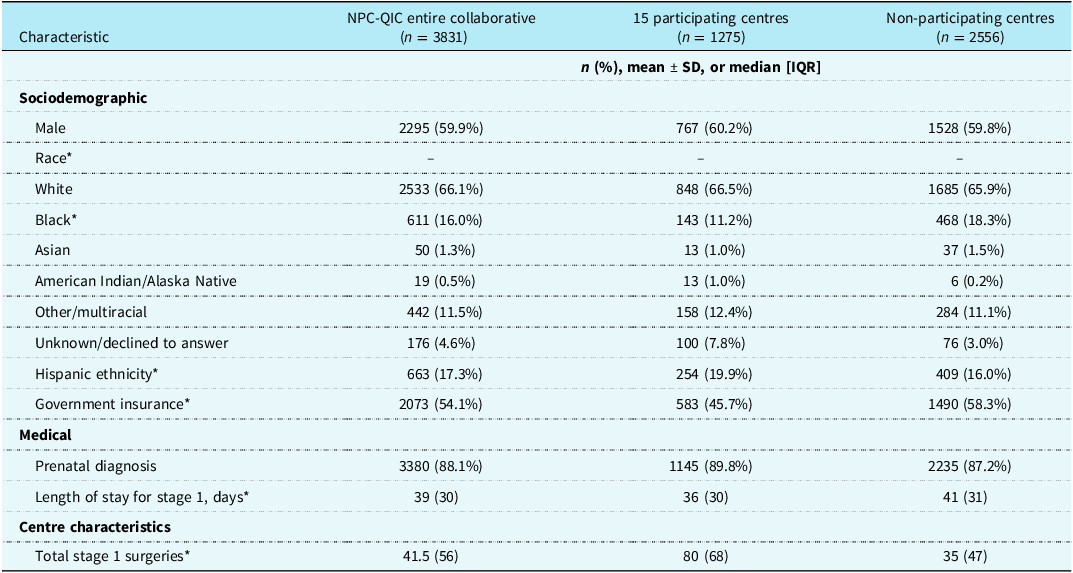
Infant demographics and centre characteristics are shown in Table 1. Centres participating in the Gross Motor Improvement Project, compared to non-participating centres, had significantly more Hispanic patients (20.0% to 16.0%), fewer Black patients (11.2% to 18.3%), fewer patients with government insurance (45.7% to 58.3%), a shorter length of hospital stay (median of 36 days to 41 days), and performed a greater volume of Stage 1 Palliation surgeries during the project time frame of January 2020 to August 2022 (80 verses 35 surgeries).
Infant demographics and centre characteristics

*Significant difference between participating and non-participating centres (p < 0.05).
Gross motor screening
At 6 months, AS Ages and Stages Questionnaires data were available for 653 infants across National Pediatric Cardiology Quality Improvement Collaborative and 319 infants at the 15 participating centres; at 12 months, for 533 and 266 infants, respectively. Within the entire National Pediatric Cardiology Quality Improvement Collaborative collective, 22% of infants scored in the “on target” range at 6 months and 35% at 12 months. Results of the gross motor findings from the developmental screening are presented in Figure 1. There were no significant differences in the proportions of infants scoring “on target” between participating and non-participating centres at either 6 or 12 months (P > 0.05).
Ages and Stages Questionnaires gross motor scores at 6 and 12 months for non-participating and participating centres. The figure illustrates the percentage of infants with on-target (dark blue) and not on target (light blue) gross motor scores at 6 and 12 months for participating and non-participating centres.

Variation in neurodevelopmental care practices
The neurodevelopmental centre survey collected at the start of the project revealed variation in inpatient practices related to gross motor skill development across the 15 participating centres. A formal holding protocol was reported by 47% of participating centres, while 87% implemented sternal precautions (lifting and handling restrictions) lasting more than two weeks postoperatively. Only one centre reported the absence of any formal sternal precautions. The timing of recommending prone positioning (tummy time) varied by centre with a range of 0 to 6 weeks post-operation, with 80% of centres recommending this within 2 weeks of surgery.
Formal interdisciplinary developmental care rounds were conducted at 80% of centres. Administration of a standardised developmental assessment tool during the inpatient stay occurred at 53% of centres. All participating centres reported that physical and/or occupational therapy services were provided for developmental support during both Stage 1 and Stage 2 hospitalisations. In addition, all centres referred infants to early intervention at the time of inpatient hospital discharge. Referral to a formal cardiac neurodevelopmental clinic by 12 months of age for infants participating in National Pediatric Cardiology Quality Improvement Collaborative occurred at 87% of centres.
Process measure: developmental plans
Supplemental Figure S2 presents control charts for the percentage of infants receiving a developmental plan at Stage 2 discharge. The overall rate of developmental plan provision showed significant improvement over time, with a centerline shift from 62% to 74% for participating centres and 53% to 61% for non-participating centres.
Outcome measure: gross motor scores
Our aim for this project was to increase the percentage of infants whose gross motor score improved or remained “on target” from 6 to 12 months. The gross motor scores improved over time across the network, with centre lines shifting for both participating and non-participating centres, but with a larger shift from 41% to 89% in the 15 participating centres compared to the shift from 54% to 68% for non-participating centres. The mean rate of data collection for the developmental screening declined over time, decreasing from 22% to 18% at 6 months and 24% to 17% at 12 months (see Figure 2). Rates of developmental screening completion at 6 months and 12 months decreased over time at both participating and non-participating centres (see Supplemental Figure S3).
Percentage of infants with gross motor scores on the Ages and Stages Questionnaires that improved or remained “on target.” The top figure presents outcomes for the participating centres and the bottom figure is for the non-participating centres. The X-axis represents time of the 6 month screening, with dates starting 3 years prior to the gross motor improvement project initiation, with data plotted quarterly. Each data point reflects the proportion of infants whose gross motor scores collected during that quarter at 12 months of age either improved from a concerning range or remained within the on-target range compared to their 6 month score. The control chart includes a centerline (red) representing the average percentage (as described in the methods), with upper and lower control limits (green).

Discussion
This study highlights the high prevalence of gross motor delays in infants with single ventricle CHD and underscores the importance of targeted interventions. Baseline screening data demonstrated that most infants scored in a concerning range for their gross motor development, with 78% scoring in the borderline or refer range at 6 months and 65% at 12 months, consistent with prior literature. Reference Williams, Brosig and Reger26,Reference Gaynor, Stopp and Wypij19 Our findings align with and extend previous work demonstrating significant early neurological and motor vulnerabilities among infants with CHD, especially in single ventricle heart disease, in both inpatient and outpatient settings, reinforcing the need for structured developmental screening and intervention beginning in infancy. Reference Butler, Sadhwani and Stopp8–Reference Sprong, Broeders, van der Net, Breur and de Vries10 Importantly, our findings demonstrate that structured quality improvement interventions can positively impact developmental outcomes and care practices in this high-risk group, supporting the role of early intervention in mitigating developmental delays. Reference Sadhwani, Marino and Ittenbach27,Reference Anderson, Beekman and Kugler28
Notably, improvements in AS Ages and Stages Questionnaires gross motor scores and developmental care planning were observed not only in the 15 participating centres but also across non-participating National Pediatric Cardiology Quality Improvement Collaborative centres, reflecting shared learning within the collaborative. While improvements occurred across the network, the magnitude of change was greater at participating centres. These findings demonstrate both strengths and variability in developmental care across institutions. Such variation reinforces the need for standardised, evidence-based strategies to ensure more equitable care and highlights the benefit of active participation in quality improvement efforts.
Among the participating centres, commonly adopted practices included early postoperative prone positioning, consistent provision of inpatient physical and occupational therapy, use of interdisciplinary developmental care rounds, and individualised developmental plans provided to caregivers at discharge. These practices increase movement opportunities and caregiver engagement, promoting continuity of developmental care after discharge. The Gross Motor Toolkit was created using the learnings and recommendations from the project and shares intervention strategies to promote optimal gross motor outcomes for hospital and home settings. The toolkit provided a practical resource to support consistent implementation and remains available to guide future practice. 23
Despite the promising results, this study also highlights challenges that must be considered when applying these findings to broader contexts. Participating and non-participating centres differed significantly in demographic and institutional characteristics, including higher surgical volumes, shorter hospital stays, and lower rates of government insurance, factors that may influence developmental outcomes independent of the interventions. These differences may affect generalisability, particularly for low-resource environments. Many of the successful interventions, such as developmental screening, discharge plans, and prone positioning, are low-cost and scalable, making broader implementation feasible even where resources are limited. Large multicentre collaborations in paediatric cardiology have traditionally emphasised medical and surgical outcomes, but this work highlights the importance of integrating developmental perspectives to support long-term quality of life.
Family members were active partners in this multidisciplinary initiative, contributing to the design and implementation of interventions that supported motor development in the hospital and at home. Their involvement helped ensure that the care strategies were not only clinically sound but also aligned with real-world family concerns and were attainable to implement. Families are often the first to notice delays in their child’s motor development and frequently seek guidance from healthcare providers. Reference Bann, Miller and Parker29 Including their perspectives in care planning fosters a more responsive, family-centred approach and improves communication between teams and caregivers. Providing families with knowledge, teaching, and tools supports developmental progress and also strengthens caregiver confidence and continuity of care after discharge.
Several limitations should be considered when interpreting these findings. First, data collection declined over time, particularly toward the end of the study, potentially affecting trend interpretation. Missing follow-up screening for infants with more significant medical complexity may introduce bias. In addition, the study relied on caregiver-completed developmental screening, which is subject to reporting bias, though the tool itself is widely validated and commonly used in developmental screening. The timing of this project, which overlapped with the COVID-19 pandemic, also posed challenges. Reduced staffing and resource constraints likely impacted both the consistency of developmental screening administration and the implementation of developmental support strategies across centres.
Another consideration is that this analysis focused on short-term outcomes at 6 and 12 months of age. Longer-term follow-up is needed to assess whether improvements persist and translate to functional gains. Additionally, because centres were not randomised, unmeasured differences in patient populations or institutional practices may have influenced results. Future research should account for these variables and explore broader developmental domains, including cognitive and social-emotional functioning.
Despite these limitations, the collaborative nature of National Pediatric Cardiology Quality Improvement Collaborative was a notable strength. The project facilitated peer learning, shared problem-solving, and widespread engagement across disciplines. The improvements observed underscore the potential of coordinated quality improvement initiatives to address complex developmental needs in infants with single ventricle CHD. Sustained progress will depend on ongoing institutional commitment, integration of developmental care into clinical workflows, and access to shared tools such as the Gross Motor Toolkit. Early developmental support is critical because motor delays may signal broader neurodevelopmental vulnerabilities. Promoting early motor competence may yield cascading benefits across multiple developmental domains, reducing the risk of compounded delays later in childhood.
In conclusion, this study demonstrates that targeted quality improvement interventions delivered within a collaborative, interdisciplinary framework can improve gross motor development and care practices for infants with single ventricle CHD. Ongoing dissemination of the Gross Motor Toolkit, integration of developmental practices into standard care, and longitudinal evaluation will be essential to sustain and extend these gains.
Supplementary material
The supplementary material for this article can be found at https://doi.org/10.1017/S1047951126111603.
Acknowledgements
We are deeply grateful to the infants and families whose participation made this project possible. Their time, insight, and commitment to developmental care were central to the success of this initiative. We also thank Ashlin Tignor, Rebecca Collins, Joseph Michael, Paige Krack, Shari Wooton, and Carole Lannon for their support on this project. We thank the additional clinicians, staff, and leadership at the 15 participating National Pediatric Cardiology Quality Improvement Collaborative centres, as well as the broader collaborative, for their dedication to improving outcomes for children with single ventricle CHD.
Financial support
This research received no specific grant from any funding agency, commercial sector, or not-for-profit sector.
Competing interests
The authors declare that they have no conflicts of interest.
Ethical standard
The project was reviewed by the National Pediatric Cardiology Quality Improvement Collaborative research committee and was approved by the Cincinnati Children’s Hospital Internal Review Board as exempt. All procedures contributing to this work complied with applicable ethical standards and protected patient confidentiality in accordance with national guidelines.