Clostridioides difficile is the most common infectious cause of healthcare-associated diarrhea in developed countries.Reference Simor1 Advanced age, longer hospitalization stays, comorbidities, and exposure to antibiotics increase vulnerability to the C. difficile acquisition and infection.Reference Bignardi2 The incidence rate of C. difficile infection (CDI) is higher in the elderly and can be up to 5–10 times higher in hospitalized adults aged >65 years compared to younger patients.Reference Simor1,Reference Kwon, Olsen and Dubberke3 In addition, CDI-attributable mortality has been shown to be 3.5 times higher in acute-care patients aged >65 years compared to those aged 18–64 years.4 Although CDI incidence and CDI-related adverse outcomes are often reported for acute-care facilities,Reference Lofgren, Cole, Weber, Anderson and Moehring5,Reference Feuerstadt, Das and Brandt6 the same is not true for long-term care facilities (LTCFs).
From 2011 to 2018, the province of Alberta had a population of ~4.1 million, with 120,000 persons (3.0%) aged >80 years.7 Alberta Health Services (AHS), the single regional health authority in Alberta, is funded by the government of Alberta and is responsible for delivering all acute-care and LTCF services.Reference Allin and Rudoler8–Reference Duckett10 Few studies have investigated the adverse outcomes following CDI in LTCFReference Lindeman, Leal and Rusk11,Reference Pereira, McGeer, Tomovici, Selmani and Chit12 ; thus, we sought to describe the epidemiology of CDI in LTCF in the province of Alberta, with a focus on 30-day all-cause acute-care admissions and 30-day all-cause mortality between April 1, 2011, and March 31, 2018.
Methods
Study design and population
This was a retrospective, population-based cohort study that included all LTCF residents in Alberta, Canada, with CDI detected between April 1, 2011, and March 31, 2018. Each study year was from April 1 to March 31 of the following calendar year. Since the clinical information related to episodes of CDI in LTCF residents was not available, the positive C. difficile laboratory result was used to define CDI. Recurrent positive C. difficile laboratory results within 56 days13 of a previous positive C. difficile result were excluded.
Data sources and definitions
CDI cases were included in this study if their unformed stool specimens tested positive for C. difficile by toxin assay or by polymerase chain reaction (PCR) test.13 An assumption was made that CDI testing was ordered only for residents with diarrheal illness suspected of CDI. All positive C. difficile laboratory records were provided by Alberta Precision Laboratories and the details are provided in the following section. The first positive C. difficile test for an individual during the study period was defined as the incident case. Any subsequent positive C. difficile test >56 days after a previous positive test was defined as a reinfection case.
To identify cases that occurred in the LTCF setting, the incident and reinfected CDI cases (ie, all positive cases) were linked to the Alberta Continuing Care Information System, a repository of data for all residents in Alberta LTCFs.14 Information regarding home living and supportive living residents were incomplete in the Alberta Continuing Care Information System, so they were not considered in this study. Each person in the province has a unique lifetime identifier that facilitates linkages with other databases. The linked data set was then matched to the provincial Discharge Abstract Database14 to determine the inpatient admissions prior to and after the CDI test. Lastly, the LTCF residents with CDI were also linked to the Vital Statistics Registry14 to identify all-cause mortality within 30 days of diagnosis.
Cases were classified based on the date of LTCF admission, specimen collection date, and discharge date from hospital according to the provincial protocol.15 Long-term care–onset CDI was considered the first positive C. difficile test captured for a resident who had been admitted to a LTCF for >3 days or a subsequent positive C. difficile test for a resident captured >8 weeks after a previous positive C. difficile test. Hospital-onset CDI was considered a positive C. difficile test captured for a resident who has been admitted to a LTCF for <3 days and was discharged from a hospital in the previous 4 weeks. Community-onset CDI was considered a positive C. difficile test captured for a resident who has been admitted to a LTCF for <3 days and was not admitted to a hospital in the previous 4 weeks.
The number of CDI episodes were counted for each resident, and they were categorized as only 1 episode (incident cases) and >1 episode (reinfection cases) for our analysis. For residents with reinfections, the last episode was used to assess the association between reinfection and adverse outcomes.
Outcomes
We were unable to determine whether an adverse outcome was related to CDI. However, since adverse outcomes within 30 days after the infection were more likely to be associated with CDI,Reference Hunter, Mu and Dumyati16,Reference Chopra, Awali and Biedron17 we considered the following 2 adverse outcomes resulting from CDI within a 30-day window: (1) Deaths that occurred within 30 days after the specimen collection date of the last positive C. difficile test were counted as 30-day all-cause mortality. (2) Admissions to acute-care hospital that occurred within 30 days after the specimen collection date of the last positive C. difficile test were counted as 30-day all-cause acute-care admissions. Diagnosis at admission was investigated using diagnosis information from the Discharge Abstract Database.
We also investigated operator type. There are 3 operator types in Alberta: (1) facilities owned by AHS; (2) private facilities, including for-profit organizations; and (3) voluntary facilities, including nonprofit organizations such as faith-based and charitable organizations.18
Microbiology
Although AHS is a single health-delivery entity, services in Alberta are still provided zonally in the province in 5 zones: South, Calgary, Central, Edmonton, and North. During the study period, although only unformed stool specimens were eligible for C. difficile testing, 3 different approaches to testing C. difficile were utilized. The laboratory that serves the Calgary zone performed C. difficile testing using a 2-step algorithm for the whole study period. All samples were screened by a chemiluminescent immunoassay to detect the glutamate dehydrogenase (GDH) specific for C. difficile. If it was negative, C. difficile was ruled out, but if the GDH was positive, Cepheid GeneXpert Dx System (Cepheid, Sunnyvale, CA), a real-time PCR test for rapid detection of toxin B gene sequences, was used to confirm the presence of a toxigenic C. difficile strain. Until 2013, all other zones used a single enzyme-linked immunosorbent assay (ELISA) for C. difficile toxins, which was repeated if results were indeterminate. After April 2013, all other zones across the province adopted a rapid enzyme immunoassay (TechLab C. diff Quik Check Complete, TechLab, Blacksburg, VA) for the simultaneous detection of C. difficile GDH antigen and toxins A and B in fecal specimens. If the result was indeterminate, it was sent for confirmatory PCR testing.Reference Leal, Ronksley, Henderson, Conly and Manns19
Statistical analysis
Demographic data (age group, sex), case classification, episode number, and type of operator were compared using univariate tests of association. Patient age on sample collection date was grouped into 2 categories: ≤80 years and >80 years. Age 65 years is a common cutoff point used in investigating the impacts of advanced age on CDI in the general population.4 However, a preliminary analysis of the data revealed that ~90% of LTCF residents in our study were >65 years of age, and the median age was 85 years. Only 101 residents (11%) were aged ≤65 years. To reflect the age distribution more appropriately in the population under study and to have enough power for statistical analyses, 80 years of age was selected as the cutoff point for investigating the impact of age on CDI among LTCF residents.
For residents with multiple episodes of CDI, the episodes were categorized into first episode and reinfection. Univariate logistic regression was used to identify the independent risk factors for CDI among LTCF residents. A post hoc analysis was repeated for CDI identified in April 2013–March 2018 due to the more consistent laboratory approach used during that period. For all statistical analyses, 95% confidence interval with a P value <.05 was considered statistically significant. Stata version 15 software (StataCorp, College Station, TX) was used for statistical analyses.
Results
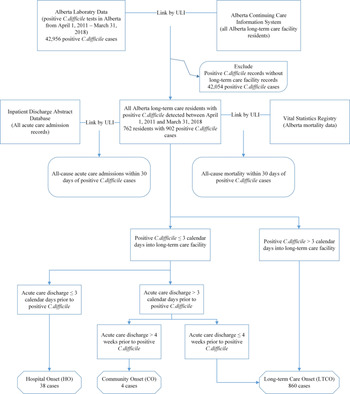
Between April 1, 2011, and March 31, 2018, AHS and its contracted partners20 provided 52,254 admissions with 35,594,067 LTCF resident days across 180 LTCFs in Alberta. The numbers of admissions for the 3 operator types of facilities were similar: 18,057 (34.6%) in AHS facilities; 19,290 (36.9%) in private facilities; and 14,907 (28.5%) in voluntary facilities. In total, 902 CDI cases were identified across 137 LTCFs, with an overall CDI rate of 2.3 per 100,000 resident days. The data linkage process is illustrated in Figure 1. Of the 902 cases, 860 (95.3%) were long-term care–onset CDI cases and 38 (4.2%) were hospital-onset CDI cases, and 4 were community-onset CDI cases (0.4%), based on our definitions.
Data linkage and case classification process. Note. ULI, Alberta Unique Lifetime Identifier.

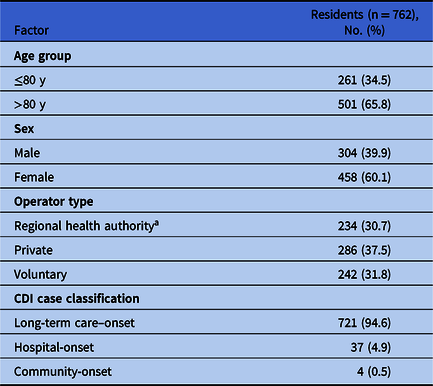
In total, 762 LTCF residents had incident CDI cases, with a resulting incident CDI rate of 2.0 per 100,000 resident days. The median age of residents with an incident CDI case was 85 years. Table 1 describes the characteristics of residents with incident CDI. In total, 105 residents (13.8%) had a total of 140 reinfections. The reinfection CDI rate was 0.3 per 100,000 resident days. Of these 105 residents, 81 (77.1%) had 1 reinfection; 19 (18.1%) had 2 reinfections; and 5 (4.8%) had 3 or more reinfections. Compared to residents with incident CDI, those with reinfections were more often aged <80 years (59.3%), more often male (41.4%), and more often with long-term care–onset CDI (97.1%), but operator type distribution was similar.
Demographic Characteristics of Residents With Incident Clostridioides difficile Infection (CDI) by Type of Long-Term Care Facility, from April 1, 2011, to March 31, 2018

a Alberta Health Services.
Mortality
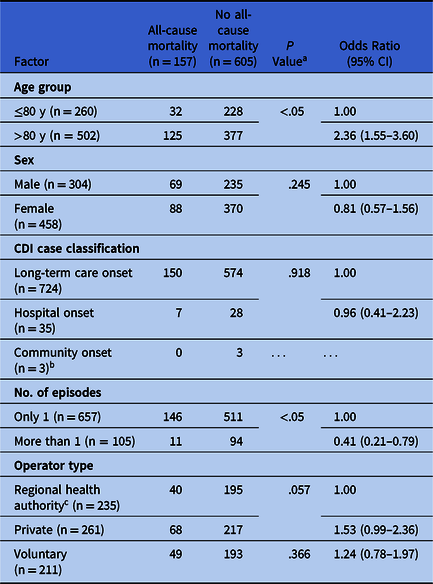
Excluding the 4 residents with community-onset CDI, the overall 30-day all-cause mortality rate was 20.6% (157 of 762) following a CDI episode (Table 2). Furthermore, 93.0% (146 of 157) of the reported mortality occurred after the first episode of CDI; 5.1% (8 of 157) occurred after the first reinfection; and 1.9% (3 of 143) occurred after a second or later reinfection. For all LTCF residents aged >80 years, the 30-day all-cause mortality rate was more than twice the rate of those aged ≤80 years old (24.9 vs 12.3 per 100 residents; P < .05). Male and female residents had similar 30-day all-cause mortality rates following their CDI episodes. In addition, case classification and operator type did not significantly affect the all-cause mortality of LTCF residents.
Demographic Data and 30-Day All-Cause Mortality Among Residents by Type of Long-Term Care Facility and Onset of Clostridioides difficile Infection (CDI) from April 1, 2011, to March 31, 2018

Note. CI, confidence interval.
a P < .05: there are statistically significant differences between groups.
b Community onset: no community onset resident had 30-day all-cause acute-care admissions, so the P value and odds ratio could not be calculated and used for logistic regression.
c Alberta Health Services.
Acute-care admissions
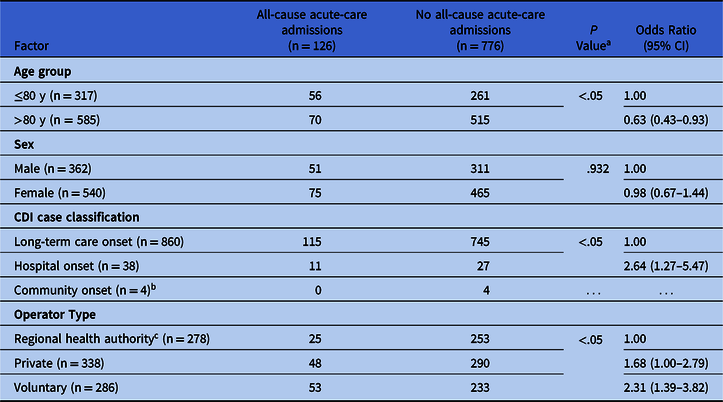
Examining all long-term care and hospital-onset CDI cases, 126 of 902 (14.0%) had an acute-care admission within 30 days of the collection of the last positive laboratory result for C. difficile (Table 3). Compared to younger LTCF residents (56 of 317 or 17.7 per 100 cases), those aged >80 years had fewer all-cause acute-care admissions within 30 days of a CDI case (70 of 585 or 12.0 per 100 cases). More LTCF residents with CDI were female (540 of 902, 59.9%), but the incidence of acute-care admissions was similar for males (13.9 vs 14.1 per 100 cases; P = .932). In addition, LTCF residents with hospital-onset CDI, and those in private or voluntary LTCFs had significantly higher 30-day all-cause acute-care admissions (Table 3).
Demographic Data and 30-Day All-Cause Acute-Care Admission among Residents by Type of Long-Term Care Facility and Onset of Clostridioides difficile Infection (CDI) from April 1, 2011, to March 31, 2018

Note. CI, confidence interval.
a P < .05: there are statistically significant differences between groups.
b Community onset: no community onset resident had 30-day all-cause acute-care admissions, so the P value and odds ratio could not be calculated and used for logistic regression.
c Alberta Health Services.
Residents with reinfections within the study period were less likely to have all-cause acute-care admissions (10 of 105 or 9.5 per 100 cases) compared to those with a single CDI episode (97 of 657 or 14.8 per 100 cases), but the difference was not statistically significant (P = .155).
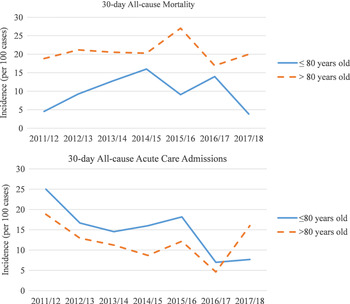
Figure 2 shows the incidence rates of all-cause mortality and all-cause acute-care admissions by age groups and fiscal year (FY). Each fiscal year was April 1 of one year to March 31 of the next year. Over each fiscal year, residents aged >80 years had higher 30-day all-cause mortality and fewer 30-day all-cause acute-care admissions except in FY2017–2018.
Incidence rate of adverse outcomes by age group and study year.

In the post-hoc analysis, 502 CDI cases were identified from 178 LTCFs between April 2013 and March 2018. The factors assessed showed similar 30-day all-cause mortality as those from April 2011–March 2018, except CDI cases identified in private LTCFs had significantly higher 30-day all-cause mortality than those that resided in AHS LTCFs (P < .05). In terms of acute-care admissions, only those who resided in private or voluntary LTCFs had significantly higher 30-day all-cause acute-care admissions (P < .05). Neither age groups (P = .06) nor case classification (P = .21) had a significant difference for acute-care admissions.
Discussion
Following our previous study about the incidence and characteristics of CDI occurring in LTCF,Reference Lindeman, Leal and Rusk11 this study focuses on 30-day all-cause mortality and 30-day all-cause acute-care admissions. To our knowledge, this is one of the first province-wide studies to examine CDI-related adverse outcomes among LTCF residents in Canada.
Between 2011 and 2016, the overall incidence of long-term care CDI in Alberta was 2.7 per 100,000 resident days, which was 14 times lower than the incidence rate of CDI in the acute-care setting.Reference Leal, Ronksley, Henderson, Conly and Manns19 However, LTCF residents had a 30-day all-cause mortality rate that was twice as high as that of residents in the acute-care setting (20.8 vs 12.2 per 100 cases).Reference Leal, Ronksley, Henderson, Conly and Manns19 Residents aged >80 years who developed CDI had a much higher mortality rate than the overall Alberta population. According to Statistics Canada, the mortality rate of people aged >80 years in Alberta 2011 to 2018, from 0.72 to 0.76 per 100 people,7,21 while the mortality of LTCF residents with CDI, according to our study, was 18.2 to 27.9 per 100 people during same time period. This observation highlights the impact of CDI among LTCF residents, especially for those aged >80 years.
There is evidence that age is associated with the development of different adverse outcomes.Reference Collins, Ayturk, Anderson and Santry22,Reference Gravel, Miller and Simor23 Our findings suggest that LTCF residents >80 years of age had higher 30-day all-cause mortality but fewer 30-day all-cause acute-care admissions compared to those aged ≤80 years. A breakdown by decade after age 65 years was used in a preliminary analysis, but the number in each age group <85 years was too small to show differences. A US study that followed acute-care patients with CDI for any acute-care readmission found that patients aged 65–84 years had higher readmission rates than patients aged >85 years (10.1 vs 8.6 per 100 cases; P < .05).Reference Collins, Ayturk, Anderson and Santry22 A potential explanation for why older residents may be less likely to be admitted to acute care, despite the increased mortality observed in this population, may be different preferences for end-of-life care. Studies from Europe and Canada showed that among persons aged >65 years, with increasing age, fewer people died in a hospital and more died in nursing homes.Reference Kalseth and Theisen24,Reference Motiwala, Croxford, Guerriere and Coyte25 A study from the United Kingdom also showed that among patients discharged to the same nursing home, residents aged <80 years had higher readmission rates.Reference Ahearn, Jackson, McIlmoyle and Weatherburn26
Case classification type had significant effects on 30-day all-cause acute-care admissions but not on mortality. This observation is similar to a finding by Kim et alReference Kim, Toy and Muder27 who found that LTCF residents with hospital-associated CDI had more acute-care admissions in the next 12 months than residents with long-term-care–associated CDI.Reference Kim, Toy and Muder27 In addition, previous hospital care was a risk factor for admissions among patients aged >65 years.Reference Pedersen, Meyer and Uhrenfeldt28
The distribution of LTCF operator type of CDI-positive residents (AHS, 31.5%; private, 38.0%; and voluntary, 30.6%) was similar to the distribution of total LTCF admissions (AHS, 28.2%; private, 37.8%; and voluntary, 34.0%). A Swedish study conducted by Kirsebom et alReference Kirsebom, Hedström, Wadensten and Pöder29 showed that nursing homes run by private for-profit providers were more likely to send residents to hospital than public domain providers. The latter finding supports our finding that private operators had a significantly higher 30-day all-cause acute-care admission rate than the AHS operator, which is in the public domain. The voluntary, nonprofit organizations also had a significantly higher 30-day all-cause acute-care admission rate than the AHS operators, but this rate was not significantly different than that of the private operators.
If a resident was reinfected with CDI, they were significantly less likely to suffer from an all-cause related death, which was consistent over the study years. This observation was an unexpected finding because reinfections with CDI may indicate more severe disease or greater levels of comorbidity. However, other studies have also shown decreased 30-day all-cause mortality with recurrent CDI.Reference Sheitoyan-Pesant, Abou Chakra, Pépin, Marcil-Héguy, Nault and Valiquette30–Reference Reveles, Lawson and Mortensen32 Potential explanations include a survival bias: residents who survived the primary CDI were more likely to survive recurrent CDI. Compared to residents with primary CDI, those with recurrent CDI may have had earlier CDI detection and treatment and host-adaptive immune-response changes. Another explanation is that asymptomatic carriage of toxigenic C. difficile and recurrent infections are prevalent in LTCF residents.Reference Ziakas, Zacharioudakis, Zervou, Grigoras, Pliakos and Mylonakis33 Therefore, those C. difficile carrier with subsequent positive results did not have more severe adverse outcomes.
Our study has several strengths. Compared to other studies that have focused on a single healthcare setting, this study collected and presented the information from all LTCFs across the province, resulting in a larger power of statistical analyses. The data were robust and consistent because the entire long-term care population in Alberta is under surveillance using a single ACCIS database for province and a single source of laboratory and DAD data. Compared to the previous Alberta study for LTCF residents,Reference Lindeman, Leal and Rusk11 we have confirmed the higher mortality and lower acute-care admissions in those residents aged >80 years. To our knowledge, this is one of the first studies presenting the 30-day all-cause acute-care admission among LTCF residents in Canada as well as assessing the role of operator type.
We recognize that our study has limitations as well. CDI cases detected in acute-care facilities usually involve both positive C. difficile laboratory results and symptoms. However, the large number of LTCF residents and limited resources in long-term care settings preclude manual CDI surveillance data collection for LTCF residents with confirmation that all those tested had diarrhea. A previous study noted that using LabID method for reporting can minimize the burden of clinical surveillance and standardize the process.Reference Gase, Haley, Xiong, Van Antwerpen and Stricof34 Selection bias may have affected our results because we assumed that all residents who had laboratory samples submitted had diarrhea. Because only unformed or loose stool specimens are eligible for CDI testing in Alberta, we know that the residents had at least 1 unformed or loose stool. However, we may have included residents with asymptomatic carriage, especially given its prevalence in LTCFs.Reference Ziakas, Zacharioudakis, Zervou, Grigoras, Pliakos and Mylonakis33 Selection bias may have affected our results because only residents with positive C. difficile tests were captured, and whether all patients were tested equally at all LTCFs remains unknown. This latter scenario could be assessed if all negative and positive C. difficile laboratory results for all LTCF were also obtained. The number of CDI cases may have been overestimated because we were unable to ascertain symptoms. A study conducted among 29 hospitals in the southeastern United States identified a 36% higher incidence of hospital-onset CDI using laboratory-identified CDI compared to traditional CDI surveillance.Reference Durkin, Baker and Dicks35 However, the laboratory-result–based definition for CDI has been widely used for LTCFs,Reference McDonald, Gerding and Johnson36–Reference Simor, Bradley, Strausbaugh, Crossley and Nicolle38 so our findings are comparable to those of other studies.
It is difficult to determine whether subsequent acute-care admissions or deaths were related to a previous CDI diagnosis in an LTCF; therefore, all-cause acute-care admission and all-cause mortality were used as indicators for CDI-related adverse outcomes. However, we may have overestimated the association with CDI in this population by not investigating whether these deaths and admissions were directly related to the CDI itself. We used a 30-day follow-up period because outcomes within 30 days could be more likely to be related to a previous CDI, and this has also been widely used as the cutoff point in other studies related to readmission and mortality following CDI.Reference Feuerstadt, Das and Brandt6,Reference Olsen, Stwalley, Demont and Dubberke39 Another limitation is the potential inconsistency in C. difficile test results over the study period. The testing methodologies changed in April 2013, and this may have led to changes in the detection of CDI over the years. However, to verify consistency, the number of CDI cases were checked for each fiscal year, and there were no obvious differences before versus after April 2013.
Risk factors such as antibiotic use, comorbidities in previous acute-care admissions, severity of CDI,Reference Bignardi2,Reference Hunter, Mu and Dumyati16,Reference Kim, Toy and Muder27,Reference McDonald, Gerding and Johnson36,Reference Pawar, Tsay and Nelson40 and other adverse outcomes such as intensive care unit admissions are not included in this study due to the limited information available. These parameters would be interesting to investigate and could provide information vital to understanding the reasons for the increased mortality in this population. To better understand the effect of age on mortality in CDI patients, future studies could focus on comparing LTCF residents with and without CDI and repeating this study to see whether any overall changes in trends occur.
In conclusion, the prevalence of 30-day all-cause mortality and 30-day all-cause acute-care admissions due to CDI in LTCFs was high, according to LabID event surveillance. Annual review of CDI adverse outcomes using LabID event data for reporting adverse can minimize the burden of surveillance and standardize the process across all Alberta LTCFs.
Acknowledgments
Financial support
No financial support was provided relevant to this article.
Conflicts of interest
All authors report no conflicts of interest relevant to this article.
Manuscript preparation
Alberta Precision Laboratories, Alberta Health Services Analytics team, and Alberta Ministry of Health provided assistance with data acquisition.