- WSRO
Wiltshire and Swindon Record Office
The ideal of ‘beauty in holiness’ was a powerful motivating force in the development of early Stuart ecclesiology. Primarily concerned with the dignified and disciplined conduct of the liturgy, and of the communion service in particular, this also had material expression in the beautification of churches and the provision of new furnishings and utensils.Footnote 1 Recent studies have revealed much of the practical working out of this ideal, and established that its appeal was not restricted to the Laudian party alone, but was shared by a broad range of positions within the English Church.Footnote 2 To date, relatively little attention has been paid to the imagery provided for many of these programmes of beautification, to the specific images chosen and how they were thought to ‘work’.Footnote 3 More frequently, consideration of such imagery has been conducted retrospectively, as it were, with reference to the iconoclasm of the 1640s. This article analyses the scheme of imagery designed for a Wiltshire parish church in the late 1630s, attending both to its content and its intended manner of reception, in order to shed light on the positive values that contemporaries may have attached to the use of imagery in church.
The plaster decorations in the chancel of East Knoyle parish church are a rare and important surviving example of this so-called Laudian beautification of sacred environments (see fig. 1). Dr Christopher Wren, father of the architect, dean of Windsor, and rector of the church in the 1630s when they were executed, was the actual inventor and designer as well as the patron of the decorations.Footnote 4 This adds significantly to their importance since, in this case, there is one controlling mind behind both the theological content and its presentation in imagery and text. Wren's theology and ecclesiology can be situated precisely with those leaders of the ‘Laudian’, or ‘avant-garde conformist’ party; his theological formation was shaped by his lifelong devotion to Bishop Lancelot Andrewes, a central figure in this movement.Footnote 5 Andrewes was of key importance in advancing the early career of Wren (and of his elder brother Matthew). As bishop of Winchester (1619–26), he also became Visitor to St John's College, Oxford, where Wren was a Fellow (1605–20), during the time when John Buckeridge and William Laud were Presidents.Footnote 6 Andrewes appointed Wren as his domestic chaplain in 1620, and preferred him to two valuable livings, Fonthill Bishop (1620) and East Knoyle (1623), in the Salisbury diocese.Footnote 7
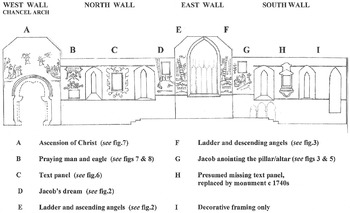
East Knoyle chancel, diagrammatic view. (© authors)

Wren's friendship with these men, and his particular devotion to Andrewes, is evident from his own surviving writings: marginalia and notes written in two books during the 1650s, whilst in retirement at Bletchingdon, in Oxfordshire.Footnote 8 His notes reveal his wide interests and knowledge as he comments on passages about medicine, horticulture or science in its wide seventeenth-century sense. But he also recalls conversations, journeys and visits to ‘great persons’. An annotation in his copy of Francis Bacon's Sylva sylvarum records in detail a conversation with Andrewes, whilst staying with him in the early 1620s. It concerns premonitions of the deaths of family members which each had experienced, and Wren recalls Andrewes's wise words of comfort to his protégé, that such a ‘touche of his [God's] Holy Hand’ was to be laid up as ‘a Treasure in [the] hearte and memory’.Footnote 9 Clearly the conversation of nearly thirty years previously had a profound and lasting effect upon Wren; he concludes his recollection of it with a eulogy to his long-dead patron and friend:
Thus that Mirror of Piety, vniversal Learning, vnparaleld Munificence & Affability; from whose Mouth (as the Beloued Disciple from our great Lord) I drew w[hat]soever I have [that] I count worthye [the] Name of Knowledge and exemplary Life, wherof next to [the] Ap[ost]les themselves, I think never any B[ishop] gave a greater Testimony.Footnote 10
Here then is evidence that Wren saw himself as a disciple of Andrewes, and declares his debt to him for whatever he counted in himself ‘worthye the Name of Knowledge and exemplary Life’. As an intimate of the bishop, Wren would undoubtedly have had access to manuscript copies of unpublished sermons and meditations, which were in wide circulation, and would have owned copies of his published works.Footnote 11 This article relates such texts to the design of East Knoyle chancel, and offers an exposition of the theological thinking embodied in Wren's sophisticated juxtaposition of images and words. It becomes clear that these plaster decorations as a whole are shot through with Andrewesian theology and that in certain respects Wren may even have been responding to specific passages in Andrewes's writings. It is often through sleight of hand that contemporary writings can seem to be the source for imagery such as that at East Knoyle, but at least the use of such evidence can help to give the modern viewer a clearer sense of the mentalities of the period. Here they not only do this, but are undoubtedly what Wren knew and used as spiritual guidance through his adult life.
II
In Wren's time the chancel of East Knoyle was employed as a ‘communion room’, set apart from the body of the church both physically and visually by its very low and narrow chancel arch, an effect lost when the arch was widened in the 1840s.Footnote 12 A seating plan of the church, drawn up in 1632, indicates a small number of pews and benches in the western half of the chancel, leaving a large open space in the centre which could have accommodated a congregation kneeling for reception of communion; against the east wall, raised up on three steps, is space for a communion table.Footnote 13 A small table fitting this space, of early seventeenth-century date, still exists in the church. Although the churchwardens' accounts for the period of Wren's incumbency are fragmentary, it is clear that, by at least 1637, communion was being celebrated monthly rather than the four or five times a year usual under his predecessor.Footnote 14 There is also evidence of cloth and utensils being provided in the period, including a silver paten bequeathed in 1637 by Augustus Mervin, whose son had married Wren's daughter.Footnote 15 All this confirms that Wren added his scheme of decoration to an already well-equipped and beautified communion room.
Within the chancel space the walls are entirely plastered above head height with panels of text and imagery. Friezes of strapwork patterns with cherubim run along the top of the north and south walls and, until the nineteenth century, the ceiling too was decorated with plaster cherubim.Footnote 16 The iconographic scheme is defined by the pairing of two major themes which face each other on the east and west walls of the chancel (see fig. 1, A, D–G). On either side of the large east window, and on the two immediately flanking panels on the north and south walls, are images and texts on the theme of Jacob's dream. Opposite, on the inner face above the chancel arch, is a much-mutilated ascension scene. Next to this, on the north wall, is a panel of image and text, clearly intended to be considered together with those of the west since it includes the figure of a kneeling man, praying fervently towards the ascension scene (fig. 1, B). Before the chancel arch was enlarged there were texts beneath the ascension; vestiges of their frames remain.
The north wall is pierced by two lancet windows, roughly evenly spaced, allowing for three areas of decoration (see fig. 1, B, C, D). The central panel has text only, within a large and elaborate strapwork frame. Visually this ensures a clear demarcation between the Jacob's dream images at the east end and the ascension/praying man images at the west, but the two themes are linked. On the opposite, south, wall there were three windows, not two, unevenly spaced so allowing only for two areas of decoration; the Jacob's sacrifice panel at the east end (see fig. 1, G) and (presumably) a text panel in the centre, mirroring that on the north wall, but unfortunately a monument was erected here in about 1741, and no earlier records of this area survive (see fig. 1, H, I).
The evidence for Wren's authorship of the designs derives from depositions taken by the Committee of Sequestrations for Wiltshire during 1646–7.Footnote 17 He had already compounded as a delinquent in 1645, but in July 1646 a witness accused him of causing ‘to bee made in frettworke Superstitious pictures in the chauncell [of East Knoyle church]’. This accusation was a side issue, made during an enquiry into Wren's possible involvement in the local ‘Clubmen Revolt’, but the matter was followed up, and in April 1647 the plasterer himself, Robert Brockway, was called before the committee.
The record of the plasterer's evidence is of crucial interest in several ways. First, he recalled having undertaken the work ‘about July last over 8 yeares or thereabouts’, giving a dating for the work in the later years of the 1630s. By then Wren was in possession of three lucrative rectories as well as the deanery of Windsor and office of Register of the Garter, and was thus in a position to afford the refurbishment of his parish church. More important, the plasterer affirms that Wren's original idea was for ‘the picture of the 4 evangelists and such other thinges as afterwards the s[ai]d. Doctor should invent and accordingly he did invent, and made a moddell or draughte thereof in paper, which he gave to the examinant and caused him to make it’. Brockway goes on to describe accurately the Jacob sequence and ‘the picture of the ascension (which was done in this manner) the picture of the 12 apostles and Christ ascending in the cloudes and nothing seen but his feet and the lower part of his garment below the clouds which stood at the lower end of the chancel next towards the church’. He also provided ‘a draughte of the Trynyty (as the s[ai]d. Doctor called it) which was sett up over the communion table in three roundes linked in each other (and God in the midst) with the glory about it and without that the clouds on the roof’.Footnote 18 That Wren had second thoughts about the four evangelists is not surprising since the spaces available on the chancel walls would not have lent themselves easily to this idea. What is more surprising is that he himself provided the working drawings.
There is ample evidence, however, of Wren's interest in the visual arts, and of his practical skill as a draftsman, which helps to explain his ability to provide detailed designs to embody his theological ideas. The marginalia in his books include descriptions of paintings, of a camera obscura and of other visual phenomena. Occasional explanatory sketches are executed with confident pen strokes and perspectival skill: it is known from a different source that he invented a device for drawing objects in perspective.Footnote 19 Several passages suggest that he knew Sir Henry Wotton as a friend, and in his copy of Wotton's Elements of architecture he drew his own design of a roof, recorded later with pride in Parentalia.Footnote 20 The famous sketch plan of Andrewes's London chapel, sent to Laud in 1623, was most probably made by Wren, at that time chaplain to Andrewes, since there are close similarities of penmanship with his marginalia.Footnote 21
Wren clearly suspected that his work might prove contentious, since in 1643 or 1644 he had written from Windsor to one of his churchwardens, Randall Dominick, ‘that there were certaine pictures in the chancel at Knoyle wch might prove scandalous and therefore willed [him] to cause them to bee taken downe’.Footnote 22 The text of the plasterer's deposition suggests that he was asked about specific elements of the plasterwork, and his answers show him anxious to avoid personal responsibility, presenting himself as merely the executor of Wren's inventions. The potentially inflammatory elements seem to have been the images, not the texts, and it is significant that the figurative work has suffered considerable losses, though when this damage was carried out, and by whom, is not known. The figure of Christ ascending to heaven has completely disappeared and the heads of almost all the figures have been mutilated. The figure of the dreaming Jacob is almost entirely effaced. The texts, however, are in good condition and the only losses here (on the south wall and beneath the ascension scene) are the result of eighteenth- and nineteenth-century alterations to the chancel.
Despite the losses, the survival of so much of Wren's scheme enables questions about its intended meaning and function. Such an investigation entails moving beyond iconographical description towards an analysis of its relationship to holy communion and to the congregation assembled for its celebration. The plaster scheme provides an emphatic declaration of the significance of the chancel, of its difference, in terms of visual experience, from the rest of the church, but it needs to be seen not only as a decorous enrichment of the ritual space but also as an active participant in it, materialising beliefs about the meaning and efficacy of what takes place in that space.
III
The Jacob's ladder theme at the east end might seem an obvious choice for the decoration of a chancel. As recounted in Genesis xxviii, Jacob dreamed of a ladder stretching from heaven to the earth, with angels ascending and descending from God. He heard God's promise to protect him and bless his seed forever. On awaking, Jacob marked the place where heaven and earth met – ‘ye hovs of god and ye gate of heaven’ – by setting up the stone on which he had slept and anointing it with oil (see figs 2, 3).Footnote 23 This episode provided a typological justification for the recognition of the divine presence in the material church. It featured prominently in pre-Reformation consecration rituals and was revived by Lancelot Andrews in his new rite for the consecration in 1620 of Jesus Chapel, Southampton, a service in which both Wren brothers had participated as celebrants. Andrewes's consecration service, which specified Gen. xxviii.10-22 as the first lesson, became the basis for many later services in England and was adopted, for example, by Matthew Wren in 1632 and again in 1634 for the dedication of the new chapel at Peterhouse, Cambridge, and the re-consecration of Dore Abbey church.Footnote 24
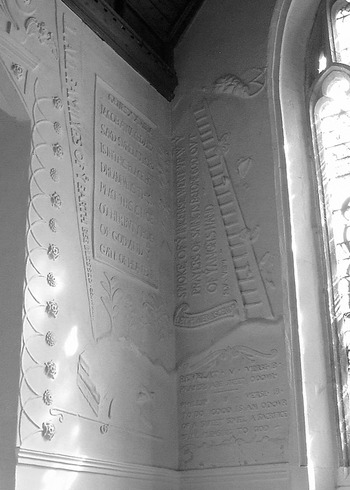
East Knoyle chancel, north and east wall: Jacob's dream; angels ascending the ladder. (© authors)

East Knoyle chancel, east and south wall: angels descending the ladder, and carrying crowns; Jacob anointing the altar. (© Crown copyright NMR)

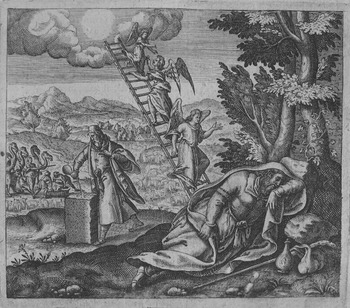
Wren's visualisation of the Jacob theme amplifies the Old Testament narrative by drawing together ideas of the divine presence within the church with the communion itself as the moment when that presence is most fully realised. Indeed his designs reveal a significant reworking of the conventional visual iconography of Jacob's dream in order to focus attention on its typological interpretation. The standard format of sixteenth- and early seventeenth-century representations of the story has the figure of the sleeping Jacob in the foreground of an extensive landscape, his traveller's staff and water bottle by his side.Footnote 25 He sleeps against rough boulders or slabs of stone. Behind him angels ascend and descend a ladder reaching up to the clouds where God, or in some Protestant versions, the tetragrammaton, appears. In some versions multiple elements from the narrative are depicted, with Jacob shown again in the background, pouring sacrificial oil onto an upright stone erected from his stony pillow (see fig. 4). At East Knoyle, however, all these elements have been separated out into different pictorial areas. Jacob sleeps on the north wall and pours out his libation on the south wall. The most significant deviation from convention is in the treatment of the ladder, which is here separated from the body of Jacob and pictured in a separate space. In fact it is pictured twice, repeated either side of the large east window, allowing for angels to ascend on one side and descend on the other.Footnote 26
Johann de Bry, ‘Jacob's dream’, Biblia sacra vulgata, Frankfurt-am-Main 1609. Reproduced by kind permission of the Warden and Fellows of All Souls' College, Oxford.

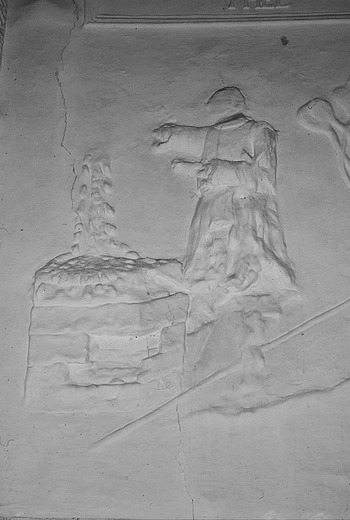
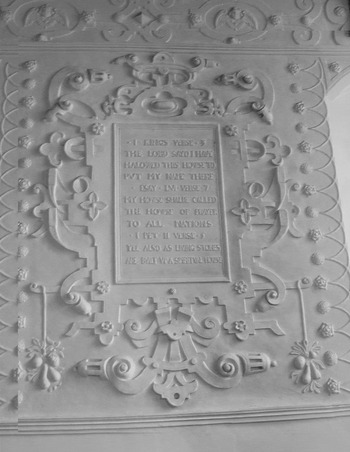
The stones upon which Jacob sleeps and onto which he pours out his sacrifice of oil are given a distinctive pictorial treatment that emphasises their altar-like appearance (see fig. 5). They are depicted as squared stones built up into an ordered structure and shown in careful perspective, the high modelling of the plaster emphasising their three-dimensional character. These must have been drawn out in detail in the ‘drafts on paper’ which Wren gave to the plasterer, for their visual exactitude makes a significant contrast with the schematic out-of-scale trees in the background, which were presumably left to the workman's invention. The structure of stones anointed by Jacob ‘reads’ as an altar and its visual importance is reinforced through Wren's treatment of the text above (Gen. xxviii.20–2).Footnote 27 In a surprising deviation from the scriptural source, he replaces Jacob's words – ‘this stone, which I have set for a pillar shall be God's house’ with the plural (and edited) form ‘these stones shall be gods hovse’.Footnote 28 But this phrase, together with the vivid image of the material stones, also resonates across the space of the chancel with the text from Peter's Epistle placed on the north wall (see fig. 6): ‘yee also as living stones are bvilt vp a spiritval howse’.Footnote 29 This shift of register, from narrative to direct address, serves to bring the Old Testament imagery on the walls into a new temporal relationship with the participants in the communion, ‘the living stones’ who are its addressees. The precise significance of this combination of images and texts could be understood in whatever way their beliefs directed, for while the especial sanctity of the physical church, God's earthly dwelling place, is clearly expressed, so too is the more Calvinist understanding of the Church as a spiritual community.Footnote 30
East Knoyle chancel, south wall: detail of Jacob anointing the altar. (© authors)

East Knoyle chancel, centre north wall: text panel. (© authors)

Above the scene of Jacob's sacrificial anointing of the stones the text concludes with his vow to return to God the tenth of ‘all that thou shalt give mee’. This, and God's words on the opposite wall, shooting down towards the sleeping Jacob – ‘all the families of ye earth bee blessed’ – sums up the old covenant between God and Jacob, of material blessings promised, and recompense offered. While these phrases might have served to remind parishioners of their duty in the matter of tithes, they are one aspect of a central theme of the east end decorations: the new covenant of sacrifice in praise and prayer rewarded by the grace bestowed through the sacraments. This is made clearer by the treatment of the ladder panels flanking the altar table. The motif of the doubled ladders, one on either side of the east window, could be seen simply as Wren's neat solution to a design problem, providing a satisfactory visual treatment to frame the east end. However, in separating them out from the image of Jacob, the ladders, and the flying angels ascending and descending beside them, are placed within a different register of meaning, their typological significance emphasised by the selection of accompanying texts. Where the Jacob images are paired with the appropriate verses from the Genesis narrative, the two ladder panels have texts assembled instead from Revelation, the Psalms and the Epistles.
Even the visual ordering of these texts is expressive. The text panels beside the ladders mirror the spiritual dynamic of the imagery and verse, emphasising the reciprocity of the new covenant of prayer and sacrifice offered and grace received. They shoot upwards or downwards with the ascending or descending angels; on one side, ‘smoke of ye incense went vp wt ye prayers of saints before god ovt of ye angels hand rev ·viii 4’, while on the other side descending angels return to earth bearing the promise that ‘the lord will give gratce and woorp [worship] and noe good thinge will hee wthhold from ye yt lead a godly life · ps lxxxii · 12’ [sic].Footnote 31 At the base of the ladders, distinguished by being set in scrolls, are the two unattributed phrases that are the key to the east end scheme: ‘let prayers ascend, and yt grace descend’.Footnote 32 Below the ladders framed panels of text on each side provide further elaborations or exegeses on the images and texts above:
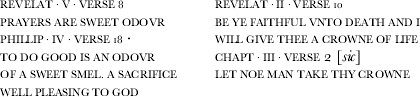
These texts spell out for communicants that prayer, faithfulness unto death and doing good are their own sacrifice which will be rewarded by the crown of eternal life. Angels mediate in this reciprocity, and Wren invents an interesting enrichment of the theme, for the descending angels are depicted carrying the promised crowns. High up on the walls and on the plaster ceiling were once many cherubim: they are still visible on the north and south wall strapwork friezes. Thus the worshippers in the chancel were physically encompassed around with angels, their spiritual presence given a material and visible one.
But if angels are intermediaries in this covenant between mankind and God, the ladder itself is the central image and metaphor. It is a Christological image, alluding to Christ as the ladder joining heaven and earth, whose sacrifice is the ground of the new covenant.Footnote 33 For a contemporary exposition of the metaphor of Christ as the ladder, and as the antetype of Jacob, one might turn to a popular handbook of biblical typology, Moses unveiled, published in 1620 by the Scottish minister, William Guild, and, as it happens, dedicated to Andrewes. His detailed commentary on Gen. xxviii.12 runs:
So Christ, albeit he was humbled in shape of sinfull flesh, touching the earth as it were, yet he was the most High God, reaching so to heaven, and reconciling, as the two natures himself by personall Union; so God and us together by his death and mediation.Footnote 34
The analogy of the ladder as the image both of the union of Christ's two natures and of Christ as the means of the union of God and man, is developed in other texts of the period, most familiarly in the Geneva Bible, where the marginal annotation to the same verse asserts: ‘Christ is the ladder where by God and Man are joined together, and by whome the Angels minister unto us. All graces by him are given to us, and we by him ascend into heaven.’ The implicit Christological and soteriological theme of the east end is reinforced visually through the positioning of the ladders which, we can now understand, were deliberately designed to point towards, and visually frame, the altar itself, and the imagery of the entire east wall would have been pulled together and completed by one final, but now lost, component of the scheme, a crucifix, which is known to have stood on or behind the communion table.Footnote 35
The strategies Wren employs in dealing with a story so suited to the space and liturgy which the decorations enrich, share method with the structure and language of Andrewes's sermons. The separating out of (visual) elements and the conflation of texts, which reveal ‘by painstaking excavation what unseen structures lie beneath the visible surface’; the use of key images, words or phrases which bring meanings into direct connection with the living communicants; the exhortations to them to act out their sacrificial part in the new covenant; all these find parallels in the sermons.Footnote 36 But most significant is the shared purpose that hearing – or seeing – must involve an active mind, and lead to action – praxis – in life.Footnote 37
IV
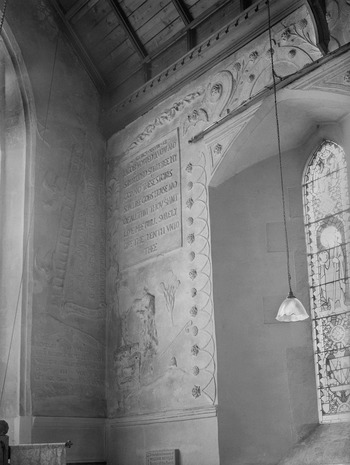
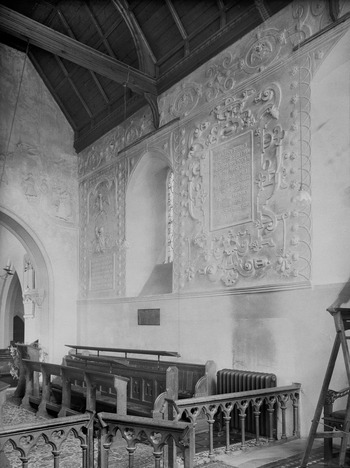
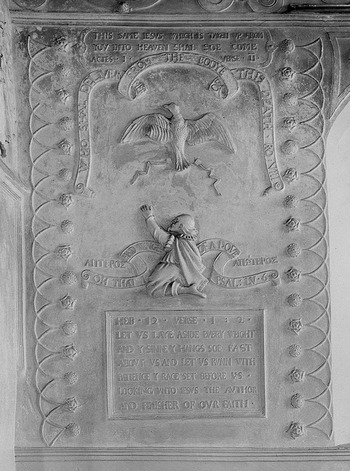
This mode of reading, and the implied exhortation from sight to praxis, is even more explicit in the arrangement of the west end scheme. The Ascension scene covering the whole of the inner chancel arch wall is coupled with a complex panel of text and imagery on the immediately adjacent north wall (see fig. 7). The central figure here is that of a kneeling man in seventeenth-century dress, an ‘everyman’ figure, who prays imploringly towards the figure of the ascending Christ, now lost (see fig. 8).Footnote 38 The import of this striking combination of biblical scene and contemporary figure, and its thematic relationship to the Jacob themes at the east end of the chancel, is not immediately obvious. But a consideration of ascension theology current in Wren's circle helps to illuminate its meaning. Indeed, if the composition of the east end scenes demonstrates a general resemblance to the strategies of an Andrewes sermon, here at the west end it is possible to propose a close thematic relationship to specific sermons and writings by Andrewes.
East Knoyle chancel, view looking west: ascension of Christ; praying man & eagle. (© Crown copyright NMR)

East Knoyle chancel, west end of north wall: praying man and eagle. (© Crown copyright NMR)

Of particular interest is Andrewes's 1622 Easter Day sermon preached before King James at Whitehall, where, surprisingly, he focuses attention not on Christ's resurrection, but on his ascension.Footnote 39 At this time Wren, as Andrewes's household chaplain, would have been in frequent attendance, and he would certainly have heard the sermon preached and even been party to discussions in its meticulous preparation. The experience must have remained vivid to him.
The sermon text, John xx.17, takes the words that Christ spoke to Mary Magdalen after his resurrection.Footnote 40 Andrewes reminds his listeners that Christ, on rising from the dead, set his mind at once on ascending to heaven and that they must do likewise in their earthly lives. There is for Christians a first resurrection, a resurrection from the sin inherited from Adam in the body – the ‘body of death’ – which deserves no more than everlasting death. This first resurrection, in life, is achieved through faith and turning away from sin. There is also for the Christian a first ascension – of the mind – in aspiring towards God in life. The second resurrection, from the grave, comes to all men – ‘All that die in Adam, shall rise in Christ, Miscreants, Jews, Turks and all’, but the second ascension, to heaven, is only for those who have set their hearts and minds upon ascension during their lives. Andrewes turns Christ's words, ‘nondum ascendi and yet ascendo’, to his listeners,
which will very well fit us, if, while we are not at ascendi yet (that is, in body ascended) we be, for all that, at ascendo (that is, ascend in mind) even as Christ heere did. And Blessed is the man (saith the Psalme) cui in corde ascensiones, that hath the ascension in his heart, or his heart on it; That while it is nondum ascendi with him, yet at times it is ascendo, lifts up his eyes, sends up his sighes, exalts his thoughts otherwhile, represents (as Christ doth) anticipates the ascension, Volo & desiderio in will and desire, before the time it selfe come of the last and final ascension.Footnote 41
The sermon continues with discussion of Christ's instructions to Mary Magdalen to convey to the Apostles that ‘I ascend unto my Father, and your Father; and to my God, and your God.’ Andrewes points out that this message, which binds Christ and his disciples in one fraternity, contains fifteen words, making them ‘as so many stepps or rongs (as it were) of Jacob's Ladder, which we to ascend by’. In conclusion, as is usual, he commends his listeners to take communion, that ordinance of the Church for the ‘solemne renewing of this fraternitie, so likewise to seale to us the fruit of it, our rising; and not rising only, but, so rising, as ascendo goe withall’.Footnote 42 While it would be mistaken to assume that Wren's decorations are simply a visualisation of this sermon, a more accurate theological gloss on Wren's designs could hardly be imagined.
The panel on the adjacent north wall provides further commentary on the ascension, drawing out its meaning through the representation of the ‘everyman’ figure, an image for the congregation of themselves, made visible and lisible. Here, two images and five passages of text interrelate to expand on the theme of the travailing Christian in this life and his promised ascension to the next. The focal point of the panel is the kneeling man, his silent prayer vocalised in the accompanying texts. Around him weaves a ribbon inscribed ‘oh that i had winges of a dove psal lv 6’ with two Greek words either side of him – ‘aπtepoσ’ (wingless) and ‘aπ′Ωtepoσ’ (yonder). Above his head a large bird soars upwards, having burst free of its jesses – the ties on the legs of birds used in falconry and always retained on the captive bird. Above the bird another band gives the yearning question of the praying man, ‘who shal deliver me from the bodye of this death ro: viii [sic]’ and above that, the message of hope for eternal life, spoken by the angels at the ascension – ‘this same jesvs which is taken vp from you into heaven shal soe come · actes · i. · verse · ii · ’.
Again, a specific Andrewes sermon provides a suggestive framework for Wren's combination of images and texts:
Forthly, this word ‘heaven’ serveth to prepare us to prayer, to the end that we should lift up our hearts and affections from earth to heaven, seeing we speak not to an earthly father but to One That is in heaven, and this is that Sursum corda, ‘Lift up your hearts.’ Touching which thing one saith, Aquilarum est hoc negotium, ‘This business belongs to eagles,’ which as they fly highest so they look most steadfastly upon the sun; … We must wish with the Prophet, ‘O that I had the wings of a dove,’ and labour more and more to fly up with the eagle into heaven, into the presence of God the Father, and His Son Who sitteth at the right hand bodily … As a consideration of God's majesty Who is in heaven doth bring us down and make us ‘bow the knees’ before God our Father, so it must cause us levare manus et corda, ‘to lift up our hands and hearts,’ and ‘to lift up our eyes to the hills,’ and to have such a continual meditation of His power that we may say with David, … ‘I have set the Lord always before me.’Footnote 43
The vivid imagery of Andrewes's words finds a parallel in Wren's combination of image and text and both invite the viewer to action – to bow the knee and to rise in prayer, like the eagle, towards the ascending Christ. The text at the base of the entire panel, paraphrased from Hebrews xii.1–2, provides both an exhortation and a comfort to members of the Church militant, in anticipation of their membership of the Church triumphant:
Andrewes's own sermon on Hebrews xii.2, given on Good Friday 1605, provides his most extended discussion of the relationship between ‘sight’ and action – or praxis.Footnote 45 Taking St Paul's exhortation to ‘look unto Jesus’, he proposes two sights of Christ to his listeners, ‘His hanging on the Crosse the beginning of our faith … sitting on the Throne the consummation of it’. He distinguishes between mere inattentive looking and the necessity for an active, reflective engagement with the thing seen: ‘what this sight is to work in us; and that is a motion, a swift motion, running: So to look on it, that we runne, and so to runne that we faint not’.Footnote 46
Such an exhortation can be taken to encapsulate the relationship between the east and west end panels in Wren's chancel, binding them into a thematically and temporally related sequence. The vision of Christ's incarnation and sacrifice at the east end (typologically in the image of Jacob's ladder and iconically in the crucifix) confronts the communicants as they ‘draw near’ to the communion table and, at the west end, they behold Christ's, and their own, ascension to their heavenly thrones, a sight to sustain them as they leave the chancel.
V
As has been apparent from this analysis of the iconographic scheme of the East Knoyle chancel, the images here do not function simply as illustrations of biblical narratives or persons, but as focuses for meditation. Their message is not laid out on the surface but has to be consciously assembled by the receptive onlooker reading across the words and images in order to internalise their meanings and to see their significance as fulfilled in the liturgical actions taking place in the chancel and embodied in the living persons who participate in the liturgy.
But if Wren's scheme constructs a particularly active spectator, the visual and textual strategies he employed would not have been strange or arcane. The images and texts chosen, set out in large, simple pictures and clear, bold lettering, would have been reasonably familiar to the average churchgoer. The mode of interpretative reading they required was also embedded in early modern literate culture. The design of Wren's plaster panels is immediately reminiscent of the types of word-image combinations familiar from popular prints and emblem books of the period, and particularly close parallels can be drawn with books of devotional emblems such as Hawkins's Partheneia sacra (1633) or Wither's Emblemes (1635).Footnote 47 These texts, both Catholic and Protestant, were intended to provide their readers with guided spiritual exercises requiring ‘consideration, penetration and acceptance of a spiritual truth through the senses, the mind and the will’.Footnote 48
This raises interesting problems of interpretation, not least in terms of the theological position implied by the designs. Is this, as might be expected, a ‘Laudian’ scheme? Was Wren deliberately setting out to make his chancel into a programmatic declaration of ‘avant-garde conformist’ churchmanship? Certainly the visual emphasis on the east end altar table, and the thematic emphasis on the reciprocity of prayer and grace, would suggest a particular reading of the nature of sacramental grace. The presentation of holy communion as a sacrificial, and not just a commemorative, act would even seem to be embodied in his treatment of the scene of Jacob anointing the stone upon which he slept. Wren has not only edited out the reference to the stone as a ‘pillar’ (a ‘commemorative’ object) from the accompanying biblical text, but the visual image he chose to represent it is unmistakably that of an altar, a scene of sacrifice. The whole ensemble, especially as completed by the crucifix at its centre, speaks of the divine presence in the communion.
The visual evidence therefore, together with what is known about the designer, makes entirely plausible a reading of the scheme as ‘Laudian’. Nevertheless, the necessity that the particular compositional format imposes on the spectator to internalise its meanings allows for the possibility of variant readings. In comparison with the more emphatically, or even polemically, Christ-centred imagery of, for example, Peterhouse Chapel in Cambridge, Wren's approach here appears to be much more circumspect.Footnote 49 His presentation of the incarnation is more veiled or allusive, his scriptural texts are uncontroversial and the typological associations he employs are sanctioned by tradition and the Geneva Bible. His scheme could just as easily be received within a Calvinist understanding of sacramental grace (as that which sustains the elect) as within a ‘Laudian’ reading of communion as propitiatory sacrifice. This open-endedness may have been an appropriate response to the particular demands of the parish church setting. The congregation of a country parish encompassed a wide variety of literary competences, and, no doubt, of beliefs about the eucharist, the nature of grace, the question of election and the appropriateness of images in church. Wren's scheme negotiates a sensitive resolution to this context. As designed, it lies somewhere between the painted wall-texts which adorned countless churches of the period, and the more uncompromisingly pictorial imagery his Laudian contemporaries were enthusiastically installing in the chapels of Oxford and Cambridge colleges.
Any decoration elevates and beautifies a space, an event, a person, whether in a domestic or sacred context. But the beauty of holiness, or rather the holiness of such beautification as at East Knoyle, lies in far more than mere visual enrichment and can be conceived of as efficacious, providing memorable images that call up godly thoughts, which viewers carry away with them. With similar aims, the sermons and devotional writings of the period encouraged the building of such memorable images in the imagination. The very particular circumstances attending the work at East Knoyle may render it exceptional. Wren's theological formation in the Andrewes circle, his experience and understanding of a parish community, his role as a court cleric and, not least, his visual skill (hardly a typical attribute of the early modern cleric), all suggest that this scheme is ‘untypical’.Footnote 50 Nevertheless this study of Wren's enrichment of his ‘Communion room’ has demonstrated the necessity to think more deeply about the specific nature of the imagery that contributed to the drive for the ‘beauty of holiness’ in early Stuart England, and to ask questions about its precise meanings and intended functions.