

I
For more than two centuries, Malthus has been a highly influential but also controversial figure. In his first Essay on population, published in 1798, he provided an elegant new framework for the discussion of the interlinkage between the rate of population growth and living standards. This was an issue that had long been discussed, but he gave it a new edge by arguing that, at best, agricultural production would rise in arithmetic progression whereas population displayed an inherent tendency to grow geometrically. The contrast between the two rates guaranteed that there must be a tendency for population to outrun food production. In the paradigm case, the tension between these two growth patterns must condemn the bulk of the population to live in deep poverty. The pressure on food supply from rising numbers would result in higher mortality, through the operation of what Malthus termed the positive check, that is a situation where rising mortality alone kept production and population in balance. Populations would live close to a Malthusian precipice and from time to time many people would be forced over the cliff's edge.
There was, however, the possibility of a less dire outcome. Where the preventive check was practised, a more favourable outcome was possible. Marriage decisions were influenced by the prevailing economic situation. If, for example, living standards were falling, couples would marry later in life and celibacy would become more common. Population growth would cease earlier than where the positive check alone halted further growth. There was the prospect of modest, sustainable prosperity for the population as a whole. The bulk of the population would live some distance from the precipice. Even the impact of severe harvest failure would be greatly mitigated.Footnote 1
The dangers associated with excessive population growth were set out very clearly by Malthus in his 1798 essay. It soon made him both famous and infamous, and, although his argument only had logical force in relation to organic economies and was rendered obsolete by the character of the industrial revolution, worry about excessive population growth has caused his name to be invoked repeatedly over the intervening centuries.
Downstream from his main contention about the dangers of excessive population growth, both in the 1798 essay and in many later publications, Malthus emphasized his deep concern about the English poor law system. He was particularly concerned about the recent surge in poor law expenditure. The 1798 essay was published in the immediate aftermath of the adoption in some parishes of what is generally termed the Speenhamland system. The system was named after the parish in Berkshire, where in 1795 the local magistrates decided to link the scale of the support given to a poor household to the price of bread and the number of children in the family. By undertaking to increase the payments made to a family as the number of their children increased, Malthus considered that this form of the allowance system strongly encouraged early and improvident marriages, undermining the operation of the preventive check. He supposed that as long as this source of increased income was available to the families of the labouring poor, population growth would be excessive, with disastrous implications for the living standards of the bulk of the population, and more generally for the future of the national economy.Footnote 2 Despite the good intentions of those who had created the system, Malthus thought it should be abolished. He argued that the Speenhamland system aggravated the problem of allowances to the poor, and as allowances were intrinsic to the poor law system as a whole he concluded the poor law legislation must be repealed.
In this article, we seek to establish to what extent, if any, he was justified in his concerns about the poor law. The first section of the article considers the argument advanced by Malthus in greater detail. The second section reviews the extensive literature on his contention that the old poor law undermined the preventive check. Its validity has been vigorously debated over many decades. The third section demonstrates that marriage patterns in the counties in which the poor law practices which Malthus greatly deplored were thought to be widespread did not differ significantly from the comparable patterns in other counties. His contention is not supported by the available evidence. Some of this evidence, however, only came into existence after Malthus's death. The fourth section considers whether the information which was available in his lifetime might arguably have caused him to modify or abandon his original stance. A final section describes his view of the character of human motivation which played a part in determining his approach to the issues with which he dealt in relation to the old poor law.
II
Early in the first Essay on population Malthus described how, in his view, in England marriage was normally undertaken only after a prudent consideration of the additional costs which might arise as the number of children increased in the years following a marriage. He considered that the preventive check could and normally did operate effectively in all social classes. Of the case of the labourer, he wrote as follows:
The labourer who earns eighteen pence a day, and lives with some degree of comfort as a single man, will hesitate a little before he divides that pittance among four or five, which seems to be just sufficient for one. Harder fare and harder labour he would submit to, for the sake of living with the woman he loves; but he must feel conscious, if he thinks at all, that, should he have a large family, and any ill luck whatever, no degree of frugality, no possible exertion of his manual strength, could preserve him from the heart-rending sensation of seeing his children starve, or of forfeiting his independence, and being obliged to the parish for their support.Footnote 3
The labourer, like other men, was well capable of acting prudently, but, alas, the poor law tempted him to behave otherwise. He went on to claim:
The poor laws of England tend to depress the general condition of the poor in these two ways. Their first obvious tendency is to increase population without increasing the food for its support. A poor man may marry with little or no prospect of being able to support a family in independence.
Secondly, the quantity of provisions consumed in workhouses upon a part of society, that cannot in general be considered as the most valuable part, diminishes the shares that would otherwise belong to more industrious, and more worthy members; and thus in the same manner forces more to become dependent.
Hard as is may appear in individual instances, dependent poverty ought to be held disgraceful.Footnote 4
Malthus also mentioned other reasons for concern about ‘the poor laws of England’. He conceded that they were ‘instituted for the most benevolent purpose; but there is great reason to think that they have not succeeded in their intention’.Footnote 5 He was especially hostile to their settlement provisions:
the common people of England, is subjected to a set of grating, inconvenient, and tyrannical laws, totally inconsistent with the genuine spirit of the constitution. The whole business of settlements, even in its present amended state, is utterly contradictory to all ideas of freedom. The parish persecution of men whose families are likely to become chargeable, and of poor women who are near to lying-in, is a most disgraceful and disgusting tyranny.Footnote 6
The prime reason why Malthus believed the old poor law must necessarily fail to alleviate the sufferings of the poor lay in his understanding of the nature of an organic economy. The productivity of the land conditioned everything else and could be increased only slowly and with great difficulty. Prolonged growth was impossible. Attempts to amend the situation held no promise of success. For example:
Suppose, that by a subscription of the rich, the eighteen pence a day which men earn now, was made up five shillings, it might be imagined, perhaps, that they would then be able to live comfortably, and have a piece of meat every day for their dinners. But this would be a very false conclusion. The transfer of three shillings and six pence a day to every labourer, would not increase the quantity of meat in the country … competition among the buyers in the market for meat, would rapidly raise the price … When an article is scarce, and cannot be distributed to all, he that can show the most valid patent, that is, he that offers most money becomes the possessor.Footnote 7
Malthus concluded his review of the problems associated with the poor law as follows:
Were I to propose a palliative … it should be, in the first place, the total abolition of all the present parish laws. This would at any rate give liberty and freedom of action to the peasantry of England, which they can hardly be said to possess at present. They would then be able to settle without interruption, wherever there was a prospect of a greater plenty of work, and a higher price for labour. The market of labour would then be free, and those obstacles removed, which as things are now, often for a considerable time prevent the price from rising according to the demand.Footnote 8
Malthus varied his argument and proposals somewhat as time passed. For example, in the fifth edition of the Essay he advocated a less abrupt termination of the poor laws, what he termed:
gradual and very gradual abolition of the poor laws [Malthus's italics]. And the reason why I have ventured to suggest a proposition of this kind for consideration is my firm conviction, that they have lowered very decidedly the wages of the labouring classes, and made their general condition essentially worse than it would have been if these laws had never existed.Footnote 9
This proposal was less drastic than his first formulation. Indeed, he added a footnote to the sentence about the ‘gradual and very gradual abolition’ stating that it should be ‘So gradual as not to affect any individuals at present alive, or who will be born within the next two years.’
He also argued that abolition would bring much benefit to urban populations. Noting that ‘those who marry in towns, and have large families, receive no assistance from their parishes’, he added that they were nonetheless adversely affected by the provision made for large families in the countryside because the excess population in rural areas, brought into being by poor law payments made to support large families, moved into towns and depressed urban wages: ‘The population raised by bounties in the country naturally and necessarily flows into the towns, and as naturally and necessarily tends to lower wages in them.’Footnote 10
Although Malthus's conviction about the dire consequences of the existence of the old poor law seldom wavered, and his comments on the poor may sometimes appear harsh, it is important to note that he recognized that the poor law could on occasion bring major benefits in the short term. For example, he showed convincingly the value of the poor law in providing assistance to the poorest families in the country when the cost of basic foods rose sharply. Following his trip to Scandinavia in 1799, where in western Sweden he saw the desperate straits to which much of the population was reduced from harvest failure, he returned to England to find that the price of the principal bread grain, wheat, had risen much more sharply than the price of rye, its equivalent in the part of Sweden which he visited, yet the poor in England did not starve. He set out to show that this apparent paradox was readily explicable. Poor law transfers to the poor meant that the demand for grain was stronger and its price increased more substantially than in Sweden where the absence of such transfers meant that the poorest could afford little or none of their normal food but were reduced to eating the inner bark of the fir and dried sorrel. Demand remained stronger in England because poor law transfers rose in parallel with the price of bread.Footnote 11
Malthus also tried to make it clear beyond doubt that the transfer of income from the wealthy to the poverty-stricken was entirely acceptable if free from the side effects induced by the poor law. He stated:
With regard to the large sum which is collected from the higher classes of society for the support of the poor, I can safely say, that in the discussion of the question it has always been with me a most subordinate consideration.
I should indeed think that the whole, or a much greater sum, was well applied, if it merely relieved the comparatively few that would be in want, if there were no public provision for them, with the fatal and unavoidable consequence of increasing their number, and depressing the condition of those who were struggling to maintain themselves in independence. Were it possible to fix the number of the poor and to avoid the further depression of the independent labourer, I should be the first to propose that those who were actually in want should be most liberally relieved, and that they should receive it as a right, and not as a bounty.Footnote 12
III
There has been a debate of long-standing attempting to assess the validity of Malthus's views about the stimulus he believed the granting of child allowances gave to marriage which tended to undermine the operation of the preventive check and to boost population growth. The debate has since its beginnings suffered from a general absence of data bearing on marriage age and incidence that could be linked directly to those individuals receiving poor relief. The early discussions of this question were based on early nineteenth-century census data and information from the Parish Register Abstracts collected by Rickman that were far from ideal for the purposes to which they were put. The contrasting interpretations are exemplified by the publications of scholars such as Krause, Marshall and Huzel. Krause concluded that ‘the Poor laws were clearly associated with high fertility’ in the period 1817–21.Footnote 13 Huzel criticized Krause's empirical analysis, particularly his use of county-level data. Given that poor relief was a provision granted at parochial level, the somewhat arbitrary allocation of counties to allowance or non-allowance categories was unfortunate. Applying no controls for factors other than poor relief provision in influencing fertility rates was also unfortunate. Moreover, the estimation of fertility rates was problematic given the shortcomings of the Parish Register Abstracts.Footnote 14 Similar criticisms could be addressed to Marshall's criticism of the Malthusian position which was based on county-level estimates of inter-censal population growth rates between 1801 and 1831.Footnote 15
The first parish-level investigation of these issues was made by Huzel in 1980. He compared vital rates in a sample of parishes, principally from Kent, with the intention of assessing the demographic impact of allowance practices and policies between 1801 and 1822.Footnote 16 Huzel was unable to detect any positive effect of child allowances and allowances-in-aid of wages on birth or marriage rates or negative effects on infant mortality. He suggested that the Malthusian hypothesis should be turned on its head since he claimed the allowance system appeared to have been associated with relatively low birth and marriage rates and high mortality among infants. Furthermore, he argued that following the abolition of allowances in 1834 in the majority of his sampled parishes marriage and birth rates rose contrary to what the Malthusian model would have predicted.Footnote 17
In 1989, Boyer published an extensive quantitative analysis of Malthus's claim, employing a sample of 214 parishes from counties located in twelve English counties distributed south and east of a line roughly drawn from the Wash to the Solent.Footnote 18 The data used for two different regression models were focused principally around the year 1831. Data on the number of births and infant deaths in each parish for the years 1826–30 were obtained from unpublished returns in the National Archive. Published data in the 1831 census provided parish population density, occupational structure and the number of inhabited houses, and the returns of the Rural Queries published as part of the Poor Law Report of 1834 provided information on poor relief practices relating to child allowances, annual incomes of agricultural labourers, and incidental information on cottage industry and availability of allotments. It was not possible to use a conventional measure of the birth rate but births per 100 families, based on data in the 1831 census, were employed as an alternative. Many of the same data had been employed by Huzel in his earlier study which had eschewed regression analysis. Boyer argued that his regression analysis showed that between 1826 and 1830 child allowances had a positive effect on birth rates across his sample parishes and that a test for exogeneity of child allowances ruled out any possibility that child allowances were a response to high birth rates. Unfortunately, the demographic measure employed by Boyer is not without its uncertainties, as he himself admitted, since not all families contained women of child-bearing age, making variations of supposed fertility potentially a function of differences in the age distributions of married females which could in part have arisen from differential patterns of parish in- or out-migration. It is also unfortunate that the analysis is focused so heavily on the tail end of the old poor law era and dependent on largely subjective reports to the commissioners on the character of relief provision in individual parishes with no use of the extant parish poor law records themselves.
Stephen Thompson, using another set of cross-sectional data relating specifically to the county of Suffolk, which was located among the Speenhamland counties, has considered the link between population growth rates and poor law institutional arrangements between 1781 and 1821 with the intention of testing a central tenet of the Malthusian hypothesis.Footnote 19 In this study, Thompson used evidence relating to the corporations of the poor in Suffolk established over the long eighteenth century through local acts of parliament. The Webbs saw these incorporations as harbingers of post-1834 poor law unions with their emphasis on the use of indoor relief provided within workhouses.Footnote 20 These incorporations were definitely designed to be cost-cutting or expenditure-restraining institutions through their use of fixed quotas for rate payments set by reference to the cost of poor relief in the period immediately prior to the incorporation. Suffolk was a county with a clear geographic divide between the east of the county where there was a powerful presence of incorporated hundreds and a western half that was entirely unincorporated and where Speenhamland-type relief practices were definitely in use.
Thompson undertook comparisons of regional population growth rates between 1781 and 1821 and percentages of children under fifteen years of age in the 1821 census. He found no systematic differences in the proportions of dependent children and population growth rates in the two areas of the county. Poor relief expenditure across the Suffolk hundreds varied greatly. Babergh Hundred in the south-west of the county spent eight times the sum per capita that was spent by Mutford and Lothingland in the north-east of the county, but Babergh's population growth rate was far lower. In fact a statistical analysis across the county showed negative correlations between population growth rates and poor relief expenditure in 1821. Echoing an argument originally made by Huzel, Thompson showed that demand for welfare seems to have been a central causal factor in the case of Suffolk, since Babergh Hundred had once formed the heart of the county's textile industry, and that area had suffered severe de-industrialization over the course of the eighteenth century resulting in an over-stocked agrarian labour market in those areas where industrial employments had once prevailed. Slow population growth rates in the western half of Suffolk were associated with relatively high poor relief expenditure per capita and hence there was little sign of any consistent geographical pro-natalist impact on those areas where parishes had adopted relieving practices that might be assumed to have encouraged early marriage.
More recently, there has been a sea change in the nature of investigations into poor law practices in rural parishes founded on careful use of nominative linkage procedures concerning individuals appearing as relief recipients in poor law accounts which allows their demographic attributes to be derived from contemporary parish registers. Such work is very time consuming but it has proved especially revealing. These studies, admittedly few in number and highly localized, offer an answer to the crucial question that Poynter posed: how often were allowances ‘a mere temporary expedient, abandoned after the emergency, and how much it became the normal method of maintaining labourers’?Footnote 21 Samanatha Williams's study of the contiguous parishes of Campton and Shefford in Bedfordshire and Henry French's investigations of the Essex village of Terling, both focused on the late eighteenth century and first third of the nineteenth century, are exemplary in allowing us to answer this question.Footnote 22 While both show features peculiar to the given parish, there is one feature they share in common. Despite the massive growth in expenditure on poor relief that reached peaks in the period 1799–1802 and 1815–22, those households headed by able-bodied males who received relief reflecting their family sizes and situations did so for relatively short periods at any one time. Supplements to household income at a maximum in these parishes would have amounted to one third to one half of the level of average adult male weekly earnings, although the majority received relief of only a few shillings for a few weeks.Footnote 23 This was a system in which average payments to individuals over a full year were relatively trivial. They basically functioned as stop-gap payments in a system that was designed to deal with infrequent emergencies rather than persistent privation.Footnote 24 Williams is at pains to stress that the most striking feature of relief in Campton and Shefford was the predominance of elderly pensioners, though the sums awarded, having been regularly up-rated until the 1820s, fell back somewhat in the decade before the reforms following the Poor Law Report of 1834. Williams is emphatic in stressing that the most surprising feature of her study is the lack of support for couple-headed households. ‘All forms of allowances to married couples with child allowances, scale relief, allowances-in-aid of wages and unemployment relief were relatively short in duration and low in cost to the parish.’Footnote 25
Williams stands alone in her work in directly addressing the question of the link between poor relief expenditure and marriage ages and their trends.Footnote 26 In Campton and Shefford, there was a long-term decline in the female age at first marriage which began in the late seventeenth century and ran through to c. 1810, although rising slightly to 1830. This trend occurred notwithstanding the fact that allowances did not begin to be employed in these two parishes until after 1790.Footnote 27 A remarkably similar trend in female marriage age was also to be found in Terling and many other agricultural parishes in the Cambridge Group's sample of parish-based family reconstitutions.Footnote 28 In the parishes studied by Williams, there were, of course, some allowances to large families, but there were also many labourers with large families who received no allowances at all. Of 143 marriages between 1767 and 1834, only ten couples later received poor relief in Campton and Shefford. Furthermore, many who did receive relief had more children subsequently, but show no evidence of receiving further relief to support them. Williams concluded that ‘it was “hard times” rather than marrying young or having a large family alone that tipped the balance for these families and necessitated a period of parish assistance’.Footnote 29
IV
Malthus's central point in his concern about the payments of allowances made to growing families under the old poor law system was that it resulted in earlier marriages among the labouring poor than would otherwise have been the case. The implementation of the Speenhamland system was particularly to be regretted since it removed any uncertainties about entitlement. If Malthus was right, counties where it was frequently adopted should have higher nuptiality levels than other counties, ceteris paribus. If it can be shown that in counties where the Speenhamland system had been widely adopted age at marriage was lower and the proportions marrying were higher than in counties where parishes seldom provided assistance of this kind, Malthus is vindicated. If no such differences are found, his fears will appear groundless. Female age at marriage and female celibacy are the key factors in this regard. Ceteris paribus, in an age before the control of conception in marriage, fertility levels were principally determined by these two variables.
Malthus was born in 1766 and died in 1834, the year in which the old poor law was repealed. The four censuses taken during his lifetime did not provide the information about age group, sex, and marital status, which would have allowed his assertion to be tested directly; and civil registration of births, deaths, and marriages began in 1837, after the repeal of the old poor law. The 1851 census was the first to provide totals of men and women in each age group, subdivided between those who were single, married, and widowed. The previous census, taken in 1841, divided male and female population totals into five-year age groups but did not subdivide further by marital status. Earlier censuses were even less informative. Since the old poor law had been abolished seventeen years before the 1851 census was taken, it might seem at first glance odd to suggest that it could throw light on marital decisions made in the early decades of the nineteenth century, but experiment suggests that it is a valuable source for this purpose.
If the prospect of support for a growing family had the effect of raising fertility among the labouring poor, it must have happened because brides married earlier and/or a smaller proportion of women remained single as a result. The Speenhamland era began in 1795 and lasted until the abolition of the old poor law in 1834. Almost all the marriages of women in the five-year age groups 45–9 to 65–9 took place in this period of forty years prior to the poor law reform of 1834. A very high proportion of women were aged 15–34 when marrying for the first time. In the period 1775–1837, 96 per cent of brides in bachelor/spinster marriages were in this age range.Footnote 30 The oldest women in the 65–9 age group in the 1851 census would have been born in 1781 and would therefore have reached the age of fifteen in 1796 and would have contracted all their first marriages within the Speenhamland era. The oldest women in the 45–9 age group in the 1851 census would have been born in 1801 and have been thirty-three when the old poor law was abolished, a virtually complete coverage of the age period when almost all first marriages were contracted. The youngest women in this age group would have been only twenty-eight when the Speenhamland era ended, yet it seemed reasonable to include this age group in the exercise, since over 80 per cent of all first marriages were celebrated when the bride was twenty-eight or younger, and coverage was even higher for all the older women in that age group.Footnote 31
A first point to bear in mind in considering marital patterns is that the number of men and women who were married will be equal: by definition, each married person has a partner. The fact that totals of married men and married women must be equal implies that the sex ratio has a major influence on percentages married. If, for example, the total of men in the marriageable age groups is higher than that of women, the proportion of married women will be higher, and the proportion of single women will be lower than where the opposite is the case, other things being equal. The totals in the main census tables, which were based on the schedules filled in on census night in each household, normally show fewer married men than married women because men who were absent from the country serving in the army overseas or in the navy and merchant navy were not recorded on the census schedules. Those directing the 1851 census were very conscious of this problem and attempted a rough estimate of the totals of men who were missing for this reason. This suggested that if men absent on census night are taken into account, overall male and female totals in the younger adult age groups were similar.Footnote 32 The sex ratios suggested by the census totals are therefore often misleading as to absolute levels, but will provide a guide to relative levels, though with the proviso that the proportion of men absent on census night varied substantially from county to county. In the age group of men and women aged 45–69 in 1851 (those whose marriages were chiefly contracted under the old poor law), 88.1 per cent of women in England were either married or widowed and the sex ratio (men per 100 women) was 93.2, but the local situation varied widely. At one extreme, in Staffordshire the sex ratio was 102.7, and 91.9 per cent of women were either married or were widows. At the other extreme, in London, where the sex ratio was 82.0, the proportion of women who were either married or widows was only 84.3 per cent. The proportion of women married or widows and the sex ratios for individual counties should be regarded with caution, not least because a proportion of the individuals present in a county in 1851 were immigrants from other counties over the period since the old poor law was repealed, and some of those who had been present in the county two or three decades earlier had moved elsewhere in the interim. The contrast between the two groups of counties evident in Table 1, however, leaves little room for doubt that the sex ratio was an important influence on the proportions marrying.
Sex ratios and percentages of women ever married in age group 45–69 in 1851

Source: 1851 Census, Population Tables, ii, vol. 1.
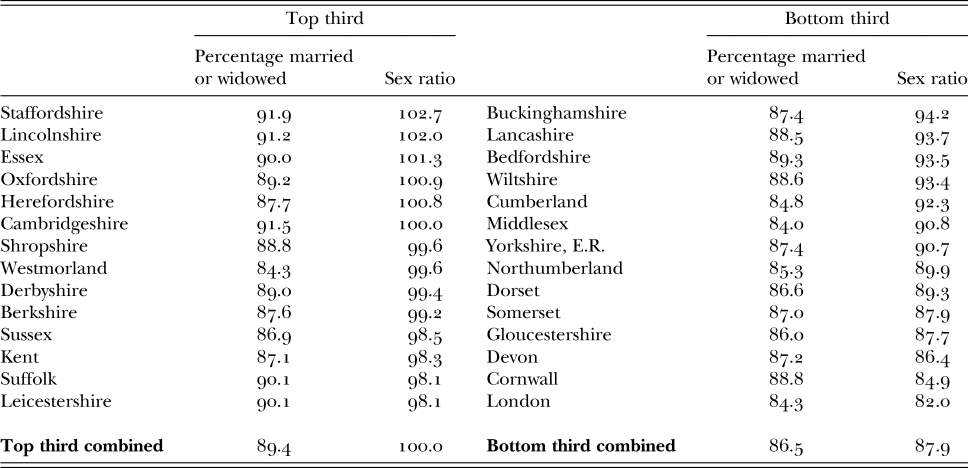
There were forty-two counties in the 1851 census (London and Middlesex (ex-metropolitan) were separated as two units). Table 1 shows the situation in the top third of counties in which the sex ratio was highest and in the bottom third in which the ratio was lowest, and for each group also shows the percentages of women ever married.
Table 1 illustrates the importance of the sex ratio in influencing the percentage of women who were or had been married. The forty-two counties were ranked by the percentage of women ever married (married plus widowed). The sex ratio (number of men per 100 women) in the top third of counties was 12.1 higher than in the bottom third, while the percentage of ever married women was 2.9 per cent higher in the top third than in the bottom third, a ratio of approximately 4 to 1 between the two figures, suggesting that on average an increase of 4 in the sex ratio resulted in an increase of c. 1 per cent in the percentage of women who were either married or widowed.
Table 2 provides detail for the fourteen counties in each group. For each county, the sex ratio is given, together with the percentage of women ever married. The counties are ranked by the former statistic. Within each group, the percentage ever married does not decline regularly in parallel with the decline in the sex ratio, but, despite this, it provides evidence that the proportions ever married were influenced by the sex ratio, even though many other factors were also involved.
County sex ratios and percentages of women ever married in age group 45–69 in 1851
Source: As Table 1.
In viewing the sex ratios, it should be borne in mind that, as already noted, many men were missed in the census since they were in the armed forces or merchant marine, and the proportions missed varied substantially between the counties. The sex ratios also often reflect sex differential migration patterns, which in turn were strongly influenced by the level of accessible employment opportunities. In Staffordshire, for example, where rising industrial activity attracted male immigrants, the sex ratio was high and a relatively high percentage of women were married, but equally in counties such as Berkshire, Essex, Suffolk, and Cambridgeshire, the sex ratio was also high, reflecting, no doubt, limited local employment opportunities for women and the fact that London was not far away. In these counties, more women than men moved away from their native counties. Contrasting rates of in- and out-migration between men and women were both capable of changing the sex ratio significantly.
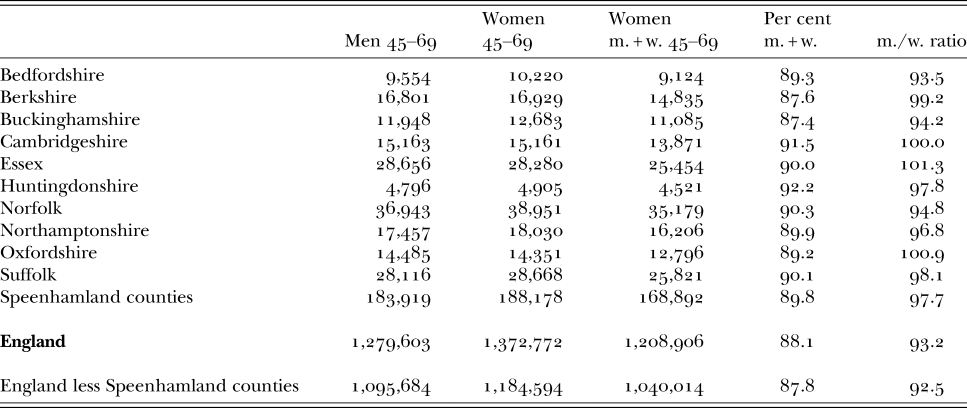
The foregoing provides a background for examining the situation in the Speenhamland counties, those counties where it has been claimed that the authorities operating the old poor law were prepared to offer growing support to labouring families as the number of their children increased. In Table 3, the sex ratios and the percentages of women ever married are given for a selection of Speenhamland counties. Any list of Speenhamland counties is bound to be somewhat arbitrary since data relevant to distinguishing them from other counties are limited. The ten counties selected form a contiguous ark to the west, north, and east of London. All figure in Blaug's tentative list of counties in which most parishes ‘subsidized wages out of the poor rates in 1824’.Footnote 33 His full list is twice as long including, for example, counties such as Devon and the East and North Ridings of Yorkshire. For the present purpose, a contiguous block all within easy distance of London and where agricultural labourers were a large fraction of the workforce appeared a suitable testbed.
Sex ratios and percentages ever married in England and the Speenhamland counties under the old poor law
Source: As Table 1.
One of the valuable features of the 1831 census was that it divided all men engaged in agriculture into three groups; farmers employing labour, farmers not employing labour, and agricultural labourers. The group foremost in Malthus's mind when describing the impact of the old poor law in weakening the preventive check was that of agricultural labourers. In nine of the ten counties, more than 40 per cent of the male workforce were agricultural labourers in 1831, and in Berkshire, the tenth county, the figure was 39.9 per cent.Footnote 34 Since agricultural employment rose relatively slowly in the early nineteenth century and county populations were increasing more rapidly, at the beginning of the century half or more of the labour force consisted of farm labourers. If the Speenhamland system did induce agricultural labourers to make early marriages, this result should be visible in these ten counties.
In England as a whole, 88.1 per cent of the women aged 45–69 were married or widowed, and the sex ratio was 93.2. In the Speenhamland counties, the comparable figures were 89.8 and 97.7. In England less the ten Speenhamland counties, the comparable figures were 87.8 and 92.5. The female marital percentage was 2.0 per cent higher in Speenhamland counties than in the rest of the country. At first sight, therefore, Malthus's belief that marital proportions were higher in counties where growing families were assisted from the poor rate appears to be supported. However, if account is taken of the sex ratio, which was 5.2 per 100 higher in these counties, it is apparent that what might be termed the propensity to marry was closely similar. That the sex ratio influenced the proportion married is evident from Table 1. It suggested that an increase of 4 in the sex ratio was associated with a rise of c. 1 per cent in the proportion of women ever married. On this showing, more than half the difference between the marital percentage in the Speenhamland counties and the rest of England was a function of the higher sex ratio in these counties. After allowing for this, the remaining difference is less than 1 per cent, suggesting that marriage behaviour in the Speenhamland counties was very similar to that in the rest of England. The evidence provided by the marital percentages in the 1851 census tells strongly against Malthus's assertions about the effect of Speenhamland. He was convinced that marriage decisions among the ‘peasantry’ were strongly influenced by the character of the parish allowances for the poor. Given the generosity of this assistance in parishes which adopted Speenhamland rules, it should have produced a much more clear-cut difference between counties in which Speenhamland practices were prevalent and where a large proportion of the workforce were agricultural labourers, and other counties.
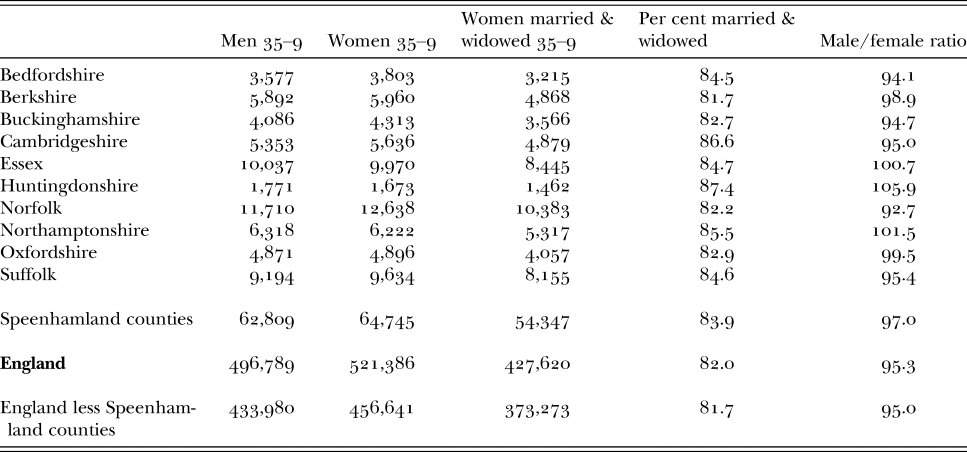
The 1851 census also provides additional evidence that Malthus was mistaken in supposing that the poor laws led to improvident early marriage. If he were correct, the abolition of the old poor law in 1834, by depriving labourers in rural areas of the unfortunate incentive to early marriage, would have led to fewer and later marriages in the Speenhamland counties after 1834 than before that date. Women in the age group 35–9 in 1851 would have been aged 18–22 in 1834. Almost all their marriages were therefore contracted after the disappearance of the incentive to early marriage supposedly provided by the old poor law. Table 4 provides information about marriage patterns in England as a whole and in the Speenhamland counties for the age group of women aged 35–9 in 1851 in the same form as that provided in Table 3.
Sex ratios and percentages of women ever married in England and the Speenhamland counties after the abolition of the old poor law
Source: As Table 1.
Table 4 largely repeats the pattern of differences between the Speenhamland counties and the rest of England which is visible in Table 3, but rather than suggesting nuptiality was constrained by the repeal of the poor law, it indicates that the difference between nuptiality levels in the Speenhamland parishes and the rest of the country increased slightly after the repeal. The sex ratio difference is substantially smaller than in Table 3, implying that the ‘real’ difference in nuptiality levels is greater than the marriage percentages alone suggest. The information in Table 4 when compared with Table 3 further undermines Malthus's assertion about the malign effects of the old poor law.
Given the patterns shown in Tables 3 and 4, Malthus's conviction that the poor law encouraged improvident marriages might still be partially justified if it were the case that Speenhamland was adopted chiefly in parishes in which the peasantry were significantly poorer than in other parishes, and had been marrying later than elsewhere as a result. Adopting Speenhamland, it might be argued, encouraged them to marry earlier but only to the point where the level of nuptiality in these parishes was similar to the level in the rest of rural England. Even this improbable scenario, however, is difficult to reconcile with the evidence in Tables 3 and 4, because, following the abolition of the old poor law, it would then be expected that marriage in the ex-Speenhamland parishes would again be restricted by their greater poverty. If anything, however, the nuptiality difference between Speenhamland counties and the rest of the country was slightly increased after the repeal of the old poor law.
In summary, there is no support in the data published in the 1851 census for the belief that marriage decisions made by the labouring poor were influenced by the character of the old poor law.
V
Was there information available in Malthus's lifetime which might have persuaded him that his viewpoint was difficult to sustain? The question may be considered in relation to four issues. The first issue concerns the size of the peasantry. In identifying the group of men whose decisions about embarking on married life concerned him, Malthus sometimes referred them as the ‘peasantry’. He clearly intended to refer primarily to men who worked on the land and were undertaking heavy manual work. He had in mind principally agricultural labourers. Although agriculture still employed more men than any other industry in the early nineteenth century, its share of the national labour force was declining steadily. In 1801, labourers employed by farmers or by market gardeners formed 25.3 per cent of the national male employment total; in 1851, this figure had declined to 17.9 per cent.Footnote 35 It is likely, therefore, that even at the time when Malthus published the first Essay on population, only about a quarter of the total national labour force consisted of agricultural labourers.
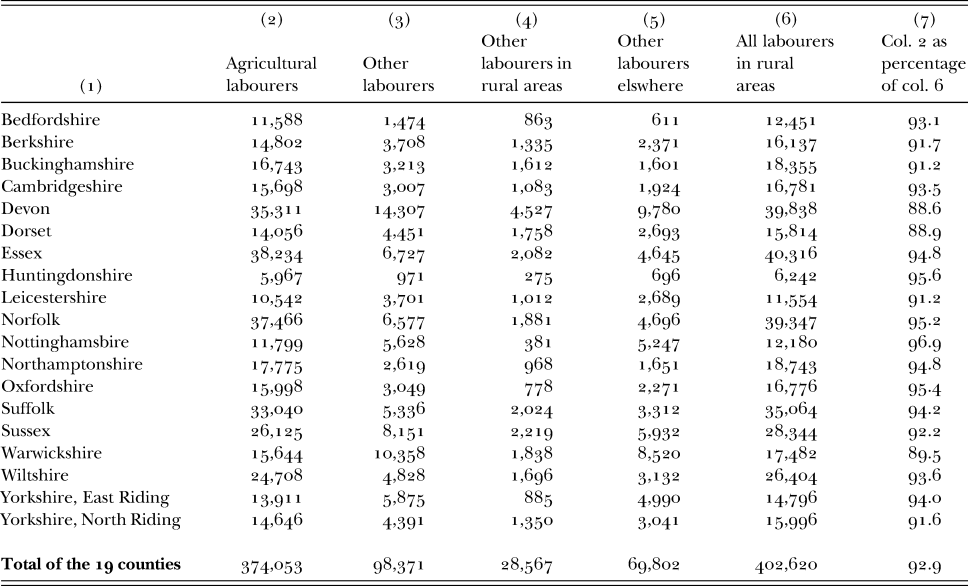
Agricultural labourers were not, of course, the only men dependent on hard physical labour for a living in rural areas. It is therefore relevant to estimate the number of other labourers, since they might also have received additional support in Speenhamland counties as their families expanded. The 1831 census provides a column headed ‘Labourers employed in labour not agricultural’, and provides the information down to the level of the individual parish. At first sight, this suggests a straightforward solution to enumerating other labourers. Unfortunately, under this heading, the enumerators were instructed to include a wide range of different occupations such as miners, fishermen, boatmen, excavators of canals, roadmakers, toll collectors, and all those ‘otherwise employed in any kind of bodily labour excepting in Agriculture’.Footnote 36 However, the problems posed by this catch-all definition are less severe than might appear at first sight in relation to rural areas. Table 5 provides for each county on Blaug's list of Speenhamland counties the totals of agricultural labourers and other labourers, with the latter total divided between those living in rural areas and elsewhere in the county.
Agricultural and non-agricultural labourers
Source: 1831 Census, Enumeration Abstract, i and ii.
To produce estimates of the number of non-agricultural labourers in the rural areas of each county was laborious but relatively straightforward. In the nineteen counties as a group only a minority of the ‘other labourers’ were living in rural parishes. The majority lived in cities like Norwich or Exeter, or in the market towns serving surrounding rural areas. Since they were urban dwellers, in Malthus's view, they would not have benefited from the Speenhamland support available in varying degrees in the rural parishes within these counties. But there were also rural parishes in which the ‘other labourers’ were unlikely to have had access to such support. The footnotes to census entries often make this clear, as, for example, at Hinderwell in the North Riding. There were 235 non-agricultural labourers in this township, a large fraction of the labour force where the total of men aged twenty and over was 401. The footnote remarks that ‘In the township of Hinderwell 223 men are employed in fishing.’Footnote 37
For each county in Table 5, a search was made to identify parishes which were either urban or which contained ‘other labourers’ who were unlikely to have access to Speenhamland benefits in supporting a growing family. In Northamptonshire, for example, ‘other labourers’ in the following market towns or other parishes fell into this category: Blisworth, Braunston, Corby, Daventry, Desborough, Gayton, Hardingstone, Kettering, Kingsthorpe, Long Buckby, Middleton Cheney, Peterborough, Rothwell, Weedon Beck, Wellingborough. Where the case seemed marginal, the parish was treated as rural, maximizing the number of ‘other labourers’ in rural areas. Even so, it is clear that agricultural labourers made up the great majority of labourers in the rural parishes in Speenhamland counties. The percentages range between 88.6 and 96.9 per cent in the nineteen counties in Table 5 and stand at 92.9 per cent if they are treated as a group. Precision is impossible in making this calculation, since there were always borderline cases, but it is clear that a total for all labourers in rural areas rather than for agricultural labourers alone would differ only modestly from the total for agricultural labourers alone.
The share of the ‘peasantry’ in the national labour force, which was estimated to be 25.3 per cent in 1801 and 17.9 per cent in 1851 when based on agricultural labourers, is therefore increased only to c. 27 per cent and c. 19 per cent if based on rural labourers of all types. These percentages, however, greatly exaggerate the possible influence of Speenhamland on marriage behaviour. Its prevalence is, of course, very difficult to establish, but, to illustrate the significance of this question, suppose that it was uniformly practised in all the counties which Blaug treated as Speenhamland counties and was not practised in the other counties which were left blank on his map, an assumption which probably overstates the prevalence of Speenhamland practice. On this supposition, since only half of the total of agricultural labourers were living in counties in which marriage decision may have been influenced by the provisions of the Speenhamland system, its impact is reduced commensurately.Footnote 38 This consideration would halve the percentages just quoted, suggesting that the relevant percentages would be c. 14 per cent in 1801 and c. 10 per cent in 1851. Detailed census information about the occupational structure of each county only became available in 1831, late in Malthus's lifetime; it is nevertheless probable that he was aware of the approximate size of the ‘peasantry’. He would also have known that there were many counties in which the poor law overseers did not follow Speenhamland practice, and where therefore young couples when contemplating marriage would not have been able to plan with certainty about the scale of support they might expect to receive if they had a large family.
A second type of information which was available to Malthus and might have given him pause for thought relates to prenuptial pregnancies. Calculations based on the size of the ‘peasantry’ overstate the proportion of bridegrooms whose marriage decisions might have been influenced in the way that Malthus suggested. In the late eighteenth and early nineteenth centuries, many first births were conceived before the marriage took place. In 1775–99 and 1800–37, the percentages in question were 35.1 and 37.6 respectively.Footnote 39 Assume, for simplicity, that throughout the period in which Malthus lived the figure was 36 per cent.
Prenuptial pregnancy had been much lower in the late seventeenth century when only 16 per cent of brides were pregnant on marriage. Moreover, in this period, about half of the births took place in the eighth and ninth months following the marriage. These children were conceived shortly before the marriage took place when the couple were often formally betrothed and the decision to marry had already been taken. In the peak period for prenuptial pregnancy during Malthus's lifetime, the pattern was very different. The proportion of brides who gave birth in the eighth and ninth months after their marriage had not changed over the preceding century but the proportion giving birth in the first seven months after the marriage almost tripled.Footnote 40 The timing of these marriages suggests that they were ‘forced’ in the sense that the bride's pregnancy decided the timing of the marriage. In the early nineteenth century, c. 8 per cent of prenuptial pregnancies were in the ‘betrothal’ period, and c. 28 per cent were the result of conceptions occurring well before marriage. The latter figure reduces the proportion of marriages which might have been influenced by the provisions of Speenhamland; in 1801 from c. 14 per cent to c. 10 per cent, and in 1851 from c. 10 per cent to c. 7 per cent. During the period when Malthus was curate of Okewood, he may well have seen heavily pregnant brides approaching the altar, but in any case the prevalence of prenuptial pregnancy must have been well known to the clergy generally.
Thirdly, Malthus might have reflected on the considerations which confronted an agricultural labourer when contemplating marriage. The supposition that the provisions of the old poor law, and especially those associated with the Speenhamland version, encouraged improvident marriages by relieving an expanding family from the additional financial burdens associated with more mouths to feed, is open to question on other grounds. It holds true only if it is reasonable to suppose that young couples in rural areas where the man was a farm labourer were swayed by an assessment of what might happen many years in the future when considering whether it was prudent to marry. It would have been a calculation suffused with uncertainties. They would have needed to take into account not merely the number of children who might be born to the wife over the next decade and a half and how many might survive, but also other points. For instance, after, say, a dozen years of marriage, the additional expenditure associated with a new birth might be counterbalanced by the oldest child becoming an income earner.
A conscious calculation of the burden of a growing family, therefore, may well have been rare because it involved many uncertainties about a relatively distant future. On the other hand, a recognition that a newly married couple were normally expected to set up a new household was universal and this concern related to the near present rather than to future decades. It often involved postponement of marriage on the part of a man and woman who wished to become husband and wife. Kussmaul's analysis of the timing of marriages in relation to the date of annual hiring fairs for servants provides persuasive evidence supporting this conclusion.Footnote 41 The immediate difficulty of accumulating the wherewithal to rent, furnish, and equip a new household probably weighed more heavily on the minds of a couple who hoped to marry than the more distant and uncertain expenditures associated with a growing family.Footnote 42 Only by spending several years in service could young men and women from poor families accumulate sufficient savings to enable them to embark on matrimony.
A fourth aspect of contemporary events which might have suggested to Malthus caution in castigating the poor law was the contemporary population trends. The very rapid growth of population in the early nineteenth century was at odds with his ‘model’ of the interplay between population and production. He did not face this issue directly but at times he displayed an awareness of the extent to which the course of events was at odds with the stance he had taken in the first edition of the Essay.
The first Essay was published in 1798, three years before the first national census was taken. Malthus did not therefore know when writing the Essay that the population was rising rapidly. From the contrast between the innate tendency of populations to grow by geometric progression and the capacity to produce food which could at best only rise by arithmetic progression, he had concluded that the English population must be rising only slowly. Anything which encouraged more rapid growth brought with it great misery for the bulk of the population and would also increase mortality. Hence, the danger of a system of support for poor families which encouraged improvident marriages. His analysis was valid for organic economies but increasingly irrelevant to the new world of the industrial revolution. In this new situation, the basic assumptions about the limitations to growth which the classical economists set out so clearly were no longer valid and population growth was not curbed as in the past.Footnote 43 The character of the new situation is illustrated in Figure 1.
Annual rates of growth of population and of a real wage series
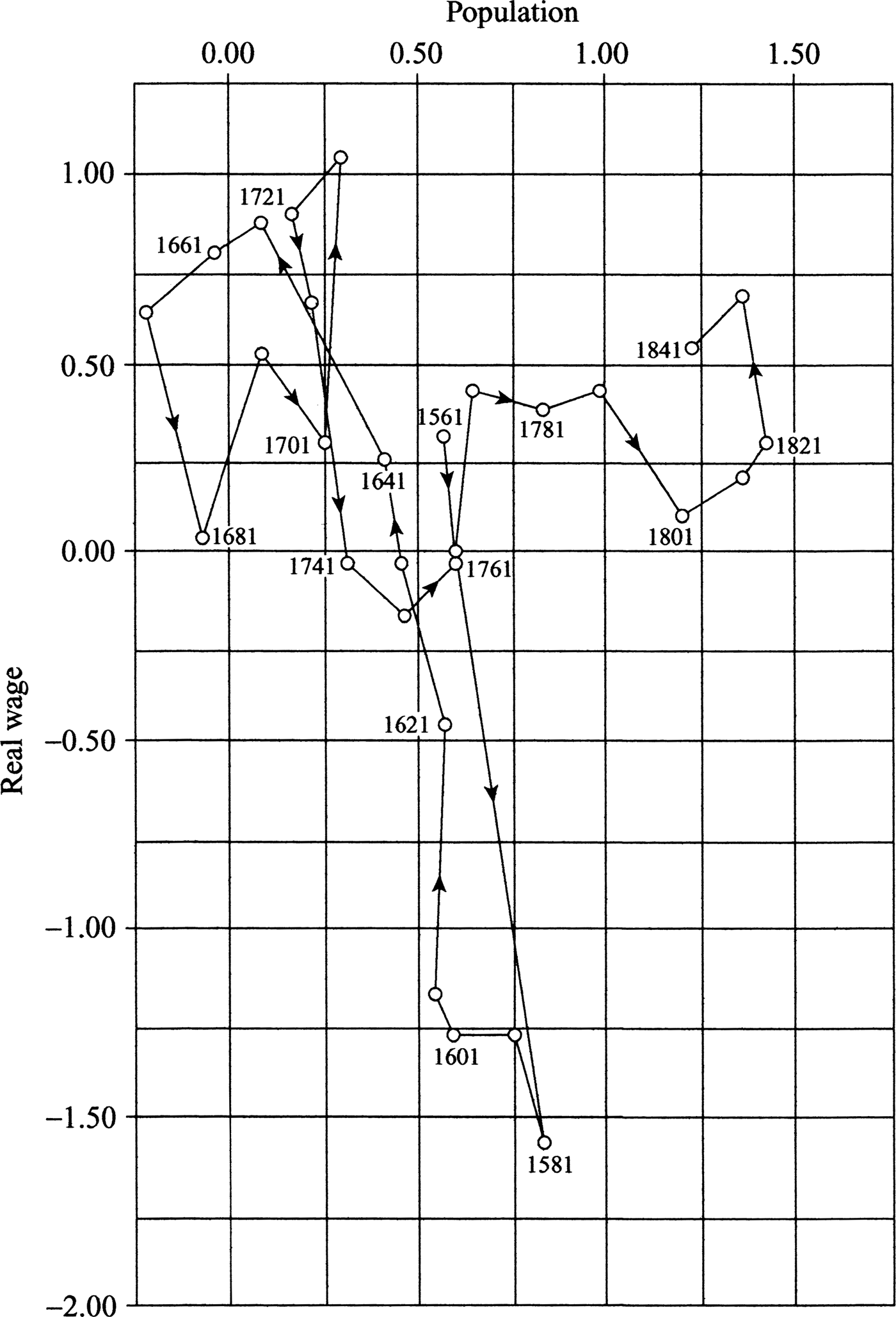
For centuries before the later eighteenth century, the tension between population growth rates and living standards is clearly visible. The economy was able to sustain an annual rate of population of c. 0.25 per cent without causing the real wage to fall. If the rate of growth exceeded this, as in the later decades of the sixteenth century, the real wage plunged. If it was below this level, the real wage rose, as it did from the mid-seventeenth to the mid-eighteenth century. However, in the middle decades of the eighteenth century, the rate of population growth increased, rising to almost 1.5 per cent per annum in the early nineteenth century without causing a calamity. In previous centuries, a rate as high as this would have produced a disastrous fall in living standards and massively increased mortality, yet real wages were maintained and even tended to rise, and there was no surge in mortality. A radically new situation had arisen, reflecting the attainment of sustained economic growth without penalty to living standards, conventionally termed an industrial revolution.
In 1801, three years after the publication of the Malthus's Essay, the first census was taken. Rickman, who directed the taking of the 1801 census, also required Anglican parish clergy to return totals of the baptisms, burials, and marriages recorded in their registers for stated years in the eighteenth century, and published an analysis of population growth during the eighteenth century based on the returns which he had secured. This left no room for doubt not only that the English population had grown substantially during the eighteenth century but that the rate of growth had accelerated in its later decades. Malthus was, of course, well aware of this evidence, and any initial doubt that the population was growing at an unprecedented rate was dispelled by the information contained in the three subsequent censuses taken during Malthus's lifetime. Furthermore, although both the stresses associated with two decades of war and the unemployment problems involved with the trade cycle undoubtedly brought suffering to many poor families, there was no general collapse in real wages, nor were there surges in mortality of the kind which were to be expected on Malthus's view of the inevitable consequences of very rapid population growth.
The information provided by the censuses of 1801, 1811, and 1821 made Malthus aware of the scale of the population growth which had taken place between 1798 when the first Essay was published and 1826 when the sixth edition appeared, yet there had neither been a sharp rise in the death rate, nor a collapse in living standards. The contrast between the course of events and what his model of the interplay between population growth, living standards, and mortality trends predicted was stark, but Malthus never confronted it squarely. He did on one occasion, however, suggest a type of economic system which might, so to speak, kick the issue into the long grass. In the 1826 edition of the Essay, he devoted three consecutive chapters to different types of economy; the agricultural system, the commercial system, and systems in which agriculture and commerce were combined. Of the three, the last was the best. Malthus came close to recognizing that growth in this system was not constrained in the manner deemed inherent in an organic economy.
It appears then, that it is the union of agricultural and commercial systems, and not either of them taken separately, that is calculated to produce the greatest national prosperity; that a country with an extensive and rich territory, the cultivation of which is stimulated by improvements in agriculture, manufactures, and foreign commerce, has such various and abundant resources, that it is extremely difficult to say when they will reach their limits.Footnote 44
Similarly, it is also worth noting that despite the frequent expression of his profound alarm over the effects of the old poor law both on the poor themselves and on the country as a whole, which was as conspicuous in the later editions of the Essay as in the first, Malthus occasionally adopted a much less decided stance on their impact. In the appendix to the third edition of the Essay, he wrote:
The obvious tendency of the poor laws is certainly to encourage marriage, but a closer attention to all their indirect as well as direct effects may make it a matter of doubt as to what extent they really do this. They clearly tend, in their general operation, to discourage sobriety and economy, to encourage idleness and the desertion of children, and to put virtue and vice more on a level than they otherwise would be; but I will not presume to say positively that they encourage population.Footnote 45
This passage was retained in subsequent editions of the Essay, yet Malthus made no attempt to explain the inconsistency of this exposition of the very limited and uncertain effects of the old poor law with his normal stance. In the years following the publication of the first Essay, he greatly extended his knowledge of demographic patterns in other European countries. This led him to conclude that what might be termed the general demographic situation was unusually favourable in England compared with most other European countries in which what was later termed the west European marriage system existed. In the sixth edition of the Essay, discussing the birth rates in European countries, he wrote:
In this point, we rank next after Norway and Switzerland, which, considering the number of our great towns and manufactories, is certainly an extraordinary fact. As nothing can be more clear, than that all our demands for population are fully supplied, if this be done with a small proportion of births, it is a decided proof of a very small mortality, a distinction on which we may justly pride ourselves … In despotic, miserable, or naturally unhealthy countries, the proportion of births to the whole population will generally be found very great.Footnote 46
In penning passages such as this, Malthus does not appear to have been conscious of the difficulty of reconciling this assessment of fertility in England with his worries about the effect of the old poor law.
VI
A final aspect of Malthus's thinking is worth a mention. It may have played a part in determining his attitude to the poor law by linking it to his view of the fundamental character of human motivation which was in-built in all mankind..
Malthus belonged to a generation in which what might be termed the gospel according to Mandeville had become widely acknowledged as describing accurately the features of contemporary European countries which had made them wealthy and powerful. He believed that the single-minded pursuit of self-interest was the basis for a prosperous society, nor did he consider that this was at odds with Christian teaching. He wrote:
The great author of nature, indeed, with that wisdom that is apparent in all his works, has not left this conclusion to the cold and speculative consideration of general consequences. By making the passion of self-love beyond comparison stronger than the passion of benevolence, he has at once impelled us to that line of conduct, which is essential to the preservation of the human race.Footnote 47
Further:
To the laws of property and marriage, and to the apparently narrow principle of self-interest which prompts each individual to exert himself in bettering his condition, we are indebted for all the noblest exertions of human genius, for everything that distinguishes the civilized from the savage state.Footnote 48
Or again:
And thus it appears that a society constituted according to the most beautiful form that imagination can conceive, with benevolence for its moving principle instead of self-love, and with every evil disposition in all its members corrected by reason, not force, would from the inevitable laws of nature, and not from any fault in human institutions, degenerate in a very short period into a society constructed upon a plan not essentially different from that which prevails in every known state at present; a society divided into a class of proprietors and a class of labourers, and with self-love for the mainspring of the great machine.Footnote 49
It is striking that an Anglican minister felt able to adopt this position, but it may help to explain in part his assessment of the old poor law. Individual acts of charity might be praiseworthy. He was not at odds with the parable of the good Samaritan, but had profound doubts about attempts to achieve the same end by institutional means. The free operation of the market was the surest means of achieving prosperity. Barriers to individual decision-making such as the settlement laws were as objectionable and damaging as the old poor law. This conviction on Malthus's part may also explain why he made little attempt to test empirically the validity of his argument concerning the poor laws. Since their existence conflicted indirectly with the general principle that ‘the passion of self-love [was] beyond comparison stronger than the passion of benevolence’, such tests were unnecessary. If there was no poor law, a man and a woman in contemplating marriage would, by the operation of self-interest, be guided to making a decision which was best both for themselves and for society as a whole.



