Implications
Scoring systems have been developed for use, on farm, to assess simply and rapidly birth difficulty, lamb vigour and sucking assistance, traits that are important for the survival of newborn and neonatal lambs. These scores provide a means of readily assessing important behavioural traits that are time-consuming to record on farm. These neonatal lamb-scoring systems have potential for use in selection of animals with greater genetic merit for low birth assistance and improved neonatal vigour traits. The systems may also be of use in management decisions and for animal welfare assessment.
Introduction
Lamb mortality remains a significant welfare and production issue in the sheep industry. Mortality rates are highest within the first 3 days of postnatal life (Nowak et al., Reference Nowak, Porter, Lèvy, Orgeur and Schaal2000; Sawalha et al., Reference Sawalha, Conington, Brotherstone and Villanuava2007) as a consequence of complex interactions between difficult births, low lamb vigour, poor maternal care, infection and starvation/hypothermia. In intensive systems, lamb mortality during parturition and the neonatal period is minimised through supervision and assistance. However, while the incidence of stillbirths due to dystocia is decreased, mortality (of both ewe and lamb) due to infections can increase (Binns et al., Reference Binns, Cox, Rizvi and Green2002). High stocking density within the lambing shed can also compromise ewe–lamb bonding: the isolation-seeking behaviour of the parturient ewe may be disrupted, resulting in an increase in stress and the possibility of a prolonged labour (Poindron et al., Reference Poindron, Soto and Romeyer1997), thus increasing the incidence of mismothering (Gonyou and Stookey, Reference Gonyou and Stookey1985).
Human intervention at birth requires a considerable investment of labour to ensure lamb survival (Fisher, Reference Fisher2003), and substantial human input is directed towards assisting difficult parturitions and ensuring that lambs suck quickly thereafter (Dwyer and Lawrence, Reference Dwyer and Lawrence2005a). As farm incomes and subsidy payments decrease, low input management systems are becoming more common as farmers attempt to reduce labour costs and as a consequence increase the number of sheep per stockperson. Therefore, to achieve a lower input system, without affecting welfare, lambs need to be delivered easily, be active, vigorous and able to suck from their mothers unaided (Dwyer and Lawrence, Reference Dwyer and Lawrence2005a). Improvements in ease of delivery and lamb vigour are therefore important not only to reduce labour input at lambing, but also to improve lamb survival and welfare (Dwyer, Reference Dwyer2008a). These traits can be improved by management interventions, and can also potentially be addressed by genetic selection, which results in permanent and cumulative response and has the potential to reduce labour costs.
Heritabilities for reproductive traits (e.g. lamb survival 0.03 to 0.33 (Sawalha et al., Reference Sawalha, Conington, Brotherstone and Villanuava2007; Afolayan et al., Reference Afolayan, Fogarty, Gilmour, Ingham, Gaunt and Cummins2008) and litter size, 0.19 (Afolayan et al., Reference Afolayan, Fogarty, Gilmour, Ingham, Gaunt and Cummins2008)) seem to be generally lower than those for performance traits (e.g. average daily gain 0.14 to 0.30 (Maxa et al., Reference Maxa, Norberg, Berg and Pedersen2007), carcass fat 0.20 to 0.37 (Greeff et al., Reference Greeff, Safari, Fogarty, Hopkins, Brien, Atkins, Mortimer and van der Werf2008) and wool 0.25 to 0.32 (Borg et al., Reference Borg, Notter and Kott2009)). Heritabilities for lamb vigour behaviours (e.g. latency from birth to standing) appear lower and range from 0.1 to 0.22, and latency from standing to sucking range from 0.08 to 0.12 (Cloete et al., Reference Cloete, Scholtz, Gilmour and Olivier2002). However, greater phenotypic variation appears to be present in reproductive traits than performance traits (Safari et al., Reference Safari, Fogarty and Gilmour2005) possibly due to a history of intensive selection for increasing performance traits coupled with little or no direct selection pressure on the behaviours related to reproduction. Records of lambing performance over a period of time could provide indirect selection criteria for reproduction characteristics, and therefore heritabilities and estimated breeding values for reproduction characteristics could be added to breeding programmes (Afolayan et al., Reference Afolayan, Fogarty, Gilmour, Ingham, Gaunt and Cummins2008).
Reproductive and behavioural traits related to development are, however, difficult to quantify and measure on farm. Proxy methods of measurement (scoring systems) are needed to measure such qualitative traits in a manner that allows for collection of sufficient data to enable genetic analysis. Scoring systems need to be easy-to-use to allow them to be incorporated into on-farm breeding programmes and are more likely to be adopted if they integrate well with the management routine already in place. Such scoring systems also need to be objective, biologically meaningful, repeatable and reflective of what is happening behaviourally.
Therefore, the objectives of this study were to develop and validate scoring systems for birth assistance and neonatal lamb behaviour that could be easily implemented on farm and are correlated to underlying behavioural traits. In the first study, historical behavioural data were used to create scoring systems. The data, from more than 1100 lambs from two pure breeds, Scottish Blackface (SB) and Suffolk (S), are known to differ in lamb vigour (Dwyer et al., Reference Dwyer, Lawrence, Brown and Simm1996; Dwyer and Lawrence, Reference Dwyer and Lawrence2005b; Dwyer, Reference Dwyer2008b), were analysed as one group to assess the distribution of data across time. As expected, analysis of this data shows that each breed had a unique distribution within each scoring system. In the second study, score data and behavioural latency data were collected simultaneously using crossbred ewes managed under commercial husbandry/housing conditions. The crossbred ewes were mated with either Texel (T) or Suffolk (S) rams to test whether the scores were sensitive enough to discriminate between two of the lamb genotypes commonly produced in commercial flocks.
Material and methods
Study 1: development of the scoring systems
Animals
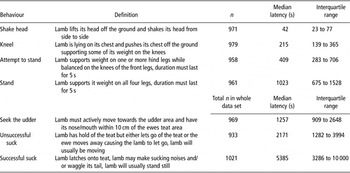
Data from 1156 lambs were used to develop scoring systems classifying: (i) birth assistance, (ii) neonatal lamb vigour and, (iii) neonatal sucking ability. This data set contained information on length of labour, lamb presentation at birth and neonatal lamb behavioural latencies (see Table 1 for definition of lamb behaviour (Dwyer et al., Reference Dwyer, Lawrence, Brown and Simm1996)) collected from SB and S flocks during the 2001 to 2005 and 2007 lambing seasons. For the purposes of developing the scores, data from both breeds were combined. These two breeds have been found to be divergent in behaviour (Dwyer et al., Reference Dwyer, Lawrence, Brown and Simm1996; Dwyer and Lawrence, Reference Dwyer and Lawrence2005b) and, therefore the combination of SB and S were considered to sufficiently represent the variation within these traits that exist within the wider sheep population.
Ethogram of neonatal lamb behavioural progression. Latencies are measured as the time from birth to when specific behaviours are first displayed for the whole data set

All ewes were allowed to give birth unaided, as far as possible, according to a standard lambing protocol. The protocol permitted assistance if the birth process failed to progress, that is, if no lamb parts were seen 1 h after the appearance of fluids and/or 2 h after lamb parts had been seen with no other obvious progress. Any intervention was kept to a minimum, correcting presentational difficulties where possible before allowing the ewe to continue unaided. Certain specific presentations (breech, head back and two lambs together) required immediate assistance. The lamb, once born, was allowed 2 h to stand and successfully suck unaided. Any lamb that had not sucked by 2 h after birth was assisted. Behavioural data were collected on videotape and analysed by Observer 5.0 data recording software (Noldus et al., Reference Noldus, Trienes, Hendriksen, Jansen and Jansen2000) as previously described by Dwyer (Reference Dwyer2003).
Three scoring systems were developed. The birth assistance score, a system based on the interaction between maternal effort and lamb presentation, consisted of data from 818 lambs for lamb presentation and 923 lambs for intervention levels and labour latencies. The lamb vigour score, based solely on the attributes of the lamb, consisted of data from 970 lambs for latency to first perform specific landmark behaviours (Table 1). Finally, the sucking assistance score, a score based on the interaction between lamb vigour and maternal behaviour, consisted of data from 964 lambs for the latency to suck successfully (Table 1) and the amount of intervention required.
Statistics
As the data were not normally distributed, all data were analysed using non-parametric tests in Minitab, version 15.1.20.0 (2007). Latency data were analysed using Kruskal–Wallis one-way-ANOVA.
Study 2: validation of the scoring systems
Animals
Validation of birth assistance score was not required as it was based upon the actual shepherd practises at lambing. The behavioural scoring systems (neonatal lamb vigour and neonatal sucking ability) were validated by collecting data at birth from 80 twin-bearing, 2-year-old SB × Border Leicester ewes. The ewes had either been mated with S (n = 42) or T rams (n = 38). Ewes were group housed in straw pens (4.3 × 9.2 m), in four groups of 20 ewes, approximately 9 weeks before lambing in order to accustom the ewes to the presence of observers. Hay and fresh drinking water were available ad libitum and 6 weeks before lambing ewes were fed a concentrate mix (g/kg; barley, 600; soyabean meal, 200; molassed sugar beet pulp, 150; rapeseed meal 50) adjusted every 2 weeks in order to meet energy requirements for the advancing stages of pregnancy (Agricultural and Food Research Council (AFRC), 1993).
Observers were present for 24 h a day during lambing. Ewes were marked to allow identification from a distance. Ewes were assisted at birth according to the protocol described for study 1. After parturition the ewes and lambs were left undisturbed for 2 h. Scores for birth assistance, lamb vigour at 5 min of age and sucking assistance (Table 3) were collected for each lamb along with more detailed behavioural latency data (Table 1). Latency data were collected by recording the time of birth (using a stopwatch) and the time at which a specific behaviour occurred. Two hours after the birth of the second lamb (or after the second lamb had sucked successfully, whichever happened first), the ewe and lambs were moved into individual straw-bedded pens (1.2 × 1.2 m). Assuming that no complications occurred, ewes and lambs stayed in the individual pens until 3 days after lambing, when they were turned out to pasture. Ad libitum access to hay and clean fresh drinking water were available in the individual pens. Ewes were fed concentrate mix to meet energy requirements.
Statistics
One ewe delivered two stillborn lambs; therefore, 158 lambs provided data that were used in the validation. As the data were not normally distributed, all data were analysed using non-parametric tests in Minitab, version 15.1.20.0 (2007). Latency data were analysed using Kruskal–Wallis one-way-ANOVA. Sire differences were investigated using Mann–Whitney U-tests with proportions investigated using χ 2 tests.
Results and discussion
Study 1: development of the scoring systems
Birth assistance
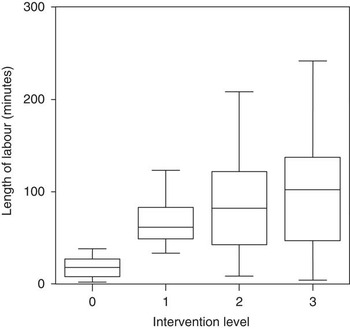
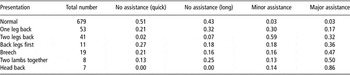
The birth assistance score was developed by considering the relationship between parturition length, lamb presentation and human intervention levels during parturition. Lambs that required no assistance (n = 679) had a median labour length of 33.0 min (confidence intervals; 31.0 to 36.0 min). Therefore, 30 min was selected as a practical cut-off point to divide lambs that required no assistance into two categories: no assistance with a labour of short duration (<30 min) and no assistance with a labour of long duration (>30 min; Figure 1). The no-assistance class contained a group of animals that had other than normal presentation, which were, nonetheless, able to give birth unaided (Table 2).
Relationship between length of labour and the need for different levels of intervention.

Different presentations of Scottish Blackface and Suffolk lambs at birth. The total number of lambs within each presentation class and the proportions of that presentation within each assistance level are given. Note that there is no information about caesarean sections, which was classed separately as veterinary intervention

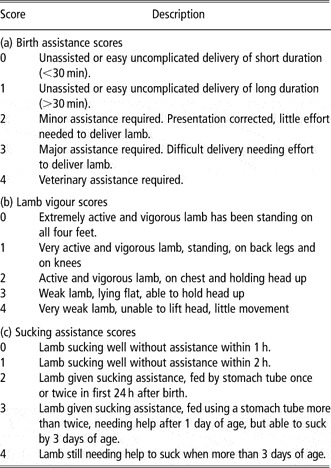
Data for assisted presentations were recorded as requiring either minor assistance (presentational difficulties that were corrected before the ewe was able to continue unaided; n = 94), major assistance required (n = 45) or veterinary assistance (n = 3). Table 2 shows that these categories reflected increasing deviation from a normal presentation: the minor assistance group mostly comprised of lambs presenting head first with either one or both legs back, whereas major assistance comprised lambs presenting with head back, backwards, breech or multiple lambs together. Veterinary assistance comprised presentations too complicated for standard assistance. Each of the above categories was assigned a score value, with the best score given a value of 0 and the worst 4 (Table 3). Length of labour increased significantly for each increase in intervention level/ score (Figure 1, P < 0.001; note that there were no labour duration data available for veterinary intervention).
Definitions of birth assistance scores, lamb vigour scores and sucking assistance scores

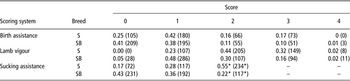
Comparison of calculated birth assistance scores for S (n = 424) and SB (n = 525) lambs indicated that S lambs required a higher level of birth assistance than SB lambs (Table 4; χ 2 test, P = 0.037).
Qualifying criteria for each of the scoring systems (birth assistance, lamb vigour and sucking assistance) with the proportion (number) of S and SB lambs attaining that score. Note that no data were available for how much sucking assistance was required for those lambs that did not suck within 2.5 h (marked as*)

S = Suffolk; SB = Scottish Blackface.
In general, as the length of parturition increased then more assistance was required (Figure 1). However, some of the more abnormal presentations were detected more quickly than others, as evidenced by Figure 1 in which the minor and major assistance were associated with a wider range of labour lengths. Prolonged labours can increase the likelihood of lamb mortality and ewe rejection of the lamb (Alexander et al., Reference Alexander, Stevens and Bradley1988; Haughey, Reference Haughey1993). In addition, human intervention during parturition is a considerable investment in labour and time (Fisher, Reference Fisher2003) and reflects a high-input system. Selection to reduce lambing difficulty could reduce human labour requirements and bring additional welfare benefits to ewe and lamb.
Lamb vigour
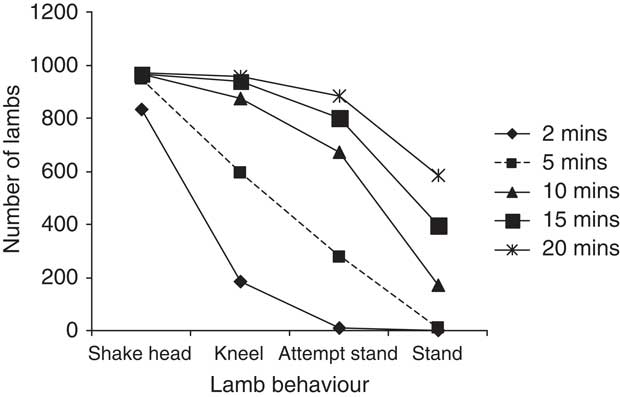
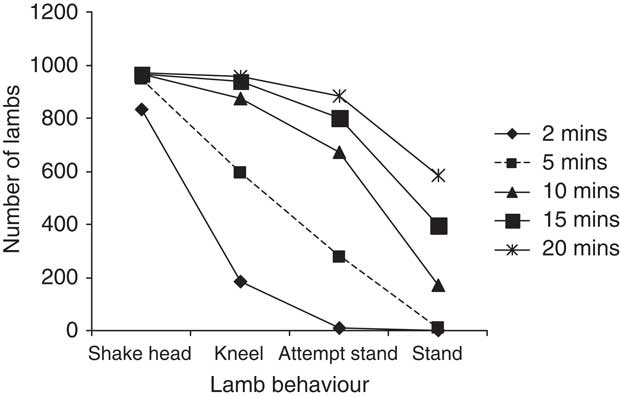
The lamb vigour score was developed by considering the range of behaviours displayed (Table 1) at a range of times after birth (2, 5, 10, 15 and 20 min) to identify a time that would not only give most information about lamb vigour but also be compatible with on-farm practice. Figure 2 shows the number of animals that had displayed a specific behaviour by the various time points. By 2 min of age, most of the lambs had shaken their heads but few had progressed to attempting to stand. For the later time points (10, 15 and 20 min), the majority of lambs had progressed to attempt to stand, which left little variation available for distinguishing between individuals. The most even distribution of lambs into the different behaviours was given at 5 min after birth. A duration of 5 min is useful as a length of time, which keeps disruption of the management routine to a minimum. Therefore, the measurement of lamb vigour at 5 min post delivery integrates well with intensive management systems. It is important to note that if the birth of the lamb is not observed then no score can be given to the lamb.
Number of lambs reaching specific landmark behaviours by certain time points after birth.
The behaviour of each lamb was analysed 5 min after birth thus creating the categories and scores shown in Table 3. At 5 min after birth, lambs were either standing (n = 10), attempting to stand (n = 264), kneeling (n = 382), had head erect and self-supported (n = 300) or were unable to lift the head from the ground (n = 26). A comparison of assigned scores for S (n = 469) and SB (n = 596) lambs indicated that S lambs had inferior vigour scores to SB lambs, (medians (with interquartile ranges): S = 2 (2.00 to 2.00), SB = 1 (1.00 to 2.00), P < 0.001; Table 4).
Sucking assistance
The sucking assistance score was developed by considering the relationship between latency to the first successful sucking event and the amount of human assistance required to keep the lamb alive. Lambs that required no assistance to suck (n = 615) had a median time to suck successfully of 60 min (confidence intervals; 58.0 to 64.12 min). Therefore, lambs requiring no assistance were divided into two categories: sucked independently within 1 h (n = 309; median time to suck (interquartile range), 42.0 min (29.1 to 52.8)) and sucked independently between 1 h and 2 h after birth (n = 306; median time to suck, 86.7 min (74.0 to 105.3)). Any lamb that had not sucked within 2 h was assisted (n = 406). In order to quantify the amount of assistance required, the assisted category was split into the following: lambs given sucking assistance once or twice within 24 h; lambs given sucking assistance more than twice, needing help after 1 day of age, but able to suck by 3 days of age; and, lambs still needing help to suck when more than 3 days of age, that is, assistance such as bottle feeding a lamb that had a weak sucking reflex or feeding a lamb too weak to suck, using a stomach tube. Each category was assigned a score value, with 0 for the best score (no assistance) and 4 for the worst (most assistance required), as shown in Table 3. Note that there are no data available for the amount of sucking assistance given. The time points of 1 and 3 days were based upon practical experience and used to distinguish the lambs that required minimal assistance on the first day of life from those that were able to suck eventually and from those that were unable to suck successfully before ewes would normally be turned out from the shed.
Comparison of the scores assigned to S (n = 424) and SB lambs (n = 540) indicated that SB lambs had superior sucking scores than S lambs (medians (with interquartile ranges): S = 2 (1.00 to 2.00), SB = 1 (0.00 to 1.00) P < 0.001). A higher percentage of SB lambs sucked independently within 2 h (scores 0 and 1) compared with S lambs (79% and 45%, respectively; P < 0.001; Table 4).
In general, lambs that attain poor vigour scores are slow to stand and to suck. Rapid neonatal behavioural development, that is, progression from birth, through kneeling to standing and sucking, has been linked to an increase in lamb survival (Owens et al., Reference Owens, Bindon, Edey and Piper1985; Dwyer et al., Reference Dwyer, Lawrence and Bishop2001; Macfarlane et al., Reference Macfarlane, Matheson and Dwyer2009) in which lambs with more vigour and greater sucking ability need less intervention, which reduces the amount of management input required (Dwyer and Lawrence, Reference Dwyer and Lawrence2005a). This can only be advantageous for developing a low-input system as labour costs are reduced.
The scoring systems developed were derived from lamb data collected from a hill breed and a lowland breed, SB and S, respectively. This resulted in a broad range of categories within the scores, potentially allowing the systems to be used for any breed; different breeds will have different distributions within each of the scoring systems.
Study 2: validation of the scoring systems
Lamb vigour
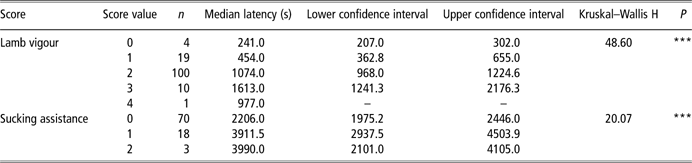
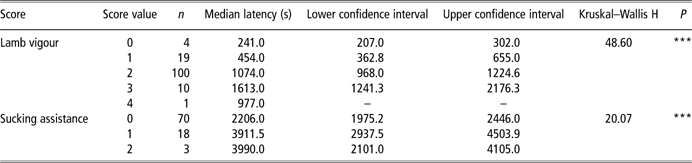
For each lamb vigour score, given at 5 min of age (Table 5), the latencies for lambs to stand, attempt to stand and kneel differed significantly (i.e. the median latency for a score of 0 was significantly different from the median latency for a score of 1, median latency for score 1 was different from that of score 2, etc.). Similarly, the latencies for other behaviours, shake the head (P = 0.037), kneel (P < 0.001) and attempt to stand (P < 0.001), increased significantly as the score increased. These results indicate that the vigour score, as a proxy, is able to discriminate between lambs with different rates of behavioural progress after birth.
Score and behavioural latencies recorded simultaneously in crossbred lambs. Lamb vigour scores are compared with the latency from birth to standing. Sucking assistance scores are compared with the latency from birth to first successful suck
Sucking assistance
Median lamb latency to suck successfully from the ewe differed significantly between different sucking scores (Table 5). Similarly, two behaviours not used to specify the sucking score criteria also differed significantly between the scores (latency to ‘seek udder’, P = 0.033, and latency to ‘suck unsuccessfully’, P = 0.022). These results indicate that the sucking assistance score is able to discriminate between lambs on the basis of how quickly a lamb progresses to the udder and sucks after birth.
Sensitivity of the scoring systems
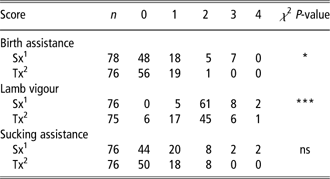
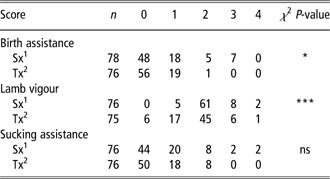
An important property of a successful scoring system, having been developed using pure bred lambs, would be the ability to distinguish between the vigour of lambs born to crossbred ewes and different terminal sires. As anecdotal evidence suggests that T-cross lambs (Tx) may be more vigorous than S-cross (Sx), the sensitivity of the scoring systems was assessed for its ability to discriminate between the scores of Sx and Tx lambs. Analysis of the scores for birth assistance, showed that Sx required a higher level of birth assistance than Tx lambs (Table 6; P = 0.04). A higher percentage of Tx lambs were born without intervention. Similarly, Tx lambs were significantly more vigorous than Sx lambs (Table 6; P < 0.001). This effect was also seen in the detailed behavioural data. Latency to stand (Tx v. Sx, medians (with interquartile ranges), 768 (482 to 1099) v. 1241 (843 to 1674) min, P < 0.001) and latency to attempt to stand (Tx v. Sx, 510 (318 to 646) v. 806 (480 to 1250), P < 0.001) were shorter in Tx than Sx lambs and thus the superior behavioural progress of the Tx lambs compared to Sx lambs was reflected in the scores. Overall, there were no significant differences between genotypes found in the sucking scores (Table 6; P = 0.247), although only Sx lambs were given the poorest sucking scores (scores 3 and 4; Tx v. Sx, 0 v. 4, P = 0.068). However, Tx lambs sucked more quickly than Sx lambs (Tx v. Sx, 2095 v. 2734 min, P = 0.012) and Tx lambs were also significantly quicker than Sx lambs to seek the udder (Tx v. Sx, 1197 v. 1663 min, P = 0.002) but not to first attempt to suck (Tx v. Sx, 1801 v. 2186 min, P > 0.05).
χ 2 distribution of scores recorded in crossbred lambs sired by either T or S rams
S = Suffolk; T = Texel.
1Lambs with S sire.
2Lambs with T sire.
The scoring systems developed (birth assistance, lamb vigour and sucking assistance) are 5-point categorical scales, ranging from 0 to 4, allowing an approximately normal distribution of the data (Figure 2, 5 min of age). This resulted in a system that is sufficiently refined to identify variation between lambs, particularly at the good end of the scale, thus increasing the range of selection possibilities. The majority of the crossbred lambs fell into the middle sections of the distribution resulting in a normal distribution of lamb vigour scores. Table 6 indicated that the scores are distributed in a way that would facilitate selection. The sucking assistance score takes into account the different management decisions made by stockmen about how often to assist lambs to suck from the ewes.
The scores developed here for birth assistance and sucking assistance increase as the amount of assistance required increases. This was found, after discussion with farmer groups, to be the most intuitive system to be used by shepherds. To improve the accuracy of on-farm data collection, and taking into account requirements from our shepherd focus group, the lamb vigour score was also designed in the same direction such that, for all scores, a higher score indicated a poorer outcome. The lamb vigour scores were developed by analysing an existing database of lamb behaviour, and were thus designed to describe specifically what behaviours lambs were expressing, rather than simply high or low vigour. To reduce any remaining subjectivity within the scores, detailed description/guidelines of the behaviours associated with the traits are given to the flock owner for data collection on commercial farms.
Several different scoring systems have been used to record levels of dystocia/birth assistance and lamb vigour. Most dystocia scoring systems refer to the amount of human assistance given. Spear-Smith et al. (Reference Spear-Smith, Brien, Grafe, Allrich and Reynolds2000) used a categorical 5-point scale that specified the area from where the lamb is pulled, that is, birth canal or uterus. However, this system is not practical for on-farm data collection requiring detailed recording and did not take into account the speed of labour. Other systems have used scales ranging from 1 to 4; in which a score of 1 represents no assistance given, a score of 2 represents slight assistance, a score of 3 represents a difficult birth with manual delivery and a score of 4 represents a difficult delivery or veterinary assistance (Speijers et al., Reference Speijers, Carson, Dawson, Irwin and Gordon2010). The birth assistance scoring system developed in this study was similar. However, emphasising speed of delivery in the ‘no assistance’ scores means that selection for low levels of birth assistance will also result in populations with easier and quicker births and a reduced risk of perinatal hypoxia (Haughey, Reference Haughey1993).
Methods for measuring lamb vigour, on the other hand, vary greatly between studies. Several studies have used time-based values, that is, the latency between birth and standing or appearing to suck (Alexander et al., Reference Alexander, Stevens and Bradley1990; Brien et al., Reference Brien, Hebart, Hocking-Edwards, Greeff, Hart, Refshauge, Gaunt, Behrendt, Thomson, Hinch, Geenty and Van der Werf2009). However, timed behavioural traits on farm are not easy and quick to measure when compared with categorical indicator traits (Brien et al., Reference Brien, Hebart, Hocking-Edwards, Greeff, Hart, Refshauge, Gaunt, Behrendt, Thomson, Hinch, Geenty and Van der Werf2009). Spear-Smith et al. (Reference Spear-Smith, Brien, Grafe, Allrich and Reynolds2000) used a vigour score based upon the Apgar score for newborn human infants measured at 1 h after birth. This 5-point scale ranges from 1, dead; 2, cannot stand; 3, minimal vigour; 4, moderate vigour; and 5, very vigorous. Whereas this score was based upon a lamb's ability to stand, nurse or walk, the score descriptions are vague and the timescale is not practical for on-farm data collection. The lamb vigour score developed in this study is based upon early lamb behaviour that has been shown to indicate rate of behavioural progression. The time at which this score is taken, 5 min after the birth of the lamb, fits well with the management of intensively housed sheep, minimising disruption to normal management. Similarly, the sucking assistance score is recorded at a time that fits well with good management practice, making the score easy to record.
Effectiveness of scoring systems as selection criteria
Scoring systems are a useful method of quantifying traits that cannot be measured conventionally. For instance, in milk sheep, the milk score relates to the size of the udder immediately after lambing. Snowder et al. (Reference Snowder, Knight, Van Vleck, Bromley and Kellom2001) found that scoring for potential milking (udder size) provided a prediction of a ewe's ability to rear lambs, and could be used for selection. To be able to use a scoring system for selection purposes there must be a high degree of relatedness between the score and the underlying biology. Not all visually scored traits have been found to relate to the underlying linear trait. For example, visually scored carcass conformation has a poor relationship to meat yield (Nsoso et al., Reference Nsoso, Young and Beatson2000). For scoring systems to be an effective method of selection, scored traits need standardisation of the categories within them and knowledge of the relationship between scored traits and linear traits (Janssens and Vandepitte, Reference Janssens and Vandepitte2004).
Use of scores in commercial farm situations
The scoring systems are already in use within member flocks of the Suffolk Sheep Society in the UK. Suffolk Sheep Society members have been involved in the score development throughout, with members advising on management practice and the subsequent ease-of-use of the scores. Data gathered from these member flocks have been used in the first study into behavioural genetic parameters in S sheep, in which Macfarlane et al. (Reference Macfarlane, Matheson and Dwyer2009) noted that the genetic heritabilities of birth assistance and lamb vigour are moderate (0.206 and 0.335, respectively), indicating that it would be possible to improve these traits through selection.
General implications
In this study, we developed a simple on-farm behavioural scoring system to collect information on birth assistance and lamb vigour in neonatal lambs, using an experimental flock of two pure breeds of sheep with known vigour – SB (hill breed) and S (lowland breed). The scores were then tested and validated in a second lambing flock, a commercially kept flock of SB × Border Leicester ewes, mated with either S or T rams, with lambs of unknown vigour. These results showed that the behavioural scoring systems were related to the underlying behavioural responses of the lambs and were sufficiently sensitive to pick out genotype differences between crossbred lambs. This would indicate that these scoring systems should be a feasible and practical method to measure neonatal lamb vigour to evaluate management systems and to improve selection criteria.
Conclusions
This study has developed and validated a suite of proxy methods that are suitable for measuring the differences in birth assistance, neonatal lamb vigour and neonatal sucking ability for ewes and lambs in intensive, indoor management systems. These scoring systems combine measurements of human intervention with quantification of behavioural traits and turn them into simple, easy-to-follow scores. The methods are designed to be used within commercial sheep flocks to allow the assessment of management changes to improve lambing ease and to aid genetic selection of animals for survival traits within breeding programmes.
Acknowledgements
The authors thank Ralph Stevens for animal husbandry. This study was supported by the Scottish Government (RERAD). SMM is supported by a BBSRC CASE studentship in association with the Suffolk Sheep Society and Biosciences KTN.