


1. The Phenomenon.
A curious aspect of word order in German obtains across clause types. Certain matrix V2 clauses allow for a flexibility of serialization that does not exist for other V2 clauses, nor does it exist for V-last clauses. The contrast is illustrated in 1 and 2.


The a- and b-sentences demonstrate the flexibility of serialization of the constituents in bold. The c- and d-sentences, however, show that this same flexibility does not always obtain. The relevant difference seems to have to do with the topological fields (prefield, midfield, postfield). In the a- and b-sentences, the relevant constituents appear in postverb position, but the sentences themselves are not divisible in such a manner that a midfield and postfield can be clearly acknowledged. The c- and d- sentences, however, are divisible into clearly recognizable fields, whereby the relevant constituents appear in the midfield.
The examples in 1–2 involve declarative V2 main and V-last subordinate clauses. The phenomenon is not limited to these clause types; it also appears in V1 interrogative clauses and zu-infinitive phrases:


Furthermore, it also obtains when the relevant VPs are fronted:

These examples demonstrate that the principle of serialization responsible for the contrast is present in various structures and clause types.
The fact that predicate elements appear on the right edge of the midfield is a widely acknowledged fact (Engel 1994:185, Helbig and Buscha 1996:576, Zifonun et al. 1997:1507–1509, Sitta 1998:821f., Dippmann and Watzinger-Tharp 2000:327), and the specific contrast illustrated in 1–5 has been noted by others; for example, Reis (1980) and Grewendorf (1988:26). Reis and Grewendorf take the contrast as evidence that the topological fields must be acknowledged in theories of word order for German. The problem with an explanation in terms of topological fields, however, lies with the theoretical status of the topological model in general. While the model has a very long and established tradition, it is a descriptive device that lacks a solid foundation in a theory of grammar. Furthermore, there are aspects of the phenomenon that cannot be addressed solely in terms of the topological fields. The contrasts in 6 and 7 generate additional questions.


The relevant constituents in these cases all appear in the midfield. While the a- and b-sentences may have nuanced meaning differences according to the scope of the adjuncts, each serialization is acceptable. In this regard, the contrast between the c- and d-sentences is curious, since these sentences illustrate the familiar pattern encountered in 1–5. The expectation is that the b-sentences should also be disallowed just as the d-sentences are disallowed. What is responsible for this contrast? The answer to this question must have to do with functional status of the constituents involved. The constituents in Anspruch in 6c,d and Mucken in 7c,d are, namely, parts of the predicates, whereas möglichst bald in 6a,b and dieses Problem in 7a,b are nonpredicate constituents. An explanation of the phenomenon illustrated in 1–7 will hence acknowledge whether the constituents involved are predicate or nonpredicate.
This paper presents an explanation of the contrast in 1–7 in terms of dependency grammar. Two cornerstones of the approach are its understanding of constituent weight and rising. The claim is made that predicate constituents are generally heavy and that in certain constellations they are obligatorily heavier than their nonpredicate sister constituents and must appear as far to the right as they can. The highlights of the account are expressed as four principles, which are presented here in the order that they are discussed below:
RISING PRINCIPLE: The head of a risen constituent must dominate that constituent's governor.
WEIGHT PRINCIPLE: Weight influences the relative order of cosister constituents, not of sister constituents in general.
PREDICATE WEIGHT PRINCIPLE
- i. If W(ord)1 and W2 are links in the same predicate chain,
- ii. W1 governs W2, and
- iii. W1 follows W2, then the constituent of which W2 is the root is heavier than its cosisters.
SCRAMBLING RISING PRINCIPLE: The dependent of a governor may not rise to a nonfronting position if that governor has a lighter dependent that does not also rise.
The Rising Principle and Weight Principle may be language universals, although no concrete claims can be made in this regard at this time. The Predicate Weight Principle and Scrambling Principle are applied to just German here, but it is likely that they are valid in related West Germanic languages as well.
There are numerous concepts in these principles that must be established in order to make them understandable, that is, RISING, CO-SISTER, CONSTITUENT, CHAIN, PREDICATE CHAIN, GOVERNS, and ROOT. Introducing and defining these concepts involves establishing particular aspects of the dependency-based approach in which the analysis is couched.
2. Dependency Grammar.
The following three subsections introduce aspects of dependency grammar. In order to make the discussion accessible to a larger audience, section 2.1 introduces the fundamental difference between dependency- based and constituency-based grammars. This introduction is necessary since dependency grammars are less known, as constituency grammars dominate the study of syntax in Anglo-American linguistics. Section 2.2 then treats aspects of the particular dependency-based grammar used in this paper to address the phenomenon in the introduction. The specific terminology for denoting the relations between units of syntax in dependency structures is introduced. Section 2.3 then demonstrates the manner in which discontinuities are addressed in the current framework. The assumption is that rising occurs.
It should be noted that the aspects of dependency syntax presented in the following subsections are consistent in many relevant respects with an established tradition (Tesnière 1959, Hays 1964, Robinson 1970, Kunze 1975, Matthews 1981, Engel 1994, Mel'čuk 1988, Schubert 1988, Starosta 1988, Lobin 1993, Pickering and Barry 1993, Covington 1994, Jung 1995, Heringer 1996, Groß 1999, Eroms 2000, Kahane 2000, Tarvainen 2000, Hudson 1984, 1990, 2000, Ágel et al. 2003, Ágel et al. 2006).
2.1 Minimal Structures.
The easiest way to understand the dependency-based approach to syntax is to compare dependency with constituency. When doing so, the distinction is best captured in terms of the respective tree structures that each principle generates. Three points are discussed in this section:
- 1. Dependency is a one-to-one relation, whereas constituency is a oneto-more-than-one relation.
- 2. Dependency inherently provides significant information about syntactic structure that constituency does not.
- 3. Despite its paucity of structure, dependency makes a more accurate prediction with respect to the results of many constituency tests.
Each of these three points is discussed in turn.
Dependency is a strict mother-daughter relation, whereby a one-toone correspondence obtains between words and nodes. For each word, there is exactly one node in the structure, and vice versa. Constituency, in contrast, is a one-to-more-than-one relation, meaning that there are always more nodes in the structure—by at least one—than there are words in the string. The trees in 8 illustrate the contrast.

The constituency tree 8a shows the manner by which the constituents, starting with the individual lexical items, COMBINE to create greater constituents. For instance, diagramming X8 combines with sentences X9 to create diagramming sentences X7. The dependency tree 8b, by contrast, illustrates the manner in which the words ATTACH to each other to create greater units. For instance, sentences X5 attaches to diagramming X4 to create the constituent diagramming sentences X4 X5.
The most striking difference between the two structures lies with the number of nodes and edges. Each word in the string in dependency tree 8b corresponds to exactly one node in the structure, and vice versa. In this regard, dependency is a one-to-one relation. By contrast, in 8a each word in the string corresponds to one node in the structure, but each node in the structure does not necessarily correspond to just a single node in the string. Constituency is thus a one-to-more-than-one relation, nodes outnumbering words. There are nine nodes and eight edges in 8a, but only five nodes and four edges in 8b. Dependency structures are minimal in comparison with their constituency counterparts.
Despite the poverty of structure in dependency hierarchies, dependency inherently conveys significant information that constituency does not. The head-dependent relation is clearly visible in 8b. For instance, the tree 8b shows diagramming as the head of sentences and enjoy as the head of some students and diagramming sentences. This same information is not visible in 8a. From the tree in 8a alone, it is not evident whether diagramming or sentences is the head of diagramming sentences, or whether enjoy or diagramming sentences is the head of enjoy diagramming sentences. In order for constituency to convey this information, it must be augmented with the phrase marker labels. By contrast, dependency conveys this information without the node labels. In this respect, dependency structures are again minimal in comparison with their constituency counterparts.
Finally, in Osborne 2005b I show that dependency structures make a much more accurate prediction in English with respect to the results of many widely employed constituency tests, for example, topicalization, clefting, pseudoclefting, stripping, and answer fragments. I do not reproduce the data here, but rather the point is made with respect to just the initial binary division that is at the core of most constituency grammars (for example, S→NP+VP). Constituency predicts the finite VP to be a constituent, whereas dependency predicts that it is not. The finite VP corresponds to node X3 in 8a.

If the finite VP enjoy diagramming sentences were a constituent, then these tests would identify it as one. Dependency thus makes the correct prediction where constituency fails.
2.2 The Terminology.
The following terminology is used to express the relations that obtain between the units of syntax in dependency structures:
STRING: A word or combination of words that is continuous with respect to precedence.
CHAIN: A word or combination of words that is continuous with respect to dominance.1
This definition of “chain” has been simplified from Osborne 2005b for expository purposes. Osborne (2005b) slightly alters O'Grady's (1998) definition of the concept as follows:
CHAIN: The words A … B … C … (order irrelevant) form a chain iff A immediately dominates B and C, or if A immediately dominates B and B immediately dominates C.
CONSTITUENT: A word plus all the words that that word dominates.
HEAD: The one word that dominates a given chain.
ROOT: The one word in a chain that is not immediately dominated by any other word in that chain.
DEPENDENT: A constituent that a given word immediately dominates.
DAUGHTER: A word that a given word immediately dominates.
GOVERNOR: The one word that licenses the appearance of a given word or constituent.
I expand on each of these definitions with the help of the abstract dependency tree in 10.

STRINGS vs. CHAINS: A string is a word or combination of words that is continuous with the respect to precedence (x-axis). There are fifteen possible strings in 10: A, B, C, D, E, AB, BC, CD, DE, ABC, BCD, CDE, ABCD, BCDE, and ABCDE. A chain, in contrast, is a word or combination of words that is continuous with respect to dominance (y- axis). There are 17 possible chains in 10: A, B, C, D, E, AB, BD, CD, DE, ABD, BCD, BDE, CDE, ABCD, ABDE, BCDE, and ABCDE. Notice that BC and ABC are strings but they are not chains. Similarly, notice that BD, ABD, BDE, and ABDE are chains but they are not strings. The understanding of chains used here follows O’Grady 1998 and Osborne 2005b.
CONSTITUENTS: Since constituency and dependency are often viewed as opposing principles, it is not common for dependency grammars to acknowledge constituents. It may therefore seem odd that the term is used in the current dependency-based approach. In this respect, however, notice that the definition is theory-neutral. In other words, the same definition can be used in constituency-based grammars to identify constituents. Hudson (1984:92) and Siewierska (1988:142) also use the term constituent for dependency structures as done here. Excluding the entirety, the definition identifies just four constituents in 10: A, C, E, and CDE. In a constituency grammar, the definition would identify significantly more constituents, almost twice the number. Finally, one should note that all constituents qualify as chains, but not vice versa; for example, CDE is a chain and a constituent, whereas BCD is a chain but it is not a constituent.
HEADS vs. ROOTS: The head of a chain is the one word that immediately dominates that chain. The root of a chain, in contrast, is the one word in that chain that is not immediately dominated by any other word in that chain. Take the chain CD as an example: B is its head and D is its root. Take the chain BDE as a second example: it has no head and B is its root. Since constituents always qualify as chains, they also have heads and roots. Take the constituent CDE as an example: B is its head and D is its root.
DEPENDENTS vs. DAUGHTERS: A dependent is a constituent that is immediately dominated by a given node, whereas a daughter is a word that is immediately dominated by a given node. Take element B as an example: it has the dependents A and CDE and the daughters A and D. Take element D as a second example: its dependents C and E fully overlap with its daughters C and E.
HEADS vs. GOVERNORS: Finally, a distinction must be drawn between the one word that immediately dominates a given word or constituent, that is, its head, and the one word that licenses the appearance of a given word or constituent, that is, its governor. The distinction is essential for a discussion of discontinuities. The sentence What did he see? serves as an example:

In this case, the head of what X1 is did X2 because did immediately dominates what. The governor of what, however, is see because see is the word that licenses the appearance of what. That is, see subcategorizes for an object. The concept “head” resides purely in surface syntax, whereas the concept “governor” resides in the lexicon. The distinction is necessary for a dependency grammar theory of discontinuities. The dashed dependency edge connecting what to did identifies a constituent the head of which and the governor of which are separate words. The manner in which such discontinuities are addressed is discussed in the next section.
2.3 Rising.
In most cases, a given constituent's head is also its governor. At times though, the two roles are played by different words, as illustrated in 11. In such cases, it appears as though a discontinuity is present. The approach here actually assumes that no discontinuities ever obtain, but rather RISING has occurred, as illustrated in 12 and 13.

The status of the relative pronoun in dependency hierarchies is controversial. I follow Kunze (1975:129f.) in assuming that the relative pronoun is a daughter of the finite verb of the relative clause, not vice versa.

Tree 12a shows know as the head and governor of what. Similarly, tree 13a shows someone as the head and governor of who you know. This practice results in projectivity violations, though, which are evident in the crossing lines (Mel'čuk 1988:35ff., Heringer 1996:243ff., Eroms 2000:311ff.). The current approach assumes rising in order to overcome such projectivity violations. In these cases, what and who you know rise and attach to do and called, respectively, as illustrated in 12b and 13b. Risen constituents are indicated by dashed dependency edges.
The rising idea pursued in this paper has precedents in the literature, although the terminology varies (Hudson 2000, Bröker 2000, Duchier and Dubesmann 2001, Gerdes and Kahane 2001). It must be noted that this concept of rising does not imply that the grammar is derivational. The term rising is a convenient metaphor for a situation where a constituent attaches to a word that dominates its governor. It does not necessitate that that constituent be understood as having appeared as a dependent of its governor at some level of grammar below or beyond the surface. It does imply, however, that certain aspects of the grammar allow, and at times require, a constituent to take on a head that dominates its governor.
An assumption in this area is that constituents may or must at times “rise,” but they can never “lower” or otherwise take on heads that do not dominate their governors.3
I am aware of one peripheral phenomenon in German where one might argue that “lowering” has occurred:

The V2 principle suggests that ein Fehler in this case attaches to the infinitival verb unterlaufen, not to the finite verb ist. If so, then this situation would constitute an instance of “lowering,” since subjects in dependency grammar appear as dependents of finite verbs. I think, though, that there is a more plausible analysis of such cases. If one assumes that subjects (most always) obligatorily rise to the finite verb, but other arguments have the option to rise, then example i need not be an instance of “lowering.” It is, rather, an instance where the subject has not undergone the rising that is most always obligatory for subjects.
RISING PRINCIPLE: The head of a risen constituent must dominate that constituent's governor.

Assuming that H can rise and that I is H's governor, the Rising Principle allows H to attach only to those nodes that dominate I. Hence H can rise and attach to G, F, or D. It cannot rise and attach to A, B, C, or E. Take E as another example: the Rising Principle allows E to rise and attach to D. It prohibits E, however, from attaching to A, B, C, G, H, or I.
The Rising Principle is a necessary limitation on discontinuities, but by no means is it a sufficient one for predicting when discontinuities may occur. A dependency grammar theory of discontinuities must acknowledge numerous other factors; for example, the syntactic category of the risen constituent, the syntactic category of the governor of the risen constituent, the syntactic category of the head of the risen constituent, the syntactic categories of the words in the chain that link the head to the governor, the position of the risen constituent in relation to its head and to its governor, etc. Acknowledging and exploring these factors can lead to a dependency grammar typology of discontinuities. In this regard, the discontinuity in 12 illustrates wh-fronting, and the one in 13 extraposition.
The Rising Principle may be a universal restriction on discontinuities. Dependency-based theories acknowledging rising will have the Rising Principle (or something akin to it) as a pillar of their approach to discontinuities.
3. Predicate Chains.
In Osborne 2005b, I demonstrate that the chain is the relevant syntactic unit behind numerous mechanisms of syntax. One of the areas I discuss is predicates, where the term predicate is understood as it is used in the grammar tradition of the German language (Heringer 1988:87ff., Homberger 1993, Lühr 1993:97ff., Helbig and Buscha 1996:536ff., Sitta 1998:625ff., Emons 1995, Zifonun et al. 1997:659ff., Hentschel and Weydt 2003:338ff., Eichinger 2006). The words constituting the central relational meaning in the semantics of a sentence always form a chain in the syntax of that sentence.
This point is illustrated here using analytic verb complexes of the verb anrufen ‘to call’. The predicate chains are in bold:

The words in bold qualify as chains in each case because they are top- down continuous. Notice that in 15a–d, the words in bold are not left-to- right continuous since uns intervenes. Despite this fact, they are still top- down continuous, so they qualify as chains.
4. The Weight Principle.
The discussion now takes a step back from predicates and considers the dependency grammar understanding of “weight.” The concept of weight is often invoked to address the order of constituents in the midfield. It is associated with Behaghel's (1932:6) first law, that is, Gesetz der wachsenden Glieder “law of growing parts,” whereby heavier (longer) constituents follow lighter (shorter) constituents. The principle is most evident with unstressed definite pronouns, which are very light. These pronouns strive leftward, often appearing immediately after the finite verb in the so-called “Wackernagel position” (Wackernagel 1892). Another widely acknowledged aspect of weight is seen in the grammatical relations, whereby subjects tend to be lighter than objects, that is, the subject tends to precede the object(s), and amongst the objects, direct and indirect objects tend to precede prepositional objects.
This study does not attempt an analysis of factors influencing the weight of constituents in general, since the area is too complex and the associated literature too extensive.4
For discussions of the various factors influencing constituent weight, see Jacobs 1988, Uzkoreit 1988:24, Hawkins 1992, 1994, Wasow 1997. I assume that at least four factors influence the weight of constituents in German:
- 1. Quantity of linguistic material, for example, number of words, and number and length of syllables.
- 2. Subject vs. nonsubject.
- 3. Definite vs. indefinite.
- 4. Stressed vs. unstressed.
An anonymous reviewer emphasizes that these factors should be ranked in a hierarchy. I do not dispute this possibility, although no hierarchy is intended for the order 1–4 given here.
Hawkins (1992, 1994) draws a distinction between the syntactic factors and the semantic/pragmatic factors influencing the order of constituents. He uses weight only to refer to the syntactic factors. He argues that apparent semantic and pragmatic factors can be reduced to purely syntactic considerations (for example, number of words). For Hawkins, constituent weight is a purely syntactic phenomenon. While I acknowledge that purely syntactic considerations play a prominent role in determining the weight of constituents, I do not think that semantic and pragmatic factors can be derived entirely from syntactic considerations. Furthermore, I use the term weight to denote the combination of factors (syntactic, semantic, and pragmatic) that influence the serialization of sister constituents.
Wasow (1997:88ff.) draws an important distinction in this regard. His review of the literature motivates him to distinguish HEAVINESS from WEIGHT. The former denotes properties of a constituent in isolation, whereas the latter is a relative concept. Wasow discusses three phenomena of English in this area: heavy NP shift, particle movement, and dative alternation. An important conclusion he reaches is that these phenomena cannot be appropriately addressed in terms of constituents in isolation, but rather a comparison is always necessary. In other words, the possible shifting of constituents is determined according to the relative weight of the constituents involved. A given constituent shifts rightward only if it is deemed “heavier” than its sister constituent. This insight is congruent with the dependency grammar view of structure. The relatively flat dependency structures enable one to predict when the weight of constituents can motivate shifting. The data in 16 illustrate this point.

Notice that er and die Wahrheit are sister constituents. Since er is the subject and a definite pronoun, it is significantly lighter than its sister constituent die Wahrheit, which is an object noun phrase—subjects tend to be lighter than objects (Hawkins 1992:212, Engel 1994:187), and unstressed definite pronouns tend to be lighter than noun phrases (Sitta 1998:822, Eisenberg 1999:394). Since lighter constituents precede heavier constituents, er must precede die Wahrheit. Consider the similar example in 17.
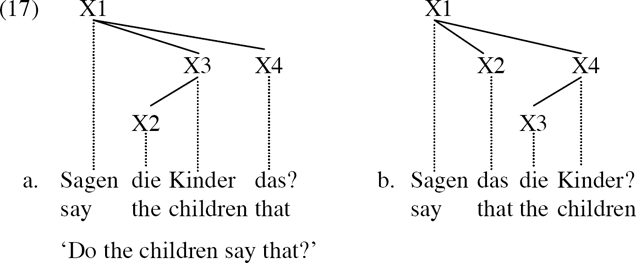
The combination of a subject NP, that is, die Kinder, with an object definite pronoun, das, results in a situation where the two factors just mentioned influencing weight compete. The fact that subjects tend to appear to the left suggests that die Kinder should precede das, and the fact that unstressed definite pronouns also tend to appear to the left suggest that das should precede die Kinder. The result of this conflict is that both orders are possible. The important point to note is that the relevant constituents are sisters.
Examples 16–17 above illustrate the effects of weight in interrogative V1 matrix clauses. The same result obtains when the constituents are in V-last subordinate clauses:


The relevant constituents are again sisters and the same acceptability judgments occur as in 16 and 17. Hence these data support the claim that weight influences the relative order of sister constituents.
A problem arises, however, when V2 clauses are included:


Notice again that the relevant constituents are sisters. However, example 20b is fine, contrary to expectation. This situation illustrates that there is an additional component to weight. Apparently, weight influences the serialization only of those sister constituents that appear on the same side of their head. The term COSISTER is suitable for denoting this relation:
COSISTERS: Two or more sister constituents are cosisters if they appear on the same side of their head.
Acknowledging this concept, the WEIGHT PRINCIPLE in dependency grammar is expressed as follows:
WEIGHT PRINCIPLE: Weight influences the relative order of cosister constituents, not of sister constituents in general.
According to the Weight Principle, 16b and 18b are disallowed because the two relevant constituents are cosisters and the heavier constituent precedes the lighter constituent. Sentence 20b, in contrast, is acceptable because the relevant constituents are no longer cosisters.
The discussion now surveys the structures where the weight of the relevant constituents helps determine word order. In the examples that follow, the relevant constituents are cosisters. In each case, the lighter unstressed definite pronoun dir should precede the heavier indefinite pronoun etwas:

The b-sentences here are marked with “??” instead of “*.” This is due to the acceptability of examples such as the following:

When the clause final pronoun receives contrastive stress, it can follow the indefinite pronoun. This possibility indicates that stress is a factor influencing weight.


Weight influences the order of constituents within NPs as well. In 27, the clause dass er weiß is heavier than the PP von dir.

And if one assumes that purely semantic principles influence the weight of constituents, then weight can be viewed as helping determine the order of prenoun modifiers in NPs also:

Like the Rising Principle, the Weight Principle may be universally valid. That is, a dependency grammar approach that acknowledges the role of weight in determining word order will have the Weight Principle (or something akin to it) at its foundation, upon which it builds a theory of weight.7
Another area that is sometimes addressed in terms of weight concerns alternations such as i and ii.

As the constituent, the root of which is zu lesen, increases in length, the more likely the order in ib becomes.

The alternation suggests that constituent weight is also a factor determining the placement of those constituents that have no cosisters. Following Hawkins (1992, 1994), however, I believe that constituent weight is only indirectly responsible for the preference of iib over iia. The direct explanation has to do with processing constraints. Processing becomes more difficult in increasing increments for each additional word that separates a head from its daughter. Hawkins' Early Immediate Constituents (EIC) metric quantifies the phenomenon. Unfortunately there is insufficient room here to explain the EIC.
To conclude this section, a comment concerning the cosister concept is appropriate. Most modern German grammars employ a hierarchy of semantic or textually based rules to explain word order in general, and especially in the midfield (Helbig and Buscha 1997:564ff., Zifonun et al. 1997:1495ff., and Eisenberg 1999:394ff.). This practice leads to most complicated results. By acknowledging the cosister rule, the current dependency-based approach identifies a generality, and in so doing, it moves an important component of word order from the semantics/pragmatics into the syntax proper. This relocation constitutes a simplification of the overall approach to word order. A straightforward syntactic criterion is employed to determine exactly when constituent weight can influence the serialization of constituents.
5. The Predicate Weight Principle.
Given the understanding of predicate chains presented in section 3 and the Weight Principle from section 4, the discussion can now proceed to the next major claim of this paper. This claim concerns the relative weight of predicate constituents, that is, constituents the roots of which are parts of predicate chains.
In most cases, predicate constituents outweigh their nonpredicate cosisters. This fact is particularly true with respect to argument NPs. In each of the cases in 29–37, the predicate constituent outweighs its sister noun (phrase). The predicate chains are in bold.


Each of the b-sentences is disallowed because the predicate constituent outweighs its cosister argument nominal and must hence follow it.8
Argument noun phrases can follow their predicate cosisters, on occasion, if they are heavy enough:

Weight in these cases is determined by the quantity of, and emphasis on, linguistic material. The fact that such cases can be acceptable should not be too surprising, since there are numerous factors that combine to determine the weight of a given constituent.
In contrast to argument noun phrases, many adjuncts can outweigh their predicate sisters; compare the c-sentences below corresponding to 29–37 above:


The predicate chains are again in bold. Each of these c-sentences has an adjunct following its predicate cosister. While some of these sentences are perhaps stylistically poor, they are all significantly better than their b- counterparts. Some adjunct types are even required to follow their predicate cosisters, namely those with clause status.
The discussion can now return to the phenomenon illustrated in the introduction. Examples 1–2 are repeated here for convenience as 38–39. The predicate chains continue to be in bold.


When the nonpredicate constituent follows the entire predicate chain as in the b-sentences, the sentences are acceptable. When the nonpredicate constituent precedes a link in the predicate chain as in the d-sentences, however, the sentences are unacceptable. Apparently a predicate constituent must appear as far to the right as it can if it precedes its predicate governor. This insight is expressed as the Predicate Weight Principle:
PREDICATE WEIGHT PRINCIPLE
- i. If W(ord)1 and W2 are links in the same predicate chain,
- ii. W1 governs W2, and
- iii. W1 follows W2, then the constituent of which W2 is the root is heavier than its cosisters.
The Predicate Weight Principle effectively formalizes an aspect of Bech's (1955) seminal distinction between coherent and incoherent constructions. According to the Predicate Weight Principle, the verbs of coherent constructions must often be contiguous, the result being that they form the right-bracket in the topological model. The remaining discussion in this paper is devoted to illustrating the validity of the Predicate Weight Principle. In so doing, it will be necessary to introduce one further principle of word order in German.
Examine the trees of 38d and 39d.


In 39, war corresponds to W1 in the Predicate Weight Principle, and freundlich to W2. Since freundlich precedes war, the Predicate Weight Principle requires freundlich to be heavier than its cosister, so it must follow gestern, not precede it. The situation is similar in 38d.
Examples 38d and 39d illustrate the force of the Predicate Weight Principle in the postroot domain of a V2 clause and in the preroot domain of a V-last clause. Examples 3d and 4d from section 1 are reproduced here as 40 and 41 to show the force of the Predicate Weight Principle in an interrogative V1 clause and in a zu-infinitive phrase.


Since in each case the adjunct phrase splits the two (lower) links in the predicate chain, the Predicate Weight Principle is violated and the unacceptability thus predicted.
The Predicate Weight Principle is valid for most all predicate types. This fact is illustrated here with respect to the list of predicate types produced above in 29–37. The d-sentences below are the V-last versions of 29c–37c:


This section presented the Predicate Weight Principle, a principle that helps determine the distribution of predicate constituents in German. As things stand, the Predicate Weight Principle is a descriptive generalization about the behavior of predicate chains. A pertinent question addresses the motivation for the principle. Why are those predicate constituents that precede their governors obligatorily heavier than their cosisters, whereas those predicate constituents that follow their governors are not necessarily heavier than their cosisters? The answer to this question probably has to do with the periphery positions in the clause. The sentence-initial and sentence-final positions often carry emphasis. Those nonpredicate constituents that can follow a predicate cosister are in sentence-final position. In this position, they receive emphasis and can hence outweigh their predicate cosisters. If the nonpredicate constituent does not appear in clause-final position, though, it does not receive the emphasis associated with that position, meaning that it will not outweigh its predicate cosister.
6. Scrambling Rising
The possibility of rising generates problems for the Predicate Weight Principle. Consider the structures in 42 and 43.


The Predicate Weight Principle predicts the unacceptability of the a- sentences: as predicate constituents, nervös and in Anspruch are heavier than their nonpredicate cosisters dich and alles, respectively. If the predicate constituents follow their nonpredicate cosisters, the results are fine, that is, Niemand will dich nervös machen and dass sie alles in Anspruch genommen hat.
Alternative analyses are shown in the b-sentences, however. There, nervös and in Anspruch have risen and attached to will and hat, respectively. The result is that the relevant constituents are no longer cosisters, meaning that the Predicate Weight Principle no longer requires nervös to follow ihn and in Anspruch to follow alles. For some reason separate from the Predicate Weight Principle, the rising in the b- examples must be disallowed.
There is a constraint on scrambling rising that predicts the unacceptability of the b-structures in 42 and 43. In Osborne 2005a, I observe that a dependent may not undergo scrambling rising if its governor has a lighter dependent that does not also rise. The data in 44 and 45, from Osborne 2005a, illustrate the phenomenon with respect to nonpredicate constituents in general.


The a-sentences have the lighter dependents of the fronted participles rising, that is, es and mich, to nonfronting positions, whereas the heavier dependents do not rise, that is, dem Kind and nach Japan. In the b- sentences, in contrast, the situation is reversed; the heavier dependent rises and the lighter one stays put. The relevant constraint is stated here as the SCRAMBLING RISING PRINCIPLE:
SCRAMBLING RISING PRINCIPLE: A dependent of a governor may not rise to a nonfronting position if that governor has a lighter dependent that does not also rise.
Instances of the so-called “third construction” provide further support for the Scrambling Rising Principle (Besten and Rutten 1989, Kiss 1995:109ff., Hinrichs and Nakazawa 1998, Wöllstein-Leisten 2001:8, Rambow 2003:231, Reis and Sternefeld 2004:488ff.). The examples in 46 and 47 are again from Osborne 2005a.


The governor of the risen constituent in each of these cases is the zu-infinitive embedded under versuchen. Each time, the lighter of the zu-infinitive's two dependents may rise alone, as illustrated in the a- sentences. The b-sentences are disallowed, in contrast, because the heavier of the two has risen alone.9
An anonymous reviewer mentions that cases of “mehrfache Vorfeldbesetzung” (“multiple prefield occupancy”), as discussed by Müller (2005), also support the understanding of weight and scrambling presented here:

The assumption that both preverb constituents in ia–b are dependents of the verb—which makes them cosisters—predicts the acceptability contrast. The lighter dauerhaft must precede the heavier mehr Arbeitsplätze.
7. Anaphoric Elements.
I am aware of one general type of exception to the Predicate Weight Principle. Predicate constituents functioning anaphorically can or must be lighter than their nonpredicate cosisters (Helbig and Buscha 1996:575, Sitta 1998:822). This fact is easily observable with the reflexive pronouns of obligatorily reflexive verbs, that is, sich schämen ‘be embarrased’, sich erkälten ‘catch a cold’, sich entscheiden ‘decide’, sich beeilen ‘hurry’, sich befinden ‘be located’, etc. Since the reflexive pronouns that appear in the structures containing these verbs qualify neither as arguments nor as adjuncts, they are viewed as predicate elements (Lühr 1993:29, Helbig and Buscha 1996:538, 575).
The problem with viewing these reflexive pronouns as predicate elements, though, is that they do not behave as such with respect to the Predicate Weight Principle:

These sentences violate the Predicate Weight Principle. The predicate element sich in each case is separated from the rest of the predicate chain by nonpredicate constituents. These reflexive pronouns must have a special status. In this regard, note that they are just that, namely pronouns. As such, they function anaphorically.
There are additional cases where the position of the predicate constituent violates the Predicate Weight Principle without ungrammaticality obtaining. Observe the acceptability contrasts in 49 and 50.


The b-sentences violate the Predicate Weight Principle because they have the predicate constituents so lustig and genau das preceding their nonpredicate cosisters das Schauspiel, nicht, and Katja. The acceptability contrast between the a- and b-sentences is interesting. Again, note that so and das are anaphoric elements. Apparently, whether or not a predicate constituent functions anaphorically influences where it can appear.
A widely acknowledged fact about unstressed definite pronouns is that they are relatively light, meaning they strive leftward. Furthermore, referential noun phrases in general tend to be lighter than nonreferential noun phrases. These facts suggest a solution to the challenge generated by the data in 48–50. Predicate constituents functioning anaphorically are exempt from the Predicate Weight Principle. Their status as anaphors makes them relatively light, that is, it overrides their status as predicate constituents, which are otherwise quite heavy. In other words, a conflict of weight principles occurs, whereby the one principle trumps the other. The principle that anaphoric constituents are relatively light overrides the principle that predicate constituents are quite heavy.
8. Conclusion.
This paper explored some traits of predicates in German. A dependency grammar approach has been employed. The dependency-based approach allows for an understanding of predicates in terms of predicate chains. The words that correspond to the semantic predicate of an utterance always qualify as a chain in the syntax of that utterance. Exploring the behavior of such chains, it is possible to acknowledge descriptive generalizations about the distribution of the links in the chains.
An important aspect of the dependency grammar analysis lies with its understanding of weight. The flatness of dependency structures creates a possibility that does not exist for the more layered constituency structures. Weight can be understood as determining the relative order of cosister constituents. The definition of cosister and the Weight Principle are reproduced here from section 4.
COSISTERS: Two or more sister constituents are cosisters if they appear on the same side of their head.
WEIGHT PRINCIPLE: Weight influences the relative order of cosister constituents, not of sister constituents in general.
The impressive aspect of the Weight Principle is that it determines the relative order of cosister constituents regardless of where they appear, be they in the postroot domain of V1 or V2 clauses, or in the preroot domain of V-last clauses or zu-infinitive phrases.
Adopting the Weight Principle and examining the behavior of predicate constituents, it is easy to observe that predicate constituents tend to be relatively heavy; they are most always heavier than their argument NPs. Many adjuncts, however, can at times outweigh their predicate cosisters. At other times though, they cannot outweigh their predicate cosisters. The Predicate Weight Principle (repeated here from section 5) predicts the serialization of these constituents:
PREDICATE WEIGHT PRINCIPLE
- i. If W(ord)1 and W2 are links in the same predicate chain,
- ii. W1 governs W2, and
- iii. W1 follows W2, then the constituent of which W2 is the root is heavier than its cosisters.
This principle identifies those predicate constituents that precede their predicate governors as obligatorily heavier than their nonpredicate co- sisters. It predicts the contrast in the data from the introduction.
Two additional areas were addressed. The first concerned difficulties associated with rising. The possibility of rising challenges the Predicate Weight Principle. The answer to this challenge comes from an independent observation. The dependent of a governor may not rise if that governor has a heavier dependent that does not also rise. The relevant constraint, that is, the Scrambling Rising Principle, is repeated here from section 6. In addition, the Rising Principle from section 2.3 is included:
RISING PRINCIPLE: The head of a risen constituent must dominate that constituent's governor.
SCRAMBLING RISING PRINCIPLE: The dependent of a governor may not rise to a nonfronting position if that governor has a lighter dependent that does not also rise.
Since predicate constituents that precede their predicate governors are heavier than their nonpredicate cosisters, they may not rise if they have a cosister that does not also rise.
The second type of data that challenges the Predicate Weight Principle concerns anaphoric elements. The reflexive pronouns of obligatorily reflexive verbs, for example, sich ‘himself/herself/ itself/themselves/yourself’, are widely viewed as predicate elements, yet they are positioned in such a manner that often violates the Predicate Weight Principle. Related difficulties occur with those predicate constituents that contain anaphoric elements, for example, so lustig ‘so funny’ and genau das ‘exactly that’. To address these exceptions to the Predicate Weight Principle, one must assume that anaphoric elements are by nature light, meaning they strive leftward. When a predicate constituent is an anaphor or contains an anaphoric element, the two principles conflict. In such cases, the principle pushing anaphoric constituents leftward trumps the Predicate Weight Principle.
Finally, it should be emphasized that the Weight Principle and the Rising Principle may be universal principles of language, although no claims to this effect are possible at this time. I think it is likely, however, that the Predicate Weight Principle is not valid beyond German and other related West Germanic languages.


