Introduction
The false codling moth (FCM), Thaumatotibia leucotreta (Meyrick) (Lepidoptera: Tortricidae), was previously known as T. roerigii Zacher (EPPO, 2019) or Cryptophlebia (= Argyroploce) leucotreta (Meyrick) (Komai, Reference Komai1999). It is one of the most economically important Tortricid insect pests causing damage to a wide range of agricultural crops (Brown, Reference Brown2005; Timm, Reference Timm2005). It is highly polyphagous and attacks various fruits, vegetables and cereal crops (EPPO, 2013; Fening et al., Reference Fening, Billah and Kukiriza2016). The larva is the most destructive stage, feeding voraciously on the pulp of the fleshy fruits, pods, seeds, bolls or cobs of the host plants which drop prematurely reducing significantly the yield of the crop (Schulthess et al., Reference Schulthess, Bosque-Pérez and Gounou1991; Vaissayre, Reference Vaissayre, Constable and Forrester1995; Djieto-lordon et al., Reference Djieto-lordon, Heumou, Elono, Alene, Ngueng and Ngassam2014). The yield loss caused by FCM infestation varies among crop species, varieties and locations. An infestation of citrus in South Africa by FCM led to a yield loss of up to 80% within 5 months (Hofmeyr, Reference Hofmeyr2003). In both South Africa and Israel, more than 30% of yield loss was reported in infested macadamia farms (La Croix and Thindwa, Reference La Croix and Thindwa1986). Yield loss as much as 90% have been reported in Kenya in Capsicum spp. (Muchemi, Reference Muchemi2015). In Cameroon, FCM was reported to attack different varieties of Capsicum spp. and causes an average yield loss of 43.80% (Djieto-lordon et al., Reference Djieto-lordon, Heumou, Elono, Alene, Ngueng and Ngassam2014). Up to 20% yield loss is caused by FCM in Uganda on cotton, as well as citrus, peach and macadamia crops (USDA, 2010). Moreover, feeding damage can lead to the development of secondary infections by fungi or bacteria further reducing the quality of the infested produce (Newton, Reference Newton1989). An infestation of fruits shortly before harvest constitutes a source of post-harvest decay (Moore, Reference Moore2017).
In addition to the physical damage caused, FCM has been categorized as an A2 quarantine pest in European and Mediterranean Plant Protection Organization (EPPO) by the European Commission for Plant health regulation (A2 pests are locally present in the EPPO region but not widely distributed), thus qualifying for inclusion as a harmful organism and restricting the international trade of its host crops such as citrus, macadamia and a number of Solanaceae crops, including capsicum into the EU (EPPO, 2013; Muchemi, Reference Muchemi2015). Follett and Neven (Reference Follett and Neven2006) defined a quarantine pest as a plant pest of potential economic importance to an area where it is not yet present or that is present but not widely distributed and is officially controlled. There are currently regulations on the export of FCM susceptible-crops and phytosanitary measures are being implemented in some ACP countries in order to enhance the trade of these produce into the EU market.
This review discussed some important aspects of the bio-ecology and management of the FCM to ensure produce from the already endemic areas such as the ACP countries, are free from the pest to meet the demands of the new EU Council Directives on FCM (European Commission's Implementing Directives 2017/1279 and 2019/532) and to promote international trade.
Distribution of the FCM
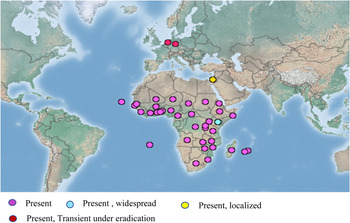
The FCM is a native insect pest in Israel and Africa. It may be most associated with ecological zones that are generally classified as desert and xeric shrubland, tropical and subtropical grasslands, savannas and moist broadleaf forest (Venette et al., Reference Venette, Davis, Da Costa, Heisler and Larson2003). In Israel, the pest was found for the first time in 1984 on macadamia nut and has a restricted distribution (EPPO, 2002). However, in Africa, FCM is thought to originate in the Ethiopian region and is currently widely distributed and has been reported in approximately 40 African countries and islands (CABI, 2000; Moore, Reference Moore2002; EPPO, 2013) (fig. 1).
Distribution map of the false codling moth from CABI (https://www.cabi.org/isc/datasheet/6904#todistribution), accessed 15 February 2020.

Though FCM was reported in many African countries, in most of these countries, except South Africa where extensive studies have been conducted, the distribution of FCM on the different hosts and geographical areas has not been established. The knowledge of in-country pest distribution may help to identify pest-free areas if any, areas with low and high prevalence. This is important for informed decision making and the phytosanitary measures to put in place and enforcement of regulations at the national, regional and international level. In South Africa, the Western Cape region was initially free of FCM until it was introduced in 1974 from stone fruit production areas due to the lack of phytosanitary measures (Honiball, Reference Honiball2004; Stibick, Reference Stibick2006). Further studies and surveying should then be conducted to determine the distribution and other aspects of the bio-ecology of FCM in different regions per country. Timm (Reference Timm2005) reported a genetic variation among FCM populations in South Africa. Analysis of population genetic variation may offer an insight into dispersal and gene flow of FCM which are important factors to consider when designing pest management strategies (Han and Caprio, Reference Han and Caprio2002, Salvato et al., Reference Salvato, Battisti, Cocato, Masutti, Patarnello and Zane2002; Timm, Reference Timm2005).
Host plants of FCM
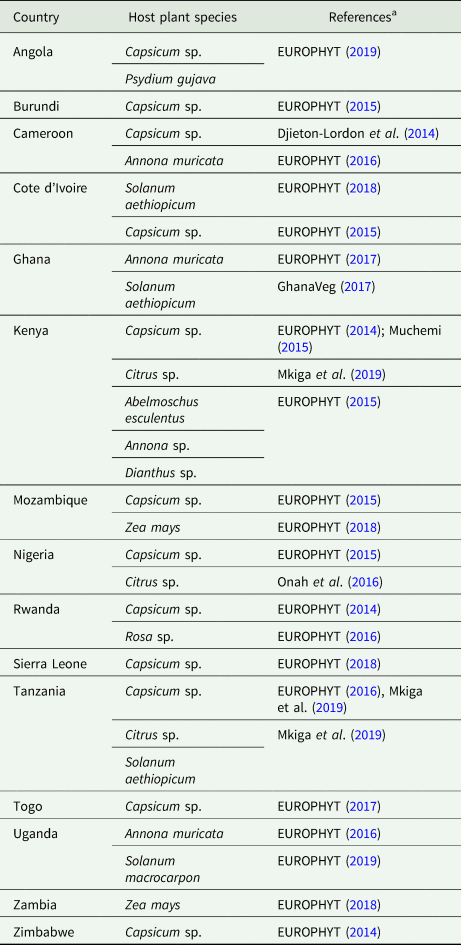
The FCM is highly polyphagous with more than 70 host plant species, within 40 plant families, including cultivated and wild species. A list of FCM host plants and associated countries is given in tables 1 and 2 of appendix 1 of the “Pest Risk Analysis for T. leucotreta” done by EPPO (2013). However, not all of the listed host plants such as apple, avocado, lime and lemon have been confirmed to support the feeding and development of the larvae (Newton, Reference Newton1998; Grové et al., Reference Grové, Steyn and De Beer1999; De Jager, Reference De Jager2013; Moore et al., Reference Moore, Kirkman and Hattingh2015). Recently reported host plants from various African countries not mentioned in EPPO (2013) review are listed in table 1.
Recently reported host plants from various African countries not mentioned in EPPO's (2013) review list

a The host plants with EUROPHYT as reference were intercepted produce infested by FCM in EU Member States and Switzerland.
Though the FCM is polyphagous, host susceptibility varies among plant species, varieties of the same species and may depend on host plant characteristics (Djieto-lordon et al., Reference Djieto-lordon, Heumou, Elono, Alene, Ngueng and Ngassam2014; Moore et al., Reference Moore, Kirkman, Stephen, Albertyn, Love, Grout and Hattingh2017; Mkiga et al., Reference Mkiga, Mohamed, Du Plessis, Khamis and Ekesi2019). For instance, in South Africa, FCM infestation level varies among citrus varieties. Lemons are not known to be infested at all, Valencia cultivars have low susceptibility, mid-season cultivars have moderate susceptibility while Navel oranges are very susceptible (Grout and Moore, Reference Grout, Moore, Prinsloo and Uys2015; Moore et al., Reference Moore, Kirkman and Hattingh2015). Sweet pepper is more preferred for oviposition than chilli pepper and African eggplant (Mkiga et al., Reference Mkiga, Mohamed, Du Plessis, Khamis and Ekesi2019). The preference of the FCM for host species may also vary with climatic conditions (Newton, Reference Newton1990; Love et al., Reference Love, Hill and Moore2014). In South Africa, of the 21 cultivated host plants reported, Citrus spp. appears to be the most preferred by FCM which represents a big concern for the citrus industry in the country (Schwartz, Reference Schwartz1981, Newton, Reference Newton1998). In tropical Africa, the FCM is a serious pest of cotton and maize (Reed, Reference Reed1974; Schulthess et al., Reference Schulthess, Bosque-Pérez and Gounou1991; Vaissayre, Reference Vaissayre, Constable and Forrester1995).
It was hypothesized that FCM biotypes having different host species may exist (Ford, Reference Ford1934; Omer-Cooper, Reference Omer-Cooper1939), however, studies based on molecular analysis of specimens collected in South Africa, did not find enough evidence of the existence of these biotypes. This suggests an extensive gene flow (genes exchange) among populations from different hosts within the same location (Timm, Reference Timm2005). The polyphagous status of FCM and gene exchangeability among host populations are important ecological factors to consider in designing management strategies for it.
Bio-ecology of FCM
The FCM is adapted to a wide ecological range and undergoes a complete metamorphosis with four distinct stages: egg, larva, pupa and adult (Daiber, Reference Daiber1979a, Reference Daiber1979b, Reference Daiber1979c, Reference Daiber1980; De Jager, Reference De Jager2013). The different life stages are described below:
Egg stage
Eggs are randomly laid singly or in batches by the female during the night flight (between 5 and 11pm) in the depression of the rind of the fruit, on foliage, on smooth surfaces, on fallen fruits and occasionally on branches (USDA, 1984; Stibick et al., Reference Stibick, Bloem, Carpenter, Ellis, Gilligan, Usnick and Venette2010). At the optimum temperature of 25°C, the female lays between 3 and 8 eggs per fruit and can lay up to 800 eggs during its lifetime with the highest daily record after 3–4 days of oviposition period depending on the host species or the diet (Newton, Reference Newton1998, De Jager, Reference De Jager2013; Mkiga et al., Reference Mkiga, Mohamed, Du Plessis, Khamis and Ekesi2019). Eggs take 2–22 days to hatch, depending on the temperature and humidity. At 25°C, De Jager (Reference De Jager2013) reported 12.42, 9.46 and 6.47 days on orange, grape and pear, respectively.
Larval stage
Upon egg hatching, the neonate larvae cut through the fruit rind and enter the fruit where it feeds on the pulp and seed of fruits. The entry point of the larvae into the fruit varies with host species (De Jager, Reference De Jager2013). The larvae are also opportunistic, entering through wounds and cracks on the fruit as secondary infestation (Stotter, Reference Stotter2009, De Jager, Reference De Jager2013). The entry point is recognizable through the presence of the frass that is left on the fruit surface, the discolouration of the rind and from the clear entry hole (Stibick, Reference Stibick2006; De Jager, Reference De Jager2013).
Different larval developmental periods varying from 12 to 67 days were reported by various authors. This wide variation is mainly due to weather conditions (especially temperature) and host fruit quality. Generally, the larval developmental period is longer in cool conditions and in poor quality fruits (Daiber, Reference Daiber1979b; Stibick et al., Reference Stibick, Bloem, Carpenter, Ellis, Gilligan, Usnick and Venette2010, De Jager, Reference De Jager2013). On artificial medium, Daiber (Reference Daiber1979b) reported larval development time of 46.6, 18.8 and 11.6 days at 15, 20 and 25°C, respectively, whereas on a natural diet, the larval development time of 31, 29 and 23 days on orange, grape and pear, respectively at 25°C was reported (De Jager, Reference De Jager2013). The larvae are cannibalistic and consequently rarely more than one larva develop in the fruit (Catling and Aschenborn, Reference Catling and Aschenborn1974; Newton, Reference Newton1998; Stibick, Reference Stibick2006).
The larval stage has five instars and by the time that the larva reaches maturity, the fruit might have fallen to the ground. If the fruit is still intact, on the branch, the last instar larva uses a silken thread to drop to the ground where it pupates (Schwartz, Reference Schwartz1981; Newton, Reference Newton1998; Stibick, et al., Reference Stibick, Bloem, Carpenter, Ellis, Gilligan, Usnick and Venette2010). The 1st, 2nd, 3rd, 4th and 5th larval stage has an average head capsule width of 0.21, 0.37, 0.61, 0.94, and 1.37 mm, respectively (Daiber, Reference Daiber1979b).
Pupal stage
The pupa undergoes firstly a prepupal stage which lasts for 2–27 days depending on prevailing conditions and then moults into a pupa (Stibick, Reference Stibick2006). Generally, male pupae are smaller than females with two knobs side by side in the centre of the ventral side of the ninth abdominal segment (USDA–APHIS–PPQ, 1983; Komai, Reference Komai1999). The pupal stage is the most sensitive of FCM developmental cycle. The development can be influenced by the relative humidity, temperature, soil cover and rainfall (Daiber, Reference Daiber1979c). The pupae sex ratio, 1:2 between males and females was recorded for wild moth population (Myburgh and Bass, Reference Myburgh and Bass1969; Daiber, Reference Daiber1979c).
Adult stage
FCM adults are noctuid moths and are sexually dimorphic. The male and female differ in overall size, wing shape and secondary sexual characters (Gilligan et al., Reference Gilligan, Epstein and Hoffman2011; EPPO, 2019). Females are larger than males, with the hind wings lacking the semi-circular pockets present in males. Females have a feature like a question mark symbol and a white dot on the forewings, when in a spread position. Males possess large genital tuft, pale grey colour; hind legs with the dense brush of greyish-white hairs; inner side of the hind tibia with tufts of modified scales (Timm et al., Reference Timm, Warnich and Geertsema2007, Reference Timm, Warnich and Geertsema2008; Muchemi, Reference Muchemi2015; EPPO, 2019).
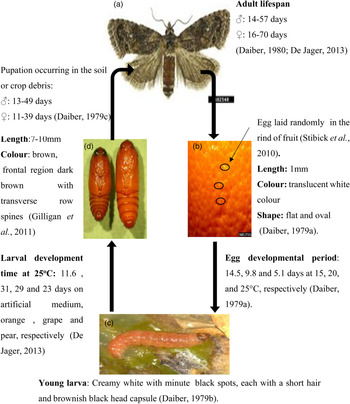
The complete life cycle of FCM (fig. 2) ranges from 30 days (under optimal conditions) to 174 days (under unfavourable conditions) and requires approximately 800-degree days. Two to ten generations can succeed annually (Daiber, Reference Daiber1980; Venette et al., Reference Venette, Davis, Da Costa, Heisler and Larson2003). With an uninterrupted supply of host plants, FCM remains active throughout the year. Diapause is not found to occur in FCM during field observations and laboratory experiment (Reed, Reference Reed1974; De Jager, Reference De Jager2013). The latter author attempted inducing diapause in FCM by simulating the start of winter in the laboratory and measured four different traits characterizing the diapause in insects, namely water loss, fat content, metabolic rate and super-cooling point. It showed that these measurements are not consistent with the direction of a priori predictions for diapause induction.
The life cycle of FCM, (a) (adult), (b) (eggs), (c) (larva), (d) (pupae). Photo credits: (a): Todd M. Gilligan and Marc E. Epstein, USDA APHIS PPQ; (b and d): photo: J.H. Hofmeyr, Citrus Research Int.; (c): Marja van der Straten, NVWA Plant Protection Service, Bugwood.org.

Most of the studies on FCM biology were done in the laboratory using citrus fruit as host. Future research should attempt to determine the development of FCM on other economically important host crops under laboratory and field conditions. Determining life table parameters of FCM on different host species will be a valuable tool in predicting the population dynamics of this pest and will contribute significantly in designing management interventions (De Jager, Reference De Jager2013).
Quarantine pest status of FCM
Pest risk analyses for FCM conducted by the EPPO demonstrated clearly that this indigenous pest from ACP countries could be introduced and established in EPPO countries and the USA as a direct result of increased international trade of host produce (Bloem et al., Reference Bloem, Carpenter, McCluskey, Fugger, Arthur, Wood, Vreysen, Robinson and Hendrichs2007; Gilligan et al., Reference Gilligan, Epstein and Hoffman2011, EPPO, 2013). This is mainly due to the fact that the host plants of the pest in its native environment are also grown in EPPO countries, for example, Capsicum crops in northern Europe, whilst in southern Europe Citrus crops would be mostly at risk (Ostojá-Starzewski et al., Reference Ostojá-Starzewski, Allen, Anderson, Eyre and Korycinska2017). Moreover, though FCM is a tropical pest, it can survive under cold temperatures and establish under favourable conditions especially in protected cultivation (EPPO, 2013). The most concerned EPPO countries with this potential invasion of FCM are UK, Netherlands, Belgium, Spain, Italy, France, Sweden and Ireland. An outbreak of FCM was reported in a greenhouse pepper in the Netherlands in 2009 (Potting and van der Straten, Reference Potting and Van der Straten2011). However, the possibility of establishment outdoors in EPPO region has not yet been proven. In the USA, Venette et al. (Reference Venette, Davis, Da Costa, Heisler and Larson2003) estimated approximately 20% of the continental land to be suitable for FCM.
Therefore, in order to mitigate its dispersion, FCM has been declared as a quarantine insect pest by the European Commission for plant health regulation in 2014. It has been categorized as A2 quarantine pest (i.e. it is present in EPPO region but not widely distributed), thus qualifying for inclusion as a harmful organism (EPPO, 2013; Muchemi, Reference Muchemi2015). The FCM is regarded as a high priority quarantine organism in the USA and is listed as a regulated pest in other countries or recommended to be regulated by other Regional Plant Protection Organizations (RPPOs). It is also a quarantine pest in Argentina, Brazil, Chile, Paraguay, Uruguay, Israel, Jordan, Japan and New Zealand (SA-DAFF, 2015).
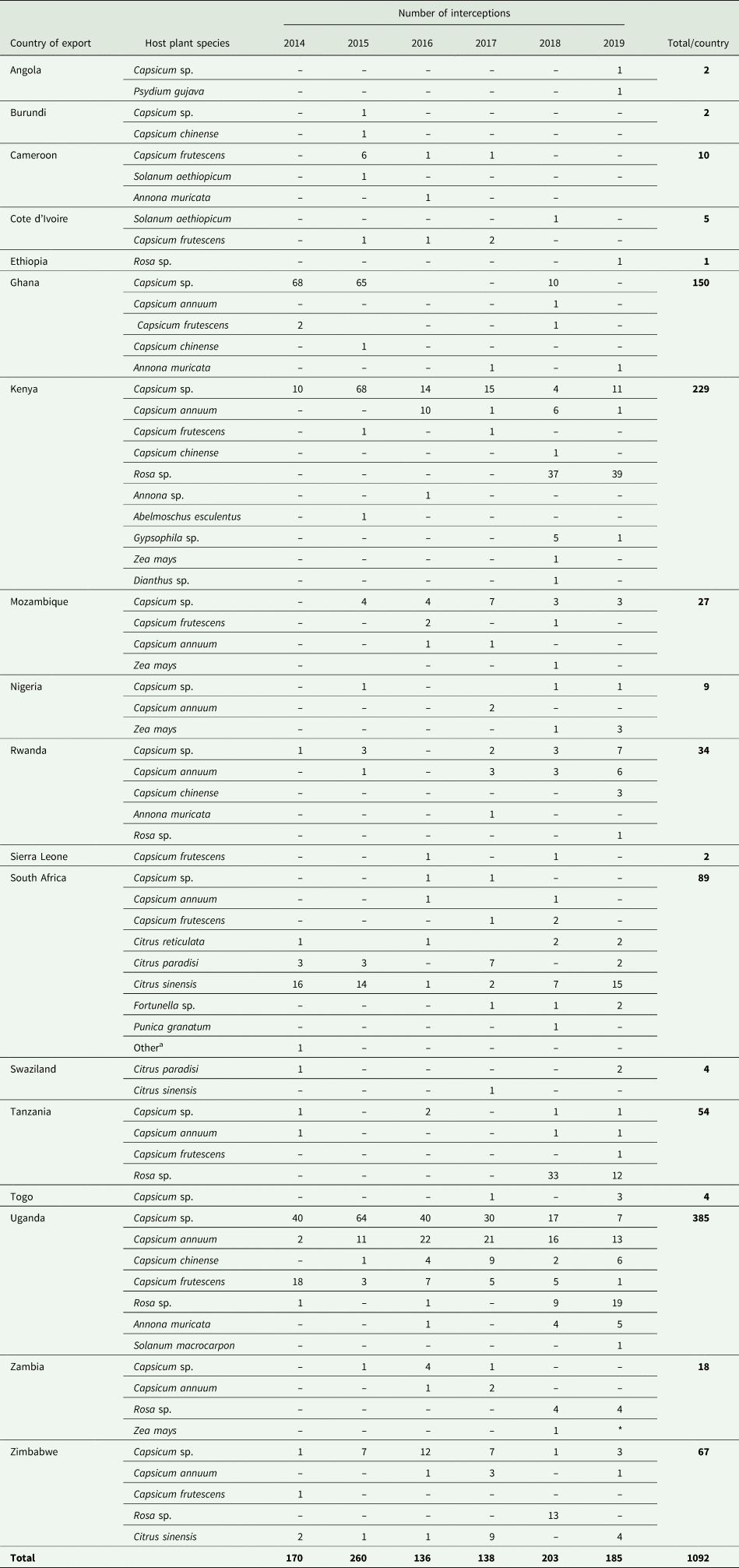
The presence of FCM in one country might have immediate effects on export markets and the detection of a single larva in fruits marked for export could result in the entire consignment being rejected (Moore, Reference Moore2002; Hattingh, Reference Hattingh2006). Effects on export markets may be in the form of a ban on the export of host fruits from the country where the pest becomes established. For instance, the FCM was the key pest intercepted in chillies exported to the UK in 2014 and 2015, thereby contributing to the ban on chillies and other affected commodities from Ghana into the EU in October 2015 (table 2) (EUROPHYT, 2014, 2015; Fening et al., Reference Fening, Billah and Kukiriza2016; GhanaVeg Sector Reports, Reference Fening and Billah2017).
Interception of produce from African countries imported into the EU and Switzerland with FCM (2014–2019)

– No report.
a Unidentified host plant.
The bold values represent total interceptions per country.
Source: EUROPYT (2014–2019).
Phytosanitary regulations on FCM
Since the declaration of the FCM as a quarantine insect pest, it has been one of the major pests intercepted in vegetables (chillies) and other commodities (Rosa) exported from the ACP countries into the EU (table 2).
Although the EU has lifted the ban since 1 January 2018 for Ghana, some challenges are still needed to be addressed. For instance, currently, the export of eggplant and chillies from ACP countries to the EU countries could only be possible if measures are put in place to produce and export these commodities in such a way that the quality will meet not only the expectations of consumers but also the new EU Plant Health Directives in force (Fening and Billah, Reference Fening and Billah2017b). According to the EU Implementing directive (EU 2017/1279) (see Annex IV, Part A, Point 16.6) of Article 13a of Council Directive 2000/29/EC, FCM host produce could be exported only from a country, area or place recognized as being free of FCM in accordance with relevant international standards for phytosanitary measures. Since FCM is widely distributed in ACP countries, this requirement may be difficult to be fulfilled unless chillies are grown in a screen house (place of production free from FCM and under supervision of the National Plant Protection Organization, NPPO) (Option 3). The other alternative according to the directive is that the produce is subjected to an effective cold treatment (or other effective treatment) (Option 4), that ensures it is FCM free. As stated, other effective treatment may refer to all other insect control methods that will ultimately lead to the effective and sustainable management of FCM in order to produce FCM-free produce as well as post-harvest treatments to kill immature stages of FCM (Fening and Billah, Reference Fening and Billah2017b). Another provision of the new directive is that the NPPO of each ACP country must send advance data on the effectiveness of the proposed treatment method to the EU, and this data is likely to be regularly updated, for the EU to decide on the fate of that country (Fening and Billah, Reference Fening and Billah2017b). Thus, the EU has already tasked ACP countries that chose option 4 and whose dossier was approved in 2017 to submit a revised and updated version based on the requirements of a new EU Implementing Directive in March 2019 (2019/523) which takes effect from 1st September 2019 in order to continue to export chillies to the EU (E-OJ, 2019; Fening and Billah, Reference Fening and Billah2019).
The guidelines for option 3 or cultivation of chillies in a screen house to eliminate the FCM remains unchanged under the new Directive. Thus, for Ghana and other ACP countries subscribing to option 4 of the guidelines, continuous research in the area of the surveillance of the FCM levels and thresholds on the targeted commodities, to ascertain how effective control interventions have been, is crucial to inform pest management decisions and interventions to adopt in order to satisfy the guidelines of the new EU implementing directives (Fening and Billah, Reference Fening and Billah2017b; E-OJ, 2019).
Management strategies of FCM
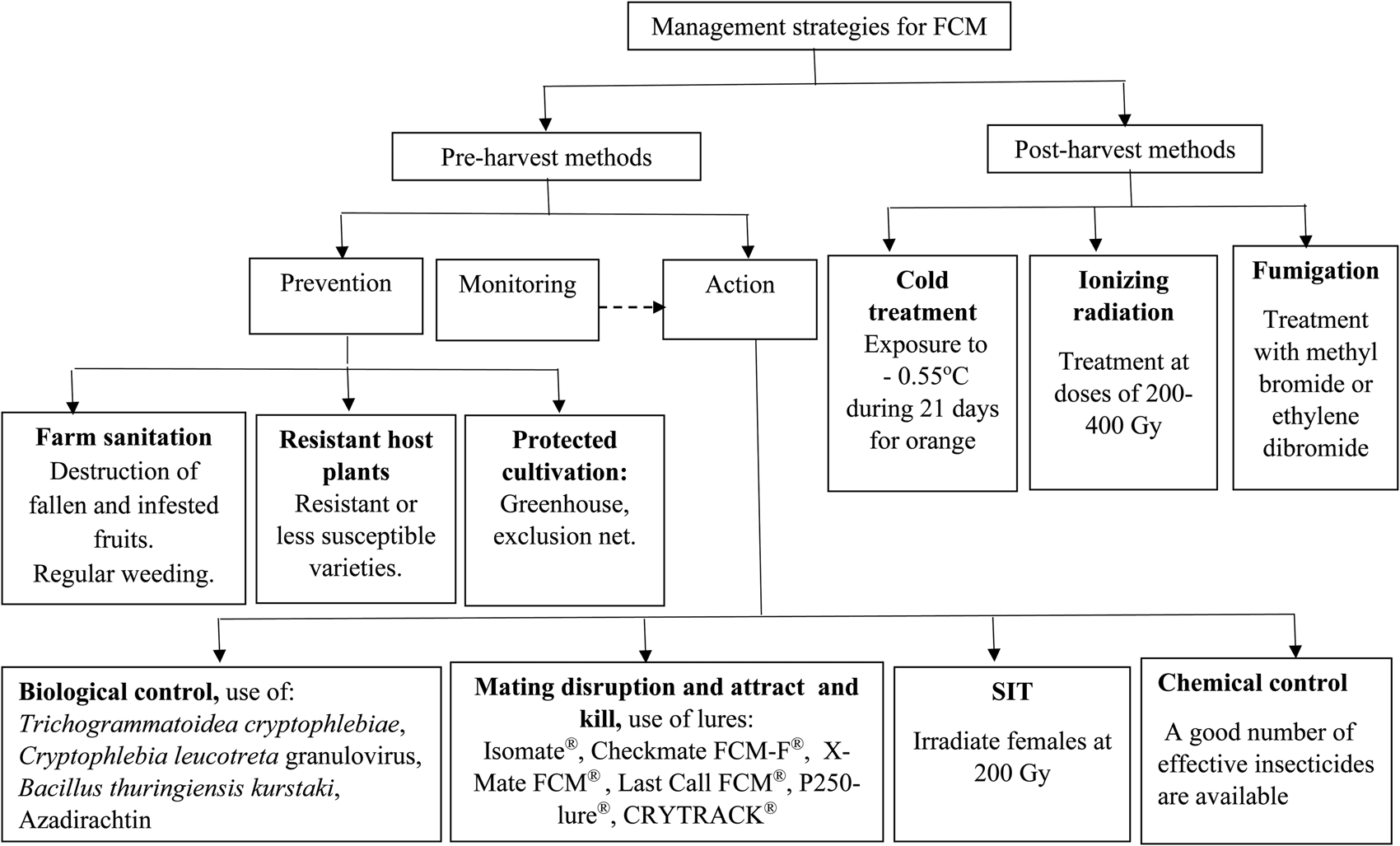
The aim of quarantine pest management is to eliminate or sterilize the target pests in exported commodities to prevent their introduction and establishment to new areas (Follett and Neven, Reference Follett and Neven2006). The most commonly used FCM management strategies can be categized into pre-harvest and post-harvest methods (fig. 3).
(1) Pre-harvest methods
Pest Monitoring
Monitoring FCM population is important to assist in the accurate timing of treatment application and to compare FCM activity levels between seasons which enable one to gauge probable post-harvest risk (Moore, Reference Moore2017). Monitoring is usually done by setting traps baited with female synthetic sex pheromone to trap males on the farm. The pheromone is a blend of (E) and (Z)-8-dodecenyl acetate (Persoons et al., Reference Persoons, Ritter, Hainaut and Demoute1976, Reference Persoons, Ritter and Nooyen1977, Newton et al., Reference Newton, Thomas, Mastro and Schwalbe1993; Venette et al., Reference Venette, Davis, Da Costa, Heisler and Larson2003). The efficacy of the pheromone to attract FCM male depends on the content of each component, (E) and (Z)-8-dodecenyl acetate. It is most effective at a ratio between 70:30 and 30:70 (E: Z) (Persoons et al., Reference Persoons, Ritter, Hainaut and Demoute1976, Reference Persoons, Ritter and Nooyen1977; Angelini, Reference Angelini1979; Angelini et al., Reference Angelini, Descoins, Lhoste, Trijau and Zagatii1981; Bourdouxhe, Reference Bourdouxhe1982). Currently, different synthetic pheromone such as FCM PheroLure®, Chempac FCM Lure®, P250-lure® and CRYPTACK® are commercially available. The monitoring can also be done by determining the presence of larvae in fallen fruits (Fening and Billah, Reference Fening and Billah2019).
Summary of the management strategies for the false codling moth.
Source: Myburgh (Reference Myburgh1963, Reference Myburgh1965); Moore and Kirkman (Reference Moore and Kirkman2008); EPPO (2013); Moore and Hattingh (Reference Moore and Hattingh2016); Fening and Billah, (Reference Fening and Billah2019).

Farm sanitation
It is known that poor farm sanitation provides breeding sites and harbouring places and promotes the development of FCM infestation in chillies and eggplant in the field (GhanaVeg Sector Report, Reference Fening and Billah2017; Fening and Billah, Reference Fening and Billah2018). Therefore, regular removal and destruction of all fallen and hanging fruits which are infested, damaged or is decaying and regular weeding will contribute significantly to reducing FCM populations. Farm sanitation represents the cornerstone of integrated management of FCM without which the efficacy of all treatments directed against FCM will be severely compromised (EPPO, 2013; GhanaVeg Sector Report, Reference Fening and Billah2017). Farm sanitation can improve pesticide efficacy in chillies and eggplant farms and reduced infestation levels up to 75% in the citrus orchard (Moore and Kirkman, Reference Moore and Kirkman2008; GhanaVeg Sector Report, Reference Fening and Billah2017). However, for farm sanitation to be effective, it is imperative to be initiated early before the larvae emerge in infested fruit to complete their life cycle and will contribute towards a sizeable subsequent generation (Moore and Kirkman, Reference Moore and Kirkman2008). In South Africa, weekly orchard sanitation is recommended for effective control of the FCM in orchards. In the warmer regions and periods, larvae would develop more quickly, and sanitation can be conducted more regularly than once a week (Moore and Kirkman, Reference Moore and Kirkman2008). The collected fruits should be disposed of properly. Different ways of disposing them of were reviewed by Moore and Kirkman (Reference Moore and Kirkman2008). In Ghana, it is recommended to destroy infested fruit by putting them in thick black polythene or plastic bags and exposing them to the sun for 10–14 days or burying them to a depth of 60–90 cm (Fening et al., Reference Fening, Billah and Kukiriza2016; GhanaVeg Sector Report, Reference Fening and Billah2017).
Although farm sanitation is effective for the control of FCM, it may have an adverse effect on the parasitoids which are their natural enemies. Therefore, a reduction in farm sanitation when parasitoid numbers are low, in order to aid the build-up of the parasitoid population is necessary. However, this might be counterproductive and parasitoid survival should be considered of secondary importance to proper farm sanitation (Keeton, Reference Keeton2008).
Use of resistant host plants
Where available, resistant varieties of crops can be used for planting to reduce the build-up of FCM population in the field. In South Africa, the level of susceptibility to FCM infestation varies significantly among citrus types and within varieties of the same citrus type (Newton, Reference Newton1990; Love et al., Reference Love, Hill and Moore2014). Among avocado cultivars in South Africa, Edranol, Hass and Pinkerton are the most susceptible to attack by FCM (Erichsen and Schoeman, Reference Erichsen and Schoeman1992). In Cameroon, Djieto-lordon et al. (Reference Djieto-lordon, Heumou, Elono, Alene, Ngueng and Ngassam2014) found that yellow pepper is more susceptible to FCM infestation than the red pepper and sweet pepper. Moreover, breeding for new resistant varieties to FCM will contribute to mitigating the dispersal of the pest.
Protected cultivation
Protected cultivation is among the strategies used in pest management (Fening and Billah, Reference Fening and Billah2017b). It consists of protecting cultivated crops using a physical barrier to exclude the FCM, preventing, therefore, the moth from reaching the crop. This can be done by using a mesh, exclusion net, greenhouse or net house. However, this strategy is not widely adopted in the control of the FCM in Africa (Fening and Billah, Reference Fening and Billah2017b). Some countries such as Israel and Kenya are using this method with additional measures to protect Capsicum spp., against FCM (EPPO, 2013). The NPPO of Ghana known as the Plant Protection and Regulatory Services Directorate (PPRSD) of the Ministry of Food and Agriculture (MoFA), stated in its roadmap to the EU the intention of exploring the potential for using protected cultivation soon as part of the management strategy for FCM in vegetable production (Fening and Billah, Reference Fening and Billah2017b). So, preliminary research and data are needed to serve as a baseline for further studies to actualize this goal by Ghana's NPPO.
Biological control
There are a number of natural enemies which contribute to reducing FCM population in the field (Grout and Moore, Reference Grout, Moore, Prinsloo and Uys2015). The egg parasitoid Trichogrammatoidea cryptophlebiae (Hymenoptera: Trichogrammatidae) occurs naturally in the field and can be used for augmentative control (Moore and Hattingh, Reference Moore and Hattingh2012). When undisrupted, T. cryptophlebiae naturally causes egg parasitism ranging from 80 to 100%, leading to at least 67% reduction in FCM infestation in Navel oranges in South Africa (Moore and Hattingh, Reference Moore and Hattingh2012). The use of T. cryptophlebiae as an augmentative biological agent has not been used extensively in Africa probably due to the cost involved in mass rearing of the parasitoids as a high number of parasitoids are required. Four to five monthly releases of 25,000 parasitoids per hectare in citrus are necessary for effective control of FCM (Moore and Richards, Reference Moore and Richards2001; Hofmeyr, Reference Hofmeyr2003). The augmentative release of T. cryptophlebiae needs also to be evaluated in other climatic conditions and crops especially in the countries where FCM represents a threat.
Some larval parasitoids including the braconids Apanteles sp. (Hymenoptera: Braconidae) and Agathis bishopi (Nixon) (Hymenoptera: Braconidae), and the Ichneumonid Apophua leucotreta (Wilkinson) (Hymenoptera: Ichneumonidae) were reported to parasitize FCM (Prinsloo, Reference Prinsloo1984). Orius bugs, assassin bugs and ants prey on FCM eggs, larvae and pupae, respectively (Moore, Reference Moore2017). Agathis bishopi can cause larval parasitism to rate up to 38% in Citrus in South Africa (Sishuba, Reference Sishuba2003). But the efficacy of most of these parasitoids and predators has not yet been proven and are not commercially available. Investigations need to be done to determine the effectiveness of those parasitoids in suppressing FCM populations and assess the option of their release through augmentative biological control programmes.
Cryptophlebia leucotreta granulovirus (CrleGV) has been used as an entomopathogenic agent for the control of FCM. There are three CrleGV-based products on the market: Cryptogran®, Cryptex® and Gratham® (Moore, Reference Moore2017). The application of CrleGV in citrus reduced the fruit infestation level up to 92% (Moore et al., Reference Moore, Kirkman and Hattingh2015). In citrus orchards in South Africa, virus formulations are recommended to be applied shortly before FCM egg hatching period which would occur 1–2 weeks at the peak in trap catches (Moore, Reference Moore2017).
The potential of the use of some other entomopathogenic agents such as nematode (Heterorhabditis bacteriophora), and fungi (Beauveria bassiana and Metarhizium anisopliae) for control of the pupal stage in the soil was also reported (Moore et al., Reference Moore, Coombes, Manrakhan, Kirkman, Hill, Ehlers, Daneel, de Waal, Dames and Malan2013; Coombes et al., Reference Coombes, Hill, Moore and Dames2016; Steyn et al., Reference Steyn, Malan, Daneel and Slabbert2017). Both nematodes and fungi have been shown to reduce T. leucotreta infestation of fruit by 80% or more for the full duration of the season, with a single application (Moore et al., Reference Moore, Coombes, Manrakhan, Kirkman, Hill, Ehlers, Daneel, de Waal, Dames and Malan2013; Coombes et al., Reference Coombes, Hill, Moore and Dames2016). In Ghana, some preliminary studies on the efficacy of biological insecticide Bacillus thuringiensis (Ecopel® and Bypel 1®) were effective against FCM larvae in chillies and eggplant (GhanaVeg Sector Reports, Reference Fening and Billah2017).
The aqueous neem kernel extract (ANKE) (Azadirachtin) applied at 50 g L−1 of water offered 100% protection of chilli and eggplant fruits against FCM infestation in the field (GhanaVeg Sector Reports, Reference Fening and Billah2017). Other Botanicals (plant extracts and essential oils) may also be effective for the control of FCM, especially in vegetable production. However, there is a need to determine the optimum application rates for these natural insecticides against FCM. Using botanicals may also be a way to reduce the application of synthetic insecticides and may aid in the management of insecticide resistance development in FCM.
Mating disruption, attract and kill technology
Pheromones have been much used for mating disruption and mass trapping of this species and constitute one of the most targeted control methods (Fening et al., Reference Fening, Billah and Kukiriza2016; GhanaVeg Sector report, Reference Fening and Billah2017; Fening and Billah, Reference Fening and Billah2017a). Some mating disruption products for FCM male mass trapping such as Isomate®, Checkmate FCM®, Splat-FCM® and X-Mate FCM® are commercially available. Isomate® was reported to reduce pest pressure in the range of 55–75% during a period of 5 months in citrus (Hofmeyr and Hofmeyr, Reference Hofmeyr and Hofmeyr2002; Moore and Kirkman, Reference Moore and Kirkman2011; Moore and Hattingh, Reference Moore and Hattingh2012).
‘Last Call FCM’ (Insect Science, South Africa), is an attract and kill product registered for the control of FCM in citrus in South Africa. (Hofmeyr, Reference Hofmeyr2003; Kirkman, Reference Kirkman2007). Mating disruption, attract and kill are negatively density-dependent approaches. Therefore, for the control to be effective, they should be initiated early in the season before a peak in moth activity occurs (Moore, Reference Moore2017). In Ghana, the lures P-250® and CRYPTACK® have been used by farmers to mass trap the FCM male moths in chilli farms (Fening and Billah, Reference Fening and Billah2019).
In Ghana, the Delta trap embedded with a card with a sticky surface and the FCM lure were used to mass trap and kill the male moths as a population suppression tool (Fening et al., Reference Fening, Billah and Kukiriza2016; GhanaVeg Sector Report, Reference Fening and Billah2017; Fening and Billah, Reference Fening and Billah2017a, Reference Fening and Billah2019). This method is relatively safe as it does not require a toxicant or an insecticide to kill the pest.
In Ghana's NPPO roadmap for the management of the FCM, it was recommended that the farmer should set up FCM pheromone traps at the beginning of the season (within the crop and on the borders), just before fruit set, to establish the presence and build-up of adults (males) in traps (Fening and Billah, Reference Fening and Billah2017b).
Sterile Insect Technique (SIT )
SIT is an area-wide pest management strategy. It is being developed in some regions in South Africa since 2002 for the control of FCM (Boersma et al., Reference Boersma, Boardman, Gilbert and Terblanche2018). It is an effective strategy which can reduce infestation by 95.2%, as a stand-alone treatment (Hofmeyr et al., Reference Hofmeyr, Hofmeyr, Carpenter, Bloem and Slabbert2016a). The response of FCM to radiation for adult sterilization is dose-dependent. Total sterility (100%) can be achieved in irradiated females for both adults and pupae at 200 Gy (Bloem et al., Reference Bloem, Carpente and hofmeyr2003). In-field flight ability of released FCM moth is sensitive to changes in temperature. Therefore, the release time of irradiated moths should target optimal temperature to allow appropriate dispersal which is an important factor for a successful release (Stotter and Terblanche, Reference Stotter and Terblanche2009; De Jager, Reference De Jager2013).
Though the SIT technique is effectively used in South Africa, further research is needed to improve on production, handling, processing, transport, and release protocols to ensure the delivery of high-quality sterile moths while considering the cost-effectiveness of the whole process (De Jager, Reference De Jager2013; Boersma and Carpenter, Reference Boersma and Carpenter2016).
Chemical control
The effectiveness of chemical control of the destructive larval stage of the FCM is reduced due to the protection the larva gains by living within the fruit or boll of the attacked host. This leads to relying on systemic insecticides for effective control. Different groups of insecticides are used to control FCM in citrus orchards in South Africa. The insect growth regulators and ovicides Triflumuron (Alsystin®) and Teflubenzuron (Nomol®) are chitin synthesis inhibitors of benzoylurea group. Novel insecticide molecules chlorantraniliprole (Coragen®), an anthranilic diamide of ryanodine group and Methoxyfenozide (Runner® and Walker®) of Diacylhydrazine group are effective against egg and larvae of FCM (Newton, Reference Newton1989; Moore, Reference Moore2017). Cypermethrin is of the pyrethroid group and has a larvicidal effect on FCM. Spinetoram (Delegate®) of spinosyn group is active across multiple insect growth stages. Other insecticides have been recommended for the control of FCM as well: Azinphos methyl (Guthion® Solupak® 50%) Methomyl and Cypermethrin 200 EC are recommended in South Africa (Sweet et al., Reference Sweet, Bot and Hollings1983). USDA–APHIS–PPQ (1983) recommended application of Azinphos methyl (Gusathion®, Guthion®), Diazinon and Fenvalerate to eradicate the false codling moth in the USA.
In Ghana, the binary insecticides Acetamiprid 16 g l−1 + Indoxacarb 30 g l−1 (Viper®) and Lambda cyhalothrin 15 g l−1 + Acetamiprid 20 g L−1 EC (Protocol®) gave a 100% protection to the chilli fruits against FCM, while Dimethoate (400 g l−1) + Cypermethrin (36 g l−1) (Cydim Super®), Bacillus Thuringiensis (Ecopel®) and Maltodextrin (Eradicoat T GH®) offered 71.2, 85.8 and 85.8% protection, respectively, in chilli. (Fening et al., Reference Fening, Billah and Kukiriza2016; GhanaVeg Sector Reports, Reference Fening and Billah2017; Fening and Billah, Reference Fening and Billah2017b).
Recently FCM has developed resistance to some insecticides in South Africa, principally benzylureas (Hofmeyr and Pringle, Reference Hofmeyr and Pringle1998). Rational use of synthetic insecticides by alternating different classes will minimize the possibility of the pests becoming resistant (Fening et al., Reference Fening, Billah and Kukiriza2016; GhanaVeg Sector Reports, Reference Fening and Billah2017).
(2) Post-harvest methods
Cold treatment
Post-harvest cold treatment of infested fruits is one of the important measures recommended by the Food and Veterinary Office (FVO) of EU for phytosanitary risk mitigation of FCM because it can reduce the risk to an acceptable level on its own (EPPO, 2013). Cold treatment can be compulsory for some export markets irrespective of the efficacy of other control measures taken (Hofmeyr and Hofmeyr, 2005; SA-DAFF, 2015).
The current cold treatment methods for FCM disinfestation were initially developed by Myburgh (Reference Myburgh1963, Reference Myburgh1965) with citrus. He recommended a post-harvest treatment protocol of 21-day exposure to – 0.55°C which would provide at least a probit 9 level of control. This protocol has been adopted by many EPPO countries and others such as the USA, China and Korea (Hofmeyr and Hofmeyr, 2005; USDA, 2005). Recently, Moore et al. (Reference Moore, Kirkman, Stephen, Albertyn, Love, Grout and Hattingh2017) demonstrated that as the temperature increases, the duration required for effective treatment increases.
Moore and Hattingh (Reference Moore and Hattingh2016) argued that cold treatment of fruits would not be feasible since cold temperatures for a protracted duration are known to be damaging to fruit quality, particularly certain mandarin, orange, lemon and grapefruit cultivars (Lafuente et al., Reference Lafuente, Zacarias, Martínez-Téllez, Sanchez-Ballesta and Granell2003; Lafuente and Zacarias, Reference Lafuente and Zacarias2006; Cronjé, Reference Cronjé2007; Wettergreen, Reference Wettergreen2015). Therefore, the mandatory cold disinfestation required for some export markets could not be applied to all fruits. Indeed, many fruits such as peppers do not tolerate cold treatment as they are sensitive to chilling injury when stored below 7°C and symptoms can appear after a few days at 0°C (EPPO, 2013). In regard to phytosanitary risk mitigation of FCM, specific treatments involving a system approach would need to be developed and implemented (EPPO, 2013). Also, the possibility of cold disinfestation of harvested chilli fruits and other produce needs to be deeply explored through active research.
Ionizing radiation
The potential use of ionizing radiation treatment for post-harvest phytosanitary disinfestation of FCM has risen as an alternative and/or complementary method to cold treatment due to increasing chilling injury concern. It was established that treated larvae at doses of 200–400 Gy could not develop into moths (Barry et al., Reference Barry, Cronjé and Vankerwel2007, Hofmeyr et al., Reference Hofmeyr, Hattingh, Hofmeyr and Slabbert2016b). Hofmeyr et al. (Reference Hofmeyr, Hattingh, Hofmeyr and Slabbert2016b) demonstrated that at 100 Gy, moth emerged from irradiated fruits were infertile and are not able to fly precluding the prospect of dispersal and mate location under field conditions. This finding validates, therefore, the probit-9 level efficacy of 100 Gy of ionizing radiation for phytosanitary treatment.
Though ionising radiation is seen as an alternative treatment, it also has a dose-dependent negative effect on fruit quality which can, therefore, be avoided with enough reduction in dose. For each produce, there is a need to determine the appropriate treatment dose to preserve its quality. Moreover, the potential of the use of cold treatment associated with ionizing radiation should be explored. However, it is worth remembering ionizing radiation is not universally accepted and this is slowing its adoption (Follett and Neven, Reference Follett and Neven2006).
Fumigation
The potential of fumigation in FCM disinfestation is less explored. Nevertheless, some have reported the efficacy of methyl bromide and ethylene dibromide in fumigation of T. leucotreta in citrus fruit. Complete disinfestation was achieved when ethylene dibromide fumigation was followed by exposure to 4.4°C for 18 days or 11.1°C for 21 days (Myburgh, Reference Myburgh1963; Schwartz and Milne, Reference Schwartz and Milne1972; Schwartz and Kok, Reference Schwartz and Kok1976). However, in 1992, methyl bromide was recognized as an ozone-depleting substance under the Montreal protocol and recently their use for quarantine purposes is restricted (Fields and White, Reference Fields and White2002; EPPO, 2013).
Integrated Pest Management (IPM) of FCM
According to Moore (Reference Moore2017), no single control measure is currently available that will suppress FCM population satisfactorily. For instance, Bloem et al. (Reference Bloem, Carpente and hofmeyr2003) suggested the combination of the SIT and biological control by releasing the egg parasitoid T. cryptophlebiae can provide pest control that is more effective than when either tactic is employed separately. As a result, a multidisciplinary approach (system approach) with integrated strategies is needed for effective and sustainable management of FCM. Rational integration of various strategies (fig. 3) including proper farm sanitation particularly may lead to effective control of FCM and minimize the possibility of insecticide resistance development in the pest. The control of FCM using an integrated strategy in the field can be highly effective (Carpenter et al., Reference Carpenter, Bloem, Hofmeyr, Vreysen, Robinson and Hendrichs2007; Moore and Hattingh, Reference Moore and Hattingh2012).
In South Africa, the IPM of FCM using SIT as the main component has succeeded in reducing pest abundance by 97% in the Western Cape Province. In Ghana, the control of FCM as outlined by NPPO's Roadmap to address important amendment to EU plant health regulations employs a holistic and sustainable approach to crop health known as Integrated Crop Management (ICM) of which IPM is an integral part. This approach involves the use of the best agronomic practices in terms of pest and plant nutrient management and follows three steps:
• Prevention: this avoids the introduction and build-up of a pest population in the farm by selecting production sites in areas with low FCM prevalence, healthy seed, adoption of proper farm sanitation, crop rotation and best agronomic practices.
• Monitoring: FCM lures Delta sticky trap is set at the beginning of the season (within the crop and on the borders) to establish the presence and build-up of adults (males) in traps.
• Acting: Use the most effective management methods and strategies to control FCM as soon as it is detected in the traps.
Conclusion
In the current situation where FCM has become a quarantine insect pest, there is a need to produce FCM-free commodities. It is necessary to further strengthen FCM management interventions through active research and put in place IPM packages appropriate to each crop and adapted to each agro-ecological condition. This demands the development of a pest surveillance system for monitoring FCM and documenting its spatio-temporal distribution on key hosts and other alternative hosts. Also, suitability studies should be undertaken to determine the optimal temperature range for cold treatment of each harvested host crop. The role of protected cultivation should be also investigated for vegetable hosts.
Successful IPM is based on a sound understanding of the pest's behaviour and the physiological mechanism underlying it. This includes the knowledge of the population dynamics of both the pest and its natural enemies and the factors that affect the population size, genetic variation between different pest populations, the host plant preferences and the alternative host species and the pests' migration and dispersal capabilities. The information related to these ecological and behavioural aspects of the FCM is still scanty in ACP countries, except in South Africa. These shortcomings in information need to be addressed in order to achieve sustainable pest management of FCM and to ensure produce exported from ACP countries to the EU and other international markets meet their strict phytosanitary requirements.
Acknowledgement
The authors acknowledge the financial and logistics support from GhanaVeg (now Hortifresh), CABI, GIZ, USAID, Ghana Association of Vegetable Exporters (GAVEX) and PPRSD in undertaking the initial studies which provided the baseline information for the development of the roadmap for the management FCM on chillies for export in Ghana.