Introduction
Volunteerism in later life is a common phenomenon around the world. In the United States of America (USA), according to the Bureau of Labor Statistics (2018), over 42 per cent of American older adults aged above 55 volunteered in 2016. In contrast, in 2016, the participation rate of older adults aged above 50 in 12 European countries varied greatly from 12 to 47 per cent (Hansen et al., Reference Hansen, Aartsen, Slagsvold and Deindl2018); and older adults (50+) accounted for 9 per cent of the total volunteers in Korea (Lee and Yeung, Reference Lee and Yeung2019). Volunteering has been suggested to benefit older adults’ health and wellbeing. Volunteerism is associated with lower morbidity rate, reduced mortality risk, better functioning health, fewer depressive symptoms and higher life satisfaction (Onyx and Warburton, Reference Onyx and Warburton2003; Gottlieb and Gillespie, Reference Gottlieb and Gillespie2008; Okun et al., Reference Okun, Yeung and Brown2013; Anderson et al., Reference Anderson, Damianakis, Kröger, Wagner, Dawson, Binns, Bernstein, Caspi and Cook2014). In addition, volunteers also benefit the organisations by saving labour costs, improving service provisions, promoting community relations and public support, among others (Handy and Mook, Reference Handy and Mook2011).
However, the causal mechanism of volunteerism affecting older adults’ health remains inconclusive (Jenkinson et al., Reference Jenkinson, Dickens, Jones, Thompson-Coon, Taylor, Rogers, Bambra, Lang and Richards2013). For example, Anderson et al. (Reference Anderson, Damianakis, Kröger, Wagner, Dawson, Binns, Bernstein, Caspi and Cook2014) suggested a beneficial health effect was caused by the host of biopsychological mechanisms and improved physical, social and cognitive functioning. Gottlieb and Gillespie (Reference Gottlieb and Gillespie2008) argued that the health and morale of older volunteers improved because they felt they were valued and needed by helping others. Besides, the social capital of older volunteers was bolstered through the social interaction process during volunteering activity (Onyx and Warburton, Reference Onyx and Warburton2003). Wheeler et al. (Reference Wheeler, Gorey and Greenblatt1998) suggested that not only did older volunteers’ wellbeing improve, but the people they served also reported better scores in functional and mental health measures.
Despite the well-acknowledged benefits of volunteerism (e.g. Gottlieb and Gillespie, Reference Gottlieb and Gillespie2008; Anderson et al., Reference Anderson, Damianakis, Kröger, Wagner, Dawson, Binns, Bernstein, Caspi and Cook2014), fewer review articles have focused on the factors correlating with or influencing older adults’ volunteering behaviour. In other words, what are the motivations and barriers of older peoples’ engagement in volunteering activities? This study is framed from the integrative perspective driven by the Socioecological Model, a well-developed and commonly used theory in ageing studies (Bengtson and Settersten, Reference Bengtson and Settersten2016). The Socioecological Model suggests individuals are embedded in their surrounding environment and therefore are affected by the contexts of community/organisation and socio-political levels (Bengtson and Settersten, Reference Bengtson and Settersten2016). Using the person-in-environment and multi-level approach, the Socioecological Model considers that individuals’ value and behaviour are determined not only by their intrapersonal characteristics, but also are shaped by their interaction with social environments, including interpersonal, institutional, organisational, community level and structural characteristics (Bengtson and Settersten, Reference Bengtson and Settersten2016). Correspondingly, we divided the correlates and impact factors of volunteerism into three levels.
At the individual level, the motivations can be functional, particularly identified as enhancement, values and social functions (Dunn et al., Reference Dunn, Chambers and Hyde2016). At the organisation level, variables like management practices and instruments, organisational attitudes and dedication, and volunteers’ action space and co-ordination played important roles (Studer and Von Schnurbein, Reference Studer and Von Schnurbein2013). At the macro-level, policy support and advocacy also facilitated the volunteering environment (Smith and Cordery, Reference Smith and Cordery2010). Therefore, the Socioecological Model can direct this study to consider the motivation and barriers of older adults’ volunteerism from an integrative and multi-level perspective. This study did not use Continuity Theory and Socioemotional Selectivity, two of the most commonly used psychological theories, to explain why people volunteer in existing studies because it is narrowly focused on individuals’ psychological traits and would not be able to consider impactful variables beyond the individual level.
Considering the unique features of older adults (e.g. age-associated health, retirement status), the motivations and barriers for older adults to volunteer could be different from those of the younger population such as working young and middle-aged adults. Fewer review articles have focused on older adult volunteers. Among them, some concerned only older adults living in Western countries. For example, Gottlieb and Gillespie (Reference Gottlieb and Gillespie2008) briefly reviewed the characteristics and motives of older volunteers living in North America. Sellon (Reference Sellon2014) discussed the recruiting and retaining of older American volunteers by reviewing publications from 2006 to 2014. Petriwskyj and Warburton (Reference Petriwskyj and Warburton2007) performed a critical review about motivation for and barriers to older adults’ volunteering using publications from 1996 to 2006. Principi et al. (Reference Principi, Chiatti, Lamura and Frerichs2012) systematically reviewed the studies about older adults’ volunteering behaviour published from 1999 to 2008. These review articles were concerned with empirical studies conducted a decade ago. New empirical articles have flourished in the past decade and might have new inspirational findings. A new review concerning globe-wide and more current research is warranted to update our view about the motivation and barriers of older adults’ volunteerism around the world.
This article aims to help understand the correlates of older adults’ volunteerism by picking up on the reviewing efforts of Petriwskyj and Warburton (Reference Petriwskyj and Warburton2007) and Principi et al. (Reference Principi, Chiatti, Lamura and Frerichs2012), and reviewing the most current empirical studies published from 2008 to 2019. It also expands the literature review to international studies rather than focusing on the USA alone or North America (Gottlieb and Gillespie, Reference Gottlieb and Gillespie2008; Sellon, Reference Sellon2014). This analysis is driven by the following questions:
(1) What is known, unknown and uncertain about the correlates of older adults’ volunteerism from the most recent literature?
(2) What recommendations can be drawn for practice, policy and future studies based on the findings in current studies?
This study was not designed to provide an exhaustive and retrospective overview of the volunteerism literature on older adults, but to address more current matters (Grant and Booth, Reference Grant and Booth2009). Results will update the evidence-based findings of what motivates or hinders the older adults’ volunteering activity, and provide the state-of-the-art implications for professional practitioners, policy makers and researchers.
Method
The review process followed the guidelines for conducting a systematic review developed by Peters et al. (Reference Peters, Godfrey, Khalil, McInerney, Parker and Soares2015) and was formatted based on the Preferred Reporting Items for Systematic Reviews and Meta-Analyses (PRISMA) statement proposed by Moher et al. (Reference Moher, Liberati, Tetzlaff and Altman2009).
Eligibility criteria
Studies were included initially if they met the following criteria:
(1) Research constructs were the volunteerism of older adults aged 60 and above.Footnote 1
(2) Studies were published in peer-reviewed English-language journals from 2008 to 2019.Footnote 2
(3) Studies used empirical evidence, including quantitative, qualitative, mixed methodology and experimental design studies.
Studies were excluded if:
(1) Study objects were general people, such as young adults aged 18–60. Patients were excluded due to the potential effect of their health status on their volunteering behaviour, but residents living in facilities without functional disability were included.
(2) Studies were not research articles, including review articles, theoretical development, policy analysis without empirical evidence, meta-analysis or commentary.
Information sources
Studies were searched and retrieved from three major academic databases in social and behavioural science disciplines: PsycINFO, Social Services Abstracts and Sociological Abstracts. Google Scholar was further searched to include more multi-disciplinary studies.
Search strategy
To include as many eligible studies as possible, the following search terms were used: ab(‘older adult*’ OR ‘senior*’ OR ‘elderly’ OR ‘older people’) AND ab(‘volunteer*’ OR ‘civic participation’ OR ‘civic engagement’) AND (‘factor*’ OR ‘barrier*’ OR ‘motivation’ OR ‘predictor*’). The same search strategy was applied to the four databases equivalently.
Study selection
Based on the search results of the four databases, two researchers independently reviewed the title and keywords of all initially included studies. These two researchers are both senior doctoral students in the Gerontology programme in a major US university. Both of them have received trainings in social science research methodology and the study of gerontology, which makes them qualified for conducting systematic review research. Studies whose title and/or keywords included both ‘older adult’ and ‘volunteer’ were screened in for the second phase of review. If there were not sufficient keywords, the abstract would be reviewed to help decide if the study was relevant. In the second phase of the review, two authors independently reviewed the abstracts and excluded the ineligible studies. Finally, studies meeting all inclusion criteria were included in the full-text review.
Data collection
For each selected study, information was collected about the authors, country, setting, study population, theoretical models, methodology, and predictors and outcome variables. The setting was concerned with the type of volunteer activity or organisation. Formal volunteering refers to the activity conducted in a formal setting, such as religious, educational, medical or community organisations. Informal volunteering refers to the activity conducted in an informal setting such as care-giving for family members or helping neighbours. Detailed descriptive statistics of the study population were collected, including the number of respondents, age eligibility, number/proportion of males, and mean and standard deviation of age. Which theoretical models were used to direct the empirical study was also identified for each study, and methodology and variables were identified. Two of the authors of this article reviewed the information many times to reduce entry error. We did not collect the effect size of findings nor assess the study quality, considering that not all the selected studies employed quantitative methods and the studies were conducted in various settings.
Synthesis of results
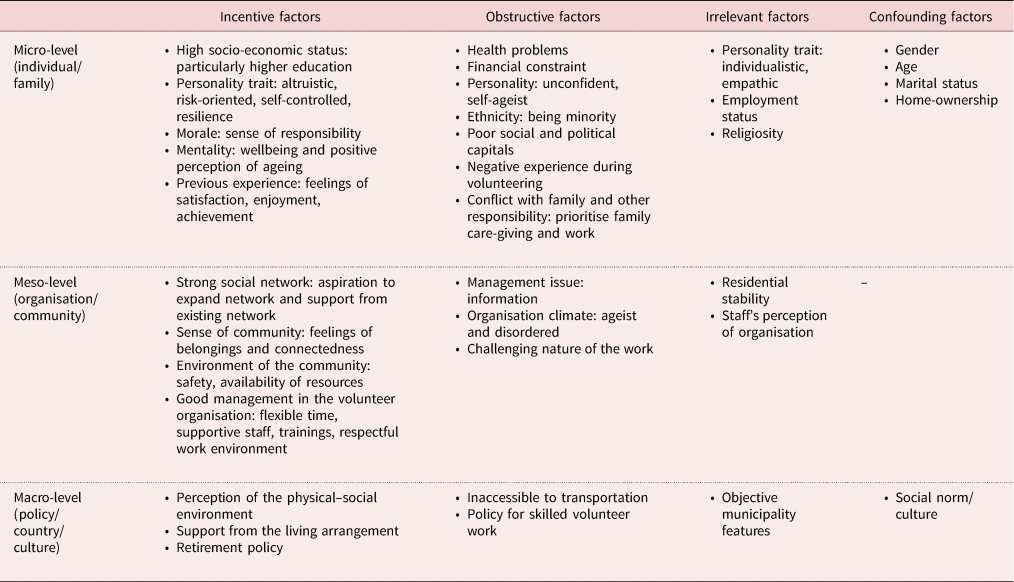
First, we divided the correlates into four categories: incentive/motivation, obstructive/barrier, irrelevant/insignificant and confounding/mixed variables. The Socioecological Model was employed to guide the synthesising process of findings from all selected studies. This integrated model can help researchers identify correlates/impact variables comprehensively. Accordingly, this study identified and synthesised the results into three levels: micro-level (e.g. individual, family), meso-level (e.g. community, organisation) and macro-level (e.g. policy, culture).
Risk of bias
Bias in this study could come from the process and assessment of researchers in selecting studies and synthesising results. When including and excluding the studies based on the inclusion/exclusion criteria, two independent researchers might make different decisions due to their understanding of the concepts employed in the studies. The researchers also had disagreements about proper categorisation of the findings according to the Socioecological Model. The researchers discussed such situations thoroughly and set up screening and coding agreements. Cohen's kappa coefficient was computed to examine the degree of agreement between two researchers’ judgement on assigning various correlates into different categories of the Socioecological Model (McHugh, Reference McHugh2012). There was high agreement between the two researchers’ judgements, with kappa = 0.825 (95% confidence interval = 0.693–0.957, p < 0.001).
Results
Characteristics of selected studies
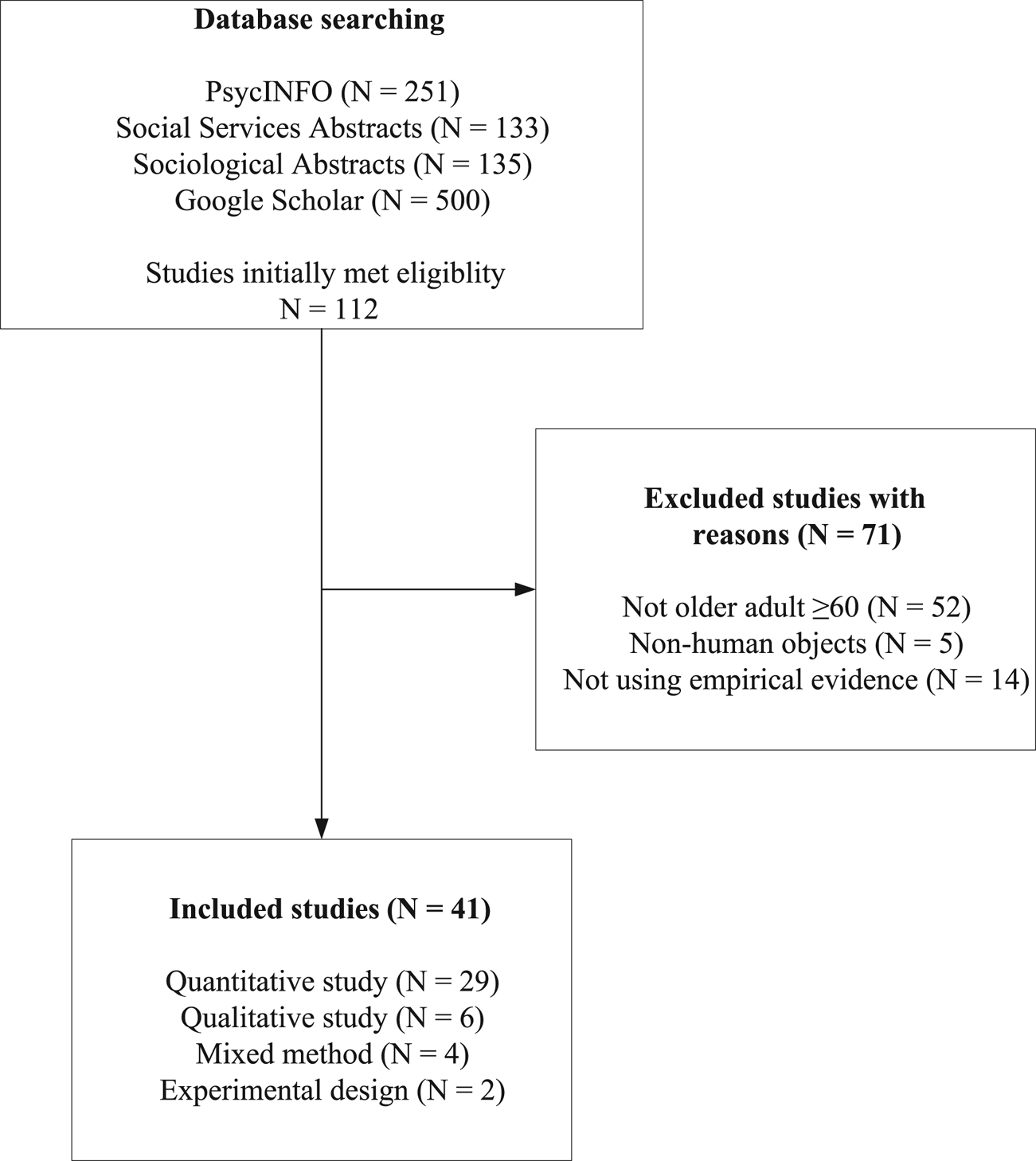
Figure 1 shows the process and results of the search. The majority of studies were excluded because of a mismatch to the research topics, leaving 112 relevant studies. The abstracts of these studies were then reviewed to see if they met the inclusion criteria. In the stage of abstract review, 71 out of 112 studies were excluded mostly because they were not concerned with older adults aged at least 60 or did not use empirical evidence. Some were excluded because they studied non-human subjects such as policies and volunteer programmes. Finally, 41 studies were included in the stage of full-text review.
Flowchart of the study selection process.
Notes: Google Scholar generated a large number of search results, but the majority of them were irrelevant or overlapped with the results in PsycINFO, Social Service Abstracts and Sociological Abstracts. We reviewed the titles of the first 500 results.

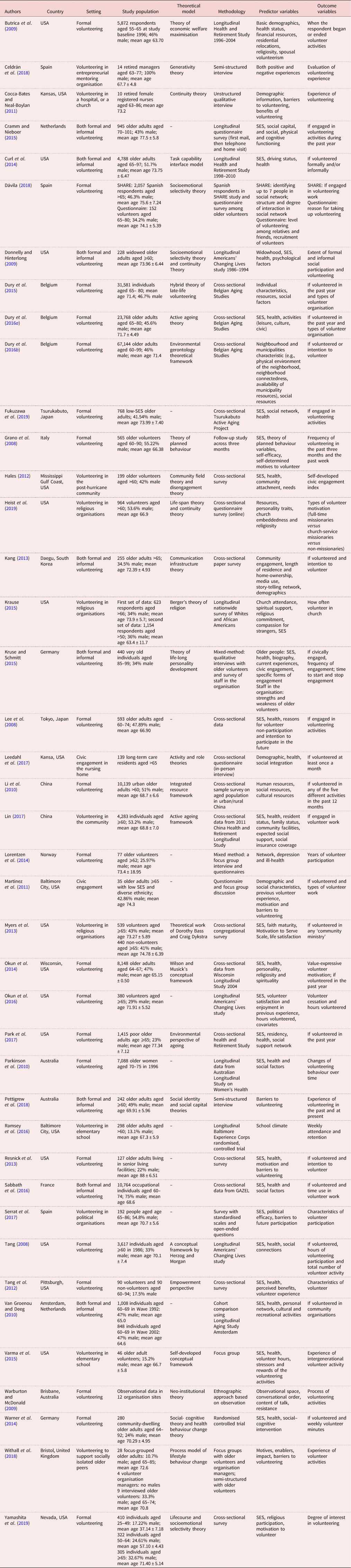
Table 1 shows the descriptive information of all 41 studies, of which 19 (46.3%) were concerned with American older volunteers and one-third were conducted in European countries. Thus, the majority of publications in the past decade were centred on the Western perspective. None were cross-national comparative studies. The settings were ambiguous in some studies, without specifying the type of volunteering organisation or work. Some studies did not distinguish formal and informal settings. The study population was diverse. Twelve studies did not use theory, although Continuity Theory and Socioemotional Selectivity Theory were the two most commonly used theories to explain older adults’ volunteering from the psychological perspective (e.g. Donnelly and Hinterlong, Reference Donnelly and Hinterlong2009). Regarding methodology, the majority (70.7%) were quantitative studies (Figure 1). Among all 29 quantitative studies, 18 used cross-sectional data. The most common correlates or predictors were socio-economic status (SES), health, social capital and religious/spiritual measures. The outcome variables were about the participatory status or experiences of older adults’ volunteering.
Summary of included studies

Notes: GAZEL: GAZ de France/ELectricite de France. SES: socio-economic status. SHARE: Survey of Health, Ageing and Retirement in Europe. USA: United States of America.
Motivations to volunteer
Table 2 shows the correlates of older adults’ volunteerism framed in the Socioecological Model. Most studies were concerned with the motivation of older volunteers. At the micro-level, which refers to the individual and family, higher SES, especially higher education, was strongly associated with older adults’ volunteering behaviours (e.g. Tang, Reference Tang2008; Cramm and Nieboer, Reference Cramm and Nieboer2015; Sabbath et al., Reference Sabbath, Matz-Costa, Rowe, Leclerc, Zins, Goldberg and Berkman2016). This relationship was verified in different volunteering settings such as long-term care (Leedahl et al., Reference Leedahl, Sellon and Gallopyn2017) and religious organisation (Myers et al., Reference Myers, Wolfer and Sherr2013). Older adults with higher education were not only more likely to start volunteering (Van Groenou and Deeg, Reference Van Groenou and Deeg2010), but also less likely to stop volunteering (Okun et al., Reference Okun, Infurna and Hutchinson2016). However, the correlate of higher education was confounded among older Chinese volunteers. Lin (Reference Lin2017) reported a positive association, which is consistent with the majority of studies, while Li et al. (Reference Li, Chi and Xu2010) found Chinese community-dwelling older adults with primary school education were more likely to volunteer compared to their counterparts with a college education.
Socio-ecological correlates of older adults’ volunteerism
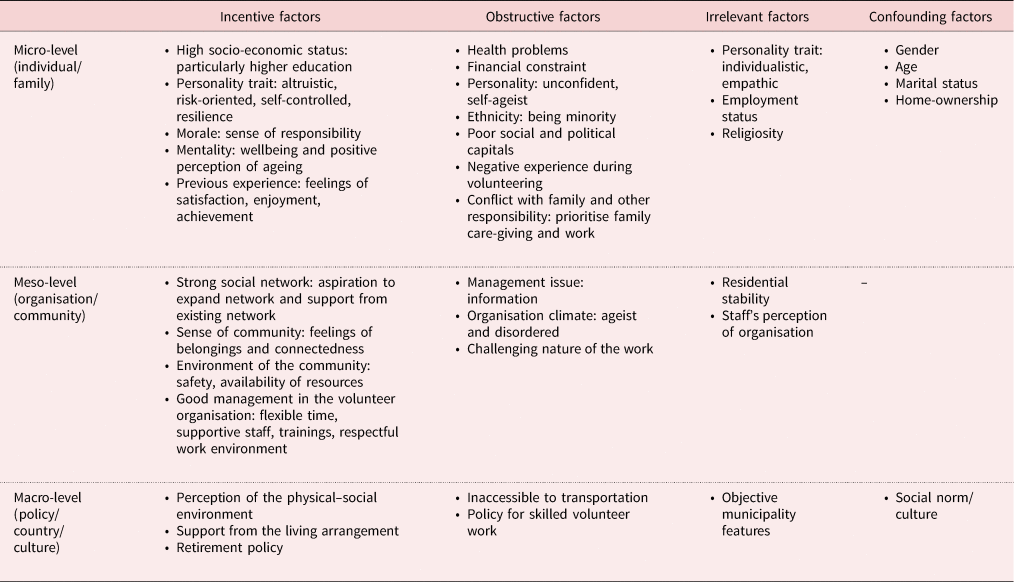
Personality traits are important in providing the incentive to volunteer. Characteristics like altruism, generativity, risk orientation, sense of self-control, resilience, and belief that volunteer work is valuable, interesting and pleasant were identified as incentives (Grano et al., Reference Grano, Lucidi, Zelli and Violani2008; Dury et al., Reference Dury, De Donder, De Witte, Buffel, Jacquet and Verté2015; Yamashita et al., Reference Yamashita, Keene, Lu and Carr2019; Heist et al., Reference Heist, Cnaan and Lough2019). Morale and mentality also mattered. Older volunteers described their choices and behaviours as being driven by a sense of responsibility, unfinished business, a ‘calling’, positive perception of ageing, and the need to improve their mental wellbeing (Grano et al., Reference Grano, Lucidi, Zelli and Violani2008; Lorentzen et al., Reference Lorentzen, Wikström and Joranger2014; Kruse and Schmitt, Reference Kruse and Schmitt2015; Leedahl et al., Reference Leedahl, Sellon and Gallopyn2017; Withall et al., Reference Withall, Thompson, Fox, Davis, Gray, de Koning, Lloyd, Parkhurst and Stathi2018; Yamashita et al., Reference Yamashita, Keene, Lu and Carr2019). Previous experience was also an important correlate. Individuals who enjoyed the sense of satisfaction and achievement (Okun et al., Reference Okun, Infurna and Hutchinson2016) and had built connections with others in previous volunteering activity (Varma et al., Reference Varma, Carlson, Parisi, Tanner, McGill, Fried, Song and Gruenewald2015) were more likely to volunteer again and re-experience the feelings of belonging and personal satisfaction.
Four main categories emerged at the meso-level of community and organisation environment or context. First, a strong social network played a role in volunteering intention by encouraging people to expand their social network (Lin, Reference Lin2017; Yamashita et al., Reference Yamashita, Keene, Lu and Carr2019) and supporting them via the existing network (Dury et al., Reference Dury, De Donder, De Witte, Buffel, Jacquet and Verté2015; Kruse and Schmitt, Reference Kruse and Schmitt2015; Fukuzawa et al., Reference Fukuzawa, Katagiri, Harada, Masumoto, Chogahara, Kondo and Okada2019). Older adults could be invited by their network members to volunteer (Withall et al., Reference Withall, Thompson, Fox, Davis, Gray, de Koning, Lloyd, Parkhurst and Stathi2018), or felt they were being supportive of their network by volunteering (Lorentzen et al., Reference Lorentzen, Wikström and Joranger2014). Dury et al. (Reference Dury, De Donder, De Witte, Brosens, Smetcoren, Van Regenmortel and Verté2016a) suggested that volunteering activity was highly correlated with other types of leisure and cultural activity because of older adults’ strong social networks. Second, from a broader perspective, the sense of community, the availability and accessibility of resources (such as various volunteer organisations and affordable public transportation), and the environment of the community were also important correlates. Living in a connected, safe and resourceful community was associated with a higher rate of volunteering (Parkinson et al., Reference Parkinson, Warburton, Sibbritt and Byles2010; Hales, Reference Hales2012; Kang, Reference Kang2013; Dury et al., Reference Dury, Willems, De Witte, De Donder, Buffel and Verté2016b; Yamashita et al., Reference Yamashita, Keene, Lu and Carr2019).
Third, from the organisational perspective, management and work environment were critical. Older volunteers could be motivated by flexible and reasonable time arrangements (Martinez et al., Reference Martinez, Crooks, Kim and Tanner2011) and the connection with clients and organisation (Celdrán et al., Reference Celdrán, Serrat, Villar, Pinazo and Solé2018). Providing support and training to volunteers could help them adapt to the new environment (Warburton and McDonald, Reference Warburton and McDonald2009; Warner et al., Reference Warner, Wolff, Ziegelmann and Wurm2014; Krause, Reference Krause2015). Fourth, it was beneficial if the staff respected the volunteers’ autonomy and created a safe and non-hostile work environment within the organisation (Warburton and McDonald, Reference Warburton and McDonald2009; Ramsey et al., Reference Ramsey, Parisi, Rebok, Gross, Tanner, Carlson, Seeman, Roth and Spira2016).
Regarding macro-level incentives, only three studies discussed the relationship of the physical–social environment with older adults’ volunteerism (Li et al., Reference Li, Chi and Xu2010; Dury et al., Reference Dury, Willems, De Witte, De Donder, Buffel and Verté2016b; Park et al., Reference Park, Kim and Cho2017). For example, Li et al. (Reference Li, Chi and Xu2010) found the early retirement policy in China (age 55 for women and age 60 for men) gave older Chinese people more time to volunteer. Positive perceptions by volunteers of support from policy and the social environment help motivate older adults to volunteer, but the specific mechanism was not identified in the selected studies.
Barriers to volunteer activity
Studies have identified some distinctive features of correlates that obstruct volunteer activity. At the individual level, most studies showed that older adults were less likely to volunteer owing to health and financial issues (e.g. Li et al., Reference Li, Chi and Xu2010; Van Groenou and Deeg, Reference Van Groenou and Deeg2010; Cocca-Bates and Neal-Boylan, Reference Cocca-Bates and Neal-Boylan2011; Hales, Reference Hales2012; Resnick et al., Reference Resnick, Klinedinst, Dorsey, Holtzman and Abuelhiga2013; Leedahl et al., Reference Leedahl, Sellon and Gallopyn2017; Serrat et al., Reference Serrat, Petriwskyj, Villar and Warburton2017). Physical limitations, mental disorders and financial constraints hindered them from going out to volunteer. In the American context, minority groups also reported a lower volunteer participation rate than Caucasians probably because they had less human and social capital (Tang et al., Reference Tang, Copeland and Wexler2012; Cramm and Nieboer, Reference Cramm and Nieboer2015). Other studies have indicated that people with less socio-political capital were less likely to volunteer (Li et al., Reference Li, Chi and Xu2010; Parkinson et al., Reference Parkinson, Warburton, Sibbritt and Byles2010). People who lack confidence and interest, are self-ageist or feel excluded also declined to volunteer (Cocca-Bates and Neal-Boylan, Reference Cocca-Bates and Neal-Boylan2011; Pettigrew et al., Reference Pettigrew, Jongenelis, Jackson and Newton2018; Withall et al., Reference Withall, Thompson, Fox, Davis, Gray, de Koning, Lloyd, Parkhurst and Stathi2018).
In addition, older volunteers who had negative experiences with volunteering such as unsuccessful outcomes (Celdrán et al., Reference Celdrán, Serrat, Villar, Pinazo and Solé2018) and feeling less valued (Serrat et al., Reference Serrat, Petriwskyj, Villar and Warburton2017) would be discouraged from volunteering again (Martinez et al., Reference Martinez, Crooks, Kim and Tanner2011). Conflict with family members also discouraged older adults’ volunteerism (Withall et al., Reference Withall, Thompson, Fox, Davis, Gray, de Koning, Lloyd, Parkhurst and Stathi2018). Older adults who need to balance their time between care-giving and work responsibilities (Myers et al., Reference Myers, Wolfer and Sherr2013) were unable to commit sufficient time to volunteering (Lee et al., Reference Lee, Saito, Takahashi and Kai2008; Resnick et al., Reference Resnick, Klinedinst, Dorsey, Holtzman and Abuelhiga2013; Serrat et al., Reference Serrat, Petriwskyj, Villar and Warburton2017). Some older adults prioritised the intermediate network centred on family members and preferred informal volunteering such as care-giving for their family (Dávila, Reference Dávila2018; Pettigrew et al., Reference Pettigrew, Jongenelis, Jackson and Newton2018).
Barriers at the meso-level mainly resulted from management and work environment within the volunteer organisation. Some older adults could not volunteer because they could not get information due to their weak media usage and social network (Lee et al., Reference Lee, Saito, Takahashi and Kai2008; Cocca-Bates and Neal-Boylan, Reference Cocca-Bates and Neal-Boylan2011; Hales, Reference Hales2012; Kang, Reference Kang2013). During the volunteer activity, it could be demotivating if older adults felt they were being devalued and were assigned to tasks that did not fit their abilities (Varma et al., Reference Varma, Carlson, Parisi, Tanner, McGill, Fried, Song and Gruenewald2015). Furthermore, disordered institutional management could reduce older adults’ intent to volunteer. Older volunteers who feel they have been discriminated against based on their age (Warburton and McDonald, Reference Warburton and McDonald2009), being disrespected for their knowledge or skills (Cocca-Bates and Neal-Boylan, Reference Cocca-Bates and Neal-Boylan2011) and lack institutional opportunity (Kruse and Schmitt, Reference Kruse and Schmitt2015) are more likely to quit. Policy constraints on licences such as nursing also hinder older adults from performing skilled volunteer work (Cocca-Bates and Neal-Boylan, Reference Cocca-Bates and Neal-Boylan2011). Inaccessibility to public transportation and feeling unsafe in the city also were identified as major obstacles to older people's volunteering (e.g. Martinez et al., Reference Martinez, Crooks, Kim and Tanner2011; Hales, Reference Hales2012).
Irrelevant and confounding correlates
While most studies were concerned with motivation and barriers to volunteering, some have found irrelevant and confounding correlates. For example, Heist et al. (Reference Heist, Cnaan and Lough2019) suggested individualism was an insignificant predictor and Krause (Reference Krause2015) indicated compassion for strangers had modest effect, implying some personality traits were irrelevant to older adults’ volunteerism. Van Groenou and Deeg (Reference Van Groenou and Deeg2010) found the employment rate did not predict differences of volunteer participation between cohorts of older adults. Many studies found that religiosity was not a significant predictor of older adults’ volunteerism (Li et al., Reference Li, Chi and Xu2010; Okun et al., Reference Okun, O'Rourke, Keller, Johnson and Enders2014; Dury et al., Reference Dury, De Donder, De Witte, Buffel, Jacquet and Verté2015; Krause, Reference Krause2015; Heist et al., Reference Heist, Cnaan and Lough2019). More broadly, the length of time living in the neighbourhood, staff members’ perceptions of the organisational environment and objective municipality features did not push or pull older adults to volunteer (Dury et al., Reference Dury, Willems, De Witte, De Donder, Buffel and Verté2016b; Ramsey et al., Reference Ramsey, Parisi, Rebok, Gross, Tanner, Carlson, Seeman, Roth and Spira2016).
Regarding the confounding variables, the majority of the selected studies were focused on the individual level. First, studies conducted in various countries showed the mixed role of gender in volunteerism. For example, Van Groenou and Deeg (Reference Van Groenou and Deeg2010) found Dutch women were more likely to engage in religious volunteering while Sabbath et al. (Reference Sabbath, Matz-Costa, Rowe, Leclerc, Zins, Goldberg and Berkman2016) suggested French men are more likely to volunteer, yet Lin (Reference Lin2017) indicated no gender difference in community participation among Chinese older adults. The ambiguity also occurred when comparing participation rates between younger and older cohorts. Many studies have found younger adults were more likely to volunteer (e.g. Resnick et al., Reference Resnick, Klinedinst, Dorsey, Holtzman and Abuelhiga2013; Okun et al., Reference Okun, Infurna and Hutchinson2016; Leedahl et al., Reference Leedahl, Sellon and Gallopyn2017) while Sabbath et al. (Reference Sabbath, Matz-Costa, Rowe, Leclerc, Zins, Goldberg and Berkman2016) reported no association between age and civic participation. Lin (Reference Lin2017) indicated younger age groups were more likely to volunteer in rural China but not in urban China.
Another heated debate was over the association of marital status with volunteering. Butrica et al. (Reference Butrica, Johnson and Zedlewski2009) suggested older volunteers were more likely to start and less likely to quit volunteering when their spouses were also volunteers. Donnelly and Hinterlong (Reference Donnelly and Hinterlong2009) suggested widowhood was positively associated with volunteering because widowers had more time. However, Van Groenou and Deeg (Reference Van Groenou and Deeg2010) considered that the effects of divorce were two-sided: it increased the likelihood of cultural and recreational activities while diminishing social network activity. Li et al. (Reference Li, Chi and Xu2010) did not find a significant relationship between volunteering and marital status. The role of home-ownership was also mixed: Dury et al. (Reference Dury, Willems, De Witte, De Donder, Buffel and Verté2016b) suggested a positive association of home-ownership with volunteering while Kang (Reference Kang2013) demonstrated an insignificant correlation. Finally, Dury et al. (Reference Dury, Willems, De Witte, De Donder, Buffel and Verté2016b) indicated cross-cultural variation in older adults’ intention to volunteer, whereas the norm in East Asian countries was that wealthy older people were less willing to volunteer. However, the confounding role of social norm needs more empirical evidence.
Discussion
Summary of results
This state-of-the-art review updated the empirical evidence about the correlates of older adults’ volunteerism in the past decade and expanded the academic views to globe-wide studies on volunteering in older age. Compared to the traditional systematic review study, this review article did not have a retrospective component but focused on the current status of knowledge and aimed at providing implications for future research (Grant and Booth, Reference Grant and Booth2009). We included 41 studies published from 2008 to 2019, of which more than half were concerned with countries outside North America. We found the majority of studies were conducted in Western countries and used quantitative methodology. Some were ambiguous about the setting of volunteering and did not use theories. Framing the results in the Socioecological Model, we synthesised the findings into three levels and categorised them into four dimensions. Studies consistently found that incentive correlates at the micro-level included better SES, altruistic and extravert personality traits, high morale and mentality, and good prior experience. Push factors at the meso-level came from a strong social network, sense of community, age-friendly environment in the community and good management in the volunteering organisation. Motivations to volunteer also increased when older people felt supportive and satisfied with their physical–social environment at the macro-level. In contrast, obstructive correlates at the individual level, such as health limitations, financial constraints, being in a minority population, negative prior experience, and conflict with family and other responsibilities, reduced the likelihood of older adults volunteering. From the organisational perspective, poor management, ageist climate and challenging nature of the work could also hinder older adults from volunteering. Restrictive policy and underdeveloped public transportation were obstructive at the macro-level. Some irrelevant correlates were also identified, such as individualistic personality, employment, religiosity, residential stability and municipality features. Finally, the roles of gender, age, marital status and home-ownership were mixed in older adults’ volunteering behaviour.
Implications for practice and policy
Considering the social and economic benefits of having older adults volunteering for organisations (Handy and Mook, Reference Handy and Mook2011), efforts from organisations and practitioners are needed to strengthen the recruitment, management and collaboration with older adult volunteers. The evidence from the literature in the past decade consistently supported the role of good health and higher SES in boosting older adults’ volunteerism, similar to what previous systematic reviews have indicated (e.g. Principi et al., Reference Principi, Chiatti, Lamura and Frerichs2012). This implies the practitioners may need to make extra efforts to facilitate the way for older persons with poor health and disadvantaged SES to volunteer. Flexible strategies, such as providing positions demanding less-physical functions and stipends to compensate for the costs of travel and meals, could alleviate the misgivings of potential volunteers. Therefore, organisational administrators may consider setting up special funds to sponsor volunteer activities.
In addition, when recruiting older adults, the practitioners should inspire them with the potential moral, social and mental benefits of volunteering, or attract volunteers through their existing social networks. Organisations could establish a rewarding policy that encourages volunteers to recruit their families/friends. To retain the volunteers, the organisation must create a pleasant, respectful and successful experience during the activity. Also, to alleviate conflict with job and family responsibilities, volunteering work should be flexible and reasonable (Sellon, Reference Sellon2014). To facilitate the interaction between practitioners and volunteers, a feedback system could be built so that volunteers can provide suggestions for the practitioners’ work. Furthermore, the ability to recruit and retain volunteers could be considered as an indicator of job performance evaluations of the practitioners, which could encourage them to collaborate with older volunteers.
At the organisation level, it is necessary to optimise management and work environment. Improving working conditions for older volunteers, such as expanding coverage of recruitment information and resolving work-related difficulties, can facilitate older adults’ choice to initiate and sustain volunteering. Should the organisation build a safe, respectful, ordered, connected and supportive environment, older volunteers are more likely to commit to volunteering. Staff members also should receive training to be sensitive to older volunteers’ needs and changes. Compared to correlates of volunteering for younger adults, the problems associated with ageism that hinder older adults’ volunteerism stand out (Principi et al., Reference Principi, Chiatti, Lamura and Frerichs2012). Therefore, policy advancing the social environment for older adults is essential. Guidelines and regulations are needed to fight against ageism and create an age-equal environment. Volunteer tasks should be assigned in accordance with older adults' abilities and skills. To motivate organisations to have older adults as volunteers, local government may also consider setting up a special fund to subsidise the volunteer activities in the organisations or a reward system that recognises the organisations with outstanding experiences utilising older volunteers. Other efforts could include creating platforms to disseminate the information and expanding public transportation available to more areas.
Concerns and implication for future research
Even though these selected studies have shed some light on how to promote old adults’ volunteerism, some non-negligible concerns arise in this spectrum of studies. First, most settings were in the USA and other Western countries. More diverse perspectives from non-Western countries are needed. Similar to the suggestion of Principi et al. (Reference Principi, Chiatti, Lamura and Frerichs2012), future research should conduct comparative/cross-cultural studies. Second, current research efforts usually did not distinguish the type of volunteering or specify the setting of activity. Research efforts are needed to expand our knowledge about older adults’ volunteering activity in various settings and compare the differences in which correlates are relevant to each setting. Third, the study population should be more diverse. There is room to focus on study subjects with diverse backgrounds such as the old-old, persons with low SES or persons living in long-term care. It will also be interesting to compare the motivations for volunteering among different population groups, to provide suggestions for incentive strategies to be addressed by practitioners and policy makers.
Empirical research on volunteering among older adults can be informed by other disciplines such as management science to expand our understanding of the correlates of older adults’ volunteerism. Considering that the majority of studies reviewed used cross-sectional quantitative methods, future studies are encouraged to use mixed methods and experimental design strategies. In addition, the selected studies frequently use the presence of volunteering as an outcome variable, but more complicated measures, such as the extent of volunteer participation, re-volunteering, or duration and cessation of volunteering, may be explored in future research. Petriwskyj and Warburton (Reference Petriwskyj and Warburton2007) also called for the development of a valid and comprehensive scale to measure the motivation of and barriers to older adults’ volunteerism.
Furthermore, there is a great need to resolve confounding correlates. Future empirical and theoretical research should be dedicated to unveiling the mechanism of how older adults conceive of and act on their volunteering choices. Future research also should dive into the reciprocal relationship between the correlates and volunteerism. For example, how would the correlated variables such as social network mutually reinforce volunteering behaviour? Finally, the major limitation of previous literature is the lack of correlates beyond the individual level. In particular, we know little about how the macro-level – i.e. policy, culture and country-related variables – correlate with older adults’ volunteerism. Future research may need to incorporate the older volunteers into a multi-level model and explore the social contextual effects underlying their participation.
Limitations
This review article comes with limitations. At the review level, we might not have retrieved all the relevant studies, especially considering that we searched only the four major databases in social and behavioural science. We examined only the first 500 search results in Google Scholar and omitted many publications. At the study and outcome level, we also limited the studies published in the past decade and might have missed some important findings in ‘old’ literature. We were not able to provide a retrospective review of all studies. We also excluded studies that set the age threshold of subjects to be 50; in this case, we missed the correlates of older adults aged above 60 nested within these studies’ findings. Finally, the review was constrained to studies published in English, which leads in part to the dominant number of studies being conducted in Western countries. Thus, we might miss findings from studies not using English and that lacked evidence from non-native-English-speaking countries. The implications for practitioners and future research thus may be limited to the Western social and cultural context.
Conclusions
Reviewing the more current publications in the past decade and including literature outside North America, this study endeavoured to provide a state-of-the-art review of the socio-ecological correlates of older adults’ (60+) volunteerism. Results found that motivations included higher SES, good prior experience, strong social network, sense of community, good management in the volunteering organisation and supportive physical–social environment. In contrast, barriers included health limitations, financial constraints, conflict with family and other responsibilities, ageist climate and inaccessibility to public transportation, among others. Some irrelevant and confounding correlates were also identified and discussed. Accordingly, it is suggested that practitioners recruit and retain older volunteers by identifying their needs and optimising management within their organisations. Organisational administrators should establish special funds to sponsor volunteer activities. Organisational policies such as building a feedback system to facilitate the interactions between older volunteers and practitioners, and incorporating the volunteer management as an indicator of practitioners’ evaluation, are also recommended. Policy makers at the local government level (such as county) should create a supportive and respectful environment and increase resource accessibility to facilitate the volunteering experience. Local governments could also set up special funds and rewarding systems to encourage organisations utilising older volunteers. In addition, this study also recommends that future research should conduct cross-cultural comparisons, use diverse methodologies and embrace more correlates, especially at the macro-level. Efforts are needed to facilitate and promote volunteerism among older adults, considering its benefits for older adults themselves and society more broadly.
Supplementary material
To view supplementary material for this article, please visit https://doi.org/10.1017/S0144686X20000082.
Acknowledgements
The authors would like to thank Dr Jennifer Margrett, director of the Gerontology Program at Iowa State University, for her help with this article. Peiyi Lu learned the research methods needed to conduct literature review research when taking her course in Spring 2019. Our article benefited greatly from Dr Margrett's comments.
Financial support
This research received no specific grant from any funding agency, commercial or not-for-profit sectors.
Conflict of interest
The authors declare no conflicts of interest.
Ethical standards
This study does not involve human subjects, thus Institutional Review Board approval is not needed.