The landscape of private pension provision is in transition and calls for pension innovation. Employers and insurance companies are withdrawing as risk sponsors of occupational defined-benefit (DB) schemes, which offer guaranteed benefits to workers. Hence, individual defined-contribution (DC) plans, in which risks are borne by individuals, are becoming more important. DC plans usually offer little guidance on how to decumulate wealth during retirement. Moreover, risk management during the accumulation phase typically does not aim at providing a stable retirement income (see Piggott and Bateman, Reference Piggott and Bateman2010). Decumulation and risk management in DC plans are major concerns in many countries around the globe.
To improve the design of DC plans, this paper proposes a way to structure pension products in new ways by unbundling the three main functions of annuities and other pension decumulation products: investment, (dis)saving and risk sharing. By combining these functions in flexible and transparent ways, pension providers can customize pay-outs and the associated risks to the needs of heterogeneous individuals. We call this synthesis Personal Pensions with Risk sharing (PPR).
The rest of this paper is structured as follows. First, we discuss our proposal to structure pension products as Personal Pensions with Risk sharing (PPR) in more detail. Subsequently we discuss how investment, insurance and (dis)saving decisions can be set so as to generate an adequate and stable income during retirement. Moreover, we explore the strengths and weaknesses of such a PPR structure compared to alternative decumulation products. We then investigate how the PPR allows for new roles of employers and financial institutions. We analyze also what the implications of the PPR are for public supervision and market structure.
What is a PPR?
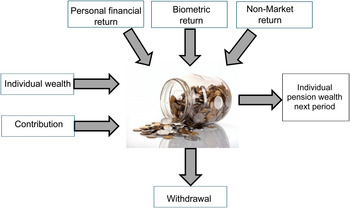
Figure 1 illustrates how a PPR works. Just as in an individual DC scheme, an individual features a personal claim on financial assets in a PPR. These assets are the property of the individual; a PPR is a personal account shielded from the investment and (dis)saving decisions of others. A PPR is a personal pension. Yet, an individual cannot freely dispose of the funds because the personal assets are earmarked for retirement income and therefore cannot be claimed for consumption before retirement. Accordingly, a PPR is a personal pension. As a third element, a PPR may include insurance of (micro and macro) longevity risk and other contracts pooling idiosyncratic risks and/or trading systematic non-financial risks. A PPR is a personal pension with risk sharing.
(Colour online) Personal Pension with Risk sharing (PPR). Source: Mehlkopf (2014).

During the accumulation phase, contributions flow into the PPR. Retirement income is drawn from the PPR during the decumulation phase. In each period, three types of returns (financial, biometric and non-market returns) add to the account. The financial assets in the personal account generate the financial returns, just as in personal DC plans. The insurance elements in the PPR yield biometric returns. These returns are conditional on idiosyncratic risks faced by the policyholder. With longevity insurance, for example, an owner who survives enjoys a positive biometric return but the assets accrue to the insurer if the owner passes away. Returns on non-market assets are generated by risk-sharing agreements within the pool written on systematic risks that are not traded on financial markets (such as (wage) inflation). Such insurance elements can but do not have to be incorporated. They can also be included at specific ages, e.g. longevity insurance can be provided only at older ages.
The following subsections discuss the insurance function involving management of idiosyncratic risks, the withdrawal function and the investment function involving management of financial risks. Subsequently, we elaborate on insuring systematic longevity risk and trading other non-market systematic risks. Finally, we explain how a PPR can optimally set withdrawals and financial investments on the basis of desired income streams during retirement.
Insurance: pooling idiosyncratic risks
The PPR combines an investment account with insurance contracts. The return on the PPR therefore depends not only on financial but also idiosyncratic risks. A PPR can include insurance of longevity risk, life, survivors and old-age care. In that case, a PPR yields a higher biometric return if the policyholder experiences these risks. This section focuses on longevity insurance.
With longevity insurance, the owner collects a biometric return if (s)he continues to live. The biometric return can thus be viewed as a bonus for staying alive. This so-called ‘longevity return’ allows a retiree to enjoy a stable retirement benefit with only a limited amount of capital. In return for this longevity return in the event the policyholder survives, the insurer collects the financial assets in the PPR in the event the owner passes away.
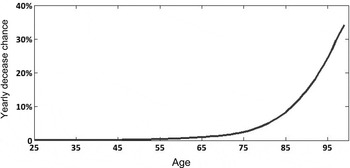
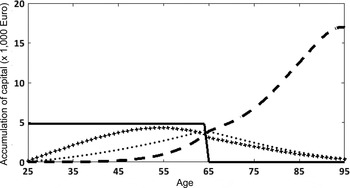
The longevity return at life is closely related to the mortality probability, and thus rises with age (see Figure 2). Indeed, the value of longevity insurance in terms of additional returns is particularly large at the end of life, when mortality probabilities become substantial. With financial returns dominating longevity returns, a PPR is mainly an investment account during the working life. In the decumulation phase, however, a PPR that includes longevity insurance becomes more of an insurance product yielding substantial longevity returns. The relative importance of the investment function versus the longevity insurance function thus shows a life-cycle pattern in a PPR with longevity insurance (see Figure 3).
Projections of mortality probabilities in the Netherlands in 2015. Source: Statistics Netherlands (CBS), 2014.

The accumulation of capital over the life cycle (in real terms). Source: Bovenberg et al. (Reference Bovenberg, Mehlkopf and Nijman2014). The accumulation of capital over the life-cycle is specified for the four components of capital. These components are pension contributions (unbroken line), real risk-free return (dotted line), risk premium (plus sign line), and biometric returns (dashed line). Computation assumes a life cycle mix in which the portfolio share of equity declines from 100% at age 25% to 20% at the retirement age of 65. The equity share remains at 20% during retirement. Biometric returns are based on mortality probabilities in Figure 2. The real risk-free interest rate equals 1% and the equity risk premium is 4%. The contribution is base is constant and equal to 24,000 euro during the working life while the contribution rate is 20%. The pay-out rule sets withdrawals such that expected real payouts are constant during the rest of life. Unexpected shocks are absorbed immediately in retirement income.

Many individuals are reluctant to insure longevity risk (Brown et al., Reference Brown, Kling, Mullainathan and Wrobel2008, Reference Brown, Kling, Mullainathan and Wrobel2013). A PPR allows a flexible design of longevity insurance during the life cycle. On one extreme, it can accommodate a drawdown strategy without any longevity insurance at all. In that case, the returns on the PPR do not depend on idiosyncratic risks affecting the owner of the PPR. To illustrate, a PPR can provide for a stable income stream during a fixed number of years irrespective of whether the owner of the PPR passes away. Alternatively, a PPR can provide a lifelong benefit without longevity insurance. This lifelong benefit will necessarily decline if the owner of the PPR becomes very old. As another possibility, an owner can buy deferred longevity insurance for the contingency that (s)he lives longer than a specified age (for example, 85) while pursuing a drawdown strategy without longevity insurance before reaching that age. In that case, biometric returns become relevant only at advanced ages.
To combat selection in longevity insurance, the insurer constrains the way the investment account is paid out. These restrictions on withdrawals become especially important at advanced ages when individuals are more likely than at younger ages to acquire information that they will soon die. For the same reason, longevity insurance demands that it is irreversible. The same holds true for survivor insurance after the survivor has reached a particular age. Otherwise, individuals with low life expectancy will reverse longevity insurance to ensure that their capital accrues to their heirs rather than to the insurer. Longevity insurance thus comes at the cost of less flexibility and liquidity, especially for older people.
Withdrawals with exogenous assumed interest rates (AIR)
The decumulation rate is the share of the personal pension account that is withdrawn at the retirement age (i.e. the age at which the individual starts to draw retirement income from the PPR). This rate is the analogue of the reciprocal of the annuity factor (or conversion rate), which converts a capital sum into a (variable) annuity. Both Assumed Biometric Returns (ABR) (based on the types of insurances taken out; in case of longevity insurance, mortality rates are relevant) and the so-called AIR determine the decumulation rate. In particular, higher ABR and AIR ceteris paribus raise the part of the capital that can be taken out at a given retirement age, and imply that market value of the PPR is enjoyed earlier in terms of retirement income (see Brown, Reference Brown2001). To illustrate, higher ABR on account of longevity insurance without survivor insurance and other bequests raise the decumulation rate. The decumulation rate is raised also by a shorter pay-out period (for example 20 years rather than lifelong). By increasing biometric returns (on the basis of higher mortality rates), a higher retirement age raises the decumulation rate of a PPR with longevity insurance.
The decumulation rate ensures that the value of the assets in the PPR is equal to the value of the ambition capital at the beginning of the retirement period. Ambition capital is the analogue of liabilities in a DB scheme. It measures the value of the current income stream on the basis of the ABR and AIR. Here we take the AIR as an exogenous variable determining the speed of decumulation. We explain below how the defined ambition (DA) approach derives the AIR endogenously from the desired properties of an income stream during retirement.
During retirement, the income stream is adjusted if the value of the assets in the PPR no longer matches the ambition capital. This mismatch may be due to the asset or liability side. On the asset side, realized financial returns may deviate from the AIR. On the liability side, unexpected changes in ABR (as a result of uninsured changes in mortality tables) or AIR (as a result of changes in interest rates, for example) produce changes in ambition capital.
In the standard Merton-Samuelson model, individuals optimally absorb the mismatch risk between assets and liability immediately in the form of a permanent change in retirement income for the rest of the pay-out period. Some individuals, however, may like to avoid large year-on-year volatility in their consumption by smoothing the adjustment of income over a longer period.Footnote 1 Smoothing of consumption adjustment is also desirable from a macroeconomic point of view.
PPR is flexible enough to allow for alternative mechanisms for absorbing mismatch through the pay-out period. One option is to absorb shocks instantaneously in accordance with the Merton-Samuelson model. In that case, the unexpected immediate adjustment of consumption equals mismatch. An alternative option is to absorb shocks gradually by permanently adjusting the growth rate of benefits during the rest of the pay-out period. In that case, shocks result in adjustments in the growth of retirement income rather than the level of current retirement income. To compute the change in the growth rate, one divides financial mismatch by the duration of the remaining income stream.
Whereas the so-called level method employs the level of the income stream to meet the budget constraint, the so-called growth rate method adopts a time-invariant adjustment of the AIR as the instrument to ensure budget balance. With adjustments in growth rates rather than levels, changes of consumption at the end of the pay-out period exceed those changes in case of immediate adjustment; larger later changes must compensate smaller immediate changes. Moreover, in case of the growth-rate method, a given mismatch results in a larger annual adjustment in retirement income if the remaining pay-out period over which the shocks can be smoothed is shorter – for example, because an individual enjoying a lifetime retirement income has reached an advanced age.
One can also employ mixtures of the level and growth-rate approaches. Another intermediate solution is to use the aspiration growth rate as the endogenous variable unless this growth rate declines to a certain minimum level. At that point, an individual either starts using the immediate consumption level to close the budget constraint or stops taking investment risk. The latter case involves a guarantee being provided, at the expense of loss of upward potential.
Financial investments
The investment strategy of a well-designed PPR balances the aim of a stable pension income during retirement and the aim of adequate expected investment returns. The hedging portfolio serves the first goal and manages income risk as a consequence of shocks in expected future returns that affect the decumulation rate. It is defined as the portfolio that hedges the impact of the tradable risk factors (such as interest rates) on the decumulation rate through their effect on the AIR. If the actual portfolio coincides with the hedge portfolio, then financial risks do not create mismatch through the liability side: changes in ambition capital are matched by changes in assets. The hedging portfolio depends on the interest sensitivity of the AIR as well as the duration of the future income flow. Since this duration declines with age, the interest sensitivity of the hedging portfolio decreases as policyholders become older.
The return portfolio is defined as the difference between the actual investment portfolio and the hedge portfolio. Shocks in the return portfolio result in financial mismatch. A return portfolio on top of the hedging portfolio can make the pension ambition more affordable and/or adequate at the expense of greater risk. The two-fund structure of the PPR with a hedge and a speculative portfolio generalizes the set-up advocated by Ambachtsheer (Reference Ambachtsheer, Bovenberg, van Ewijk and Nijman2014).Footnote 2 This two-fund structure applies in both the accumulation and decumulation phases. Adequate investment for retirement products should hedge changes in expected future returns long before retirement.
Insuring systematic longevity risk
If they insure longevity risk, individuals can insure themselves against the contingency that an entire generation lives longer than was expected when the insurance was contracted. In that case, they protect themselves against not only idiosyncratic but also systematic longevity risk (i.e. changes in life expectancy as a consequence of changes in mortality projections). Indeed, just as the hedge portfolio hedges changes in AIR (i.e. future financial returns), insuring systematic longevity risk hedges changes in ABR (i.e. future biometric returns). The insurer typically demands a risk premium for this insurance in the form of a lower biometric return. Indeed, the insurer will have to accumulate solvency buffers as collateral to make this contract credible.
The PPR allows insurance of systematic risks to be customized to personal circumstances. To illustrate, in contrast to older retirees, workers may not want to hedge systematic longevity risk because increased longevity accompanies lower morbidity and more vitality – and thus more human capital. Workers may also avoid insuring systematic longevity risk because they have to pay a higher price for this insurance; their life expectancy is more fundamentally uncertain than that of older people, while the longer duration of their longevity risk increases the risk for an insurer. As a consequence of these considerations, the optimal insurance of systematic longevity risks exhibits a life-cycle pattern.
Non-market investments
In addition to absorbing systematic longevity risk, an insurer can also absorb other systematic risks that are not (yet) traded on financial markets, such as expected (wage) inflation. These non-financial risks can be traded within the insurance pool through separate agreements. With these contracts, a PPR includes a non-market return (see Figure 1). These agreements can be viewed as non-market investments. These contracts, however, may be difficult to implement because the risks cannot be priced objectively, especially if the agreements span a long period. Moreover, since these non-market risks cannot be hedged on financial markets, an insurer may have to carry solvency buffers as collateral to ensure the credibility of these contracts.
Mutual insurers are owned by policyholders. Policyholders in a mutual insurer in effect own a non-market investment in the form of an equity claim in the mutual insurer. These instruments can be classified as being part of the return portfolio in the PPR of an individual. In that case, the business risk of the mutual insurer is distributed in the same way as financial risk.Footnote 3 Whereas a for-profit insurer may suffer from potential conflicts of interest between shareholders and policyholders, a mutual insurer has to deal with potential conflicts about the prices charged for new insurance policies between present policyholders (as owners of the mutual insurer) and new policyholders.
Defined ambition
Up to now, we have taken the AIR as an exogenous variable determining the speed of decumulation and thus the allocation of market value over time. An alternative approach is to derive the AIR and the investment portfolio endogenously from the nature of the desired income stream (i.e. the ‘liability’). We call this a Defined Ambition (DA) approach. In this approach, the income ambitions are defined in terms of a distribution with a particular (maximum) volatility and (minimal) expected growth rate (i.e. the so-called aspiration growth rate). These parameters may depend on traded risk factors (such as interest rates and inflation). The desired income stream involves also insurance aspects: should income depend on the owner or dependents being alive, for instance? Another aspect of the income stream is for how long is the income stream promised: a limited period or the rest of life? Using a financial model (involving expected rates of returns, volatilities and correlations of the various systematic risk factors) and ABR, one can then compute an efficient portfolio that replicates the desired income stream and yields the maximum AIR. The market value of the efficient portfolio then in effect values the aspired income stream.
This procedure extends the concept of liability-driven investment and market valuation of promised cash flows from guaranteed DB pensions to stochastic pensions. The market value of the desired income stream is the ambition capital. The cost of this pension ambition (‘liability’) falls (rises) with the maximum volatility of the desired income stream, the Sharpe ratios assumed in the financial model and the biometric returns (i.e. the mortality risk in case of longevity insurance). The cost rises (falls) with the aspiration growth rate and the ambitions for leaving bequests and/or insuring survivors. The relationship between the pension ambition (in terms of expected income stream and bequests), volatility and costs (AIR) captures the well-known trade-off between adequacy, safety and affordability of pensions.
The growth rate of actual retirement income develops in line with the aspired growth rate if realized returns coincide with expected returns in the financial model (and biometric returns do not deviate from expectations). Indeed, assets continue to match liabilities in the absence of unexpected shocks. If shocks are fully hedged and a return portfolio is absent, then a PPR yields a guaranteed pension if systematic longevity risks are insured and the PPR does not include non-market assets. Hence, a guaranteed pension (a DB pension) is a special case of a PPR. However, unless they are infinitely risk averse, individuals prefer to take some investment risk and systematic longevity risk in order to benefit from risk premia. Hence, a pure DB pension is not optimal. A PPR should thus optimally include a return portfolio taking rewarded systematic financial risks. It should also leave open some systematic longevity risk if insurers charge a price for insuring that systematic biometric risk.
The growth-rate method endogenously determines the aspiration growth rate from the budget constraint when individuals experience unexpected shocks after retiring. With the growth rate approach, DA schemes specify ex ante the volatility of the growth rate rather than the level of consumption. The risk premium in the endogenous term structure of the AIR then rises with the investment horizon because long-term income streams are more risky than short-run income streams. Indeed, to avoid volatile retirement income, liability-driven investment implies that the return portfolio takes less risk when individuals become older because they have a smaller remaining time horizon over which to smooth shocks. Life-cycle investment in which investment risk is reduced with age thus continues in the pay-out phase.
Alternative pension designs versus PPR
This section compares a PPR design with alternative decumulation strategies: guaranteed DB pensions, drawdown products without longevity insurance, variable annuities without smoothing and variable annuities with smoothing and dynamic investment strategies.
DB pensions
Employers in many countries are withdrawing as risk sponsors of DB schemes. One reason is that the aging of the workforce and the maturing of plans have expanded pension obligations compared with the income these firms generate. Guaranteed pay-outs have thus become more expensive for employers in that they result in more volatility in pension contributions compared with the core business of these firms. New accounting rules are also stimulating companies to no longer take pension risks on their balance sheets. These regulations disclose pension risks taken on by companies and thus reveal the substantial risks of DB obligations. Another reason why companies are no longer providing guarantees to DB plans involves the increasingly competitive and dynamic world economy. More intense competition implies that companies exhibit shorter lifespans. Firms can thus offer less long-run security to their employees. Indeed, the increased bankruptcy risk of sponsoring companies in a dynamic, more competitive economy implies that workers with DB claims are saddled with substantial credit risk. This increased counterparty risk implies that insurance of DB plans by external insurers becomes more expensive. This insurance may result in moral hazard. To combat this danger, insurance authorities have to impose onerous and rigid funding and investment rules on company pension funds.
Buying guaranteed annuities from external insurers is also becoming more expensive for employers and individuals. In the face of rising longevity, insurers are increasingly aware of the systematic longevity risk they take on in the face of rising longevity. At the same time, regulators are tightening solvency requirements. Also low interest rates raise the costs of these guarantees. In addition, individuals are concerned about the bankruptcy risk of insurers, as they have to hand over their capital to the insurer when they buy an annuity.
With a PPR, individuals can earn investment risk premia while at the same time enjoying longevity insurance. Indeed, by unbundling the investment and insurance functions, a PPR provides more flexibility to customize investment profiles in the presence of longevity insurance. Benefiting from risk premia is especially important immediately after retirement, when individuals have accumulated (and not yet decumulated) most pension wealth. A macroeconomic environment with low interest rates renders this even more important. By pooling longevity risks, managing interest-rate risks and smoothing shocks, a PPR can prevent volatility of retirement income even though individuals take on investment risks. Hence, even though employers and insurers are withdrawing as the bearers of systematic risks in DB plans, the PPR allows for stable, affordable and adequate lifelong retirement benefits by not only taking on rewarded systematic risks but also hedging and diversifying unrewarded risks.
Draw-down products without longevity insurance
Draw-down products do not benefit from longevity insurance. If individuals live longer than expected, they experience a decline in income and/or they have to rely on means-tested government benefits. Hence, individuals and the government carry idiosyncratic longevity risk. To self-insure against this risk, individuals have to accumulate substantial amounts of precautionary savings, thereby making old-age insurance expensive.
The PPR structure allows individuals to hedge their idiosyncratic longevity risks by generating substantial biometric returns if individuals happen to survive longer than average. Hence, a PPR allows for stable lifelong retirement benefits without necessitating substantial private saving or relying on means-tested public benefits, which tend to generate perverse incentives to save and work less. More generally, by unbundling the investment and insurance functions, a PPR provides more flexibility to customize insurances (such as longevity and old-age care insurance) to individual needs while individuals bear priced systematic risks. By providing old-age insurance, the private sector relieves the government from the burden of providing substantial means-tested benefits to the elderly and being the only party providing reliable old-age insurance.
Another advantage of PPR compared with drawdown products is that risk management in the accumulation phase is integrated with the goal of a stable retirement benefit as a liability. This risk management at the household level improves the risk-return trade-off: high expected returns do not necessarily lead to volatile retirement income. Indeed, by deriving the AIR endogenously from the desired risk profile of retirement income, the PPR in effect includes a hedging portfolio that hedges the risk of changes in the AIR due to changes in interest rates and possibly other traded risk factors. In this way, a PPR in effect applies ALM techniques familiar from managing the risks on the balance sheets of pension funds and insurers in DB schemes to the balance sheets of households.
Variable annuities without smoothing
Variable annuities provided by insurers are one way to reconcile old-age security and adequacy with affordability of private old-age insurance. Just as PPRs, these insurance products provide lifelong benefits with longevity insurance while at the same time taking investment risk.Footnote 4 Policyholders thus benefit from both investment risk premia and mortality credits. Unlike PPRs, however, variable annuities lack adaptable, tailor-made investment- and pay-out profiles and typically fail to integrate risk management during the accumulation phase with the goal of providing stable income streams in retirement. Moreover, without smoothing shocks, variable annuities yield consumption streams that feature high year-on-year volatility. This reduces the risk exposure that variable annuities can afford to take, especially if agents exhibit habit formation, loss aversion or money illusion. Hence, retirees cannot earn risk premia for fear of excessive volatility of their income streams.
By unbundling the investment and insurance functions, a PPR allows for more flexibility and more scope for attuning insurance to personal circumstances than variable annuities do. In particular, insurances of individual longevity, survivors and old-age care can be tailored to individual circumstances and preferences. In addition, the PPR allows shocks to be smoothed, thereby reconciling investment risk with low year-on-year volatility of retirement income.
With a PPR, the individual carries less credit risk on the insurer than in the case of a variable annuity. The financial assets of the owner of a PPR are not transferred to an insurer but remain the property of the individual. This contributes to trust and raises the demand for longevity insurance. Moreover, since insurance companies do not take investment risks on their balance sheets, solvency requirements are less strict. Indeed, by unbundling the various risks, PPRs allow solvency buffers to be tailored to the risks that insurers take on.
Variable annuities with smoothing
To prevent high year-on-year volatility, mutual insurers administering self-annuitizing group plans often smooth shocks over time through complex profit-sharing rules and collective buffers. These plans have often emerged from DB company or multi-employer plans from which employers have withdrawn as risk bearer. We call these pension plans without external risk sponsors Collective Defined Distribution (CDC). These CDC plans feature a collective asset pool that is distributed to policyholders on the basis of complex profit-sharing rules. A PPR offers important advantages to these CDC plans in terms of simplicity, transparency, and easy-to-value property rights, on the one hand, and customization to heterogeneous individual circumstances and scope for adapting to unexpected developments, on the other.
Simplicity and transparent valuation of individual property rights
In DB schemes in which employers guaranteed annuities, individual property rights in terms of an income stream (‘annuity units’) had a clear meaning for policyholders. With employers no longer bearing the risks of pension plans, however, annuity rights have become variable annuities. In particular, the annuity units typically vary with the funding rate (defined as the value of all the financial assets in the collective compared with the value of all liabilities in the pool), according to a particular distributional rule. A valuation methodology based on assumed interest rates is required to compute the value of the liabilities in this rule.
This valuation typically has no clear relationship with the true market value of risks associated with the variable annuities.Footnote 5 Hence, the purchase of new policies typically imposes external effects on existing policyholders. Moreover, discretionary changes in distributional rules yield non-transparent redistribution across policyholders. The redistribution among stakeholders associated with this opaqueness generates intergenerational conflicts and politicizes the policies of mutual insurers. Indeed, with policyholders supplying risk-bearing capital to the mutual, internal conflicts between policyholders loom – for example, about who should bear what risk at which price.
Unlike variable annuities with smoothing, the PPR allows investment risks to be combined with longevity insurance without giving rise to high year-on-year volatility in consumption streams or opaque and rigid valuation rules. In particular, a PPR defines individual ownership of financial risks in terms of easy-to-value financial assets rather than future cash flows. Transparent valuation allows for an easily understandable link between individual contributions, financial returns, individual assets and benefits. Pension contributions are paid directly into a personal account from which easy-to-value financial assets are bought. This transparency contributes to the confidence and sense of ownership of policyholders and enhances good governance. In particular, insurers can communicate ex ante about risk profiles and ex post about the difference between realized returns, the realized benchmark return and projected returns.
Clear individual property rights also facilitate the portability of pension rights. A PPR thus fits a flexible labor market with substantial labor mobility. Moreover, workers are no longer exposed to the credit risk of the employer or the discontinuity risk of their sector. Indeed, they hold a direct claim on the financial assets in their personal accounts. Discretionarily changing the AIR, for example, does not redistribute value across policyholders. Since policyholders have a claim on financial assets rather than on an insurer, insurers face fewer solvency requirements.
Customization and adaptability
The withdrawal of employers as risk bearers in DB schemes has changed the nature of risk management. Customization of risk profiles to the characteristics of the policyholder is becoming more important because heterogeneous policyholders are the risk bearers. Risk sharing in CDC schemes is guided by one funding rate, which is often based on a fixed methodology for setting the AIR in order to prevent intergenerational conflicts about the AIR. This one-size-fits-all approach does not offer much scope for customizing risk profiles and adapting these profiles to macroeconomic developments. It also leads to potential intergenerational conflicts about investment of the collective asset pool. Moreover, in order to prevent controversies about the assumed rate of return, mutual insurers often adopt a fixed risk-free nominal interest rate as AIR. This reduces flexibility further, thereby intensifying conflicts among heterogeneous policyholders about the investment policy of the aggregate asset pool.
The market valuation of financial risks in a PPR combined with the unbundling of functions allows for more instruments to tailor the investment, pay-out and insurance functions to individual needs and to adapt these functions to the macroeconomic environment. Indeed, these functions can be customized so as to optimize the trade-offs between adequacy, safety and affordability without giving rise to complexity and controversies about valuation. The market valuation also allows for pricing individual decisions properly. This provides more scope for undistorted collective and individual choice options, which do not impose externalities on others.
As regards the investment function, a PPR allows both the hedging and return portfolios to be tailored to personal circumstances, including age. In the presence of proper risk management, individualizing financial risks in the investment function of a PPR allows for better risk-return trade-offs than in variable annuities. In particular, pooling tradable, non-diversifiable risk in a collective investment pool does not generate a better return-risk trade-off than can be achieved through risk management of individually owned financial assets. At the same time, more instruments for tailoring systematic risks to individual features enhance the risk-return trade-offs. Indeed, by unbundling the investments of various policyholders, the mutual insurer prevents conflicts about investment portfolios; each generation can construct its own optimal hedge portfolio without affecting other generations. To illustrate, the hedge portfolio can depend on the duration of retirement income and thus the age of the owner of the PPR. Also the return portfolio may vary with age in line with the principle of life-cycle investment.
PPR: who does what?
The unbundling of functions in the PPR allows various players (government, social partners, other groups, employers, financial institutions, individuals) to play new roles. The transparent market-based valuation of a PPR implies that decentralized parties can make choices without imposing externalities on others. Hence, a PPR allows responsibilities to be delegated to decentralized parties, such as mutual insurers, social partners, employers and individuals.
At the same time, consistent with the subsidiarity principle, different parties can select and administer the various unbundled functions depending on the institutional structure and history of a particular country. In fact, various parties (employers, unions, organizations of self-employed, civic society, pension funds, commercial insurers, government) can play a role in deciding on a particular function – with the mix of responsibilities being different in each country, depending on its social preferences and institutions.
We can illustrate the flexibility to allocate responsibilities to various parties with the savings function. The government may set limits for tax deductible pension contributions, social partners may negotiate the choice architecture (including default contributions and employer incentives to contribute) and individual workers may opt out of (part of) these contributions. Alternatively, the government can set a minimum contribution rate (as in Australia) or it can force employers to offer a minimum default contribution rate to their workers (as in the UK). The transparent link between contributions and accrued capital in a PPR makes voluntary contributions more attractive for the self-employed, who at present often accrue substantially fewer pension rights than employees do.
PPR structures can accommodate different parties arranging risk sharing. In particular, insurance pools may be formed by commercial insurers through competition on the market for individual longevity insurance. Alternatively, social partners or professional groups can form these pools. Also the government (for example, regional governments) may play a role. The government can pool longevity risks in the decumulation phase, while the private sector manages the financial assets in PPR. The public sector then essentially acts as a mutual insurer, while individuals or collectives (for example, organized by social partners) can select asset managers and the risk profile of investments. The premium pension in Sweden comes close to this construction.
Also pay-as-you-go pensions can be organized as PPRs. Indeed, Sweden organized the accumulation phase of its NDC system this way. Contributions flow into a personal pension account with non-tradable claims on the government. This government debt yields a rate of return related to the growth rate of the premium base. If this non-tradable government debt were valued, it would become clear that part of the contributions is in fact employed to service the implicit debt in the pay-as-you-go system, due to the gift to the first generation (Valdés-Prieto, Reference Valdés-Prieto2000, Reference Valdés-Prieto, Holzmann and Palmer2006).
Our proposals for a PPR respect and accommodate corporatist pension traditions in various countries. Although in several countries employers are withdrawing as bearers of systematic risk in occupational pension schemes, they can continue to play an important role in these pensions by addressing imperfections in insurance and financial markets and behavioral issues. In other countries without corporatist traditions, in contrast, individuals can take investment, insurance and (dis)saving decisions.
Even though they no longer necessarily insure systematic longevity risk, commercial insurers can continue to play a role in pension insurance by supplying PPRs to individuals or groups. They can pool longevity risks and may insure base risk (i.e. the risk that realized mortality in the pool does not correspond to the mortality projections) or provide partial insurance of systematic longevity risks (i.e. the risk that mortality projections change).
Financial institutions administering PPR may set up pension platforms for bringing together demand and supply sides in markets for financial and insurance services. This platform involves a choice architecture for customers, endeavors to bargain on behalf of clients with suppliers about prices and ensures the quality of services provided. These are especially important services at the end of life, when people experience a loss of cognitive skills. Such services are valuable also at the beginning of the working life, however, when young workers have a low interest in pensions. Indeed, risk management on behalf of workers has become a key function now that employers and insurers are no longer bearing risks in occupational pensions.
Market structure and public regulation
Unbundling responsibilities in the PPR creates new markets, enhances competition and deepens the internal market for financial and insurance services. Moreover, it increases the scope for creating a level playing field between mutual insurers and other insurers on the insurance market, and between pension funds and other asset managers on the market for asset management. Enhanced portability of pensions implied by market valuation in PPR also enhances labor mobility.
Existing annuity products combine investment, pay-out and insurance functions in one single product. Hence, annuity markets are often non-transparent and not competitive. Indeed, a poorly functioning annuity market was an important reason for the government in the UK to withdraw the obligation to annuitize tax-privileged retirement products. More transparent longevity insurance through unbundling in PPR may stimulate the demand for longevity insurance and create more competitive insurance markets.
Public regulation should induce pension providers to communicate the ex-ante risk profile of the PPR and the realized risks (compared with the promised benchmark). Providers should communicate about not only the value of the PPR but also the projected retirement income (in terms of purchasing power), including the risks. Public supervision should ensure that actual investments are consistent with the communicated risk profiles.
To protect lifelong benefits, the government may impose ceilings on the AIR, especially for low incomes that may otherwise profit from means-tested benefits at the end of life. In this context, the government may also want to constrain the minimum retirement age (that is, the age at which the first withdrawals from the tax-privileged PPR can be made).
Conclusions
This paper proposes to structure pension products as personal pensions with risk sharing (PPRs). With adequately designed PPRs, private funded pensions can continue to supply stable lifelong retirement income even though employers and insurers are stepping back as bearers of systematic risks. In particular, individuals can benefit from both financial risk premia and additional biometric returns associated with longevity insurance, tailored to their specific circumstances. At the same time, a PPR can produce stable and secure lifetime benefits by pooling idiosyncratic longevity risk, by smoothing and customizing the exposures to systematic shocks and by conducting asset-liability risk management to hedge shocks in future returns. PPR can produce this stability without the income volatility, opaqueness and credit risk associated with variable annuities. During the life cycle of an individual, the character of a PPR with longevity insurance changes from a portable financial product during the working life to an insurance product at the end of life, when biometric returns become more important compared with financial returns.
The key to the pension innovation of PPR is the combination of two elements. The first element is unbundling the investment, (dis)saving (or drawdown) and insurance (or risk-sharing) functions of pensions. The second element is market valuation of financial risks by defining financial property rights in terms of personal investment accounts with easy-to-value financial assets. The combination of unbundled functions and market valuation of financial risks allows for tailoring systematic and idiosyncratic risks to personal features and the macroeconomic environment. This innovation also facilitates communication about risks and pensions, strengthens individual ownership, prevents conflicts of interest within an insurance pool, and facilitates portability of pensions.
The PPR combines the strengths of collective DB schemes and individual DC schemes, and avoids the opaqueness of variable annuities; in fact, individualization of financial risks protects collective risk sharing of non-financial risks. In particular, similar to DB schemes, PPRs engage in asset-liability risk management by defining ambitions for retirement income already in the accumulation phase. Moreover, idiosyncratic longevity risk may be pooled and investment risk can be smoothed in consumption. PPRs allow each collective to tailor the extent of risk sharing to specific needs and circumstances.
As in DC schemes and in contrast to variable annuities, PPRs feature transparent bookkeeping (of the link between individual contributions, financial returns and individual benefits), clear property rights based on market valuation of financial assets and adaptable investment and pay-out profiles that can be customized to individual circumstances. PPRs also allow scope for more individual choice regarding contributions (e.g. for those who are self-employed) and risk profiles. The direct link between contributions, capital and income also allows for the introduction of options to employ pension capital for other purposes (such as renovating one's home to make it more comfortable at later ages) without complex valuation.