Introduction
Patients, surgeons and hospitals are all interested in the results of surgery performed at their clinics. Questionnaires are now commonly used in the quality control of nasal surgery.Reference Rhee, Sullivan, Frank, Kimbell and Garcia 1 We use the Nasal Surgical Questionnaire (Figure 1) for ongoing evaluation of nasal septal surgery performed in our hospital.Reference Haye, Amlie, Shireyaeva and Døsen 2 The questionnaire has two versions, a pre-operative and a post-operative version. Response rates to mailed questionnaires about the results of septoplasty vary from 47 to 98 per cent.Reference Illum 3 – Reference Sundh and Sunnergren 6 Although the response rate to our mailed questionnaires is 67 per cent, we wanted to assess the influence that the non-responder ratings may have on the total result.
Nasal surgical questionnaire (pre-operative version).

We interviewed non-responders by telephone, asking them to respond orally to each of the items in the questionnaire. In addition, we sought information about the reasons for their non-response to the mailed questionnaire, and asked for suggestions for improving the questionnaire and response rate. We also wanted to determine whether the demographic characteristics of the non-responders differed significantly from those of the responders.
Materials and methods
This study was approved by the Ethics Committee of Lovisenberg Diakonale Hospital. The study population consisted of patients undergoing septoplasty, with or without surgery to the inferior concha, between April and September 2014. The post-operative version of the Nasal Surgical Questionnaire was mailed to each patient 5.5 months post-surgery, along with a pre-paid return envelope. The 1-page questionnaire contains 16 questions, with the most relevant question, regarding sense of obstruction, being at the top.
The Nasal Surgical Questionnaire (Figure 1) contains separate visual analogue scales (VAS) that assess nasal obstruction during the day, at night and during exercise. Each VAS has a 10 cm line, with the left end of the line (numbered ‘0’) representing no obstruction and the right end of the line (numbered ‘10’) representing complete obstruction. The patients are asked to rate their sense of nasal obstruction on each of the three scales with a vertical line. The score is measured in millimetres from the left-hand side of the scale. For other nasal symptoms and therapies, four-point Likert scales are used with the following response categories: none, slight, moderate, and severe/daily use. For ease of calculation, we converted this rating to a numerical value, where 0 = none, 1 = slight, 2 = moderate and 3 = severe/daily use. Questions about smoking habits and allergies are also included.
Three weeks after the post-operative questionnaire was originally mailed to patients, a second questionnaire was mailed to those who had not yet returned the first questionnaire. No questionnaire was returned because of delivery failure. Patients who did not return either questionnaire (i.e. non-responders) were contacted and interviewed by telephone 7.5–13 months post-surgery by a registered nurse experienced in interviewing patients by telephone. The interviews took place between mid-May and mid-June 2015, mostly outside of the pollen seasons. The patients were asked to respond to all items on the Nasal Surgical Questionnaire, indicating how they felt on a normal day. In the telephone interviews, the patients were asked to rate their subjective sense of nasal obstruction on a numeric rating scale ranging from 0 to 10 (0 = completely open and 10 = completely closed). The scores were multiplied by 10 for ease of comparison with VAS scores. Finally, we asked the patients for the reason they did not respond to the mailed questionnaires.
Statistical analysis
All statistical analyses were conducted using SPSS software, version 22 (IBM, Armonk, New York, USA). Descriptive statistics (means and frequencies) were used to summarise sample characteristics and questionnaire responses. Independent sample t-tests were used to compare patients who completed the mailed questionnaire (responders) with those who completed the telephone interview (non-responders) on continuous variables; the Mann–Whitney U test was used to test for group differences on ordinal variables. Chi-square tests (or Fisher's exact test when any expected cell frequencies were less than 5) were used for group comparisons on categorical variables. A significance level of p < 0.05 was used for all analyses.
Results
Septoplasty with or without surgery to the inferior concha was performed on 182 patients between April and September 2014. A total of 120 patients (65.9 per cent) returned the mailed post-operative questionnaire an average of 26 weeks (range, 24–30 weeks) after their surgery. The 62 patients who did not respond to either of the mailed questionnaires were contacted by telephone a minimum of 7.5 months after their surgery. The mean time between the operation and the telephone interview was 48 weeks (range, 37–58 weeks). We were able to fully interview 58 (93.5 per cent) of the non-responders. The total response (to either the mailed or telephone questionnaires) was 97.8 per cent.
The patients interviewed by telephone were younger than those who responded to the mailed questionnaire (Table I), but there was no difference between the groups with regard to gender, smoking habits or presence of self-reported allergy. The retrospective rating of nasal obstruction was not significantly different between the two groups based on the Mann–Whitney U test, although the Fisher's exact test indicated that the response categories were not equally distributed among the responders and non-responders (Table II).
Demographic comparisons*

* For patients who completed the questionnaire by mail (responders) or by telephone (non-responders).†Age range = 12–71 years. ‡Separate variance t-test with adjusted degrees of freedom because of unequal variances. **Indicates statistical significance (p < 0.05). SD = standard deviation; χ2 = chi-square
Retrospective assessment of nasal obstruction improvement*

Data represent percentages (and numbers) of patients, unless indicated otherwise.
* Comparisons of patients who completed the questionnaire by mail (responders) or by telephone (non-responders). †Indicates statistical significance (p < 0.05).
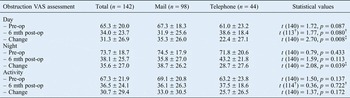
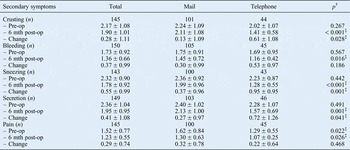
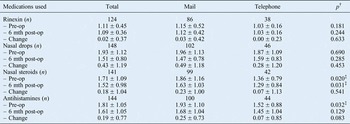
A total of 145 patients completed the pre-operative Nasal Surgical Questionnaire; however, a few items remained unanswered in some of them. The post-operative non-responders had slightly, but not significantly, lower pre-operative VAS obstruction scores and slightly, but not significantly, higher post-operative scores compared to patients who responded to the post-operative questionnaire. As a result, the differences in scores between pre- and post-operative ratings were significantly better during the day and at night among patients who had responded to the mailed Nasal Surgical Questionnaire (Table III). The non-responders had significantly greater improvements in nasal crusting, sneezing and secretion compared to the mail responders (Table IV). Medication use scores generally did not change following surgery, regardless of questionnaire presentation mode (i.e. written vs verbal) (Table V).
Pre- and post-operative vas obstruction score differences*

Data represent means ± standard deviations, unless indicated otherwise.
* Comparisons of patients who completed both the pre-operative and the six-month post-operative questionnaire by mail or by telephone (n = 142). †Separate variance t-test with adjusted degrees of freedom because of unequal variances. ‡Indicates statistical significance (p < 0.05). VAS = visual analogue scale; pre-op = pre-operative; mth = month; post-op = post-operative
Pre- and post-operative secondary symptom differences*

Data represent mean ± standard deviation values, unless indicated otherwise. Note: positive change values indicate symptom improvement; negative change values indicate symptom worsening.
* Comparisons of patients who completed both the pre-operative and the six-month post-operative questionnaire by mail or by telephone. †Mann–Whitney U test. ‡Indicates statistical significance (p < 0.05). Pre-op = pre-operative; mth = month; post-op = post-operative
Pre- and post-operative medication score differences*

Data represent mean ± standard deviation values, unless indicated otherwise. Note: positive change values indicate decreased medication use; negative change values indicate increased medication use.
* Comparisons of patients who completed both the pre-operative and the six-month post-operative questionnaire by mail or by telephone. †Mann–Whitney U test. ‡Indicates statistical significance (p < 0.05). Pre-op = pre-operative; mth = month; post-op = post-operative
We limited the number of telephone calls to a maximum of five per patient. We made a total of 108 calls, with a mean number per patient of 1.74 calls (range, 1–5 calls). The mean duration of the telephone interviews was 8.11 minutes (range, 3–12 minutes). Most of the interviews were conducted during the work day, but 10 interviews had to be carried out in the evening.
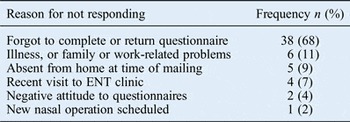
The most commonly reported reason for lack of response to the mailed questionnaire was forgetfulness (Table VI). In addition, 22 patients suggested that an electronic version of the questionnaire would increase the response rate, and 7 patients suggested a telephone option.

Some of the non-responders wanted separate VAS items for rating obstruction on each side of the nose. Twelve patients spontaneously expressed great satisfaction with the results of the operation and wanted an item added to the questionnaire in which this could be expressed.
There were also some spontaneous complaints by the non-responders. Two patients felt that the pre-operative information was inadequate. Three others complained of an unpleasant experience during the anaesthesia. Post-operative complaints were as follows: change in the sense of smell (n = 3), increased nasal dryness (n = 3), post-operative bleeding (n = 2), hospitalisation requirement (n = 1), post-operative pain (n = 3) and difficulty douching the nose (n = 2). Three patients experienced improvement in nasal obstruction during the first post-operative months, followed by later deterioration.
Discussion
In this study, patients who responded to the mailed questionnaires differed from those who did not, both demographically and clinically. The non-responders were younger than the patients who responded to the mailed questionnaires. This finding is consistent with some septoplasty studies,Reference Toyserkani and Frish 7 , Reference Croy, Hummel, Pade and Pade 8 but not others.Reference Bulut, Wallner, Plinkert, Prochnow, Kuhnt and Baumann 9 – Reference Gandomi, Bayat and Kazemei 12 In line with some studies,Reference Bulut, Wallner, Plinkert, Prochnow, Kuhnt and Baumann 9 – Reference Gandomi, Bayat and Kazemei 12 there was no gender difference in our study, although other studies have reported a higher response rate among females.Reference Toyserkani and Frish 7 , Reference Croy, Hummel, Pade and Pade 8 In some orthopaedic surgical studies, the non-responders were younger, but there was no difference in gender.Reference Solberg, Sørlie, Sjaavik, Nygaard and Ingebrigtsen 13 – Reference Nota, Stooker and Ring 15 Differences across studies may be a result of patient selection and study size.
A randomised parallel study of the different modes of questionnaire presentation (i.e. written vs verbal) might be more precise in comparing their effects, but would still leave several non-responders unaccounted for. Recalling the non-responders for a consultation visit would have been costlier and would still probably leave us with non-attenders. Our choice to use telephone interviews when the mailed questionnaires were not returned appears to have been successful; we were able to obtain adequate replies from the vast majority of non-responders.
The responders and non-responders did not differ significantly in their pre- or post-operative ratings of obstruction, but they did differ significantly in terms of improvement between pre- and post-operative scores. Scores for obstruction during the day improved by 35 points in responders and only by 22 points in non-responders. It is possible that this difference was a result of the 0–10 numeric rating scale used in the telephone interviews instead of the 0–100 VAS used in the mailed questionnaires. However, while the non-responders scored their post-operative sense of obstruction using the numeric scale, most had completed the pre-operative ratings on the printed edition of the Nasal Surgical Questionnaire and were therefore familiar with the VAS rating. We were unable to find prior studies of nasal surgery outcomes using both numeric and VAS ratings. However, there are many studies of pain intensity that used both numeric scales and VAS in parallel, and these showed a good correlation between them.Reference Bijur, Latimer and Gallagher 16 , Reference Hjermstad, Fayers, Haugen, Caraceni, Hanks and Loge 17 We therefore believe that the numeric ratings in the telephone interviews were comparable to the VAS ratings, and were an acceptable means of assessing non-responders.
Two studies investigating septoplasty results showed significant improvements in obstruction at three months, which was sustained at six months.Reference Stewart, Smith, Weaver, Witsell, Yueh and Hannley 4 , Reference Solberg, Sørlie, Sjaavik, Nygaard and Ingebrigtsen 13 Another study comparing retrospective ratings of results at six months and at three years after septoplasty showed that the initial success had deteriorated during the time interval.Reference Sundh and Sunnergren 6 We have found no data comparing results between 6 and 11 months, and cannot exclude the possibility that the difference in timing between the mail and telephone questionnaires might have influenced the results.
Some studies have shown improvement in nasal symptoms other than obstruction after nasal septal surgery. One study reported a reduction in nasal secretion and facial pain at six weeks.Reference Arunachalam, Kitcher, Gray and Wilson 18 Another described a reduction in secretion at three months, which was maintained at six months post-operatively.Reference Gandomi, Bayat and Kazemei 12 In another study, sneezing and secretion scores two years after septoplasty were reduced from pre-operative values.Reference Uppal, Mistry, Nadig, Back and Coatesworth 19 In this study, most of the other nasal symptoms were rated more positively in the telephone interviews at 11 months compared to the mailed questionnaires at 6 months. This discrepancy may be because of the differing presentation modes (i.e. written vs verbal).
We found that the post-operative use of nasal medication was similar in both groups and unchanged from pre-operative use. Stewart et al. reported that post-operative use of antihistamines and vasoconstrictive nasal sprays at three months remained the same as pre-operative use, whereas nasal steroids were used less frequently post-operatively.Reference Stewart, Smith, Weaver, Witsell, Yueh and Hannley 4 The use of nasal medication can vary for a number of reasons, and can be affected by: the post-operative time interval, the intensity of the nasal symptoms and the composition of the patient population. Thus, the use of medication may influence the post-operative ratings of nasal symptoms. In order to reduce this interference of medication, we asked the patients to answer the questionnaire by indicating how they felt on a normal day.
The main reason patients gave for not responding to the mailed questionnaire was forgetfulness. This supports the findings of an orthopaedic surgery study of non-responders.Reference Solberg, Sørlie, Sjaavik, Nygaard and Ingebrigtsen 13 Our patients suggested that an electronic option would increase the response rate. Exclusive use of electronic questionnaires in quality control of septoplasty has been in place in Sweden for many years.Reference Holmstrøm 20 However, electronic questionnaires should probably be offered as an addition to the mailed questionnaire, as response rates have been found to be lower with electronic versus mailed questionnaires.Reference Nota, Stooker and Ring 15 During the interviews, several of the patients made comments about their treatment, which gave us valuable information. Therefore, we plan to add an additional item, ‘Comments’, to our questionnaire, to give patients the opportunity to provide further information.
-
• The influence of questionnaire non-responders on septoplasty results has not previously been described
-
• Non-responders to mailed questionnaires were younger than responders, but did not differ in gender
-
• Post-operative nasal obstruction ratings obtained from mailed questionnaires (responders) and telephone interviews (non-responders) were not significantly different
-
• Non-responders had less improvement in nasal obstruction ratings after septoplasty
-
• Low response rates may bias questionnaire findings related to nasal surgery outcomes
Given that the non-responders in this study had significantly less improvement in their nasal obstruction VAS scores than the responders, conclusions based only on the ratings of responders are likely to be biased toward indicating a more positive effect of nasal surgery on obstruction, particularly when response rates are low. We have been unable to find any prior studies that investigated non-responders after septoplasty or considered the possible influence of non-response on the findings. More studies of non-response are needed to confirm our results. As we perform ongoing quality control of our septoplasty results, this bias may not pose a significant problem for comparisons of results over time, as long as the response rates remain reasonably high and do not differ substantially from month to month. However, studies with low response rates may suffer from significant non-response bias, and this should be clearly acknowledged in the study limitations.