Following the authorization of the emergency use of COVID-19 vaccines in the United States, vaccinations were primarily administered through mass vaccination clinics. However, many people who met the high-risk criteria were not able to receive vaccinations due to the same socio-economic barriers that were responsible for rapidly emerging disparities in infection and mortality rates in racial and ethnic minority populations. 1
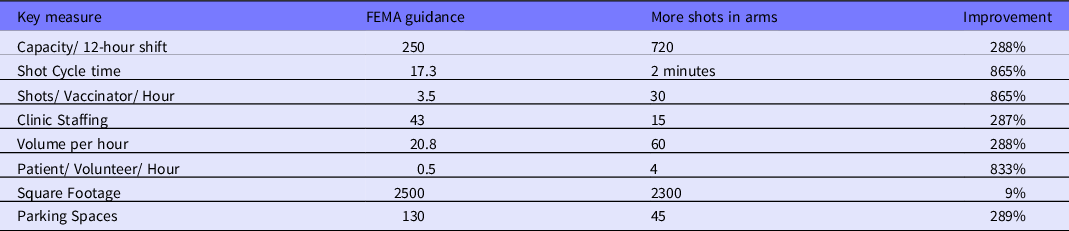
FEMA guidance, provided through the Community Vaccination Center Playbook, estimated that small vaccination clinics would require 43 volunteer staff (6 vaccinators) and 2500 sf. space to deliver 250 shots during a 12-hour clinic. 2 This equated to 17.3 minutes per vaccination. Observations of actual mass vaccination clinics in Snohomish County, WA and Olmsted County, MN validated that clinics following FEMA guidance were effective at safely delivering available vaccines, but often with inefficient and excess use of physical and human resources.
Recognizing that the resources recommended to run a mass vaccination clinic may not be available in small community-based settings, and the urgent need to optimize available resources in all settings to get ‘more shots in arms’ and help ‘flatten the curve’ of infection and mortality rates, a different approach to mass vaccination was needed.
This report from the field describes the experience of a volunteer group of continuous improvement professionals who came together to assist the COVID-19 vaccination efforts in their local communities. The report details specifics of the approach, intervention, and results of those efforts.
Method
Customer-focused approach
As a group of improvement professionals supporting small community-based clinics, we recognized the reality of the situation: our customers were under-resourced in every aspect. Solutions needed to be as close to no-cost as possible and processes needed to be portable to ‘bring’ vaccination clinics to the community. In order to support this mindset, all solutions had to pass the simple tests of spending no money, keeping people and resource needs to a minimum, and providing services in the smallest spaces possible while meeting social distancing guidelines.
Focusing on value to establish process flow
The team’s initial task was to define the process, with the goal of eliminating waste and focusing on the value-added process of administering the shot. All other activities, such as the completion of vaccination cards and patient insurance forms, were to be handled by other volunteers in the process, thereby allowing the skilled vaccinator to focus on providing the shot. To further streamline the process, an additional, medically trained volunteer role was created to assist the vaccinator. The assisting volunteer was co-located with the vaccinator and tasked with filling syringes as patients arrived. The new role reduced the overproduction of filled syringes and disposal of unused vaccines.
Pacing and balancing the work
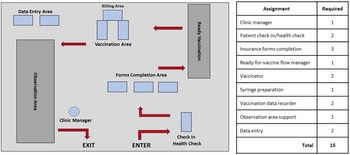
Time studies were performed once we established the delivery of the shot as the pace-setting process. The delivery of the shot consistently took 15 seconds, with changeover between patients taking anywhere from 30 to 90 seconds (based on patient mobility). With these data, the team established a target time of 2 minutes per shot, per vaccinator. This provided a safe and repeatable pace that could be maintained for the full duration of a clinic. Using this target pace, additional supporting roles were developed to define the patient and clinical process flow (Figure 1). Tasks were assigned to each role in 2-minute increments, balancing the work and time to perform each process. The additional roles included: patient check-in/health check, insurance forms completion, ready-for-vaccine station flow manager, syringe preparation, vaccination data recorder, observation area support, and clinic manager. It is important to note that patient data was collected during clinics using paper forms and data entry was completed within 48 hours by additional volunteers outside of the clinic operation.
Patient and clinical process flow.

Patient movement between roles was visually controlled by volunteer staff using a Pull System (represented by the curved arrows between process steps in Figure 1). In a pull system, a patient only moves between processes when the downstream process is ready to receive them and signals the upstream process, eliminating any queues of patients between process steps and enabling single-patient flow. Maintaining single-patient flow ensures appropriate distancing while minimizing lead-time, space, and cost.
Staffing and training to meet demand
The team was able to resource plan and establish clinic hours, based on the number of available vaccine doses. The 2-minute pace enabled the development of standardized work for each role, allowing for targeted volunteer training. The planning of expected hourly performance was based on the target of each vaccinator providing 30 shots per hour.
Establishing patient flow
With the process roles defined, the team designed a U-shaped layout (Figure 2) for the clinic that supported 3 primary goals: (1) use the smallest footprint possible while maintaining distancing, (2) single-spot, visual management of the process for the manager and team, and (3) flexibility to adapt to available space.
U-shaped vaccination clinic layout, patient flow, and staffing requirements.

Establishing an on-demand clinic
Once the pacing, standardized roles, and layout were determined, work began to make the clinics portable and replicable. This included identifying equipment needs, developing supply kits, defining the clinic set-up/tear-down procedures, and refining documentation as improvements were identified during the clinics. To keep costs low and maximize flexibility, the team utilized 5-foot folding tables and chairs. This allowed for indoor or outdoor set-up using temporary canopies. The total equipment requirement for a 60 shot per hour clinic was 6 tables, 30 chairs, and 7 canopies. The total space required to support a clinic (2300 sf.) equals approximately ½ of a regulation basketball court. The layout of the clinic was purposefully designed to be modular and scalable to meet capacity needs. Also, additional modules could be added to meet higher volumes without the need to redesign the process.
Another key aspect of quick clinic set-up and tear-down was the development of individual station supply kits that were prepared ahead of each clinic. These kits included: bandages, gloves, cotton balls, hand sanitizer, CDC vaccination cards, alcohol swabs, and other supplies to support 3 hours of vaccinations. Documented guidance on clinic set-up and tear-down was also provided.
Results
Summarized results achieved by our ‘More Shots in Arms’ community-based, pop-up clinics are presented in Table 1 below. Key results are compared to FEMA resource recommendations (and extrapolated process measures) for a fixed-site (Type 4) vaccination clinic. Our process yielded significant improvements in every measure. Notably, our value-focused approach achieved an 833% percent improvement in productivity relative to FEMA guidance. In addition, the clinic layout, standardized roles, and visual management combined to yield an overall lead time for a patient to go through the entire process, from check-in to departure, of only 23 minutes; this included the recommended observation time of 15 minutes. Each clinic can be set-up in 30 minutes, including on-site volunteer training, with tear-down taking 15 minutes.
Results comparison

Discussion
A major strength of our pop-up clinic design is that it was iteratively developed and field tested over the course of several small, community-based vaccination clinics. We believe our modular design to be effective and scalable. However, although our efforts showed that achieving 2 minutes per shot is possible, several challenges presented themselves during the team’s work in the field. Our work was impacted by existing professional/patient attitudes and an overabundance of available volunteers relative to the limited availability of vaccines.
Clinical professionals were individually accountable for documenting care provided. While this attitude enabled accurate data collection during clinics, it also proved to be an initial barrier to dividing work within the multidisciplinary team. For example, nurse vaccinators were initially resistant to divide and document tasks completed jointly with a medically trained assistant. This was addressed through process testing and shared decision making. Additionally, while the time to administer a single shot is technically less than 1 minute, it proved challenging to flow patients through the clinic at that speed. Accelerated pacing leaves minimal time for providers to educate patients or address their concerns, causing anxiety for some patients. Though achievable, reducing the pace to less than 1 minute per shot was not practical or desirable for patients or clinic staff.
Early in the pandemic, vaccine supplies were limited and volunteer support for vaccination clinics exceeded available supply. As a result, the urgency to improve the capacity and flow of vaccination clinics was diminished, despite accelerating infection and mortality rates. Contributing to this, clinic organizers needed to focus their attention on procuring vaccines for each clinic, leaving little time for resource and improvement planning. Attempts to facilitate pre-clinic education, planning discussions, or improvement simulations with clinic organizers were met with initial support, but capability to execute recommendations was limited. This underscores a need for simple and flexible guidance for vaccination clinic design and operation. With this guidance, vaccination clinics can be brought directly to smaller communities to improve access for underserved populations and help address population health disparities.
Our team recognized 3 potential limitations to the scalability of our work. First, our design had not been tested in a higher-volume vaccination clinic setting. Second, the signage and paperwork used in our community-based clinics were provided in English, and some patients needed assistance from other volunteer clinic staff or community liaisons who spoke their native language. Providing signage and paperwork at a basic reading level and in other common languages would be needed to improve scalability. Third and finally, the modular clinics were intentionally designed to be brought directly to a specific underserved community and staffed with volunteers from that same community. Offering pop-up clinics in higher-volume, more-diverse settings would require additional consideration of factors affecting access, such as advertising for broader public awareness and availability of public transportation options.
Conclusion
Our work showed that delivering vaccinations at a pace of 2 minutes per shot is achievable in small, community-based clinics. If scaled to mass vaccination clinics, it may be possible to achieve an 833% improvement in productivity, hence extending the reach of available resources. Although many states have recently discontinued mass vaccination clinics as vaccination rates declined, the need for mass vaccination clinics may return. With the evolution of new virus variants, the potential need for booster shots and the national drive to encourage everyone to get vaccinated, the results of our work remain relevant and timely. Additionally, the potential benefits of this approach deserve attention as vaccines become more available in less-developed countries.
Authors’ contribution
Each author contributed to this work as an independent volunteer, outside of any professional or academic affiliations.
Conflict of interest
The authors have no conflicts of interest to declare.