Use of live viruses in the treatment of cancer
The use of oncolytic viral immunotherapy is an emerging modality for cancer treatment. Certain viruses have innate tropism for cancer cells or can be genetically engineered to infect and, subsequently, enhance the recognition of tumor cells by the host immune system. This immune mediated tumor destruction is achieved via the induction of virus-specific antigens on tumor cells or via the increased expression of existing antigens.Reference Kobayashi1 A second and direct mechanism for a viral anticancer effect involves virus-induced cytolytic killing of tumor cells, called oncolysis. Use of oncolytic viruses in combination with other immunotherapies, such as immune checkpoint inhibitors (ICIs), has catapulted this form of treatment to the forefront of novel cancer therapeutics.Reference Desjardins, Gromeier and Herndon2, Reference Johnson, Puzanov and Kelley3 Although these advances hold immense promise, extension of infectious agents from the laboratory to the bedside invokes numerous infection prevention and control issues related to the risk of horizontal transmission of oncolytic viruses to other patients as well as the safety of healthcare workers (HCWs). These challenges mirror issues already familiar to infection preventionists, such as the use of live virus vaccines (eg, measles, mumps, and rubella—MMR) in cancer patients and other immunosuppressed populations or their household contacts.
Although the concept of viral immunotherapy dates back to the 1950s, talimogene laherparepvec (TVEC), commercially known as IMLGYIC (AmGen, Newbury Park, CA), recently became the first oncolytic viral agent approved by the FDA in the United States for the treatment of unresectable melanoma.Reference Sheridan4 Since then, a variety of viral vectors have entered clinical investigation for a broad range of indications.Reference Desjardins, Gromeier and Herndon2, Reference Puzanov, Milhem and Minor5, Reference Ribas, Dummer and Puzanov6 The re-emergence of oncolytic viruses offers a unique opportunity for infection preventionists to contribute to safe delivery of effective therapies and to further the overarching clinical and research mission of improving cancer-related survival. As these agents become ubiquitous in clinical environments, guidelines to ensure safe administration are essential.
In this review, we describe the existing data related to transmission of the first FDA-approved oncolytic viral agent, TVEC, and we draw attention to practical issues involved in its administration to patients and their ongoing care. Additionally, we describe our systematic approach to evaluating oncolytic viral clinical trials from an infection prevention perspective at Memorial Sloan Kettering Cancer Center.
Talimogene laherparepvec (TVEC)
A watershed moment for oncolytic viral vector therapy occurred in 2015 with the FDA approval of TVEC, a genetically engineered herpes simplex virus (HSV-1). Derived from a wild-type strain of HSV-1 (JS—1), TVEC was originally isolated from cold sore lesions and is indicated for the treatment of unresectable metastatic melanoma in Europe and the United States through direct injection of visible and/or palpable tumors.Reference Harrington, Puzanov and Hecht7, Reference Kohlhapp and Kaufman8 Gene deletions engineered in TVEC block antigen presentation and eliminate neurovirulence to attenuate any off-target effects. TVEC is also modified to selectively proliferate within cancer cells and to reduce infectivity in noncancer cells.Reference Conry, Westbrook, McKee and Norwood9, Reference Williams10 An important feature of the modified virus is inclusion of a GM-CSF encoding gene to evoke systemic antitumor effects and durable immune response beyond the site of injection.Reference Liu, Robinson and Han11
Despite these genetic modifications, the viral thymidine kinase (TK) gene is unchanged, preserving susceptibility to a common antiviral medication, acyclovir.12, Reference Kaufman and Bines13 Viral detection by commercially available assays also remains unperturbed due to preservation of target gene regions for these assays in TVEC. For patients with suspected infection after TVEC, commercially available polymerase chain reaction (PCR) testing for cutaneous lesions, cerebrospinal fluid, and blood may be used for viral detection, but the distinction from the wild-type virus requires specialized testing available only through the drug manufacturer.
Safety profile, viral shedding, and risk of local and disseminated infection in TVEC recipients
The foremost concern with oncolytic viral agents is the risk of uncontrolled replication in vivo and possible transmission to close contacts, other patients, and HCWs. With TVEC, initial concerns centered on the risk of developing disseminated herpes infection, including from reversion to wild-type HSV and manifesting as oral and cutaneous herpes, herpetic keratitis, herpetic whitlow, and disseminated herpes.12, Reference Hu, Coffin and Davis14–Reference Papanastassiou, Rampling and Fraser16
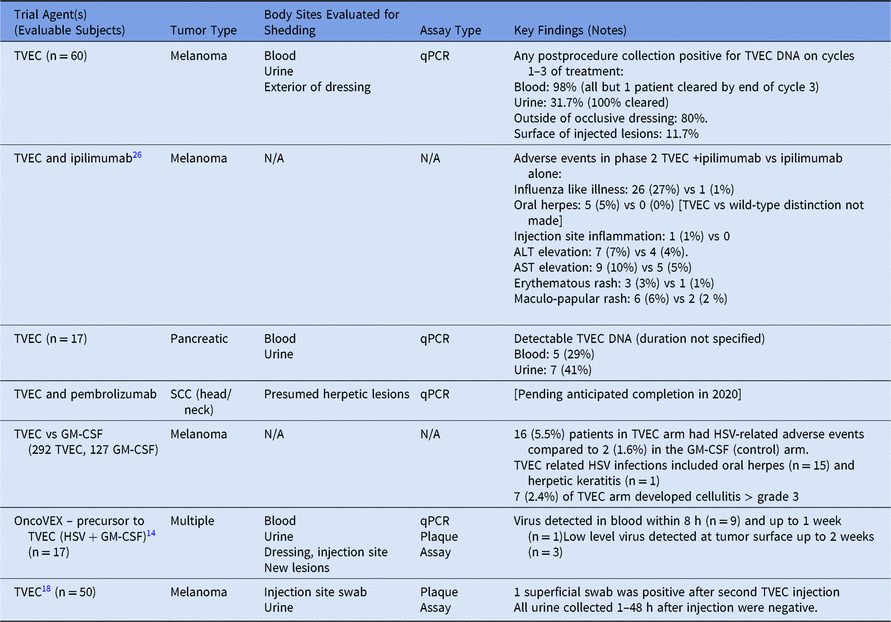
The safety of TVEC is now reported in several primary clinical trials and expanded access outcomes trials (Table 1). Overall, adverse events related to the administration of TVEC are reported to be minor and local. In phase 1 studies primarily evaluating the local administration of TVEC, the duration and intensity of local inflammatory reactions were more pronounced among HSV seronegative patients.Reference Hu, Coffin and Davis14 Peak viral recovery from blood (n = 17, 85% ) and urine (n = 4, 20%) occurred on the day of treatment and was notably absent from injection site vesicular lesions in this single study.Reference Gangi and Zager17 Phase 2 studies confirmed that HSV antibody negative patients seroconverted after treatment with TVEC.Reference Senzer, Kaufman and Amatruda18 No established cases of disseminated HSV have been reported in any patients included in the pivotal clinical trials, although FDA-mandated postmarketing evaluations are ongoing (Table 1).Reference Andtbacka, Kaufman and Collichio19, Reference Chesney, Awasthi and Curti20
Summary Viral Shedding and Safety Data Reported From Trials Involving Talimogene Laherparepvec (TVEC) as Mono- or Combination Therapy

Note. ALT, alanine aminotransferase; AST, aspartate transaminase; HSV, herpes simple virus; N/A, not available; qPCR, quantitative polymerase chain reaction; SCC, squamous cell carcinoma.
Since its approval in 2015, more than 300 cases of adverse events involving TVEC have been reported and registered in the FDA Adverse Event Reporting System (FAERS) public dashboard.21 Of these 333 cases, 121 are categorized as serious cases, including 21 deaths, but none are specified as disseminated HSV infection. A single FDA warning related to TVEC and noting concern for disseminated HSV infection was issued in 2016, but outcomes from the investigation prompted by this warning have not yet been publicly reported. An FDA-mandated postmarketing study to characterize the long-term risk of herpetic infection in TVEC-treated melanoma patients, care givers, and HCWs started in August 2017. Completion of enrollment and evaluation of this observational cohort of nearly 1,000 patients in the United States and Europe is anticipated in late 2024.
Transmission to HCWs
Limited data are available on the transmission of HSV viral infections to HCWs involved in TVEC administration or subsequent care of patients. A self-reported survey from 82 HCWs across 36 study sites with 4,100 treatment visits, reported 5 occurrences of accidental exposure to TVEC by needlestick injury or mucosal splash. The most notable among these was an HCW who developed herpetic whitlow that resolved after acyclovir treatment. Also, 2 other treatment-related exposures included an accidental needlestick during drug preparation (treated with antiviral agent) and conjunctival splash without any reported clinical consequence. None of the cases in HCWs resulted in secondary transmission. No cases of secondary or tertiary transmission from patient to HCW have been reported. Postexposure prophylaxis with acyclovir is recommended in case of accidental exposure of HCWs to TVEC, and serious disease has not been described among those exposed.
Transmission from TVEC recipient to household contacts
As part of the viral surveillance program for one of the pivotal trials, 1,217 surveillance questionnaires from 177 subjects identified 15 individuals (8.4%) who reported signs and symptoms possibly related to TVEC treatment among their close contacts.12, Reference Andtbacka, Kaufman and Collichio19 Suspected herpetic lesions among household contacts were not completely characterized as wild type versus secondary to TVEC transmission, although none of these reported events were severe.Reference Chesney, Awasthi and Curti20 The incidence of this potential risk to close household contacts is being addressed in an ongoing postmarketing trial.12
Practical concerns: Transmission from TVEC recipient to immunocompromised contacts, including HCWs
No documented transmission of HSV infection from TVEC-treated patients to other immunocompromised contacts has been reported, although studies on viral shedding indicate that there is a nonzero risk of this occurring. Pregnant patients and HCWs or those with immunocompromising conditions are precluded from receipt or direct administration of the agent and are advised caution during direct patient care due to theoretical risk of transmission of TVEC across the placenta. Pregnant HCWs are instructed not to perform dressing changes or provide direct care to patients through the duration of shedding. This recommendation is extrapolated from adverse events associated with transplacental HSV infection rather than TVEC-specific data.Reference Gangi and Zager17
TVEC: Summary and recommendations for infection prevention
At MSK, TVEC administration guidelines were developed by a multidisciplinary team of key stakeholders from infection control, nursing, oncology, and pharmacy departments after evaluating available clinical and viral shedding data from early phase trials. These data indicated that most detectable virus from evaluated sites waned by 7 days postexposure.Reference Hu, Coffin and Davis14, Reference Wall and Baldwin-Medsker22 TVEC is classified as a BSL2-level agent at MSK, in accordance with FDA guidance, and this dictates preparation and environmental management for TVEC. Agent preparation by trained pharmacy personnel occurs in a negative-pressure room biosafety cabinent (BSC) using a closed transfer system. Post preparation, the BSC is cleaned with a 2-step process including high-level disinfectant and sterile alcohol and remains unavailable for other preparations pending recommended contact time. Personal protective equipment is required for preparation and administration of the agent in agreement with BSL2 recommendations. Practically, this results in the use of gowns, gloves and eye shields for TVEC preparation and administration, which complies with the manufacturer’s prescribing information.23 Post injection, the treated site is covered with an occlusive dressing with a red alert sticker to indicate to staff that TVEC was administered. Electronic practice alerts and learning modules were developed to educate staff. Additionally, a dedicated contact isolation precaution indicator is placed in the patient’s electronic medical record, which serves to alert staff to recent treatment with TVEC and the need for contact precautions.Reference Wall and Baldwin-Medsker22 Entry and removal of the indicator is undertaken by the clinical support teams. Precautions are instituted until all lesions are healed or scabbed as determined by direct observation at follow-up or day 7 following injection of TVEC, whichever is longer.
Other investigational oncolytic viruses
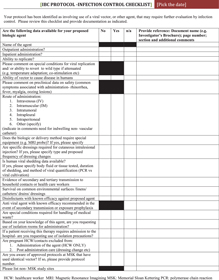
Since TVEC approval, >15 clinical protocols and 9 unique viral oncolytic agents have been evaluated for transmission-based precautions. The current process for trial evaluation evolved out of the TVEC experience and is conducted under the auspices of the Institutional Biosafety Committee (IBC), which is tasked with reviewing clinical and laboratory research protocols involving infectious agents and recombinant or synthetic DNA in accordance with National Institutes of Health (NIH) guidelines. The 3 phases of our process include (1) preapproval review, (2) operationalization, and (3) post implementation protocol audit and review (Fig. 1). Studies proposing research that includes oncolytic viral vectors, or other infectious agents, are identified in the protocol registration system and investigators are required to complete the embedded IC checklist (Fig. 2), which focuses on key IC issues such as infectivity, transmissibility, and environmental disinfection. Information reported on the checklist is reviewed and corroborated to determine infection control recommendations in partnership with the clinical study team. Finally, compliance with infection control recommendations is audited at a prespecified interval following study approval.
Infection control workflow for review of clinical trials involving potentially infectious agents.

Infection control checklist.

Discussion
The infection control approach to isolation and management of patients involved in oncolytic viral vector trials is nothing more than a refinement of everyday thinking. Even though most agents used are attenuated or conditionally replicative, the risk of transmission and its implications are not completely understood. Current challenges in developing effective guidelines for investigational agents include limited knowledge of influencing factors such as the in vivo pathogenic potential of engineered viruses, duration of viral shedding, infectivity, unpredictable control over replication competent viruses with concomitantly administered immunomodulators, and finally, the potential for regaining replication competence or wild-type reversion of engineered oncolytic viral agents. The principles articulated here are also applicable to other nonvirologic biologic antitumor therapies, such as Clostridium novyi and Listeria monocytogenes, with specific attention to individual patient risks and appropriate instiutional review board oversight.
For FDA-approved agents, the infection control community must recognize the emergence of viral immunotherapy in mainstream oncologic care and its positive impact on patient survival to develop standardized guidelines that can be broadly adopted to overcome implementation challenges across a variety of settings (eg, inpatient vs outpatient or treatment in the context of a clinical trial vs nontrial setting). Protocols established for these agents will guide institutional practices for use of oncolytic viral vectors currently in development.
The approach of embedding the role of infection preventionists within existing research regulatory structure (eg, IBC or IRB) enhances adherence to IC recommendations. Through our rigorous process of preapproval agent review, operational planning, and postapproval audit and feedback, we have been able to achieve responsible conduct of research and safe implementation of various oncolytic viral vector trials. Recent modifications to NIH oversight of human recombinant gene therapy trials, including the transfer responsibility to institutional biosafety committees, further highlights the importance of infection control oversight of oncolytic viral vector trials.24, Reference Collins and Gottlieb25
Financial support
This infection control research was supported by the MSKCC Core Grant (grant no. P30 CA008748).
Conflicts of interest
Dr Glickman is a consultant for Vedanta Biosciences. All other authors report no conflicts of interest relevant to this article.