Implications
Organic farming is an integrated system based on agroecological principles. The implementation of organic milk production is associated with many problems, especially with regard to animal nutrition under pasture conditions. Most tropical pasture areas are degraded soon after their establishment because of problems arising from incorrect management. The silvopastoral system with several herbaceous and tree species is one alternative for farmers who want to reconcile animal production and environmental conservation.
Introduction
Organic farming can be considered an integrated system that mobilises several agroecological principles (Dumont et al., Reference Dumont, Fortun-Lamothe, Jouven, Thomas and Tichit2013). In the livestock context, the International Federation of Organic Farming Association Movement (IFOAM) established the following three basic objectives for organic animal production: (i) the maintenance of biodiversity, which contributes towards increasing system resilience; (ii) the establishment of living conditions that support the natural behaviour of the animals; and (iii) the promotion of a balanced mix of crop and livestock production, leading to closed and sustainable nutrient cycles (Hovi et al., Reference Hovi, Sundrum and Thamsborg2003), and thus to a lower reliance on inputs and to reduced waste. Besides these benefits, organic agriculture is recognised as a tool to reduce the use of chemical drugs and, consequently, the dumping of pharmaceutical residues into the environment (Food and Agriculture Organization (FAO), 2000).
The implementation of organic milk production is associated with many challenges that must be overcome, especially with regard to animal nutrition under pasture conditions. Most tropical pasture areas are degraded soon after their establishment because of problems arising from incorrect management. The pasture decline is principally associated with lack of maintenance and fertilisation and excessively high animal stocking rates (Boddey et al., Reference Boddey, Macedo, Tarre, Ferreira, Oliveira, Rezende, Cantarutti, Pereira, Alves and Urquiaga2004). Advanced degradation entails a progressive reduction in herbage biomass and decreases forage CP content and digestibility, as well as dry matter intake (DMI) by the animals.
Several authors have suggested that one option for improving dairy system efficiency is the integration of pastures with tree species, including legume trees, in silvopastoral systems (SPS, Yamamoto et al., Reference Yamamoto, Dewi and Ibahim2007; Sousa et al., Reference Sousa, Maurício, Moreira, Gonçalves, Borges and Pereira2010; Paciullo et al., Reference Paciullo, Castro, Gomide, Maurício, Pires, Müller and Xavier2011). These systems have the potential to increase soil fertility, improve forage quality and animal production, promote animal thermal comfort and provide income diversification for the producer (Rozados-Lorenzo et al., Reference Rozados-Lorenzo, Gonzalez-Hernandez and Silva-Pando2007; Paciullo et al., Reference Paciullo, Castro, Gomide, Maurício, Pires, Müller and Xavier2011). There are also environmental benefits, such as biodiversity conservation (Murgueitio et al., Reference Murgueitio, Calle, Uribe, Calle and Solorio2011) and increase of the potential for sequestration of carbon, compared with treeless pastures (Andrade et al., Reference Andrade, Brook and Ibraihm2008; Schoeneberger, Reference Schoeneberger2009; Soto-Pinto et al., Reference Soto-Pinto, Anzueto, Mendonça, Ferrer and Jong2010).
Thermal comfort is especially important for European or mixed European × Zebu cattle breeds, which are more sensitive to the high temperatures of the tropics than pure Zebu breeds (Kendall et al., Reference Kendall, Nielsen, Webster, Verkerk, Litllejohn and Matthews2006; Nonaka et al., Reference Nonaka, Takusari, Tajima, Suzuki, Higuchi and Kurihara2008). When access is provided, cows readily use shade, which can alleviate negative heat load effects (Kendall et al., Reference Kendall, Nielsen, Webster, Verkerk, Litllejohn and Matthews2006; Tucker et al., Reference Tucker, Rogers and Shütz2008).
The higher nutritional value of forage grass under tree shade, resulting mainly from a higher CP content and decrease in lignification, contributes to improved animal performance (Yamamoto et al., Reference Yamamoto, Dewi and Ibahim2007; Bocquier and González-García, Reference Bocquier and González-García2010; Sousa et al., Reference Sousa, Maurício, Moreira, Gonçalves, Borges and Pereira2010; Paciullo et al., Reference Paciullo, Castro, Gomide, Maurício, Pires, Müller and Xavier2011). The use of herbaceous legumes in animal production systems may improve dietary quality and increase animal production while decreasing the input of external nitrogen fertiliser (Coates et al., Reference Coates, Miller, Hendricksen and Jones1997; Tudsri et al., Reference Tudsri, Prasanpanich, Sawadipanich, Jaripakorn and Iswilanons2001). Another advantage of herbaceous legumes is the lower seasonal variation in forage nutritional value compared with grasses, as well as higher protein contents, which can improve the quality of the diet (Klusmann, Reference Klusman1988).
The adoption of these systems is still dependent on research evaluating the factors that may influence the efficiency of different systems, including organic milk production. Therefore, the objective of this study was to compare the pasture nutritional characteristics, grazing activity and performance of dairy cows reared, during the rainy season, in two contrasting grazing systems, both cultivated according to the rules of organic milk production certification (IFOAM, 2002) and broken down as follows: (1) the SPS constituted by Brachiaria decumbens intercropped with several herbaceous and tree legume species and (2) an open B. decumbens pasture intercropped with only one herbaceous legume cultivar.
Material and methods
Location and experimental treatments
This experiment was carried out at Empresa Brasileira de Pesquisa Agropecuária (EMBRAPA) Dairy Cattle, Coronel Pacheco, Minas Gerais, Brazil, from February 2007 to June 2009. The geographical coordinates are 21°33’22’’ south latitude, 43°06’15’’ west longitude and 410 m altitude. The climate is denominated as a Cwa type (mesothermal) according to Köppen’s classification. The soil in the experimental area is classified as a red-yellow Latosol type (EMBRAPA, 1999), corresponding to Orthic Ferralsol, according to FAO (2006); it is dystrophic, with a clayey texture and wavy relief. The chemical characteristics of the soil were as follows: pH in water, 4.2; available P (Mehlich-1 method), 2.3 mg/dm3; Al, 0.91 cmol/dm3; K, 0.11 cmol/dm3; Ca, 0.53 cmol/dm3; Mg, 0.31 cmol/dm3; and organic matter, 15.5 g/kg. Weather data were collected at a meteorological station located 500 m from the experimental area. The minimum and maximum temperatures (average) and the precipitation between January and June for 3 experimental years were 17.0 ºC and 29.4ºC and 1188, 801 and 778 mm during the 1st, 2nd and 3rd years, respectively.
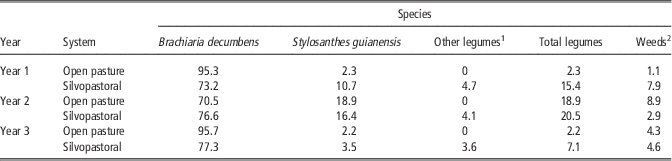
The treatments consisted of two pasture systems grazed by dairy cattle, and defined according to their botanical composition (Table 1) as (i) open pastures (OP) of signalgrass (B. decumbens Stapf. cv. Basilisk) mixed with stylo cultivar Mineirão (Stylosanthes guianensis) and stylo cultivar Campo Grande (Stylosanthes macrocephala+Stylosanthes capitata) and (ii) a SPS constituted of signalgrass, herbaceous legumes (cultivars Mineirão and Campo Grande, Pueraria phaseoloides and Calopogonium mucunoides) and tree legume species (Acacia mangium, Leucaena leucocephala and Glyricidia sepium).
Botanical composition (% of herbaceous species on dry weight basis) of organic pastures

1 Calopogonium mucunoides and Pueraria phaseoloides.
2 Several species.
Forage and tree species were seeded in November 2002 over an area of 12 ha (6 ha for each treatment). During the planting, a density of 100 trees/ha was adopted. The distance between each tree, planted in rows, was 5 m. Each row was interspersed with 20-m-wide bands of pasture.
The tree density during the experimental period (5 years after tree plantings) was estimated at 70 trees/ha because of the mortality that occurred during the establishment period (30%). The average tree heights during the experimental years were 12.0, 4.7 and 3.9 m for A. mangium, G. sepium and L. leucocephala, respectively. The shade provided by the trees averaged 19% of the full photosynthetic active radiation.
Treatments were distributed in a switch back design, to 12 cows of ½ Holstein×½ Zebu (Gir) breed, divided into two sub-groups composed of six cows each. The same cows were used throughout the experimental period, except for two cows that were replaced during the 2nd and 3rd years of the experiment. The cows had similar average days in terms of milk production (64.7±22.9; 70.0±18.6 and 51.2±14.5 in the 1st, 2nd and 3rd years, respectively). The number of lactations was 2.0±1.2; 3.0±1.3 and 4.0±1.3 in the 1st, 2nd and 3rd years, respectively, and average liveweights were 492±34, 517±41and 503±32 kg in the 1st, 2nd and 3rd years, respectively. Treatment groups were balanced on the basis of the following criteria: parity, lactation stage, milk yield and BW as recorded in the previous 2 weeks. The experimental trial was conducted during the rainy season (January to May) over 3 consecutive years. The comparison of the systems was performed during the rainy season because the arboreous legumes Gliricydia and Leucena, which are deciduous, lose their leaves during the dry period, characterised by low incidence of light and low temperatures. During the same period, pasture production is drastically reduced, requiring supplementation to dairy cows (e.g. sugarcane or corn/grain sorghum silage). Another aspect to be considered relates to thermal comfort. In the rainy season, when the potential for livestock production is higher, the level of insolation is excessive for dairy cows. Therefore, the natural shading may contribute towards maintaining the animal’s thermal comfort.
During each year, there was a 126-day experimental period divided into three periods of 42 days (14 days for adaptation and 28 days of data collection). All year round, the pastures were grazed by cows according to the initially planned management (rotational stocking method and herbage allowance between 8.0% and 9.0% of animal BW).
Pasture management
The experimental area (12 ha) was divided into two sub-areas of 6 ha, which were divided again into six 1-ha paddocks. A rotational stocking method was adopted for pasture management by using a paddock occupation period of 7 days and 35 days for resting. Water and mineral salts were provided (ad libitum) during the whole experimental period.
According to the soil analysis, 350 kg/ha of dolomitic lime, 84 kg/ha of potassium sulphate (48% K2O) and 166 kg/ha of thermophosphate (18% P2O5) were applied to the pasture areas. Lime was applied in November 2006, and N, P and K fertilisation was performed in January 2007. All these fertilisers were allowed by the organic milk production certification rules (IFOAM, 2002).
Sward measurements
In each experimental period, all the paddocks were evaluated 1 day before the entry of the cows into the paddock. As each system (SPS or OP) was composed of six paddocks, in each period of 42 days, six paddocks from each system were subjected to the measurements described.
The pasture botanical compositions were estimated by dry-weight-rank method (Jones and Hargreaves, Reference Jones and Hargreaves1979) with a metal square of 0.25 m2 (0.5×0.5 m), which was allocated according to systematic transect lines covering the entire area of each paddock (1 ha) resulting in 90 sampling points.
The dry mass was estimated during pre-grazing using the same metal 0.25 m2 (0.5×0.5 m) square at 20 randomised collection points in each paddock and forage cuts were made at 5 cm above ground level. After cutting, samples were weighed and hand-split into live and dead material. Each component (live and dead) was dried separately in a forced-draught oven at 55°C until it reached a constant weight, and the herbage mass (live material), dead material and total dry mass were measured.
For nutritive value determinations, samples of signalgrass, stylo cultivars, C. mucunoides and P. phaseoloides were manually collected over the proposed post-grazing height of 20 cm. The forage samples from each species were weighed, pre-dried in a forced air circulation oven at 55°C, ground in a Wiley mill equipped with a 1 mm mesh screen, and stored in labelled plastic containers for laboratory analyses. The following methods were used for chemical analysis: dry matter (DM) was obtained after oven drying at 105°C, ash at 600°C for 2 h and CP contents were analysed following the Kjeldahl procedure described by the Association of Official Analytical Chemists (2009) and calculated as N×6.25. NDF was assayed using the procedure described by Van Soest et al. (Reference Van Soest, Robertson and Lewis1991) without the use of α-amylase. NDF was expressed inclusive of residual ash. The in vitro dry matter digestibility (IVDMD) was obtained according to the procedures described by Tilley and Terry (Reference Tilley and Terry1963).
DMI
An intake trial was performed during the first 2 experimental years. The cows were not supplemented during the experimental period. Faecal production (FP) was estimated using chromic oxide (Cr2O3) as an external marker at the rate of 10 g/animal per day, which was orally administered in paper-wrapped form with the aid of a speculum over a period of 12 days (in two doses of 5 g each, immediately before milking time). Faeces were collected directly from the rectum twice a day from the 6th to 12th day during the chromium administration period. Daily animal faecal samples from each period were pooled for analysis. Each sample was dried at 65°C, ground through 1 mm sieves and submitted for digestion by nitro-hydrochloric acid following the methodology proposed by Kimura and Miller (Reference Kimura and Miller1952). After chemical digestion, chromium (Cr) was determined by atomic absorption spectroscopy. FP was then calculated using the following formula:
 $${\rm FP}={\rm Cr \ dose}\,\left( {{\rm g}/{\rm day}} \right)/{\rm Cr \ in \ the \ faecal \ DM}\,\left( {{\rm g}/{\rm kg}} \right).$$
Daily DMI was estimated using the following formula:
 $${\rm DMI}\,\left( {{\rm g}/{\rm day}} \right)={\rm FP}/\left( {{\rm 1}{\minus}\left( {{\rm digestibility}/{\rm 1}00} \right)} \right).$$
The digestibility of overall diet was evaluated using the Tilley and Terry (Reference Tilley and Terry1963) method. The plants were sampled by hand-plucking (four samples per paddock), which was carried out by three visually trained technicians, over the entire experimental period, simulating a cow’s grazing. The grazing behaviour of the animals was observed during sample collection after prior familiarisation.
Grazing activity and milk production
Grazing activities were evaluated during the 1st year of the experiment. One paddock per treatment was randomly selected to monitor feeding behaviour. This evaluation was performed on the 1st and 7th days of paddock occupation, for a total of 6 days of data collection. Observations of grazing activities began after the morning milking (0600 h) and ended at ∼1800 h, for an average of 12 h per day. The scan-sampling behaviour method (Setz, Reference Setz1991) was performed every 10 min by two observers in each paddock. For each animal, the time spent in grazing, ruminating and idling was measured and this time was transformed as a percentage of time spent by animals in executing each activity per day.
Cows were milked twice a day (0600 and 1500 h), and individual daily milk production was measured after the morning and afternoon milkings. The correction of milk production to 4% fat was made according to National Research Council (NRC) (2001).
Statistical analysis
A variance analysis of non-transformed data was performed using the MIXED procedure (Statistical Analysis Systems Institute, 2001), which is specific for measurements repeated over time (experimental years) and also for when time is a factor and a potential cause of variation. For data relating to the pasture (herbage mass and nutritive value), the paddock was considered as the statistical unit, with four paddocks of each system used as replicates. The effects of pasture system, year and their interactions were treated as fixed effects. The switch back design was applied to examine the pasture system effects on DMI and milk production data (ANOVA). Pasture systems, cow activity periods and interactions were treated as fixed effects and the experimental error was considered as a random effect.
Grazing activities (time spent grazing, ruminating and idling) were recorded during the 1st experimental year. With respect to the pasture system effects on the time spent on different activities, the data were relativised (as the percentage of total observation time) and analysed by considering the day of measurement (1st or 7th).
The estimated averages from the least square means option were compared by the Tukey’s test at a probability level of 5%.
Results
Botanical composition
During the 1st year, the botanical composition of the OP was undiversified and characterised by a small number of forage species, with a high proportion of signalgrass and a low proportion of legumes (Table 1). The SPS presented at least three legume species. It should also be noted that legume trees were not included in estimates of botanical composition, because tree foliage was out of reach. During the 2nd year, there was an increase in stylo abundance in both systems, although the more pronounced increase occurred in the pasture without trees. During the 3rd year, stylo biomass was reduced in both systems. The proportion of other herbaceous legumes in the SPS remained fairly constant over the experimental period (Table 1).
Herbage mass, forage nutritional quality, stocking rate and milk production
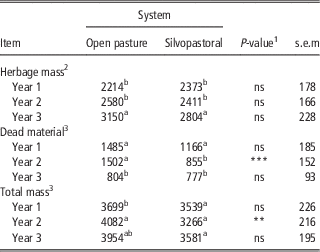
Herbage mass did not vary with system or with the statistical interaction between the system and year (P>0.05), but it was influenced (P<0.05) by the experimental year, with the highest values recorded during the 3rd year. The dead material and total dry mass were affected (P<0.01) by interactions between the system and year. OP values were higher compared with the SPS in the 2nd year, but similar results were found for the 1st and 3rd years (Table 2).
Herbage mass, dead material and total mass (kg DM/ha) in open pasture and silvopastoral system, according to experimental year

DM=dry matter.
a,bLowercase letters were used to compare the effect of year within system, for each characteristic. Means followed by different letters differ at P<0.05.
1 Probability of significant effect due to system (**P<0.01; ***P<0.001).
2 Significant year effect (P<0.01).
3 Significant year×system effect (P<0.05).
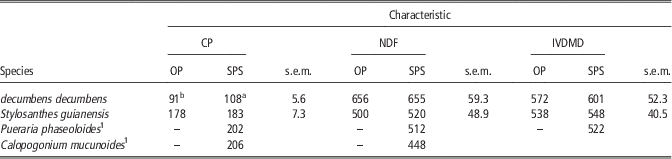
The CP content of signalgrass in the SPS was higher than that in the OP (P<0.05), and was not affected (P>0.05) by the year and system/year interaction (Table 3). The NDF content and IVDMD coefficient of signalgrass were similar for both treatments, reaching means of 656 and 587 g/kg DM, respectively. The stylo CP, NDF and IVDMD were not influenced (P>0.05) by grazing system. The other two herbaceous legumes (C. mucunoides and P. phaseoloides) were present only in the SPS, and showed a high nutritive value based on levels of CP and NDF contents (Table 3).
CP, NDF and IVDMD of forage species (g/kg DM) in OP and SPS

IVDMD=in vitro dry matter digestibility; DM=dry matter; OP=open pasture; SPS=silvopastoral system.
a,bDifferent superscripts in the same row, for each characteristic, indicate a statistical difference (P<0.05).
Values represent the average of 3 years.
1 Species present only in the SPS.
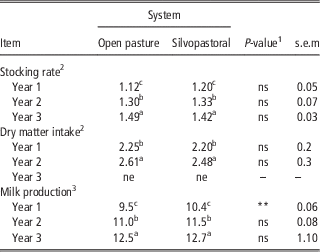
Stocking rate and DMI did not vary (P>0.05) for either system or interaction, but they were influenced (P<0.05) by year (Table 4). An increasing value for the stocking rate was observed throughout the experimental years and the DMI (not evaluated in the 3rd year) was higher (P<0.05) in the 2nd compared with the 1st year.
Stocking rate (AU/ha), dry matter intake (kg DM/100 kg BW) and milk production (kg/cow per day) in organic pastures, according to production system and experimental year

AU=animal unit (450 kg liveweight); DM=dry matter; ne=not evaluated.
a,bLowercase letters were used to compare the effect of year within system, for each characteristic. Means followed by different letters differ at P<0.05.
1 Probability of significant effect due to system (**P<0.01).
2 Significant year effect (P<0.01).
3 Significant year×system effect (P<0.05).
Milk production was affected by the year (P<0.05) and by interactions between the system and year (Table 4). During the 1st year, milk yield was higher in the SPS than in the OP. During the 2nd and 3rd experimental years, milk production did not vary according to grazing system. In both systems, it increased between the 1st and the 3rd year.
Grazing activity
The percentage of time spent grazing, ruminating and idling during daylight were 75, 65; 10, 17; and 8, 13 for OP and SPS, respectively. Differences were significant (P<0.05).
Discussion
Botanical composition
The proportion of stylo in the pasture areas increased from the 1st to the 2nd year and markedly decreased from the 2nd to the 3rd year. The increase in stylo population could be related to an intensive spittlebug (Mahanarva fimbriolata) attack on signalgrass, which occurred at the beginning of the 2nd year. This attack reduced the regrowth of signalgrass and consequently allowed for better legume development due to the low competition between grass and legume. The reduced stylo population during the last year in comparison with the first 2 years, however, suggests a low inter-annual stability when intercropped with signalgrass. Through visual observations, it was possible to verify that stylo was the principal legume grazed by cows during the experimental period. In fact, stylo is part of the cattle diet throughout the year (Aroeira et al., Reference Aroeira, Paciullo, Lopes, Morenz, Saliba, Silva and Ducatti2005) and contributes to increased animal production in tropical regions (Coates et al., Reference Coates, Miller, Hendricksen and Jones1997). Stylo plants that escaped grazing completed their life cycle until the end of the 2nd experimental year. The literature reports a low natural seeding capacity for stylo, especially for the Mineirão cultivar (Aroeira et al., Reference Aroeira, Paciullo, Lopes, Morenz, Saliba, Silva and Ducatti2005). There were thus few seeds available to increase the population of ‘new plants’ for the subsequent rainy season, explaining the strong reduction in the stylo abundance during the 3rd year. In addition, the highly competitive (good tolerance to drought and high annual seed production) potential of B. decumbens contributed to the reduced stylo abundance in the pasture (Coates et al., Reference Coates, Miller, Hendricksen and Jones1997) during the 3rd year, when precipitations were lower.
The low natural seeding of stylo cultivar ‘Mineirão’ associated with its good acceptability and the higher growing capacity of signalgrass may threaten the adequate balance of grass/legume under grazing conditions. However, the persistence of herbaceous legumes under grazing in tropical conditions could be improved by using adapted species or cultivars that have high annual seed production. Olanite et al. (Reference Olanite, Tarawali and Akenova2004) suggest that additional studies will be needed to further assess the promising species over an extended period under normal grazing, especially to ensure that the legume–grass balance can be maintained. C. mucunoides and P. phaseoloides have low palatability (Kretschemer and Pitman, Reference Kretschemer and Pitman2001) and were least consumed by animals, which could explain their relative stability over the 3 experimental years.
Herbage mass, DMI and stocking rate
Similar herbage mass between the two systems indicates that the shade provided by trees in the SPS did not affect pasture growth. The similarity in dead material, especially during the 1st and 3rd years, confirms the lack of shading effect on pasture biomass. Several studies have shown that herbage production is not affected or is slightly decreased under shade percentages of up to 30% to 40%, as long as the forage species has some tolerance to shade (Devkota et al., Reference Devkota, Kemp, Hodgson, Valentine and Jaya2009; Paciullo et al., Reference Paciullo, Castro, Gomide, Fernandes, Rocha, Müller and Rossiello2010; Sousa et al., Reference Sousa, Maurício, Moreira, Gonçalves, Borges and Pereira2010 and Reference Paciullo, Castro, Gomide, Maurício, Pires, Müller and Xavier2011). The tolerance of B. decumbens for moderate shade is the result of morphological and physiological adaptations leading to light acclimation. Increasing the concentration of leaf chlorophyll, the specific leaf area, the leaf elongation rate and the aerial/root ratio (Cruz, Reference Cruz1997; Dias-Filho, Reference Dias-Filho2000; Cavagnaro and Trione, Reference Cavagnaro and Trione2007) are the main morphophysiological adaptations responsible for the increased photosynthetic capacity and DM production under moderate shade (Paciullo et al., Reference Paciullo, Castro, Gomide, Fernandes, Rocha, Müller and Rossiello2010; Sousa et al., Reference Sousa, Maurício, Moreira, Gonçalves, Borges and Pereira2010).
A comparison among years demonstrated a greater herbage mass in the 3rd year, in relation to the 1st and 2nd years, which allowed an increase in the animal stocking rate during the 3rd year. The stocking rate data varied from 1.12 to 1.49 AU/ha, providing an herbage DM allowance between 8.7% and 9.0% of the animal BW. These herbage allowance levels were at least threefold higher than the DMI required for lactating cows (DMI of 2.5% of BW/animal; NRC, 2001). Therefore, no restriction on the DMI by grazing animals was observed, and intake levels allowed maximum daily milk yield per cow according to forage quality. In addition, the range of intake values estimated in the studied systems (2.20% to 2.61% of BW or 11.0 to 13.1 kg of DM/cow per day) was close to the value suggested by the literature in tropical forages. Intake values from 2.3% to 2.7% of BW or from 11.6 to 13.8 kg/cow per day were indeed observed in B. decumbens, B. brizantha and Pennisetum purpureum pastures (Aroeira et al., Reference Aroeira, Lopes, Deresz, Verneque, Dayrell, Matos, Vasquez and Vittori1999; Gomide et al., Reference Gomide, Wendling, Bras and Quadros2001; Fike et al., Reference Fike, Stapies and Sollenberger2003) grazed by crossbred lactating cows.
There were similarities in herbage mass, stocking rate and DMI between the two grazing systems, as well as for attack of spittlebug. Although the diversification of species is interesting for increasing the resilience of the system, the large number of species in the SPS was not enough to prevent the damage imposed by pest attack. In fact, the large amount of natural enemies in SPS (Auad et al., Reference Auad, Resende, Silva and Fonseca2012), mainly those that are predators of spittlebug, could improve the degree of resilience of SPS in the long term.
Nutritive value
The higher nutritive value of forage legumes compared with most forage grass is one of the great advantages of including these species in animal production systems. Here, the high CP (ranging from 17.8% to 20.6%) and the low NDF (ranging from 44.8% to 52.0%) of legumes represented an advantage to the SPS because of its higher legume abundance in the pasture, especially during the 1st year.
The higher CP content of B. decumbens in the SPS compared with that in OP also contributed to the better nutritive value of forage in the SPS. Previous studies have shown that shade in the SPS can increase pasture CP content (Yamamoto et al., Reference Yamamoto, Dewi and Ibahim2007; Sousa et al., Reference Sousa, Maurício, Moreira, Gonçalves, Borges and Pereira2010; Paciullo et al., Reference Paciullo, Castro, Gomide, Maurício, Pires, Müller and Xavier2011), and several hypotheses have been advanced to explain this effect. Wilson (Reference Wilson1996) attributed this phenomenon to increasing organic matter degradation and nitrogen recycling in the soil under shady conditions. In this context, the high CP contents in the pasture could be associated with an increased flow of nitrogen into the soil, especially when the tree component consists of legumes with the potential for biological nitrogen fixation (Sierra et al., Reference Sierra, Dulormne and Desfontaines2002). Sousa et al. (Reference Sousa, Maurício, Moreira, Gonçalves, Borges and Pereira2010) discussed a mechanism related to a delay in the ontogenetic development of plants cultivated under more intense shade. In this case, grasses tended to be physiologically younger, which prolongs the juvenile vegetative phase and allows for the maintenance of higher metabolic levels for a longer period of time. Furthermore, the increased CP in shaded plants could be associated with reduced cell size as caused by the shade. Kephart and Buxton (Reference Kephart and Buxton1993) speculated that the reduced cell size, along with a constant quantity of N per cell, may have a concentrating effect.
Although the CP concentration of B. decumbens was higher in the SPS relative to OP, the NDF contents were similar in both systems (Table 3). Similar results have been reported in previous comparisons of SPS with OP (Kallenbach et al., Reference Kallenbach, Kerley and Bishop-Hurley2006; Paciullo et al., Reference Paciullo, Castro, Gomide, Maurício, Pires, Müller and Xavier2011). Sousa et al. (Reference Sousa, Maurício, Moreira, Gonçalves, Borges and Pereira2010) reported the same values of NDF and ADF for pastures submitted to shade or in full-sun condition. In the present study, 19% average shade was not enough to change ADF fraction, and consequently the average cell wall constituents of the forage.
The increased CP content in the SPS pasture had no effect on IVDMD. This confirms results from previous studies investigating the effect of shade on IVDMD (Samarakoon et al., Reference Samarakoon, Wilson and Shelton1990; Sousa et al., Reference Sousa, Maurício, Moreira, Gonçalves, Borges and Pereira2010). However, under the same growing conditions, shade increased the IVDMD of Setaria sphacelata and decreased that of Panicum maximum (Deinum et al., Reference Deinum, Sulastri and Seinab1996). Senanayake (Reference Senanayake1995) reported that the IVDMD of four forage grasses was reduced under intense shade (28% light transmission), but was increased under moderate shade (64% light transmission) relative to the full-sun condition. The different grass responses, in terms of IVDMD results, most likely vary according to shade percentage differences, forage species and weather conditions (Samarakoon et al., Reference Samarakoon, Wilson and Shelton1990).
Grazing activity and milk production
The higher grazing time in OP was most likely explained by the lower CP content of herbage, which was compensated by selective grazing by the animals and thus longer grazing duration (Olivo et al., Reference Olivo, Charão, Ziech, Rossarolla and Moraes2006; Baliscei et al., Reference Baliscei, Souza, Barbosa, Cecato, Krutzmann and Queiroz2012). The results indicated that higher idling time in the SPS may reflect benefits from the shade of trees during daylight.
In tropical conditions, a lower forage nutritive value is the main factor limiting milk yield (Stobbs, Reference Stobbs1975). Daily milk yield (range of 9.5 to 12.7 kg/cow per day) is within the range reported in the literature from grazing experiments with tropical forages and crossbred cows. Aroeira et al. (Reference Aroeira, Lopes, Deresz, Verneque, Dayrell, Matos, Vasquez and Vittori1999) reported average milk yield of 11.4 kg/cow per day for cows grazing on elephant grass (P. purpureum). Henning et al. (Reference Henning, Barnard and Venter1995) observed values of 10.1 kg/cow per day in a Kikuyu pasture (Pennisetum clandestinum). For Brachiaria spp., the performance of crossbred cows varied from 9.8 to 14.4 kg/cow per day, according to management (Lopes, Reference Lopes2008).
The legume trees were out of reach and could not be directly browsed by the animals, but provided shade. Great productivity has been reported in intensive SPSs with Leucaena planted at high densities (10 000 plants/ha), which can be directly grazed by livestock (Murgueitio et al., Reference Murgueitio, Calle, Uribe, Calle and Solorio2011). In terms of productivity, the results have indicated high carrying capacity (4.3 cow/ha) and milk production (16 000 l/ha per year) (Murgueitio et al., Reference Murgueitio, Calle, Uribe, Calle and Solorio2011). Here, the improved herbage quality in the SPS was probably good enough to reach the animal genetic potential. However, the carrying capacity was lower than that reported by Murgueitio et al. (Reference Murgueitio, Calle, Uribe, Calle and Solorio2011).
Milk yield was higher in the SPS than in OP during the 1st year, but was similar in subsequent years. Herbage biomass and DMI were similar between the two grazing systems. The high percentage of herbaceous legumes with a high CP content most likely had a positive impact on the nutritional quality of the diet from the SPS. Aroeira et al. (Reference Aroeira, Paciullo, Lopes, Morenz, Saliba, Silva and Ducatti2005) concluded that legume intake by cows grazing Brachiaria intercropped with stylo improved diet quality throughout the year. In fact, the evidence indicates that the contribution of legumes to the ruminant diet results in higher cattle performance on mixed forages compared with those grazing on grass only (Tudsri et al., Reference Tudsri, Prasanpanich, Sawadipanich, Jaripakorn and Iswilanons2001). This hypothesis can be further supported by the similarity in milk production between pastures during the 2nd and 3rd years, when differences in legume abundance between the two systems were reduced (Table 1).
Second, the CP in B. decumbens from the SPS was 18.7% higher than that from the OP (Table 3), which could also make an important contribution to the better nutritive value of forage ingested by cows. In a similar study, Paciullo et al. (Reference Paciullo, Castro, Gomide, Maurício, Pires, Müller and Xavier2011) concluded that a 13% increase in the CP content of B. decumbens in SPS compared with OP was sufficient to increase liveweight gain of dairy heifers by 17% during the rainy season.
Improvements in the CP of pasture material constitutes one of the major advantages of SPSs for animal production in the tropics compared with grazing systems based on grass monocultures. Therefore, both the diversification of herbaceous species, with its associated grasses and legumes, and the introduction of tree legumes in pastures are important strategies that should be adopted by organic milk producers. The persistence of herbaceous legumes under grazing tropical conditions could be improved by using adapted species or cultivars that have high annual seed production.
Acknowledgement
The author thanks FAPEMIG for partial funding of this research.