Take-Home Points
▪ The new DSM 5 (Diagnostic and Statistical Manual of the American Psychiatric Association, 5th edition) is an update of the diagnostic system for mental illnesses based on symptoms chosen by votes of experts.
▪ The DSM “categorical” approach organizes psychiatric illnesses as collections of symptoms to facilitate making clinical diagnoses that are descriptive and reliable, but not predictive of treatment response nor linked to neurobiology.
▪ Recognizing that most psychiatric symptoms do not respect the DSM categories, a new approach to classifying mental illnesses, known as Research Domain Criteria (RDoC), organizes psychopathology as a set of symptom domains that cut across numerous DSM 5 psychiatric disorders and attempts to link these domains to malfunctioning brain circuits.
▪ Theoretically, centering psychiatric diagnoses on brain circuits will allow symptom domains to be tracked upstream to critical clinical features, such as treatment response, and downstream to the genetic, molecular, and cellular factors that regulate information processing in those circuits.
With the recent publication of the DSM 5 (Diagnostic and Statistical Manual of the American Psychiatric Association, 5th edition),1 a fresh round of criticism of this nomenclature and of psychiatric disorders in general comes forth, as it does every time a new edition is published. This criticism ranges from “disease mongering” and inventing new illnesses while pathologizing normal behavior (especially in children), to conflicts of interest and the notion that the DSM is a political or commercial but not a scientific document. Although many criticisms have merit, the field of mental health is better off having a common vocabulary with reliable descriptions of psychiatric syndromes than to have a nosologic free-for-all by every mental health professional's idiosyncratic use of terms.
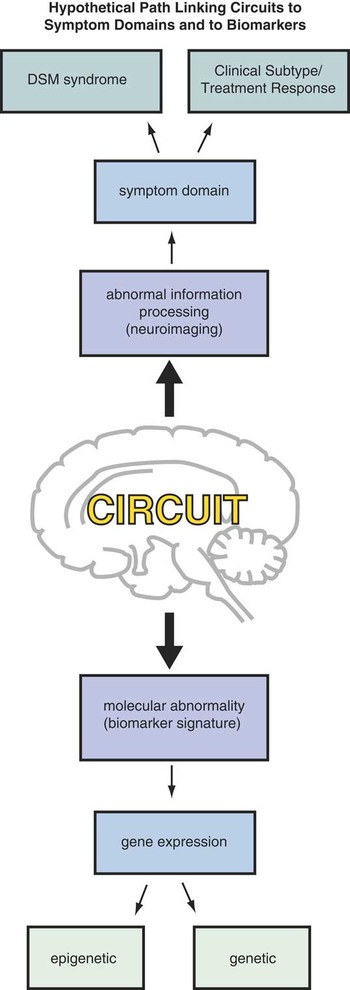
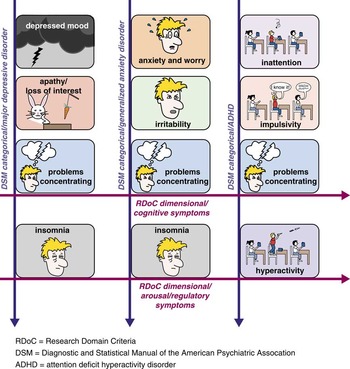
Unlike previous editions, with the publication of DSM 5,1 there may never be a DSM 6, since this document will not stay on the shelf until another revision is undertaken in another 30 years, but is foreseen as a living document with frequent iterative updates. The vision for where this is headed is foreshadowed by the RDoC project,Reference Insel, Cuthbert and Garvey2 where psychiatric symptoms are linked both downstream to brain circuits and the molecules, genes, and neurobiology that regulate them, as well as upstream to diseases with shared pathophysiologies, and treatment responses rather than to syndromes with shared symptom clusters (Figure 1). That is, we are aiming to go from categorical to dimensional (Figure 2).
Pathways from circuits upstream to clinical features and downstream to molecular and genetic regulation.

Diagnostic criteria for mental illnesses: from DSM categorical to RDoC dimensional. DSM = Diagnostic and Statistical Manual of the American Psychiatric Association, RDoC = Research Domain Criteria, ADHD = attention deficit hyperactivity disorder.

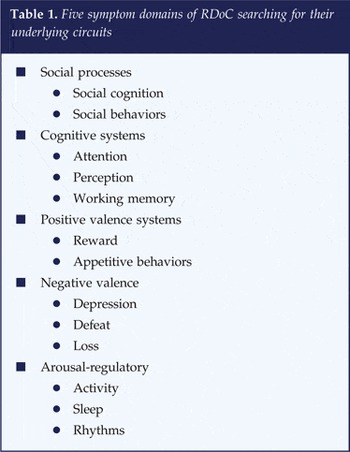
The current DSM is categorical (down/vertical arrows in Figure 2); i.e., it clusters together symptoms into syndromes that we now call psychiatric disorders, whereas RDoC is dimensional (horizontal arrows in Figure 2; see also Table 1), taking a key domain of psychopathology, quantitating its magnitude or severity, and attempting to develop biomarkers so that dimensions become reliable, measurable, and valid in clinical practice. This is what the geneticists and neurobiologists want, since biomarkers such as gene variants and brain circuit abnormalities expressed as inefficient information processing appear to correlate much better with a symptom domain (e.g., horizontal cognition in Figure 2) than with a psychiatric syndrome (e.g., vertical DSM major depressive disorder in Figure 2).Reference Stahl3
Five symptom domains of RDoC searching for their underlying circuits

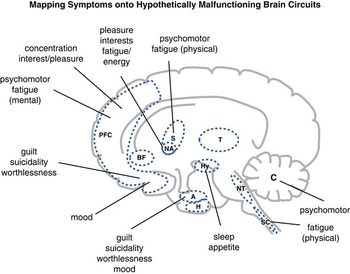
Already, rudimentary “symptom maps” are being proposed based on neuroimaging findings from living patients with symptom domains whose circuits are “stress tested” with provocative stimuli, such as mental calculations, exposure to scary faces, or tests of impulsivity (Figure 3) (e.g., reviewed by StahlReference Stahl3, Reference Stahl4). The hope is that the DSM, over time, will be replaced by a brain-circuit and biosignature-based classification of mental disorders that will facilitate reorganization of psychiatric disorders from their current status of categorical syndromes into psychiatric diseases with known pathophysiologies and much enhanced treatments.
Mapping symptoms onto hypothetically malfunctioning brain circuits. A = amygdala, BF = basal forebrain, C = cerebellum, H = hippocampus, Hy = hypothalamus, NA = nucleus accumbens, NT = monoamine neurotransmitter centers, PFC = prefrontal cortex, S = striatum, SC = spinal cord, T = thalamus.

Stephen M. Stahl, MD, PhD is an Adjunct Professor of Psychiatry at the University of California, San Diego School of Medicine, Honorary Visiting Senior Fellow at the University of Cambridge, UK and Director of Psychopharmacology for California Department of State Hospitals. Over the past 12 months (January 2012–January 2013). Dr. Stahl has served as a Consultant for Avanir, Biomarin, Forest, Genentech, Genomind, GSK, Jazz, Merck, Navigant, Novartis, Noveida Health, Otsuka, PamLabs, Reviva, Shire, Sunovion, Teva and Trius. He has served on speakers bureaus for Arbor Scientia, Genomind, Janssen, Lilly, Neuroscience Education Institute, PamLabs, Pfizer and Sunovion; he is a board member of RCT Logic and GenoMind and he has received research and/or grant support from Avanir, Cenerex, Dey Pharma, Eli Lilly, Forest, GenoMind, Mylan, Otsuka, PamLabs, Servier, Shire, Sunovion and Takeda.