Introduction
Religion, defined as a social network in which its members share a common cultural environment and social rules, exercised a strong influence over pre-industrial societies and still now continues to shape social behaviour as well as cultural, economic and political factors (McGregor & McKee, Reference McGregor and McKee2016; Peri-Rotem, Reference Peri-Rotem2016; Naveed & Wang, Reference Naveed and Wang2018). Religion can strongly influence its members’ sexual behaviour and, as a result, their reproduction and fertility (McQuillan, Reference McQuillan2004; Moreau et al., Reference Moreau, Trussell and Bajos2013; Quiamzade et al., Reference Quiamzade, Sommet, Burgos Laborde, L’Huillier and Guiso2017). Abstention from premarital sexual activity, monogamy or limitations on divorce possibilities are some of the most common controls that religions exert over reproductive behaviour (Thornton et al., Reference Thornton, Axinn and Hill1992; Stolzenberg et al., Reference Stolzenberg, Blair-Loy and Waite1995; Kemkes-Grottenthaler, Reference Kemkes-Grottenthaler2003; Frejka & Westoff, Reference Frejka and Westoff2008; Rowthorn, Reference Rowthorn2011).
Catholicism was the main religion in Western and Central Europe until the Age of Reformation, when Martin Luther introduced Protestantism (Kemkes-Grottenthaler, Reference Kemkes-Grottenthaler2003; Quiamzade et al., Reference Quiamzade, Sommet, Burgos Laborde, L’Huillier and Guiso2017). Apart from their theological differences, the religions differ in their political, social and economic characteristics (McQuillan, Reference McQuillan2004; Huijts & Kraaykamp, Reference Huijts and Kraaykamp2011; McGregor & McKee, Reference McGregor and McKee2016; Peri-Rotem, Reference Peri-Rotem2016). For instance, although both religions promote traditional family values, the Catholic Church is in strict opposition to pre-marital sexual relations and divorce while the Protestant Church is more permissive (Thornton et al., Reference Thornton, Axinn and Hill1992; McQuillan, Reference McQuillan2004; Quiamzade et al., Reference Quiamzade, Sommet, Burgos Laborde, L’Huillier and Guiso2017).
From an anthropological point of view, differences between Catholicism and Protestantism have had a direct influence on age at marriage, and consequently, age at birth of first child, birth spacing practices, reproductive span and number of children (Thornton et al., Reference Thornton, Axinn and Hill1992; Avong, Reference Avong2001; Kemkes-Grottenthaler, Reference Kemkes-Grottenthaler2003; McQuillan, Reference McQuillan2004; Frejka & Westoff, Reference Frejka and Westoff2008; Peri-Rotem, Reference Peri-Rotem2016). Therefore, religion may have influenced fitness-related traits, also known as life history traits (LHTs), at least until the last decades of the 20th century. Another factor that has influenced LHTs is Demographic Transition. The Industrial Revolution, as well as political revolutions, resulted in improvements in socioeconomic conditions and quality of life (Lucas, Reference Lucas2004). By the middle of 19th century, mortality and fertility had diminished dramatically (Galor, Reference Galor2012; Liu & Lummaa, Reference Liu and Lummaa2014; Zavala de Cosio, Reference Zavala de Cosío and Rabell2014; Bolund et al., Reference Bolund, Hayward, Pettay and Lummaa2015; Bolund & Lummaa, Reference Bolund and Lummaa2016). At the same time, the influence of religion on fertility declined because of a decrease in religiosity and, consequently, differences in fertility between Catholics and Protestants tended to be reduced (Kemkes-Grottenthaler, Reference Kemkes-Grottenthaler2003; McQuillan, Reference McQuillan2004; Frejka & Westoff, Reference Frejka and Westoff2008; McGregor & McKee Reference McGregor and McKee2016; Peri-Rotem, Reference Peri-Rotem2016).
The influence of religion on European populations before and after crucial social changes such as the Demographic Transition may illustrate how religious beliefs impact on biological processes such as fertility and survival (Mason, Reference Mason1997; Franzoni Lobo et al., Reference Franzoni Lobo, Aldaz-Velez and Collado-Miranda2000; Reher, Reference Reher2011; Galor, Reference Galor2012; Liu & Lummaa, Reference Liu and Lummaa2014; Zavala de Cosio, Reference Zavala de Cosío and Rabell2014; Bolund et al., Reference Bolund, Hayward, Pettay and Lummaa2015; Bolund & Lummaa, Reference Bolund and Lummaa2016). The availability of Catholic and Protestant parish records in Hallstatt, Austria, is a good starting point to investigate this. The former Catholic Hallstatt community was split in two during the Reformation when Lutheranism acquired adherents. Although parishioners of both communities lived together and shared certain socioeconomic factors, it is also possible that those who remained Catholics and those who became Protestants were not the same in terms of professional activities, social status and/or socioeconomic level. Unfortunately, no information was recorded on these factors in Hallstatt.
One of the best indicators of the socioeconomic conditions of a population is childhood mortality (under-five mortality rate) because children’s health is very sensitive to changes in social, economic, health, hygienic, environmental and behavioural factors (Moring, Reference Moring1998; Rychtaríková, Reference Rychtaríková, Smelsen and Baltes2001; Scott & Duncan, Reference Scott and Duncan2000; Kruger & Nesse, Reference Kruger and Nesse2006; Pison, Reference Pison2010; Bruckner et al., Reference Bruckner, Helle, Bolund and Lummaa2015; Tavares, Reference Tavares2017). As an example, the high values of infant mortality observed in Ostrobothnia in Finland during 1792 and 1805 were due to poor diet and hygiene (Moring, Reference Moring1998). In Poznan, Poland, child mortality between 1855 and 1874 was higher in Catholics because Protestants had better access to food and clean water (Liczbinska, Reference Liczbinska2009).
This paper combines social and biological aspects to determine the influence that religion and time have exerted on reproduction and survival using Catholic and Protestant records from Hallstatt in Austria.
Methods
Study population
Hallstatt is a village located 75 km south-east of Salzburg in Austria. During the 18th and 19th centuries, the main economic activity was salt mining and the main religion was Catholicism, whose followers usually outnumbered Protestants. It was considered an isolated village until the end of 19th century, when the old footpaths were replaced by a road in 1875 (Sjøvold, Reference Sjøvold, van Vark and Howells1984). Nevertheless, inbreeding was almost non-existent because the village experienced a substantial amount of migration (Sjøvold, Reference Sjøvold, van Vark and Howells1984, Reference Sjøvold, Saunders and Herring1995; Esparza et al., Reference Esparza, Martínez-Abadías, Sjøvold, González-José and Hernández2015). This has been proved by the entries in the ecclesiastical records, where individuals’ births were registered, but not their deaths. Sjøvold (Reference Sjøvold, Saunders and Herring1995) calculated that at least one-third of those born in Hallstatt were missing from the death records. In the same way, a considerable number of registered deaths were for people born outside Hallstatt (Sjøvold, Reference Sjøvold, Saunders and Herring1995). Another interesting demographic trait is the high rate of illegitimate children, reaching as much as 30% in Hallstatt in 1850. This was also observed in the surrounding regions, which had similar levels (Prioux, Reference Prioux1993; Kurz, Reference Kurz2002; Martínez-Abadías, Reference Martínez-Abadías2005).
Data records and life history traits
Catholic and Protestant genealogies were built using data from the parish records of births, marriages and deaths from 1602 to 1900 for Catholics, and from 1783 to 1906 for Protestants. Catholic genealogies included first to fourth degree familial relationships covering a time span from 1507 to 1906 and included a total of 18,134 individuals representing fourteen generations (Martínez-Abadías et al., Reference Martínez-Abadías, Esparza, Sjøvold, González-José, Santos and Hernández2009). Protestant genealogies included first to fourth degree familiar relationships with a temporal span from 1733 to 1908, including 4176 individuals representing six generations. From 1781 to 1848, Protestants were permitted to celebrate baptisms, marriages and funerals, though their congregation had to register both at the Protestant and the Catholic parishes. After 1848, the two churches registered their own records (Martínez-Abadías, Reference Martínez-Abadías2005; Esparza et al., Reference Esparza, Martínez-Abadías, Sjøvold, González-José and Hernández2015). Once the Protestant genealogies were obtained, these were excluded from the Catholic database. The analysed sample included data from 5678 Catholics and 3282 Protestants from 1733 to 1908.
Life history traits included measures of fertility and survival (Gavrus-Ion et al., Reference Gavrus-Ion, Sjøvold, Hernández, González-José, Esteban Torné, Martínez-Abadías and Esparza2017). From the data recorded, the following variables were estimated: a) ‘lifespan below 15 years’ (LS>15), defined as the number of years that an individual survived between birth and death, including those who survived 15 years; b) ‘lifetime reproductive success’ (LRS), defined as the number of children who survived up to 15 years, reaching reproductive age; this represents the ability to leave offspring; c) ‘number of offspring’ (hereafter ‘Offspring’), defined as the total number of children of an individual, including those from different relationships, only taking into account those who had at least one child; d) ‘reproductive span’ (RS), defined as the reproductive period of a woman or man, estimated as the difference between the last child’s year of birth and the first child’s year of birth (in decimal dates); e) ‘age at birth of first child’ (ABF), defined as the age of the mother or father at the birth of the first child, calculated by subtracting the child’s date of birth from the mother’s or father’s date of birth; and f) ‘age at birth of last child’ (ABL), which represents the age of the mother or the father at the birth of the last child, calculated by subtracting the child’s date of birth from the mother’s or the father’s date of birth (in decimal dates).
Other variables, including ‘number of children born out of wedlock’ (number of illegitimate children and number of recognized children) and ‘under-5 mortality rate’ (MR<5) were also analysed. All children with unknown fathers were considered as illegitimate children, whereas children legally recognized by the father, but whose parents were not married, were considered as recognized children. The MR<5 was the number of infant deaths under the age of 5 years scaled to the size of the Catholic and Protestant sample in 5-years periods, estimated by applying the following formula:
 $${\rm{MR}} < 5 = {{{\rm{No.\ Infant\ Dead\ aged}} < 5{\rm{years}}} \over {{\rm{No.\ Live\ Births}}}}\times 1000$$
Quantitative analysis
All LHT variables were quantitative, without missing values. After applying a Kolmogorov–Smirnov non-parametric test, none of the variables followed a normal distribution. Accordingly, their distribution was summarized with medians and quartiles. Variables were compared using the Mann–Whitney non-parametric test with a significance level of p<0.05. Data and comparisons were provided for the whole sample and also divided by sex due to differences in mortality and reproduction between the sexes, as reported in previous studies (Kruger & Nesse, Reference Kruger and Nesse2006; Liu & Lummaa, Reference Liu and Lummaa2011; Courtiol et al., Reference Courtiol, Pettay, Jokela, Rotkirch and Lummaa2012; Pettay et al., Reference Pettay, Rotkirch, Courtiol, Jokela and Lummaa2014; Störmer & Lummaa, Reference Störmer and Lummaa2014; Gavrus-Ion et al., Reference Gavrus-Ion, Sjøvold, Hernández, González-José, Esteban Torné, Martínez-Abadías and Esparza2017; Schoumaker, Reference Schoumaker2017). Calculations were done using SPSS Statistics (IBM SPSS Statistics) version 21.0.
The interaction of sex, time and religion on LHTs was checked by means of the Aligned Rank Transform for non-parametric factorial ANOVAs described in the ARTool package (Wobbrock et al., Reference Wobbrock, Findlater, Gergle and Higgins2011; Feys, Reference Feys2016). From the list of LHTs, LS>15 was chosen as representative of survival; and Offspring and ABF were selected as representative of fertility. Sex, religion and time period were introduced as predictor variables. Since predictors had to be categorical variables, time (from 1733 to 1908) was recorded in consecutive periods of 25 years.
Taking into account the noticeable number of children born out of wedlock in the population, conception seasonality was also estimated since it could provide information about the socio-cultural factors involved in this (Pascual et al., Reference Pascual, García-Moro and Hernández2000; Danubio et al., Reference Danubio, Di Donato, Vecchi and Coppa2003; Grech et al., Reference Grech, Savona-Ventura, Agius-Muscat and Janulova2003; Fellman & Eriksson, Reference Fellman and Eriksson2009). Conception seasonality was estimated by means of seasonal coefficients calculated according to Henry’s method (Henry, Reference Henry1976). Henry’s method was applied to transform the absolute value in a coefficient using the formula:
 $${C_m} = 1200 \times ({N_m}/{D_m})/\sum \left( {{N_m}/{D_m}} \right)$$
where C m is Henry’s coefficient for the month m, N m is the number of deaths in the month m and D m is the number of days of the month m.
To identify statistically significant seasonal variations in conception rate, the observed frequencies were analysed using the chi-squared test for homogeneity (with 11 degrees of freedom) and the Edwards test (with 2 degrees of freedom) for detecting a simple harmonic cycle (Edwards, Reference Edwards1961).
Results
Analysis of life history traits
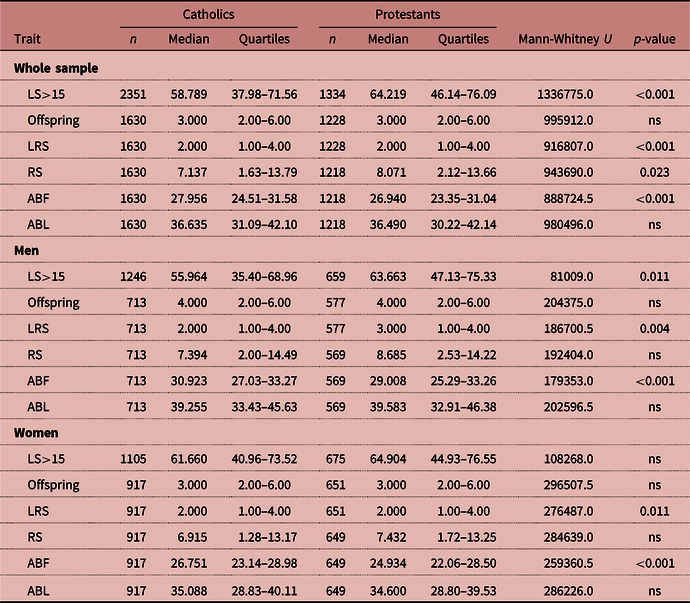
The life history traits for Catholics and Protestants for the whole period are given in Table 1. Protestants showed significantly higher lifespan values (LS>15: 64.2 years vs 58.8; p<0.001), had their first child earlier (ABF 26.9 vs 27.9; p<0.001) and their reproductive span was longer (8.1 vs 7.1; p=0.023) than for Catholics. Offspring, LRS and ABF did not show significant differences between the two religions. The values for men and women showed the same trend.
Life history trait differences between Catholics and Protestants for the period 1733–1908

Sample size (n) varies according to the trait because information was not available for all individuals.
ns, non-significant p-values.
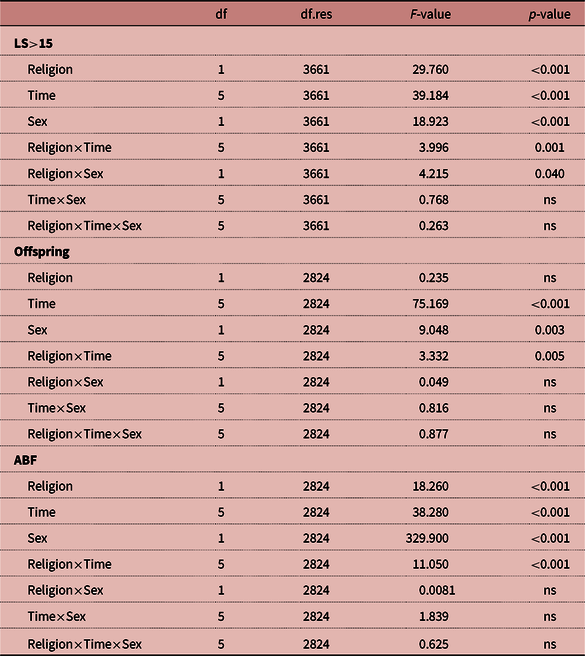
Once LHT values were described by religion and sex over the whole studied period, the interaction of religion, sex and time on LS>15, Offspring and ABF was tested. The results of the non-parametric ANOVA are summarized in Table 2. Individually, religion, sex and time showed significant effects on LS>15 and ABF. Religion failed to show a significant effect on Offspring. When taken in pairs, religion showed a significant effect with time and sex on LS>15. For Offspring and ABF, only religion and time showed a significant interaction.
Non-parametric factorial ANOVAs to test the interaction of religion, sex and time on LS>15, Offspring and ABF

df, degrees of freedom; ns, non-significant p-values.
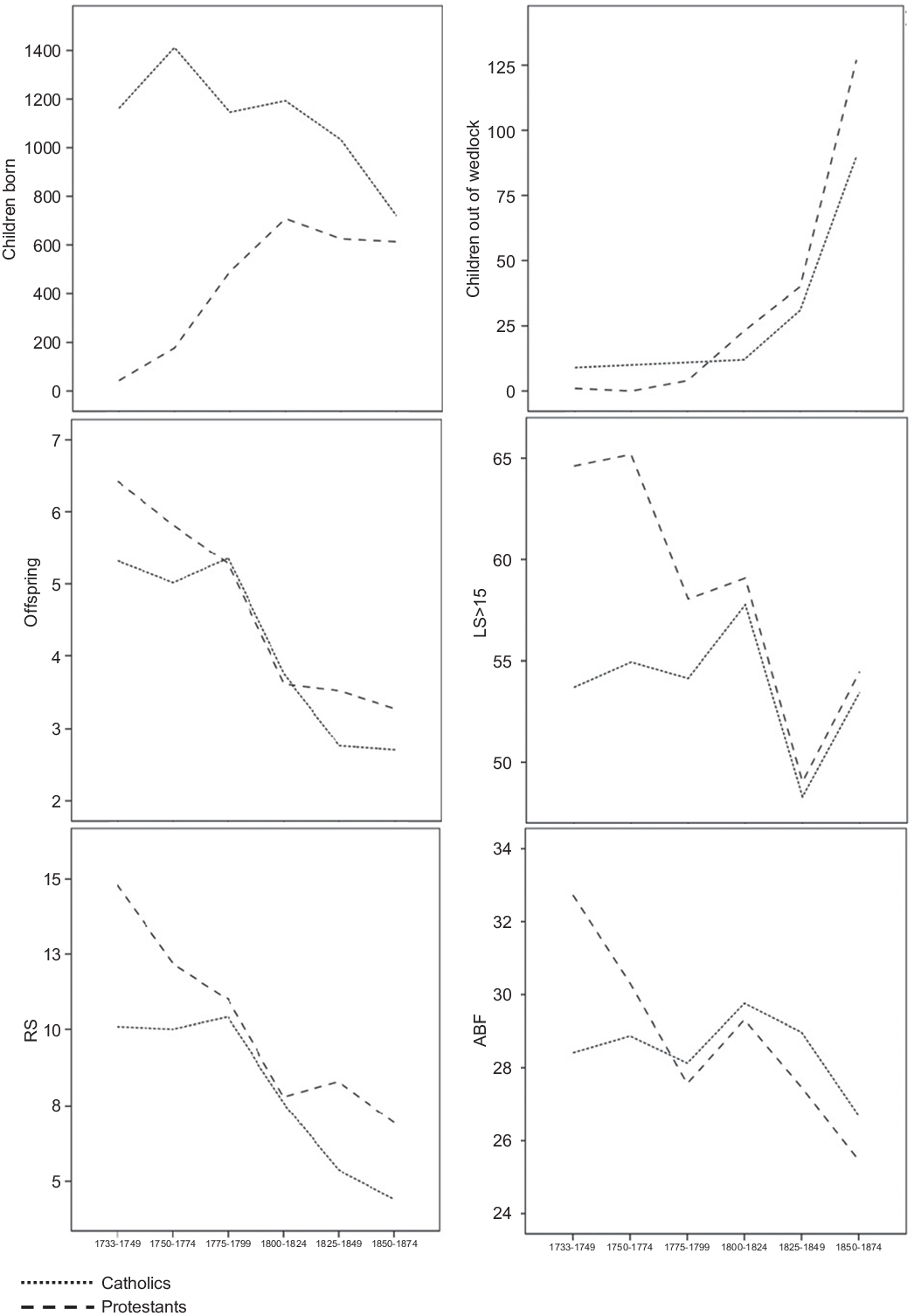
The distribution of these life history traits along the studied period is shown in Fig. 1. Before 1800 all variables were higher in Protestants than in Catholics. After 1800, for both religions, Offspring, RS and ABF fell. However, a sharp decline in LS>15 was observed between 1825 and 1850. After this period it gradually increased again. Children born out of wedlock presented an opposite trend, with a clearly high increase after 1800.
Total children born, children born out of wedlock, number of offspring, LS>15, RS and ABF for Catholics and Protestants (1733–1875).

Children born out of wedlock
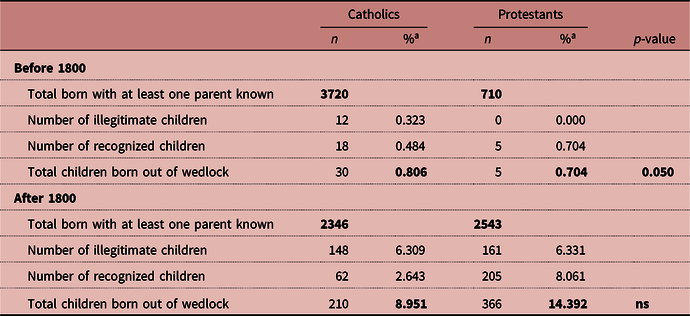
The numbers of children born out of wedlock, both illegitimate and recognized, are shown in Table 3 for both religious groups. Before 1800, the number of children born out of wedlock was lower than 1%, and differences between Catholics and Protestants were bordering on statistical significance. After 1800, these numbers rocketed to almost 9% and 14.4%, respectively. The number of illegitimate children was higher in Catholics than in Protestants, whereas the number of recognized children showed the opposite trend.
Percentages of illegitimate and recognized children before and after 1800 by religion

a Of all individuals with at least one parent know.
ns, non-significant p-values.
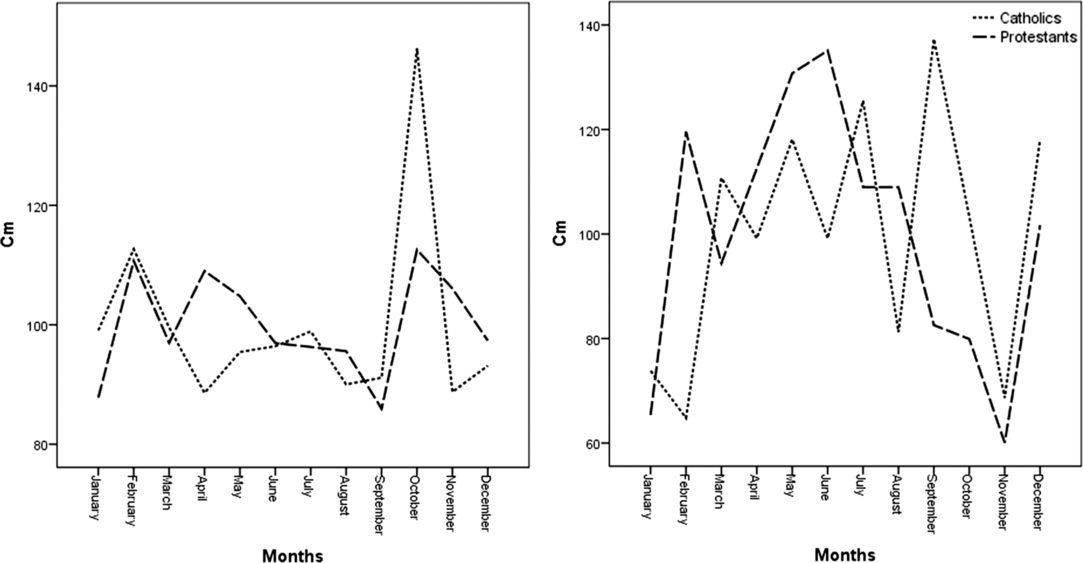
In an effort to understand the large increase in children born out of wedlock after 1800, in particular illegitimate ones, the conception seasonality of all births was compared with that of illegitimate births (Fig. 2). In the case of all births, a significant increase in conceptions was observed during autumn and winter, with a peak in October (p<0.05 in Catholics vs Protestants). Although the conception of illegitimate children was more common during spring and summer, it did not reach statistical significance.
Seasonality of all children (left) and children born out of wedlock (right) for Catholics and Protestants.

Under-5 mortality
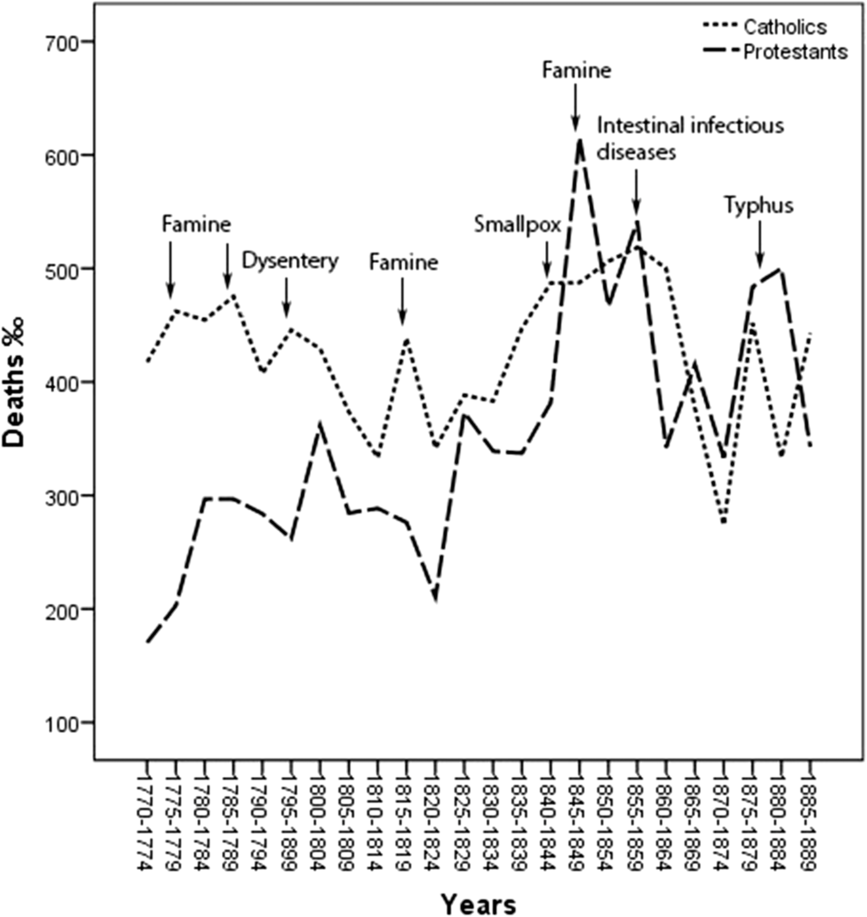
Under-5 mortality (MR<5) between 1770 and 1890 is shown in Fig. 3 for Catholics and Protestants. In Catholics MR<5 ranged between 274 and 518‰, while in Protestants it ranged between 170 and 615‰. Before 1850, famine and infectious diseases were the main causes of child mortality. Catholic children presented clearly higher values of mortality than Protestant children in all the crises except the ones due to famine occurring between 1845 and 1850, and the peak of 1855, which could have been caused by an episode of intestinal infectious disease, such as cholera or typhus, exacerbated by the precarious living conditions strongly affecting Protestants in that time. After that, smallpox and typhus epidemics affected Catholics and Protestants, with Protestants showing higher values. Under-5 mortality was similar for legitimate (42% in Catholics and 34% in Protestants) and illegitimate children (38% in Catholics and 37% in Protestants).
Under-5 mortality (MR<5) for Catholics and Protestants, 1770–1890.

Discussion
The availability of data from Catholic and Protestant parish records from the Austrian village of Hallstatt over a long period (1733–1908) has allowed the examination of how religion can influence biological processes over time. The study found that the interactions between religion, sex and time were not the same for survival and fertility. In the former, the significant interaction on lifespan below 15 years (LS>15) of religion in combination with time or sex suggested that the effect exerted by religion has not been the same in the two sexes, or in the two centuries analysed. In Europe, the consequences of the Industrial Revolution, as well as the political revolutions of the mid-19th century, improved socioeconomic conditions and quality of life (Lucas, Reference Lucas2004). It would be expected that these changes would have equally affected Catholic and Protestants in Hallstatt, and indeed, LS>15 increased in both religions and both sexes. However, the significant interaction of religion and time suggests that differences in living and sanitary conditions may have contributed to the higher LS>15 values of Protestants compared with Catholics, particularly in the first half of the 18th century, and from 1850 onwards (Fig. 1).
Time, sex and religion showed significant individual influences on the age at birth of the first child (ABF), and only time and sex did so for number of offspring. However, only the interaction between religion and time was statistically significant in the two life history traits. Number of offspring decreased over time in both religious groups, with huge differences between Catholics and Protestants. The differences softening throughout the 19th century; ABF was higher in Protestants during the first half of the 18th century, but the trend changed in the 19th century (Fig. 1).
It is interesting to note that in Hallstatt, both Catholics and Protestants had fewer children (around 3 children) than other European populations for a similar period of time. They also showed a relatively short reproductive span (RS), with birth intervals of 2.51 in Catholics and 2.87 in Protestants (Kemkes-Grottenthaler, Reference Kemkes-Grottenthaler2003; Liu et al., Reference Liu, Rotkirch and Lummaa2012; Skjaervø & Røskaft, Reference Skjaervø and Røskaft2012; Manfredini & Breschi, Reference Manfredini and Breschi2013; Gillespie et al., Reference Gillespie, Rusell and Lummaa2013; Bolund & Lummaa, Reference Bolund and Lummaa2016; Cinnirella et al., Reference Cinnirella, Klemp and Weisdorf2017). The low number of children could be due to Hallstatt’s particular environmental and economic characteristics. It is a small village enclosed between mountains and a lake, with limited communication with neighbouring towns until well into the 19th century. The main economic source was work in the salt mine, and very little land was available for cultivation. Even so, for both religions, men had more children than women (4 vs 3 children) because widowed men increased their number of descendants by remarrying younger women and continuing to have children (8.58% of men versus 2.45% of married women two or more times) (Waynforth, Reference Waynforth1998; Lahdenperä et al., Reference Lahdenperä, Lummaa and Rusell2011; Maklakov & Lummaa, Reference Maklakov and Lummaa2013; Pettay et al., Reference Pettay, Rotkirch, Courtiol, Jokela and Lummaa2014; Gavrus-Ion et al., Reference Gavrus-Ion, Sjøvold, Hernández, González-José, Esteban Torné, Martínez-Abadías and Esparza2017).
After 1800, Catholics and Protestants had fewer offspring and started and ended having children at earlier ages. This suggests that the Demographic Transition in Hallstatt could have started, since in the first phase of the Demographic Transition mortality decreases, and it is only in the second phase that fertility diminishes (Mason, Reference Mason1997; Reher, Reference Reher2011; Galor, Reference Galor2012; Zavala de Cosio, Reference Zavala de Cosío and Rabell2014; Bolund et al., Reference Bolund, Hayward, Pettay and Lummaa2015; Bolund & Lummaa, Reference Bolund and Lummaa2016). However, Protestants continued to have more offspring, a higher RS and a lower ABF than Catholics. These results are in line with those of other studies, which observed a reduction in fertility and an increase in longevity during and after the Demographic Transition in European populations (Frejka & Westoff, Reference Frejka and Westoff2008; Reher, Reference Reher2011; Bolund et al., Reference Bolund, Hayward, Pettay and Lummaa2015; Bolund & Lummaa, Reference Bolund and Lummaa2016). McQuillian (Reference McQuillan2004) observed that, in France, Catholics were the initiators of the fertility decline, unlike Ireland, where Catholics still presented a higher fertility than Protestants after the Demographic Transition. Peri-Rotem (Reference Peri-Rotem2016) found that Protestants had lower fertility than Catholics in Britain, but higher fertility in the Netherlands. Kemkes-Grottenthaler (Reference Kemkes-Grottenthaler2003), after analysing two populations in Germany, observed that Protestants married earlier, had shorter reproductive spans and stopped having children long before reaching menopause compared with Catholics, who maintained a natural fertility regime. To understand the differences among studies, it should be taken into account that fertility is population specific, being determined both by individual behaviour and by social, economic and cultural conditions (Kemkes-Grottenthaler, Reference Kemkes-Grottenthaler2003; McQuillan, Reference McQuillan2004; Peri-Rotem, Reference Peri-Rotem2016).
In the whole population of Hallstatt, during the 18th century, the birth rate of illegitimate children was lower than 1%, while during the 19th century the rate increased by over 10%, following the same dynamic as the rest of Austria. It was not just young women who had children out of wedlock, since there were also adultery cases and relationships after widowhood, and no differences were found between rich and poor women (Prioux, Reference Prioux1993; Kurz, Reference Kurz2002). In an attempt to understand the origin of the high number of illegitimate conceptions in Hallstatt, their seasonality was explored. For the whole population and both religions, the highest number of conceptions was observed in autumn and winter. In illegitimate children, however, a certain seasonality of conceptions was observed during spring and summer. As seasonality greatly depends on the relationship of populations with their environment (Hernández, Reference Hernández and Bernis1994; Danubio et al. Reference Danubio, Di Donato, Vecchi and Coppa2003; Grech et al. Reference Grech, Savona-Ventura, Agius-Muscat and Janulova2003; Kemkes-Grottenthaler, Reference Kemkes-Grottenthaler2003; Fellman & Eriksson Reference Fellman and Eriksson2009), studies comparing legitimate and illegitimate conceptions have yielded discordant results (Lam & Miron, Reference Lam and Miron1991; Esparza et al., Reference Esparza, Hernández, García-Moro, Toja, Font and Aluja2003; Hernández et al., Reference Hernández, García-Moro, Toja, Esparza, Font and González2003). Illegitimate child mortality, for both Catholics and Protestants, was similar to child mortality in the whole samples. Kurz (Reference Kurz2002) affirmed that illegitimate children were widely accepted into families. A particular explanation for this could be that, in 1763, a restriction on weddings was introduced to decrease the birth rate, which lasted until 1921. The Hallstatt salt mine authorities obtained the right to grant ‘permissions to marry’, which were only given to those men who satisfied certain economic requirements. Individuals who were not involved in salt production could obtain permission from the Markt judge (Prioux, Reference Prioux1993; Urstöger, Reference Urstöger2000). This need for a ‘permission to marry’ could have increased non-marital relationships. Due to the strict norms regarding extramarital relationships promoted by the Catholic Church (Thornton et al., Reference Thornton, Axinn and Hill1992; McQuillan, Reference McQuillan2004; Quiamzade et al., Reference Quiamzade, Sommet, Burgos Laborde, L’Huillier and Guiso2017), the number of children born out of wedlock would be expected to be lower in Catholics than in Protestants. However, before 1800, the number of children born out of wedlock was higher in Catholics, but with a minimal difference. It was only after 1800 that the number of Protestant children born out of wedlock exceeded the number of Catholic children born out of wedlock (Fig. 1). It was also observed that the number of illegitimate children (those born out of wedlock without a recognized father) was higher in Catholics than in Protestants, contrary to the recognized ones. Since the Protestant Church allowed marriage pacts that permitted non-marital sexual relations, the high number of recognized children was most likely due to broken commitments. Similar to the results obtained, Kemkes-Grottenthaler (Reference Kemkes-Grottenthaler2003) affirmed that in Germany, before and after 1800, Protestants showed a higher number of prenuptial conceptions, as premarital cohabitation had a greater acceptability. McQuillian (Reference McQuillan2004) observed a very low rate of extramarital childbearing in Catholics of Ireland, but the author assumed that in rural areas children born out of wedlock might have been falsely recorded as belonging to the young woman’s parents.
In Hallstatt before 1850, famine due to harvest crises in wheat and potatoes, extreme summers and winters and inflation alternated with dysentery, smallpox and typhus outbreaks (Fig. 3; Kurz, Reference Kurz2002; Solà Soley, Reference Solà Soley2014). As a result, high values of MR<5 were observed, particularly in Catholics (>300‰). Similar values were also observed in Ostrobothnia (Finland) between 1792 and 1805, where the critical determinants were diet and hygiene (Moring, Reference Moring1998). The observed differences between MR<5 for Catholics and Protestants in Hallstatt could be due to better conditions of Protestants for fighting against famine and infectious diseases because of a better nutritional status and hygiene. The famine crises that occurred between 1845 and 1850 deserve special attention, since this was a crucial moment in Hallstatt. Changes in salt mine management occurred and the lack of sensitivity of the authorities towards community, especially towards Protestants, increased (Kurz, Reference Kurz2002). An economic crisis, together with poor crops and subsequent inflation, mainly affected Protestants, prompting them to migrate to North America (Kurz, Reference Kurz2002). This whole situation resulted in a population decline, and consequently a decline in the number of children born in Hallstatt after 1850 (see Fig. 1).
After 1850, the economic and social conditions in Hallstatt improved due to the arrival of new revenue, mainly for the increase in tourism, so there were no more episodes of hunger. Nevertheless, there were still epidemics of cholera, smallpox and typhus (Kurz, Reference Kurz2002). As the second half of the century progressed, the differences between Catholics and Protestants were diluted due to socioeconomic and health improvements. However, a reduction in religiosity could also have contributed to these differences. This secularization has also been observed in other European regions, although the process was slow and did not affect all countries equally (McQuillan, Reference McQuillan2004; Peri-Rotem, Reference Peri-Rotem2016).
The results of this study show differences in the living conditions between Catholics and Protestants that determined the extent to which religion influences fertility patterns through time. Other studies in European populations have found that religion is related with other social, cultural, economic and political factors (Kemkes-Grottenthaler, Reference Kemkes-Grottenthaler2003; McQuillan Reference McQuillan2004; Liczbinska Reference Liczbinska2009; Peri-Rotem Reference Peri-Rotem2016). Since economic information for Hallstatt’s inhabitants was not available, further studies in different populations with different cultural conditions are needed to compare with the present findings.
Acknowledgements
The authors thank the authorities of the Hallstatt Parish for permission to access their demographical records.
Funding
This work was supported by the Wenner-Gren Foundation for Anthropological Research (Gr. 7149) and 2017 SGR 1630 Grup de Recerca en Antropologia Biològica (GREAB).
Conflicts of Interest
The authors declare no conflict of interest to declare.
Ethical Approval
No ethical approval was required for this study.