





Introduction
The genus Conyza (Asteraceae) includes numerous species distributed across temperate, subtropical, and tropical regions worldwide. Horseweed ([Conyza canadensis (L.) Cronquist; syn.: Erigeron canadensis L.], hairy fleabane [Conyza bonariensis (L.) Cronquist; syn.: Erigeron bonariensis L.], and Sumatran fleabane [Conyza sumatrensis (Retz.) E. Walker] are major agricultural weeds owing to their broad ecological adaptability, prolific seed production, and wind dispersal (Bajwa et al. Reference Bajwa, Sadia, Ali, Jabran, Peerzada and Chauhan2016; Lazaroto et al. Reference Lazaroto, Fleck and Vidal2008; Weaver Reference Weaver2001). However, mapping their native distribution and secondary spread remains challenging due to overlapping geographic ranges, frequent hybridization, and taxonomic ambiguities. In terms of life history, C. canadensis exhibits considerable life-cycle plasticity, occurring as a winter annual, summer annual, or occasionally biennial depending on environmental conditions, whereas C. bonariensis and C. sumatrensis are primarily annual species. Furthermore, reliable species-level identification can be difficult because of morphological similarities, particularly at the seedling stage, supporting the use of genetic methods to distinguish closely related species and facilitate early weed management (Wang et al. Reference Wang, Wu, Zhu and Lin2018). Phenotypically, C. canadensis is generally more slender and less hairy, with narrow leaves, small flower heads, and clearly visible white ray florets (Bajwa et al. Reference Bajwa, Sadia, Ali, Jabran, Peerzada and Chauhan2016; Weaver Reference Weaver2001). Conyza bonariensis is usually shorter and more densely hairy, with narrow leaves and a strongly branched, spreading inflorescence. Conyza sumatrensis, in comparison, is typically taller and more robust, with broader leaves and a large, pyramidal inflorescence concentrated toward the upper part of the stem. However, even these traits may not always allow reliable species differentiation, and unverified photographic records may consequently be insufficient for confirming species identity. All three species reproduce mainly by wind-dispersed seed, enabling long-distance spread and colonization of diverse habitats—a pattern best documented in C. canadensis and C. bonariensis (Bajwa et al. Reference Bajwa, Sadia, Ali, Jabran, Peerzada and Chauhan2016; Lazaroto et al. Reference Lazaroto, Fleck and Vidal2008; Weaver Reference Weaver2001). Nevertheless, their high seed production is not uniform, with seed output varying substantially according to plant size, environmental conditions, and population characteristics. Seedlings emerge mainly from late summer to autumn, overwinter as rosettes, and resume growth in spring, while spring-emerging plants complete the life cycle within the same growing season (Jursík et al. Reference Jursík, Holec and Soukup2008; Weaver Reference Weaver2001). Their small, light-requiring seeds favor establishment in reduced-tillage systems, orchards, vineyards, and roadsides, where repeated herbicide exposure can increase selection pressure for resistance, with this ecology being most thoroughly characterized for C. canadensis and C. bonariensis (Jursík et al. Reference Jursík, Holec and Soukup2008; Lazaroto et al. Reference Lazaroto, Fleck and Vidal2008; Weaver Reference Weaver2001).
The economic importance of Conyza has increased markedly over the past three decades. These species are increasingly recognized as major weeds in conservation agriculture and perennial cropping systems, where reduced soil disturbance favors establishment and weed management relies heavily on herbicides (Bajwa et al. Reference Bajwa, Sadia, Ali, Jabran, Peerzada and Chauhan2016). Dense infestations can reduce crop productivity through competition for light, water, nutrients, and space, with yield losses in crops such as soybean [Glycine max (L.) Merr.] and cotton (Gossypium hirsutum L.), especially in regions where these species are prevalent (Bajwa et al. Reference Bajwa, Sadia, Ali, Jabran, Peerzada and Chauhan2016; Weaver Reference Weaver2001). Herbicide resistance has further increased their economic impact by reducing effective control options. Conyza bonariensis, a globally widespread warm-climate species, infests diverse agricultural and disturbed habitats, posing management challenges in conservation tillage systems and horticultural crops (Wu Reference Wu2007). Some Conyza species can also serve as hosts for economically important pests and pathogens, including tarnished plant bug and aster yellows phytoplasma, further increasing their agricultural importance (Bajwa et al. Reference Bajwa, Sadia, Ali, Jabran, Peerzada and Chauhan2016; Weaver Reference Weaver2001).
The widespread reliance on herbicides for Conyza management has made this genus an important model for studying herbicide-resistance evolution. Early reports of resistance in C. canadensis during the 1980s involved paraquat (Group 22) and photosystem II (PSII)-inhibiting herbicides (primarily Group 5). Resistance later evolved to glyphosate (Group 9), acetolactate synthase (ALS) inhibitors (Group 2), PSII inhibitors (Group 5), protoporphyrinogen oxidase (PPO) inhibitors (Group 14), and synthetic auxins (Group 4) (Baccin et al. Reference Baccin, Albrecht, Albrecht, Silva and Filho2022; Jursík et al. Reference Jursík, Holec and Soukup2008; Weaver Reference Weaver2001). Resistance in Conyza is mediated by both target-site resistance (TSR) and non–target site resistance (NTSR). TSR involves target-site mutations or increased target-site abundance, while NTSR includes reduced absorption, vacuolar sequestration, and enhanced detoxification (Baccin et al. Reference Baccin, Albrecht, Albrecht, Silva and Filho2022; Gaines et al. Reference Gaines, Duke, Morran, Rigon, Tranel, Küpper and Dayan2020; Jugulam and Shyam Reference Jugulam and Shyam2019; Powles and Yu Reference Powles and Yu2010). Increasing evidence indicates that transporter activity and metabolic pathways, including cytochrome P450–mediated detoxification, contribute to NTSR in some populations and may facilitate resistance across herbicides with different modes of action (Moretti and Hanson Reference Moretti and Hanson2017; Moretti et al. Reference Moretti, Alárcon-Reverte, Pearce, Morran and Hanson2017).
Herbicide resistance in Conyza has been extensively investigated, but most studies have focused on single species, specific resistance mechanisms, or regional case studies (Baccin et al. Reference Baccin, Albrecht, Albrecht, Silva and Filho2022). Consequently, current knowledge remains fragmented across species, geographic regions, resistance mechanisms, and production systems. Nevertheless, a comparative synthesis integrating resistance evolution, species-specific resistance profiles, mechanisms, and ecological drivers is still limited. To address this gap, the current review presents a narrative synthesis of published global evidence. It is not intended as a systematic review or quantitative meta-analysis, but instead integrates findings from experimental, field, and genomic studies to identify and trends in resistance evolution. It compares resistance trajectories, examines TSR and NTSR mechanisms, and identifies trends that can improve resistance monitoring and support integrated management of the three species.
Herbicide Resistance in Conyza Species
Herbicide resistance in Conyza represents a well-documented example of adaptive evolution under herbicide selection. High selection pressure, prolific seed production, genetic variation, and efficient dispersal have enabled resistant C. canadensis, C. bonariensis, and C. sumatrensis populations to establish worldwide. As noted earlier, since initial resistance cases were reported around 1980, these species have evolved multiple resistance across additional herbicide modes of action, including paraquat, PSII inhibitors, glyphosate, ALS inhibitors, PPO inhibitors, and synthetic auxins (Matzrafi et al. Reference Matzrafi, Lazar, Sibony and Rubin2015).
The remarkable ecological and evolutionary success of Conyza is closely linked to biological traits that facilitate resistance evolution and dissemination. These species produce large numbers of small wind-dispersed seeds, rapidly colonize disturbed habitats, and maintain persistent populations in both agricultural and non-agricultural environments. Roadsides, railway systems, orchards, vineyards, and unmanaged areas can function as reservoirs of resistant populations, potentially contributing to gene flow and reinvasion of cultivated fields (Amaro-Blanco et al. Reference Amaro-Blanco, Osuna, Romano, Roldán-Gómez, Palma-Bautista, Portugal and De Prado2019; Beres et al. Reference Beres, Ernst, Ackley, Loux, Owen and Snow2018). Furthermore, several resistance traits frequently exhibit dominant or incompletely dominant inheritance, allowing resistant alleles to increase rapidly under repeated herbicide selection (Davis et al. Reference Davis, Kruger, Hallett, Tranel and Johnson2010; Zelaya et al. Reference Zelaya, Owen and VanGessel2004). These biological characteristics, combined with sustained herbicide selection pressure, contribute to the evolution of TSR and NTSR mechanisms that ultimately lead to multiple resistance and increasing weed management challenges (Figure 1).
Conceptual framework illustrating herbicide-resistance evolution in Conyza species, from selection pressure to resistance mechanisms and management challenges.

Resistance evolution is discussed here according to herbicide mode of action rather than chronology, because similar resistance mechanisms have evolved independently across Conyza species. The following sections compare resistance among C. canadensis, C. bonariensis, and C. sumatrensis within each herbicide group, highlighting both common and species-specific resistance mechanisms.
Resistance to Photosystem I (PSI) Inhibitors (Paraquat)
Paraquat resistance represents the earliest documented cases of herbicide resistance in Conyza. Early reports from the 1980s documented resistance to paraquat and PSII inhibitors in several Conyza species (Fuerst et al. Reference Fuerst, Nakatani, Dodge, Penner and Arntzen1985; Kato and Okuda Reference Kato and Okuda1983; Pölös et al. Reference Pölös, Mikulás, Szigeti, Matkovics, Quy Hai, Párducz and Lehoczki1988). Initial cases occurred primarily in perennial cropping systems, vineyards, orchards, roadsides, railway systems, and industrial habitats, where repeated paraquat applications may have imposed intense selection pressure (Fuerst et al. Reference Fuerst, Nakatani, Dodge, Penner and Arntzen1985; Szigeti et al. Reference Szigeti, Rácz and Lásztity2001). Unlike glyphosate resistance, which subsequently became widespread worldwide, paraquat resistance was initially reported mainly from localized populations exposed to prolonged herbicide use.
Conyza canadensis
Paraquat resistance in C. canadensis is predominantly mediated by NTSR physiological mechanisms rather than alterations in PSI sensitivity. Resistant plants accumulate paraquat within intracellular compartments, including vacuoles, which reduces herbicide toxicity through intracellular compartmentalization likely mediated by membrane transport systems (Jóri et al. Reference Jóri, Soós, Szegő, Páldi, Szigeti, Rácz and Lásztity2007; Lehoczki et al. Reference Lehoczki, Laskay, Gaál and Szigeti1992). Indeed, the application of specific transporter inhibitors significantly restored paraquat sensitivity in resistant C. canadensis biotypes, providing evidence for a transporter-mediated sequestration mechanism (Halász et al. Reference Halász, Soós, Jóri, Rácz, Lásztity and Szigeti2002). This is further supported by upregulated stress and transporter genes, such as CAT4, alongside nitrate-inhibited vacuolar sequestration (Soós et al. Reference Soós, Jóri, Szegő, Bratek, Rácz, Lásztity and Szigeti2005).
Early investigations showed that enhanced activities of antioxidant enzymes, such as superoxide dismutase (SOD), ascorbate peroxidase (APX), glutathione reductase (GR), and catalase (CAT), were insufficient to explain high resistance levels (Turcsányi et al. Reference Turcsányi, Surányi, Lehoczki and Borbély1994, Reference Turcsányi, Darkó, Borbély and Lehoczki1998). However, subsequent evidence indicated that oxidative-stress responses may complement sequestration-based resistance (Soós et al. Reference Soós, Jóri, Páldi, Szegő, Szigeti, Rácz and Lásztity2006). Paraquat-resistant biotypes also had about 2.5-fold higher polyamine and putrescine levels, and exogenous putrescine protected susceptible leaves, suggesting that polyamines may contribute to resistance (Szigeti et al. Reference Szigeti, Rácz, Darkó, Lásztity and Lehoczki1996). Field and greenhouse dose–response experiments further demonstrated that repeatedly exposed C. canadensis populations in Ontario orchards had ED50 values 25 to 35 times higher than those of susceptible populations (Smisek et al. Reference Smisek, Doucet, Jones and Weaver1998).
Cross-resistance has also been documented in paraquat-resistant C. canadensis. Resistant populations exhibited extremely high resistance to paraquat together with substantial cross-resistance to diquat, indicating that sequestration and compartmentalization mechanisms may contribute to protection against related bipyridyl herbicides (Szigeti et al. Reference Szigeti, Darkó, Nagy and Lehoczki1994). Physiological mechanisms associated with paraquat resistance have also been associated with cross-resistance to atrazine (Pölös et al. Reference Pölös, Mikulás, Szigeti, Matkovics, Quy Hai, Párducz and Lehoczki1988). Furthermore, these atrazine-resistant populations displayed resistance to chlorbromuron and metobromuron while remaining susceptible to diuron, demonstrating that cross-resistance depends on both herbicide structure and the underlying resistance mechanism (Pölös et al. Reference Pölös, Laskay, Lehoczki, Szigeti and Pataki1987).
Conyza bonariensis
In C. bonariensis, paraquat resistance likewise results primarily from physiological rather than TSR mechanisms. Early studies showed that resistance was not associated with altered PSI sensitivity, enhanced herbicide metabolism, or generalized antioxidant activity. Instead, resistance resulted from intracellular sequestration that prevented paraquat from reaching chloroplast targets, with resistance depending on intact cellular structures (Norman et al. Reference Norman, Fuerst, Smeda and Vaughn1993). Additional investigations reported increased chloroplast activities of SOD, APX, and GR, suggesting that enhanced organellar detoxification of reactive oxygen species contributes to resistance expression (Shaaltiel and Gressel Reference Shaaltiel and Gressel1986). Moreover, transient, oxidant-induced upregulation of antioxidant transcripts and protective enzyme activities strongly correlates with enhanced paraquat resistance in C. bonariensis biotypes (Ye and Gressel Reference Ye and Gressel2000). Genetic analyses further showed that paraquat resistance appears to be controlled by a dominant nuclear gene, suggesting genetic control of resistance-associated physiological traits (Shaaltiel et al. Reference Shaaltiel, Chua, Gepstein and Gressel1988).
Conyza sumatrensis
Paraquat resistance has also been documented in C. sumatrensis, including populations reported in Taiwan and Brazil (Chiang et al. Reference Chiang, Wu, Chiang and Wang2008; Zobiole et al. Reference Zobiole, Pereira, Albrecht, Rubin, Adegas and Albrecht2019). Greenhouse evaluations showed that resistant plants possessed differences in baseline physiological traits, enhanced antioxidant activity, and reduced membrane peroxidation, which were associated with rapid photosynthetic recovery after application (Pereira et al. Reference Pereira, Carbonari, Silva, Costa, Krenchinski, Bevilaqua and Velini2023). While enhanced GR activity was historically linked to resistance, direct mechanistic evidence remains more limited than in C. canadensis and C. bonariensis (Chiang et al. Reference Chiang, Wu, Chiang and Wang2008). More recently, a Bolivian biotype from Cuatro Cañadas showed a high resistance index of 24.8, while 2,4-D and dicamba remained effective (Vitorio et al. Reference Vitorio, Arteaga and Saavedra-Avila2025). Multiple-resistant populations also combine paraquat resistance with glyphosate and ALS inhibitors (Albrecht et al. Reference Albrecht, Thomazini, Albrecht, Pires, Lorenzetti, Danilussi and Silva2020b). These findings suggest that paraquat resistance in C. sumatrensis may involve multiple physiological responses, including enhanced antioxidant capacity, rather than a single dominant mechanism. The occurrence of multiple resistance further indicates that paraquat resistance can develop within broader resistance profiles, potentially complicating management where several herbicide modes of action are used repeatedly.
Comparative Synthesis of Resistance to PSI Inhibitors (Paraquat) among Conyza Species
Across the genus, paraquat resistance in Conyza has been primarily associated with NTSR mechanisms, although the strength of mechanistic evidence varies among species (Table 1). Conyza bonariensis relies on antioxidant defenses and sequestration, while C. canadensis utilizes intracellular compartmentalization supported by transporter regulation and oxidative-stress responses. Conyza sumatrensis features enhanced antioxidative capacity and differences in physiological traits, although mechanistic data remain limited (Chiang et al. Reference Chiang, Wu, Chiang and Wang2008; Norman et al. Reference Norman, Fuerst, Smeda and Vaughn1993; Shaaltiel and Gressel Reference Shaaltiel and Gressel1986; Shaaltiel et al. Reference Shaaltiel, Chua, Gepstein and Gressel1988; Turcsányi et al. Reference Turcsányi, Surányi, Lehoczki and Borbély1994, Reference Turcsányi, Darkó, Borbély and Lehoczki1998). Thus, while NTSR mechanisms are shared across the genus, their relative contribution differs: sequestration is best characterized in C. canadensis, and antioxidant responses in C. bonariensis and C. sumatrensis. These studies show that diverse non–target site physiological processes can contribute to herbicide resistance.
Comparative overview of PSI inhibitor (paraquat) resistance in Conyza speciesa

Table 1. Long description
The table has four rows and four columns. The columns are labeled Species, First reports/occurrence, Major resistance mechanism(s), and Supporting citations. The rows are labeled with different Conyza species and their respective details. Row 1: Conyza canadensis, Earliest documented cases; localized populations in perennial systems, NTSR (intracellular sequestration/compartmentalization; altered oxidative-stress responses; elevated endogenous polyamines/putrescine implicated in resistance), Fuertst et al. (1985); Halász et al. (2002); Jóri et al. (2007); Kato and Okuda (1983); Lehoczki et al. (1992); Polös et al. (1987, 1988); Smisek et al. (1998); Soós et al. (2005, 2006); Szigeti et al. (1994, 1996); Turcsányi et al. (1994, 1998). Row 2: Conyza bonariensis, Early localized populations, NTSR (enhanced antioxidant defense; proposed intracellular sequestration; dominant nuclear inheritance), Norman et al. (1993); Shaaltiel and Gressel (1986); Shaaltiel et al. (1988); Ye and Gressel (2000). Row 3: Conyza sumatrensis, Documented populations in Taiwan, Brazil, and Bolivia; multiple-resistant populations subsequently reported, Putative NTSR (enhanced antioxidative capacity); limited mechanistic evidence; a Bolivian biotype showed high paraquat resistance (RI = 24.8), Albrecht et al. (2020b); Chiang et al. (2008); Vitorio et al. (2025); Zobiole et al. (2019).
a Abbreviations: NTSR, non–target site resistance; PSI, photosystem I.
Resistance to PSII Inhibitors
Resistance to PSII-inhibiting herbicides represents one of the earliest documented forms of herbicide resistance in Conyza, although its occurrence has been more localized and less frequently documented than resistance to paraquat or glyphosate. Early cases were reported primarily from perennial cropping systems such as vineyards, citrus groves, tree nut plantations, and pome fruit orchards and non-crop habitats like railways and roadsides, where repeated applications of atrazine and simazine imposed sustained selection pressure (Fuerst et al. Reference Fuerst, Nakatani, Dodge, Penner and Arntzen1985; Kato and Okuda Reference Kato and Okuda1983; Lehoczki et al. Reference Lehoczki, Laskay, Gaál and Szigeti1992; Szigeti et al. Reference Szigeti, Rácz and Lásztity2001). These early reports showed that continuous herbicide use could promote the evolution of resistant populations, thereby providing an early example of herbicide-resistance evolution within the genus.
Conyza canadensis
Among the three major agricultural species, PSII inhibitor resistance has been documented most extensively in C. canadensis. Early investigations showed that atrazine-resistant populations exhibited differential cross-resistance to other PSII inhibitors (Lehoczki et al. Reference Lehoczki, Laskay, Pölös and Mikulás1984). Resistant biotypes showed resistance to chlorbromuron and metobromuron while remaining susceptible to diuron, indicating that resistance depended on herbicide structure rather than conferring uniform resistance across all PSII inhibitors (Pölös et al. Reference Pölös, Laskay, Lehoczki, Szigeti and Pataki1987). Moreover, paraquat-resistant populations also exhibited cross-resistance to atrazine, suggesting that physiological mechanisms associated with oxidative-stress protection and intracellular sequestration may influence responses to multiple herbicide groups (Pölös et al. Reference Pölös, Mikulás, Szigeti, Matkovics, Quy Hai, Párducz and Lehoczki1988).
Conyza bonariensis
Compared with C. canadensis, relatively few studies have documented confirmed resistance to PSII inhibitors in C. bonariensis. For example, atrazine and metribuzin resistance has been reported in a multiple-resistant population, with TSR resistance associated with the psbA Ser-264-Gly mutation and additional NTSR mechanisms remaining insufficiently characterized (Matzrafi et al. Reference Matzrafi, Lazar, Sibony and Rubin2015). Existing evidence indicates that repeated herbicide applications in perennial cropping systems were associated with localized resistance evolution during the early stages of herbicide-resistance development within the genus (Matzrafi et al. Reference Matzrafi, Lazar, Sibony and Rubin2015).
Conyza sumatrensis
Confirmed resistance to PSII inhibitors remains uncommon in C. sumatrensis, with few documented cases (Pinho et al. Reference Pinho, Leal, Souza, de Oliveira, de Oliveira, Langaro, Machado, Christoffoleti and Zobiole2019). A confirmed case of diuron resistance was reported in a multiple-resistant population, representing an early documented example of PSII inhibitor resistance in this species (Pinho et al. Reference Pinho, Leal, Souza, de Oliveira, de Oliveira, Langaro, Machado, Christoffoleti and Zobiole2019). The resistant population showed resistance indices of 7.29 and 5.05 based on LD50 and GR50, respectively, and was simultaneously resistant to paraquat, glyphosate, saflufenacil, and 2,4-D. However, the specific mechanism responsible for diuron resistance in C. sumatrensis remains unclear.
Comparative Synthesis of PSII Inhibitor Resistance among Conyza Species
Although PSII inhibitor resistance represented an important early stage in the evolution of herbicide resistance within Conyza, its current agronomic significance is limited compared with glyphosate, ALS, and multiple resistance (Table 2). Nevertheless, these studies demonstrated that prolonged herbicide selection can result in cross-resistance and co-resistance involving PSII inhibitors, with TSR and NTSR mechanisms documented or proposed in some Conyza populations. However, the specific mechanisms underlying PSII resistance remain insufficiently characterized in several Conyza species.
Comparative overview of photosystem II (PSII) inhibitor resistance in Conyza species a

Table 2. Long description
A table comparing herbicide resistance mechanisms in Conyza species. The table has four rows and four columns. Column headers are Species, First reports/occurrence, Major resistance mechanism(s), and Supporting citations. Row 1: Species, Conyza canadensis; First reports/occurrence, Earliest and most extensively documented cases; localized populations in perennial cropping systems and non-crop habitats; Major resistance mechanism(s), Differential cross-resistance among PSII inhibitors; resistance influenced by herbicide structure; physiological cross-resistance with paraquat reported; Supporting citations, Lehoczki et al. (1984); Pölös et al. (1987, 1988). Row 2: Species, Conyza bonariensis; First reports/occurrence, Rare, localized cases, including multiple-resistant populations exposed to repeated herbicide selection; Major resistance mechanism(s), Target-site mutation (psbA Ser-264-Gly) and additional uncharacterized NTSR mechanisms; resistance to atrazine and metribuzin has been reported; Supporting citations, Matzrafi et al. (2015). Row 3: Species, Conyza sumatrensis; First reports/occurrence, Very uncommon; few confirmed cases; Major resistance mechanism(s), Limited mechanistic evidence; diuron resistance has been confirmed, but the specific mechanism responsible in C. sumatrensis requires further clarification; Supporting citations, Pinho et al. (2019).
a Abbreviation: NTSR, non–target site resistance.
Resistance to Glyphosate
Glyphosate resistance is a widespread and extensively studied phenomenon in Conyza species. Following the rapid expansion of glyphosate use in the late 1990s and early 2000s, resistance emerged in multiple agricultural populations and regions, with the first documented case reported in C. canadensis in 2000 (Beres et al. Reference Beres, Ernst, Ackley, Loux, Owen and Snow2018; Okada et al. Reference Okada, Hanson, Hembree, Peng, Shrestha, Stewart, Wright and Jasieniuk2013; Tahmasebi et al. Reference Tahmasebi, Alebrahim, Roldán-Gómez, Da Silveira, De Carvalho, Alcántara-de la Cruz and De Prado2018; VanGessel Reference VanGessel2001). This pattern of repeated selection is evident in several major agricultural regions. For example, multiyear monitoring in Brazil confirmed high-frequency resistance to glyphosate and multiple herbicides (Mendes et al. Reference Mendes, Takano, Netto, Picoli, Cavenaghi, Silva, Nicolai, Christoffoleti, De Oliveira, De Melo and Ovejero2021). Similarly, Australian surveys linked exclusive herbicide reliance in no-tillage systems to low-level glyphosate resistance, which is compounded by windborne seed dispersal and stress tolerance (Walker et al. Reference Walker, Bell, Robinson and Widderick2011).
Conyza canadensis
Conyza canadensis represents the most extensively studied Conyza species regarding glyphosate resistance. The first resistant populations were identified in North American soybean and cotton production systems, where glyphosate had become the principal weed management tool. Resistance frequently functions as an incompletely dominant nuclear trait, allowing heterozygous plants to survive standard application rates and favoring increases in resistance allele frequencies under repeated selection (Davis et al. Reference Davis, Kruger, Hallett, Tranel and Johnson2010; Zelaya et al. Reference Zelaya, Owen and VanGessel2004). Subsequent cases included multiple herbicide resistance confirmed in Ontario populations (Byker et al. Reference Byker, Soltani, Robinson, Tardif, Lawton and Sikkema2013c) and low-level glyphosate resistance identified in Montana cereal production (Kumar et al. Reference Kumar, Jha and Jhala2017). Resistance is often associated with NTSR mechanisms, including impaired translocation (González-Torralva et al. Reference González-Torralva, Brown and Chivasa2017). These are linked to ATP-binding cassette (ABC) transporter upregulation (Nol et al. Reference Nol, Tsikou, Eid, Livieratos and Giannopolitis2012; Tani et al. Reference Tani, Chachalis and Travlos2015, Reference Tani, Chachalis, Travlos and Bilalis2016) and differential DNA methylation (Margaritopoulou et al. Reference Margaritopoulou, Tani, Chachalis and Travlos2018). However, TSR mechanisms, such as 5-enol-pyruvyl-shikimate-3-phosphate synthase (EPSPS) overexpression and Pro-106-Ser mutations also occur in some populations (Mei et al. Reference Mei, Xu, Wang, Qiu and Zheng2018; Page et al. Reference Page, Grainger, Laforest, Nurse, Rajcan, Bae and Tardif2018; Palma-Bautista et al. Reference Palma-Bautista, Vázquez-Garcia, López-Valencia, Domínguez-Valenzuela, Barro and De Prado2023). Ecologically, these biotypes exhibit early flowering, competitive biomass, and minimal fitness penalties (Shrestha et al. Reference Shrestha, Hanson, Fidelibus and Alcorta2010). These traits may facilitate persistence and spread, including secondary spread from multiple independent local origins (Okada et al. Reference Okada, Hanson, Hembree, Peng, Shrestha, Stewart, Wright and Jasieniuk2013).
Conyza bonariensis
Glyphosate resistance has become widespread in C. bonariensis throughout South America, southern Europe, Africa, and Australia. Resistant populations have been reported to increase following prolonged glyphosate use in soybean production systems in Brazil (Lamego et al. Reference Lamego, Kaspary, Ruchel, Gallon, Basso and Santi2013; Paula et al. Reference Paula, Vargas, Agostinetto and Nohatto2011). Similar South African populations showed resistance factors ranging between 0.6- and 26.9-fold, where herbicide efficacy was influenced by plant development and environmental conditions; older plants and high temperatures reduced glyphosate sensitivity (Okumu et al. Reference Okumu, Vorster and Reinhardt2019).
Physiological and molecular investigations of several C. bonariensis populations indicate that resistance in C. bonariensis is dominated by NTSR mechanisms, although TSR has also been documented. Resistance is driven primarily by altered subcellular distribution and reduced foliar translocation, which are influenced by plant growth stage and environmental conditions (Kleinman et al. Reference Kleinman, Ben-Ami and Rubin2016; Kleinman and Rubin Reference Kleinman and Rubin2017). In South African and Greek populations, no mutations were detected at positions Thr-102, Ala-103, or Pro-106, nor was EPSPS expression elevated, supporting a major role for non–target site physiological control (Mylonas et al. Reference Mylonas, Giannopolitis, Efthimiadis, Menexes, Madesis and Eleftherohorinos2014; Okumu et al. Reference Okumu, Robbertse, Vorster and Reinhardt2022). However, TSR is not entirely absent; recent work has documented TSR involving the EPSPS Pro-106-Thr (P106T) mutation in specific C. bonariensis biotypes (Kaspary et al. Reference Kaspary, Cutti, Turra, Angonese, Dos Santos and Merotto2025). Inheritance studies indicate that while resistance functions generally as an incompletely dominant trait, more complex models involving two separate genetic loci occur in certain populations, reflecting diverse evolutionary trajectories (Okada and Jasieniuk Reference Okada and Jasieniuk2014).
Conyza sumatrensis
Glyphosate resistance has been increasingly reported in C. sumatrensis, particularly in South American and Mediterranean production systems. For instance, Turkish populations exhibited 3.8- to 7.8-fold resistance to glyphosate, while simultaneously exhibiting reduced sensitivity to chlorsulfuron but remaining susceptible to metribuzin (İnci et al. Reference İnci, Galvin, Al-Khatib and Uludağ2019). The mechanisms underlying glyphosate resistance in this species appear to be diverse. Although some resistant populations showed no EPSPS target-site mutations (Doğan et al. Reference Doğan, Kaya-Altop, Türkseven and Serim2022), the EPSPS Pro-106-Thr (P106T) mutation has been documented in other resistant C. sumatrensis populations, demonstrating that TSR can occur in some populations. In addition, resistant populations examined by Schneider et al. (Reference Schneider, Rizzardi, Grando, Ceccon, Nunes and Didone2021) displayed increased expression of ABC transporter genes potentially involved in glyphosate sequestration, further supporting the role of NTSR mechanisms.
The practical challenges posed by the diversity of resistance mechanisms are illustrated by chemical control trials. Glyphosate-based tank mixes may provide inadequate control of some multiple-resistant biotypes, whereas incorporating alternative modes of action, such as saflufenacil, glufosinate, synthetic auxins, contact herbicides, or 4-hydroxyphenylpyruvate dioxygenase (HPPD) inhibitors, can improve control (Cassol et al. Reference Cassol, Albrecht, Albrecht, Silva, Larini and Galvão2024; Dos Santos et al. Reference Dos Santos, Vargas, Christoffoleti, Martin, Mariani and Da Silva2015). The occurrence of different resistance mechanisms among populations further complicates management, as the effectiveness of alternative herbicides may vary depending on the underlying resistance mechanism and resistance profile of each biotype. Genomic analyses of Brazilian populations indicate that resistance evolution in C. sumatrensis has been shaped by multiple independent local origins and substantial intra- and interspecific gene flow (Kalsing et al. Reference Kalsing, Velini, Merotto and Carbonari2024).
Comparative Synthesis of Glyphosate Resistance among Conyza Species
Despite regional variations in intensity and distribution, glyphosate resistance across all three Conyza species shares several common evolutionary characteristics (Table 3). Resistance is frequently inherited as a dominant or incompletely dominant trait (Davis et al. Reference Davis, Kruger, Hallett, Tranel and Johnson2010; Okada and Jasieniuk Reference Okada and Jasieniuk2014; Zelaya et al. Reference Zelaya, Owen and VanGessel2004), which can favor increases in resistant genotypes under sustained glyphosate selection. Although quantitative NTSR mechanisms like restricted translocation, vacuolar sequestration, and altered gene expression are frequently reported, target-site mutations and EPSPS overexpression also play major roles in specific biotypes (Doğan et al. Reference Doğan, Kaya-Altop, Türkseven and Serim2022; González-Torralva et al. Reference González-Torralva, Rojano-Delgado, Luque de Castro, Mülleder and De Prado2012; Mei et al. Reference Mei, Xu, Wang, Qiu and Zheng2018; Mylonas et al. Reference Mylonas, Giannopolitis, Efthimiadis, Menexes, Madesis and Eleftherohorinos2014; Okumu et al. Reference Okumu, Robbertse, Vorster and Reinhardt2022; Schneider et al. Reference Schneider, Rizzardi, Grando, Ceccon, Nunes and Didone2021). Consequently, available evidence indicates that glyphosate resistance in Conyza is rarely attributable to a single mechanism, but instead involves varying combinations of reduced translocation, EPSPS overexpression, and target-site substitutions (Dinelli et al. Reference Dinelli, Marotti, Bonetti, Minelli, Catizone and Barnes2006, Reference Dinelli, Marotti, Bonetti, Catizone, Urbano and Barnes2008).
Comparative overview of glyphosate resistance in Conyza species a

Table 3. Long description
A table comparing glyphosate resistance mechanisms in Conyza species. The table has four rows and four columns. The columns are labeled Species, First reports/occurrence, Major resistance mechanism(s), and Supporting citations. Row 1: Species: Conyza canadensis; First reports/occurrence: First reported in North American soybean and cotton systems; now widespread globally; Major resistance mechanism(s): Both TSR and NTSR; reduced translocation, vacuolar sequestration, and increased EPSPS expression; target-site mutations reported in some populations; Supporting citations: Byker et al. (2013c); Davis et al. (2010); González-Torralva et al. (2012); Kumar et al. (2017); Margaritopoulou et al. (2018); Mei et al. (2018); Nol et al. (2012); Okada et al. (2013); Tani et al. (2015, 2016); VanGessel (2001); Zelaya et al. (2004). Row 2: Species: Conyza bonariensis; First reports/occurrence: Widespread in South America, southern Europe, Africa, and Australia; Major resistance mechanism(s): NTSR predominates, including reduced translocation; TSR involving the EPSPS Pro-106-Thr (P106T) mutation also documented; Supporting citations: Cassol et al. (2024); Doğan et al. (2022); Dos Santos et al. (2015); İnci et al. (2019); Kalsing et al. (2024); Kasapy et al. (2025); Kleinman et al. (2016); Kleinman and Rubin (2017); Lamego et al. (2013); Mylonas et al. (2014); Okada and Jasieniuk (2014); Okumu et al. (2019, 2022); Paula et al. (2011). Row 3: Species: Conyza sumatrensis; First reports/occurrence: Rapid expansion in South America and Mediterranean production systems; Major resistance mechanism(s): Both TSR and NTSR; altered translocation, increased ABC-transporter expression potentially associated with sequestration, and EPSPS Pro-106-Thr (P106T) mutation documented in some populations; Supporting citations: Cassol et al. (2024); Doğan et al. (2022); Dos Santos et al. (2015); İnci et al. (2019); Kalsing et al. (2024); Schneider et al. (2021).
a Abbreviations: ABC, ATP-binding cassette; EPSPS, 5-enol-pyruvyl-shikimate-3-phosphate synthase; NTSR, non–target site resistance; TSR, target-site resistance.
Multiple independent origins, windborne seed dispersal, and gene flow may contribute to the spread and diversification of glyphosate resistance in Conyza, extending resistance beyond initially affected populations and contributing to the development of multiple- and cross-resistance profiles (Kalsing et al. Reference Kalsing, Velini, Merotto and Carbonari2024; Okada et al. Reference Okada, Hanson, Hembree, Peng, Shrestha, Stewart, Wright and Jasieniuk2013).
Resistance to ALS Inhibitors
Resistance to ALS-inhibiting herbicides has increased in Conyza over the last two decades, partly because ALS inhibitors have frequently been adopted following the failure of glyphosate-based weed management. Consequently, many populations have evolved resistance to ALS inhibitors either independently or in combination with glyphosate resistance, contributing to the increasing occurrence of multiple-resistant biotypes (Albrecht et al. Reference Albrecht, Pereira, Souza, Zobiole, Albrecht and Adegas2020a).
Conyza canadensis
ALS resistance in C. canadensis has been reported in several cropping systems where sulfonylurea and imidazolinone herbicides were repeatedly used. Surveys of Indiana C. canadensis populations documented widespread biotypes resistant to both glyphosate and ALS-inhibiting herbicides, illustrating the frequency with which these two resistance traits co-occur in the field (Kruger et al. Reference Kruger, Davis, Weller, Stachler, Loux and Johnson2009). Resistance is generally associated with target-site mutations in the ALS gene, although NTSR mechanisms have also been reported in some populations (Mora et al. Reference Mora, Cheimona, Palma-Bautista, Rojano-Delgado, Osuna-Ruiz, Alcántara de la Cruz and De Prado2019; Trainer et al. Reference Trainer, Loux, Harrison and Regnier2005; Zheng et al. Reference Zheng, Kruger, Singh, Davis, Tranel, Weller and Johnson2011). The repeated evolution of ALS resistance in C. canadensis is consistent with selection under sustained herbicide use (Matzrafi et al. Reference Matzrafi, Lazar, Sibony and Rubin2015).
Conyza bonariensis
Several resistant populations of C. bonariensis have evolved resistance to ALS inhibitors together with glyphosate resistance, particularly in South American production systems. These populations frequently exhibit resistance to sulfonylurea herbicides while maintaining susceptibility to herbicides with alternative modes of action, illustrating the progressive accumulation of resistance traits under continuous herbicide selection (Kaspary et al. Reference Kaspary, Waller Barcena, García, Cabrera and Hill2024). Resistance involves both TSR and NTSR mechanisms, with ALS gene mutations documented in some populations (Kaspary et al. Reference Kaspary, Cutti, Turra, Angonese, Dos Santos and Merotto2025; Lamego et al. Reference Lamego, Kaspary, Ruchel, Gallon, Basso and Santi2013).
Conyza sumatrensis
Among the three species, ALS resistance has also been documented in C. sumatrensis, particularly where it occurs as part of multiple resistance to glyphosate and other herbicide modes of action. Early evidence of this trait was established when a C. sumatrensis (syn.: Conyza albida) biotype exhibiting cross-resistance to ALS-inhibiting herbicides was identified, representing one of the first documented cases of ALS resistance in this species complex (Osuna and De Prado Reference Osuna and De Prado2003). In Turkey, populations exhibited simultaneous resistance to glyphosate and chlorsulfuron while remaining susceptible to metribuzin, illustrating different patterns of resistance among herbicide modes of action (İnci et al. Reference İnci, Galvin, Al-Khatib and Uludağ2019). More recently, Brazilian populations resistant to glyphosate, the ALS inhibitor chlorimuron-ethyl, paraquat, and saflufenacil have been reported, illustrating the complexity of multiple-resistance profiles in this species (Albrecht et al. Reference Albrecht, Thomazini, Albrecht, Pires, Lorenzetti, Danilussi and Silva2020b; Leal et al. Reference Leal, Souza, Borella, Araujo, Langaro, Alves, Ferreira, Morran, Zobiole, Lucio, Machado, Gaines and de Pinho2022).
Comparative Synthesis of ALS Inhibitor Resistance among Conyza Species
Across the genus, ALS resistance frequently occurs in glyphosate-resistant populations and often forms part of multiple-resistant phenotypes (Table 4). While target-site mutations contribute to resistance in some populations, the frequent co-occurrence of ALS and glyphosate resistance suggests that repeated exposure to different herbicide modes of action can favor the accumulation of distinct resistance mechanisms within populations (Albrecht et al. Reference Albrecht, Thomazini, Albrecht, Pires, Lorenzetti, Danilussi and Silva2020b; Pinho et al. Reference Pinho, Leal, Souza, de Oliveira, de Oliveira, Langaro, Machado, Christoffoleti and Zobiole2019).
Comparative overview of acetolactate synthase (ALS) inhibitor resistance in Conyza species a

Table 4. Long description
A table comparing acetolactate synthase inhibitor resistance in Conyza species. The table has four rows and four columns. The columns are labeled Species, First reports/occurrence, Major resistance mechanism(s), and Supporting citations. Row 1: Species, Conyza canadensis; First reports/occurrence, Reported in agricultural systems with repeated sulfonylurea and imidazolinone use; Major resistance mechanism(s), Primarily TSR (ALS gene mutations); NTSR reported in some populations; Supporting citations, Kruger et al. (2009); Matzrafi et al. (2015); Mora et al. (2019); Trainer et al. (2005); Zheng et al. (2011). Row 2: Species, Conyza bonariensis; First reports/occurrence, Frequently associated with glyphosate-resistant populations, particularly in South America; Major resistance mechanism(s), Both TSR and NTSR; TSR includes ALS gene mutations; commonly occurs as part of multiple resistance with glyphosate; Supporting citations, Kasapy et al. (2024, 2025); Lamego et al. (2013). Row 3: Species, Conyza sumatrensis; First reports/occurrence, Increasingly common, particularly in South America and the eastern Mediterranean; Major resistance mechanism(s), Multiple resistance involving ALS inhibitors, glyphosate, and other herbicide modes of action; specific TSR mechanisms remain less well characterized; Supporting citations, Albrecht et al. (2020a, 2020b); Inci et al. (2019); Leal et al. (2022); Osuna and De Prado (2003); Pinho et al. (2019).
a Abbreviations: NTSR, non–target site resistance; TSR, target-site resistance.
Resistance to PPO Inhibitors
PPO-inhibiting herbicides (e.g., saflufenacil, oxyfluorfen, oxadiazon) have increasingly been incorporated into weed management programs to control glyphosate-resistant Conyza. However, their intensive use has imposed new selection pressures, resulting in the recent evolution of PPO-resistant populations.
Conyza canadensis
No confirmed PPO-resistant populations have been documented in C. canadensis in the cited studies, and PPO inhibitors remain effective against glyphosate-resistant populations (Mellendorf et al. Reference Mellendorf, Young, Matthews and Young2013; Owen et al. Reference Owen, Mueller, Main, Bond and Steckel2011).
Conyza bonariensis
Confirmed PPO resistance in C. bonariensis remains rare. However, resistance to PPO-inhibiting herbicides (oxadiazon and oxyfluorfen) has been documented in agricultural biotypes (Qasem Reference Qasem2023). Where reported, resistance often occurs alongside resistance to other herbicide groups like PSI inhibitors (Moreira et al. Reference Moreira, Melo, Carvalho and Christoffoleti2010a, 2010b; Qasem Reference Qasem2023).
Conyza sumatrensis
PPO resistance has been documented in C. sumatrensis, including biotypes exhibiting resistance to saflufenacil in South America (Pinho et al. Reference Pinho, Leal, Souza, de Oliveira, de Oliveira, Langaro, Machado, Christoffoleti and Zobiole2019). These biotypes frequently possess complex multiple-resistance profiles spanning EPSPS, ALS, PSI, and PPO inhibitors (Albrecht et al. Reference Albrecht, Pereira, Souza, Zobiole, Albrecht and Adegas2020a). Evidence suggests a possible contribution of NTSR mechanisms, including enhanced metabolism and altered stress response pathways (Albrecht et al. Reference Albrecht, Pereira, Souza, Zobiole, Albrecht and Adegas2020a; Pinho et al. Reference Pinho, Leal, Souza, de Oliveira, de Oliveira, Langaro, Machado, Christoffoleti and Zobiole2019).
Comparative Synthesis of PPO Inhibitor Resistance among Conyza Species
As summarized in Table 5, PPO resistance is less widespread than glyphosate or ALS resistance but has emerged in C. bonariensis and, more notably, C. sumatrensis. Its evolution reduces the range of herbicide options available for some resistant populations. Because PPO inhibitors provide important postemergence alternatives for managing glyphosate-resistant Conyza, their effectiveness depends on avoiding excessive reliance and integrating other control measures (Dennis et al. Reference Dennis, Hembree, Bushoven and Shrestha2016; Palma-Bautista et al. Reference Palma-Bautista, Vázquez-García, Domínguez-Valenzuela, Ferreira Mendes, Alcántara de la Cruz, Torra and De Prado2021; Tahmasebi et al. Reference Tahmasebi, Alebrahim, Roldán-Gómez, Da Silveira, De Carvalho, Alcántara-de la Cruz and De Prado2018).
Comparative overview of protoporphyrinogen oxidase (PPO) inhibitor resistance in Conyza species a

Table 5. Long description
A table comparing PPO inhibitor resistance in Conyza species. The table has four rows and four columns. The columns are labeled Species, First reports/occurrence, Major resistance mechanism(s), and Supporting citations. Row 1: Species, Conyza canadensis; First reports/occurrence, No confirmed PPO-resistant populations; PPO inhibitors remain effective against glyphosate-resistant populations; Major resistance mechanism(s), No confirmed PPO-resistance mechanism; Supporting citations, Mellendorf et al. (2013); Owen et al. (2011). Row 2: Species, Conyza bonariensis; First reports/occurrence, Confirmed resistance to oxadiazon and oxyfluorfen reported in Jordan; Major resistance mechanism(s), Unidentified/limited mechanistic evidence; Supporting citations, Moreira et al. (2010a, 2010b); Qasem (2023). Row 3: Species, Conyza sumatrensis; First reports/occurrence, Confirmed resistance to saflufenacil reported in Brazil, often occurring as multiple resistance; Major resistance mechanism(s), Potential NTSR mechanisms (enhanced metabolism); Supporting citations, Albrecht et al. (2020a); Dennis et al. (2016); Palma-Bautista et al. (2021); Pinho et al. (2019); Tahmasebi et al. (2018).
a Abbreviation: NTSR, non–target site resistance.
Resistance to Synthetic Auxins
Synthetic auxin herbicides (e.g., 2,4-D, dicamba, halauxifen-methyl) remain important components of integrated Conyza management, primarily because resistance to this herbicide group is less frequently reported than resistance to EPSPS or ALS inhibitors. Nevertheless, confirmed resistance has evolved across multiple Conyza species, indicating that continued selection could reduce the effectiveness of synthetic auxin herbicides in some populations.
Conyza canadensis
Cases of reduced susceptibility and altered sensitivity to 2,4-D and dicamba have been documented in C. canadensis (Kruger et al. Reference Kruger, Davis, Weller and Johnson2010). However, confirmed high-level resistant populations remain limited, and synthetic auxins can retain utility against glyphosate- and ALS-resistant biotypes (Byker et al. Reference Byker, Soltani, Robinson, Tardif, Lawton and Sikkema2013a).
Conyza bonariensis
Confirmed 2,4-D resistance in C. bonariensis has evolved in populations already exhibiting multiple-resistance traits (Heap Reference Heap2025). The resistance mechanism in C. bonariensis is associated with NTSR and enhanced metabolic degradation of 2,4-D (Palma-Bautista et al. Reference Palma-Bautista, Vázquez-García, Domínguez-Valenzuela, Ferreira Mendes, Alcántara de la Cruz, Torra and De Prado2021).
Conyza sumatrensis
Confirmed resistance to 2,4-D is established in C. sumatrensis, frequently manifesting within multiple-resistant phenotypes (Leal et al. Reference Leal, Souza, Borella, Araujo, Langaro, Alves, Ferreira, Morran, Zobiole, Lucio, Machado, Gaines and de Pinho2022; Souza et al. Reference Souza, Leal, Montgomery, Ortiz, Simões Araujo, Morran, De Figueiredo, Langaro, Zobiole, Nissen, Gaines and De Pinho2023). Resistance in this species is characterized by a rapid physiological response (rapid leaf necrosis) that is associated with reduced systemic translocation of 2,4-D throughout the plant (Leal et al. Reference Leal, Souza, Borella, Araujo, Langaro, Alves, Ferreira, Morran, Zobiole, Lucio, Machado, Gaines and de Pinho2022; Souza et al. Reference Souza, Leal, Montgomery, Ortiz, Simões Araujo, Morran, De Figueiredo, Langaro, Zobiole, Nissen, Gaines and De Pinho2023).
Comparative Synthesis of Synthetic Auxin Resistance among Conyza Species
Synthetic auxins continue to provide effective control of many Conyza populations (Table 6). However, the evolution of enhanced metabolism in C. bonariensis and rapid leaf necrosis associated with reduced translocation in C. sumatrensis underscores that repeated reliance on auxinic herbicides as sole postemergence options could increase selection for resistance. Therefore, synthetic auxins should be integrated alongside nonchemical practices and alternative herbicide modes of action (Palma-Bautista et al. Reference Palma-Bautista, Vázquez-García, Domínguez-Valenzuela, Ferreira Mendes, Alcántara de la Cruz, Torra and De Prado2021).
Comparative overview of synthetic auxin resistance in Conyza species a

Table 6. Long description
A table comparing synthetic auxin resistance in Conyza species. The table has four rows and four columns. Column headers are Species, First reports/occurrence, Major resistance mechanism(s), and Supporting citations. Row 1: Species, Conyza canadensis; First reports/occurrence, Reduced susceptibility to 2,4-D and dicamba reported; confirmed resistance remains limited; Major resistance mechanism(s), Resistance mechanisms poorly characterized; Supporting citations, Byker et al. (2013a); Kruger et al. (2010). Row 2: Species, Conyza bonariensis; First reports/occurrence, Confirmed 2,4-D resistance in multiple-resistant populations; Major resistance mechanism(s), NTSR; enhanced 2,4-D metabolism; Supporting citations, Palma-Bautista et al. (2021). Row 3: Species, Conyza sumatrensis; First reports/occurrence, Confirmed 2,4-D resistance in multiple-resistant populations; Major resistance mechanism(s), NTSR; rapid leaf necrosis and reduced 2,4-D translocation; Supporting citations, Leal et al. (2022); Souza et al. (2023).
a Abbreviation: NTSR, non–target site resistance.
Multiple and Cross-Resistance
One of the defining characteristics of contemporary Conyza populations is the rapid evolution of multiple and cross-resistance, driven by decades of intense agricultural selection. While early resistant biotypes typically survived only a single herbicide group, many modern populations possess resistance to three, four, or even five modes of action simultaneously (Heap Reference Heap2025). Multiple resistance has developed independently across all three species, combining glyphosate with ALS inhibitors, PPO inhibitors, or paraquat—a trend highlighted by complex regional phenotypes (Albrecht et al. Reference Albrecht, Pereira, Souza, Zobiole, Albrecht and Adegas2020a) and extensive field confirmations in C. bonariensis (Aves et al. Reference Aves, Broster, Weston, Gill and Preston2020). Furthermore, cross-resistance within herbicide groups demonstrates that single physiological mechanisms can confer protection against related compounds without requiring independent evolution. Examples include paraquat-resistant C. canadensis exhibiting tolerance to diquat, and atrazine-resistant biotypes responding differently to PSII inhibitors (Pölös et al. Reference Pölös, Laskay, Lehoczki, Szigeti and Pataki1987; Szigeti et al. Reference Szigeti, Darkó, Nagy and Lehoczki1994).
The emergence of these resistance profiles is consistent with the cumulative effects of repeated herbicide selection and sequential use of alternative herbicides, indicating that simple herbicide rotation is often insufficient and emphasizing the necessity of integrated chemical, cultural, and mechanical weed management (Bajwa et al. Reference Bajwa, Sadia, Ali, Jabran, Peerzada and Chauhan2016; Lamego et al. Reference Lamego, Kaspary, Ruchel, Gallon, Basso and Santi2013). A comparison of the three species highlights both shared evolutionary trajectories and species-specific traits (Table 7). Conyza canadensis serves as the primary model for NTSR and translocation mechanisms. Meanwhile, C. bonariensis exhibits similar physiological adaptations across Mediterranean, South American, and African systems, including shared glyphosate–paraquat pathways (Moretti and Hanson Reference Moretti and Hanson2017; Moretti et al. Reference Moretti, Bobadilla and Hanson2021), whereas C. sumatrensis has been reported with complex multiple-resistance profiles.
Comparative overview of multiple and cross-resistance in Conyza species a

Table 7. Long description
A table comparing resistance profiles and major patterns/mechanisms in three Conyza species. The table has four rows and four columns. Column headers are Species, Resistance profile, Major patterns/mechanisms, and Supporting citations. Row 1: Species: Conyza canadensis; Resistance profile: Multiple resistance to glyphosate, ALS inhibitors, and occasionally paraquat or PSII inhibitors; Major patterns/mechanisms: Accumulation of independent resistance mechanisms; cross-resistance to related herbicides (e.g., paraquat/diquat and some PSII inhibitors); Supporting citations: Moretti and Hanson (2017); Moretti et al. (2021); Pólos et al. (1987); Szigeti et al. (1994). Row 2: Species: Conyza bonariensis; Resistance profile: Multiple resistance commonly involving glyphosate and ALS inhibitors; Major patterns/mechanisms: Progressive accumulation of resistance traits under repeated herbicide selection; Supporting citations: Aves et al. (2020); Kaspary et al. (2025); Mylonas et al. (2014); Palma-Bautista et al. (2021). Row 3: Species: Conyza sumatrensis; Resistance profile: Complex multiple resistance involving glyphosate, ALS inhibitors, PPO inhibitors, and paraquat; Major patterns/mechanisms: Among the most complex multiple-resistance profiles reported; accumulation of diverse resistance mechanisms and documented cross-resistance patterns; Supporting citations: Albrecht et al. (2020a).
a Abbreviations: ALS, acetolactate synthase; PPO, protoporphyrinogen oxidase; PSII, photosystem II.
Overall, the available evidence demonstrates that herbicide resistance in Conyza has progressed from isolated cases of paraquat and PSII resistance into globally distributed multiple-resistant populations capable of surviving numerous herbicide modes of action. This pattern illustrates the limitations of relying exclusively on chemical control and supports integrated weed management (IWM) that combines herbicide diversification with cultural, mechanical, and ecological approaches (Bajwa et al. Reference Bajwa, Sadia, Ali, Jabran, Peerzada and Chauhan2016; Damalas and Koutroubas Reference Damalas and Koutroubas2024; Riechers et al. Reference Riechers, Soltani, Chauhan, Concepcion, Geddes, Jugulam, Kaundun, Preston, Wuerrfel and Sikkema2024).
Evolutionary Consequences of Multiple Resistance: Spread, Fitness, and Persistence
Multiple and cross-resistant Conyza populations arise through sequential selection: populations resistant to one herbicide progressively accumulate additional TSR and NTSR mechanisms via mutation, gene amplification, metabolic adaptation, or gene flow. NTSR mechanisms, including altered transport, sequestration, and enhanced metabolism, may confer cross-resistance across different herbicide classes, although the extent depends on the underlying mechanism (Bo et al. Reference Bo, Jia, Le, Won, Khaitov, Cho, Park and Park2021; Piasecki et al. Reference Piasecki, Yang, Benemann, Kremer, Galli, Millwood, Cechin, Agostinetto, Maia, Vargas and Stewart2019b). Combined with high reproductive output, efficient dispersal, and persistence in both cropped and non-crop habitats, these traits can facilitate the survival and spread of resistant populations under diverse management conditions.
Species-Specific Genetics and Fitness
Conyza canadensis provides the most extensively documented case of herbicide resistance among the three species. Glyphosate resistance is controlled by a major, incompletely dominant nuclear gene in some populations (Zelaya et al. Reference Zelaya, Owen and VanGessel2004; confirmed in a GFP-marked line by Halfhill et al. [Reference Halfhill, Good, Basu, Burris, Main, Mueller and Stewart2007]). However, population-genetic studies point to multiple origins of resistance, together with EPSPS amplification and NTSR, suggesting that the genetic architecture varies by population (Okada et al. Reference Okada, Hanson, Hembree, Peng, Shrestha, Stewart, Wright and Jasieniuk2013). Fertile hybrids with dwarf horseweed [Conyza ramosissima Cronquist] also inherit resistance as a partially dominant trait, although its evolutionary significance depends on hybrid fitness (Zelaya et al. Reference Zelaya, Owen and VanGessel2007). Fitness costs are often low or undetectable, with resistant biotypes matching or exceeding the growth of susceptible counterparts and bolt earlier (Beres et al. Reference Beres, Owen and Snow2019; Shrestha et al. Reference Shrestha, Hanson, Fidelibus and Alcorta2010). However, this advantage can reverse under environmental stress (Grantz et al. Reference Grantz, Shrestha and Vu2008). As the most agriculturally damaging Conyza species, it reduces cotton yield by up to 46% while producing approximately 134,000 to 148,000 seeds m−2 (Steckel and Gwathmey Reference Steckel and Gwathmey2009). It can also suppress young grapevine (Vitis vinifera L.) growth by approximately 30% (Alcorta et al. Reference Alcorta, Fidelibus, Steenwerth and Shrestha2011).
Conyza bonariensis resistance is usually controlled by a single gene, although two-locus control has been reported in some populations (Okada and Jasieniuk Reference Okada and Jasieniuk2014). Brazilian populations also show evidence of independent resistance origins combined with intra- and interspecific gene flow (Kalsing et al. Reference Kalsing, Velini, Merotto and Carbonari2024). While fitness costs vary depending on mutations and genetic backgrounds (Vila-Aiub et al. Reference Vila-Aiub, Neve and Powles2009), some studies have reported trade-offs involving reduced germination, lower vigor, higher empty seed rates, and lower vegetative growth (Amaral et al. Reference Amaral, Alcántara-De la Cruz, da Costa, Coelho, De Prado and de Carvalho2020; Galon et al. Reference Galon, Ferreira, Concenço, Silva, Silva, Silva, Aspiazú and Vargas2013; Moreira et al. Reference Moreira, Melo, Carvalho and Christoffoleti2010a, Reference Moreira, Melo, Carvalho, Nicolai and Christoffoleti2010b; Piasecki et al. Reference Piasecki, Mazon, Agostinetto and Vargas2019a). However, enhanced dormancy may represent an additional fitness trade-off while simultaneously increasing seedbank persistence. Ecologically, native plant diversity acts as a key biotic barrier against species invasion (Prieur-Richard et al. Reference Prieur-Richard, Lavorel, Dos Santos and Grigulis2002). However, the species remains highly problematic in Mediterranean perennial systems (Bajwa et al. Reference Bajwa, Sadia, Ali, Jabran, Peerzada and Chauhan2016; Lazaroto et al. Reference Lazaroto, Fleck and Vidal2008) and disturbed non-crop habitats that facilitate recolonization (Amaro-Blanco et al. Reference Amaro-Blanco, Osuna, Romano, Roldán-Gómez, Palma-Bautista, Portugal and De Prado2019; Beres et al. Reference Beres, Ernst, Ackley, Loux, Owen and Snow2018).
Conyza sumatrensis resistance has spread rapidly in intensive Brazilian soybean systems through a combination of independent resistance origins and gene flow (Kalsing et al. Reference Kalsing, Velini, Merotto and Carbonari2024). Under intensive selection, populations can progressively accumulate both TSR and NTSR mechanisms, although their relative contributions remain population specific (Kalsing et al. Reference Kalsing, Velini, Merotto and Carbonari2024). Fitness effects, however, are highly context dependent. Paraquat- and glyphosate-resistant biotypes can display hormesis, in which low herbicide doses stimulate growth and reproduction before higher doses take effect (Asaduzzaman et al. Reference Asaduzzaman, Koetz, Wu and Shephard2022; Cesco et al. Reference Cesco, Krenchinski, Rodrigues, Alcántara-de la Cruz, Duke, Velini and Carbonari2024). Conversely, glyphosate-resistant populations at 13 to 23 plants m−2 did not significantly reduce soybean establishment, showing that resistance alone does not guarantee competitive dominance, because ecological outcomes remain heavily dependent on emergence timing, density, and crop competition (Correia Reference Correia2023).
Although these three Conyza species differ in genetic architecture, fitness responses, and ecological persistence, they share characteristics that may facilitate the establishment and spread of herbicide resistance, as summarized in Table 8.
Evolutionary dynamics of herbicide resistance in Conyza species a

Table 8. Long description
A table comparing herbicide resistance evolution, fitness, and persistence in three Conyza species. The table has three rows and three columns. Column headers are Species, Resistance evolution, Fitness and persistence, and Supporting citations. Row 1: Species: Conyza canadensis; Resistance evolution: Major gene inheritance in some populations; EPSPS amplification, NTSR, and gene flow contribute to resistance diversification; Fitness and persistence: Generally low fitness penalties; high fecundity, rapid growth, seed dispersal, and habitat persistence promote spread; Supporting citations: Alcorta et al. (2011); Beres et al. (2019); Grantz et al. (2008); Halfhill et al. (2007); Okada et al. (2013); Shrestha et al. (2010); Steckel and Gwathmey (2009); Zelaya et al. (2004, 2007). Row 2: Species: Conyza bonariensis; Resistance evolution: Complex genetic control, independent evolution, and gene flow contribute to multiple resistance; Fitness and persistence: Fitness costs are more common; seed dormancy and non-crop habitats support persistence; Supporting citations: Beres et al. (2018); Kalsing et al. (2024); Moreira et al. (2010a, 2010b); Okada and Jasieniuk (2014); Piasecki et al. (2019a). Row 3: Species: Conyza sumatrensis; Resistance evolution: Rapid resistance evolution is driven by repeated selection and movement of resistance alleles; Fitness and persistence: Fitness responses vary; intensive agriculture and gene flow enhance persistence and spread; Supporting citations: Asaduzzaman et al. (2022); Correia (2023); Kalsing et al. (2024).
a Abbreviations: EPSPS, 5-enol-pyruvyl-shikimate-3-phosphate synthase; NTSR, non–target site resistance.
Shared Evolutionary Drivers of Spread and Persistence
Across all three species, resistance is sustained by the same interacting factors, summarized in Table 9. Genetic diversification and NTSR generate and broaden resistance, while repeated glyphosate-dominated selection in soybean systems can favor its evolution (Kalsing et al. Reference Kalsing, Velini, Merotto and Carbonari2024; Lamego and Vidal Reference Lamego and Vidal2008). High seed production, together with wind- and pollen-mediated dispersal can facilitate the spread of resistance alleles and populations (Bajwa et al. Reference Bajwa, Sadia, Ali, Jabran, Peerzada and Chauhan2016; Lazaroto et al. Reference Lazaroto, Fleck and Vidal2008; Wang et al. Reference Wang, Qi, Huang, Ye, Li and Stewart2017; Weaver Reference Weaver2001; Ye et al. Reference Ye, Huang, Alexander, Liu, Millwood, Wang and Stewart2016). Roadsides, railways, industrial land, and field margins can act as reservoirs of resistant plants that may contribute to crop reinfestation (Amaro-Blanco et al. Reference Amaro-Blanco, Osuna, Romano, Roldán-Gómez, Palma-Bautista, Portugal and De Prado2019; Beres et al. Reference Beres, Ernst, Ackley, Loux, Owen and Snow2018; Page et al. Reference Page, Meloche, McMurray and Laforest2019). Finally, environmental conditions and plant developmental stage can modify resistance expression and herbicide efficacy under field conditions (Kanatas et al. Reference Kanatas, Ntaoulis, Gazoulis, Andreou, Danaskos, Mpounanos, Karanika, Papastylianou and Travlos2023; Moretti et al. Reference Moretti, Hanson, Hembree and Shrestha2013; Santos et al. Reference Santos, Oliveira, Constantin, Constantin Francischini, Machado, Mangolin and Nakajima2014; Travlos and Chachalis Reference Travlos and Chachalis2010, Reference Travlos and Chachalis2013).
Shared evolutionary drivers of herbicide resistance in Conyza species.

Table 9. Long description
A table with seven rows and four columns. The columns are labeled Evolutionary driver, Evidence across Conyza spp., Contribution to resistance evolution, and Supporting citations. The rows detail various evolutionary drivers and their contributions to herbicide resistance. Row 1: Genetic diversification, Target-site mutations and NTSR mechanisms occur across multiple species, Generates heritable variation enabling adaptation to repeated herbicide selection, Kalsing et al. (2024); Okada et al. (2013); Piasecki et al. (2019a); Zelaya et al. (2004). Row 2: Non-target site resistance (NTSR), Altered herbicide transport, sequestration, enhanced metabolism (cytochrome P450s, glutathione S-transferases, glycosyltransferases), and antioxidant systems, Confers cross-resistance and facilitates accumulation of multiple resistance mechanisms, Bo et al. (2021); Piasecki et al. (2019b). Row 3: Repeated herbicide selection, Continuous use of limited herbicide modes of action, particularly glyphosate in soybean systems, Strong directional selection favors resistant genotypes, Kalsing et al. (2024); Lamego and Vidal (2008). Row 4: High reproductive capacity, Abundant seed production and rapid population growth, Increases the probability of resistance mutations and accelerates the spread of resistant alleles, Bajwa et al. (2016); Lazaroto et al. (2008); Weaver (2001). Row 5: Long-distance dispersal, Wind-dispersed seeds and pollen-mediated gene flow, Facilitates rapid regional dissemination of resistance alleles, Bajwa et al. (2016); Wang et al. (2017); Ye et al. (2016). Row 6: Persistence in non-crop habitats, Roadsides, railways, industrial areas, and field margins act as reservoirs, Maintains resistant populations and promotes reinfestation of cropped fields, Amaro-Blanco et al. (2019); Beres et al. (2018); Page et al. (2019). Row 7: Environmental plasticity, Resistance expression varies with plant growth stage, temperature, and drought, Modifies herbicide efficacy and selection intensity under field conditions, Kanatas et al. (2023); Moretti et al. (2013); Santos et al. (2014); Travlos and Chachalis (2010, 2013). Row 8: Landscape heterogeneity, Gene flow among agricultural and non-agricultural habitats, Promotes persistence and redistribution of resistant populations, Amaro-Blanco et al. (2019); Beres et al. (2018); Kalsing et al. (2024).
Integrated Management of Herbicide-Resistant Conyza
Principles of IWM
IWM provides the foundation for suppressing Conyza, as herbicide failures largely result from repeated selection pressure rather than isolated operational errors (Bo et al. Reference Bo, Jia, Le, Won, Khaitov, Cho, Park and Park2021; Norsworthy et al. Reference Norsworthy, Ward, Shaw, Llewellyn, Nichols, Webster, Bradley, Frisvold, Powles, Burgos, Witt and Barrett2012; Piasecki et al. Reference Piasecki, Yang, Benemann, Kremer, Galli, Millwood, Cechin, Agostinetto, Maia, Vargas and Stewart2019b; Powles and Yu Reference Powles and Yu2010). Sustainable control requires combining chemical, cultural, mechanical, and preventive tactics to reduce selection intensity and seedbank replenishment (Bajwa et al. Reference Bajwa, Sadia, Ali, Jabran, Peerzada and Chauhan2016; Damalas and Koutroubas Reference Damalas and Koutroubas2024). Adjuvants may improve control under moderate NTSR but rarely overcome multi-mechanism resistance (Palma-Bautista et al. Reference Palma-Bautista, Tataridas, Kanatas, Travlos, Bastida, Domínguez-Valenzuela and De Prado2020). Because TSR and NTSR often coexist, early diagnosis using whole-plant assays, molecular markers, or transcriptomic tools is important for proactive management (Beres et al. Reference Beres, Giese, Mackey, Owen, Page and Snow2020; Yuan et al. Reference Yuan, Abercrombie, Cao, Halfhill, Zhou, Peng, Hu, Rao, Heck, Larosa, Sammons, Wang, Ranjan, Johnson and Wadl2010). Key resistance phenomena and management priorities are summarized in Table 10.
Resistance mechanisms in Conyza and management implications.

Table 10. Long description
A table with three columns and five rows. The columns are labeled Resistance phenomenon/mechanism, Management implications, and Supporting citations. The rows are as follows: Row 1: Target-site resistance (TSR), Rotate herbicide modes of action and combine chemical and nonchemical control practices to reduce selection pressure, Beres et al. (2020); Norsworthy et al. (2012); Powles and Yu (2010); Yuan et al. (2010). Row 2: Non-target site resistance (NTSR), Use early detection and diversified management strategies, because resistance may extend across multiple herbicide groups, Damalas and Koutroubas (2024); Yuan et al. (2010). Row 3: Cross-resistance, Avoid reliance on herbicide rotation alone; integrate multiple control tactics to prevent further selection, Bajwa et al. (2016); Damalas and Koutroubas (2024); Powles and Yu (2010). Row 4: Multiple resistance, Implement integrated weed management (IWM) to reduce resistance spread and maintain herbicide effectiveness, Bajwa et al. (2016); Norsworthy et al. (2012); Powles and Yu (2010). Row 5: Early resistance evolution, Increase monitoring and intervene before resistant populations become established and widespread, Beres et al. (2020); Damalas and Koutroubas (2024); Yuan et al. (2010).
Herbicide-Based Management Strategies
Glyphosate-Based Management
Widespread glyphosate and multiple resistance have severely reduced glyphosate efficacy, highlighting the limitations of repeated applications or replacing one herbicide dependency with another (Kaspary et al. Reference Kaspary, Cutti, Turra, Angonese, Dos Santos and Merotto2025; Matzrafi et al. Reference Matzrafi, Lazar, Sibony and Rubin2015; Tahmasebi et al. Reference Tahmasebi, Alebrahim, Roldán-Gómez, Da Silveira, De Carvalho, Alcántara-de la Cruz and De Prado2018). Reduced translocation is an important NTSR mechanism, while leaf-dip and shikimate-accumulation assays enable rapid detection of glyphosate resistance (Koger and Reddy Reference Koger and Reddy2005; Koger et al. Reference Koger, Shaner, Henry, Nadler-Hassar, Thomas and Wilcut2005; Moretti and Hanson Reference Moretti and Hanson2017). Alternative modes of action are therefore essential; for instance, glyphosate-resistant C. sumatrensis populations have remained susceptible to the PSII inhibitor metribuzin (İnci et al. Reference İnci, Galvin, Al-Khatib and Uludağ2019), while halauxifen-methyl has provided effective control of glyphosate-resistant C. canadensis (Zimmer et al. Reference Zimmer, Young and Johnson2018).
PPO Inhibitors
PPO inhibitors, particularly saflufenacil applied with glyphosate, provide effective burndown control of glyphosate-resistant Conyza, particularly when applied to small plants or rosettes, providing an alternative mode of action to glyphosate (Budd et al. Reference Budd, Soltani, Robinson, Hooker, Miller and Sikkema2016, Reference Budd, Soltani, Robinson, Hooker, Miller and Sikkema2017; Byker et al. Reference Byker, Soltani, Robinson, Tardif, Lawton and Sikkema2013b; Owen et al. Reference Owen, Mueller, Main, Bond and Steckel2011; Piasecki et al. Reference Piasecki, Carvalho, Avila, Agostinetto and Vargas2020; Waggoner et al. Reference Waggoner, Mueller, Bond and Steckel2011). Their rapid contact activity also makes PPO inhibitors particularly valuable for controlling small, actively growing Conyza plants before they reach more difficult-to-control bolting stages (Owen et al. Reference Owen, Mueller, Main, Bond and Steckel2011; Waggoner et al. Reference Waggoner, Mueller, Bond and Steckel2011).
Synthetic Auxin Herbicides
Dicamba, 2,4-D, halauxifen-methyl, and triclopyr provide alternatives for managing glyphosate-resistant Conyza, particularly at early growth stages (Byker et al. Reference Byker, Soltani, Robinson, Tardif, Lawton and Sikkema2013a; Quinn et al. Reference Quinn, Soltani, Ashigh, Hooker, Robinson and Sikkema2020). Rapid-necrosis resistance to 2,4-D in C. sumatrensis has been associated with altered transport and stress-response pathways; nevertheless, dicamba, triclopyr, and halauxifen-methyl can control resistant biotypes, while dicamba or 2,4-D combined with glyphosate can improve control (Angonese et al. Reference Angonese, De Queiroz, Angonese, Machado, Napier, Markus, Delatorre and Merotto2023; De Queiroz et al. Reference De Queiroz, Delatorre, Markus, Lucio, Angonese and Merotto2022; Soares et al. Reference Soares, Oliveira, López-Ovejero and Christoffoleti2012).
Contact Herbicides and Other Alternative Modes of Action
Alternative modes of action can provide effective control when appropriately integrated. HPPD inhibitors such as mesotrione, tolpyralate, and topramezone combined with PSII partners such as atrazine or bromoxynil can provide >90% postemergence control of resistant C. canadensis in corn (Zea mays L.) (Ditschun et al. Reference Ditschun, Soltani, Robinson, Tardif, Kaastra and Sikkema2016; Fluttert et al. Reference Fluttert, Soltani, Galla, Hooker, Robinson and Sikkema2022; Metzger et al. Reference Metzger, Soltani, Raeder, Hooker, Robinson and Sikkema2019; Sarangi and Jhala Reference Sarangi and Jhala2017). Glufosinate and saflufenacil can provide >90% control of glyphosate–paraquat-resistant C. bonariensis where sequential glyphosate–paraquat applications may fail (Moretti et al. Reference Moretti, Shrestha, Hembree and Hanson2015). Tiafenacil combined with bromoxynil or dicamba can provide 81% to 91% control of glyphosate-resistant C. canadensis while maintaining crop yields (Soltani et al. Reference Soltani, Shropshire and Sikkema2021). Integrating PPO, synthetic auxins, glufosinate, paraquat, HPPD, and PSII inhibitors can therefore diversify selection pressure and reduce reliance on individual herbicide groups (Figure 2).
Herbicide options for management of resistant Conyza populations. Abbreviations: EPSPS, 5-enol-pyruvyl-shikimate-3-phosphate synthase; HPPD, 4-hydroxphenylpyruvate dioxygenase; PSII, photosystem II; PPO, protoporphyrinogen oxidase.

Optimizing Herbicide Performance
Herbicide efficacy depends strongly on application timing, plant growth stage, and environmental conditions, with young rosettes generally more susceptible than bolting plants (Dennis et al. Reference Dennis, Hembree, Bushoven and Shrestha2016; Travlos and Chachalis Reference Travlos and Chachalis2010). Low temperatures (12 C) can reverse glyphosate resistance in C. bonariensis, whereas ammonium sulfate can improve control under warmer conditions (25 C) (Dalazen et al. Reference Dalazen, Pisoni, Menegaz and Merotto2019). Adjuvants may enhance glyphosate retention, absorption, translocation, and efficacy, although their effects depend on resistance mechanisms and formulation (Palma-Bautista et al. Reference Palma-Bautista, Alcántara-de la Cruz, Rojano-Delgado, Dellaferrera, Domínguez-Martínez and De Prado2019, Reference Palma-Bautista, Tataridas, Kanatas, Travlos, Bastida, Domínguez-Valenzuela and De Prado2020). Increased trichome and altered stomatal density may also affect foliar herbicide retention and penetration in resistant biotypes (Baccin et al. Reference Baccin, Albrecht, Araújo, Dotta, Pedroso and Victoria Filho2023).
Nonchemical and Cultural Management
Nonchemical tactics suppress Conyza emergence and biomass while reducing seed production. Winter cover crops, including cereal rye (Secale cereale L.), wheat (Triticum aestivum L.), oats (Avena sativa L.), annual ryegrass (Lolium multiflorum Lam.), and vetch (Vicia angustifolia L.), can suppress early-season emergence and biomass, likely through competition for light and other resources (Cholette et al. Reference Cholette, Soltani, Hooker, Robinson and Sikkema2018; Essman et al. Reference Essman, Loux, Lindsey, Dobbels and Regnier2020; Lamego et al. Reference Lamego, Kaspary, Ruchel, Gallon, Basso and Santi2013; Paula et al. Reference Paula, Vargas, Agostinetto and Nohatto2011; Schramski et al. Reference Schramski, Sprague and Renner2021a, Reference Schramski, Sprague and Renner2021b). Crop rotation, narrow row spacing, and “planting green” can further suppress establishment and seed production (Byker et al. Reference Byker, Soltani, Robinson, Tardif, Lawton and Sikkema2013b; Fisher and Sprague Reference Fisher and Sprague2022). Because Conyza produces abundant wind-dispersed seeds, preventing flowering and seed production is critical for limiting population replenishment and resistance spread (Dauer et al. Reference Dauer, Mortensen and VanGessel2007).
Landscape-Scale Resistance Prevention
Wind-dispersed seeds can cross field boundaries, making roadsides, railways, and industrial margins potential reservoirs or sources of resistant Conyza populations (Amaro-Blanco et al. Reference Amaro-Blanco, Osuna, Romano, Roldán-Gómez, Palma-Bautista, Portugal and De Prado2019; Beres et al. Reference Beres, Ernst, Ackley, Loux, Owen and Snow2018; Dauer et al. Reference Dauer, Mortensen and VanGessel2007). Regional containment therefore requires coordinated monitoring and multi-tactic management across crop and non-crop habitats. Although negative cross-resistance has been documented in C. canadensis, its occurrence is resistance-mechanism dependent and should not be relied upon as a primary control strategy (Gadamski et al. Reference Gadamski, Ciarka, Gressel and Gawronski2000).
Conclusions
Herbicide resistance in Conyza has evolved from isolated cases involving single herbicide groups into a globally important challenge characterized by TSR, NTSR, cross-resistance, and multiple resistance. This review shows that resistance evolution is driven by the interaction of genetic, physiological, ecological, and agronomic processes rather than by individual resistance mechanisms alone. The accumulation of target-site mutations, altered herbicide transport, metabolic detoxification, and enhanced stress-response pathways has enabled resistant populations to survive repeated herbicide selection and expand across diverse agricultural systems. By integrating evidence from molecular biology, physiology, population genetics, ecology, and weed management, this review shows that resistance evolution differs among Conyza species. Nevertheless, resistance is consistently shaped by common evolutionary drivers, including repeated herbicide selection, high reproductive capacity, efficient dispersal, gene flow, and persistence in non-crop habitats. Together, these factors promote the emergence, maintenance, and regional spread of resistant populations, explaining the increasing prevalence of multiple resistance worldwide.
The current synthesis further highlights that sustainable weed management cannot rely on herbicide substitution alone. Although alternative herbicide chemistries remain important, their long-term effectiveness depends on integration with cultural, mechanical, and preventive practices. Accordingly, effective resistance management should combine diversified herbicide programs with early detection, optimized herbicide use, continuous monitoring, and coordinated management across field and landscape scales. Despite significant advances in understanding herbicide resistance, important knowledge gaps remain regarding the interactions among TSR and NTSR mechanisms and their influence on the evolution of multiple resistance. Future research should integrate molecular, physiological, ecological, and population-genetic approaches to improve resistance diagnostics, predict evolutionary trajectories, and support the development of durable management strategies.
Overall, the remarkable adaptive capacity of Conyza under sustained herbicide selection emphasizes the need to shift from reactive responses to proactive resistance management informed by evolutionary principles. Long-term preservation of herbicide efficacy will depend on reducing selection pressure through diversified control tactics, preventing the spread of resistant populations, and integrating chemical and nonchemical practices within sustainable weed management programs.
Funding statement
This review did not receive any specific grant from funding agencies in the public, commercial, or not-for-profit sectors.
Competing interests
The author declares no conflict of interest.
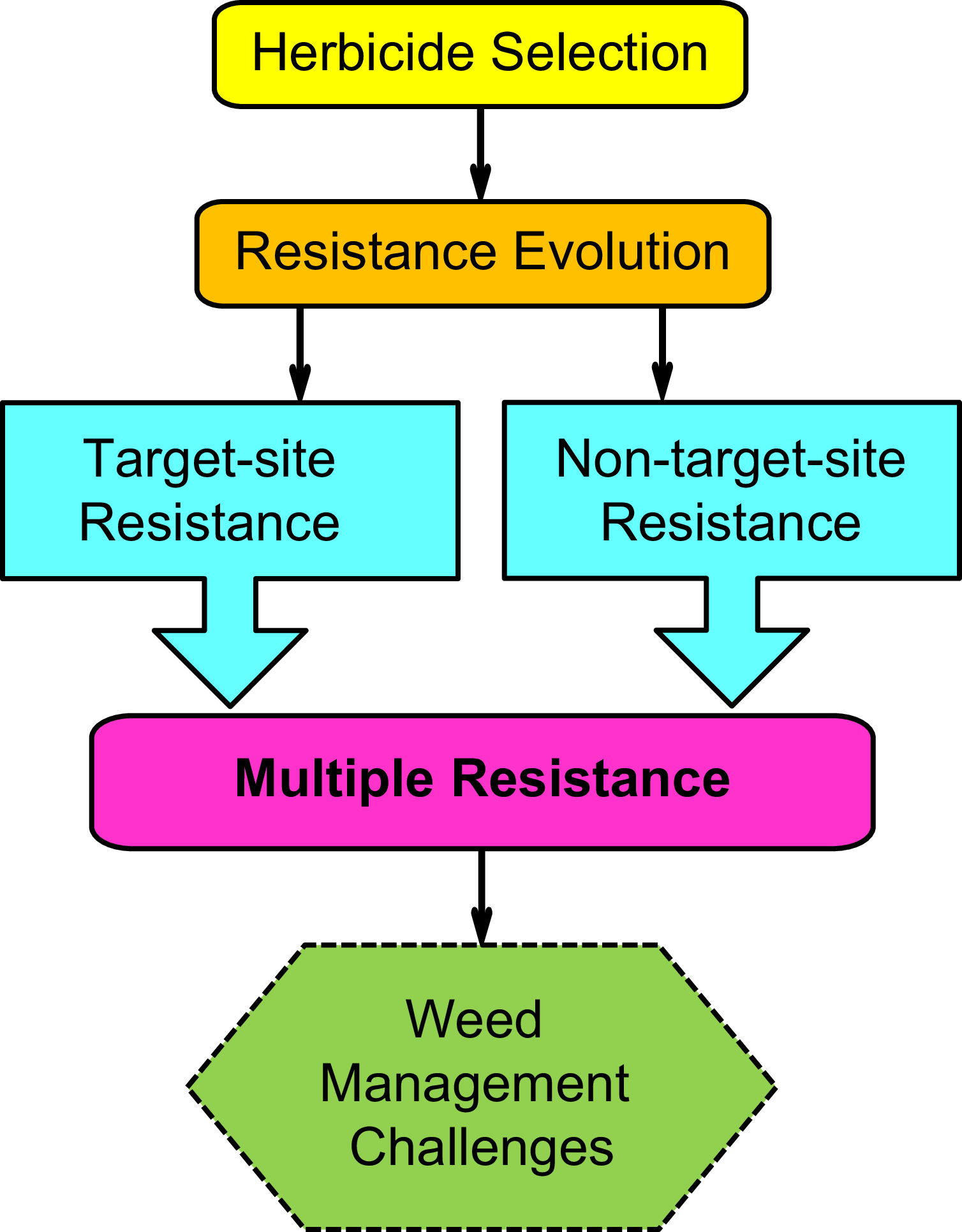
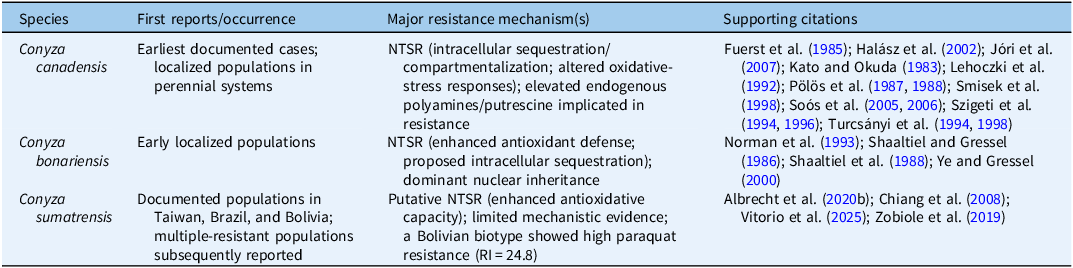
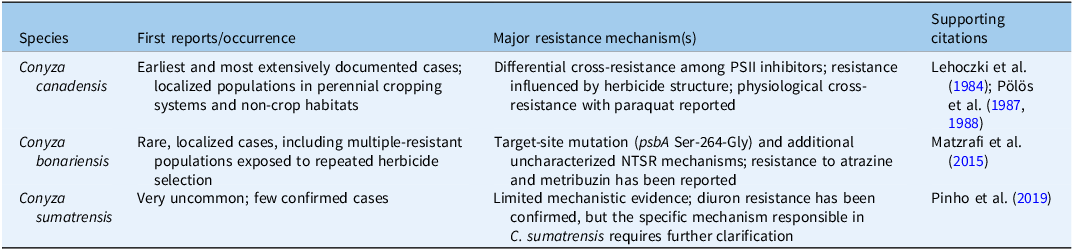
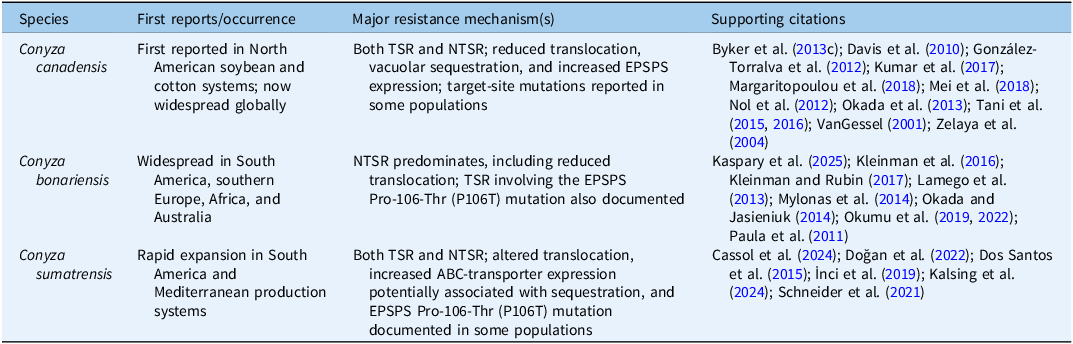
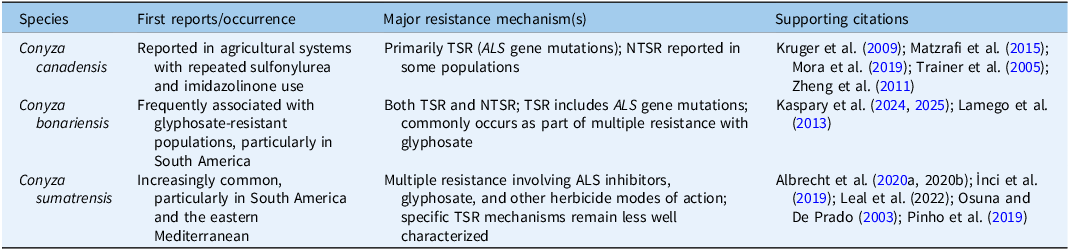


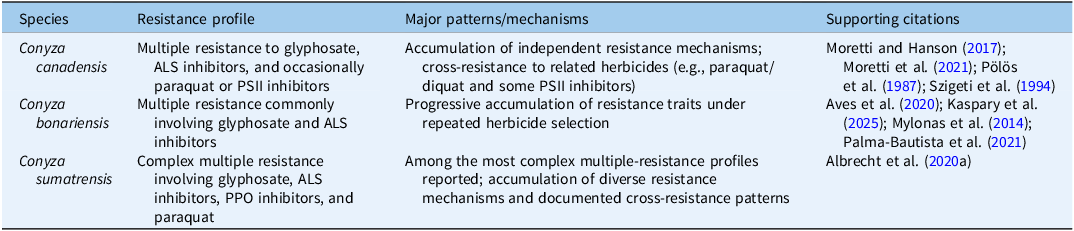
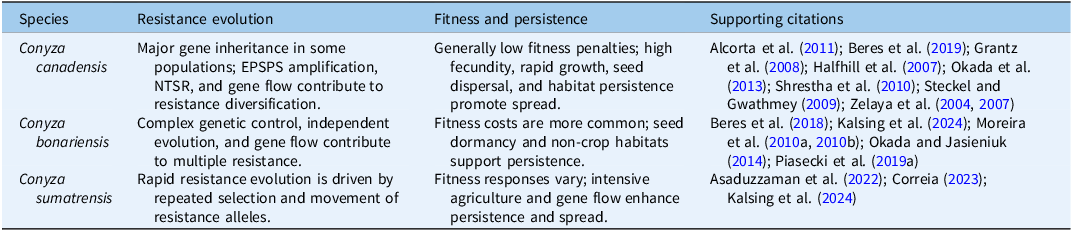
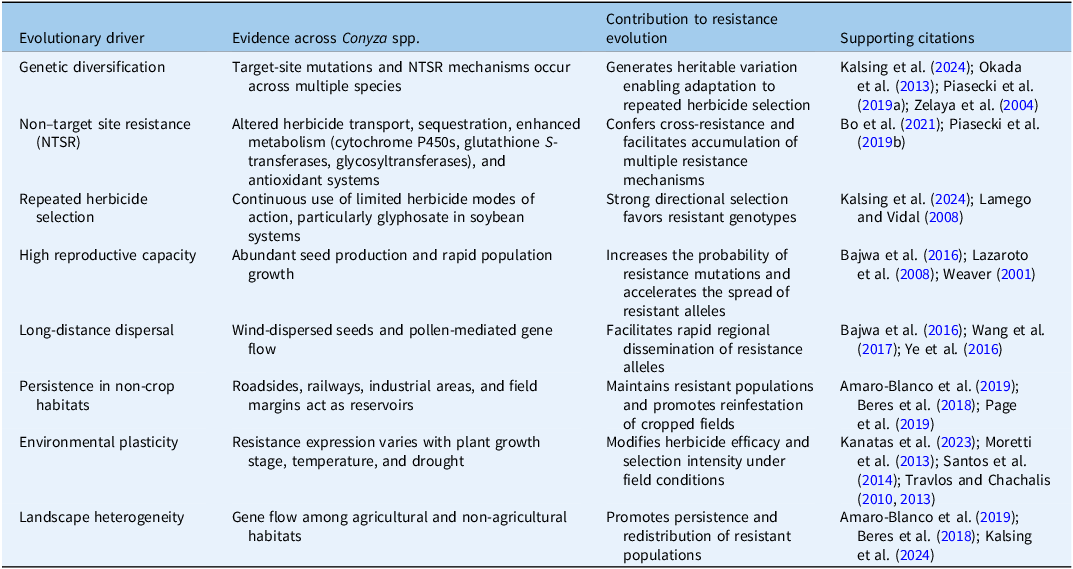
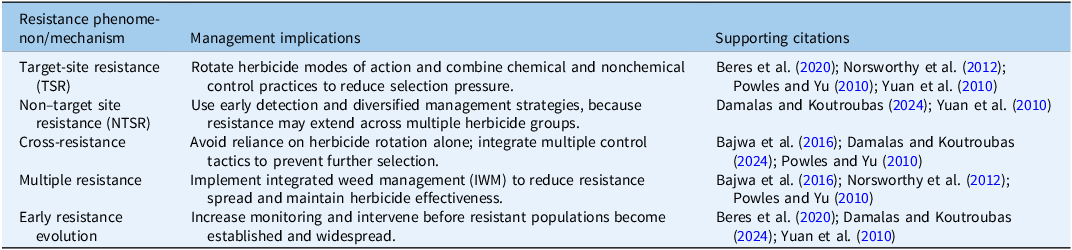


 Open access

