Optimal feeding programs for Jonica breed goats and their lactation curves have not yet been well established. Few attempts have been made to increase the milk production and milk components through dietary manipulation of forage to concentrate ratio in the diets of ruminants. Particularly, the effect in dairy goats on milk production responses to diets varying in forage to concentrate ratio have not been as extensively defined as for beef cattle and sheep (Goetsch et al. Reference Goetsch, Detweiler, Sahlu, Hayes and Puchala2003). The incorporation of concentrate in goat diets is intended to increase dietary energy and protein and to optimize feed utilization for growth, gestation and milk production (Cerrillo et al. Reference Cerrillo, Russell and Crump1999; Sanh et al. Reference Sanh, Wiktorsson and Ly2002; Carnicella et al. Reference Carnicella, Dario, Ayres, Laudadio and Dario2008). Goetsch et al. (Reference Goetsch, Detweiler, Sahlu, Hayes and Puchala2003) reported that high levels of concentrate diet (65%) depressed milk yield in does in late lactation compared with a 50% concentrate diet. Conversely, these results did not support similar influences of dietary concentrate and energy levels with dairy cows (NRC, 2001). High levels of concentrate diet that depress milk production during late lactation might not be true for efficiency of energy use and milk production over the entire lactation period in dairy goats (Min et al. Reference Min, Hart, Sahlu and Satter2005).
Moreover, milk production is largely dependent on the shape of the lactation curve. The key elements that describe the pattern of milk secretion are the peak yield, which represents the maximum output per day during the lactation, and its persistency, which expresses the ability of animals to sustain constant milk yield after the lactation peak. Mathematical modelling of lactation curves provides a valuable tool with which to identify characteristics that best describe superior lactation potential. Modelling of lactation curves would allow extrapolation of information when data are not available, and would aid farmers in management. Modelling could also be used to benefit the industry by aiding in the development of breeding programs to increase the genetic gain of the animals (Groenewald et al. Reference Groenewald, Ferreira, van der Merwe and Slippers1996). To study the lactation curve several papers have dealt specifically with the application of Wood's model (Reference Wood1967) to goat (Fernandez et al. Reference Fernandez, Sanchez and Garces2002; Macciotta et al. Reference Macciotta, Fresi, Usai and Capplo-Borlino2005; Zambom et al. Reference Zambom, Alcalde, Martins, dos Santos, de Macedo, Horst and da Veiga2005) and ewe (Sakul & Boylan, Reference Sakul and Boylan1992; Groenewald et al. Reference Groenewald, Ferreira, van der Merwe and Slippers1996; Portolano et al. Reference Portolano, Spatafora, Bono, Margiotta, Todaro, Ortoleva and Leto1996) breeds. The most commonly utilized method to determine the trend of the lactation curve uses experimental data as a function of time, it is continuous and able to be distinguished throughout lactation (Cappio-Borlino et al. Reference Cappio-Borlino, Portolano, Todaro, Macciotta, Giaccone and Pulina1997). These authors proposed a non-linear modification of Wood's equation for the lactation curve of dairy ewes in order to make it fit better with the rising phase of lactation and this function has been successfully applied to the lactation curve of Italian ewe breeds (Cappio-Borlino et al. Reference Cappio-Borlino, Portolano, Todaro, Macciotta, Giaccone and Pulina1997; Franci et al. Reference Franci, Pugliese, Acciaioli, Parisi and Lucifero1999). Williams (Reference Willians1993), in test models for lactating goats, found that the difference between the residual variance of Wood's model with other models containing more parameters was relatively small, which suggests that the Wood's model may be appropriate to study the factors that affect the lactation curve of goats.
Therefore, the aim of the present trial is to obtain new information about the effect of forage to concentrate ratio in diet on milk yield and composition and to use an appropriate mathematical model to obtain parameter estimates that would provide a better understanding of the biological nature of the different shapes of lactation curves of Jonica breed goats.
Materials and Methods
Experimental design and animal management
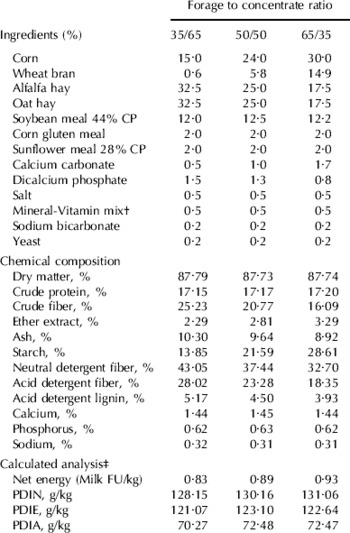
The trial was conducted from April to August of 2006 in Bari province of the Apulia region in Southern Italy (latitude: 41° 7′ and longitude: 16° 52′). Twenty-four dairy Jonica breed goats, with an average body weight of 48·36±4·88 kg, were used from the prepartum (21 d before kidding) to 152 d lactation. Animals were housed in a farm provided with external paddocks before the experiment. Goat health was checked throughout the study period and no cases of clinical mastitis were recorded. Goats were subdivided into three experimental groups, which were balanced for parity, number of kids suckled and milk yield. The experimental design was a completely randomized, with eight replicates per treatment. Goats were kept in individual pens and fed once daily, after morning milking. The trial was divided in two experimental periods of 60 d (early and late lactation). Experimental diets were formulated to provide three different forage to concentrate ratios (35/65, 50/50 and 65/35). Feed ingredient samples were collected weekly and subsequently were analyzed according to Official Analytical Chemists (AOAC, 1990) and Van Soest et al. (Reference Van Soest, Robertson and Lewis1991). The diets were balanced according to goats' requirements of energy, protein and minerals in accordance with INRA (1988), taking into consideration a goat body weight of 50 kg and 2·0 kg of daily milk production (Table 1). The protein (PDIA: digestible CP in the intestine from dietary origin; PDIN: from microbial protein synthesis when availability of fermentable N in the rumen is limiting; PDIE: from microbial protein synthesis when availability of energy in the rumen is limiting) and energy values (Milk FU) were estimated (INRA, 1988).
Ingredient and chemical composition of experimental diets
Values are means for n=15 samples

† Amount provided per kg of diet: vitamin A 20 000 IU; vitamin D3 2000 IU; vitamin E 30 mg; vitamin B1 3 mg; vitamin PP 250 mg; vitamin B12 0·01 mg; Co 0·5 mg; Fe 50 mg; I 2·5 mg; Mn 50 mg; Cu 10 mg; Se 0·1 mg; Zn 105 mg
‡ Calculated according to INRA 1988
Milk sampling and analysis
Daily milk yield oF each goat was recorded by means of graduated measuring cylinders attached to individual milking units. Milk samples from individual animals, consisting of proportional volumes of morning and evening milk, were taken every 2 weeks after cleaning and disinfection of teats and discharging the first streams of foremilk. Samples were collected in 200 ml sterile plastic containers at fortnightly intervals through the lactation period and taken to our laboratory under refrigeration. Milk samples were analysed for protein, fat, lactose (Milkoscan 255; Foss Electric), casein (AOAC, 1990) and somatic cells content (SCC) (Fossomatic 250; Foss-Electric). The SCC data were transformed into a linear score (LS=log2(SCC/12,500) according to Wiggans & Shook, Reference Wiggans and Shook1987). The three renneting properties were determined for milk samples according to Zannoni & Annibaldi (Reference Zannoni and Annibaldi1981) by Formagraph apparatus (Foss Italia, Padova) where rennet clotting time (r) is the time from rennet addition to the beginning of coagulation; curd firming time (K20) is the time from coagulation until reaching the curd firmness corresponding to an amplitude of 20 mm on the Formagraph trace; and curd firmness (A30) is the amplitude of the trace 30 min after the rennet addition.
Statistical analysis and lactation curve model
Data were analysed by ANOVA using the Mixed Procedure of SAS (2001) with the repeated statement (Littell et al. Reference Littel, Henry and Ammerman1998), using the following model:

where Yijk=response at time k on goat j in treatment group i; M=overall mean; Ti=fixed effect of treatment (i=35/65, 50/50, 65/35); Gij=random effect of j goat in i treatment; Pk=fixed effect of time k (k=first 60 d of lactation, last 60 d of lactation); (T×P)ik=fixed interaction effect of treatment i with time k; and eijk=random error at time k on animal j in treatment i.
A nonlinear mixed model (Wood Reference Wood1967) was used to fit the lactation curves to the goats per each dietary group:

where: Yt=milk production (kg) at t time (days of lactation); a=initial milk production (kg); b=rate of increase until reach the peak; C=rate of decline after peak production; t=day of lactation and exp=exponential. Beginning from the considered model parameters, the day of peak production (Pd) and peak production (PP) were analyzed, where: Pd=b/C and PP=a(b/C)b e−b. All results are reported as least squares means.
Results and Discussion
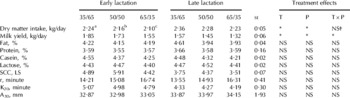
Derived from the composition of forage and concentrate fractions of diets, the ingredients and chemical composition of experimental diets are shown in Table 1. Mean of dry matter intake, milk yield, composition and renneting properties of goats in early and late lactation are reported in Table 2. During the first 60 d lactation, dry matter intake of goats decreased (P<0·05) as forage to concentrate ratio increased. This finding is justified because during prepartum period, dry matter intake of animal is reduced due to the compression of the uterus rumen (Jouany Reference Jouany2006). After parturition, dry matter intake gradually increased and reached the maximum between the 8th and 14th weeks of lactation, which corresponds to the period of high weight gain and increased milk production. During this period, the goats were in positive energy balance, as the dry matter intake was increasing.
Dry matter intake, milk yield and composition, and renneting properties of Jonica goats in early and late lactation fed diets with different forage to concentrate ratio
Values are means for n=80

a,b,c Values in the same row having a different letters differ significantly (P<0·05)
* = P<0·05
† NS, not significant
Milk yield was significantly (P<0·05) affected by forage to concentrate ratio in both lactation stages. In fact milk yield tended to decrease with a decrease in concentrate content. Milk fat concentration was not different among treatments and fat decreased from 4·61 to 3·93% when forages increased from 35 to 65% of diet. Other researchers reported that an increase of forage to concentrate ratio in diet provides higher milk fat, due to the greater formation of acetic acid in the rumen (Min et al. Reference Min, Hart, Sahlu and Satter2005). Kawas et al. (Reference Kawas, Lopes, Danelon and Lu1991) working with cross-bred goats (Saanen×Marota), during late lactation, evaluated the forage to concentrate ratio and did not find significant differences in milk yield and milk protein and lactose content. However, a positive effect was observed between forage to concentrate ratio and milk fat content. The milk protein content did not significantly differ among dietary treatments. Abijaoudé et al. (Reference Abijaoudé, Morand-Fehr, Tessier, Schmidely and Sauvant2000) evaluated the influence of type of starch in the diet on milk production and some qualitative parameters of Saanen and Alpine goats in mid lactation and receiving diets with forage to concentrate ratio of 30/70 or 55/45. They found that the higher forage to concentrate ratio determined the lower ruminal acidity.
Milk casein, lactose and SCC content did not change between the different diets. After the peak production, dry matter intake did not differ significantly compared with the early lactation stage. On the contrary, a similar trend was registered for milk yield which decreased when forage to concentrate ratio increased (P<0·05). Milk casein, lactose and SCC content after the peak production not did not vary significantly between treatments.
Considering the renneting properties, the data obtained fit with the trend described for these parameters during lactation by Bava et al. (Reference Bava, Rapetti, Crovetto, Tamburini, Sandrucci, Galassi and Succi2001), indicating that milk was suitable for cheese making. In particular, dietary treatments did not decrease the milk clotting aptitude. These results are important since most goat milk is destined for cheese production.
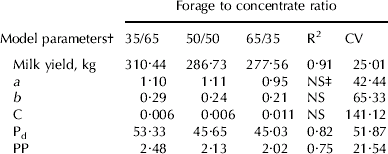
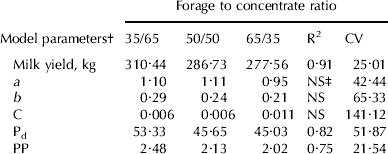
Milk yield and parameters of Wood model are shown in Table 3. The Wood (Reference Wood1967) nonlinear mixed effects model fitted to the lactation data was successful in describing the shapes of the lactation curves of these goats. Increasing the quantity of forage in diet resulted in a negative effect on total milk production (P<0·05), in fact goats fed on higher forage to concentrate ratio have produced the lower quantity of milk. Previous studies in the area have noted that the Wood (Reference Wood1967) model is effective at determining differences between lactation curve shapes within the population (Cappio-Borlino et al. Reference Cappio-Borlino, Pulina and Rossi1995; Franci et al. Reference Franci, Pugliese, Acciaioli, Parisi and Lucifero1999).
Total milk yield, non-linear Wood's model and derived variables (Pd and PP) and coefficients of determination (R2) and variation (CV) of lactation curve of Jonica goat fed diets with different forage to concentrate ratio
† Model parameters: a, initial production; b, rate of increase until reach the peak; c, rate of decline after peak production; Pd, day of peak production; PP, peak production
‡ NS, not significant (P >0·05)
The fit obtained in this study was slightly higher than that reported in a review (Gipson & Grossman, Reference Gipson and Grossman1990) on goats involving the model tested here. Todaro et al. (Reference Todaro, Madonia, Montalbano, Genna and Giaccone2000) using a non-linear modification of the Wood's model obtained a good description of the entire lactation curve. Rota et al. (Reference Rota, Gonzalo, Rodriguez, Rojas, Martin and Tovar1993), making a study of a native Spanish breed goat (Verata), found a good fit of the incomplete gamma model, and the model was adequate to describe parity and stage of lactation. No significant differences were observed in the Wood's model parameters for a (initial production), b (rate of increase until reach the peak) and C (rate of decline after peak production) values due to the forage to concentrate ratio. However, significant differences were obtained, with a negative effect, for Pd (day of peak production, P<0·05) and PP (peak production, P<0·05), on the calculated variables beginning from the model parameters (Rota et al. Reference Rota, Gonzalo, Rodriguez, Rojas, Martin and Tovar1993). This trend was also observed by Zambom et al. (Reference Zambom, Alcalde, Martins, dos Santos, de Macedo, Horst and da Veiga2005) on lactating Saanen breed goats. Moreover, Fernandez et al. (Reference Fernandez, Sanchez and Garces2002) working with Murciano-Granadina goats confirmed a good description of lactation curve using Wood's model, whereas with the Cappio-Borlino model (Cappio-Borlino et al. Reference Cappio-Borlino, Portolano, Todaro, Macciotta, Giaccone and Pulina1997) showed worse fit than the others and failed to predict peak yield.
Therefore, diets with higher proportions of concentrate (35/65 and 50/50) induced milk production throughout lactation, and resulted in a greater persistence of production during the weeks of lactation. Peak lactation was >8 days later and peak production was >20% higher for goats on 35/65 diet compared with those on the 65/35 diet (Table 3). The 35/65 forage to concentrate ratio, during the entire lactation period, provides greater milk production, without influencing the milk quality.
The results confirmed that forage to concentrate ratio, with different energy levels, influences the day of peak production and milk production at the peak of lactation. These increases of lactation output in Jonica goats would be desirable for milk producers of all species as it would aid in feed and reproductive management during lactation. However, there is renewed interest in the persistency of lactation because the maximization of yield does not necessarily represent the best economical choice.
Finally, the low to moderate heritability of lactation persistency suggests the possibility of selecting for the optimal shape of the lactation curve (Chang et al. Reference Chang, Rekayab, Gianola and Thomas2001) and, in conclusion, monitoring energy balance of goats will be important because of the high genetic variability within breed leading to marked differences in milk yield.
The contact details of the corresponding author are: Dr Marie-Hélène Famelart, INRA-Agrocampus Rennes, UMR1253, Science et Technologie du Lait et de I'Oeuf, 65 rue de Saint Brieuc F-35042 Rennes cedex, France. Not Danone as shown in the original manuscript.