Introduction
The radiocarbon results presented in this article are the result of a larger project aimed at synchronising the absolute chronologies of Southern Mesopotamia, the Syrian Jezirah and Iran during the fourth-third millennia B.C. The original intention of the project was to build a large body of radiocarbon dates for important sites from Southern Iraq in order to expand and fine-tune the absolute chronology of the transition from prehistory to history in Sumer and Akkad.
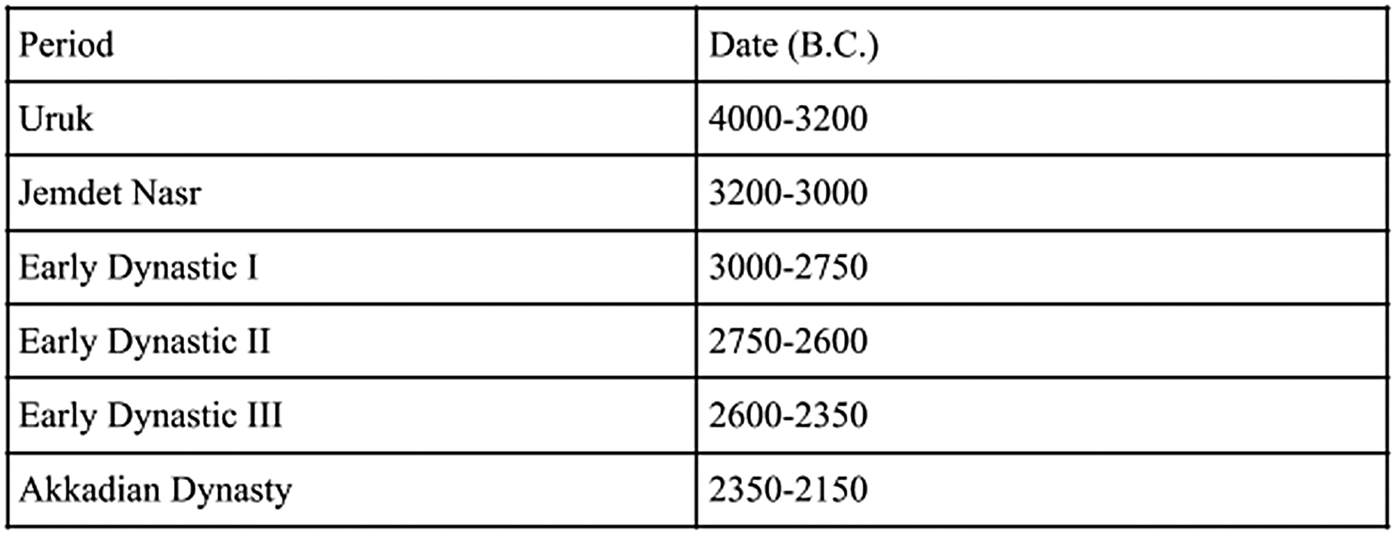
The standard chronology (Fig. 1) of Early Bronze Age Mesopotamia relies heavily on ancient written sources, anchored to absolute calendar dates by astronomical observations and a few historical synchronicities. Apart from problems with the credibility of the astronomical observations, which remain the cornerstone of the third and second millennium B.C. chronology (e.g. Huber Reference Huber1999; Roaf Reference Roaf2012), the availability and reliability of historical sources decrease sharply before the establishment of the Akkadian Empire in the 24th century B.C., forcing researchers to rely on mythologised literary texts (Frayne Reference Frayne2009; Nissen Reference Nissen, Aurenche, Evin and Hours1987; Sallaberger and Schrakamp Reference Sallaberger, Schrakamp, Sallaberger and Schrakamp2015). This problem is further exacerbated by the fact that in Southern Mesopotamia, changes in the archaeological record often do not reflect the dynamics of ancient politics, and vice versa (Koliński Reference Koliński2007: 342; McMahon Reference McMahon2006: 2; Moon Reference Moon1982: 67). Therefore, additional and independent sources of chronological information in the form of scientific dating are needed. Dendrochronology (e.g., Manning Reference Manning2001; Manning et al. Reference Manning, Griggs, Lorentzen, Barjamovic, Bronk Ramsey, Kromer and Wild2016) and radiocarbon dating are important allies for researchers of late prehistory and early history in Southern Mesopotamia. These techniques have had profound influence on our understanding of the appearance and evolution of other ancient civilisations, for example in Egypt (Bronk Ramsey Reference Bronk Ramsey, Dee, Rowland, Higham, Harris, Brock, Quiles, Wild, Marcus and Shortland2010; Dee et al. Reference Dee, Wengrow, Shortland, Stevenson, Brock, Girdland Flink and Bronk Ramsey2013; Dee et al. Reference Dee, Wengrow, Shortland, Stevenson, Brock and Ramsey2014), Iran (Pollard et al. Reference Pollard, Davoudi and Mostafapour2012) and Subartu (Weiss et al. Reference Weiss, Manning, Ristvet, Mori, Besonen, McCarthy, Quenet, Smith, Bahrani and Weiss2012). Previous attempts to reconstruct an absolute chronology based on radiocarbon dating (Bruins Reference Bruins2001; Bruins and Mook Reference Bruins and Mook1989; Bruins et al. Reference Bruins, van der Plicht and Mook1991; Hassan and Robinson Reference Hassan and Robinson1987; Mellaart Reference Mellaart1979; van der Plicht and Bruins Reference van der Plicht and Bruins2001) were hampered by the fact that most of the available radiocarbon measurements lacked sufficient contextual information and/or were performed during the infancy of the radioisotope chronometric technique, and they were thus not subject to appropriate pretreatment and measurement procedures. The need for more comprehensive dating projects on archaeological material from Southern Mesopotamia (Fig. 2) is painfully apparent. This project builds on and contributes to the work of other researchers working to update and expand the database of radiocarbon dates for Southern Mesopotamia (Hritz et al. Reference Hritz, Pournelle, Smith, Albadran, Issa and al-Handal2012; van Ess Reference van Ess, Crüsemann, van Ess, Hilgert and Salje2013; van Ess and Heußner Reference van Ess and Heußner2015; Wright and Rupley Reference Wright, Rupley and Rothman2001).
Conventional absolute chronology of Southern Mesopotamian cultures and periods (based on Postgate Reference Postgate1994: 22).

Map of Iraq, showing the archaeological sites mentioned

Initial attempts to sample and date a larger number of objects from museum collections were hindered by issues of access to material and extremely poor sample preservation. As a result, the project moved its focus to two specific sites, Abu Salabikh in Iraq and Tell Brak in Syria, for which large amounts of short-lived plant material were available (Wencel in preparation). The samples from Tell Fara/Shuruppak and Tell Muqayyar/Ur reported here were the only other ones sufficiently well preserved to allow for dating. In order to contextualise the new radiocarbon dates, they are listed and compared with already published dates from other Mesopotamian sites. The samples from Fara and Ur were taken from materials held by the University of Pennsylvania Museum of Archaeology and Anthropology, Philadelphia, and the British Museum, London, whose help and cooperation made this project possible.
The objects were sampled and dated at the Research Laboratory for Archaeology and the History of Art (RLAHA), University of Oxford, using standard pretreatment methods whenever possible (Brock et al. Reference Brock, Ramsey and Higham2007, Reference Brock, Higham, Ditchfield and Ramsey2010). The radiocarbon measurements were performed with the Oxford Radiocarbon Accelerator Unit (ORAU) Accelerator Mass Spectrometre (AMS) (Bronk Ramsey et al. Reference Bronk Ramsey, Higham and Leach2004).
The radiocarbon date from Fara

Tell Fara / Shuruppak
OxA-33,185 (4178 ± 35 B.P.)
Object type: bone tool (unknown species)
Museum no.: Penn 33-13-432
Context info.: DE 39; Grave, Level 2; Exc. no. 436
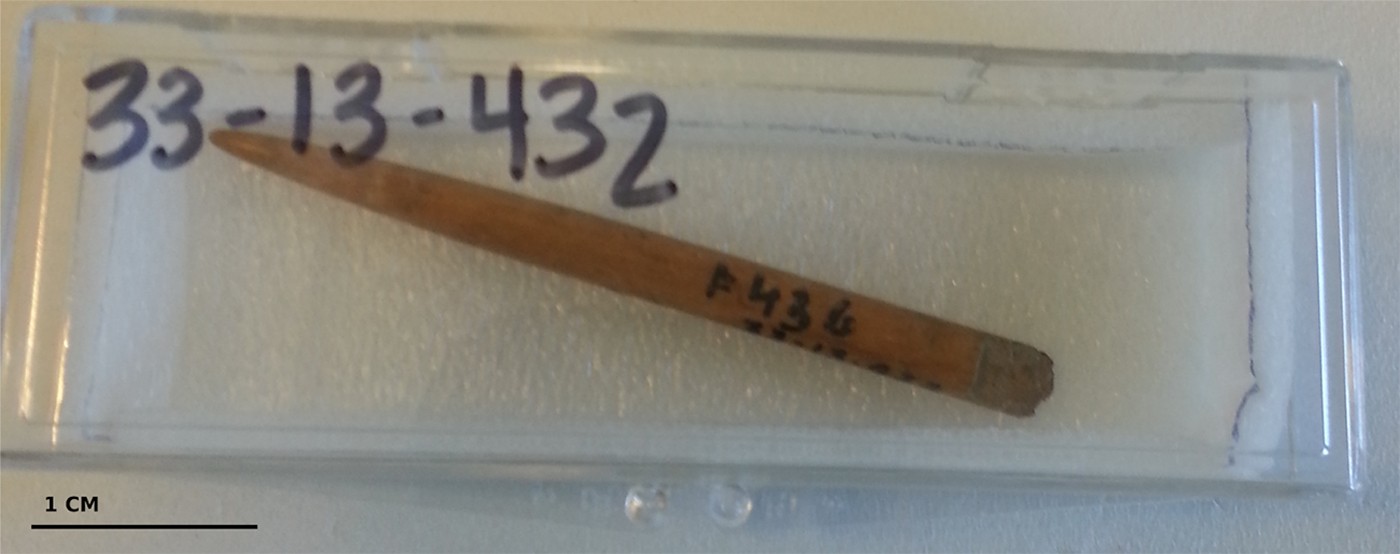
This small broken bone pin was the only one of five sampled Early Dynastic (hereafter ED) I/II tools from Fara to produce sufficient collagen yield, which is usually used for radiocarbon dating (Fig. 3). There seems to be a slight conflict of information regarding the context of this sample. On the one hand, according to the museum records, this object came from Level 2. On the other, its recorded depth is 3.4 to 3.5 m below the surface, which would place it in Level 4 (Martin Reference Martin1988: 24). This makes me believe that the object likely came from the fill of one of the graves sunk from Level 2. Though the number of the grave is not recorded, one may expect the pin to have originally come from the shaft of one of the following deep graves in D E 39: 11, 13, or 14. All three of these graves are believed to have corresponded to the late ED I/II, pre-ED IIIa period on the basis of stratigraphy and associated finds (Martin Reference Martin1988: 26–31). Given the Fara-style (ED IIIa) tablet found just below Level 1, the date provides a good terminus post quem for the ED IIIa period on the site.
Bone pin, Penn 33-13-432 from Tell Fara/Shuruppak, sampled for radiocarbon dating
The pin was polished (possibly waxed) and glued, therefore the sample's surface was air-abraded prior to solvent wash. A section of the pin was drilled and the powder underwent standard solvent extraction and acid-alkali-acid pretreatment, followed by collagen extraction.
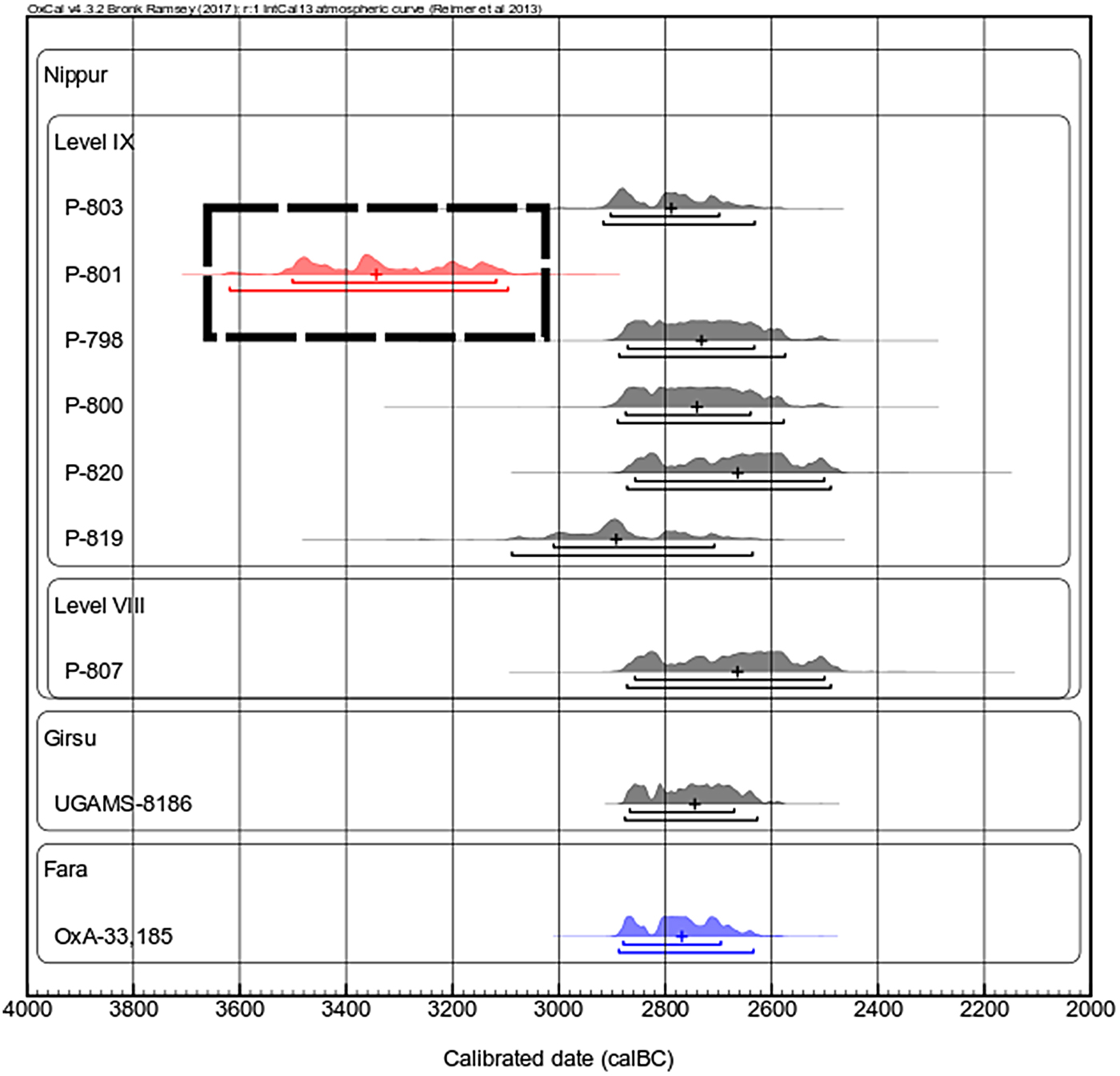
As visible in Figure 4, a plateau in the calibration curve c. 2850–2550 B.C. adversely affects the precision of the measurement. Nevertheless, the result suggests a range of c. 2880–2700 B.C. as the most likely date for the pin. The date finds its closest parallels in the samples from Levels IX and VIII at the Nippur Inanna sounding (Stuckenrath Reference Stuckenrath1963; Stuckenrath and Ralph Reference Stuckenrath and Ralph1965) plotted in Figure 5. Together with the ceramic evidence (Hansen Reference Hansen and Ehrich1965; Hansen and Dales Reference Hansen and Dales1962; Wilson Reference Wilson, Finkbeiner and Röllig1986) as well as the few cuneiform tablets recovered from these levels (Buccellati and Biggs Reference Buccellati and Biggs1969), the radiocarbon sample from Fara confirms the ED I/II date of the context. Moreover, it corresponds closely to the single radiocarbon measurement performed on a sample from pre-Ur-Nanshe levels at Tello/Girsu (Hritz et al. Reference Hritz, Pournelle, Smith, Albadran, Issa and al-Handal2012).
Probability distribution showing the calibrated date OxA-33,185 from Fara

Comparison of radiocarbon dates from ED I/II contexts from the Nippur Inanna Temple Sounding, Girsu, and Fara; P-801 is highlighted as an obvious outlier

Tell Muqayyar/Ur
OxA-33,848 (4166 ± 32 B.P.)
Object: wood (Cedrus libani)
Museum no.: BM 1935,0116.87
Context: coffin wood from PG1648
PG1648 was described by Woolley as the smallest of all the royal tombs - a single limestone chamber no larger than 2 x 1.5 metres (Woolley Reference Woolley, Burrows, Keith and Legrain1934: 133–134). It was dominated by a wooden coffin, which contained a poorly preserved skeleton of a young man. Beads of gold, silver and lapis lazuli placed around the individual's head suggested an elaborate headdress. The chamber contained three subsidiary burials: a male and two females, one young and one older. Molleson and Hodgson (Reference Molleson and Hodgson2003) analysed the skeletons and found that the bodies had been exposed to high temperatures and that the male body showed stress commensurate with head basket-carrying. Not much can be said about the stratigraphic position of the grave, except that it is overlaid by another small royal tomb, PG1618. The coffin fragment was identified by Dr C. Cartwright as cedar wood, at least 35 years old at the time of its felling. The sample is therefore likely affected by the old wood problem.
Wood samples from the Royal Cemetery at Ur proved extremely difficult to date due to poor preservation. Standard pretreatment methods involving the alkali phase were too destructive, and so an alternative approach was adopted. The sample was cleaned with a weak HCl solution, followed by seven rounds of microfiltering and ultrasound baths in ultrapure water. This method is likely to be less effective in removing humic acids from the sample; however, previous studies (Wild et al. Reference Wild, Steier, Fischer and Höflmayer2013) showed the potential effects of exogenous humic acids on Bronze Age samples from the Eastern Mediterranean to be minimal, and therefore it is unlikely that the choice of the pretreatment protocol affected the final readings.
OxA-34,011 (4211 ± 32 B.P.)
Object: wood (Cedrus libani)
Museum no.: BM 1935,0116.87
Context: coffin wood from PG1648
The sample was taken from the same piece of wood as OxA-33,848. The two measurements were combined into a single date estimate.
OxA-X-2685-8 (3992 ± 36 B.P.):
Object: ox tooth
Museum no.: BM 1935,0116.17
Context: PG789
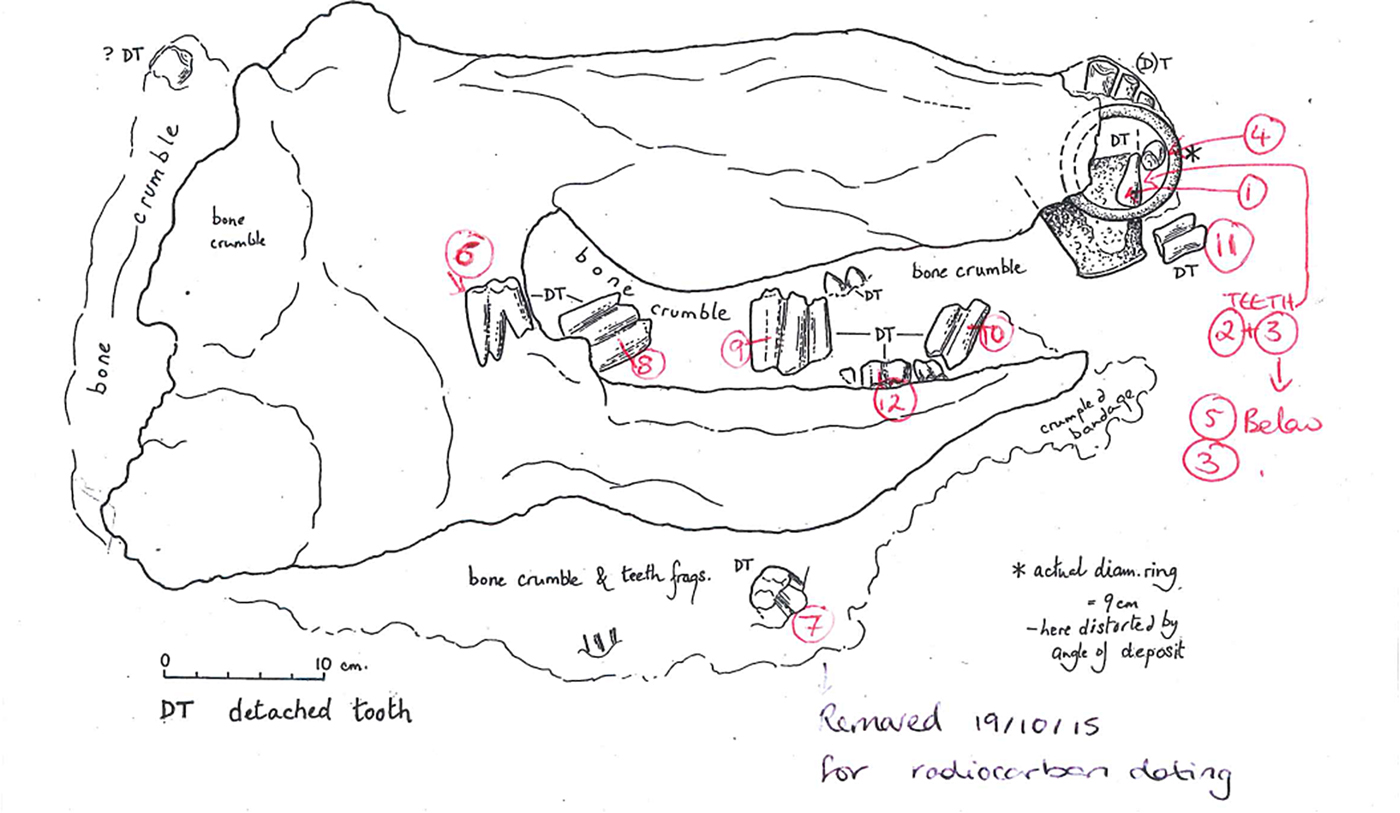
A detached molar (no. 7 in Fig. 6) was found near an ox jaw in the richly furnished PG789. The tooth most likely belonged to the ox which pulled the ceremonial chariot. The animal itself was decorated with jewellery, as evidenced by a gold nose-ring (c. 9 cm in diameter). There is therefore little doubt that the ox tooth can be associated with the royal burial.
Sketch of the ox jaw found in PG789; molar marked with 7 was sampled for dating. Courtesy of Dr. A. Fletcher, British Museum

Unfortunately, none of the teeth recovered from the Royal Cemetery yielded enough collagen to allow dating. As a result, the radiocarbon measurement was performed on the mineral fraction. Previous attempts to date the mineral fraction of bones and teeth (Cherkinsky Reference Cherkinsky2009; Zazzo Reference Zazzo2014; Zazzo and Saliège Reference Zazzo and Saliège2011) showed that there is a visible difference between dates performed on bioapatite and collagen from the same organism. The likely explanation for this difference is the fact that mineral fractions are known to exchange carbon with the environment post-deposition, unlike collagen which simply degrades and decomposes. Unfortunately, the difference is by no means systematic and can result in the apatite dates being either younger or older by anywhere between 0 and 300 years for samples from the last 10,000 years, depending on the type of environment, water percolation and pre-treatment method used. For these reasons, bioapatite dates are seen as less reliable than their collagen counterparts. ORAU protocols do not include a standard methodology for bioapatite samples. For the purpose of this study, the chemical pretreatment method developed by Hopkins et al. (Reference Hopkins, Snoeck and Higham2016) was adopted. The study tested several pretreatment methods and identified one which produced dates which, while still possibly younger (by 0-100 years), were the closest to those performed on the collagen fraction. Therefore, although not as reliable as a potential collagen date, this measurement provides the most likely age estimate for the tomb's construction.
BM-64 (3920 ± 150 B.P.)
Object: human bone
Context: PG755
Source publication: Barker and Mackey Reference Barker and Mackey1961
This bone sample came from the skeleton of a young man usually identified as king Meskalamdu of Ur. This sample, together with BM-70 and BM-76, was published in 1961 and represents the very earliest attempt to apply radiocarbon dates to archaeological contexts in the region, hence the enlarged measurement error.
BM-70 (4030 ± 150 B.P.)
Object: human burnt bone
Context: PG1515
Source publication: Barker and Mackey Reference Barker and Mackey1961
The identity of the individual buried in the grave is unknown.
BM-76 (3990 ± 150 B.P.)
Object: human bone
Context: PG800
Source publication: Barker and Mackey Reference Barker and Mackey1961
This bone sample came from the female skeleton usually identified as queen Pū-abim.
P-724 (3959 ± 59 B.P.)
Object: wood
Context: unknown
Source publication: Stuckenrath and Ralph Reference Stuckenrath and Ralph1965
This reading was performed on a bulk sample of wood collected from various axes found within the graves. Little can be said about the context of this sample, however the fact that measurement has been performed on material likely affected by the old wood effect gives sufficient grounds to treat it as a terminus post quem for the bone samples.
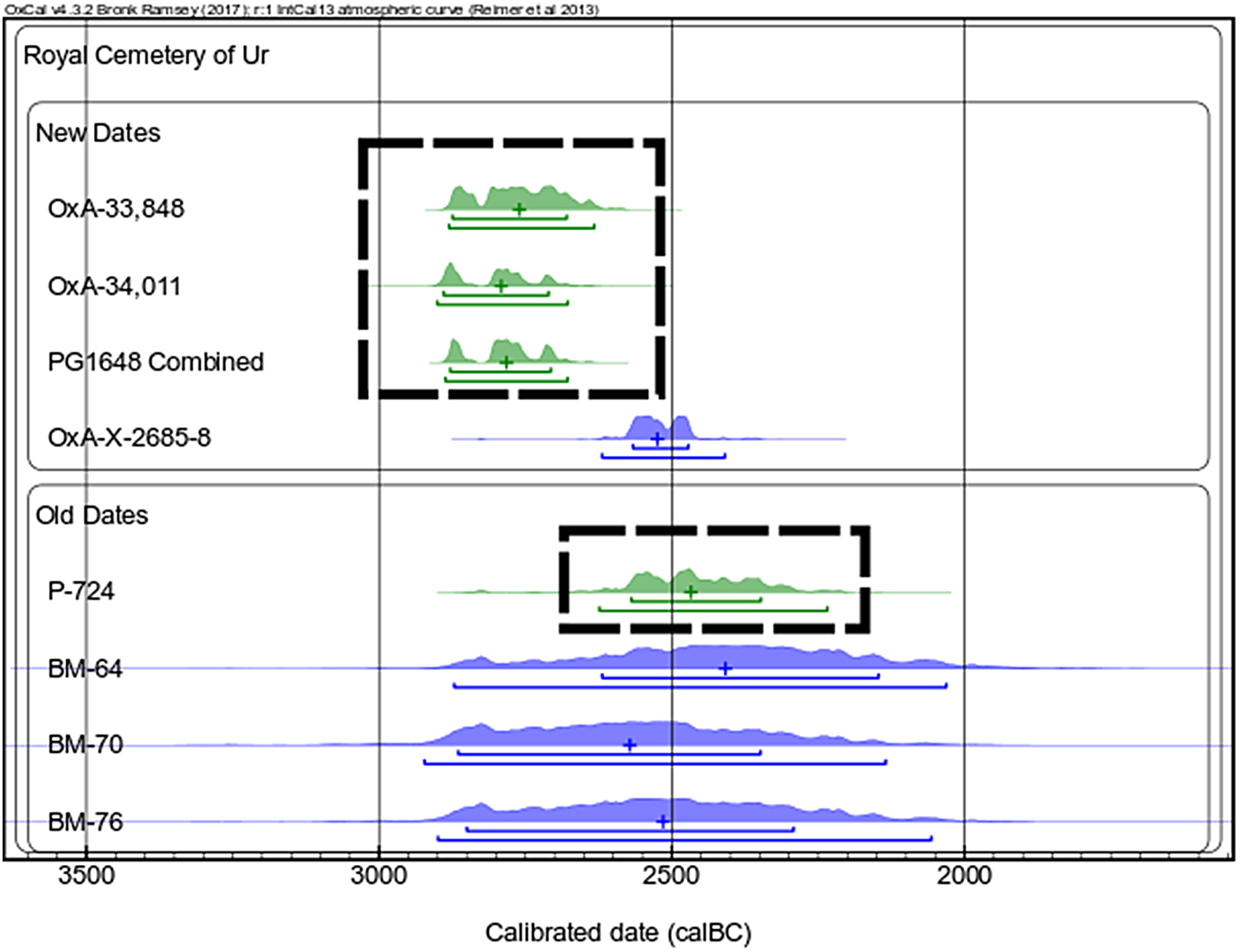
Figure 7 clearly shows the difference in age between the wood and bone samples. As expected, the wood samples are older, most likely indicating an offset due to inbuilt age. The date of P-724 seems closer to the bone apatite date, however the credibility of the sample is questionable due to the mixed source material. The early British Museum dates are too imprecise to allow for any meaningful inference. Therefore, OxA-X-2685-8 remains the most reliable age estimate for the construction of the early graves in the Royal Cemetery, placing it most likely in the 2500 ± 50 B.C. range.
Radiocarbon dates from the Royal Cemetery of Ur; dates taken on wood samples are highlighted

New radiocarbon results for the Royal Cemetery of Ur

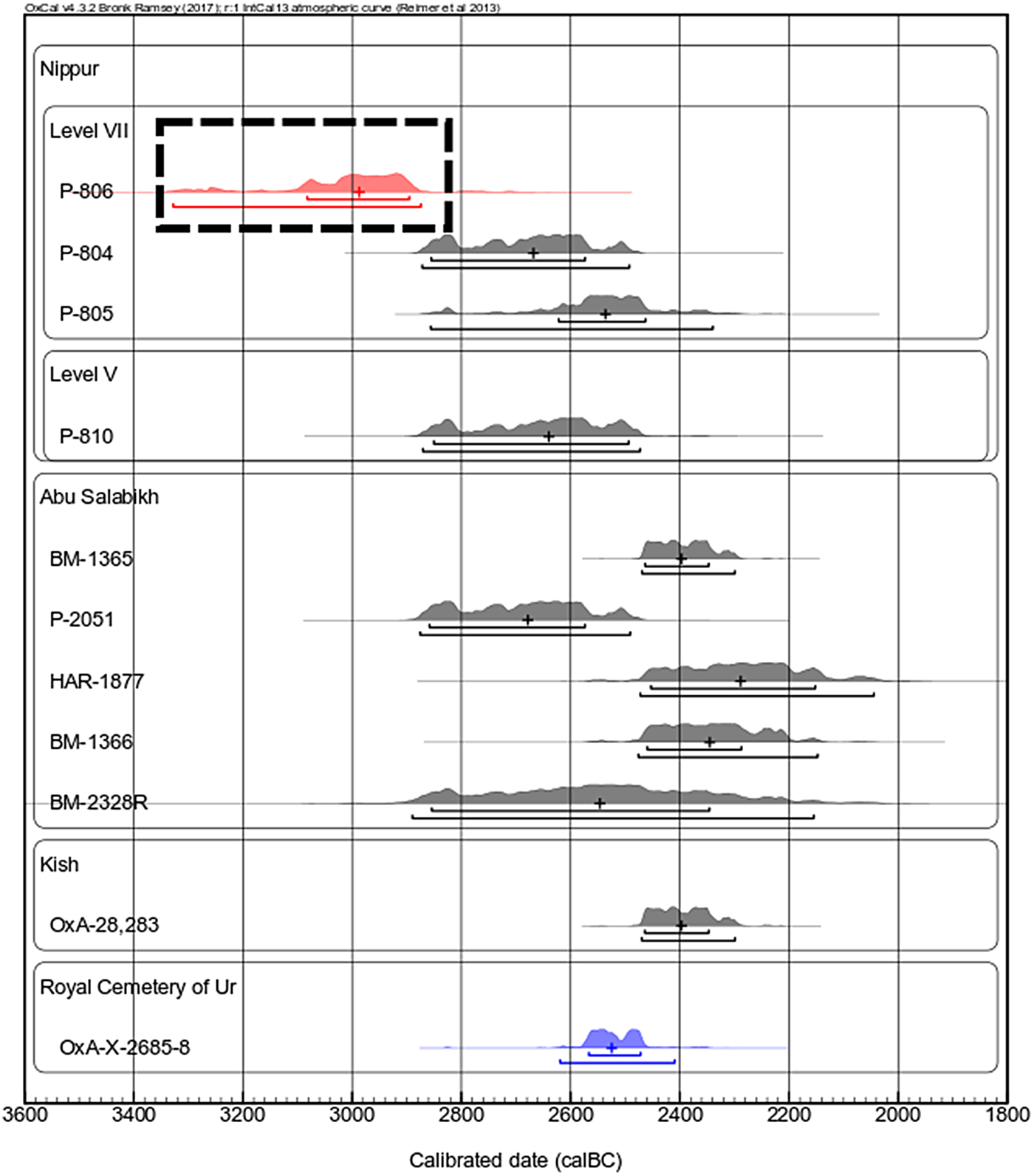
The comparison of radiocarbon dates in Figure 8 shows that Nippur Inanna levels VII-V (Stuckenrath Reference Stuckenrath1963; Stuckenrath and Ralph Reference Stuckenrath and Ralph1965) appear to be slightly older than the age estimate for the Royal Cemetery. Considering, however, that the Nippur dating was performed on charcoal samples, this may be the result of inbuilt age. Though the Inanna levels VIII-V were rather poor in datable ceramic, some finds (especially stone bowls, inlays and seals) from Level VII suggest that the stratum was roughly contemporary with the Royal Tombs of Ur (Hansen & Dales Reference Hansen and Dales1962: 79; Hansen Reference Hansen and Ehrich1965: 209). Radiocarbon samples from Areas A and E in Abu Salabikh (Bowman et al. Reference Bowman, Ambers and Leese1990; Burleigh and Matthews Reference Burleigh and Matthews1982; Fishman et al. Reference Fishman, Forbes and Lawn1977) plotted in the graph (Fig. 8) all came from contexts closely associated with the Fara-style tablets, often seen as characteristic of the ED IIIa period (Biggs Reference Biggs1966; Biggs Reference Biggs1974; Biggs and Postgate Reference Biggs and Postgate1978; Krebernik and Postgate Reference Krebernik and Postgate2009). Except for two very imprecise readings (BM-2328R and P-2051), the dates seem younger than the Royal Cemetery Tombs, which may be surprising. The BM readings from this batch, however, are problematic for technical reasons (Bowman et al. Reference Bowman, Ambers and Leese1990; Tite et al. Reference Tite, Bowman, Ambers and Matthews1987), and a new absolute chronology for Abu Salabikh (Wencel in preparation) allows us to doubt the credibility of these readings. A single date from the Ywn sounding in Kish (Zaina Reference Zaina2015) appears younger, which is to be expected considering the fact that its context was identified as more or less contemporaneous with Cemetery A at Kish, i.e. late ED IIIb/Akkadian in date. In summary, the radiocarbon dating of some of the earliest graves in the Royal Cemetery at Ur places it on the verge of ED IIIa and ED IIIb, corroborating archaeological periodisation.
Comparison of radiocarbon dates from ED IIIa/b contexts from Nippur, Kish, Abu Salabikh, and the Royal Cemetery of Ur; P-806 is highlighted as an obvious outlier

Concluding Remarks
Although the results presented in this report do not contradict the conventional absolute chronology, they do contribute to the general discussion about the transformations which occurred in Southern Mesopotamia during the early third millennium B.C. Firstly, they offer a useful benchmark for the construction of more refined chronological models. Secondly, they provide independent support for a chronological scheme which, until now, has been highly speculative. The dates discussed in this paper have not been modelled, which means that the numbers were presented as they are, without any supplementary assumptions. The ultimate goal of this dating project is to follow a holistic, interdisciplinary methodology combining historical, archaeological, and radiocarbon data, using modern statistical techniques, in order to arrive at reliable and precise date estimates. Nevertheless, even the most sophisticated statistical technique will not be able to produce reliable estimates if the model has to rely on flawed, incomplete, or skewed datasets. For this reason, the importance of an in-depth assessment of the quality of individual radiocarbon dates and their archaeological provenience cannot be overstated. Further work on materials from Abu Salabikh and Tell Brak will provide additional radiocarbon measurements to address the problem of the limited radiocarbon dataset, before the entire database of radiocarbon measurements can be combined into a regional chronological model. Radiocarbon dating as well as other scientific chronometric techniques provide the unique opportunity to weigh in on relevant archaeological debates such as the date and duration of controversial periods or cultures (e.g. Jemdet Nasr, ED II), correspondence between history and archaeology (e.g. the Royal Cemetery of Ur and the First Dynasty of Ur), or the philological and palaeographic development of the cuneiform script (e.g. Fara tablets and ED IIIb texts). Future radiocarbon work should target such problematic periods in order to fully exploit the strengths of the technique.
Acknowledgements
I would like to thank Dr A. Fletcher, Dr B. Halgestad, and Dr C. Cartwright of The British Museum, and Ms L.A. Grant of the University of Pennsylvania Museum for their help in gaining access to the samples. I am also extremely grateful for the supervision of Prof. C. Bronk Ramsey and Prof. M. Dee. The project would be impossible without the generous help of the Lorne Thyssen Scholarship and the Natural Environment Research Council, UK.