INTRODUCTION
Biogenic Modiolus modiolus (L.) reef communities are rich in species (e.g. Thorson, Reference Thorson1971; Holt et al., Reference Holt, Rees, Hawkins and Seed1998; Rees et al., Reference Rees, Sanderson, Mackie and Holt2008) and have a limited distribution in UK coastal waters (see Holt et al., Reference Holt, Rees, Hawkins and Seed1998). They are of nature conservation importance partly because of the rich assemblage of organisms associated with them, and they are identified as one of the important reef types in Special Areas of Conservation (1992 EC Habitats and Species Directive: Council Directive 92/43EEC) and as a priority habitat by the Oslo Paris Commission (OSPAR). Lindenbaum et al. (Reference Lindenbaum, Bennell, Rees, McClean, Cook, Wheeler and Sanderson2008) provide evidence that established reefs are long-lived features of 150 years or more. However, some M. modiolus beds have been degraded or destroyed by fisheries using mobile gear, particularly scallop dredges and trawls (Service & Magorrian, Reference Service and Magorrian1997; Veale et al., 2001; Roberts et al., Reference Roberts, Davies, Mitchell, Moore, Picton, Portig, Preston, Service, Smyth, Strong and Vize2004).
Some M. modiolus reefs appear on side-scan sonar images to have an undulating bed-form (see Wildish et al., Reference Wildish, Fader, Lawton and MacDonald1998). This morphology is characteristic of the reef surveyed in our study, which was located in the Irish Sea, north of Pen Llŷn, in north-west Wales (52°56′ N 04°38′W; Lindenbaum et al., Reference Lindenbaum, Bennell, Rees, McClean, Cook, Wheeler and Sanderson2008; Figure 1). Side scan sonar and multibeam images from this reef area are shown in part I of this series of papers (Lindenbaum et al., Reference Lindenbaum, Bennell, Rees, McClean, Cook, Wheeler and Sanderson2008), where the extent of the reef, mapped by applying geographical information system methods to geoacoustic data, is shown to be between 349 and 373 ha.
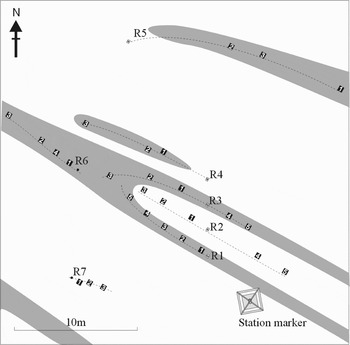
Schematic scale diagram of epibenthic quadrats at the north Pen Llŷn Modiolus reef station in June 1999. Quadrat positions were deployed along transects originating from row markers (R1–R7). Grey areas indicate distinctive ridges.

Photographic series from sledge-mounted still-cameras triggered by timers had previously indicated patchiness in epifaunal composition at this site (E.I.S. Rees, personal observation) as did a diving survey (Bunker, Reference Bunker1999). Some of the spatial variation seemed to relate to the sequence of sub-habitats associated with the undulating surface, where a mass of Alcyonium digitatum (L.) colonies and other fauna appeared to be attached to the live M. modiolus. Variation in community assemblage associated with the physical structure or complexity of mussel matrices have been shown in other species (Suchanek, Reference Suchanek1980; Tsuchiya & Nishihara, Reference Tsuchiya and Nishihira1985, Reference Tsuchiya and Nishihira1986; Asmus, Reference Asmus1987; Lintas & Seed, Reference Lintas and Seed1994; Stewart et al., Reference Stewart, Miner and Lowe1998) and mussel beds often support diverse macrofaunal communities (e.g. Lintas & Seed, Reference Lintas and Seed1994; Gunther, Reference Gunther1996; Seed, Reference Seed1996; Ragnarsson & Raffaelli, Reference Ragnarsson and Raffaelli1999; Thiel & Ullrich, Reference Thiel and Ullrich2002; Tsuchiya, Reference Tsuchiya2002) especially when compared to surrounding assemblages (Valentine & Heck, Reference Valentine and Heck1993; Crooks, Reference Crooks1998). The present work aimed to use targeted in situ recording by divers to measure the spatial variations in the epifaunal community between the sub-habitats formed by the ridge and trough morphology of the horse mussel reef. Monitoring the horse mussel reef is desirable because of its designated importance in European legislation and identifying, accounting for, and removing sources of natural variation is an important precursor to the development of assemblage-based monitoring schemes (e.g. Holland et al., Reference Holland, Shaignessy and Hiegel1987; Underwood, Reference Underwood1997; Krebs, Reference Krebs1999).
MATERIALS AND METHODS
Using the acoustic mapping work of Lindenbaum et al. (Reference Lindenbaum, Bennell, Rees, McClean, Cook, Wheeler and Sanderson2008: figure 4), a fixed benthic station marker, re-locatable by an acoustic beacon, was placed on part of the same horse mussel reef. The station was 1.5 km from the north Pen Llŷn coast (Lindenbaum et al., Reference Lindenbaum, Bennell, Rees, McClean, Cook, Wheeler and Sanderson2008; Figure 1) with a prevailing south-westerly fetch to St Georges Channel and the Irish coast of about 200 km. The depth was 32 m below chart datum and the seawater was fully saline in this area with an average spring tidal run of approximately 2 knots or 100 cms−1 (Hydrographic Office, 1992). Near-benthic seawater temperatures here typically range from 8 to 16ºC over a year (W.G. Sanderson & R.H.F. Holt, unpublished data). Ridge and trough sub-habitats around the station were marked by SCUBA divers on 5 June 1999. Quadrats were then deployed at stratified random positions along transect lines on five reef ridges and two troughs (rows 1–7; Figure 1). The quadrats used were 0.5 × 0.5 m and were divided into 25 equal squares with cord to assist in situ recording. A team of divers were trained to recognize a list of species based on a previous inventorial survey (Bunker, Reference Bunker1999) and to spread observer variability across the bed-form types each person recorded from the different ridge and trough features.
All multivariate analyses employed the Bray–Curtis similarity coefficient and were carried out using PRIMER v.6 (Clarke & Gorley, Reference Clarke and Gorley2006). Numerical abundances in the cluster analysis of the quadrat samples were scaled by a square root transformation in order to limit the influence of species exhibiting high numerical dominance. The hierarchy of the dendrogram was determined by group average fusion and a SIMPROF permutation procedure tested the significance (at 5% level) of the clusters. Analysis of similarities (ANOSIM) was used to examine the effect of the location factor, and the species contributing most to the dissimilarity between ridge and trough samples were examined using SIMPER analysis.
Still photographs from an underwater camera sledge survey of the whole horse mussel reef in July 1994 and video footage from another survey across the reef in July 1999 (E.I.S Rees, unpublished data) were reviewed to provide context to the present work.
RESULTS
The majority of epifaunal species encountered were readily enumerated in situ. However, some species could not be reliably counted because they were small and hidden in the crevices made by the Modiolus modiolus clumps. For this reason Alcyonium digitatum colonies <15 mm were not counted and records of several abundant species such as the porcelain crab Pisidia longicornis (L.), saddle oyster Pododesmus patelliformis (L.), slit-limpet Emarginula fissura (L.), calcareous tubeworm Pomatoceros spp., and the barnacles Balanus balanus (L.) and Verruca stroemia (Müller) were excluded from subsequent multivariate analyses. Colonies of the hydroids Abietinaria abietina (L.) and Halecium halecinum (L.) were too aggregated for separate colonies to be counted so the numbers of clumps were recorded.
Divers noted 61 epifaunal taxa on the ridges and 27 in the troughs (Figure 2). All except four of the taxa from troughs were also found on the ridges. Of these, two were single records of motile fauna (Liocarcinus depurator (L.) and Onchidoris bilamellata (L.)) and the others were incompletely determined taxa (Hydrozoa indet. and ?Polycarpa sp.) that could have been species that were recorded on the ridges.
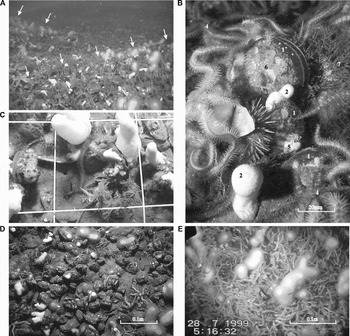
North Pen Llŷn Modiolus modiolus reef. (A) General view of bed-forms showing ridges (arrows); (B) close-up view of horse mussel ridge community: 1, Modiolus modiolus; 2, Alcyonium digitatum; 3, Psamechinus miliaris; 4, Ophiothrix fragilis; 5, Balanus balanus; 6, encrusting Bryozoa indet.; 7, Sertularella sp.; (C) image from video record of quadrat from row 7. One complete sub-square (10 × 10 cm) is visible; (D) image from towed camera on sled during July 1994; and (E) image from towed video in approximately the same place and depth (30 m) as D in July 1999. Images from: (A) Paul Kay, Marine Wildlife Photo Agency; (B) B. Sanderson; (C) R. Holt; (D) I. Rees; and (E) University of Wales Bangor/Countryside Council for Wales.

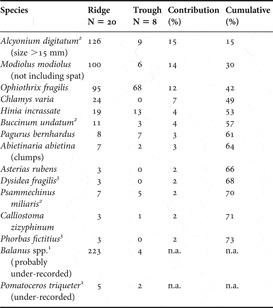
Table 1 shows the estimated numbers m−2 of the more abundant taxa that could be counted in situ. Modiolus modiolus (not including spat) was about 17 times more abundant in the ridge than the trough quadrats. Similar or greater differences applied to the species that preferentially settle on the living mussels, such as Alcyonium digitatum and Chlamys varia (L.). For species less directly exploiting the mussels for attachment the differences were much less, these included the brittle star Ophiothrix fragilis (Abildgaard), the gastropod Hinia incrassata (Ström), the hermit crab Pagurus bernhardus (L.) and the sea urchin Psammechinus miliaris (Gmelin).
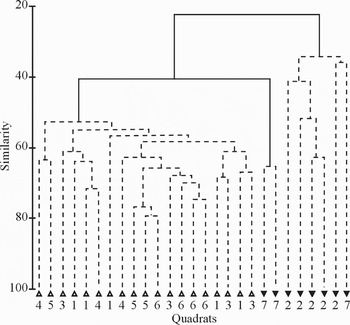
Cluster diagram based on Bray–Curtis similarity matrix for square root transformed epifaunal records on the horse mussel bed. Codes for records indicate the ridges/troughs from which they are derived (see Figure 1). Hatched lines, non-significantly differing quadrats (SIMPROF P > 0.05); open triangles, ridge; filled inverted triangles, trough.

Abundances, converted to N/m2 of the species contributing most to significant ridge/trough dissimilarity based on 28 quadrats. (ANOSIM significant at 0.1% based on 999 permutations; global R value 0.721.) The contribution and cumulative contribution made by each species to this difference was provided by SIMPER analysis.

1Species not included in multivariate analyses; 2species sensitive to scallop dredging (Hill et al., Reference Hill, Brand, Veale and Hawkins1997, Reference Hill, Veale, Pennington, Whyte, Brand and Hartnoll1999); 3Poriphera likely to be sensitive to scallop dredging (Veale et al., Reference Veale, Hill, Hawkins and Brand2001); n.a., not applicable.
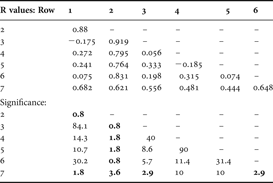
Clustering and ANOSIM showed the separation between the ridge and trough quadrats (Figure 3; Table 2). Collectively, trough records accounted for at least 40% of the total dissimilarity. Individual ridges did not seem to show any aggregation. Dissimilarities between rows 4 and 5 and row 7 were not statistically significant (Table 2) but these ridges were reported to be more morphologically variable and had lower levels of replication.
R values and significance of pairwise comparisons between rows from analysis of similarities (ANOSIM). Based on 999 permutations: random sample from a large number. Global test has R value of 0.368. Significant at 0.1%. Significantly different pairwise comparisons in bold.

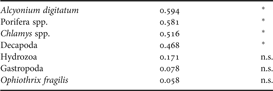
Within the group of quadrats from the ridges there were significant positive correlations between the ranked abundances of Modiolus modiolus in each quadrat and the abundances of Alcyonium digitatum, and Chlamys spp. (Table 3). Porifera and Decapoda were also correlated with mussel abundance, but there was no significant relationship for Ophiothrix fragilis, Hydrozoa or Gastropoda.
Spearman's rank correlation with abundance of Modiolus modiolus in quadrats from ridges.

* significant; n.s., not significant.
The brittle star Ophiothrix fragilis was common on still images from the July 1994 survey but in video footage from July 1999 it was so abundant that M. modiolus were often entirely obscured by them (Figure 2D & E).
DISCUSSION
Our study finds the same three main components of the Modiolus modiolus reef as Magorrian (Reference Magorrian1996) in Strangford Lough: (a) very dense aggregations of living M. modiolus and dead shells; (b) an assemblage of free living and sessile epifauna and predators; and (c) a diverse community which shelters in the crevices between the M. modiolus shells and the byssus threads, and which flourishes on its sediment. This seems to be a predictable pattern (Holt et al., Reference Holt, Rees, Hawkins and Seed1998) and closely corresponds to the overall components of Mytilus edulis beds (e.g. Seed & Suchanek, Reference Seed, Suchanek and Gosling1992).
Three different M. modiolus bed community types were found by Mair et al. (Reference Mair, Moore, Kingston and Harries2000) in three Scottish sea-lochs. Although there were many similarities in species due to the niches provided by the horse mussels, there were distinctions due to turbidity, depths at which red algae could grow and tidal currents. The Pen Llŷn horse mussel reef community compares well with the tide swept beds described in Loch Creran by Mair et al. (Reference Mair, Moore, Kingston and Harries2000) and those from the north basin of Strangford Lough described by Erwin et al. (Reference Erwin, Picton, Connor, Howson, Gilleece and Bogues1990) and Roberts et al. (Reference Roberts, Davies, Mitchell, Moore, Picton, Portig, Preston, Service, Smyth, Strong and Vize2004). Connor et al. (Reference Connor, Allen, Golding, Howell, Leiberknecht, Northen and Reker2004) described this community as ‘Modiolus modiolus beds with Chlamys varia, sponges, hydroids and bryozoans on slightly tide-swept very sheltered circalittoral mixed substrata’ (i.e. tidal streams <1 kn or 50 cm s−1 to 3 kn or 150 cm s−1 and fetch <20 km). The Pen Llŷn location has tidal streams in the middle of this range but is not ‘sheltered’ from wave action. On the Pen Llŷn reef, Modiolus modiolus and Chlamys varia, bryozoans, hydroids and sponges were nevertheless abundant. As in Loch Creran and Strangford Lough, Alcyonium digitatum and Pisidia longicornis were also abundant fauna but the open coast Pen Llŷn reef lacked some of the abundant sheltered fauna from Loch Creran and Strangford Lough such as the caprellid Phtisica marina (Slabber); the ascidian Pyura microcosmus (Savigny) and the holothurians Thyone fusus (Müller) and Thyonidium drummondii (Thompson) (see Millar, Reference Millar1970; Picton, Reference Picton1993).
Despite the significant difference between the trough and ridge community, species composition was markedly similar in our study with most of the dissimilarity between ridges and troughs explained by greater abundance on the ridges rather than species exclusive to either sub-habitat (Table 1). Trough communities are therefore ‘reduced’ ridge communities, in epifaunal terms, rather than truly different assemblages. This is in keeping with the lower number of M. modiolus in the trough areas (Table 1) and the associated reduction in habitat complexity.
Horse mussel numbers are greater on the ridges at this site than in any other comparable UK study (Roberts, Reference Roberts1975; Mair et al., Reference Mair, Moore, Kingston and Harries2000; Roberts et al., Reference Roberts, Davies, Mitchell, Moore, Picton, Portig, Preston, Service, Smyth, Strong and Vize2004), although records by divers underestimate the actual number recorded from samples (see Rees et al., Reference Rees, Sanderson, Mackie and Holt2008). Dense M. modiolus can cause depletion in seston concentrations (Wildish & Kristmanson, Reference Wildish and Kristmanson1984, Reference Wildish and Kristmanson1985) and food limitation can occur in dense aggregations of intertidal and infaunal bivalves (e.g. Fréchette & Bourget, Reference Fréchette and Bourget1985; Peterson & Black, Reference Peterson and Black1987). Food availability has also been implicated as one of the factors influencing the distribution and density of M. modiolus in the Gulf of Maine (Lesser et al., Reference Lesser, Witman and Sebens1994). Therefore, competition for available suspended food resources in the downstream benthic boundary layer may be partly responsible for the greater aggregation of horse mussels and other suspension feeders on the ridges of the reef where there is a greater chance of escaping near-bed food-depleted water. Elevated position may also increase flow rates over a biogenic reef and therefore enhance food supply further (e.g. Lenihan, Reference Lenihan1999). Greater accretion and less winnowing of fine faecal muds also occurs in areas of high mussel density and accumulated sediment and mussel density have been shown to play an important role in structuring mussel patch communities in the intertidal (e.g. Seed & Suchanek, Reference Seed, Suchanek and Gosling1992; Crooks, Reference Crooks1998). Overall, the processes of aggregation and deposition may start to explain the undulating bed-form of the Pen Llŷn reef (see Lindenbaum et al., Reference Lindenbaum, Bennell, Rees, McClean, Cook, Wheeler and Sanderson2007; Figure 2).
The present work shows that, in an epifaunal monitoring campaign, a large degree of the spatial variance in the data could be eliminated if monitoring stations were stratified on ridges in preference to stations throughout the range of sub-habitats present. Removal of sources of variation in space and time are common issues in monitoring (e.g. Holland et al., Reference Holland, Shaignessy and Hiegel1987; Krebs, Reference Krebs1999). This approach would make monitoring horse mussels more sensitive to change (more precise), apparently without having to account for differences in ridges. Additionally, this approach would focus on the richer, more ‘biodiverse’ fraction of the epifaunal community, which is appropriate because horse mussel reef communities are valued, in part, for being species-rich assemblages.
It is now well established that trawling and dredging can damage seabed communities, emergent epifauna and biogenic reefs (e.g. Watling & Norse, Reference Watling and Norse1998; Auster & Langton, Reference Auster, Langton and Benaka1999; Cranfield et al., Reference Cranfield, Manighetti, Michael and Hill2003) and scallop dredges and trawls have been documented destroying the structure of Modiolus modiolus and Limaria hians bivalve reefs in UK waters (Service & Magorrian, Reference Service and Magorrian1997; Magorrian & Service, Reference Magorrian and Service1998; Hall-Spencer & Moore, Reference Hall-Spencer and Moore2000). Overall, Auster & Langton (Reference Auster, Langton and Benaka1999) found that in 22 studies, mobile fishing gear reduced habitat complexity; removed or caused epifauna to be killed; smoothed sedimentary bed-forms and reduced bottom roughness and removed taxa that produce structure. The epifaunal element of the M. modiolus community that protrude from the reef are sensitive to queen scallop fisheries (Magorrian & Service, Reference Magorrian and Service1998; Roberts et al., Reference Roberts, Davies, Mitchell, Moore, Picton, Portig, Preston, Service, Smyth, Strong and Vize2004). Species such as the dead-man's-fingers Alcyonium digitatum; the sea urchin Psammechinus miliaris (Gmelin); the whelk Buccinum undatum (L.); the spider crabs Inachus and Hyas; and sponges were all concentrated on the ridges in our study (e.g. Table 1) and have all been found to be damaged by scallop fishing elsewhere (Hill et al., Reference Hill, Brand, Veale and Hawkins1997, Reference Hill, Veale, Pennington, Whyte, Brand and Hartnoll1999; Magorrian & Service, Reference Magorrian and Service1998; Veale et al., Reference Veale, Hill, Hawkins and Brand2001; Roberts et al., Reference Roberts, Davies, Mitchell, Moore, Picton, Portig, Preston, Service, Smyth, Strong and Vize2004). Mobile fishing gear presents one of the greater threats to the Pen Llŷn reef and therefore sensitive erect sessile species, found in greatest numbers on the more complex ridges of the horse mussel reef, are an important indicator of anthropogenic activity within the Special Area of Conservation. The abundant Ophiothrix fragilis in the present study and the video images from July 1999 (Table 1; Figure 2) were not seen in the images from the 1994 survey. Mair et al. (Reference Mair, Moore, Kingston and Harries2000) also showed another ophuroid, Ophiopholis aculeata, to vary considerably between surveys in Loch Creran and, although Holme (Reference Holme1984) related major changes in brittle star beds in the Plymouth area to changes in the predatory starfish Luidia ciliaris, there is no apparent mechanism for the variation we observed. However, temporal variability in echinoderm populations could create difficulties in viewing the ridge epifauna in a monitoring time series with remote camera methods, whereas divers are able to look-around such obstructions (e.g. Munro, Reference Munro, Elefheriou and McIntyre2005).
Overall, this study shows that in situ recording, stratified to ridges, could reduce variance associated with monitoring the fauna of the horse mussel reef, improving the statistical sensitivity of a monitoring campaign and simultaneously focusing on the more sensitive threat indicators relevant to management.
ACKNOWLEDGEMENTS
This work was a contribution by the Countryside Council for Wales to the ‘UK Marine SACs Project’, a project receiving support from the EC LIFE programme. The authors also appreciate the diving contributions made by Paul Turkentine and Paul Kay and the provision of important background information by J. Bennell (School of Ocean Sciences, Bangor University) and Bill Cook (North Western & North West Sea Fisheries Committee). Comments made by the referees were very much appreciated.