Introduction
Approximately 1–3% of the young adult female population suffer from full syndrome eating disorders (EDs), which include anorexia nervosa (AN), bulimia nervosa (BN) and binge eating disorder (BED) (Hoek & van Hoeken, Reference Hoek and van Hoeken2003; Striegel-Moore et al. Reference Striegel-Moore, Dohm, Kraemer, Taylor, Daniels, Crawford and Schreiber2003; Hudson et al. Reference Hudson, Hiripi, Pope and Kessler2007). Rates of subthreshold EDs have been reported to exceed those of full syndrome EDs, with the combined rates easily exceeding 4%, and subthreshold or partial syndrome EDs exist on a continuum with full syndrome EDs and represent similar levels of functional impairment (Fitzgibbon et al. Reference Fitzgibbon, Sanchez-Johnsen and Martinovich2003). ED attitudes and behaviors can have serious psychological and physical consequences (Killen et al. Reference Killen, Hayward, Wilson, Taylor, Hammer, Litt, Simmonds and Haydel1994a; Stice et al. Reference Stice, Killen, Hayward and Taylor1998; Taylor et al. Reference Taylor, Altman, Shisslak, Bryson, Estes, Gray, McKnight, Kraemer and Killen1998; Mitchell et al. Reference Mitchell, Myers and Glass2002).
Risk factors for EDs
In recent years, considerable progress has been made in identifying risk factors for EDs (Jacobi et al. Reference Jacobi, Hayward, de Zwaan, Kraemer and Agras2004b; Striegel-Moore & Bulik, Reference Striegel-Moore and Bulik2007). Because of the inconsistent use of the terms risk and risk factor, Kraemer et al. (Reference Kraemer, Kazdin, Offord, Kessler, Jensen and Kupfer1997) proposed exact definitions and methods for identifying risk and etiology factors. In this approach, precedence is a crucial criterion for the definition of risk factors. Accordingly, the most informative risk factor studies are longitudinal studies. This model has been used to confirm potential risk factors for AN, BN, BED, and syndromes including EDs not otherwise specified (EDNOS) (Jacobi et al. Reference Jacobi, Hayward, de Zwaan, Kraemer and Agras2004b; Jacobi, Reference Jacobi, Wonderlich, Mitchell, Zwaan and Steiger2005, Reference Jacobi2007). Although the low incidence of AN has limited the usefulness of prospective studies to identifying risk factors for that disorder, several risk factors have been confirmed for BN and EDNOS. Of these, gender and weight/shape concerns are consistently the most replicated and most potent factors for identifying students at risk of developing an ED (Taylor et al. Reference Taylor, Bryson, Altman, Abascal, Celio, Cunning, Killen, Shisslak, Crago, Ranger-Moore, Cook, Ruble, Olmsted, Kraemer and Smolak2003; Jacobi et al. Reference Jacobi, Hayward, de Zwaan, Kraemer and Agras2004b). Unfortunately, the majority of samples in previous longitudinal studies were too small for consistent and meaningful risk factor detection of clinical disorders. The selection of subjects already at higher risk at the beginning of the study may therefore yield more promising results. No previous risk factor studies have examined risk factors within high-risk populations.
Based on these data, Taylor et al. (Reference Taylor, Bryson, Luce, Cunning, Doyle, Abascal, Rockwell, Dev, Winzelberg and Wilfley2006) used high weight and shape concerns to identify female college-age students at potential risk of EDs and to determine whether a brief psychosocial intervention could reduce risk. As part of the study design, most of the risk factors identified by Jacobi et al. (Reference Jacobi, Hayward, de Zwaan, Kraemer and Agras2004b) were included in the baseline analysis, with the assumption that these factors might identify subgroups of high-risk students who were most likely to develop EDs. Identifying such students is of both theoretical and practical importance. Theoretically, some factors may identify subgroups of high-risk students at highest risk and potentially different etiologies. Practically, these high-risk groups might benefit from targeted interventions, thus conserving preventive interventions for those most at risk.
Another limitation of previous risk factor studies is the lack of consideration of interactions among risk factors, information useful for improving the understanding of the etiology of the disorder and the development and effectiveness of preventive interventions. To address the different interactions among risk factors (i.e. overlapping factors, proxies, mediators, and moderators), additional definitions and methodological recommendations were proposed (Kraemer et al. Reference Kraemer, Stice, Kazdin, Offord and Kupfer2001). In the context of EDs, this extended methodological approach has been applied in only two studies (Taylor et al. Reference Taylor, Bryson, Altman, Abascal, Celio, Cunning, Killen, Shisslak, Crago, Ranger-Moore, Cook, Ruble, Olmsted, Kraemer and Smolak2003; Agras et al. Reference Agras, Bryson, Hammer and Kraemer2007). Accordingly, the aims of this study were (1) to identify risk factors and their interactions for ED onset in a high-risk sample of college-age women using the methods developed by Kraemer et al. (Reference Kraemer, Kazdin, Offord, Kessler, Jensen and Kupfer1997, Reference Kraemer, Stice, Kazdin, Offord and Kupfer2001) and (2) to determine the most potent risk factors for ED onset (including sensitivity, specificity, and optimal cut-offs) in a high-risk sample.
Method
Design
Potential risk factors for the onset of EDs and interactions between these factors were assessed longitudinally over 3 years with assessments at years 1, 2 and 3. For the assessment of potential risk factors, the non-treatment study arm of a randomized controlled prevention trial for EDs was used (Taylor et al. Reference Taylor, Bryson, Luce, Cunning, Doyle, Abascal, Rockwell, Dev, Winzelberg and Wilfley2006).
Participants
Participants were 236 college-age women from San Diego and San Francisco aged 18 to 30 years (mean=20.8, s.d.=2.6) originally recruited for participation in a randomized controlled prevention trial for EDs (for details see Taylor et al. Reference Taylor, Bryson, Luce, Cunning, Doyle, Abascal, Rockwell, Dev, Winzelberg and Wilfley2006). Overall, 21 participants (8.9%) had no follow-up data and were not available for the survival analysis.
Mean body mass index (BMI) of participants was 23.7 (s.d.=2.7). Ethnicity of the sample was 61.0% white, 2.1% African American, 8.5% Hispanic, 16.5% Asian, and 11.9% other. By year in school, the sample consisted of 33.8% freshman, 20.2% sophomore, 20.2% junior, 17.8% senior, and 8.0% graduate students.
The Weight Concerns Scale (WCS) was used to determine high-risk status. The WCS consists of five questions that assess worry about weight and shape, fear of gaining 3 pounds, last time on a diet, importance of weight, and feelings of fatness. The WCS has good test–retest reliability (r=0.85); a score of ⩾47 has good predictive validity for ED caseness (Killen et al. Reference Killen, Taylor, Hayward, Wilson, Haydel, Hammer, Simmonds, Robinson, Litt, Varady and Kraemer1994b, Reference Killen, Taylor, Hayward, Haydel, Wilson, Hammer, Kraemer, Blair-Greiner and Strachowski1996; Jacobi et al. 2004 a). Participants were considered potentially eligible for this study if they scored ⩾50 on the WCS, reported that they were moderately or very afraid of gaining 3 pounds, or reported that their weight was the most important thing in their life.
Women who met clinical criteria for a DSM-IV-diagnosed ED at baseline were excluded from the study. Additional exclusion criteria were a current subthreshold ED diagnosis obtained from the Eating Disorder Examination (EDE) interview or treatment for ED within the past 6 months, acute suicidal ideation and/or drug or alcohol abuse or dependence (see Taylor et al. Reference Taylor, Bryson, Luce, Cunning, Doyle, Abascal, Rockwell, Dev, Winzelberg and Wilfley2006 for a more detailed description). At baseline, 49 (21%) participants endorsed sporadic binge eating or compensatory behaviors (vomiting, laxative use, diuretic use) in the previous 3 months, but not at a frequency that met diagnostic criteria for clinical or subthreshold EDs. Of these, 31 (13%) reported objective binge episodes (median=4), 18 (8%) engaged in some kind of compensatory behavior (median=1.5) and seven (3%) in both over the past 3 months.
The study was approved by the human subjects committees at each of the participating institutions, including Stanford University and San Diego State University.
Measures
Most of the potential risk factors were assessed at baseline and at 1-, 2- and 3-year follow-up. The following potential risk factors were assessed at baseline only: participant's self-reported age, year in school, ethnicity, and mother's and father's highest level of education, maximum parental and maximum own weight, negative comments about weight, shape and eating, parental psychopathology, childhood trauma, and previous own psychopathology. Maximum parental weight and maximum own weight were assessed using Stunkard's figures (Stunkard et al. Reference Stunkard, Sorenson, Schulsinger, Kety, Rowland, Sidman and Mathysee1983).
Negative comments on weight, shape and eating and parental psychopathology were assessed using items from a risk factor interview developed by Fairburn et al. (Reference Fairburn, Doll, Welch, Hay, Davies and O'Connor1998). The items related to negative comments were: ‘Before you were 18, did anyone ever make negative comments about your shape or weight?’ and a similar item was used for eating. The participants rated this for all relatives, friends, peers, coaches, or teachers as ‘never,’ ‘a few comments’ or ‘repeated comments’. Parental (or primary caregiver) history of depression, alcohol use, and EDs were also assessed using the respective items from the risk factor interview (Fairburn et al. Reference Fairburn, Doll, Welch, Hay, Davies and O'Connor1998).
Possible childhood maltreatment was assessed by the Childhood Trauma Questionnaire (CTQ; Bernstein & Fink, Reference Bernstein and Fink1998; Scher et al. Reference Scher, Stein, Asmundson, McCreary and Forde2001).
Participants' previous psychopathology was assessed using Section C of the SCID, which screens for the major DSM-IV diagnoses. In this model, any ‘yes’ answers are followed up with completion of the relevant module. However, the SCID current and past depression and anxiety modules were completed on everyone.
Case definition
The ED diagnoses and assessment of ED behaviors were made with the EDE interview adapted to include the diagnostic criteria for BED. The EDE (Cooper & Fairburn, Reference Cooper and Fairburn1987) is a semi-structured interview that generates ED diagnoses based on DSM-IV criteria. It has demonstrated high internal consistency, sensitivity to change, and inter-rater reliability (Rosen et al. Reference Rosen, Vara, Wendt and Leitenberg1990; Luce & Crowther, Reference Luce and Crowther1999). Diagnoses of AN, BN and BED corresponded with the DSM-IV and were consistent with previous studies (Taylor et al. Reference Taylor, Bryson, Altman, Abascal, Celio, Cunning, Killen, Shisslak, Crago, Ranger-Moore, Cook, Ruble, Olmsted, Kraemer and Smolak2003).
ED attitudes and behaviors were assessed using the WCS (Killen et al. Reference Killen, Taylor, Hayward, Wilson, Haydel, Hammer, Simmonds, Robinson, Litt, Varady and Kraemer1994b, Reference Killen, Taylor, Hayward, Haydel, Wilson, Hammer, Kraemer, Blair-Greiner and Strachowski1996), the Eating Disorder Inventory (EDI) drive for thinness and bulimia subscales (Garner & Olmsted, Reference Garner and Olmsted1984), and the EDE Questionnaire (EDE-Q), a self-report version of the EDE (Luce & Crowther, Reference Luce and Crowther1999). Apart from these, the following other potential risk factors were assessed at all assessment points.
Social support was measured with the Multidimensional Scale of Perceived Social Support (Zimet et al. Reference Zimet, Powell, Farley, Werkman and Berkoff1990), a 12-item self-report measure of perceived social support (Clara et al. Reference Clara, Cox, Enns, Murray and Torgrudc2003). The Center for Epidemiological Studies – Depression Scale (CES-D), a 20-item self-report questionnaire, was used to assess depressed mood (Orme et al. Reference Orme, Reis and Herz1986). The CES-D has high internal consistency, adequate test–retest reliability, and convergent validity (Plutchik & van Praag, Reference Plutchik and van Praag1987). Coping strategies that participants typically use when facing stressful events were assessed by the 28-item measure Brief COPE (Carver, Reference Carver1997).
Global self-esteem was assessed by the Rosenberg Self-Esteem Scale (RSE; Rosenberg, 1965). Current social (mal-)adjustment was assessed using the Social Adjustment Scale Self-Report (SAS-SR), modified for college participants (Weissman & Bothwell, Reference Weissman and Bothwell1976). The SAS-SR has good reliability and convergent validity with clinician ratings. Negative life events were assessed by asking students to note if any of 24 events (such as having a serious illness, or parental divorce) occurred in the past year and, if so, to rate their impact on their life as: none, some, moderate, great (Johnson & McCutcheon, Reference Johnson, McCutcheon, Sarason and Spielberger1980). Alcohol use was assessed by asking how many times in the past month the participant had four or more drinks on one occasion and how many drinks they usually have in a week (Wechsler et al. Reference Wechsler, Lee, Kuo and Lee2000).
Statistical analysis
The model for the identification of potential risk factors follows the methodological and statistical recommendations by Kraemer et al. (Reference Kraemer, Stice, Kazdin, Offord and Kupfer2001, Reference Kraemer, Lowe and Kupfer2005). In this model, potential risk factors are first ordered temporally according to the time period of their assessment. For the present study, the following time periods were determined: (1) pre-baseline (birth to early adulthood assessed retrospectively before onset of ED), and (2) baseline (with factors assessed prospectively). Because changes between baseline and the follow-ups have only theoretical value and little value for screening purposes, these factors were omitted from the analyses.
The analysis was carried out in three separate steps:
Step 1: The relationship between each of the potential risk factors and the outcome was assessed univariately by Cox regression models. The significance level for these analyses was set at p<0.05.
Step 2: Within each time period, the risk factors remaining from step 1 were examined pairwise in relation to the outcome using Cox regression models. Factors were examined and identified as independent, proxy or overlapping risk factors according to the definitions by Kraemer et al. (Reference Kraemer, Stice, Kazdin, Offord and Kupfer2001, Reference Kraemer, Lowe and Kupfer2005). Two factors (A and B) were considered as independent if they were uncorrelated (r<0.2). Correlated factors were considered as proxies (B) if only A remained a predictor of the outcome, and as overlapping if both A and B predicted outcome in the bivariate model. Proxies were removed from further analyses, overlapping factors were combined (e.g. into one factor using principal component analysis).
Step 3: Following the identification of independent and overlapping risk factors within time, independent risk factors, mediators and moderators were identified across time periods according to the procedure outlined above. All variables were centered according to the recommendations of Kraemer & Blasey (Reference Kraemer and Blasey2004). The significance level for testing the moderator interaction was set at p=0.01 (Kraemer et al. Reference Kraemer, Lowe and Kupfer2005).
Potency of confirmed risk factors was first determined by odds ratios for binary variables and by Cohen's δ for continuous variables. To enable comparisons of effect sizes for binary and continuous variables, the area under the curve (AUC) was also calculated (Kraemer et al. Reference Kraemer, Morgan, Leech, Gliner, Vaske and Harmon2003). The standards used to categorize the AUC are: <56 very low, 56% ⩽AUC <63% low, 64% ⩽AUC <70% medium, and AUC ⩾70% large (Kraemer et al. Reference Kraemer, Morgan, Leech, Gliner, Vaske and Harmon2003).
Finally, all confirmed risk factors were entered into a receiver operator characteristics (ROC) analysis to determine optimal cut-offs and also sensitivity and specificity of the most potent risk factors (Kraemer et al. Reference Kraemer, Kazdin, Offord, Kessler, Jensen and Kupfer1999) (www.stanford.edu/~yesavage/ROC.html).
Results
Onset of EDs
Over the course of the study, 24 out of 215 participants (11.2%) were classified as subthreshold or full clinical ED cases. Of the participants with full EDs, one (0.5%) fulfilled criteria for BN, 11 (5.1%) for subthreshold BN, and seven (3.3%) for subthreshold BED. Five (2.3%) participants were classified as cases for EDs on the basis of reporting entering treatment for an ED. One of them with a BMI of 17.6 entered treatment and might have been anorectic. Seven of the 24 participants classified as cases endorsed sporadic binge eating and/or compensatory behaviors below the threshold of full or subthreshold cases already at baseline (four participants binging only, two participants purging only, and one participant both).
Comparison between drop-outs and completers
Differences between participants who completed all follow-up assessments and those who did not were tested by t tests. Participants who completed all follow-up assessments did not differ from those who dropped out before the completion of all follow-up assessments on any of the sociodemographic variables, eating-related variables, or general psychopathology.
Step 1: Univariate analyses
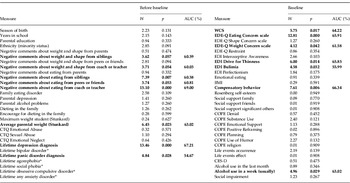
Before baseline, the following variables were related significantly and positively to ED onset (Table 1): comments about eating by coach or teacher, comments about eating by friends, comments about eating by siblings, comments about weight and shape by coach or teacher, comments about weight and shape by siblings, previous diagnoses of depression, and previous panic disorder diagnoses. Lower parental weight predicted ED onset. At baseline, the following variables were related significantly and positively to ED onset: EDE-Q Eating Concern, EDE-Q Weight and Shape Concerns, weight concerns, EDI Drive for Thinness, EDI Bulimia, compensatory behavior, and number of alcoholic drinks per week.
Univariate relationships between potential risk factors and outcome

W, Wald statistic; AUC, area under the curve; WCS, Weight Concerns Scale; EDE-Q, Eating Disorder Examination Questionnaire; EDI, Eating Disorder Inventory; BMI, body mass index; CTQ, Childhood Trauma Questionnaire (CTQ); CES-D, Center for Epidemiological Studies – Depression Scale.
Bold indicates significant univariate relationships.
a Cox regressions only performed for n>5 cases.
Table 1 also displays potential risk factors that were not significant in the univariate analyses and were then omitted from further analyses.
Step 2: Within-time analyses
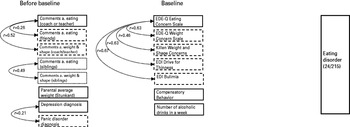
In the pairwise comparisons, the following overlapping risk factors and proxies were identified (Fig. 1): before baseline, both comments about eating by friends and comments about weight and shape by coach or teacher turned out to be proxies for comments about eating by coach or teacher. Because comments about weight and shape by siblings and comments about eating by siblings turned out to be overlapping factors, they were combined into one factor that was independent of the factor comments about eating by coach or teacher. Furthermore, a history of panic disorder was a proxy for a history of depression diagnosis.
Within-time analyses. Boxes with dashed lines indicate proxies, dotted lines indicate overlapping risk factors.

At baseline, EDE-Q Weight Concern, Weight and Shape Concerns, EDI Drive for Thinness and EDI Bulimia turned out to be proxies for EDE-Q Eating Concern, whereas EDE-Q Eating Concern and compensatory behaviors turned out to be overlapping factors (r=0.20). Because they cover different aspects of eating problems (i.e. attitudes and behaviors), they were retained as separate factors.
Step 3: Across-time analyses
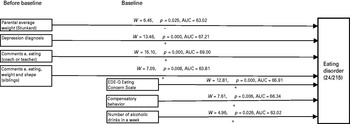
Risk factors were examined across time periods to determine mediators, moderators, and proxies (Fig. 2). No proxies were found across time periods. None of the factors could be confirmed as moderator or mediator according to our preset criteria regarding correlations between risk factors (r>0.20) and the required significance levels for testing the interactions (p<0.01). When interactions between risk factors were examined across time periods, factors identified in the within-time analyses were confirmed as independent risk factors (Fig. 2).
Across-time analyses.

Potency and cut-off determination
Effect sizes (AUCs) for previous depression diagnosis, negative comments by coach or teacher, negative comments by siblings, EDE-Q Eating Concern, compensatory behavior, and changes in negative life events can be classified as in the medium range, whereas effect sizes for the remaining risk factors were small or very small (previous panic disorder diagnosis) (Kraemer et al. Reference Kraemer, Morgan, Leech, Gliner, Vaske and Harmon2003).
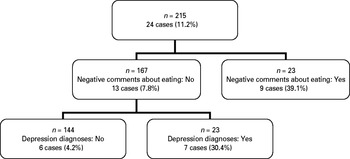
In the ROC analysis (Fig. 3), the best predictor was negative comments by coach or teacher, with a prevalence of 39.1% in those participants endorsing comments versus 7.8% in those not endorsing comments (χ2=17.73, p⩽0.000). The optimal cut-off was ‘1’, equivalent to a few or repeated comments versus none. In participants not reporting negative comments, the best predictor was depression diagnoses, with a prevalence of 30.4% in participants with a positive diagnosis of depression ever versus 4.2% in participants without depression diagnosis ever (χ2=19.1, p⩽0.000).
Receiver operating characteristic (ROC) analysis.

The prevalence of EDs in participants endorsing either negative comments or a depression diagnosis was 34.8% compared to participants not endorsing any of these predictors (4.2%) (χ2=31.9, p⩽0.000). The sensitivity of either negative comments or depression diagnosis was 0.75, specificity 0.82 [positive predictive value (PPV)=0.35].
Discussion
This is the first prospective study examining risk factors for EDs and their interactions across time periods in a high-risk sample based on the methodology proposed by Kraemer et al. (Reference Kraemer, Stice, Kazdin, Offord and Kupfer2001). The study is of theoretical importance as it adds insight into the nature of EDs and of practical importance as two items proved to have high sensitivity and specificity, allowing for preventive resources to be used more efficiently.
In this high-risk group of college-age women (i.e. high weight and shape concerns), we found an 11% onset rate of full or subthreshold EDs, which is consistent with rates of 10% and 12% found in risk factor studies of adolescents (Killen et al. Reference Killen, Hayward, Wilson, Taylor, Hammer, Litt, Simmonds and Haydel1994a, Reference Killen, Taylor, Hayward, Haydel, Wilson, Hammer, Kraemer, Blair-Greiner and Strachowski1996). Comparable to what has been found in the majority of longitudinal studies, most of the cases in our study were subthreshold (Jacobi et al. Reference Jacobi, Abascal and Taylor2004a; Jacobi & Fittig, Reference Jacobi, Fittig and Agras2010). No full cases of AN and only one full case of BN were found. Of the large number of potential risk factors included, only a few turned out to be predictive of ED onset when interactions between factors were examined both within and across time periods. Sixteen of the 88 potential risk factors originally included were confirmed as risk factors, seven of these turned out to be proxies, two were overlapping factors, and seven were independent risk factors.
Of the seven independent risk factors, a history of depression was one of the two factors with the highest potency (AUC=67.21) for predicting ED onset. Although a history of depression has not as yet been examined as a risk factor prospectively, negative emotionality and neuroticism, both of which are probably proxies for depression, have been confirmed as predictors of eating disturbances and disorders in most of the longitudinal studies of ED onset (Attie & Brooksgunn, Reference Attie and Brooksgunn1989; Graber et al. Reference Graber, Brooksgunn, Paikoff and Warren1994; Leon et al. Reference Leon, Fulkerson, Perry and Early-Zald1995, Reference Leon, Fulkerson, Perry, Keel and Klump1999; Killen et al. Reference Killen, Taylor, Hayward, Haydel, Wilson, Hammer, Kraemer, Blair-Greiner and Strachowski1996; Moorhead et al. Reference Moorhead, Stashwick, Reinherz, Giaconia, Streigel-Moore and Paradis2003; Taylor et al. Reference Taylor, Bryson, Altman, Abascal, Celio, Cunning, Killen, Shisslak, Crago, Ranger-Moore, Cook, Ruble, Olmsted, Kraemer and Smolak2003; Bulik et al. Reference Bulik, Sullivan, Tozzi, Furberg, Lichtenstein and Pedersen2006). Further support for this factor comes from cross-sectional case–control studies with retrospective assessment of depression diagnosis, which found up to sevenfold higher rates of pre-morbid depression compared to healthy controls (Fairburn et al. Reference Fairburn, Welch, Doll, Davies and O'Connor1997, Reference Fairburn, Doll, Welch, Hay, Davies and O'Connor1998, Reference Fairburn, Cooper, Doll and Welch1999; Pike et al. Reference Pike, Hilbert, Wilfley, Fairburn, Dohm, Walsh and Striegel-Moore2007).
A history of negative comments from a coach or teacher about eating and a history of negative comments about eating, weight and shape by siblings were two other risk factors predicting ED onset. Although longitudinal evidence for these factors is fairly weak, there is evidence from cross-sectional studies that a history of critical comments about shape, weight and eating by the family was significantly more prevalent (two- to sixfold risk) in patients with EDs (AN, BN and BED) compared to healthy controls (Fairburn et al. Reference Fairburn, Welch, Doll, Davies and O'Connor1997, Reference Fairburn, Doll, Welch, Hay, Davies and O'Connor1998, Reference Fairburn, Cooper, Doll and Welch1999). Similarly, a study of Australian twins found that retrospectively assessed parental comments about weight were associated with onset of both objective binge eating and self-induced vomiting (Wade et al. Reference Wade, Treloar and Martin2008). In a longitudinal study by Neumark-Sztainer et al. (Reference Neumark-Sztainer, Wall, Haines, Story, Sherwood and van den Berg2007), weight teasing by family was one of the strongest predictors of various outcomes including binge eating and being overweight in a large group of adolescent girls at the 5-year follow-up. A history of a lower parental average weight was the final risk factor assessed pre-baseline found to predict ED onset. This finding somewhat contradicts an earlier finding where bulimic patients, when compared to healthy controls, reported higher rates of parental obesity before the onset of their ED (Fairburn et al. Reference Fairburn, Welch, Doll, Davies and O'Connor1997). On one hand, it seems plausible that a parent with a lower average weight increases pressures to be thin and thus promotes dieting, weight and shape concerns, and subsequent EDs in the child. On the other hand, parental weight assessed by the Stunkard figures in our study was still in the normal range in both groups and the potency of this factor was fairly small.
At baseline, the EDE-Q Eating Concern scale, level of compensatory behaviors, and number of alcohol drinks in a week predicted ED onset. The factor ‘weight and shape concerns’ is the most potent and consistently supported risk factor for ED onset on the basis of longitudinal research (Jacobi et al. Reference Jacobi, Hayward, de Zwaan, Kraemer and Agras2004b). Because it overlaps or correlates highly with EDE-Q Eating Concern, it is not surprising that it predicts onset even in the high-risk sample. In the randomized trial, participants with high levels of compensatory behaviors at one site had onset of EDs at the 2-year follow-up of 30.4% (Taylor et al. Reference Taylor, Bryson, Luce, Cunning, Doyle, Abascal, Rockwell, Dev, Winzelberg and Wilfley2006). Alcohol abuse has been found to predict ED onset (Killen et al. Reference Killen, Taylor, Hayward, Haydel, Wilson, Hammer, Kraemer, Blair-Greiner and Strachowski1996; Field et al. Reference Field, Austin, Frazier, Gillman, Camargo and Colditz2002; Wonderlich et al. Reference Wonderlich, Connolly and Stice2004). Other studies also found ED symptoms to be predictive of alcohol use (Strober et al. Reference Strober, Freeman, Bower and Rigali1996; Measelle et al. Reference Measelle, Slice and Hogansen2006). One hypothesis is that a subset of women with EDs who use substances and binge eating to cope with distress (Safer et al. Reference Safer, Telch and Agras2001) are more likely than non-bulimic or bingeing women to have difficulties with affect regulation. If so, it would be expected that higher alcohol use, as an indication of dysfunctional coping, might predict ED onset.
Most of the potential risk factors measured in our study were based on those confirmed in the meta-analysis (Jacobi et al. Reference Jacobi, Hayward, de Zwaan, Kraemer and Agras2004b). Only a few factors were not measured: acculturation, pubertal timing, some personality factors, and neuroticism. The present study differs from most of the studies included in the meta-analysis with regard to risk status, age and sample size. Although sample sizes were usually larger among the studies in the meta-analysis, high-risk samples were not assessed, and mainly adolescents were studied. However, with the two exceptions of lower parental weight and compensatory behavior, risk factors found in this high-risk college-age sample are in accordance with factors from the meta-analysis.
On the basis of the most potent risk factors, the two questions identified in the ROC analysis could serve as a useful two-step screen. The first step would be to use the WCS to identify college-age students with high weight and shape concerns. The risk of developing an ED in this sample would be about 10%. The next step would be to select students with high weight concerns who endorsed either a history of negative comments about eating or a history of depression. Based on the ROC analysis, the final model using these two questions as a screen would have a reasonably high sensitivity (0.75) and specificity (0.82).
Data from this study, combined with that from existing literature, allow us to estimate the at-risk population in a college-age population. About 25% of college-age women have weight and shape concerns, placing them at some risk (10%) of developing an ED (Drenowski et al. Reference Drenowski, Hopkins and Kessler1988; Killen et al. Reference Killen, Taylor, Hayward, Haydel, Wilson, Hammer, Kraemer, Blair-Greiner and Strachowski1996). Of these, assuming the current sample represents a typical population, about a third would be very high risk. Within this very high-risk group, about a third would develop an ED. Accordingly, in a sample of 100 college-age women, about 25 could be classified as high risk. Of these 25, eight or nine would be at very high risk, and of these, two or three would develop an ED for an incidence rate of 2–3%.
There are several limitations to this study. Cases were limited primarily to (subthreshold) BN and BED and thus risk factors may not be equally relevant for AN. Although students did not have an ED in the 6 months before the trial, a few might have had a lifetime history before that time frame. However, the prevalence of a past history of ED is too small for us to determine whether the intervention might have had an effect on preventing relapse.
Some of the variables could only be obtained retrospectively. In addition, we cannot fully rule out that the risk status of included participants, even though they do not fulfill criteria for an ED at baseline, may have affected their recall of some childhood or current experiences and feelings. The sample involved individuals who were interested in an intervention to reduce weight and shape concerns and to improve body image. The specificity of the risk factors for EDs was not tested in this study. However, some of the factors (e.g. negative affect/depression) represent confirmed risk factors for other disorders (Hayward et al. Reference Hayward, Killen, Kraemer and Taylor2000; Hirshfeld-Becker et al. Reference Hirshfeld-Becker, Micco, Simoes and Henin2008).
In recent years, there has been some debate about the validity of the frequency criterion for BN. Some authors have suggested relaxing the frequency criterion by adopting a once a week or even lower (⩾2 times/month) threshold in DSM-V (e.g. Spoor et al. Reference Spoor, Stice, Burton and Bohon2007; Wilfley et al. Reference Wilfley, Bishop, Wilson and Agras2007; Wilson & Sysko, Reference Wilson and Sysko2009). Although evidence-based cut-offs are still to be determined by future research (Wilson & Sysko, Reference Wilson and Sysko2009), preventive interventions may need to attempt to reduce any binge eating and compensatory behaviors even if below subthreshold disorders.
Although the application of a systematic risk factor approach (Kraemer et al. Reference Kraemer, Kazdin, Offord, Kessler, Jensen and Kupfer1997, Reference Kraemer, Stice, Kazdin, Offord and Kupfer2001) has proved effective in separating correlates from prospective factors and in addressing interactions among risk factors, there are also limitations to this approach. Proxy factors or risk factors that are correlated may be important but are excluded if they are less strongly associated with the outcome. However, it would not make sense, as implied by the statistical model, to recommend teachers and coaches to focus on not making critical comments only about eating. Similarly, it is not clear why a history of depression would be more important than current depression or depressed mood; the latter would need to be addressed in an intervention. In similar populations, slight changes in distribution of depression scores or prevalence of current or past depression could make any of these variables proxies to others. An ROC analysis, although indicating which groups might benefit from intervention, suffers from the same issue. Depending on slight changes in distribution, other factors might have emerged as important.
Overall, the results of this study identify a group of students within an already high-risk sample who are very likely to develop an ED. Preventive interventions addressing weight and shape concerns should be expanded to focus on issues of affect and affect regulation and on the effects of negative comments about eating and shape.
Acknowledgments
This study was funded by National Institute of Mental Health grant R0115 MH60453. D. Wilfley is also supported by National Institute of Mental Health grant 16 1K24MH070446-01. We thank R. Striegel-Moore and A. Field for serving on the Data Safety and Monitoring Board.
Declaration of Interest
None.