Introduction
There are about two million lone-parent families in the UK with about three million children (Office for National Statistics, 2007). Lone parents, who are mainly lone mothers, face a high risk of poverty and many are dependent upon social security benefits for most or all of their incomes. Over the past decade or so there have been important changes in government policy towards these families, as part of a wider reform of the goals and instruments of social policy aimed at creating an employment-based welfare state. Lone parents are a key target group for these policies. Over the past ten or so years, about a quarter of a million lone parents have entered the labour market, taking their employment rate to about 57 per cent in 2007 and about the same in 2008 (Office for National Statistics, 2008). Given these trends, the government target for an employment rate of 70 per cent for lone parents by 2010 is very unlikely to be met. The intention of government policy is that employment should become the norm for the majority of lone mothers, with state benefits providing only temporary support for short time periods.
This is a challenging policy agenda and one which requires some significant changes at several different levels. For the government it means a substantial investment in measures to support employment, both in cash and in kind. For employers there will be stronger legal requirements to provide ‘family-friendly’ employment conditions, and pressure to recognise the needs of parents and other carers in various ways, including more flexible working. For lone parents, as for other parents, it means that paid work outside the home must be integrated with caring for their children on an ongoing basis, sustained over time as part of their everyday family practices. For the children in lone-parent families, it means that they are likely to experience a wider range of caring situations, including more time in school-based care.
Employment for lone mothers should also mean that material circumstances improve for the family, and income adequacy in work is clearly important in enabling employment sustainability over time. But it is not only economic situations that change as a result of employment; time use and social relationships also change. When the lone mother starts work, her daily life changes in various ways, and so do the lives of her children, and perhaps also other family members who may become involved in childcare, or in other forms of help. These social relationships – at home, in work, in care settings, at school – may be a key element in employment sustainability, and one that has not yet been systematically explored in research. This is the focus of this article, which draws on our current research that is exploring issues of sustainability and well-being in work for lone mothers and their children. We start from the assumption that sustaining work over time is a process that actively involves the family as a whole and not just the individual lone mother. In this article we explore how social relationships, inside and outside the family, are central to the ‘family–work project’ of sustaining employment.
In the next section, we outline the key features of the changing policy environment that affect lone parents. We then describe our research methodology and sample. The main section of the article explores the changing social relationships for the mothers at work, for the children in care settings, and within the family.
Work for all
There is a substantial literature discussing the Labour government's approach to social policy over the past decade (see for example, Social Policy Review published annually by Policy Press for the Social Policy Association). In particular, there has been a strong policy shift towards an ‘employment-based’ or ‘active’ welfare state in which all adults are expected, and in some cases required, to support themselves and their families by participation in the labour market. This is supported by a discourse that stresses the links between rights and responsibilities, in which ‘fairness’ demands that all those who can work, should do so. The definition of who can work is being drawn much more widely than in the past, in particular to include parents, carers and disabled people. Secondly, there has been an increasing emphasis on family policy and in particular on the needs of children as future citizens and workers. The investment in early years education, the commitment to eradicating child poverty, and the emphasis on parenting skills and obligations are all elements in this. The establishment of the Department for Children, Schools and Families in 2007 provides institutional support, and the comprehensive Children's Plan sets out an ambitious programme of policies across a range of areas, taking it for granted that most parents are ‘juggling family life with paid work’ (DCSF, 2007, para. 1.11).
The specific policies that have had the most impact on lone parents can be divided into four main areas. First, there are measures to move non-employed lone parents from ‘welfare to work’ through a range of provisions provided or managed by Jobcentre Plus. These include the New Deal for Lone Parents which provides information, advice, some training opportunities, help with claiming in-work financial support, the provision of an in-work credit of £40 per week for those who have been on income support for at least 12 months, and opportunities for work trials. From April 2008, some lone parents leaving income support for work will be eligible for in-work advisory support from a personal adviser, and the in-work emergency discretion fund can provide up to £300 in the first 26 weeks to help with unexpected needs in work. Second, there are the ‘make work pay’ financial supports, including the national minimum wage and the child and working tax credits, with the childcare tax credit. Third, the national childcare strategy and ten-year childcare plan seek to ensure the provision of ‘good quality affordable childcare’ for all children aged under 14. Provisions have included free part-time (up to 12.5 hours per week) nursery places for all three and four year old children, the expansion of school-based care provision for older children, and the establishment of children's centres. Fourth, the ‘family-friendly’ employment agenda has included the right to ask for flexible working arrangements for parents of children aged under six or with disabilities, paid paternity leave, and higher levels of maternity leave and pay. Various employment rights have been extended to part-time workers on the same basis as full-time workers.
In addition, requirements to seek work have been progressively strengthened, including the introduction of compulsory work-focused interviews for all lone parents claiming income support. From October 2008 onwards, lone parents will be progressively moved from income support to jobseeker's allowance. This will apply first to those lone parents with a youngest child aged 12 and above. In 2009, it will apply to those with a youngest child aged ten and above, and in 2010 to those with a youngest child of seven and above. Thus by 2010 all lone parents with children aged seven and above will have to be available for work as a condition of receiving social security benefits (DWP, 2007).
The new policy environment inevitably remains somewhat piecemeal and patchy in practice. For example, the delivery of tax credits has been problematic and some families have faced hardship as a consequence (Millar, Reference Millar2008a), working poverty is still a substantial issue for families with children (Cooke and Lawton, Reference Cooke and Lawton2008), childcare provisions vary significantly across the country (Daycare Trust, 2007) and accessing employment rights is not always straightforward, especially for low-skilled workers (Dean, Reference Dean2007). There are also some tensions and contradictions across these various measures, for lone parents not least between requirements to work and time for parenting. Nevertheless, over the past decade there have been significant changes in the conditions under which non-employed lone mothers make decisions about employment, and under which employed lone mothers manage employment and care.
Methods and sample
This article draws on data from our ongoing longitudinal qualitative research project, which is following a sample of lone-mother families from the point of leaving income support and taking up paid employment. The research design is intended to allow us to explore how the mothers and the children both create and respond to changes in work, school, care and family lives over time, and in the context of various patterns and trajectories of engagement with the labour market.
Interviewing the children as well as the mothers was an important part of the study. Ridge's previous research with children in families living on income support showed that children play an active role in managing and coping with poverty in various settings, including in the family, at school and in friendship and social activities (Ridge, Reference Ridge2002). As noted above, life is likely to change for everyone in the family, including the children, when a mother starts work. We take as a starting point that the children as well as the mothers are active participants in negotiating and managing the changes involved. Interviewing both mothers and children allows us to explore these processes from their different – and possibly conflicting − perspectives.
The sample was drawn from Inland Revenue (as it then was) records between October 2002 and October 2003. The specific selection criteria were a lone mother, with at least one child aged eight to 14, receiving tax credits, living in specified postcode areas in south-west England and Yorkshire, including urban and rural areas, and who left income support/jobseeker's allowance during a specified 12-month period. We interviewed the families for the first time between January and June 2004, and this included 50 lone mothers and 61 of their eight- to 14-year old children. The families were interviewed again about 12 to 18 months later, between June and October 2005, including 44 mothers and 52 children. Consent for the interviews with children was sought first from lone mothers and then from children themselves. Both the mothers and the children were given further opportunities to withdraw or not to discuss particular topics during the interviews. The mothers and children were interviewed on the same day but separately, usually with the mother first. All interviews have been tape recorded and transcribed. In the analysis we use a mixture of summaries prepared by hand (index cards), in word processing packages, and through NVivo software.
The interviewed families
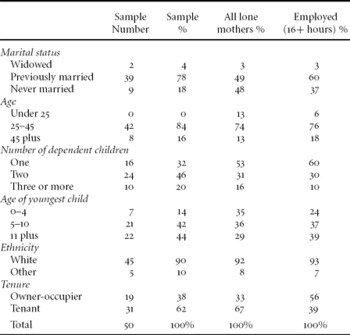
Table 1 summarises some key characteristics of the families and compares these to the profile for all lone mothers in 2002/3 (when our study started), using data from the national Family and Children Survey (FACS), which is carried out annually on behalf of the Department for Work and Pensions. Bearing in mind our sample size of 50, there appear to be some differences between our sample and the national profile of all lone mothers. Ethnicity is similar, but our sample is mainly separated or divorced women, who are older, with older children, and larger families. These differences in family and personal characteristics are to be expected given that one of the defining characteristics for our sample selection was that there should be at least one child aged eight to 14. This means that fewer younger unmarried mothers were included. Nevertheless, there were seven women with pre-school age children in our sample. The sampled lone mothers were generally similar in characteristics to all employed (16 hours plus) lone mothers, who also tend to be formerly married, older and with older children. However, we have a higher proportion of people in rented accommodation compared with all employed lone mothers.
Profile of sample and all lone mothers, 2002/3

Source for national statistics: Barnes et al. (Reference Barnes, Willitts and colleagues2004: tables 2.1, 2.7, 2.9, 8.1) and Barnes et al. (Reference Barnes, Lyon, Morris, Robinson and Yau2005: table 2.2).
That these are older women – with a median age of 38 – has an impact on various other characteristics. First, they have larger families than average. In particular, their families often included older non-dependent children: there were 21 women with older children, including ten with older children still in the household. These older children, both in and outside the household, often played an important role in domestic life and care. Second, about a quarter of the mothers in the sample reported some health problems, which is higher than the FACS figure for all lone mothers reporting health ‘not good’ over the past 12 months (15 per cent) and for lone mothers employed for 16 hours plus (9 per cent) (Barnes et al., Reference Barnes, Willitts and colleagues2004: table 3.1).
About half of the women had been lone mothers for five years or more when we first interviewed them. Twenty of the women were receiving some child support payments at the first interview. By the second interview, five of the women were living with a new partner, including two who were pregnant.
Employment
Most of the women had had some breaks in employment when their children were young and/or had mainly worked part-time. Half of the women had left work around about the time that they separated from their partners. Some had returned to work quickly but others had spent several years receiving income support. About two-thirds – 35 out of 50 – had been on income support for a year or more. However, just over half of the women had experience of working part-time, doing voluntary work, and/or studying while they were receiving income support.
At the first interview, 44 out of the 50 mothers were still in employment. Most (36) were working in care homes, offices, retail, catering or cleaning. There were 11 women in professional or semi-professional jobs, all in care or education, most of whom had completed some further education or training. This is similar to the profile for all employed lone mothers, of whom about 27 per cent are managers, professionals or associated professionals (Barnes et al., Reference Barnes, Willitts and colleagues2004: table 8.6). Just 13 of the women worked full-time (over 30 hours per week). There were six women who had more than one job, four were working nights and five were working weekends.
Pay was typically £5–£6 per hour, which was about average for women in part-time work in 2002. All were receiving tax credits, most often both working tax credit and child tax credit, and this formed an important source of income. In general, being in work had improved the financial situations of the families compared with being on income support. In most cases, however, family income in work was still relatively low and the extent to which the women and children felt that the family was ‘better-off’ in work was tempered by a range of factors, both financial (such as debts, unexpected outgoings) and non-financial (such as security of jobs, time pressures, health) (Millar, Reference Millar, Glendinning and Kemp2006).
At the second interview, 37 out of 44 women were employed. However, there was considerable change in work situations over time. Just 11 women were working in the same job with the same hours of work that they had started in when they left income support. Thus the majority had changed their jobs, sometimes with a period out of work, or had changed hours, or had time off for sickness or maternity leave.
By accident rather than design, our sample of lone mothers with at least one child aged eight and above almost mirrors the new target group that the government has identified for employment requirements from 2010 (those with children aged seven and above). However, these lone mothers all chose to take up employment. They were ‘willing workers’, not required to attend work-focused interviews, or to seek work. Nevertheless, the types of jobs, hours and pay reflect the labour market that faces many lone mothers leaving income support for paid work. Their experiences can thus cast some light upon the issues that others, perhaps less willing, might face in sustaining employment.
Sustaining work, sustaining care
For mothers in employment, work and care are two sides of the same coin, which must be managed together. The family–work project is thus as much about sustaining care as it is about sustaining work. We can illustrate this, and the importance of social relationships in this process, with a short case study. Alice who is a single mother with a son, Simon, aged 11. At the first interview, she was working in a care home for two nights of ten-hour shifts a week, including some weekends. Her son stayed overnight with her former partner's parents when she was at work, and sometimes with her former partner. At the second interview, she was still in care work but had stopped working nights:
Purely because I felt I was either at work or I was sleeping and I wasn't seeing Simon and he was either round at his Nana's or off with his Dad and I thought, you know, it just wasn't working . . . one of his friends' mums, she works for the company I work for now, and she said well why not come and join us, we are recruiting she said and you'll find it a lot better and hours are to suit, you can do what hours you want to do so that's what I did and I find it a lot easier.
These new working hours had enabled her to change her care arrangements. She now worked school hours:
Apart from a Wednesday and then I work until 5.30, but he has after-school clubs anyway so it works out quite well because by time he's finished his after-school club he goes to his Nana's, has his tea and then I just pick him up as soon as I've finished so it's not so bad.
Thus it was the change in work than enabled her to sustain care and in turn sustain the work: the two were closely interlinked. But what is also noteworthy here is the role that social relationships had played in these changes. Alice wanted to change hours so she could spend more time with her son. Her relationships with her parents-in-law and separated partner were crucial in both the initial childcare arrangement and in the changed arrangement. She found her new job through a personal contact, the mother of her son's friend at school. Relationships are also central to her son Simon's account of why he is happier with the new arrangement, which is because he gets to spend more time with both his mother and his father:
The last job that she were doing she got really tired and she like slept through to about 3 or 4 in the afternoon and I couldn't go and see my Dad because he was working as well but I can see him a lot now . . . when she went to work she took me around [to parents-in-law] at about 7 and then she had to go so I felt really sad because I could hardly see her
Simon also noted the impact of the change on his parents and on the family as a whole:
I think she feels better. I do, my Dad does, because last time he was worrying that she didn't get enough bed, and we're all happy now.
In highlighting the importance of social relationships in sustaining work and care, we do not mean to suggest that structural and material factors – such as job location, hours of work, type of job, type of childcare, income adequacy – are not also important. Simon himself was well aware of this: ‘when she changed her job and got a new one we got more money I felt really happy again because I got more food’. Health status was also an important issue for some families. These factors are all an important part of the overall picture, but here we focus on how social relationships help to create the potential to sustain work and care.
Social relationships at work
Social relationships at work were important in enabling the mothers to sustain care and therefore employment. For example, it was essential for the women that they could negotiate some flexibility in working when this was required: if children were ill, for example, or during school holidays. This usually requires getting agreement from immediate supervisors and some cooperation from co-workers. When the women talked about their relationships with their employers, managers and colleagues, they often stressed the importance of common ground or identity, in particular in relation to being a working parent. For example, Sally worked for a retail company which involved travelling to different local schools. She talked about flexibility in terms of shared identity:
Fine, they're all family people, they've all got children . . . they've got a great understanding that your kids come first . . . they're really understanding and that's the only reason I think I've stayed really.
As did Parveen, who worked for a charity:
They're quite flexible, they're quite good, if I rang up and said my son's not very well there's been nothing about tough you know, my manager has children herself and same thing happens with her, you know and there's no big issue made of that.
By contrast, Jessica was an example of how lack of responsiveness on the part of an employer could make a particular job feel unsustainable. At the first interview, Jessica, with two children under ten, was working in a shop. Her youngest child was going to a childminder, the older was at school and she managed holidays with the help of a neighbour. However, she left that job, even though she did not have another job to go to, because:
My area manager wasn't particularly helpful in situations that actually, like if the children were ill, things like that, she got quite funny. And having no children of her own . . . I had an operation and had to have a few days off work and I just got a phone call from my manager the following day . . . No asking how are you, it was just, when will you be back?
The lack of practical support and empathy prompted Jessica to leave that job. She contrasted this with her current employer, who was flexible with time off although not with financial support for this: ‘I can say, Sebastian's ill. I can't come in. They're fine about it. But I would have to take a couple of days' holiday or a day unpaid.’
Bullying at work and poor relationships with colleagues were also a problem for some women and a cause of concern and anxiety. Fran had been doing office work through an agency, but had stopped work by the first interview:
I worked for them a whole year . . . I started being bullied by people in the job, which was difficult. I sorted it out myself by saying look, what's going on? . . . Then it started happening again. So I then rang up the agency and said, look, I can't work here any more.
Her daughter Ashia, aged nine, was concerned: ‘I worry because when she comes home, she's had, like, a really bad day, and like recently, this thing with work and people weren't being nice to her and, basically, it was bullying.’
Social relationships in childcare
In the sample, there were 17 families (out of the 44 interviewed twice) who were using some sort of formal care usually alongside some help from family members. This included childminders and nurseries, but was more commonly before- or after-school clubs, school holidays schemes and camps. There were 13 women who largely managed their care needs by themselves, which usually meant that their children spent some time alone, and that older children might be looking after younger children. Family and sometimes friends played an important role in 14 families, including the fathers of the children, grandparents, and stepfathers or new partners. There were changes in childcare arrangements in about half of the families between the two interviews, not least as children got older and more independent and also because the circumstances of family members changed.
Schools were the location for the main formal care provision, in before- and after-school clubs, and holiday schemes. Before-school care – mainly at-school breakfast clubs – were often disliked by these children, and generally perceived as boring and lacking in opportunities for enhanced social relationships. The children were also often cautious of taking part in breakfast clubs because of the element of social stigma (a relationship of difference and ‘otherness’) they identified with this type of care. Relationships with care providers – often other parents as well as professional carers – were important for children's well-being. As one eight-year old, William, explains, there can be happy parents and staff but also ‘mardy parents and staff so I like going some days but not other days’.
Jake (William's brother) was one of the children in the study who experienced a range of formal and informal care over time. His relationships with his carers, his family and his friends were key elements in shaping his experiences of care and his changing responses to his mother's employment. His early experiences of breakfast club, recounted at the first interview when he was nine years old, were problematic: he was bored and his friends were not there. The stigmatised status of breakfast club also presented a challenge for his wider social relationships:
At morning club, like when I came out all my friends used to like say why have you been there and I used to have to make a lie up, saying I had a job there, a morning job . . . Yeah because I were afraid that if I told them that I'd gone there because my Mum was at work they'd just call me names like baby and stuff like that.
Jake was already very sensitive about stigma because of his experiences of exclusion and difference among his peers before his mother was working. Although breakfast club did not appeal, Jake said he enjoyed attending his after-school club and his account reveals the importance of good after-school care for social relationships with peers:
Because the breakfast club you don't really have much to do, because your friends aren't there, and you can't think of anything. But with your friends there you can think of everything, anything to do.
Children's experiences of care are not static, they change over time as their needs – especially their social needs – change. Although Jake enjoyed his after-school club when he was younger, by the second interview – when he was 11 – he was attending less often and felt that after-school club was affecting his friendships, because he was not seeing enough of his friends or his mother:
Because I stay at after-school club until like 6 or 5 or 4 something and when we come home it's like dark so we can't play out and we don't get to see our mates as much.
Relationships of care in the family
Family relationships change as time passes, and in ways not necessarily related to work status. The way the mothers and children interacted changed as children grew older and became more independent. Some of the families moved, some of the women had new partners, some were remarried, some had new babies or were pregnant at the second interview, some women became grandmothers, there were family bereavements, several children moved up to new secondary schools. All these sorts of changes were taking place alongside, and interacting with, employment continuity and change. Nevertheless, the mothers' jobs did have a significant impact on the ways in which family members spent time together and apart.
For the children, the central relationship of care is with the mother, and in lone-mother households children can develop particularly close supportive and caring relationships with their mothers (Brannen et al., Reference Brannen, Heptinstall and Bhopal2000; Smart et al., Reference Smart, Neale and Wade2001; Ridge, Reference Ridge2007). The mothers' work meant changes in the type and quality of time that children and their mothers could spend together. This was a strong mediating factor in how children experienced their mothers' work. The mother being in work leads to a reduction in family time and, despite the perceived material benefits, this can have a negative impact on children's experiences. Some mothers had tried to arrange their working time to have as little impact as possible on their time with their children. This meant working school hours and for some women working in jobs well below their potential capacity. Working school hours and school terms had the least impact on the children's time and, probably for that reason, was generally most popular with children, especially younger children. To some extent, if the mother worked school hours, the children could see the benefits of work (for example, in terms of increased income) but without experiencing significant costs, although illness and school holidays still needed to be managed. It was often children in families where mothers were working school hours who were very resistant to the idea of formal childcare provision, especially after-school clubs and breakfast clubs. They stated a strong preference for being at home and held the view that clubs were boring and unsuitable for them.
As noted above, some of the families largely managed their care needs alone without any regular help from other people. Children might therefore spend some time alone, for example getting home after school before the mother arrived back from work. This could be a source of anxiety for the mothers, and some also expressed concern about the possible bad influence of friends, especially those with teenage children: ‘one I can trust, two I can't, two teenagers I won't trust, so I need to know that his friends are going to be supervised’. Some mothers were also anxious about the ‘fairness’ of relying on the older children to look after younger children: ‘as good as she is, you know, she needs to be a 13-year old. No, I could depend on her for anything . . . she'd always help, but maybe one day a week but not five.’ And in another family at the second interview: ‘I encourage her now to not think about trying to help me out with [younger child], but to think about her future.’
However, what was valued by both mothers and children was the opportunity for independence and responsibility. As one of the teenage children said, ‘We all got our keys cut not long ago when mum started doing night duties because we can lock the doors behind us . . . we'd make ourselves dinner . . . it's alright, like you have a bit of independence and responsibility so it's not too bad.’
The relationship of care between mother and children goes in two directions – not just from mother to child but also from child to mother. Children often played an important role in supporting their mothers stay in work and were engaged in a complex range of caring and coping strategies to manage the changes in their lives and to support their mothers in employment. This included taking on extra responsibilities: for example, doing more to help around the house with the domestic chores of cleaning, washing, cooking and so on, as well as offering emotional support (Ridge, Reference Ridge2007).
Time spent with other family members also often changed as a consequence of the mothers' employment. For some children, school holidays, or parts of these, were spent staying with other family members – grandparents and aunts/uncles and cousins in particular. Grandparents often provided regular care. For example, Fiona has two children and was working school hours and school terms in the same job at both interviews. Her former partner's father (who she calls Dad) plays an important role in the family. He comes to the house every morning to take the children to school, sometimes picks them up after school, looks after the children if they are ill, and also regularly baby-sits at night. As Fiona said: ‘my Dad's brilliant, I said to loads of people if it wasn't for my Dad then I wouldn't be working . . . well I would but it wouldn't be you know the job I really enjoy’. Her two children appreciate his care and are settled in a steady routine. Both children are resistant to the idea of after-school clubs, preferring to have this type of care relationship. But as is often the case with familial care relationships there is also some fragility and, as her daughter pointed out, any tensions in the relationship could have dire consequences for them:
My mum and granddad had like a fallout quite a while ago now and like he didn't used to come up in the morning and it was so hard, like what were we to do . . . I think that if he wasn't here it would make all our lives a lot harder, so he's quite a big part in our family.
Changing time with, and relationships with, their fathers were another important part of the overall picture for some children. There were seven fathers who were closely involved with their children at the second interview. The fathers did not usually provide childcare while mothers were at work, but when children spent time with their fathers (weekends, overnight stays and holidays) this helped the mothers by giving them some time for themselves. In a few families, care relationships between children and their fathers had flourished into a more regularised and essential part of the family–work project, enhancing child/father relationships generally and often improving mother/father relationships in the process. Maia was nine at her first interview and she was enmeshed in a dense network of care relationships across different settings. Her father played an important role in this:
Well, I see him from Tuesday afternoon when I come home from school and then I see him again Wednesdays from when I come home from school, then on Thursdays I go to Kids Club where my dad picks me up from there at 6 . . . and on Friday mornings I see him because he sleeps in my room when my mum goes to work.
By the second interview, her mother was no longer in work and as a consequence Maia was seeing less of her father, although he still picked her up from some of her afternoon clubs. Irene, her mother, reflected on how her relationship with her former partner had changed and the role that her employment had played in renegotiating and remaking family relationships:
Maia's always had time with her dad . . . Strangely enough, because obviously I'm not working at the moment, she's not getting that time with her dad and I actually think she's missing it and it only occurred to me on Wednesday, when he took her up to bed and I heard the conversation and I heard him say I've not seen you tonight . . . and I suddenly realised because I'm not working any more at the moment then that time that they did have . . . is taking it away from him.
Children were thus engaged in negotiating a range of new caring relationships in the context of their mothers' employment. Some of these involved family members in new roles, as in the examples above, but some were with their mothers' new partners or stepfathers and stepsiblings. These new relationships can be positive and supportive but they can also be challenging. For example, Jake's relationships with his informal family carers changed over time. When he was younger, he was looked after by his grandparents at weekends while his mother was working, and he enjoyed this arrangement. However, his mother re-partnered and, by the time of the second interview, his new stepfather had taken over some elements of care while his mother was at work. Jake had lost care time with his grandparents but gained care time with his new stepfather. This relationship was still developing and Jake expressed uncertainty and some insecurity, recognising the need to develop a more trusting relationship which would take time: ‘because like when I'm at home, because I've known him quite a long time but not enough time to know what he's like so I don't really trust, I trust him, but not like much’. As Jake's experience shows, when new care relationships are forged the quality of those relationships may be critical in sustaining the family–work project.
For some children, new care relationships have to be negotiated alongside other family changes, and the success or failure of these other relationship changes can impact on the quality of care relationships. Kitty was eight years old when we first interviewed her and her mother worked nights, while she was cared for by her grandmother and at times her mother's non-resident boyfriend. The couple had married and Kitty's relationship with her carer therefore changed as he moved from caring as a non-family member to caring within the family. However, this was proving to be a difficult transition and she dislikes her care arrangements and is often bored:
I get stuck with him, he never lets me do anything, well hardly, and he just, once I ask him to do a favour for me and he went ‘no I'm too busy’ right and he was only lying down.
Kitty's overall unhappiness with her stepfather is reflected into her care relationship and this in turn is mapped on to anxieties about her mother's employment and the time that they spend together as a family. She misses her mother when she is at work and blames her employment for family changes. Her dissatisfaction threatens to undermine the family–work project:
I miss her and sometimes I cry because she's at work, and I just sit there and just think about my family and her . . . when my mum wasn't working she wasn't paid and she could spend time with me, but now she is, she's paid and she can't spend time with me.
Kitty's situation highlights potential tensions that can arise in caring relationships which are generated through other family relationships.
Discussion and conclusions
Our sample of lone mothers was, in general, managing to sustain their engagement with the labour market over the period of two to three years between leaving income support and our second interviews. This did not mean they stayed in the same jobs, and in fact the majority experienced some changes in employment. They changed jobs or hours of work or had time off for sickness or other reasons. In this article, we have been focusing on social relationships, especially family relationships, and how these are involved in the complex set of ingredients that are needed in order to sustain work and care.
These lone mothers, and their children, were in general committed to what we have called the ‘family–work project’. Sustaining work and care requires an active input from both the mothers and the children and involves them, not only in managing changing time use and income levels and sources, but also in managing changing social relationships. At work, the mothers needed to be able to depend on support from employers and colleagues to allow them to manage work and care. These informal systems are crucial in enabling flexibility at work (Backett-Milburn et al., Reference Backett-Milburn, Cunningham-Burely and Kramer2001; Dean, Reference Dean2007). At school and in other care settings, children are not simply passive recipients of care but form relationships with carers. Practices of care, including social relationships, are thus an important element in how childcare arrangements work (Brannen and Moss, Reference Brannen and Moss2003; Vincent and Ball, Reference Vincent and Ball2006). In the family, the mothers and the children interacted with each other, and with other family members, in different ways as a consequence of the mother's employment. These changing relationships often supported the family–work project but could also be a source of tension and difficulty.
Most of these mothers and children were committed to the family–work project for a variety of social, economic and personal identity reasons (Millar, Reference Millar, Glendinning and Kemp2006, Reference Millar2008b; Ridge, Reference Ridge, Glendinning and Kemp2006). Other family members – older siblings, grandparents, former partners, current partners – also offered various types of practical and emotional support (although we do not have any direct data on their views about the mother's employment). However, the concept of a family–work project does not mean that all family members necessarily share the same degree of commitment or are able to put their views into practice in the same way. As Tobío and Trifiletti argue, conceptualising strategies as social practices means recognising these are negotiated in social contexts and this ‘implies that each member will start negotiating from a different degree of authority as well as building on past patterns already stabilised in time’ (Reference Tobío, Trifiletti, Gerhard, Knijn and Weckwert2005: 63). Working hours were one of the areas where these different views and tensions were apparent. Many of the younger children in particular wanted to have more time with their mothers. They wanted their mothers to be employed but only to work school hours and school terms. This would mean that their time and relationships with their mothers could be relatively undisturbed. However, children also often valued time spent with other family members. Older children valued their independence and were not so anxious about working hours, but tensions could sometimes arise about caring and other demands placed upon children. Mothers were constantly seeking to minimise the negative impact of work on their time with children and to maximise the positive impact of increased incomes.
As noted in the introduction, the government proposes that from 2010 lone mothers with children aged seven and above will be expected to participate in employment (DWP, 2007). One of the key justifications for this strong focus on employment is that ‘work is good for you: people who work are better off financially, better off in terms of their health and well-being, their self-esteem and future prospects for themselves and their families’ (ibid.: 23). Our research shows that working lone-mother families are engaged in intense and often demanding family practices, which, under the right circumstances, can generate a powerful collective effort to sustain the family–work project and enhance family well-being. However, the family–work project is also subject to flux and instability, including in relationships of care. Well-being does not just happen in work; it has to be made to happen. It involves not just the ‘right’ types of jobs, but also the ‘right’ types of care, and the ‘right’ types of social relationships.
There is a small but growing body of research exploring what employment sustainability for lone mothers means in practice (for example, Graham et al., Reference Graham, Tennant, Huxley and O'Connor2005; Dorsett et al., Reference Dorsett, Campbell-Barr, Hamilton, Hoggart, Marsh, Miller, Phillips, Ray, Riccio, Rich and Vegeris2007; Ray et al., Reference Ray, Vegeris, Brooks, Campbell-Barr, Hoggart, Mackinnon and Shutes2007; and in the US and Canada, Scott et al., Reference Scott, London and Hurst2005; Bancroft, Reference Bancroft2004). This research underscores the importance of social as well as economic factors in sustaining employment. Our analysis focusing in particular on the role of social relationships highlights three main issues for policy. First, part-time work is crucial in enabling lone mothers to sustain work and care and is especially popular with those with younger children trying to arrange work around children's preferences, as Bell et al. (Reference Bell, Finch, La Valle, Sainsbury and Skinner2005) also found. The 16 hours per week threshold for tax credit eligibility sets an arbitrary level at which part-time work can be accessed. Jobs with the right sort of hours can be hard to come by and also the pay, conditions and mobility opportunities of part-time work can be very limited (Grant et al., Reference Grant, Yeandle and Buckner2005). Part-time work is still mainly confined to women and largely segregated from full-time work. Nor does part-time work necessarily mean flexible work, as is sometimes assumed. Part-time workers may have less flexible conditions than full-time workers and be less able to access employment rights (Millar et al., Reference Millar, Ridge and Bennett2006). Much more policy attention needs to be paid to the conditions and prospects in the part-time employment sector.
Second, the extent to which working lone mothers can achieve the sort of flexibility they need at work is currently dependent on informal social relationships. These can be very supportive, but employers can also be inconsistent and arbitrary (Dean, Reference Dean2007). This does not provide a solid basis for security at work. The report by the TUC Commission on Vulnerable Employment (2008: 3) argues that not only is the law not strong enough to protect the most vulnerable workers (especially agency workers and migrant workers), but also that in ‘certain low-paid sectors, including care, cleaning, hospitality, security and construction our evidence shows that some employers routinely break the law’. Their recommendations include the establishment of a ‘Commission on Fair Employment’ to monitor vulnerable employment on an ongoing basis and to promote solutions. The government have announced that the right to request flexible working is to be extended to parents with children aged under 16, and there are proposals to promote knowledge and understanding of these employment rights among employers (Walsh, Reference Walsh2008). However, as Yeandle et al. (Reference Yeandle, Bennett, Buckner, Shipton and Suokas2006) argue, for employers to be ‘care-friendly’ in practice requires cultural change, good communication and flexibility within the organisation. Making the business case for this is an important element in promoting change.
Third, care experiences for children differ according to the care settings, care practices and the social relationships that children experience when they are being cared for. Providing out-of-school care in school environments is central to the government's childcare strategy, with all schools open to provide care from 8 a.m. to 6 p.m. by 2010. But this approach does not always provide stimulating and appropriate care for children and nor does it necessarily map on to children's own changing social environments and needs. Care provisions for older children, and how these fit with school provision, also require more policy attention.
Finally, the extent to which increased compulsion to seek work will promote employment sustainability must be open to question. As this and other studies show, for lone mothers to manage work and care on a daily basis over time requires substantial commitment from both the mothers and the children, and effective social relationships to support this. If lone mothers are pushed into employment before they and their families are ready, the result is more likely to be repeated moves between unsuitable jobs and benefits rather than sustainable employment and well-being in work.
Acknowledgements
This research was funded by the Economic and Social Research Council (RES-000-23-1079). We are grateful to the Inland Revenue (HMRC) for their help in drawing the sample. Thanks to colleagues in the Centre for the Analysis of Social Policy at Bath and to anonymous referees for comments.