Introduction
DNA barcoding is a fast and efficient method for species identification using short standardized sequences. It is commonly used for identification of quarantine and agricultural pests (Hebert et al., Reference Hebert, Ratnasingham and deWaard2003; Hebert and Ratnasingham, Reference Hebert and Ratnasingham2007; Park et al., Reference Park, Suh, Oh and Hebert2010; Shin et al., Reference Shin, Jung, Lee and Lee2013). DNA-based methodologies are also useful for species identification in taxa where females or immatures lack diagnostic morphological characters (Boehme et al., Reference Boehme, Amendt, Disney and Zehner2010).
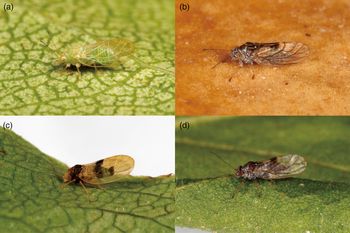
Pear psyllids (Hemiptera: Psylloidea: Psyllidae: Cacopsylla spp.) are major pests of pear (Pyrus spp.) in the Palaearctic region and, as introductions, in the New World (Valle et al., Reference Valle, Burckhardt, Mujica, Zopolo and Morelli2017). They inflict damage by excessive removal of phloem sap and by soiling the fruits with honeydew which, in turn, provides a substrate for sooty mould (Hodkinson, Reference Hodkinson and Ananthakrishnan1984; Burckhardt and Hodkinson, Reference Burckhardt and Hodkinson1986; Burckhardt, Reference Burckhardt1994). Some species are known as vectors of Candidatus Phytoplasma spp., the causal agents of the pear decline disease (Weintraub and Jones, Reference Weintraub and Jones2010; Seemüller et al., Reference Seemüller, Schneider, Jarausch, Hadidi, Barba, Candresse and Jelkmann2011). In the past, the presence of seasonal dimorphism, controlled by temperature and photoperiod (Soroker et al., Reference Soroker, Alchanatis, Harari, Talebaev, Anshelevich, Reneh and Levsky2013), that affect adult colour, size and wing morphology in some species (fig. 1), as well as uncritical use of species names led to much confusion in the taxonomy of pear psyllids (Burckhardt and Hodkinson, Reference Burckhardt and Hodkinson1986; Cho et al., Reference Cho, Burckhardt, Inoue, Luo and Lee2017). Several revisions based on morphology addressed and solved many of these problems (Burckhardt and Hodkinson, Reference Burckhardt and Hodkinson1986; Yang et al., Reference Yang, Huang and Li2004; Luo et al., Reference Luo, Li, Ma and Cai2012; Cho et al., Reference Cho, Burckhardt, Inoue, Luo and Lee2017). Currently, 34 species of Cacopsylla developing on Pyrus are considered valid but more work is needed, in particular on the psyllid fauna of the Middle East, India, Central Asia and Far East Russia, to completely untangle the confused taxonomy of the group (Cho et al., Reference Cho, Burckhardt, Inoue, Luo and Lee2017).
Habitus of seasonally dimorphic polyvoltine pear psyllids: (a) C. jukyungi (summer form); (b) C. jukyungi (winter form); (c) C. maculatili (summer form); (d) C. maculatili (winter form). Photos are from Cho et al. (Reference Cho, Burckhardt, Inoue, Luo and Lee2017), with modifications.

Several recent molecular studies (Kang et al., Reference Kang, Baek, Lee, Cho, Kim, Han and Kim2012; Katoh et al., Reference Katoh, Inoue, Kuchiki, Ide, Uechi and Iwanami2013, Reference Katoh, Inoue, Uechi, Fujikawa, Miyata and Iwanami2014; Cho and Lee, Reference Cho and Lee2015; Chen et al., Reference Chen, Liu, Qiao, Wang and Zhang2018) have addressed the problems of identity of and phylogenetic relationships between populations of pear psyllids. Judging from the respective GenBank entries, several of these sequences were attributed to the wrong species, adding to the confusion.
Here, we test the suitability of DNA barcoding for the identification of pear psyllid species with a particular focus on the East Asian fauna. East Asia (China, Japan, Taiwan and Korea) constitutes one of the largest and most important pear producing regions of the world (FAO, 2016). We also rectify some of the wrong entries in the GenBank.
Materials and methods
Sampling, identification and data acquisition
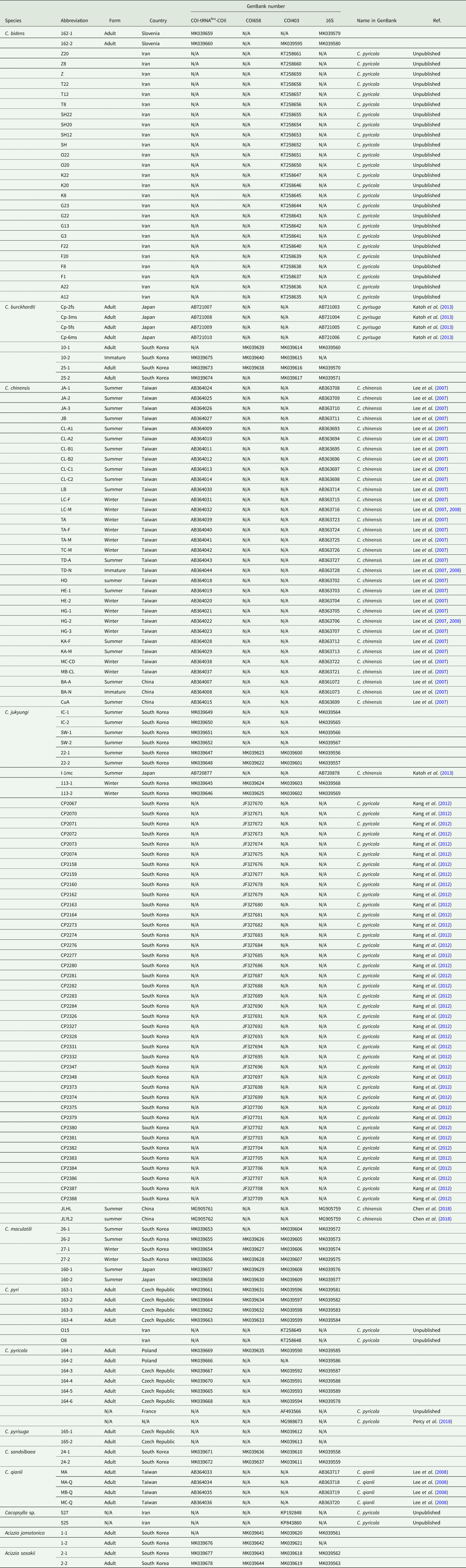
Samples were collected by G. Cho in Korea in 2014–2015, H. Inoue in Japan in 2014 and I. Malenovský, L. Štarhová Serbina and P. Lauterer in central Europe (Czech Republic, Poland and Slovenia) in 2008–2018. They were stored in 95–99% ethanol at ‒20°C for genomic DNA extraction. DNA-extracted samples were permanently mounted on microscopic slides in Canada balsam as voucher specimens. The vouchers are deposited at the College of Agriculture and Life Sciences (CALS), Seoul National University (SNU), the Republic of Korea. Specimens were identified based on morphology using the keys by Burckhardt and Hodkinson (Reference Burckhardt and Hodkinson1986) and Cho et al. (Reference Cho, Burckhardt, Inoue, Luo and Lee2017). Additional sequences of several pear psyllid species from China, Japan and Taiwan published by Lee et al. (Reference Lee, Yang, Li and Yeh2007, Reference Lee, Yang and Yeh2008), Katoh et al. (Reference Katoh, Inoue, Kuchiki, Ide, Uechi and Iwanami2013) and Chen et al. (Reference Chen, Liu, Qiao, Wang and Zhang2018) and unpublished sequences of ‘Cacopsylla pyricola’ from France and Iran were downloaded from the GenBank (table 1).
Pear psyllid sequences of COI-tRNAleu-COII, COI658, COI403, and 16S rDNA used in this study.

DNA extraction, amplification and sequencing
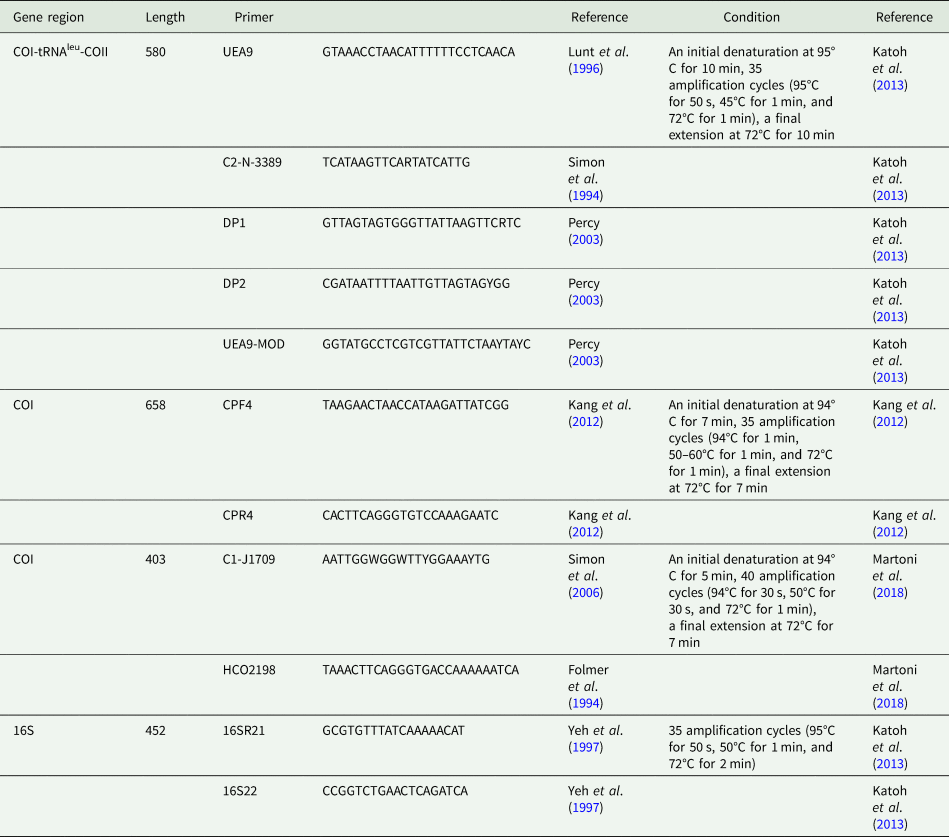
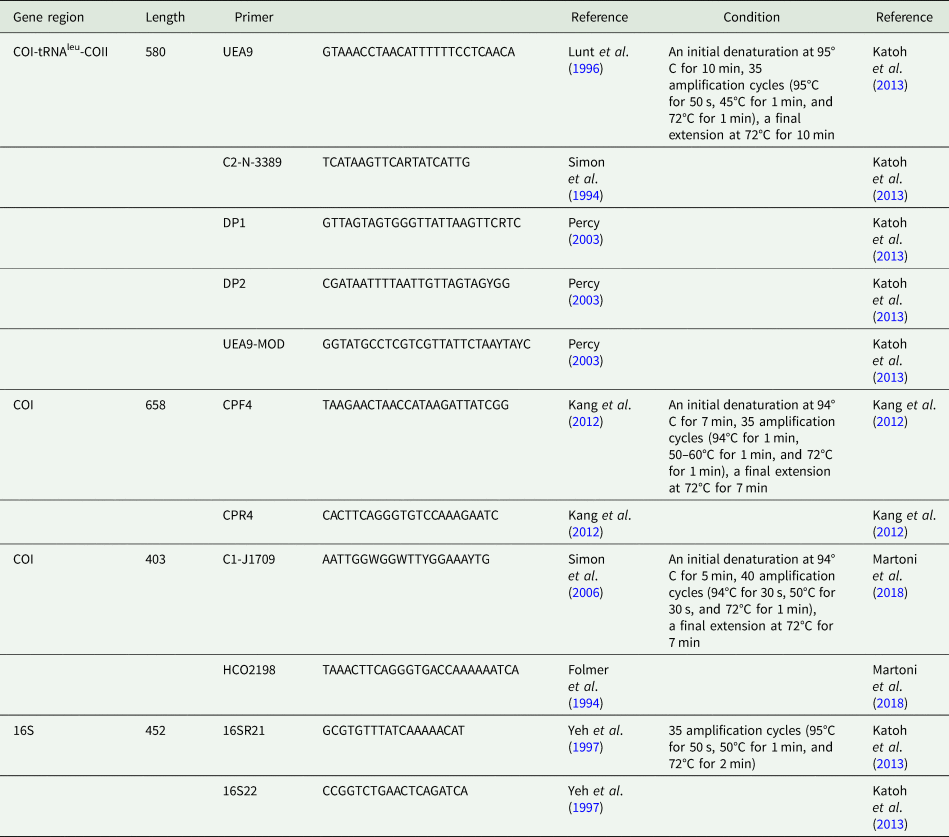
Total genomic DNA was extracted from single individuals using a DNeasy Blood and Tissue kit (QIAGEN, Germany). To make voucher specimens, we used a non-destructive DNA extraction protocol by Kim et al. (Reference Kim, Hoelmer, Lee, Kwon and Lee2010) modified by leaving samples in the lysis buffer with proteinase K solution at 56°C overnight instead of 24 h. Polymerase chain reaction (PCR) was performed with the PTC-100 thermocycler (MJ Research Inc., USA) using AccuPower PCR premix (BIONEER, Korea). A reaction mixture (20 μl) contained 1 unit of Top DNA polymerase (BIONEER, Korea), 250 μM of dNTP, 10 mM of Tris-HCl, 30 mM of KCl and 1.5 mM of MgCl2, 1 μl of each primer (10 μM) and 5–20 ng of template DNA. The primers used for amplification and PCR conditions are listed in table 2. PCR products were cleaned using a QIAquick PCR purification kit (QIAGEN, Inc.) and directly sequenced using an automated sequencer (ABI PrismH 3730 XL DNA Analyzer) at Macrogen, Inc.
Primers and PCR conditions used in this study.
Sequence alignment and phylogenetic analysis
All sequences were initially assembled and examined using SeqMan Pro ver. 7.1.0 (DNASTAR, Inc., USA). Alignment of the DNA sequences was conducted online using the MAFFT ver. 7 package (Katoh and Toh, Reference Katoh and Toh2008; Katoh et al., Reference Katoh, Misawa, Kuma and Miyata2002, Reference Katoh, Kuma, Toh and Miyata2005) on the server (http://mafft.cbrc.jp/alignment/software/). The COI and COI-tRNAleu-COII sequences were aligned using the FFT-NS-I strategy implemented in MAFFT with the default settings. The Q-INS-I strategy was chosen for the 16S rDNA gene using the default setting which considers RNA secondary structure and small data sets (Katoh et al., Reference Katoh, Misawa, Kuma and Miyata2002). COI and COII sequences translation was checked in MEGA 6 (Tamura et al., Reference Tamura, Stecher, Peterson, Filipski and Kumar2013) for the presence of in-frame stop codons and indels, which can indicate nuclear mitochondrial pseudogenes (NUMTs), generally known to be an impediment to DNA barcoding (Song et al., Reference Song, Buhay, Whiting and Crandall2008; Leite, Reference Leite2012). For the aligned data set, phylogenetic trees were constructed using the neighbour-joining (NJ) algorithm with bootstrap support analysis (1000 replicates) in MEGA 6 based on a Kimura 2-Parameter (K2P) model. This has been the most widely used method for DNA barcoding analyses (e.g. Yeh et al., Reference Yeh, Yang and Kang1997; Shin et al., Reference Shin, Jung, Lee and Lee2013; Gwiazdowski et al., Reference Gwiazdowski, Foottit, Maw and Hebert2015; Wu et al., Reference Wu, Trepanowski, Molongoski, Reagel, Lingafelter, Nadel, Myers and Ray2016; Amouroux et al., Reference Amouroux, Crochard, Germain, Correa, Ampuero, Groussier, Kreiter, Malausa and Zaviezo2017; Kanturski et al., Reference Kanturski, Lee, Choi and Lee2018; Song et al., Reference Song, Lin, Wang and Wang2018), including previous studies on pear psyllids (Lee et al., Reference Lee, Yang and Yeh2008; Kang et al., Reference Kang, Baek, Lee, Cho, Kim, Han and Kim2012; Katoh et al., Reference Katoh, Inoue, Kuchiki, Ide, Uechi and Iwanami2013, Reference Katoh, Inoue, Uechi, Fujikawa, Miyata and Iwanami2014; Chen et al., Reference Chen, Liu, Qiao, Wang and Zhang2018). To compare our results with those papers, we preferred to use the same methodology despite some potential limitations, such as a poor fit of the K2P model at the species level (Srivathsan and Meier, Reference Srivathsan and Meier2012; Collins et al., Reference Collins, Boykin, Cruickshank and Armstrong2012). Eleven pear psyllid species of the genus Cacopsylla (Psyllidae: Psyllinae) were included into the analyses and two Acizzia species (Psyllidae: Acizzinae) were used as outgroups (table 1). Pairwise distances were also computed using MEGA 6 (Tamura et al., Reference Tamura, Stecher, Peterson, Filipski and Kumar2013).
Results
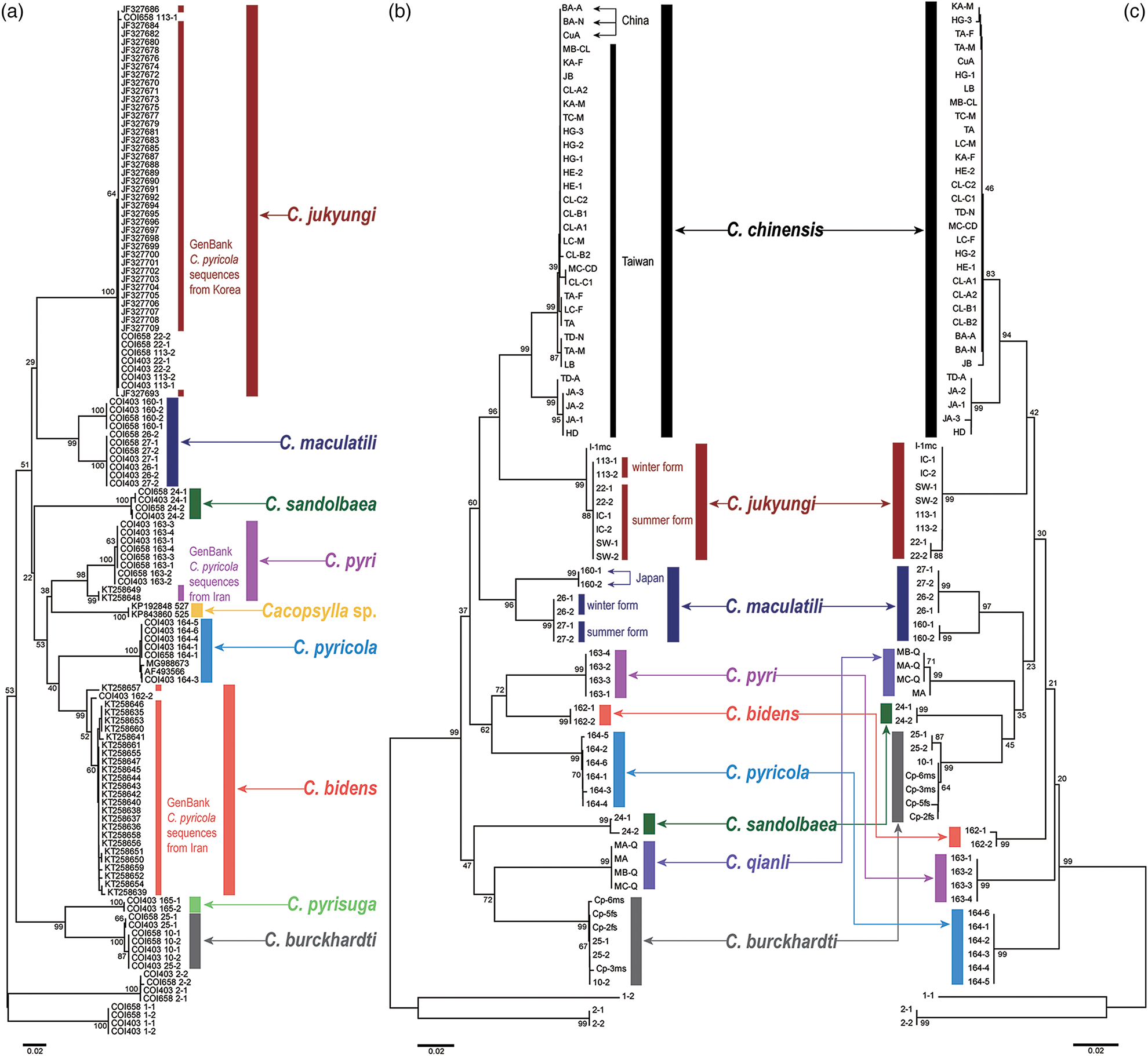
A total of 375 aligned sequences (COI 403–658 bp, COI-tRNAleu-COII 580 bp and 16S rDNA 452 bp sequence fragments; table 1) of 11 pear psyllid species and two outgroup species were analysed (table 1). All species are characterized by a distinctive set of COI, COI-tRNAleu-COII and 16S rDNA sequences that form well-supported clusters in the NJ-trees (bootstrap values of 94–100%; fig. 2). No internal stop codons or frame shifts were detected in the aligned COI and COII sequences, suggesting that none derive from pseudogenes (NUMTs).
NJ trees based on Kimura 2-parameter genetic distance: (a) COI; (b) COI-tRNAleu-COII; (c) 16S rDNA. *Bootstrap support values are shown at the branch points and are based on 1000 replications.

Korean ‘Cacopsylla pyricola’ sequences from the GenBank (Kang et al., Reference Kang, Baek, Lee, Cho, Kim, Han and Kim2012) show no significant divergence from C. jukyungi in the COI gene fragment (fig. 2) but significantly differ from European specimens of C. pyricola; this indicates that the material of Kang et al. (Reference Kang, Baek, Lee, Cho, Kim, Han and Kim2012) was misidentified, as was suggested by Cho et al. (Reference Cho, Burckhardt, Inoue, Luo and Lee2017). Also, all GenBank sequences under ‘Cacopsylla pyricola’ from Iran by Zohdi and Hossini and Zendehdel et al. (data deposited in the GenBank without reference to a published article) are misidentified; based on our analysis, these specimens belong to three different species, viz. C. pyri, C. bidens and Cacopsylla sp. (fig. 2, table 1). The last taxon is close to C. pyri but distinct with a mean of 16.6% genetic difference (range 12.4–20.3%). This species may be C. permixta though the corresponding material was not available for morphological identification. Another previous misidentification concerns the sequences of ‘C. pyrisuga’ by Katoh et al. (Reference Katoh, Inoue, Kuchiki, Ide, Uechi and Iwanami2013) from Japan. Based on our analysis, they are conspecific with samples of C. burckhardti from Korea (fig. 2).
Chinese and Taiwanese Cacopsylla chinensis sequences (Lee et al., Reference Lee, Yang, Li and Yeh2007, Reference Lee, Yang and Yeh2008) together form well-supported clusters in the NJ trees based on COI-tRNAleu-COII and 16S rDNA gene fragments (fig. 2). The sequences of COI-tRNAleu-COII and 16S rDNA of C. chinensis lineage III from Northeast China (Jilin and Heilongjang, near North Korea) by Chen et al. (Reference Chen, Liu, Qiao, Wang and Zhang2018) and C. jukyungi from Korea are identical suggesting that the two taxa are conspecific and that the former constitutes a misidentification. Japanese (Katoh et al., Reference Katoh, Inoue, Uechi, Fujikawa, Miyata and Iwanami2014) and Korean C. jukyungi (of both summer and winter forms) sequences are monophyletic, supported by 99% bootstrap values in COI-tRNAleu-COII and 16S rDNA NJ trees (fig. 2). The conspecificity of the summer and winter forms of C. maculatili is also highly supported by bootstrap values of 99% in COI-tRNAleu-COII and 16S rDNA NJ trees as well. Cacopsylla sandolbaea and C. qianli form distinct clades recognized in all NJ trees (fig. 2).
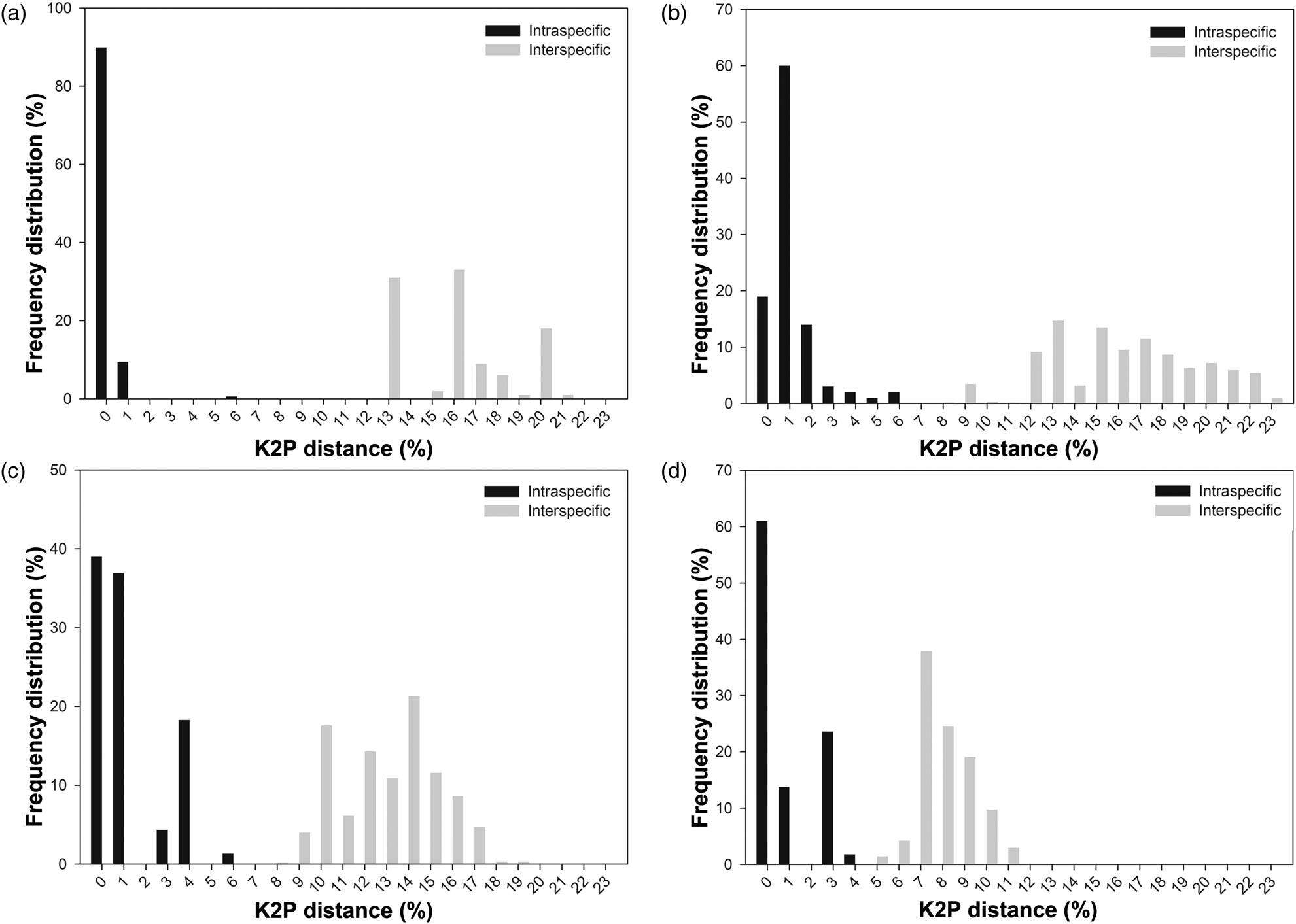
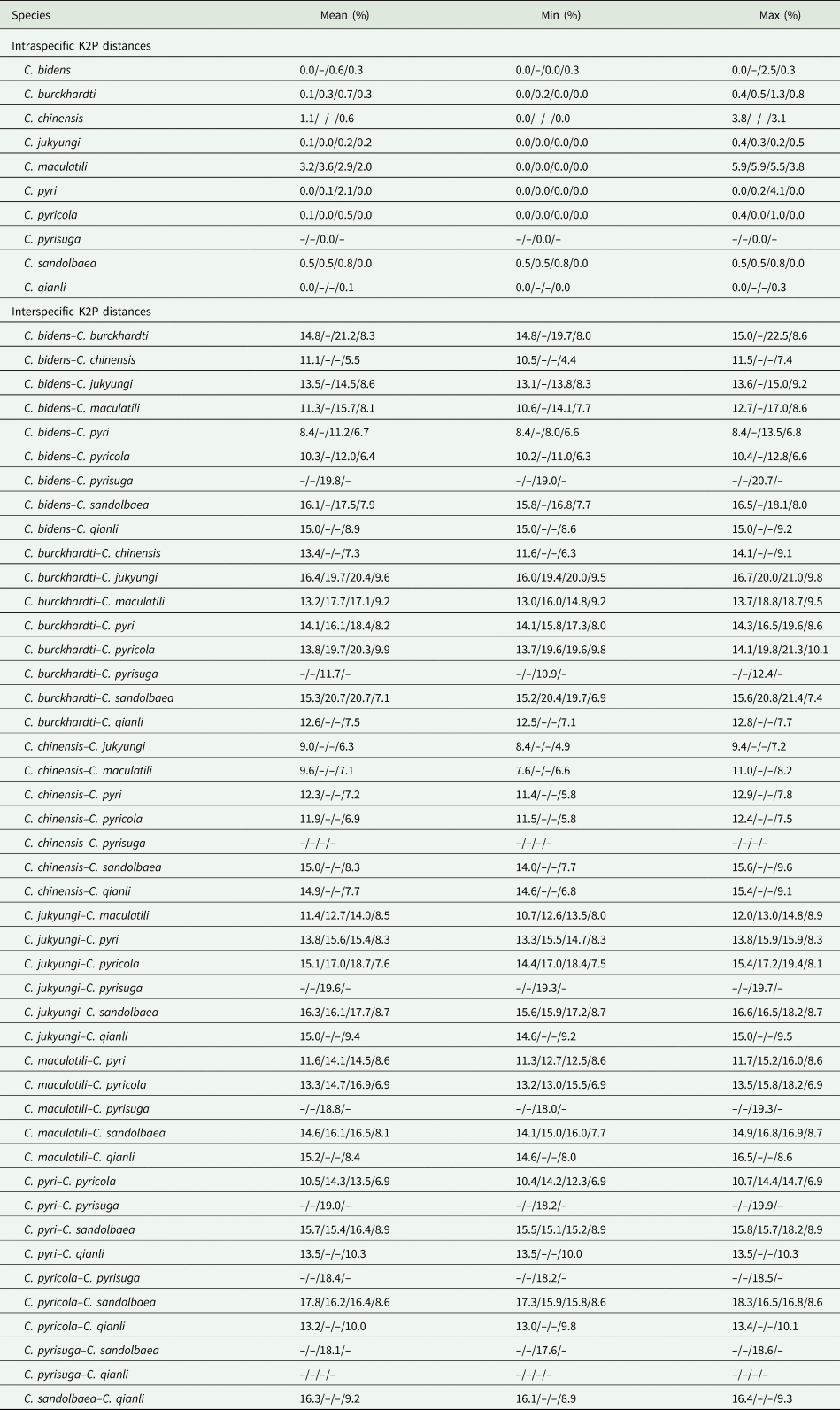
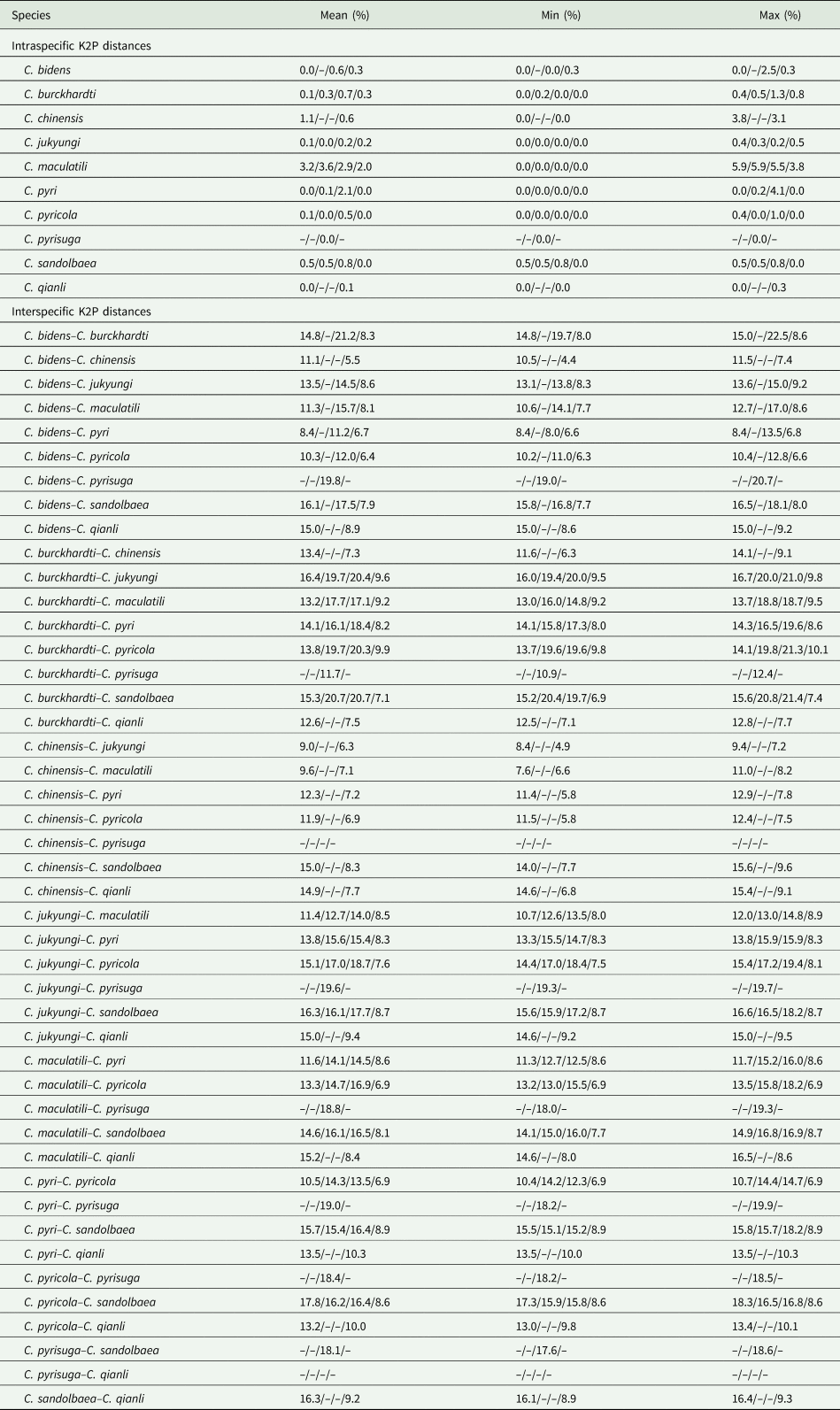
The mean intraspecific K2P distance is 0.1% in COI 658 bp (range 0–5.9%), 0.7% in COI 403 bp (range 0–5.5%), 1% in COI-tRNAleu-COII (range 0–5.9%) and 0.6% in 16S rDNA (range 0–3.8%), with a maximum observed value of 5.9% for C. maculatili (fig. 3, table 3). The interspecific divergences (K2P distance) between the examined Cacopsylla species average 15.7% (range 12.6–20.8%) in COI 658 bp, 15.7% (range 8.0–22.5%) in COI 403 bp, 12.4% (range 7.6–18.3%) in COI-tRNAleu-COII and 7.5% (range 4.4–10.3%) in 16S rDNA (table 3). Significant barcoding gaps are thus observed between the intra- and interspecific K2P distance divergences of congeneric species (fig. 3, table 3). The barcoding gaps average 4% for all gene fragments. Intra- and inter-specific variations for the examined pear psyllids are shown in table 3.
Frequency distributions of the intra- and interspecific K2P distances for congeneric sequences: (a) COI 658 bp; (b) COI 403 bp; (c) COI-tRNAleu-COII; (d) 16S rDNA.

Intraspecific and interspecific K2P distances of tested species (COI-tRNAleu-COII/COI658/COI403/16S rDNA).
In most analyses, the western Palaearctic species C. pyri, C. pyricola and C. bidens form a monophyletic clade (including Cacopsylla sp. from Iran in the COI tree), albeit with only a moderate support, while C. chinensis and C. jukyungi are strongly to moderately supported as sister species. Cacopsylla pyrisuga and C. burckhardti constitute sister species in the COI tree (fig. 2).
Discussion
The present study shows that DNA barcoding can correctly identify the species of pear psyllids (Cacopsylla spp.). Overall, the identification efficiency using DNA barcoding is extremely high (100%) and all morphologically recognized species are clearly separated in all NJ trees (fig. 2). All markers (COI, COI-tRNAleu-COII and 16S rDNA) with criteria (K2P distance) performed well and no overlap between intra- and inter-specific divergences is observed in any of the analyses (fig. 3). The COI and COI-tRNAleu-COII fragments are more effective for comparison of relatively closely related (congeneric) species than 16S rDNA because of wider gaps and divergences (fig. 3). A DNA study of west Palaearctic species of Arytaina, Arytinnis and Livilla (Psyllinae) associated with Fabaceae showed maximum intraspecific variation generally of less than 3% in case of widespread continental species; the intraspecific divergence was higher within some species occurring on different islands (Percy, Reference Percy2003). The threshold of 3% mostly holds also for the Palaearctic pear psyllids though it is slightly higher in C. chinensis and C. maculatili (3.8 and 5.9% maximum intraspecific divergence, respectively) which were sampled in this study from continental eastern Asia and the islands of Taiwan and Japan, respectively (table 3). Percy (Reference Percy2003) explained this pattern as a result either from greater gene flow on the continent than between islands or by the establishment of recent continental distributions.
In the past, seasonal dimorphism within some of the pear psyllid species led to misidentifications and taxonomic chaos but several studies using morphological evidence solved the puzzle (Burckhardt and Hodkinson, Reference Burckhardt and Hodkinson1986; Yang et al., Reference Yang, Huang and Li2004; Luo et al., Reference Luo, Li, Ma and Cai2012; Cho et al., Reference Cho, Burckhardt, Inoue, Luo and Lee2017). Here, we confirm that C. cinereosignata is the winter form of C. jukyungi, and C. maculatili that of C. qiuzili; the names have been formally synonymized by Cho et al. (Reference Cho, Burckhardt, Inoue, Luo and Lee2017).
Previously, the two east Palaearctic species C. burckhardti and C. jukyungi were misidentified as the west Palaearctic C. pyrisuga and C. pyricola, respectively (Paik, Reference Paik1963; Kwon, Reference Kwon1983; Park, Reference Park1996; Kim et al., Reference Kim, Cho, Jeon, Yiem and Lee2000, Reference Kim, Yang and Jeon2007; Inoue, Reference Inoue2010; Kang et al., Reference Kang, Baek, Lee, Cho, Kim, Han and Kim2012; Park et al., Reference Park, Park, An, Park, Choi, Koo and Kim2013, Reference Park, Kwon, Yu and Youn2016; Kwon et al., Reference Kwon, Suh and Kwon2016; Cho et al., Reference Cho, Burckhardt, Inoue, Luo and Lee2017). By including C. pyrisuga samples from central Europe in our analyses we show that the records and sequences of ‘C. pyrisuga’ from Japan (Katoh et al., Reference Katoh, Inoue, Kuchiki, Ide, Uechi and Iwanami2013) belong, in fact, to C. burckhardti which is also known from Korea. Our study also shows that ‘C. pyricola’ reported from Korea by Kang et al. (Reference Kang, Baek, Lee, Cho, Kim, Han and Kim2012) is a misidentification of C. jukyungi. There is no evidence for the presence of west Palaearctic pear psyllids in East Asia, confirming the conclusions by Cho et al. (Reference Cho, Burckhardt, Inoue, Luo and Lee2017) based on morphological evidence. Furthermore, Inoue et al. (Reference Inoue, Kuchiki, Ide and Mishima2012) and Katoh et al. (Reference Katoh, Inoue, Kuchiki, Ide, Uechi and Iwanami2013, Reference Katoh, Inoue, Uechi, Fujikawa, Miyata and Iwanami2014) misidentified C. jukyungi from Japan as C. chinensis. They detected exceptionally high genetic differences from C. chinensis from Taiwan and concluded that the Japanese populations belong to a distinct lineage of the same species. Later, Cho and Lee (Reference Cho and Lee2015) followed this interpretation and misidentified C. jukyungi from South Korea as C. chinensis.
The same misidentified C. chinensis sequences from China deposited in the GenBank were also used uncritically by Chen et al. (Reference Chen, Liu, Qiao, Wang and Zhang2018). Their sequences from Northeast China (Harbin, Heilongjiang; Helong, Jilin; Yanlong, Jilin) named ‘C. chinensis lineage III’ grouped with ‘C. chinensis’ from Japan, a misidentification of C. jukyungi. Their intraspecific divergences of ‘lineage III’ showed 12.4 and 9% sequence divergence in 16S rDNA and COI-tRNAleu-COII from C. chinensis from the Chinese mainland and Taiwan, respectively, confirming the first being C. jukyungi.
Our molecular analyses indicate that, except for two sequences from Europe, all the ‘C. pyricola’ sequences in the GenBank are misidentified. These misidentifications concern, in addition to C. jukyungi mentioned above, three species from Iran: C. bidens, C. pyri and Cacopsylla sp. (probably C. permixta, a species associated with pears and recorded from Iran by Burckhardt and Lauterer, Reference Burckhardt and Lauterer1993). C. pyricola was reported from Iran by Ossiannilsson (Reference Ossiannilsson1992), by Burckhardt and Lauterer (Reference Burckhardt and Lauterer1993) with doubts on the basis of two females and by Zendedel et al. (Reference Zendedel, Burckhardt, Fekrat, Manzari and Namaghi2016) on the basis of GenBank information but without morphological identification (D. Burckhardt, pers. information). Cho et al. (Reference Cho, Burckhardt, Inoue, Luo and Lee2017) suggested that the records of C. pyricola from Iran concern C. bidens, which is partly supported here.
DNA barcoding is a useful identification tool for insects in general and, as shown here, also for pear psyllids. A major problem in some molecular studies is the misidentification of the specimen subjected to DNA sequencing and the difficulty to check later its identity by other researchers. For developing a reliable library of DNA barcodes of pear psyllids, it is crucial that new entries are correctly identified and existing mistakes weeded out. Misidentifications of pear psyllid species may result in serious problems in the quarantine and control measures regarding these pests. Our study also confirms that morphological characters reliably diagnose species of Cacopsylla associated with pear.
Acknowledgements
We are grateful to David Ouvrard (Natural History Museum, London), Valerie Dennis (Editorial board, Bulletin of Entomological Research) and an anonymous reviewer for comments on earlier manuscript drafts and Liliya Štarhová Serbina (Masaryk University, Brno) for the donation of material.
Financial support
This work was partly supported by a grant from the Korean National Arboretum ‘Development of an integrated identification system of Korean insects’ (Project No. KNA 1-1-20, 16-1) and a grant from the Rural Development Administration, Republic of Korea ‘Cooperative Research Program for Agriculture Science & Technology Development (Project No. PJ01257202)’.