Implications
Hair sheep are important in many production systems in developing countries; however, knowledge of the specific mineral requirements of hair sheep is limited.
Meeting the mineral requirements for growth and maintenance is necessary for animals to express their maximum productive potential. The results of the present study emphasize the need to update the mineral recommendations of Brazilian Somali lambs. Moreover, accurate prediction of mineral requirements might minimize mineral excretion and environmental pollution.
Introduction
Advancement of ruminant nutrition in tropical environments requires a better understanding of the nutritional requirements of ruminants (Galvani et al., Reference Galvani, Pires, Kozloski and Wommer2008; Regadas Filho et al., Reference Regadas Filho, Pereira, Pimentel, Villarroel, Medeiros and Fontenele2013). Several factors have been shown to affect net requirements (Salah et al., Reference Salah, Sauvant and Archimède2014). Knowledge of the nutrient requirements of growing hair sheep has global importance because it would allow the development of improved food strategies (Oliveira et al., Reference Oliveira, Pereira, Biffani, Medeiros, Silva, Oliveira and Marcondes2018) and would reduce costs in the formulation of diets.
Minerals are essential to animal metabolism. They function as structural components of tissues (National Research Council (NRC), 2007) and act as electrolytes in body fluids to maintain the acid-base balance, osmotic pressure, and the permeability of cell membranes (Underwood and Suttle, Reference Underwood and Suttle1999). Mineral deficiencies and excesses can cause severe nutritional changes that impair animal performance. Thus, ensuring adequate mineral nutrition is fundamental to optimize animal performance and avoid contamination of soil and water, resulting from mineral excretion into the environment via feces and urine. Cu metabolism is influenced by genetics, and there are differences in Se, Cu and Zn metabolism between small ruminants and cattle (Kincaid, Reference Kincaid2000). Such differences in mineral metabolism likely directly affect mineral requirements.
Studies on the minerals requirements in hair sheep are few, and the reported results are in conflict with the recommendations of international committees regarding the requirements for small ruminants (Mendes et al., Reference Mendes, Silva, Silva, Nóbrega, Lôbo and Pereira Filho2010; Pereira et al., Reference Pereira, Carmo, Costa, Medeiros, Oliveira, Pinto, Carneiro, Lima, Campos and Gomes2016). The diet formulations for sheep in Brazil are based on tables generated by NRC (2007), however, such formulations are likely sub-optimal, as the mineral requirements of an organism vary with species, breed, dietary aspects, production level and environmental factors (McDowell, Reference McDowell1992; NRC, 2007).
The Brazilian Somali breed has great potential for use as a maternal breed in terminal crossings. It provides benefits such as increased fertility and lower maintenance costs due to its lower BW at maturity compared with other breeds (Barbosa Neto et al., Reference Barbosa Neto, Oliveira, Faco and Lobo2010). These animals are widespread in several regions of Brazil and other regions, including arid and semiarid regions.
Thus, this study was carried out with the objective to determine the body composition and macro (Ca, P, Mg, Na, K) and micromineral (Zn, Fe, Mn and Cu) requirements for maintenance and weight gain in Somali Brazilian Somali lambs fed with diets of different metabolizable and energy levels.
Material and methods
Animal care and experimental diets
This study was performed at the Department of Animal Science at the Federal University of Ceara in Fortaleza, Ceara State, Brazil. Prophylactic measures against sheep infectious diseases and endo- and ectoparasite infestation were implemented to ensure that the animals were in healthy condition throughout the study.
Animals, diets and experimental design
A total of 48 animals with an initial average BW of 13.5±1.8 kg and 60±15 days of age were used in this study. Lambs were randomly allocated to five dietary treatments (eight animals/treatment) of different levels of metabolizable energy (ME) (4.93, 8.65, 9.41, 10.12 and 11.24 MJ/kg DM). The ratios of roughage to concentrate were 100 : 0, 80 : 20, 60 : 40, 40 : 60 and 20 : 80. The rations were formulated to allow a maximum growth rate 200 g/day of late maturity lambs as recommended by the NRC (2007). The total mixed ration (TMR) was composed of Tifton 85 hay ground in an agricultural chopper and an added concentrate ration composed of ground corn grain, soybean meal, urea, limestone, dicalcium phosphate, salt and premix as a loose mixture of single components (Table 1). The lambs were individually fed ad libitum twice daily (0800 and 1600 h), allowing for up to 20% orts. The lambs were housed in individual stalls that were each equipped with a feeder and water. At the beginning of the experimental period, eight lambs were randomly selected and slaughtered to serve as a reference group for the estimation of initial EBW and body composition. Fasted BW (FBW) was determined as the BW after 18 h of no access to feed or water.
Ingredients and chemical compositions of the experimental diets

1 Chemical composition: 266 g/kg calcium (calcium carbonate); 147 g/kg phosphorus (dicalcium phosphate); 7 g/kg magnesium; 3 g/kg potassium; 7 g/kg sulfur (cobalt sulfate and zinc sulfate); 1.0 mg/kg copper (copper chelated); 16 500 mg/kg iron (iron sulfate); 1728 mg/kg manganese (manganese chelated); 4198 mg/kg zinc (zinc sulfate); 136 mg/kg cobalt (cobalt sulfate).
Digestibility trials and calculation of metabolizable energy
To determine the concentration of metabolizable energy in the rations, digestibility trials were conducted eight times throughout the experiment. Indigestible NDF (iNDF) was used as a marker to estimate the daily fecal excretion, as described by Lippke et al. (Reference Lippke, Ellis and Jacobs1986). Feces were collected for three consecutive days every 15 days during the experimental period at 0800 h on the first day, noon on the second day and 1600 h on the third day. The amount of iNDF in the fecal samples, orts, concentrates and Tifton 85 hay were obtained through waste in situ incubations over a period of 240 h in the rumen of a cow by using nylon bags according to the methodology of McDonald and Orskov (Reference McDonald and Orskov1979). After incubation, the bags were washed in water until they became clear. Then, following the protocol of Van Soest et al. (Reference Van Soest, Robertson and Lewis1991), the residue was weighed and considered as the iNDF. The level of total digestible nutrients (TDN) was calculated according to Weiss (Reference Weiss1993): TDN=CP d +NFC d +aNDFom d +EE d ×2.25 (subscript d means digestible). The digestible energy (DE) was estimated at 18.4 MJ/kg of TDN, and the DE was converted to metabolizable energy (ME) at an 82% efficiency rate (National Research Council, 2000).
Slaughter and sampling
Every 15 days, the lambs were weighed in the morning (at 0700 h, before feeding) to obtain their BW. When the mean of one of the experimental treatments reached 28 kg BW, which was the treatment with 10.12 MJ/kg DM, at that time, all experimental animals were slaughtered. The FBW was obtained as described for the reference group.
The slaughters were carried out by stunning the animals and causing a brain concussion and then sectioning the jugular veins until the animals bled out completely. Blood collection procedures, gastrointestinal tract, organs and other body parts followed as described by Pereira et al. (Reference Pereira, Lima, Marcondes, Rodrigues, Campos, Silva, Bezerra, Pereira and Oliveira2017). EBW was defined as FBW at slaughter minus digestive tract contents.
The carcasses were weighed and chilled in a cold chamber (4°C) for 24 h. After chilling, each carcass was divided into two halves lengthwise. All of the right-half carcasses, non-carcass components (blood, head, hooves, internal organs, and the cleaned gastrointestinal tract) and hides were ground separately in an industrial meat grinder. The combined mass of the non-carcass components was recorded. The same protocol was used for the right halves of the carcasses and hides, submitted and maintained at 4°C. All of the samples were stored frozen until the laboratory chemical analyses were performed.
Laboratorial analysis
The mass of the ground organs, blood, hooves, head and right half of the carcass and hide was homogenized, sampled and placed in a forced ventilation oven at 55°C for 72 h. Subsequently, the samples were defatted by extraction with ether in a Soxhlet apparatus according to the methods of the Association of Official Analytical Chemists (AOAC) (1990) (method number 920.39). The samples were ground in a ball mill and stored in closed containers. The DM contents were determined by AOAC (1990) (method number 967.03). The ash (AOAC, 1990; method number 942.05) and CP (AOAC, 1990; method number 981.10) levels were determined in fat-free samples, following the method described above for experimental diet ingredients. The body water content was calculated as 100% minus the DM.
The concentrate, forage and ort samples were ground using a Wiley mill (TE–650; Tecnal, Piracicaba, Sao Paulo, Brazil). The analysis for the determination of minerals was conducted by means of acid digestion (Mahanti and Barnes, Reference Mahanti and Barnes1983). For the digestion of the samples, a mixture of nitric acid (HNO3) with hydrochloric acid (HCl) and hydrogen peroxide (H2O2) was used, and the mineral solution was obtained. This extract was used to obtain dilutions to determine the different minerals under study. Ca and Mg levels were determined by atomic absorption spectrometry by using a GBC Avanta Sigma spectrometer (Hampshire, Illinois, USA) (AOAC, 1990; method number 935.13). For Na and K contents (AOAC, 2000) (method number 985.35), readings were obtained by using a flame spectrophotometer (atomic emission), and P content was determined by colorimetric analysis (AOAC, 1990; method number 965.17).
The Cu, Fe, Mn and Zn concentrations were determined according to Braselton et al. (Reference Braselton, Stuart, Mullaney and Herdt1997), using inductively coupled plasma-atomic emission spectroscopy with ultrasonic nebulization.
Models and calculations
The content of each mineral retention in the empty body was estimated by regressing the logarithm of the content of Ca, P, Mg, Na, K, Zn, Fe, Mn or Cu on log of empty BW according to the Agricultural Research Council (ARC) (1980):
 $${\rm log}\,\left( Y \right){\equals}a{\plus}b{\times}{\rm log}\left( X \right)$$
where Y is the mineral content of the EBW; a the intercept; b the slope; X the EBW.
After applying the antilog of equation (1), its derivation regarding the EBW was used to determine the daily net requirements of each mineral per kg of empty BW gain (EBWG) (equation (2)):
 $$Y'{\equals}b{\times}10^{a} {\times}{\rm EBW}^{{b{\minus}1}} $$
where Y' is the net requirement of each mineral for gain; a the intercept; b the regression coefficient. The equation was differentiated to compute the estimates of the gain composition at various EBW values.
A linear regression of the retained minerals (mg/kg EBW) on mineral intake (mg/kg EBW) was used to calculate the net mineral requirements for maintenance (Lofgreen and Garrett, Reference Lofgreen and Garrett1968). The intercepts of the regression were considered the endogenous and metabolic losses of the minerals, which were assumed to represent the net mineral maintenance requirements.
For the conversion of net mineral requirements to gain, the factor of 1.23 obtained by the BW/EBW ratio was used. The EBW was estimated from the regression equation of the EBW as a function of the final BW of the 40 experimental animals.
Statistical analysis
Statistical analyses were performed according to the following statistical model through the PROC MIXED of SAS (V 9.1): Y ij =µ+α i +b j +e ij where Y ij is the value observed in the plot that received treatment i in the block j; µ the overall mean; α i the fixed effect of treatment i; b j the random effect of the block j; e ij the random error ∼NID (0,σ 2). The least squares means were obtained by LSMEANS statement. An orthogonal partition of treatments effect into linear and quadratic degree effects was obtained following an analysis of variance (α=0.05). Linear regressions were performed using the PROC REG (SAS 9.0; 2003). The nonlinear regression model to estimate the mineral requirement for maintenance was performed using the NLIN procedures of SAS 9.0, using the iterative method of Marquardt.
Results
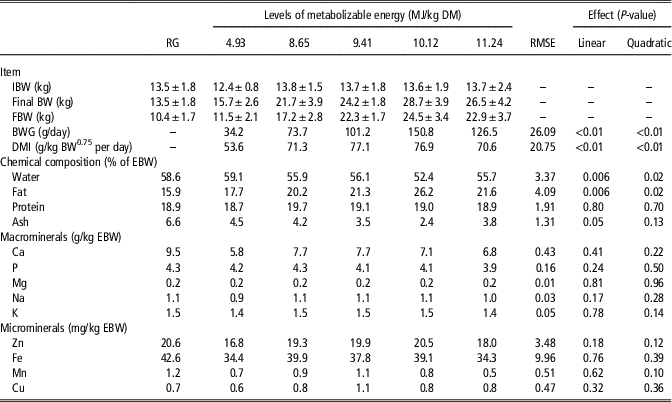
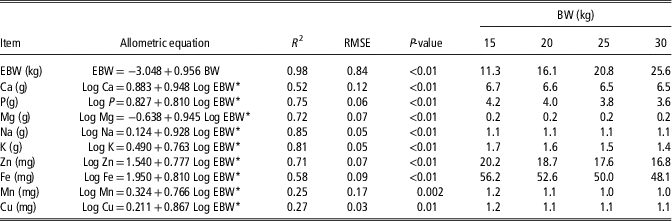
As expected, the DM intake (DMI) showed a quadratic response to the ME content of the ration: DMI (g/kg0.75 BW per day)=53.863+1.588 ME+0.036 ME² (R 2=0.53, RMSE=20.75). The concentration of fat increased linearly with the increase of ME in the diet (P=0.005), whereas no difference in EBW protein content was observed among the treatments. BWG presented a linear increase (P<0.05) with the increase in the metabolizable energy of the diet: BWG=−56.27+17.22 ME (R 2=0.629, RMSE=28.25). Mineral body composition was not affected by the experimental treatments (Table 2). The allometric equations describing the relationship between the mineral body contents and EBW were significant for all of the minerals (Table 3). The equations used to predict the mineral requirements are showed in Table 4. As BW increased, the macro and micromineral requirements for BW gain in Brazilian Somali lambs decreased (Table 5). The equations used to estimate the mineral net requirement for maintenance are presented in Table 6.
Body parameters, DM intake (DMI), chemical compositions of the empty BW of Brazilian Somali lambs fed diets with different levels of energy

RG=reference group; EBW=empty BW; IBW=initial BW; FBW=fasted BW; BWG=BW gain; DMI=DM intake.
Allometric equations used to estimate mineral body compositions of Brazilian Somali lambs (g/kg EBW)

EBW=empty BW.
*Equations obtained from the linear regression of the logarithm of the mineral content on the EBW.
Equations obtained from baseline data of hair sheep – Brazilian Somali lambs to estimate mineral retention in growing

EBW=empty BW.
*Equations obtained from derivation of the regression equation of the logarithm of the minerals in the empty body in function of the logarithm of the EBW.
Net macro and micromineral requirements for BW gain (BWG) in growing stage for Brazilian Somali lambs

Daily net mineral maintenance requirements of Somali Brazilian lambs are estimated by regressing the daily intake of a mineral (g or mg/kg of BW against the daily retention of the mineral (g or mg) in the body)

Ret.=retained, mg/kg; Int.=intake, mg/kg EBW.
*Equations obtained from the linear regression of the retained minerals on mineral intake.
Discussion
As expected, the responses were in agreement with current theories related to the regulation of intake (Conrad et al., Reference Conrad, Hibbs and Pratt1964; Mertens, Reference Mertens1987; Allen et al., Reference Allen, Bradford and Oba2009). The chemostatic nature of the regulation of intake appeared to operate as predicted. In our study the DMI was lower in animal fed with 11.2 MJ ME diet. Considering that the NDF content is inversely proportional to the energy density of the ration, the reduction of the NDF content with the increase in the energy density of the ration increased the DMI to a maximum point, so that from that point, the DMI decreases in response to the energy demand of the animals. In addition, with the increase of the level of concentrate in the rations, there is an increase in the concentration of propionate in the rumen and lactate in the duodenum, which may depress the feed intake.
The mineral concentrations (g/kg EBW or mg/kg EBW) decreased with the increase of the BW. This pattern was due to the higher fat content in the body of animals. Brazilian Somali sheep present a higher rate of accumulation of body fat than do other hair sheep. This higher rate of body fat can primarily be attributed to breed characteristics (Pereira et al., Reference Pereira, Fontenele, Silva, Oliveira, Ferreira, Mizubuti, Carneiro and Campos2014). The increase in fat content causes a dilution effect with respect to the minerals in the body as adipose tissue has very low concentrations of minerals. Fat content is directly related to animal age and weight (NRC, 2007): as BW increases and physiological maturity approaches, muscle tissue deposition is reduced, and fat content is increased (Sanz Sampelayo et al., Reference Sanz Sampelayo, Allegretti, Gil Extremera and Boza2003).
Previous studies conducted by our team revealed that early-maturing hair sheep tend to have increased fat deposition during weight gain compared with late- maturing animals, which might cause them to have different nutritional requirements (Costa et al., Reference Costa, Pereira, Silva, Paulino, Mizubuti, Pimentel, Pinto and Rocha Junior2013; Regadas Filho et al., Reference Regadas Filho, Pereira, Pimentel, Villarroel, Medeiros and Fontenele2013). According to the ARC (1980), the deposition of minerals EBW gain is constant, and they recommend values of 11.0, 6.0, 0.41, 1.10 and 1.80 g/kg of EBW gain for Ca, P, Mg, Na and K, respectively, which are greater than the values obtained in the present study. However, body tissues do not grow uniformly, resulting in changes in body composition and tissue deposition between different weight ranges (Suttle, Reference Suttle2010). Consequently, mineral deposition is reduced as weight gain proceeds due to increased fat deposition and reduced deposition of bone and muscle tissue. Due to the inverse relationship between fat deposition and mineral deposition, the factors that influence fat deposition also influence mineral deposition (NRC, 2007). Our study is the first to evaluate the net mineral requirements of Brazilian Somali lambs during the growing stage. As information on the macromineral requirements for the maintenance of growing lambs is limited, we are unable to compare our results with results in the literature.
Approximately 98% of the calcium in the body is located within the skeleton, the other 2% of the calcium in the body is found primarily in the extracellular of the body (NRC, 2001), and 80% of the phosphorus in the body is found in the tissues (Commonwealth Scientific and Industrial Research Organization, 2007), and the net requirements for gain are highly related to the growth of the skeleton. It is possible that once the deposition of calcium and phosphorus in the skeleton stabilizes the requirements for these minerals for weight gain approach zero. Ca and P are absorbed in the small intestine by the same transporters; therefore, these minerals have interrelated pathways (Ahmed et al., Reference Ahmed, Siham and Barri2000). This relationship affects the absorption of these two minerals in the body. The proportions of sodium, potassium and magnesium are higher in other body components than they are in bone. Therefore, the net requirements of these minerals for gain are related to the corporal gains as a whole, with continuous increases as the animal grows. However, in this study, we observed a decrease in Na concentration over time. This decrease can be attributed to a reduction of extracellular content: after birth, extracellular volume in the body of organisms decreases (Ahmed et al., Reference Ahmed, Siham and Barri2000), causing body Na concentrations to decrease. Na and K are responsible for the osmotic and acid–base balances of an organism, and they must be present at a constant ratio in the body to perform their balance functions (Suttle, Reference Suttle2010). The concentrations of Na and K in Brazilian Somali lambs that are reported in this study are similar to the values of 1.10 and 1.80 g/kg EBW, respectively, reported by the ARC (1980).
The highest concentrations of trace minerals are primarily found in soft tissues, such as the pancreas, liver, spleen, kidneys and accessory glands, as well as in the secretions of the digestive tract (ARC, 1980). The increase in fat deposition in the carcass with increasing BW leads to reductions in organ and tissue weights, reducing the body contents of microminerals. Bellof et al. (Reference Bellof, Most and Pallauf2007) found that the concentrations of these minerals were lower in adipose tissue than in other tissues.
Trace mineral requirements to ruminants change during growth due to modification in the metabolic needs tissues over the growth period. In our study, for example, lambs weighing 20 kg with a gain of 100 g/day had net requirements of Zn (1.20 mg/kg EBW) and Fe (3.52 mg/kg EBW). These values were ~50.54% and 35.98% lower than those recommended by the NRC (2007) (2.40 and 5.50 mg/kg EBW), respectively. This is due to reduced muscle growth and increased adipose tissue, as well as, to differences in the methodologies used and the nature of the experimental data.
The amount of minerals required for maintenance and weight gain reduced when BW increased. The minerals reduced of 0.82 to 0.81 g/day Ca, 0.55 to 0.51 g of P, 0.03 to 0.03 g of Mg, 0.13 to 0.12 g of Na, 0.19 to 0.17 g of K, 1.43 to 1.21 mg for Zn, 4.04 to 3.49 mg of Fe, 0.08 to 0.07 mg of Mn and 0.10 to 0.09 mg Cu for animals with a BW ranging from 15 to 30 kg and a BWG of 100 g/day.
It’s important make sure that the absorption of Ca can vary according on the P content of roughages and concentrate rations, as well as the mineral sources that are used to feed animals (Agricultural and Food Research Council, 1991). The results of this study indicate that the net minerals requirements for weight gain and maintenance in Brazilian Somali lambs are different than values commonly recommended by the main evaluation systems for feed and nutritional requirements for sheep. The results of this study may help to optimize mineral supply for hair sheep.
Acknowledgments
The authors thank the National Council for Scientific and Technological Development (CNPq - Brazil).
Declaration of interest
The authors have no conflicts of interest to declare.
Ethics statement
Humane animal care and handling procedures were followed according to the guidelines and animal care requirements of the Ethics Committee on Animal Research of the Federal University of Ceara, Fortaleza, Brazil (UFC) (protocol number 98/2015).
Software and data repository resources
No data or models deposited on data repositories.