




Introduction
The year 2025 opened in the shadow of Robert Fico’s late December 2024 visit to the Kremlin – the first bilateral meeting between a sitting EU head of government and Vladimir Putin since Russia’s full-scale invasion of Ukraine. The visit, followed by Fico’s two-week disappearance from public life, unleashed a political crisis on multiple fronts simultaneously. Within the coalition, rebel MPs from both junior partners – Hlas-Social Democracy (Hlas-SD) and Slovenská Národná Strana (SNS) – exploited the moment of disarray to demand government posts and state appointments, temporarily stripping the government of its majority. In the streets, protest organisers mobilised tens of thousands in Bratislava and in dozens of other cities under the banner ‘Slovakia is Europe’, representing the most sustained civic mobilisation in years. In Parliament, the opposition attempted multiple no-confidence motions, with one session controversially shifted to a classified mode at Fico’s request, citing an intelligence report alleging a foreign-backed coup attempt.
Having weathered these simultaneous pressures (see Cabinet report), the coalition stabilised through a March reshuffle that transferred two ministries from the junior partners to SMER-SD. By autumn, the government achieved its most significant legislative milestone: a constitutional amendment that Fico described as ‘a huge bulwark against progressivism’ (Bloomberg 2025). The amendment, which required a three-fifths majority that the coalition did not hold on its own, passed with the support of most of the Kresťanskodemokratické hnutie (KDH) caucus and two opposition MPs from the Slovensko movement. The passage (see Institutional report) reshaped parliamentary relations, fractured KDH internally, and drew immediate criticism from EU institutions. The year ended with Slovakia in a more confrontational posture towards Brussels than at any point since EU accession, with infringement proceedings launched.
Cabinet report
The Fico IV Cabinet entered 2025 with a formal majority of 79 MPs but quickly found itself governing on a knife-edge. The immediate trigger was Fico’s Moscow visit and the attendant political fallout, which gave discontented MPs within the coalition’s junior parties cover to act on long-standing personal grievances. From SNS, three MPs aligned with Rudolf Huliak – whose appointment as Minister of Environment was refused by President Zuzana Čaputová in October 2023 – broke from their caucus. From Hlas-SD, a group of four MPs, led by Samuel Migaľ and Radomír Šalitroš, broke ranks after publicly alleging internal bullying and accusing the party’s founding chairman, now President Peter Pellegrini, of continuing to exercise ‘shadow’ influence over the party from the presidential palace (China-CEE Institute 2025). The departures left the coalition without a reliable majority, with parliamentary sessions unable to open on several occasions and the government unable to advance its agenda.
The opposition moved swiftly to exploit the situation. Leader of PS, Michal Šimečka, initiated a no-confidence motion in January. When the session opened, however, Fico requested that the proceedings be moved into classified mode, citing an intelligence report alleging that the opposition and protest organisers were coordinating with foreign entities to bring about a ‘Maidan-style’ change of government through civil disobedience, building occupations, and a nationwide strike. The opposition walked out, and the motion was effectively blocked. Fico’s claim that the protests formed part of an orchestrated foreign coup attempt was dismissed by opposition leaders and protest organisers as an attempt to intimidate the public; critics noted that the SIS (Slovak Information Service) leadership had close personal ties to Fico’s political allies.
In late January, Hlas-SD expelled rebelling MPs S. Migaľ and R. Šalitroš from the party caucus, leaving the coalition at its narrowest possible functional majority. To restore a functioning majority in Parliament, the ruling coalition signed an amendment to its coalition agreement in late February, under which SMER-SD assumed control of two additional ministries: the Investments, Regional Development and Informatisation Ministry, relinquished by Hlas-SD, and the Tourism and Sports Ministry, relinquished by SNS. As a result, SMER-SD now controlled nine of the seventeen cabinet posts, with Hlas-SD retaining six and SNS one. This new division of power also reflected the declining popularity of Hlas-SD and SNS among voters, with only SMER able to keep its support since the 2023 elections.
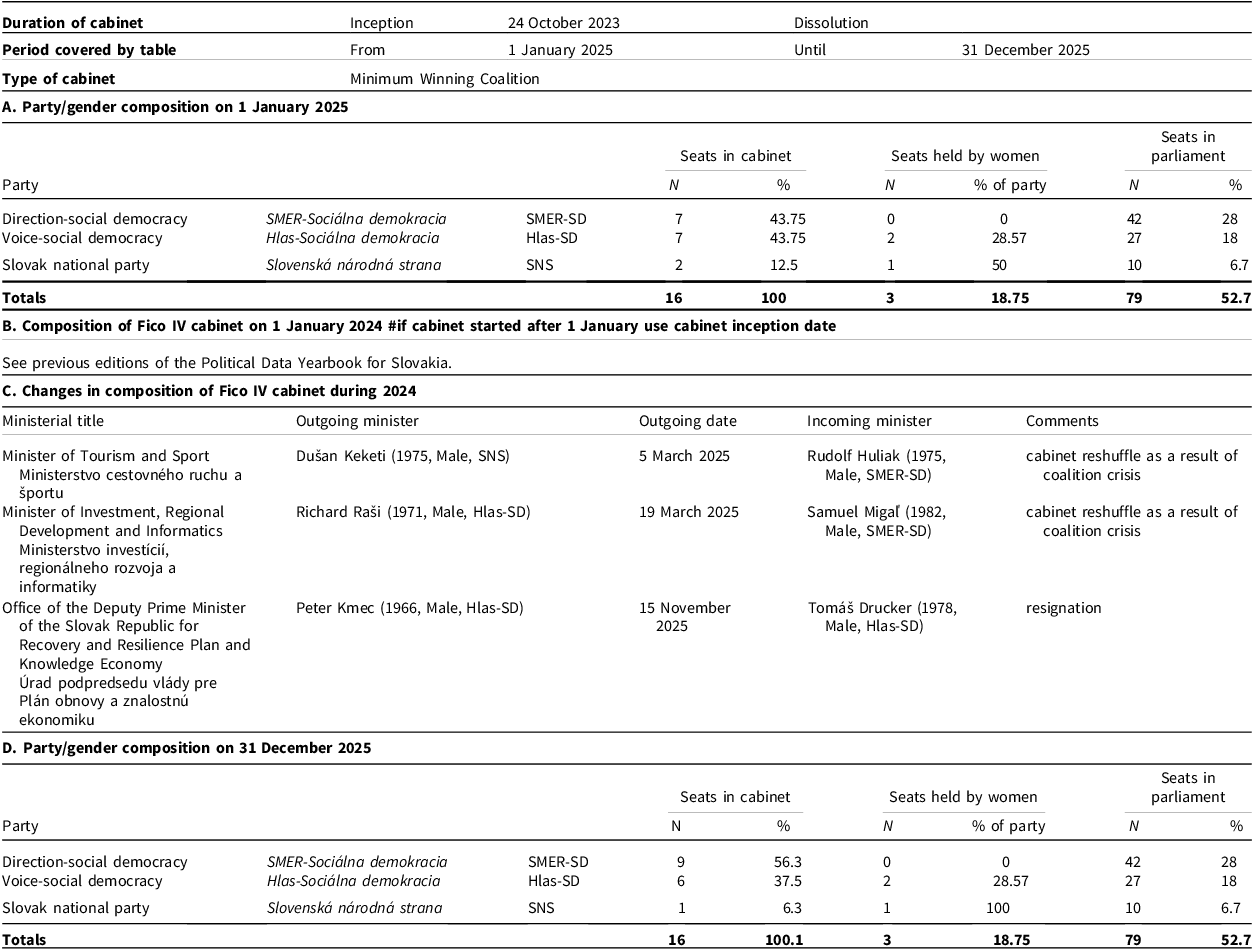
Full stabilisation came in March, when President P. Pellegrini appointed S. Migaľ as the new Minister of Investments and Regional Development, in exchange for Migaľ’s commitment to support the coalition. R. Huliak, whose appointment had once been rejected by President Z. Čaputová, was appointed Minister of Tourism and Sports. R. Šalitroš became a state secretary at Migaľ’s ministry (see Table 1). With these changes, the coalition restored its original majority of 79 MPs by 19 March. Fico described the outcome as completing ‘a difficult path leading to the stabilisation of the governing coalition’ (Euronews 2025).
Cabinet composition of Fico IV in Slovakia

Table 1. Long description
The table provides information on the duration of the cabinet, its composition by party and gender, and changes in ministerial positions. It includes data from January 2025 to December 2025. The table is divided into several sections: A, B, C, and D. Section A lists the party/gender composition on 1 January 2025, including the number of seats in the cabinet, seats held by women, and seats in parliament for each party. Section B projects the composition of the cabinet on 1 January 2024 if it started after that date. Section C details changes in the cabinet during 2024, including the outgoing and incoming ministers, their dates, and comments on the changes. Section D provides the party/gender composition on 31 December 2025, similar to Section A.
Source: Office of the Government website, https://www.vlada.gov.sk/; April 2026.
Parliament report
The parliamentary year was defined above all by the resolution of two long-standing vacancies and by the passage of the constitutional amendment in September. The speakership, vacant since P. Pellegrini’s election to the presidency in April 2024, had remained a source of tension throughout late 2024, with Hlas-SD and SNS unable to agree on a successor. The crisis was ultimately resolved as part of the broader coalition stabilisation deal. On 26 March, all 79 coalition MPs elected R. Raši (Hlas-SD) as Speaker of the National Council, ending nearly a year of provisional management under Deputy Speaker Peter Žiga. With Raši’s election, Slovakia for the first time in nearly a year had all three senior constitutional officials in place: President P. Pellegrini, Prime Minister R. Fico, and Raši (STVR 2025).
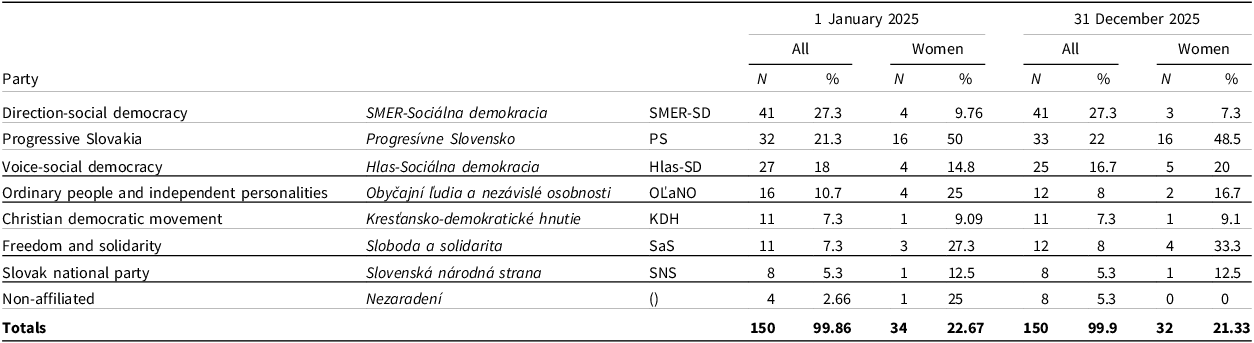
The coalition crisis also altered the personal composition of Parliament through the operation of Slovakia’s candidate list replacement system, under which seats vacated by MP’s in executive roles are filled automatically by the next candidate on the relevant party’s 2023 electoral list (see Table 2). When R. Huliak left Parliament to take up the Tourism and Sports Ministry, he was replaced by Milan Radačovský, who had run on the SNS slate in 2023 and pledged to support the ruling coalition. Similar substitutions followed Richard Raši’s transition to the speakership and S. Migaľ’s move to the Investment Ministry. By the end of 2025, seven parliamentary party groups remained in the National Council, with the three coalition groups – SMER-SD, Hlas-SD, and SNS – collectively holding 79 seats. The Národná koalícia [National Coalition], a minor party that ran on the SNS party list in the 2023 elections and whose MPs had played a pivotal role in the coalition’s survival, held no formal caucus, with its members sitting as independents (National Council of the Slovak Republic 2025).
Parliamentary Report, no changes

Table 2. Long description
The table presents the distribution of parliamentary seats by party and gender for January and December 2025. It includes seven parties and non-affiliated members, with columns for total seats and percentage of seats held by women. The parties listed are Direction-social democracy (SMER-SD), Progressive Slovakia (PS), Voice-social democracy (Hlas-SD), Ordinary people and independent personalities (OLaNO), Christian democratic movement (KDH), Freedom and solidarity (SaS), Slovak national party (SNS), and Non-affiliated (Nezaradeni). Each party’s total seats and the percentage of seats held by women are provided for both January and December 2025. Notable trends include the consistent representation of women across parties and the slight changes in seat distribution over the year.
Source: National Council of Slovak Republic, www.nrsr.sk, April 2026.
Political party report
Two developments in the party landscape stood out in 2025. For SMER-SD, the year brought the formalisation of its break with European social democracy. Following the suspension imposed in October 2023 for forming a coalition with the far-right SNS, the Party of European Socialists voted unanimously at its congress in Amsterdam in October 2025 to expel SMER-SD entirely, citing positions that ‘contradict severely and deeply the values and principles our family stands for. Fico responded defiantly, stating he was “proud of this exclusion”’ (Slovak Spectator 2025b). The expulsion left SMER-SD’s MEPs without a parliamentary group home in the European Parliament, with negotiations underway about joining V. Orbán’s Patriots for Europe grouping, though no final decision had been reached by the year’s end, with some SMER-SD MEPs openly resisting the move.
The KDH’s decision to support the constitutional amendment split the party internally. Two KDH MPs, František Majerský and František Mikloško, refused to support the proposal despite party pressure, and former MEP Ivan Štefanec resigned from the party entirely, accusing its leadership of helping SMER divert attention from its moral and economic decline. The fallout extended beyond KDH. Two members of the conservative opposition movement Slovensko – Marek Krajčí and Rastislav Krátky – also crossed the aisle to support the amendment, having pledged just the day before to vote against it. Both offered strikingly different explanations: Krajčí cited advice from a theologian and invoked religious conscience, while Krátky described it plainly as a political decision. The party’s response was equally asymmetric: Slovensko expelled Krátky but forgave Krajčí after he publicly repented – with leader Igor Matovič condemning the former’s vote as an act of betrayal while excusing the latter as an act of conscience. PS and SaS temporarily froze cooperation with both KDH and Slovensko, accusing them of enabling Fico’s culture-war agenda and helping divert public attention from the government’s economic failures (Balkan Insight 2025a).
Institutional change report
The dominant institutional development of 2025 was the constitutional amendment adopted by the National Council on 26 September and signed by President P. Pellegrini on 30 September. Its content was sweeping: the amendment recognised only biologically determined male and female sexes, rendered legal gender reassignment possible only in exceptional circumstances defined by law, restricted adoption to married heterosexual couples, introduced a nationwide ban on surrogacy, and made parental consent mandatory for access to sexual education. Most significantly for Slovakia’s relationship with European institutions, it revised the constitutional hierarchy of norms to assert that international treaties – including those arising from EU membership – could not override the Constitution in matters of ‘national identity’, defined as encompassing fundamental cultural and ethical questions relating to life, human dignity, family, parenthood, culture, and language. (Slovak Spectator 2025a)
The manner of the amendment’s passage was as consequential as its substance. The ruling coalition held only 78 reliable votes, twelve short of the three-fifths constitutional majority required for constitutional change. The breakthrough came through an unlikely cross-aisle alliance: most of the KDH caucus, whose leadership had negotiated significant concessions to the final text including bans on surrogacy and human cloning and a conscience clause for health and education workers, switched sides, as did two MPs from the Slovensko movement. Speaker R. Raši announced a final tally of 90 votes in favour out of 99 present – the bare constitutional minimum.
The practical implications of this national sovereignty clause were contested immediately. The European Parliament warned that the proposed changes were incompatible with Article 2 of the Treaty on European Union and the principle of the primacy of EU law. In November 2025, the European Commission formally launched infringement proceedings against Slovakia, stating that ‘even when a Member State amends its constitution, such an exercise of national competence cannot circumvent the need to comply with fundamental principles of Union law’ (JURIST 2025). Fico dismissed the proceedings, declaring there would be no change to the constitution and that his government was looking forward to the conflict.
The year also saw the continued hollowing out of anti-corruption architecture which began in 2024, alongside deepening political capture of the media landscape. The new public broadcaster STVR – established in July 2024 to replace the dissolved RTVS under a governance structure granting decisive influence over appointments to the Ministry of Culture and Parliament – moved further in a pro-government direction in 2025. In May 2025, STVR’s politically composed oversight council elected a new Director General – an appointment widely interpreted as a further step in the ruling coalition’s capture of the broadcaster. STVR recorded the biggest fall in public trust of any Slovak media brand, dropping eight percentage points, as political debate formats were restructured to feature the Prime Minister or the President speaking one-to-one with presenters without opposition representatives (Reuters Institute 2025). The development drew criticism from European bodies monitoring press freedom, which identified Slovakia as a critical case study in the broader erosion of public media independence within the EU (IPI 2025).
Issues in national politics
Slovakia’s most turbulent political sequence unfolded between January and March, driven by the compounding effects of the Moscow visit, the coalition’s near collapse and a dispute over gas transit. From 1 January, Ukraine halted Russian gas transit following the expiry of the Gazprom agreement, dealing a blow to Slovakia’s Eustream revenues that Fico estimated at €500 million annually. Fico responded by calling President Zelensky an ‘enemy’ of Europe and threatening to cut electricity supplies to Ukraine (The Kyiv Independent 2025). Coalition partner Hlas-SD and President Pellegrini pointedly refused to endorse the most extreme rhetoric, with Pellegrini reaffirming Slovakia’s ‘indisputable membership’ in the EU and NATO after SMER’s Deputy Speaker Tibor Gašpar speculated in a televised broadcast that Slovakia might one day consider withdrawal from both organisations.
The protest movement that emerged was the most sustained since the murder of journalist Ján Kuciak in 2018. The first major mobilisation on 24 January drew an estimated 40,000 participants in Bratislava and 15,000 in Košice under the slogan ‘Slovakia is Europe’, with subsequent waves following in February, March, April, and December. Counter-demonstrations under the slogan ‘Slovakia is not Ukraine’ attracted only marginal support. Foreign media increasingly framed Slovakia alongside Hungary as a case of democratic backsliding within the EU.
After withdrawing an original foreign agent labelling proposal due to the risk of conflict with European law and resistance from Hlas-SD, the coalition passed a modified NGO transparency law requiring organisations to submit annual reports detailing donors contributing more than €5,000. Civil society organisations criticised it as administrative pressure on independent actors, and the Public Defender of Rights challenged it before the Constitutional Court.
The closing weeks of the year brought the government’s most symbolically charged act of institutional dismantlement. On 9 December – International Anti-Corruption Day – all 78 coalition MPs approved the abolition of the Whistleblower Protection Office (ÚOO), replacing it with a new body whose leadership would be appointed directly by the government. The timing was widely read as retaliatory: the proposal came weeks after the ÚOO had fined the Interior Ministry in three cases involving police officers reassigned during corruption investigations. The opposition branded it ‘a law of revenge’, the Commission and the European Public Prosecutor’s Office raised concerns about compatibility with EU law, and opposition PS announced a Constitutional Court challenge (Balkan Insight 2025b). Following the dissolution of the Special Prosecutor’s Office in 2024 and criminal code revisions reducing penalties for financial crimes, the removal of an independent whistleblower body left Slovakia’s anti-corruption architecture significantly diminished (Reuters 2025).
In foreign policy, Fico continued his recalibration away from Western partners, attending the Victory Day parade in Moscow on 9 May as the only sitting EU head of government to do so. In July, the government accused the UK Foreign Office of funding influencers to boost the opposition PS during the 2023 elections and summoned the British ambassador; the UK rejected the accusation as unfounded, and police later dropped the investigation without charges. In electoral politics, Fico and Interior Minister Matúš Šutaj-Eštok floated in May a package of proposed changes to the electoral system, including reducing the number of MPs from 150 to 100, substantially increasing electoral deposits, and restructuring the unitary national constituency. None of the changes had been submitted as legislation by the year’s end, but experts warned that the proposals, if adopted in combination, could entrench structural barriers to participation. With no elections scheduled until 2027, and speculation about a snap vote intensifying throughout the year, the proposals were widely read as an attempt to reshape the competitive terrain ahead of an early election that Fico himself had not ruled out (Domin Reference Domin2025).
Data availability statement
The data for this article can be found at the PDY Interactive website: http://politicaldatayearbook.com
Competing interests
The author declares none.

 Open access

