Introduction
When a seed is dispersed from the mother plant and reaches the soil surface, it may germinate immediately or persist on or in the soil until conditions become suitable for germination, thus forming a soil seed-bank (Thompson and Grime, Reference Thompson and Grime1979; Garwood, Reference Garwood, Leck, Parker and Simpson1989; Baskin and Baskin, Reference Baskin and Baskin1998; Thompson, Reference Thompson and Fenner2000). A soil seed-bank is the total number of viable seeds in the leaf litter, on the soil surface and buried in the soil (Roberts, Reference Roberts1981). Density and species richness of seeds in the seed bank may peak at the end of a season, when seeds mature and are dispersed from the mother plants. This seasonal variation of the number of seeds in seed banks has led to the classification of seed-bank strategies according to seasonal germination patterns, based on carry-over of seeds from one year to the next (Thompson and Grime, Reference Thompson and Grime1979), or from one germination season to the next (Walck et al., Reference Walck, Baskin, Baskin and Hidayti2005). Transient seed banks consist of seeds that do not persist in the soil or litter for more than 1 year (Thompson and Grime, Reference Thompson and Grime1979) or for one germination season to the next (Walck et al., Reference Walck, Baskin, Baskin and Hidayti2005), whereas in persistent seed banks, some seeds persist for more than 1 year (Thompson and Grime, Reference Thompson and Grime1979) or until at least the second germination season (Walck et al., Reference Walck, Baskin, Baskin and Hidayti2005). The seed-bank strategy is more of a function of the species than of the environment (Thompson and Grime, Reference Thompson and Grime1979; Lavorel et al., Reference Lavorel, Debussche, Lebreton and Lepart1993; Onaindia and Amezaga, Reference Onaindia and Amezaga2000). However, seed-bank strategies of many species are still unknown, and thus more research is needed to understand seed-bank strategies of individual species and of plant communities found in various environments.
There are more than 500,000 km2 of karst landforms in southern China (Yan et al., Reference Yan, Zhu, Weng, Zhu, Han, Wang, Cai, Zhu, Cui and Deng1994), where various types of evergreen broadleaved forests grow across a wide climatic spectrum (Wu, Reference Wu1980). In both natural and regenerated forests, plants frequently experience shortages of water and nutrients because of shallow discontinuous soils separated by rocks (Wu, Reference Wu1980; Su and Zhu, Reference Su and Zhu2000; Wang, Reference Wang2002; Zhu, Reference Zhu2002). Plants in karst areas are also exposed to severe large-scale changes through tree cutting, pasture creation, slash-and-burn agriculture and collection of firewood (Zhou et al., Reference Zhou, Mao, Yu, Ding, Xie, Nie and Cheng2002). Despite their potential importance for the response of plant communities to these disturbances and forest degradation, few studies have investigated soil seed-banks in the karst areas of China (Liu, Reference Liu2000; Shen et al., Reference Shen, Jiang, Chen, Cai and Zhang2004), and there have been no studies on the seasonal variation in their soil seed-banks.
In this study, seasonal variation in the seed banks of karst forests and of their degraded vegetation were examined. The following questions were asked: (1) Is there seasonal variation in the soil seed-bank? (2) How is the soil seed-bank pattern linked to the seasonal pattern of seed production? (3) What types of seed-bank strategies occur in plants of karst areas of SW China? and (4) Does the seasonal pattern and seed-bank strategy vary among sites covered with different vegetation types?
Materials and methods
Study sites and sampling procedure
This study was conducted at the Shilin Stone Forest Geographical Park (24°38′–24°58′N, 103°11′–103°29′E), a typical karst geo-park famous for its various stone-forests. This park is an area of approximately 900 km2 with underlying Permian carbonate rocks, of which more than 400 km2 have developed into karst and related landforms. These are confined to a north–south trending terrain that is more than 30 km long and 10 km wide. Altitudes range from 1600 to 2203 m above sea level. Mean annual precipitation is 967.9 mm (at 1680 m), 80% of which falls between May and October. Mean annual temperature is 16.2°C, mean maximum temperature 20.7°C (July) and mean minimum temperature 8.2 °C (January) (Zhang et al., Reference Zhang, Geng, Li, Liang, Yang, Ren, Wang, Tao and Li1997). The ground of the karst area consists of rock gaps, rock ditches, small rock caves and rock slots, all of which are surrounded by soil that accounts for about 30% of the land surface on slopes and about 90% in flat areas. The soil is shallow and patchily distributed on or between these various rock surfaces. Water and nutrients are the main limiting factors for plant growth. The growing season coincides with the rainy season and with moderate temperature periods from late spring into summer (Wu, Reference Wu1980).
Slopes of five sites covered with different vegetation types were included in this study: (1) a primary forest; (2) a young secondary forest; (3) a highly degraded shrubland; (4) a grassland; and (5) a Pinus yunnanensis plantation. The primary forest on this karst land is an evergreen broadleaved forest mixed with a few deciduous species. Dominant species include Cyclobalanopsis glaucoides Schottky, Olea yunnanensis Hand-Mazz, Pistacia weinmannifolia J. Poisoon ex Fr., Pistacia chinensis Bunge, Neolitsea homilantha Allen and Albizia mollis (Wall.) Boiv. (Jin and Peng, Reference Jin and Peng1998; Shen et al., Reference Shen, Liu, Li and Cui2005). Over the past several decades, the primary forest has been destroyed as a result of human activities, such as firewood harvesting and clearing of land for agriculture and animal grazing. As a result, shrubland, and then grassland, were created in some areas. Through conservation activities, young forest was regenerated naturally on the degraded area; Pinus yunnanensis Fr. was also planted. The five vegetation types represent the main vegetation types in this area. The secondary forest is dominated by N. homilantha with a low tree density (780 stems per hectare with a diameter at breast height of 3–10 cm, unpublished survey results). Spiraea martini Levl., Zanthoxylum armatum DC. and Berberis pruinosa Franch. are the dominant species of the shrubland. Some dominant tree species of primary forest, such as O. yunnanensis, P. weinmannifolia and N. homilantha, also are found at low density in the shrubland. Heteropogon contortus (L.) P. Beauv. ex Roemer, Oplismenus compositus (L.) P. Beauv., Schizachyrium delavayi (Hack) Bor, and Eupatorium adenophorum Spreng. are the dominant species in the grassland. Some dominant species of the shrubland also are present at very low density in the grassland.
Soil seed-bank sampling and germination
At each of the five sites, four 50 m transects were established, and five sampling points were marked at 10 m intervals along each transect. Soil samples, 10 cm × 10 cm × 10 cm, were taken at each point in February 2003, at the end of winter. Thus, 20 samples were collected at each site. Since the soil was patchily distributed, samples were taken nearest to the marked sampling point. Seeds of some species, such as Eupatorium adenophorum and Spiraea martini, mature and are dispersed before the beginning of the rainy season, normally in May (Zhang et al., Reference Zhang, Geng, Li, Liang, Yang, Ren, Wang, Tao and Li1997). For most species, however, seeds mature from September to November (end of rainy season and beginning of dry season). Consequently, we also collected soil samples from the primary forest and from the grassland in May, August and November at each sampling point, as close as possible to the previous sample, to study seasonal variations in the seed bank. Soil samples were taken from the other three sites in May and November as well, but not in August.
Each soil sample was washed through a 4 mm mesh sieve to eliminate coarse materials, and then through a 0.21 mm mesh sieve to eliminate fine materials (Ter Heerdt et al., Reference Ter Heerdt, Verweij, Bekker and Bakker1996). The concentrated residue, which contained all seeds from the sample, was spread out evenly onto a 3 cm layer of perlite in plastic seed trays (c. 18 cm × 10 cm × 10 cm deep). Trays were placed in an unheated greenhouse in the Kunming section of the Xishuangbanna Tropical Botanical Garden (80 km away from the Park, 1892 m above sea-level), and seedling emergence was monitored. The sides of the greenhouse were covered with a double layer of fine nylon mesh cloth and the roof with a sheet of plastic. Trays with sterilized soil were placed randomly in the greenhouse to check for contamination. All trays were monitored and watered, usually twice a day. Seedlings were counted and discarded as soon as they could be identified, or they were transplanted into 15-cm-diameter pots filled with fertile soil and grown until identification was possible. Soil in the trays was stirred two to three times during the germination monitoring period, normally after a large flush of germination. Samples collected in February and May were monitored until the end of October (end of germination season), whereas those collected in August and November were monitored until the end of October of the following year. No seedlings were found in the contamination trays.
Numerical analyses
For each species, sample, site and season, the number of seedlings that emerged was transformed into seed density. Densities for the five vegetation types and for different seasons were compared using both one- and two-way analysis of variance (ANOVA) tests after logarithmic [log10(x+1)] transformation. Mean number of species per sample was compared among vegetation types and seasons directly, using both one- and two-way ANOVA tests. Sorensen's similarity index was used on data pooled by vegetation type to compare seasonal seed-bank similarities.
Results
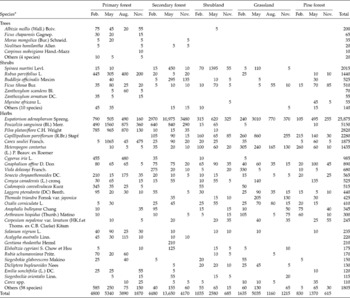
A total of 10,872 seedlings representing 112 taxa (9 trees, 17 shrubs and 86 herbs) emerged from the samples. All but nine were identified to species level. Seedling emergence varied considerably during the year among both species and sites (Table 1).
Seed density (number m−2) of the main species in the seed bank of the five vegetation types over four seasons in central Yunnan, SW China. Data are based on twenty 10 cm×10 cm×10 cm soil samples

a Species in which total germinants were ≥ 2 for trees, ≥ 10 for shrubs, and ≥ 20 for herbs.
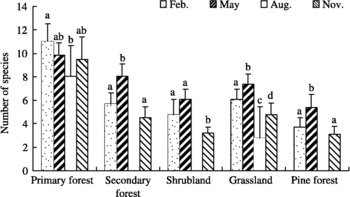
The number of species identified in each sample varied with the season. The average number of species in the soil samples ranged from 2.8 in August (grassland) to 11 in February (primary forest). The mean number of species per sample increased from February to the highest level in May, decreased to the lowest level in August, and then increased in November (Fig. 1). A minor exception was for the primary forest, where the highest number of species was found in February. Sampling time (ANOVA, F 2,332 = 54.1, P < 0.001) and site (F 4,332 = 22.4, P < 0.001) had significant effects on number of species present in soil seed-bank samples. However, no significant interaction was found between sites and sampling times (F 8,300 = 1.8, P = 0.07).
Mean number of species found in twenty 10 cm × 10 cm × 10 cm soil samples for each of the five vegetation types at different sampling times. Means within sites not sharing the same letter are significantly different at P < 0.05. Bars = 95% confidence interval.

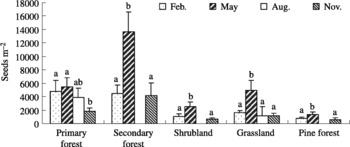
Seed-bank density ranged from 615 seeds m− 2 (November, pine forest) to 13,650 seeds m− 2 (May, secondary forest), averaging 3198 seeds m− 2 across all sampling times and sites (Table 1). Mean seed-bank density peaked in May at all five sites. Other than for the primary forest, density in February, August, and November were not significantly different (Fig. 2). Sampling time (F 3,332 = 62.9, P < 0.001) and site (F 4,332 = 51.5, P < 0.001) had significant effects on seed-bank density. There were significant interactions between sites and sampling times (F 12,332 = 15.5, P < 0.001).
Seasonal variation in soil seed-bank density in each of the five vegetation types (twenty 10 cm × 10 cm × 10 cm soil samples each). Means within sites not sharing the same letter are significantly different at P < 0.05. Bars = 95% confidence interval.

The seasonal pattern in mean number of species coincided with the density pattern in the secondary forest, shrubland, grassland and pine forest. In the primary forest, species density peaked in May, although mean number of species peaked in February.
Seed densities of different species varied during the year at each site (Table 1). Of the tree species, Albizia mollis had the highest seed density, and its seeds were present in the soil seed-bank throughout the year. Seeds of the other tree species were not present in the soil seed-bank in August, which was before the seeds of the current year matured. Spiraea martini had the highest seed density in the shrub communities at each site, followed by Rubus parvifolius L. and Ficus tikoua Bur. Seeds of the latter two species were present in the soil seed-bank throughout the year, whereas those of the other species were present in only two or three seasons. Most trees and shrubs had their highest seed-bank density in February. Seeds of herbs dominated the seed banks at all sites, and those of E. adenophorum, a worldwide invasive species, made up a large portion of the soil seed-bank. Pouzolzia sanguinea (Bl.) Merr., Pilea plataniflora C.H. Wright and Capillipedium parviflorum (R.Br.) Stapf also contributed greatly to the seed banks. Many seeds of E. adenophorum, P. sanguinea, P. plataniflora, Carex souliei Franch., Heteropogon contortus (L.) P. Beauv. ex Roemer, Gnaphalium affine D. Don, Senecio chrysanthemoides DC., Codonopsis convolvulacea kurz, Laggera pterodonta (DC) Benth., Solanum nigrum L. and Acalypha australis Linn. were present in the soil seed-banks throughout the year.
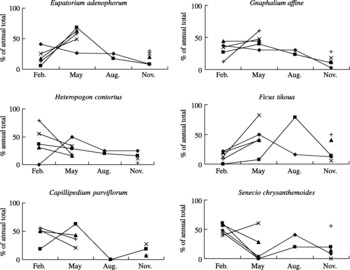
Densities of species occurring at more than one site varied between sites. However, certain similarities were observed between seasonal patterns obtained at the five sites. For instance, seasonal patterns (expressed as % of total seeds year round) of E. adenophorum, G. affine and H. contortus were similar for all sites, except the primary forest (Fig. 3). Seasonal patterns of F. tikoua and C. parviflorum were similar, except for the grassland, and of S. chrysanthemoides, except at the pine forest.
Examples of species with seasonal seed-bank patterns in each of the five vegetation types (♦, primary forest; ■, grassland; ▲, secondary forest; × , shrubland; +, pine forest) in karst areas, central Yunnan, SW China.

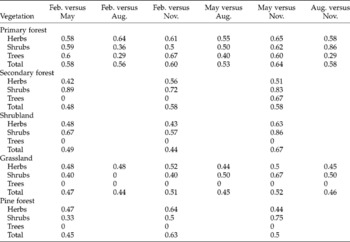
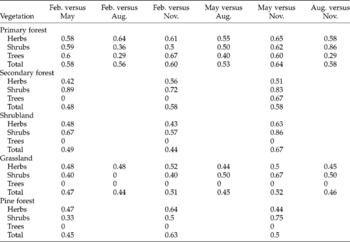
The similarity index for herbs between seasons was stable at all sites, but it varied greatly for shrub and tree species (primary forest) (Table 2). Shrub and tree species indices between August and the other seasons were smaller for primary forest and grassland than for those of the other three vegetation types.
Sorensen's similarity index between seasons, calculated from species pooled from each soil seed-bank of each vegetation type in the karst area, central Yunnan, SW China
Discussion
Seed input is an important factor determining the seasonal pattern of soil seed-banks. According to long-term phenological observations by the Institute of Geography, Chinese Academy of Sciences and National Planning Commission (1989, 1992), there are two major seed maturation seasons in the study area: spring (April–May) and autumn (September–October). Seeds of the shrub S. martini and of the herbs E. adenophorum, P. sanguinea, A. australis, Viola delavayi Franch. and Oxalis corniculata L. mature in April and May. Seeds of tree species and most shrub and herb species mature in autumn (September–October) and are dispersed over a long period of time, especially in the case of small-seeded species. Seeds of spring-fruiting species are dispersed immediately after ripening. However, the number of seeds produced by spring-fruiting species is great, which results in very high seed-bank densities (Table 1). For example, density of E. adenophorum reached 10,975 seeds m− 2, which accounted for 80% of the soil seed density in the secondary forest in May. Autumn-fruiting species may release their seeds gradually between maturation and the following spring, depending on seed dryness and wind speed. Seed densities of these species in the soil seed-bank may peak at any time from November to May of the next year, or the changes may be relatively small. For example, the size of the seed bank of A. mollis peaks in February (Table 1). Accumulation of seeds from both spring- and autumn-fruiting species causes the soil seed-bank to peak in May. Germination of viable seeds during summer (rainy season), seed predation and senescence probably reduce seed numbers in the seed bank, which could explain why the lowest seed-bank values were recorded in August.
The seasonal pattern of germination is one of the most important adaptations to the local environment. In ecosystems in which seed maturation and germination seasons are not synchronized, the ability of a species to persist in the seasonal seed-bank allows plants to delay germination until conditions are suitable for seedling survival. Other studies also found strong seasonal patterns in seed-bank composition and density. For instance, in both natural woodland and coniferous plantations in northern Spain, seed-bank richness and density in spring are higher than in summer or autumn because of the persistence of seeds from the previous years’ production (Onaindia and Amezaga, Reference Onaindia and Amezaga2000). In a 3-year study of Mediterranean grasslands, maximum seed density occurred each year at the time of seed maturity in late spring (May), and the minimum density occurred just before seed dispersal (April) (Russi et al., Reference Russi, Cocks and Roberts1992). A similar pattern was found in Argentinean (Bertiller, Reference Bertiller1992; Mayor et al., Reference Mayor, Boo, Pelaez and Elia2003) and Patagonian grasslands (Bertiller, Reference Bertiller1992).
The seasonal strategy of soil seed-banks seems to be more of a function of species than of vegetation type or environment. Thus, seasonal patterns of species occurring at more than one site were similar between sites (Fig. 3), which agrees with results of studies in ecologically contrasted sites in northern England (Thompson and Grime, Reference Thompson and Grime1979), Mediterranean grasslands (Lavorel et al., Reference Lavorel, Debussche, Lebreton and Lepart1993) and Spanish forests (Onaindia and Amezaga, Reference Onaindia and Amezaga2000). However, seed density may be influenced by input of new seeds and by the rate at which existing seed reserves are lost through predation, senescence and germination. Thus, seed density might be influenced by site conditions that determine these factors. This is the reason why the patterns in Fig. 3 are not identical in all five sites. If site effect is great enough, it may shape the seasonal seed-bank pattern. Cabin and Marshall (Reference Cabin and Marshall2000) found that the micro-environment (subshrub versus intershrub) had a great impact on temporal seed patterns of Lesquerella fendleri in the soil seed-bank in a New Mexico desert.
Thompson and Grime (Reference Thompson and Grime1979) measured seasonal variation in density of germinable seeds in ten contrasting habitats in a temperate area and classified soil seed-banks into four basic types: two transient and two persistent. This was consistent with the morphology and germination characteristics they obtained in the laboratory. However, species included in their study were annual and perennial herbs in which seeds are released mainly during late spring and summer. Since their study, additional types of persistent seed-banks have been identified in annuals and in perennials (Roberts and Neilson, Reference Roberts and Neilson1981; Baskin and Baskin, Reference Baskin and Baskin1984, Reference Baskin and Baskin1985, Reference Baskin and Baskin1986). More soil seed-bank strategies may exist in tropical than in temperate areas because reproduction occurs throughout the year. Based on germination behaviour and temporal patterns of seed dispersal, Garwood (Reference Garwood, Leck, Parker and Simpson1989) summarized five basic seed-bank strategies (transient, persistent, pseudopersistent, seasonal transient and delayed transient) for lowland tropical species. In our study, at least four basic types of seed-bank strategies could be identified.
(1) Transient 1. Seeds are dispersed in late spring, germinate in summer and are present in the soil seed-bank only in May, e.g. Gentiana rhodantha Hemsl. This is similar to type 1 in Thompson and Grime (Reference Thompson and Grime1979) (seeds released in summer, but germinate in autumn) and to the transient seed bank in the study by Garwood (Reference Garwood, Leck, Parker and Simpson1989) (immediate germination after seed release).
(2) Transient 2. Seeds are released in autumn and germinate in spring of the next year. Most tree and shrub species have seeds in the soil seed-bank in November, February and May, but not in August, and their total seed densities are very low, e.g. N. homilantha and Carpinus mobeigiana. Some herb species, e.g. C. parviflorum, Themeda triandra Forssk var. japonica, Elsholtzia cypriani and Emilia sonchifolia, have high seed densities in November, February and May, but not in August. This is comparable to type 2 of Thompson and Grime (Reference Thompson and Grime1979) (seeds released in summer, but germinate in spring of the following year), and to a combination of the seasonal transient seed-bank and delayed transient seed-bank of Garwood (Reference Garwood, Leck, Parker and Simpson1989).
(3) Persistent 1. Seeds are released in late spring, and a portion of them germinates after release, whereas the others are present in the soil throughout the year, e.g. E. adenophorum, O. corniculata, S. chrysanthemoides and A. australis, thus forming persistent seed-banks (Baskin and Baskin, Reference Baskin and Baskin1998).
(4) Persistent 2. Seeds are released in autumn, some of which germinate in spring, while others persist in the soil throughout the year. This includes some autumn-fruiting species whose seeds are still present in the soil before new seeds are released in August, e.g. the tree A. mollis, the shrubs R.. parvifolius and F. tikoua, and the herbs P. sanguinea, P. plataniflora, C. souliei, G. affine, C. convolvulacea, L. pterodonta and S. nigrum.
Since we did not take soil samples in the secondary forest, shrub or pine sites in August, we may lack the information necessary to define the seed-bank strategy of some species. From the existing data, only a few tree and shrub species were present in the soil throughout the year, and thus most of them had transient soil seed-banks. On the other hand, many herbs formed persistent soil seed-banks, and their seeds were present in soil throughout the year (Table 1). This result suggests that different component groups in the soil seed-bank (trees, shrubs and herbs) have different seasonal patterns.
Only a few tree species had seeds present in the soil seed-bank in the primary or secondary forests; many of the dominant species were present in very low numbers or absent altogether (Table 1). Tree seeds mature in autumn and are released gradually. Therefore, they lie on the soil surface or buried in the soil until suitable germination times in spring and early summer, when the rains come. Logically, these seeds may have a short transience in or on the soil before germination. However, seeds of most tree species were not determined in samples between dispersal (November) and germination (May). Possible reasons for the failure to detect tree seeds may include animal predation, dormancy, or large seeds failing to pass through the 4 mm filter. Bossuyt et al. (Reference Bossuyt, Heyn and Hermy2002) also found that tree species abundant in such forests were absent in soil seed-banks, which they attributed to few tree species producing long-lived seeds. More studies need to be undertaken to determine the reason why seeds of many tree species are not found in soil seed-banks.
Acknowledgements
We thank Professor Liu Lunhui, a retired botanist, for help in identifying seedlings, and Professors Jerry and Carol Baskin, for help with writing the manuscript. This study was supported by China's National Key Project for Basic Research on Ecosystem Changes in Longitudinal Range–Gorge Regions and Trans-boundary Eco-security of Southwest China (No. 2003CB415101), and the Yunnan Science and Technology Foundation (2002C00042).