1. New Latino-Punic inscription from Bani Walid
A neo-Punic funerary inscription has been newly discovered in the environs of Bani Walid, in the Werfalla district, about 100 km inland from modern Tripoli (ancient Oea). This inscribed stone block was found in a tomb discovered in Wadi el-Amud, south-west of Bani Walid. Although the language of the text is neo-Punic, it is written in the Latin alphabet and thus represents a significant addition to the small corpus of such Latino-Punic texts known from Roman North Africa (currently 67), all of which have been found within the region of Tripolitania (Kerr Reference Kerr2010, 169–227).
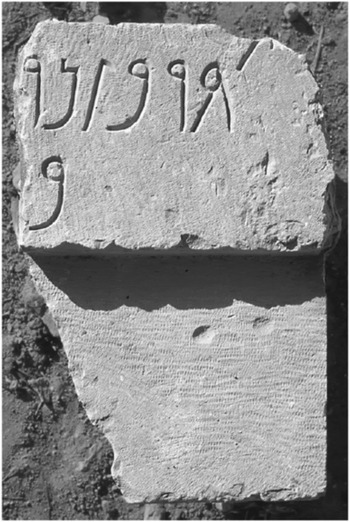
When I visited Bani Walid in July 2004, I took a photograph of the stone (Figure 1), upon which my subsequent transcription is based. The rectangular block (no dimensions known) bears a carefully incised recessed tabula ansata on its front face, with further moulded decoration above and below. The text comprises seven lines of relatively evenly sized capitals (each line accommodating approximately 14 to 17 letters). The right-hand end of lines 1–5 is illegible as a result of damage to the surface of the stone. The first six lines are inscribed within the tabula ansata and the last line on the bottom border.
Neo-Punic funerary inscription from Bani Walid. (Photo: A. F. Elmayer)

Transcription
A suggested reading is as follows (uncertain letters are under-dotted):
IASVCTHAN ṾỴ [ – – c. 5 – –]
VY LVGANTHAN VY Ḍ[ASA–]
MV VY LV BINM FẸḶ[V M–]
YNSYFTH L ABVNOM [N–]
5 ASIF ARMOHEM [VY BIN–]
ỊṂ PAVLINE VY BINIM
SAṬṾṚṆICE VY ḄECVS
Translation
Iasucthan and … and Luganthan and D[asa]mu also on behalf of his son made this memorial for their father Nasif Armohem [and for] his [son] Paulinus and his son Saturnicus (?) and Decus (?).
Line-by-line commentary
Lines 1–2. These comprise a series of Libyan personal names, probably grammatically the subject of the sentence, linked by the conjunction VY (Kerr Reference Kerr2010, 150–51), which occurs in several Latino-Punic inscriptions from Roman Tripolitania (e.g. IRT 886f, l.6; 873, l.3; 889, l.1; 992, l.5) and also lines 3, 6, and 7 below.
Line 1. IASVCTHAN: This Libyan personal name, attested in Phoenician neo-Punic and Libyan texts (Jongeling Reference Jongeling2008, 340), appears with the same orthography (with aspirated TH) as the cognomen of a centurion of the Legio III Augusta, Porcius Iasucthan, author and dedicator of the inscribed Latin acrostich verse from Bu Ngem (AE 1995, 1641), datable to AD 222.
Line 2. LVGANTHAN: Although not known to Jongeling (Reference Jongeling1994; Reference Jongeling2008) or Kerr (Reference Kerr2010), probably a three-syllable Libyan personal name, with similar termination to Iasucthan (line 1), Iarnuhan (IRT 886k, ll.3–4), Masauchan (IRT 906, l.2; 992, ll.1–2; 996, l.1), Masinthan (IRT 886j, ll.2–3).
Lines 2–3. Ḍ[ASV]MV: The Libyan personal name Dasama occurs in a Latin alphabet neo-Punic inscription from Gasr Shmekh in the Wadi el-Bir (IRT 889 = Elmayer Reference Elmayer1983, 90 = Elmayer Reference Elmayer1984b, 149 = LPE Bir Shmech LP 1, l.1).
Line 3. LV: Presumably to be understood as the preposition ‘for’, though it is not otherwise attested as being vocalised lu, rather than by the simple consonant l, in the Latino-Punic inscriptions of Tripolitania (Kerr Reference Kerr2010, 149). BINM is presumably to be understood as bin(i)m (son of him, i.e. his son), here either imperfectly vocalised or written with the second I combined with second upright of N; cf. line 6 below, where the form binim is clearly present. For the phrase ᶜl binim in the sense of ‘on behalf of his son’, see CIS I 178 (Krahmalkov Reference Krahmalkov1970, 186). FẸḶ[V] (they built) is probably to be restored in the damaged area, where only traces of the tops of the first three letters survive. This verb occurs in various forms in several Latino-Punic inscriptions from Roman Tripolitania: fela = ‘she made’ (CIL VIII 10971 = 10991 = CIL III 744 = IRT 901, ll.2, 4; IRT 826, l.3); fel = ‘he made’ (IRT 873, l.2; 877, l.2; LPE Zliten LP 1, l.1); felo = ‘he made’ (Vattioni Reference Vattioni1976, 539 = LPE Zliten LP 1, l.5); felu = ‘they made’ (IRT 889, l.2).
Lines 3–4. MYNSYFTH is equivalent to the Latin monumentum/memoria, indicating the funerary monument (Kerr Reference Kerr2010, 209), which is most likely the direct object of the sentence. The word is ultimately derived from Phoenician MṢBT (KAI 6, l.1; 7, ll.1–2, Um el-Alwamid), meaning ‘stele’. The orthography employs the special grapheme, not found in the regular Latin alphabet, of an S broken by a line, which is used to represent the Semitic voiceless velar sibilant /ṣ/ (Kerr Reference Kerr2010, 126–28). The term mynsyfth occurs, again with the same specific orthography (including the more cursive form for the F), in a number of other Latino-Punic inscriptions from Tripolitania (IRT 828, l.1; 873, l.1; 906, ll.1–2; 992, l.1; Elmayer Reference Elmayer1998 = LPE Nawalia LP 1, ll.1–2; LPE Wadi Chanafes LP 1, l.1; Wadi Ghalbun LP 1, l.1); cf. Elmayer Reference Elmayer2006 = LPE Libya OU LP 2, ll.5–6, where it is slightly misspelt as mynsyth.
Line 4. L ABVNOM = ‘for father of them’, i.e. ‘for their father’ (Kerr Reference Kerr2010, 88, 97, 143, 149), which occurs elsewhere in the Tripolitanian Latino-Punic corpus (IRT 996, l.2; LPE Wadi Chanafes LP 1, l.2; Wadi Ghalbun LP 1, l.2); cf. the forms lobuthem (CIL VIII 22664 = IRT 893, ll.2–3), lobythem (IRT 828, ll.1–2), lybythem (LPE Zliten LP 1, l.2) = ‘for his parents’, and lybythha (CIL VIII 10971 = 10991 = CIL III 744 = IRT 901, l.5) = ‘for her parents’. Krahmalkov (Reference Krahmalkov1970, 184 n. 3) mentions that the bound form of the noun ab (father) in Phoenician takes a long /u/ (as in abunom here), as also in Aramaic. One might also add that it is similar (abuhom) in Arabic.
Lines 4–5. [N]ASIF is a Libyan personal name that occurs in several other Latino-Punic texts from Tripolitania (IRT 886f, l.1; 901, ll.3–4; 906, l.1).
Line 5. ARMOHEM may be a proper noun indicating a function/rank (cf. the zonmon/zobmon, which immediately follows the Libyan personal names in IRT 886a, ll.4–5 and 886c, ll.2, 9, and which appears to gloss tribunus). Note also the parallel of the traces read as BṚ[.]ṆEM after the Semitic personal name Anobal in IRT 996 = LPE Wadi Umm el-Agerem, l.4. Alternatively the termination -em may indicate the Punic dual suffix (Kerr Reference Kerr2010, 144).
Lines 5–6. [VY BIN]ỊṂ: The letters at the beginning of line 6 are not clear but are compatible with reading binim (his son), which is also suggested by the parallel in lines 6–7 below.
Line 6. PAVLINE reflects the regular neo-Punic rendering of masculine Latin personal names terminating in -us in a form morphologically equivalent to Latin vocative (Kerr Reference Kerr2010, 68–74). So the Latin equivalent here is Paulinus. BINIM: ‘his son’ (cf. binm in line 3 above).
Line 7. SAṬṾṚṆICE: If the content of this line is taken as a gloss on the immediately preceding BINIM of line 6, then we would expect a personal name to be present. The letters CE preceding VY (and) strongly suggest a neo-Punic rendering of a Latin personal name ending in –us (cf. Pauline in line 6 above). There is a Latin word Saturniacus and here one may read a name equivalent to Saturnicus. If, however, the traces were read SAṬẠṂICE, then note also the rather enigmatic Latino-Punic amice, taken to be a rendering of the Latin amicus (friend) in IRT 827, l.1 by Kerr Reference Kerr2010, 205. ḄECVS: although the first letter seems closer in shape to a D, the reading becvs is attractive in light of the well-known personal name, born by at least two Numidian kings, usually rendered in Latin texts as Bocchus and in Phoenician script as bqs (Jongeling Reference Jongeling2008, 325); cf. bvcv in a Latino-Punic building dedication from el-Khadra (IRT 877 = LPE Breviglieri LP 1, l.7); and bycus, which may represent a personal name in a Latino-Punic religious dedication from Gasr el-Ureia (IRT 892 = Elmayer Reference Elmayer1984a, 100, l.3, cf. Kerr Reference Kerr2010, 198). Alternatively, the last line might not represent two personal names at all but a closing formula of some kind.
Conclusions
The inscription attests to the dedication in neo-Punic of a tomb monument by a group of siblings to their father, all of whom bore Libyan names, and to other members of the deceased's family group, at least one of whom bore a Latin-derived personal name. The very fact that the funerary text is written in Latin letters demonstrates a certain degree of Roman cultural influence. These individuals are perhaps representative of a local population that still used Punic as their literary language but that was either no longer literate in Phoenician letters or chose to use Latin letters as an expression of social ambition or in order to communicate with an audience that was more comfortable with the Latin than the Phoenician script. On the other hand, aside from the onomastic borrowing, the text appears to be largely free of the Latin terminology that pervades some late Roman Latino-Punic texts (e.g. IRT 877; 886a, c, d, f, j, and k; 889; 901). These features, combined with the general appearance of the letterforms, are consistent with a dating of this text to the second or third century AD.
2. The Libyan god Gurzel in a neo-Punic inscription from Roman Tripolitania
On 15 July 1995 I visited the Roman period mausoleum at Gasr Doga in the Gebel Tarhuna, with Dr Musbah Smia, Controller of Antiquities in the Tarhuna District, and his deputy, Dr Muftah Alhdad. We found, thrown on the ground beside this mausoleum, an inscribed architectural block (47 cm high by 35 cm wide) carrying a neo-Punic inscription broken off on the left-hand side (Figure 2). This block would appear to belong to the right-hand corner of the entablature of a monumental edifice. The text consists of two lines of elegant Phoenician letters inscribed on a band which projects forward from the body of the block and measures 23 cm in height.
Neo-Punic inscription from Gasr Doga, originally published by A. F. Elmayer Reference Elmayer1995, as seen in the photograph with republication by Di Vita-Evrard Reference Di Vita-Evrard2009. (Photo: F. Felici)

Transcription
L HRBT KR[ZL]
(vac.) B[TM]
Discussion
I originally published the text, with the restitutions proposed above, and a translation (meaning ‘for the god Gurzel … accomplished’) in an Arabic journal (Elmayer Reference Elmayer1995). A Libyan bull deity Gurzel, offspring of the sun god Ammon and a heifer, is mentioned as the patron god of the rebellious Ilasguas tribe by the sixth-century poet Corippus (Iohannis 2.109; 5.22–26; 5.519; 8.304; 8.617–18) and a rock picture that resembles an ox carrying a sun disc between its horns was found at Maia Dib in Wadi Marsit, Mizda (Haynes Reference Haynes1965, 23–24). The existence of the cult is probably confirmed by the Muslim scholar al-Bakri, who visited Libya in the tenth century and mentioned that the Libyan Hauara tribe worshipped a stone on a hill called Kurza (al-Bakri Reference Bakri, al-., Mac Guckin and de Slane1913). I had already proposed a reference to this god in another neo-Punic text, originally from Lepcis Magna (Elmayer Reference Elmayer1982; cf. IPT 11 and HNPI Labdah N 3). Accordingly, I identified the text as the votive dedicatory inscription in honour of Gurzel that must have come from a sanctuary in the vicinity of the Gasr Doga mausoleum. The restoration of the bottom line was inspired by the verb form btm (‘completed’; Jongeling Reference Jongeling2008, 409 s.v. tm) found at the end of the very comparable, and well preserved, dedication to the temple of Ammon at nearby Ras el-Hadagia, beside the Italian colonial settlement of Breviglieri (KAI 118 = IPT 76 = HNPI Ras el-Hadagia N 1), which is dated precisely to the proconsulate of L. Aelius Lamia, i.e. c. AD 15–17 (PIR 2 A 199; Thomasson Reference Thomasson1984, 39: 017): lᵓdn lᵓmn mᵓš ᵓlm špᶜr st wmqdš btᵓy wḥᶜrpt ᵓš bᵓnᵓ wᵓyqdš | bšt rb tḥt rb mḥnt bšd lwbym lwqy ᶜyly lᶜmyᶜ n/tksp bn | šᶜsydwᶜsn/t bn n/tmrr ᵓš bbnᵓ mᶜsnkᶜw [ ] btṣᵓtm btm (‘To the lord Ammon, the divine statue of this bull and the sanctuary of his rooms [?] and the porticos that Nksp, the son of Shasidwasan, the son of Nmrr, who is among the sons of Masankaw, built and consecrated in the year of the proconsul in the territory of the Libyans, Lucius Aelius Lamia, completely at his own expense.’ Trans. Jongeling Reference Jongeling2008, 11 [adapted]). I have repeated this interpretation in two subsequent publications (Elmayer Reference Elmayer2001; Reference Elmayer2005).
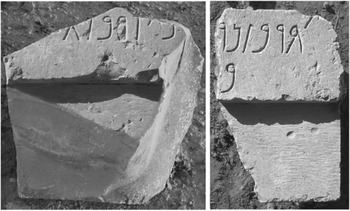
In the meantime, a second inscribed fragmentary block of matching profile was found on the site in 1999, and was published along with the first one by Ginette Di Vita-Evrard (Reference Di Vita-Evrard2009). The second block bears only a single line of text (again broken off to the left) in the upper half of the band: BSTRBTH[– – –].
Thanks to the parallel of the dedicatory text of the Ammonium at Ras el-Hadagia (KAI 118 = IPT 76 = HNPI Breviglieri N 1, l.2) the letters on the more recently found block (Figure 3, left) are plausibly identified as the opening of a dating formula, which would originally have named the current proconsul of the Roman province of Africa. Although her reading of the letters of the first block did not differ from that already established (apart from confessing uncertainty over the graphically indistinct N and T), Di Vita-Evrard proposed a number of alternative solutions for understanding the first line of the text on the first block. Assuming first that the inscription pertains to the mausoleum and carries the name of its deceased owner, and reading L HR BN KR[– – –], she proposed that it reads ‘To Hr, son of Kr[– – –] (Di Vita-Evrard Reference Di Vita-Evrard2009, 38), rightly rejecting the alternative readings of L HRB N/TKR ‘To the chief of the N/Tkr’ or HRBNKR as an unknown and exceptionally long Libyan personal name (Di Vita-Evrard Reference Di Vita-Evrard2009, 39). However, she also admitted that the blocks might belong to the entablature of a separate monument and, understanding RBT in the first line of the first block as the feminine singular of the honorific address rb ‘lord/lady’ (Jongeling Reference Jongeling2008, 405), she rather tentatively suggested a dedication addressed to the Greek goddess Korè (KR[Wᵓ – – –]), appealing to a Punic funerary stele in Carthage that apparently commemorates a priestess of Korè (CIS I 5987). Di Vita-Evrard (Reference Di Vita-Evrard2009, 39) does concede that a dedication to this goddess here would be ‘a momentous novelty in the religious field’. In whatever fashion the name of the divinity ought correctly to be completed, as Di Vita-Evrard commented, the inclusion of the clause dating by the Roman governor, is more appropriate to the dedication of a temple than to that of a private funerary monument, such as the mausoleum of Gasr Doga (Di Vita-Evrard Reference Di Vita-Evrard2009, 39).
The previously known (right) and more recently discovered (left) fragments of the neo-Punic inscription from Gasr Doga, as published by Di Vita-Evrard Reference Di Vita-Evrard2009. (Photos: F. Felici)

As it happens, rbt is also epigraphically attested as a masculine plural form in one Phoenician text (KAI 101, l.2; Jongeling Reference Jongeling2008, 195) and perhaps specifically as a dual, when applied to Shadrapa and Milk ‘Ashtart, as the twin tutelary deities of Lepcis Magna in a Punic text (IPT 31, l.1). Accordingly, we might be permitted to retain the reference to Gurzel on the first block, if he were one of two deities honoured together. So, drawing inspiration from the Ammonium dedication, we might understand the two fragments of the inscription together as follows:
Block 1 Block 2
L H RBT KR[ZL – – –] BŠT RBTᵓḤ[T RB MḤNT
BŠD LWBYM – – –]
(vac.) B[TṢᵓTM BTM]
and translate it as:
To the lords Gurzel and … in the year of the chief acting as the military chief (i.e. proconsul) in the territory of the Libyans … completely at his own expense.
As Di Vita-Evrard (Reference Di Vita-Evrard2009, 39) points out, the parallel of the Ammonium text suggests that, once complete with the object being dedicated and the names of the proconsul and the dedicator, this would have made a lengthy text, which she estimates would occupy an entablature at least 4 m across.
Conclusions
Given that the content of the portion of the text preserved on block 2 is much more appropriate to a public monument, it seems eminently plausible that these two blocks originally came not from the still standing mausoleum but from a temple somewhere in the vicinity. This lost edifice may have been demolished and the blocks transported to the area of their findspot when the early Roman mausoleum was converted into a fortified watchtower in the late Roman period (Bigi et al. Reference Bigi, Di Vita-Evrard, Fontana and Schingo2009, 39–40). The surviving letters of the opening of the text are consistent with understanding it as a votive dedication to the Libyan bull god Gurzel along with another deity whose name is now lost. The stylistic closeness of the script to that on the surviving dedicatory inscription from Ras el-Hadagia, where an individual with a Libyan name, Shasidwasan (Jongeling Reference Jongeling2008, 376), dedicated a temple to the Phoenician deity Bal Ammon in c. AD 15–17, suggests an equivalent (i.e. early first-century) date for the temple of Gurzel and his companion.
Acknowledgement
I would like to thank Dr Benet Salway for reading this article and offering suggestions.
Abbreviations
- AE
L'Année épigraphique. Paris, 1889–.
- CIL
Corpus Inscriptionum Latinarum. Berlin, 1863–.
- CIS
Corpus Inscriptionum Semiticarum. Pars Prima. Paris, 1880–90.
- HNPI
= Jongeling Reference Jongeling2008. Texts available online at www.punic.co.uk/phoenician/neopunic-inscr/puninscr.html (accessed on 18 July 18).
- IPT
Levi Della Vida, G., and Amadasi Guzzo, M. G. (eds). 1987. Iscrizioni Puniche della Tripolitania (1927–1967). L'Erma di Bretschneider, Rome.
- IRT
Reynolds, J. M., and Ward-Perkins, J. B. (eds). 1952. Inscriptions of Roman Tripolitania. British School at Rome, Rome/London; IRT2009: Inscriptions of Roman Tripolitania, enhanced electronic reissue by G. Bodard and C. M. Roueché, 2009. Available at: http://inslib.kcl.ac.uk/irt2009/ (accessed on 18 July 18).
- KAI
Donner, H., and Röllig, W. 1966–69. Kanaanäische unde Aramäische Inschriften, mit einem Beitrag von O. Rossler, I-III2. Harrassowitz, Wiesbaden.
- LPE
= Kerr Reference Kerr2010.
- PIR 2
Groag, E., et al. (eds). 1933–. Prosopographia Imperii Romani saec I. II III. Editio altera. Berlin.