Organic modification of clay minerals such as montmorillonite (Mnt), palygorskite (Plg), vermiculite and kaolinite has emerged as a promising approach for drug-delivery applications due to their capacity to adsorb and desorb substances (Park et al., Reference Park, Shin, Kim, Kim, Kang and Lee2016; Boaro et al., Reference Boaro, Campos, Varca, Dos Santos, Marques and Sugii2019; Pazourková et al., Reference Pazourková, Reli, Hundáková, Pazdziora, Predoi, Simha and Lafdi2019; Yue et al., Reference Yue, Zhang, Li, Su, Jin and Qin2019). Of these, Mnt has received the most attention in the development of antibacterial materials and is currently being investigated as a nanofiller (Nedeljkovic et al., Reference Nedeljkovic, Teughels, De Munck, Van Meerbeek and Van Landuyt2015; Zhang et al., Reference Zhang, Ma, Weir, Xu, Bai and Melo2017). Mnt consists of octahedral and tetrahedral sheets arranged in layers, with an interlayer space filled with exchangeable cations. While Plg can also be used for this purpose, there are scarce reports of its use to date. Plg is composed of octahedral and tetrahedral sheets organized into blocks that stack on top of each other, ultimately forming fibres with structural cavities known as tunnels (Cisneros-Rosado et al., Reference Cisneros-Rosado, Paz-Alpuche and Uribe-Calderon2017).
In addition, 1D nanorod-like clay minerals (such as Plg) have been found to offer advantages over the 2D platelets present in laminar clay minerals (such as Mnt) for the preparation of nanocomposites. According to Nikolic et al. (Reference Nikolic, Petrovic, Veljovic, Cosovic, Stankovic and Djonlagic2017) and Huang et al. (Reference Huang, Zhang, Ma and Quan2018), 1D nanorod-like clay minerals could be dispersed easily in polymer matrices with fewer aggregations than 2D platelets due to their smaller contact surfaces and the weaker bonding between the fibres or rods. In contrast, 2D platelets exhibit stronger hydrogen bonding and van der Waals forces, which tend to cause agglomeration of particles.
Various antibacterial surfactants, including triclosan, octenidine dihydrochloride, chlorhexidine diacetate (CA) and benzalkonium chloride (BAC), can be used to modify clay minerals organically in the healthcare field, particularly for dental applications (Sehgal et al., Reference Sehgal, Shetty, Mogra, Bhat, Eipe, Jacob and Prabu2007; Mehdawi & Young, Reference Mehdawi, Young and Vallittu2013; Boaro et al., Reference Boaro, Campos, Varca, Dos Santos, Marques and Sugii2019; Pazourková et al., Reference Pazourková, Reli, Hundáková, Pazdziora, Predoi, Simha and Lafdi2019; Barot et al., Reference Barot, Rawtani and Kulkarni2020; Khan et al., Reference Khan, Ur Rehman, AlMaimouni, Ahmad, Khan and Ashiq2020; Mansour et al., Reference Mansour, Hussein and Salem2021; Alansy et al., Reference Alansy, Saeed, Guo, Yang, Liu and Fan2022). Because these drugs are surfactants, they can be leachable and so could be released into the area surrounding the tooth restoration. Darder et al. (Reference Darder, He, Charlet, Ruiz-Hitzky and Aranda2021) investigated the suitability of Mnt intercalated with gentamicin for wound-dressing applications. The study demonstrated that films composed of gentamicin-Mnt and hydroxypropyl methylcellulose exhibited a reduction in bacterial activity, even with a low drug content in the films. Regarding dental applications, Boaro et al. (Reference Boaro, Campos, Varca, Dos Santos, Marques and Sugii2019) conducted a study on the development of a composite material with antibacterial activity composed of CA-loaded Mnt, which exhibited a sustained release of CA over a period of 28 days. The resulting composite material demonstrated effective inhibition of bacterial growth. Furthermore, Barot et al. (Reference Barot, Rawtani and Kulkarni2020) also employed CA to modify halloysite nanotubes to improve the mechanical properties of dental composites.
Plg has also been modified using surfactants such as hexadecyltrimethylammonium bromide (Boudriche et al., Reference Boudriche, Bergaya and Boudjemaa2023) and cetyltrimethylammonium bromide (Silva et al., Reference Silva, Góis, Ramme, De Castro Dantas, Barillas and Santanna2021), resulting in organo-Plg clay minerals with various applications. Wu et al. (Reference Wu, Ding, Chen, Zhou and Ding2014) and Yahia et al. (Reference Yahia, García-Villén, Djelad, Belaroui, Sánchez-Espejo and Sassi2019) conducted research on the development of microspheres or beads employing chitosan and organo-Plg modified with hexadecyl betaine or tripolyphosphate using diclofenac as a drug model. However, despite such research, the use of this clay mineral as a drug carrier in the healthcare field remains limited.
As mentioned above, CA is the most used antibacterial agent in dental applications, being considered the gold standard (Barot et al., Reference Barot, Rawtani and Kulkarni2020; Khan et al., Reference Khan, Ur Rehman, AlMaimouni, Ahmad, Khan and Ashiq2020). Therefore, exploring alternative surfactants such as BAC, which have not been extensively studied in this context, could be of interest.
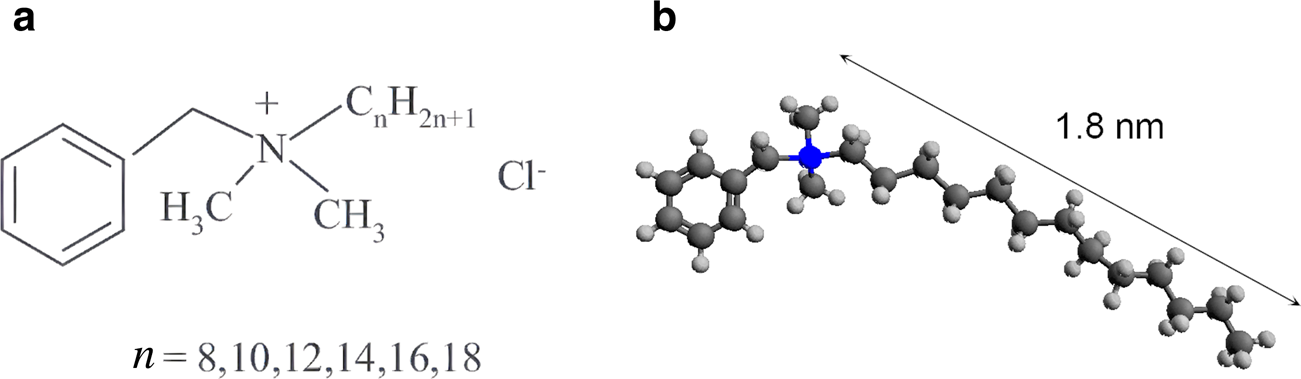
BAC is a positively charged quaternary ammonium compound containing a phenyl, two methyl groups and a long hydrocarbon chain. The antibacterial activity of BAC is attributable to its amphiphilicity due to its long hydrophobic alkyl chain and hydrophilic cationic ammonium group. Its antibacterial action involves the breakup of bacterial membranes via its cationically charged group, after which the long alkyl chain penetrates the membrane, leading to cell leakage and lysis (Zanini et al., Reference Zanini, Ovesen, Hansen and Strobel2013; Flores et al., Reference Flores, Loveira, Yarza, Candal and Sánchez2016). In addition, it has been reported that dental composites containing 0.25–2.50 wt.% BAC exhibited antibacterial activity against Streptococcus mutans, a bacterium that is often found in the human oral cavity and is the top contributor to dental caries (Mehdawi & Young, Reference Mehdawi, Young and Vallittu2013).
The use of Plg as a carrier for BAC is a promising approach to obtaining organo-clay minerals that not only could dispersed be more easily, but also could exhibit antibacterial properties. While previous studies have reported on the use of BAC to modify other clay minerals such as Mnt and halloysite nanotubes (Flores et al., Reference Flores, Loveira, Yarza, Candal and Sánchez2016; Barot et al., Reference Barot, Rawtani and Kulkarni2020), there have been no studies conducted involving the organic modification of Plg with BAC for drug-delivery applications.
Therefore, the objective of this work was to evaluate the use of Plg as a carrier for BAC and to determine its drug-release kinetics. To achieve this, BAC-Plg was prepared using ion-exchange reactions with BAC as the organic modifier, and the drug-release kinetics were compared with those of BAC-Mnt. The physicochemical properties of the BAC-Mnt or BAC-Plg were characterized and their capability to release the loaded drug was assessed.
Experimental
Materials and reagents
Plg was obtained from a mine at Chapab, Yucatán, Mexico, and purified using a 1 N HCl solution to remove impurities (Lobato-Aguilar et al., Reference Lobato-Aguilar, Uribe-Calderón, Herrera-Kao, Duarte-Aranda, Baas-López and Escobar-Morales2018), with a cation exchange capacity (CEC) of 26.2 cmol(+) kg–1 (Cisneros-Rosado et al., Reference Cisneros-Rosado, Paz-Alpuche and Uribe-Calderon2017). Mnt (Cloisite™ Na+) was purchased from Southern Clay Products (Austin, TX, USA) and has a CEC of 92.6 cmol(+) kg–1 (reported by the supplier). BAC (Fig. 1a) was used as an organic modifier supplied by Sigma Aldrich Co. (St. Louis, MO, USA; Sigma B6295), with a purity of 100% calculated on a dry basis. This antibacterial compound is a mixture of homologues that contain alkyl tails with various numbers of carbon atoms (n = 8, 10, 12, 14, 16, 18), with the homologue with a chain of 12 carbons (C12) being predominant in the product (Flores et al., Reference Flores, Loveira, Yarza, Candal and Sánchez2016). The 3D model (Fig. 1b) of the C12 homologue (BAC-12) was drawn using Avogadro software (Open Molecules, Pittsburgh, PA, USA).
(a) Chemical structure of BAC (Blazheyevskiy & Kovalska, Reference Blazheyevskiy and Kovalska2017) and (b) the 3D model of BAC-12.

Preparation of organo-clay minerals
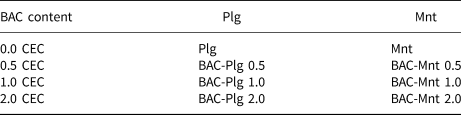
For the preparation of organo-clay minerals, 0.5 g of Plg or Mnt were dispersed in 25 mL of distilled water using a Bransonic CPX2800 ultrasonic bath (Danbury, CT, USA) for 2400 s at room temperature and at a frequency of 40 kHz. Various amounts of BAC (0.5, 1.0 and 2.0 CEC of Plg or Mnt) were dissolved in 25 mL of distilled water using a magnetic stirrer. The BAC solution was mixed with the clay mineral suspension (Plg or Mnt) using a magnetic stirrer for 3 h at 70°C. Finally, the dispersion was centrifuged at 3500 rpm for 30 min, washed with distilled water, dried in an oven at 80°C for 24 h and ground using a mortar. The proposed BAC organo-clay minerals were then designated as presented in Table 1.
BAC organo-clay minerals.

Characterization methods
Fourier-transform infrared spectroscopy
Fourier-transform infrared (FTIR) spectra of the modified and unmodified clay minerals were obtained using a Thermo Scientific Nicolet 8700 instrument (Waltham, MA, USA) via the attenuated total reflectance technique with a ZnSe crystal. Data were collected in the 4000-650 cm–1 wavenumber range with a resolution of 4 cm–1, and an average of 100 scans was taken.
Thermogravimetric analysis
Thermogravimetric analysis (TGA) of the thermal decomposition of the organo-clay minerals was conducted using a Perkin Elmer TGA 8000 (Waltham, MA, USA) from 50 to 650°C at a heating rate of 10°C min–1 under a nitrogen atmosphere.
X-ray diffraction
The X-ray diffraction (XRD) traces of the powdered organo-clay minerals were acquired using a Bruker D-8 Advance diffractometer (Billerica, MA, USA) with Cu-Kα radiation (0.15418 nm wavelength), generated at a voltage of 40 kV and a current of 30 mA. Data were collected in the range 2–60°2θ, with a step size of 0.02° and a step count of 0.5 s. The d-values were determined using the °2θ angle according to Bragg's law.
Elemental analysis
The elemental compositions were obtained by means of a Thermo Scientific Flash 2000 series CHNS-O (Waltham, MA, USA) elemental analyser. Energy-dispersive X-ray spectroscopy (EDS) was also performed to determine the elemental composition using a characteristic X-ray spectrometer (EDS) coupled to a JEOL JSM 7601F scanning electron microscope (SEM; Peabody, MA, USA). For this, two measurements were obtained in different areas of the samples to determine the average composition of the samples.
Scanning electron microscopy
SEM images were o from various sections of the samples using a JEOL JSM 6360LV device (Peabody, MA, USA) at a high magnification (10,000×) and at an acceleration voltage of 20 kV. The samples were coated with a thin layer of gold before the imaging process. The average apparent diameter and diameter distribution of 100 Plg fibres were calculated by measuring the images using ImageJ software (National Institute of Mental Health, Bethesda, MD, USA).
Drug-release studies
The BAC release kinetics from the modified clay minerals were studied in vitro. Organo-clay minerals containing the greatest BAC contents (BAC-Plg 2.0 and BAC-Mnt 2.0) were dispersed in phosphate-buffered saline (PBS) medium (pH = 7.3) and stirred at 37°C for 24 h. Aliquots (5 mL) of the samples were withdrawn every 1 h until 7 h had elapsed, and the last aliquot was collected at the end of the test (24 h). The withdrawn samples were centrifuged and the supernatants were analysed using an AE-UV1608 spectrophotometer (A & E Laboratory Instruments Co., Ltd, Guangzhou, China) at 207 nm. The withdrawn volume was replaced with fresh solution medium and the studies were conducted in duplicate for each sample to obtain average values for data analysis.
Results and discussion
Characterization of BAC-modified clay minerals
FTIR spectroscopy
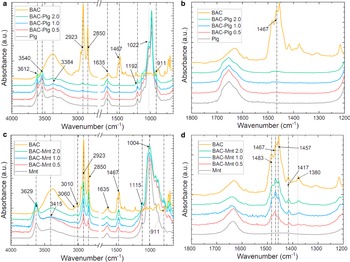
The modified organo-clay minerals were subjected to FTIR spectroscopy analysis to detect the presence of organic functional groups associated with loaded BAC. The infrared spectra of unmodified Plg and Mnt have been reported previously to exhibit similar compositions, consisting of Si–O octahedra and Al–O tetrahedra, as well as comparable infrared spectra (Cisneros-Rosado et al., Reference Cisneros-Rosado, Paz-Alpuche and Uribe-Calderon2017; Huang et al., Reference Huang, Zhang, Ma and Quan2018). The infrared spectra of unmodified Plg and Mnt showed bands related to O–H stretching vibrations for Al–OH and Si–OH linkages in the range of 3650–3600 cm–1 (Fig. 2a,c). Plg also exhibit a band associated with the stretching vibrations of coordinated water at 3540 cm–1, as reported by Cisneros-Rosado et al. (Reference Cisneros-Rosado, Paz-Alpuche and Uribe-Calderon2017) and Lobato-Aguilar et al. (Reference Lobato-Aguilar, Uribe-Calderón, Herrera-Kao, Duarte-Aranda, Baas-López and Escobar-Morales2018). A broad band attributed to the O–H stretching vibrations of water was also observed at 3384 cm–1 for Plg and at 3415 cm–1 for Mnt, along with a bending vibration of water at 1635 cm–1. In addition, two bands at 1022 and 1004 cm–1 were detected for Plg and Mnt, respectively, associated with the stretching vibrations of Si–O–Si from silicate, both out of the plane and in plane. A low-intensity band at 911 cm–1 was also observed due to Al–OH bending vibrations, which is consistent with previous studies (Cisneros-Rosado et al., Reference Cisneros-Rosado, Paz-Alpuche and Uribe-Calderon2017; Lobato-Aguilar et al., Reference Lobato-Aguilar, Uribe-Calderón, Herrera-Kao, Duarte-Aranda, Baas-López and Escobar-Morales2018; Caccamo et al., Reference Caccamo, Mavilia, Mavilia, Lombardo and Magazù2020).
FTIR spectra of Plg and Mnt organo-clay minerals in the (a,c) 4000–650 cm–1 and (b,d) 1800–1200 cm–1 regions.

Following the modification procedure, the infrared spectra of BAC-Plg and BAC-Mnt organo-clay minerals (Fig. 2a,c) revealed new bands associated with BAC. Two characteristic bands at 2850 and 2923 cm–1 were observed for both modified clay minerals (BAC-Plg and BAC-Mnt), which were attributed to asymmetric and symmetric C–H stretching vibrations of the methylene groups belonging to the alkyl tail of BAC. Furthermore, a band at 1467 cm–1 (Fig. 2b,d) due to methyl group bending vibrations of C–H linkage was observed (Misni et al., Reference Misni, Nor and Ahmad2018; Yue et al., Reference Yue, Zhang, Li, Su, Jin and Qin2019). The FTIR spectra of BAC-Mnt organo-clay minerals also displayed bands in the 1457–1350 cm–1 range, attributed to C–C linkage in the aromatic ring (Fig. 2d), as well as two bands at 3060 and 3010 cm–1 associated with C–H linkage in the aromatic ring (Fig. 3a; Misni et al., Reference Misni, Nor and Ahmad2018; Yue et al., Reference Yue, Zhang, Li, Su, Jin and Qin2019). As expected, the intensity of the bands increased as BAC content increased in both systems, although this effect was less noticeable in the BAC-Plg samples. The characteristic bands belonging to BAC that were identified in the organically modified Mnt and Plg infrared spectra demonstrated successful loading of BAC into the clay minerals.
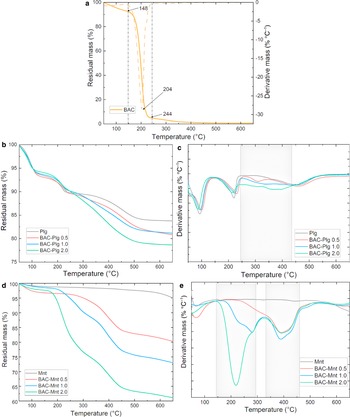
TGA and DTGA curves (a) for BAC, (b,c) modified and unmodified Plg and (d,e) modified and unmodified Mnt.

Thermogravimetric analysis
The TGA and differential TGA (DTGA) curves of pure BAC (Fig. 3a) showed that BAC had a maximum degradation temperature of 204°C. A small mass loss at <100°C was also detected, which was attributed to free water release, and no residual mass was observed at 600°C.
The TGA curve of pristine Plg (Fig. 3b) showed that its thermal decomposition was a multi-step degradation process. Cisneros-Rosado et al. (Reference Cisneros-Rosado, Paz-Alpuche and Uribe-Calderon2017) noted that Plg exhibited a dehydration process occurring in three steps, which is in agreement with the results obtained in this work. The BAC-Plg samples showed different behaviour compared to pristine Plg. Only one degradation stage in the BAC-Plg samples was observed between 245 and 435°C, which occurred due to the physically adsorbed BAC onto the clay mineral fibres (Fig. 3c). As expected, the signal between 245 and 435°C became stronger at greater drug concentrations.
Pristine Mnt was thermally stable during the TGA experiments, but the thermal stability of the samples decreased significantly after the BAC modification process of Mnt (Fig. 3d). In addition to the release process of free water that occurred at <100°C, the BAC-Mnt samples exhibited two degradation stages (Fig. 3e). The first one, which occurred at 150–325°C, was attributed to the release of physically adsorbed BAC, while the second one, which occurred at 325–450°C, may have been related to the decomposition of BAC molecules intercalated within the interlayer space of Mnt. This was due to the fact that the Mnt layers protected the drug, allowing BAC thermal decomposition at greater temperatures. Interestingly, the first signal became stronger at greater BAC concentrations, indicating that at greater BAC contents, more drug is adsorbed on the Mnt surface. This is because Mnt had reached the drug saturation point in the interlayer space and so no more drug could be loaded into this space, meaning that the drug could only be adsorbed onto the Mnt surface. In contrast, the second mass loss in the DTGA curves for the modified Mnt clay minerals demonstrated the same intensity as the unmodified Mnt because it had reached the saturation point. It is important to note that the second degradation stage seen in the BAC-Mnt samples did not occur in the BAC-Plg samples because of the reduced dimensions of the Plg tunnels. Overall, it was also noted that Plg adsorbed less BAC than Mnt. According to the TGA analysis, the mass losses related to the BAC content were calculated as 5.12 wt.% for Plg (BAC-Plg 2.0) and 33.86 wt.% for Mnt (BAC-Mnt 2.0). This observation can be explained by the fact that Plg had a lower CEC than Mnt. Consequently, Plg tended to adsorb lesser quantities of the drug.
X-ray diffraction
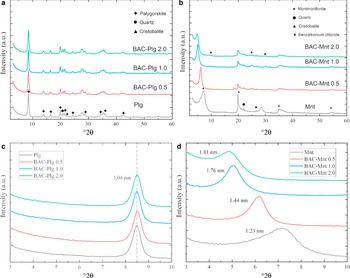
No apparent changes were observed in the Plg peaks of the XRD traces when BAC was introduced (Fig. 4a). This suggested that the organic modification process did not affect the crystalline structure of Plg (Yahia et al., Reference Yahia, García-Villén, Djelad, Belaroui, Sánchez-Espejo and Sassi2019). Specifically, Plg did not exhibit changes in the reflection located at 8.5°2θ (Fig. 4c), even at greater drug contents (i.e. the basal space of Plg remained unaffected at 1.04 nm, calculated using Bragg's law). This indicated that the tunnels inside the fibrous structure preserved their dimensions as BAC was added to the clay mineral.
XRD traces of modified and unmodified (a) Plg and (b) Mnt.

After the organic modification of Mnt, three new peaks (9.9, 24.8 and 29.8°2θ) emerged, and the characteristic peaks of Mnt became weaker (Fig. 4d). This could be related to the introduction of BAC into the interlayer space of the clay mineral (Sun et al., Reference Sun, Peng, Liu and Xian2015). The (001) reflection peak of unmodified Mnt was observed at 7.17°2θ, suggesting that the d 001 value of the basal space is 1.23 nm (calculated using Bragg's law), which is consistent with values reported previously (Sun et al., Reference Sun, Zhang, Zhou, Chu, Yuan and Chi2018; Pazourková et al., Reference Pazourková, Reli, Hundáková, Pazdziora, Predoi, Simha and Lafdi2019; Yue et al., Reference Yue, Zhang, Li, Su, Jin and Qin2019) for this laminar clay mineral. The (001) reflection peaks of the BAC-Mnt samples (Fig. 4d) were shifted towards lower angles, with the °2θ values decreasing as the BAC content increased. This indicates that the d 001 value increased with greater drug content. Thus, the basal spacing of Mnt increased from 1.23 nm for pristine Mnt to 1.81 nm when BAC was added at the greatest drug concentration, corresponding to a 47% increase in the basal space. This value is greater than that reported by Flores et al. (Reference Flores, Loveira, Yarza, Candal and Sánchez2016) and Yue et al. (Reference Yue, Zhang, Li, Su, Jin and Qin2019), who reported a value of 1.75 nm for a BAC-Mnt sample.
Based on the d 001 value, the arrangement of BAC cations between the layers of Mnt can be described (Zanini et al., Reference Zanini, Ovesen, Hansen and Strobel2013; Wójcik-Bania & Matusik, Reference Wójcik-Bania and Matusik2021). The cations in the interlayer space of BAC-Mnt 0.5 were arranged in monolayers (d 001 ≈ 1.4 nm), while the molecules adsorbed in BAC-Mnt 1.0 and BAC-Mnt 2.0 were arranged in bilayers with a flat and parallel configuration (d 001 ≈ 1.8 nm). These d 001 values are similar to those reported by Zanini et al. (Reference Zanini, Ovesen, Hansen and Strobel2013) and Wójcik-Bania & Matusik (Reference Wójcik-Bania and Matusik2021) for BAC-12. The positively charged surfactant heads were attached to the silicate layers, while the hydrophobic alkyl chains tended to adopt a layered structure (Lagaly et al., Reference Lagaly, Ogawa, Dékány, Bergaya and Lagaly2013).
The d 001 value (1.81 nm) of BAC-Mnt 2.0 was greater than that achieved in a previous work (Lobato-Aguilar et al., Reference Lobato-Aguilar, Uribe-Calderón, Herrera-Kao, Duarte-Aranda, Baas-López and Escobar-Morales2018) in which Mnt was modified with CA and reached a value of 1.49 nm as CA was added at 2.0 CEC. This result was very interesting because CA is bulkier than BAC. Normally, the increase in basal space is due to bulkier organic modifiers and their greater concentration, but in the case of CA the increase in basal spacing was less than that observed for BAC due to the lateral and monolayer arrangement of the CA molecules incorporated into the Mnt interlayer space, as discussed previously by Sun et al. (Reference Sun, Zhang, Zhou, Chu, Yuan and Chi2018) and Pazourková et al. (Reference Pazourková, Reli, Hundáková, Pazdziora, Predoi, Simha and Lafdi2019).
Elemental analysis
The results from the CHNS-O elemental analysis (Table 2) indicate that both carbon and nitrogen contents increased with increasing BAC content in terms of the CEC values for Plg and Mnt. It is interesting to note that the nitrogen content values obtained for Plg were generally four times lower than those obtained for Mnt. These results are associated with the amount of BAC loaded into the clay minerals. The surfactant contents calculated using the elemental analysis technique (Table 2) have been used previously to quantitatively estimate the amount of drug loaded into these clay minerals (Lobato-Aguilar et al., Reference Lobato-Aguilar, Uribe-Calderón, Herrera-Kao, Duarte-Aranda, Baas-López and Escobar-Morales2018). As expected, based on the FTIR spectroscopy, TGA and nitrogen content results, the drug loaded into Plg was four times lower than that for Mnt (at the same CEC value). It was also observed that the BAC load efficiency decreased with increasing drug concentration, which indicated that these clay minerals cannot absorb more molecules into them (or within their channels) because they have reached the saturation point. In this case, the decrease in load efficiency was more evident for Plg than for Mnt.
BAC content in organo-clay minerals and load efficiencies.

The calculated BAC loaded into Plg increased as the drug concentration increased (i.e. from 0 to 6.95 wt.% when the BAC content was increased from 0 to 2.0 times the CEC of Plg). In addition, BAC-Mnt exhibited an increasing amount of BAC loaded into the clay mineral structure as the drug concentration increased (i.e. from 0 to 32.37 wt.% when the BAC content was increased from 0 to 2.0 times the CEC of Mnt).
Interestingly, Plg was not as efficient as Mnt at loading drugs due to its lower CEC value, and it could not absorb molecules within its tunnels; BAC cations could only interact with the surface of this fibrous phyllosilicate. Taking this into consideration, it seemed unnecessary to load large amounts of drugs into Plg.
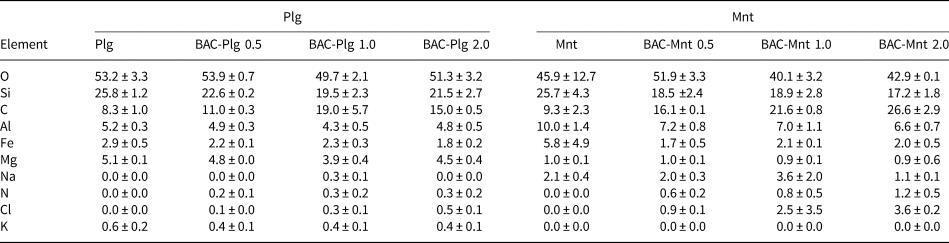
Elemental analysis using EDS revealed that the samples consisted mainly of silicon, aluminium, oxygen, magnesium and iron (Table 3), as these clay minerals are aluminosilicates. Typical exchangeable cations such as sodium and potassium were also identified. In addition, some elements related to the chemical composition of BAC, including carbon, nitrogen and chlorine, were also detected. As expected, the concentration of these elements increased with increasing BAC content in terms of the CEC values of Plg and Mnt. Changes related to cation exchange were identified at greater BAC contents (i.e. sodium content was decreased from 2.1 to 1.1 wt.% in Mnt, whereas nitrogen increased from 0 to 1.2 wt.%). This could indicate that sodium cations were replaced successfully by the drug cations.
Elemental compositions (wt.%) of BAC-Plg and BAC-Mnt organo-clays obtained by EDS.

Chlorine content also increased in relation to increasing BAC incorporation. This was interesting because chlorine is the anionic component of BAC. The simultaneous adsorption of chlorine with BAC cations occurs after the complete alkyl ammonium ion exchange of Mnt (Tahani et al., Reference Tahani, Karroua, Van Damme, Levitz and Bergaya1999; Lagaly et al., Reference Lagaly, Ogawa, Dékány, Bergaya and Lagaly2013). Tahani et al. (Reference Tahani, Karroua, Van Damme, Levitz and Bergaya1999) described this two-stage surfactant adsorption mechanism as follows: (1) surfactant cation-exchange adsorption until the CEC of Mnt is reached; and (2) simultaneous surfactant cation–anion (Cl–) adsorption.
Plg also underwent changes in carbon, nitrogen and chlorine contents that were attributed to drug loading. It is important to mention that Plg was capable of loading lesser amounts of BAC compared to Mnt due to their differences in CEC values (Plg has a CEC of 26.2 cmol(+) kg–1, whereas Mnt has a CEC of 92.6 cmol(+) kg–1).
Scanning electron microscopy
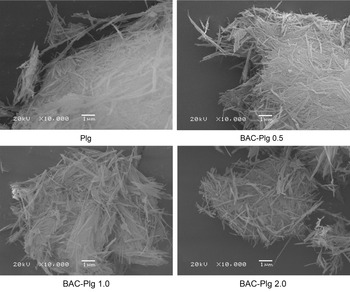
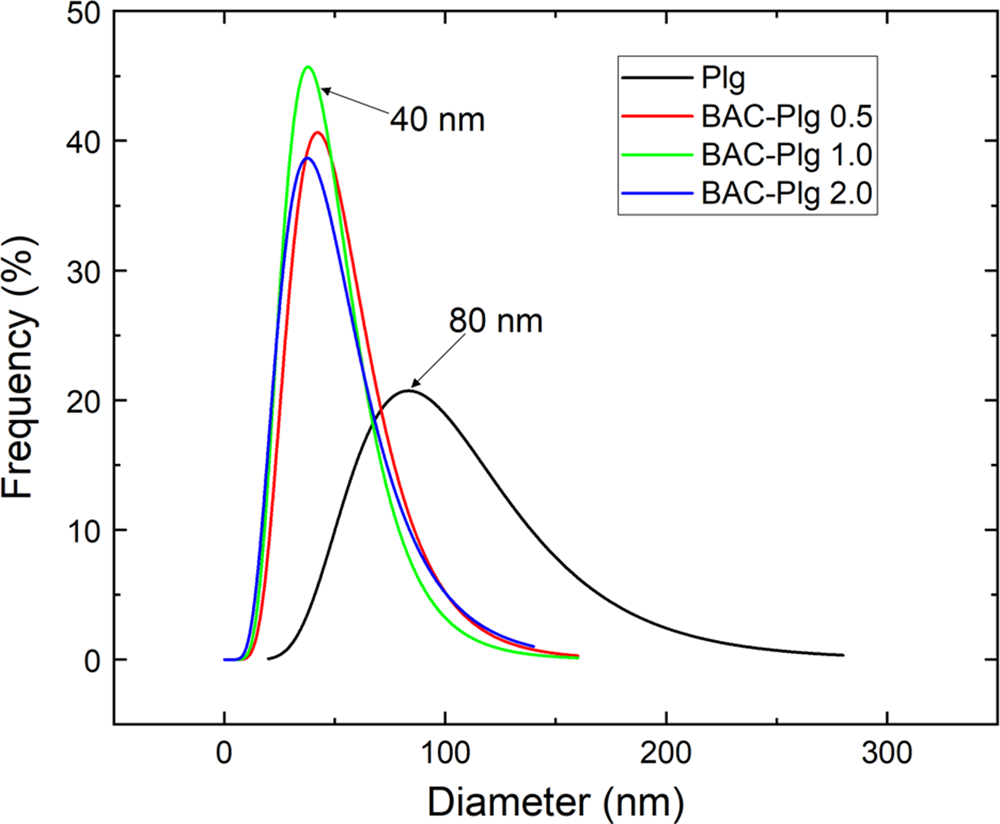
Unmodified and modified Plg SEM images (Fig. 5) revealed a fibrillar morphology. Analysis of the apparent diameter distribution of the Plg nanofibres (Fig. 6) showed that the average diameter decreased by almost half (from ~80 to ~40 nm) upon organic modification, although the BAC content seems to have had no effect on this parameter.
SEM images of Plg and BAC-Plg organo-clays.

Apparent diameter distribution of Plg and BAC-Plg fibres.

This reduction in apparent diameter could be due to the functionalization process keeping the fibres separated and preventing them from coming into close contact. This prevents agglomeration after drying of the samples, resulting in the fibres remaining more separated and dispersed in the sample, leading to a reduction in apparent diameter. Similarly, the apparent diameter distribution width seemed to reduce when Plg was modified, although the BAC content also seems to have had no effect on this parameter as well (Fig. 6).
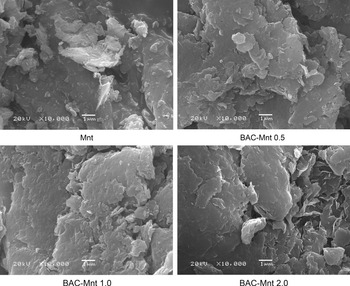
By contrast, Mnt (Fig. 7) consists of agglomerated platelets forming micron-sized particles. The same morphology was observed in Mnt modified with BAC at all studied concentrations. Thus, it was possible to postulate that organic modification did not alter the morphology of Mnt.
SEM images of Mnt and BAC-Mnt organo-clays.

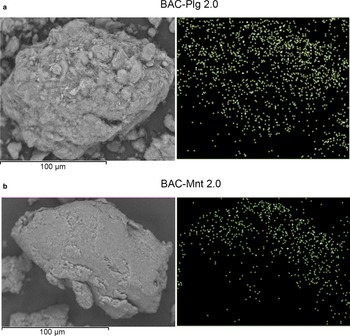
BAC distribution analysis in Plg and Mnt was performed according to nitrogen EDS mapping in samples prepared using the greatest drug concentrations (BAC-Plg 2.0 and BAC-Mnt 2.0), as pristine clay minerals do not have this element in their composition (Fig. 8). The results show that nitrogen was distributed uniformly on the surfaces of both organo-clay minerals.
EDS mapping of nitrogen in organo-clay minerals.

Benzalkonium chloride-release studies
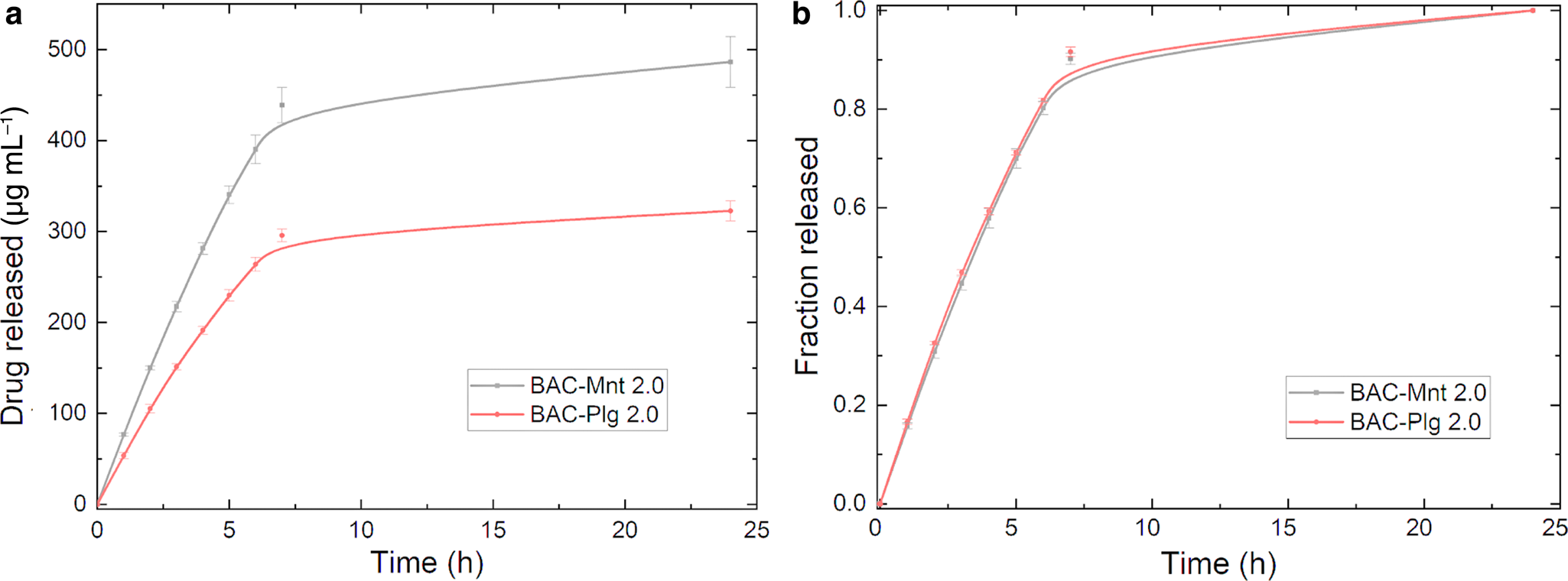
The drug-release profiles for the BAC-Plg 2.0 and BAC-Mnt 2.0 samples (Fig. 9) showed continuous release during the testing period (24 h), although a burst release was observed within the first 5 h. This behaviour was attributed to the molecules of BAC adsorbed onto the surfaces of the clay minerals. After the burst release, the drug underwent a slower release due to BAC being attached to deeper layers in Mnt or located in the innermost structures of the Plg fibres, which hindered the deintercalation or release of the drug molecules. It was also observed that the amount of drug released from Plg was ~1.5 times smaller than that observed for modified Mnt during burst and sustained release. This could be attributed to the different amounts of BAC loaded in Plg and Mnt due to the differences in their CEC values (Fig. 9a). Regardless the total drug amount released (Fig. 9b), there were no differences observed between the release profiles of BAC from both clay minerals.
(a) Cumulative release and (b) fraction release of BAC from Plg and Mnt.

Conclusions
FTIR spectroscopy, TGA, elemental analysis and SEM demonstrated that BAC was incorporated successfully into the clay minerals. The BAC load efficiency of Plg (45.78% at 2.0 CEC) was less than that observed for Mnt (86.41% at 2.0 CEC). As expected, the XRD traces indicated that there were no changes in the reflections of Plg. By contrast, the d-value of Mnt increased as the BAC content increased. Elemental analysis revealed that the BAC load increased with increasing drug concentration (from 0.5 to 2.0 CEC), being lower for Plg than for Mnt. The apparent diameter average of Plg fibres was reduced by almost half (~80 to ~40 nm) when the drug was added, and the diameter distribution was shifted to lower values, suggesting that BAC incorporation prevented the agglomeration of Plg fibres to some extent. The drug-release studies presented a burst release during the first 5 h of the testing period, followed by continuous release until the end of the test (24 h). The amount of BAC released from Plg was ~1.5 times less than that observed for Mnt due to the different amounts of drug loaded into both clay minerals; however, the release profiles appeared to be similar. As a result, both modified clay minerals could be utilized as viable drug carriers for several applications, such as in dental composite resins. Additional studies are required to improve the deagglomeration of Pal fibres or Mnt platelets, as agglomeration represents a significant challenge in the field of clay materials science.
Acknowledgements
The authors thank Dr Patricia Quintana and M.S. Daniel Aguilar Treviño for the XRD experiments at Laboratorio Nacional de Nano y Biomateriales (LANNBIO), Cinvestav-IPN, Unidad Mérida (Projects FOMIX-Yucatan 2008-108160, CONACYT LAB-2009-01-123913, 292692, 294643, 188345 and 204822). The authors also thank M.S. José Martín Baas López for the CHNS-O elemental analysis at Unidad de Energía Renovable, Centro de Investigación Científica de Yucatán A.C.
Competing interests
The authors declare none.