INTRODUCTION
The family Polychelidae Wood-Mason, Reference Wood-Mason1874 includes deep-sea blind lobsters and is widely distributed around the world, being characterized by chelate pereopods 1–4 and non-functional eyes (Ahyong, Reference Ahyong, Martin, Crandall and Felder2009).
In a revision of the polychelids, Galil (Reference Galil and Crosnier2000) recognized 32 species distributed in five genera: Cardus Galil, Reference Galil and Crosnier2000; Homeryon Galil, Reference Galil and Crosnier2000; Pentacheles Spence Bate, Reference Spence Bate1878; Polycheles Heller, Reference Heller1862; and Willemoesia Grote, Reference Grote1873. However, in a recent phylogenetic study of Polychelidae, Ahyong (Reference Ahyong, Martin, Crandall and Felder2009) recognized six genera for the family, the five presented by Galil (2000) plus Stereomastis Spence Bate, 1888; the latter as a distinct and monophyletic genus.
Among the 38 extant species of the family Polychelidae listed by Chan (Reference Chan2010), five have been recorded in the south-western Atlantic: Pentacheles laevis Spence Bate, Reference Spence Bate1878; Pentacheles validus A. Milne Edwards, Reference Milne Edwards1880; Polycheles typhlops Heller, Reference Heller1862; Stereomastis sculpta (Smith, Reference Smith1880); and Willemoesia forceps A. Milne Edwards, Reference Milne Edwards1880 (Ramos-Porto et al., Reference Ramos-Porto, Viana, Silva, Cintra and Coelho2000; Melo & Xavier Filho, Reference Melo and Xavier Filho2002; Silva-Ferreira et al., Reference Silva-Ferreira, Matos, Matos and Neves2003; Dall'Occo & Tavares, Reference Dall'Occo and Tavares2004; Coelho et al., Reference Coelho, Almeida, Bezerra and Souza-Filho2007; Serejo et al., Reference Serejo, Young, Cardoso, Tavares, Rodrigues, Almeida, Costa, Olavo and Martins2007). The present work reports Stereomastis nana (Smith, Reference Smith1884) for the first time from the south-western Atlantic and provides an identification key to all south-western Atlantic polychelids.
MATERIALS AND METHODS
The material herein analysed was sampled by the Project Campos Basin Environmental Heterogeneity (HABITATS), coordinated by CENPES/PETROBRAS. Samples were obtained from 18 stations, with one trawl at each station, using a shrimp fishery net in deep waters of the Campos Basin, State of Rio de Janeiro, Brazil (20.5°S–24°S).
The sampled material was fixed in ethanol 70% and deposited at the Crustacea Collection in the Museu Nacional/UFRJ. The nomenclature used at diagnosis and the spine formulae of post-rostral carina and lateral carapace margin were based on Galil (Reference Galil and Crosnier2000). Carapace length is given in the Material Examined section. The synonymy includes the prime synonym and significant contributions on the taxonomy of the group after 2000. A complete synonymy prior to 2000 is provided by Galil (Reference Galil and Crosnier2000).
RESULTS
SYSTEMATICS
Order DECAPODA Latreille, 1802
Infraorder POLYCHELIDA De Haan, 1841
Family POLYCHELIDAE Wood-Mason, Reference Wood-Mason1874
Genus Stereomastis Spence Bate, 1888
Stereomastis nana (Smith, Reference Smith1884)
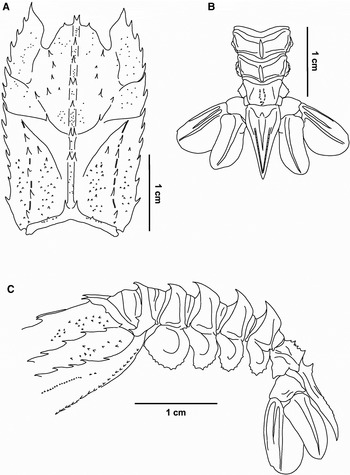
(Figure 1)
Stereomastis nana, male (carapace length 25.35 mm), MNRJ 23312: (A) carapace, dorsal view; (B) abdominal somites 4–6 and telson, dorsal view; (C) abdomen, lateral view.

Pentacheles nanus Smith, Reference Smith1884: 359.
Pentacheles andamanensis Alcock, Reference Alcock1894: 239.
Polycheles nanus—Galil, Reference Galil and Crosnier2000: 329, figure 19; Ahyong & Brown, Reference Ahyong and Brown2002: 71; Ahyong & Galil, Reference Ahyong and Galil2006: 765.
Polycheles grimaldii Bouvier, Reference Bouvier1905a: 481; Reference Bouvier1905b: 4.
Stereomastis nana—Kensley, Reference Kensley1968: 293; Yaldwyn & Webber, Reference Yaldwyn and Webber2011: 206; Ahyong, Reference Ahyong2012: 3.
MATERIAL EXAMINED
2 males, 19.4–25.35 mm, HAB1, Station 6, 21°51′54.036″S and 39°41′15.754″W, 1912 m, MNRJ 23312.
DIAGNOSIS
Carapace subrectangular; rostrum bifid; frontal margin of carapace with U-shaped dorsal orbital sinus; internal angle of dorsal orbital sinus with spine, external angle of dorsal orbital sinus without spine. Basal antennular segment rounded, produced anteriorly to a sharp point and two spines on antero-external angle. Postorbital carina with five spines. Posterior margin of cervical groove with a single spine between median post-cervical and branchial carinae. Branchial carina prominent bearing five spines. Branchial groove with spine. Lateral margins of carapace posterior to post-cervical incision with 6–9 spines. Posterior margin of carapace spinulose. Abdominal tergites bearing median carina; tergites 1–5 with anterior spine curved forward; spines on tergites 3–5 larger than others; sixth tergite with a pair of denticulate carinae convergent posteriorly in a prominent spine. Telson without basal tubercle; prominent spine at the base and two minutely serrulate carinae convergent posteriorly. Epipod of third maxilliped reduced (modified from Galil, Reference Galil and Crosnier2000).
DISTRIBUTION
Western Atlantic: Canada, United States (Smith, Reference Smith1884, Reference Smith1887; Wenner, Reference Wenner1979; Boyko, Reference Boyko2006), Brazil, Campos Basin (new record, present work). Eastern Atlantic: Iceland, Greenland, Ireland, Gulf of Biscay (Caullery, Reference Caullery and Koehler1896), Portugal, Azores, West Africa (Macpherson, Reference Macpherson1991), South Africa (Kensley, Reference Kensley1968). Indo-Pacific: Gulf of Aden, Arabian Sea, India, Japan, China Sea, Philippines, Indonesia, Australia (Griffin & Stoddart, Reference Griffin and Stoddart1995; Ahyong, Reference Ahyong2012), Tasman Sea (Ahyong & Brown, Reference Ahyong and Brown2002), Solomon Islands (Ahyong & Galil, Reference Ahyong and Galil2006), Vanuatu, New Zealand (Yaldwyn & Webber, Reference Yaldwyn and Webber2011); at depths between 300 m and 4000 m (Galil, Reference Galil and Crosnier2000).
REMARKS
The present work is the first record of Stereomastis nana in the south-western Atlantic region and the second species of the genus recorded in the region, S. sculpta being the other (Ramos-Porto et al., Reference Ramos-Porto, Viana, Silva, Cintra and Coelho2000; Silva-Ferreira et al., Reference Silva-Ferreira, Matos, Matos and Neves2003; Dall'Occo & Tavares, Reference Dall'Occo and Tavares2004; Coelho et al., Reference Coelho, Almeida, Bezerra and Souza-Filho2007; Serejo et al., Reference Serejo, Young, Cardoso, Tavares, Rodrigues, Almeida, Costa, Olavo and Martins2007).
Smith (Reference Smith1884) in the original description of S. nana affirms that this species is morphologically similar to S. sculpta. These two species can be distinguished by the number of spines on the post-rostral median carina; the carina spine formula in S. sculpta is 1:2:1 vs 1:1:2:1 in S. nana (Smith, Reference Smith1884; Kensley, Reference Kensley1968; Galil, Reference Galil and Crosnier2000). Another feature that distinguishes these species is the shape and ornamentation of the pair of dorsal carinae on abdominal tergite 6. In S. sculpta they are rounded, with small tubercles and united posteriorly, while in S. nana they are denticulate and united posteriorly in a strong spine. Besides that, S. nana presents a spine on the branchial groove, absent in S. sculpta (Smith, Reference Smith1884; Galil, Reference Galil and Crosnier2000). The specimens herein identified as S. nana agree with the description provided by Galil (Reference Galil and Crosnier2000).
KEY TO SOUTH-WESTERN ATLANTIC POLYCHELIDAE GENERA AND SPECIES
Modified from Galil, Reference Galil and Crosnier2000, Dall'Occo & Tavares, Reference Dall'Occo and Tavares2004, and Ahyong, Reference Ahyong, Martin, Crandall and Felder2009.
-
1. Frontal margin of carapace with dorsal orbital sinus ..................... (2)
-
1′. Frontal margin of carapace without dorsal orbital sinus ..................... Willemoesia forceps
-
2. Third maxilliped epipod reaching ischium distal margin or overreaching it; outer proximal region of basal antennular segment square ..................... Pentacheles (3)
-
2′. Third maxilliped epipod not reaching one half of ischium length or epipod rudimentary; outer proximal region of basal antennular segment rounded ..................... (4)
-
3. Carapace lateral margins posterior to post-cervical incision with 14 or 15 spines; carina on abdominal tergites 1–3 with a distinct anteriorly directed spine, curved upwards ..................... Pentacheles laevis
-
3′. Carapace lateral margins posterior to post-cervical incision with 20–32 spines; carina on abdominal tergites 1–3 with low, obtuse anterior apices ..................... Pentacheles validus
-
4. Dorsal orbital sinus ‘V’ shaped; epipod on pereopods 1–5 longer than coxa length ..................... Polycheles typhlops
-
4′. Dorsal orbital sinus ‘U’ shaped; epipod on pereopods 1–5 reduced, shorter than coxa length ..................... Stereomastis (5)
-
5. Branchial groove with spine; spine formula of post-rostral median carina 1:1:2:1; abdominal tergite 6 with a pair of carinae united posteriorly ............................................ Stereomastis nana
-
5′. Branchial groove without spine; spine formula of post-rostral median carina 1:2:1; abdominal tergite 6 with a pair of carinae united anteriorly and posteriorly ..................... Stereomastis sculpta
ACKNOWLEDGEMENT
The authors thank CENPES/PETROBRAS for sampling this important material, allowing the increase of the knowledge about the south-western Atlantic deep-sea fauna.