Introduction
In many societies, religion plays an important role in decisions about fertility and family planning. There is a large literature on the association between fertility and religion (Schenker & Rabenou, Reference Schenker and Rabenou1993; Frejka & Westoff, Reference Frejka and Westoff2008), much of which focuses on the supposed higher fertility and greater resistance to family planning among Roman Catholics and Muslims than among the adherents of other faiths (Jones & Nortman, Reference Jones and Nortman1968; Chamie, Reference Chamie1977; Mosher & Hendershot, Reference Mosher and Hendershot1984; Knodel et al., Reference Knodel, Gray, Sriwatcharin and Peracca1999). In the case of the Roman Catholic faith, there seems to be a general consensus that despite the Vatican's prohibition on most methods of family planning, many individual Catholics do practise contraception, and their fertility is only marginally higher than that of Protestant Christians or those of no faith.
In the case of Islam, the impact of the faith on fertility and family planning is, perhaps, less clear. Fertility remains high in many Muslim countries: the total fertility rate (TFR) is currently above 4.0 children per woman in Iraq, Sudan and Yemen, for example; but elsewhere in the Islamic world levels approaching replacement have been achieved, as in Bahrain, Kuwait, Tunisia and Turkey (Population Reference Bureau, 2010). There is an intriguing contrast between Bangladesh, where the TFR is 2.4 children per woman, and Pakistan, with a TFR of 4.0 children per woman (Population Reference Bureau, 2010), a difference that is reflected in contraceptive prevalence rates: in Bangladesh in 2007, 73% of women aged 15–49 years were currently using a method of contraception, compared with 30% in Pakistan in the same year (United Nations Statistics Division, 2010).
It may be that such contrasts as this are associated with different views towards family planning. Although it is sometimes thought that devout Muslims have views opposed to the use of contraception, the evidence on this is mixed (Underwood, Reference Underwood2000). Family planning enjoys widespread popular approval in some Muslim populations. For example, in both Egypt and Bangladesh more than 90% of women in recent surveys reported that media messages about family planning were acceptable (Macro International, 2010).
One possible reason for the variation in the prevalence of contraception in Muslim societies could be the attitudes of religious leaders. Islam is practised under the supervision of (mainly) male religious leaders, who form a kind of elite group, entry into which is through religious education carried out in religious schools, commonly called madrasas. The views of religious leaders carry great weight, and can exert a profound influence on the opinions, and through them the behaviour, of the population. It should not be supposed that religious leaders in Muslim countries are invariably conservative, acting as a drag on the spread of positive views about family planning in the population as a whole. In Jordan, for example, contemporaneous surveys of the general population and religious leaders found similar levels of approval of modern methods of contraception among both groups – and higher levels of approval for traditional methods among the religious leaders – although the arguments used by religious leaders to justify approval were sometimes different from those of the population as a whole (Underwood, Reference Underwood2000). However, it is reasonable to believe that the opinions of religious leaders, whatever they may be, are influential. Consequently understanding the beliefs and attitudes of religious leaders towards contraception and family planning, and especially the factors associated with religious leaders' approval of family planning, is important.
This paper presents some evidence from a survey of the opinions of religious leaders in Pakistan carried out in 1999–2000. Pakistan is a particularly interesting case study, for although it was one of the ‘pioneer’ Asian countries that adopted family planning policies in the 1950s (Khan, Reference Khan1964), the performance of the family planning programme in transforming attitudes towards contraception, increasing contraceptive prevalence and hence in hastening the fertility decline, has been patchy at best (Stoeckel & Choudhury, Reference Stoeckel and Choudhury1969; Zaidi et al., Reference Zaidi, Alahuddin and Hardee1975; Retherford et al., Reference Retherford, Mirza, Irfan and Alam1987). There remains a wide gap between knowledge and use, and fertility is higher than in several neighbouring Muslim countries – notably Iran. Previous research suggests that the majority of the population of Pakistan consider their religious leaders to be opposed to contraception (Ali & Ushijima, Reference Ali and Ushijima2005). Since Pakistan is a highly patriarchal society, in which great deference is shown to the views of religious leaders, this seems to be one plausible explanation for the reluctance of the population to practise birth control.
Empirical evidence about the attitudes of religious leaders in Pakistan towards contraception has, however, been lacking up to now. In this paper this gap in our knowledge is addressed by presenting a statistical examination of the relationship between contraceptive approval and certain demographic, socio-demographic, socioeconomic, geographic and other characteristics of religious leaders in Pakistan. Potential differences between the religious sects within Islam on attitudes towards family planning are also considered, as well as the impact of the amount of religious education the leaders had received, and certain other factors (such as exposure to mass media).
Data and Methods
The data for the study come from the 1999–2000 Survey of Perception of Religious Leaders about Population Welfare conducted by the National Institute of Population Studies in Islamabad. This was a nationwide survey covering the four provinces, Azad Jammu Kashmir and Federal administrative tribal areas. A two-stage probability sampling design was implemented to select a nationally representative sample. At the first stage 40 districts from a total of 112 districts were randomly selected. Lists of religious leaders to construct a sampling frame were obtained from the districts' Auqaf offices (provincial government offices that appoint religious personnel and monitor their progress), and 25 religious leaders from each selected district were selected at the second stage. The total sample size drawn was 1000 respondents, of whom 959 were approached for interview, and 931 successfully interviewed (for further information on the sample design see National Institute of Population Studies (2000)).
For the analysis the factors potentially associated with attitudes towards family planning were divided into seven groups: demographic (respondent's age, age at marriage, number of children ever born and number of children surviving); socio-demographic (son preference, desire for more children and ideal family size); socioeconomic (education, category of religious leader and occupation); religious (time spent in religious qualification and affiliation to an Islamic school of thought commonly known as a sect or Fiqah); geographic (province and place of residence); family planning knowledge and use (knowledge about the location of a nearby family planning centre, whether the respondent had ever used contraception and, if so, what type); and exposure to mass media (newspaper, radio and television).
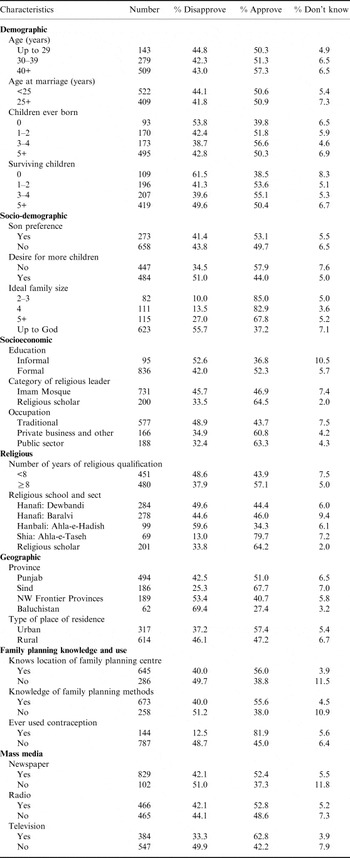
The outcome variable used in the study was contraceptive approval. The question was posed by asking the respondents about the attitude of the Islamic faith towards contraception. There were four possible responses: ‘Islam approves contraceptives’, ‘Islam approves contraceptives under certain conditions’, ‘Islam disapproves’ and ‘Don't know’. The first two categories clearly indicate contraceptive approval (51% of respondents), and the third indicates disapproval (43%). Of the 931 responses, only 58 (6%) were in the ‘Don't know’ category. Table 1 shows the responses of religious leaders on contraceptive approval by their demographic, socio-demographic, socioeconomic, religious, family planning and use, and mass media characteristics. The ‘Don't know’ category is included in the table in order to identify corresponding respondent characteristics. Following Islam et al. (Reference Islam, Padmadas and Smith2006), these cases were investigated more fully. Just over half of these 58 cases were aged 40 years or more, two-thirds of them had three or more surviving children, 71% were rural dwellers, 88% were formally educated and 93% were Imams at mosques. Islam et al. (Reference Islam, Padmadas and Smith2006) suggest that this kind of distribution indicates that the respondents who gave the ‘Don't know’ response were probably not openly approving contraceptives. Therefore, it was decided to consider the ‘Don't know’ response as being in the disapproval category for logistic regression analysis. In other words, the response variable is whether or not a religious leader made a positive statement that Islam approves contraception.
Results
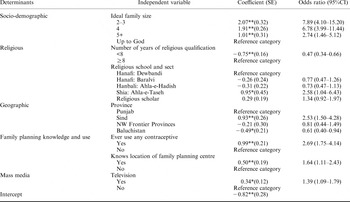
Table 2 displays the results of the final estimated logistic regression model. This model is the outcome of a lengthy modelling process. It includes all the covariates available that have a statistically significant association with the response variable; covariates not included did not display a statistically significant association once those listed in Table 2 were included in the model. In the estimation of the model, the design of the survey and the sampling weight were taken into account using the ‘svy’ command in STATA.
There was a strong association between ideal family size and the opinion expressed about contraception. Respondents whose ideal family size was four children or fewer were more than six times as likely to give a positive response than were respondents who expressed the view that the ideal family size was ‘Up to God’. Those respondents who expressed a numerical ideal family size, but larger than four, were in an intermediate position. Unsurprisingly, there was a strong association between the individual use of family planning by the religious leaders and their response. Those who had used contraception were nearly three times as likely to give a positive response about the attitude of Islam towards the practice as those who had not. In addition, knowledge of the availability of nearby family planning facilities was positively associated with the reported attitudes of Islam towards family planning: those who knew the location of a nearby family planning centre were 60% more likely to state that Islam approved of contraception than were those who did not know where a nearby family planning centre could be found. Religious leaders in the province of Sind, in the south of Pakistan, were the most likely to claim that Islam approves of family planning, and those in the province of Baluchistan were the least likely. Watching television was associated with a positive response, but whether a respondent listened to the radio or read a newspaper made little difference.
One of the most interesting results is that the opinion that Islam approves of contraception is more commonly expressed by religious leaders with more than eight years' religious education (and therefore arguably a more profound knowledge of the faith) than by religious leaders with a shorter period of religious training. The divide at eight years is not arbitrary. The normal time taken to learn by heart the holy book (Qu'ran) for a newly inducted scholar is about two or three years. It then takes a minimum of five or six years to learn Islamic doctrine through Hadith (the sayings of Muhammad). These two elements of religious education, therefore, typically occupy eight years, during which time scholars learn and understand the faith, and learn and memorize Hadith. But those who continue their religious education after eight years, not only memorize Hadith but also understand and interpret both Hadith and the Tafseer, or commentary on the Qu'ran. They are assumed not only to be the medium between man and God but also the first source of religious information for the people. Such men with the ability to interpret religious doctrine are known as ‘Fuqaha’, to distinguish them from those who have simply learned and memorized Hadith, who are called ‘Muhadith’. Our categorization of religious education into ‘Less to eight years’ and ‘Eight years or more’ is aimed at identifying which of these two groups each of the leaders in the sample falls. The results suggest that ‘Fuqaha’ leaders with deeper knowledge of the Islamic faith are twice as likely to say that Islam approves of contraception than are the ‘Muhadith’.
Responses of religious leaders on contraceptive approval, Pakistan, 1999–2000 (sample size 931)

Source: 1999–2000 Survey of Perception of Religious Leaders about Population Welfare in Pakistan.
Logistic regression estimates of the factors associated with contraceptive approval by religious leaders of Pakistan, 1999–2000 (sample size 931)

* 0.05>p≥0.01;
** p<0.01.
Source: 1999–2000 Survey of Perception of Religious Leaders about Population Welfare in Pakistan.
The religious sect a respondent was affiliated to was important. Respondents were allocated to one of the three main schools of Islamic thought, namely: Hanafi (Dewbandi, Baralvi), Hanbali (Ahla-e-Hadish) and Shia. Leaders belonging to the Shia school of Islamic thought were much more likely to state that Islam approved contraception. This greater approval of contraception among the Shia is a factor in the recent dramatic fall in fertility in Iran (Aghajanian, Reference Aghajanian1994; Aghajanian & Merhyar, Reference Aghajanian and Merhyar1999). In the case of Pakistan, Shia leaders express similar levels of approval, but Shia only form about 25% of the total Muslim population.
The possibility of trying to measure community-level effects using a multi-level model was considered. However, this was not done because of an inability to define and measure the appropriate ‘community’. The analysis is not of individuals resident in a particular locality, in which case the clusters used in the survey provide an obvious framework for measuring community-level effects. In the case of this study the individuals are religious leaders. The process by which religious leaders are assigned to localities in Pakistan suggests that the appropriate higher-level unit for the model is likely to be the institution (or perhaps the region) in which the leaders were trained. Unfortunately, this information was not available.
Discussion
These findings suggest that there are likely to be great variations in the degree of approval for family planning exhibited by religious leaders in Pakistan. For example, the final model predicts that a Shia leader with an ideal family size of four children, living in the Punjab, who watches television and who had more than eight years of religious education would have a probability of 91% of approving of family planning, even if he himself had never used it. Even if such a leader believed that God should decide the ideal number of children, he would still be more likely than not to state that Islam approves of contraception. Conversely, a non-Shia leader living in the same region, who watches television, but who has fewer than eight years of religious education and believes that God should decide the ideal number of children would only have a probability of 17% of a positive response.
Thus the opinions of Pakistan's religious leaders on the support of their faith for family planning diverge widely. Given the importance of the views of religious leaders in Pakistani society this is likely to have profound implications for the support for family planning expressed by the population as a whole, and for attitudes towards family planning policy. On the one hand, the involvement of supportive religious leaders (of whom there are many) in family planning programmes could increase their effectiveness in encouraging couples to translate their knowledge into practice. The involvement of male religious opinion makers in family planning programmes and policies will not change the male-dominated patriarchal norms of Pakistani culture, but this very nature of Pakistani society is likely to amplify the impact of the involvement of religious leaders, and lead to greater adoption of family planning, and a speedier fertility decline. Motivating those religious leaders who believe Islam to be favourably disposed to birth control to get involved in family planning programmes and policies is one of the key challenges for policy makers.
A greater challenge, though, is posed by those religious leaders who believe Islam to be opposed to family planning, for the deferential and patriarchal nature of Pakistani society will likewise amplify their influence on the behaviour of those whom they lead. In parts of the country where these leaders' influence is dominant, it seems likely that the family planning programme will struggle to gain traction. Rising to this challenge is likely to be difficult, especially using the normal methods of trying to get across the family planning message (for example, using information, education and communication strategies). It may be that less conventional approaches would be more successful. For example, one implication of this study is that encouraging a longer period of training and education among religious leaders may well reduce the proportion who are opposed to family planning, and be an effective means of promoting the use of birth control.
Acknowledgment
The authors are grateful to Mr Waqas Imran, Research Associate in the National Institute of Population Studies, Islamabad, Pakistan, for making available the data from the Survey of Perception of Religious Leaders about Population Welfare.