Introduction
The term consanguinity is derived from the Latin consanguineus – literally, of the same blood, and in biology and medicine a consanguineous marriage is usually defined as a union between a couple who are related as second cousins or closer (Bittles, Reference Bittles2001). It has been conservatively estimated that 10.4% of the global population match this definition, with marriages between first cousins the most prevalent form of intra-familial union (Bittles & Black, Reference Bittles and Black2010; Hamamy et al., Reference Hamamy, Antonarakis, Cavalli-Sforza, Temtamy, Romeo and ten Kate2011). In genetic terms, the progeny of a first cousin marriage are predicted to inherit identical genes from a common ancestor at 1/16 of loci, i.e. a coefficient of inbreeding (F) = 0.0625, while for second cousin progeny F = 0.0156 and for children born to uncle–niece or double first cousin couples F = 0.125. At the population level, total consanguinity is expressed as the mean coefficient of inbreeding (α), which is calculated by summing the proportion of marriages reported at each specific level of consanguinity (Bittles, Reference Bittles2012).
Globally, the prevalence and types of consanguineous marriage contracted can alter quite markedly (www.consang.net), variously reflecting the prevailing social, cultural and religious attitudes towards close kin unions in different societies (Bittles, Reference Bittles2012). During the course of the late 19th and early 20th centuries there was a marked decline in consanguinity in Western countries (Bittles, Reference Bittles2012), and decreases have recently been observed in societies with strong traditions of intra-familial marriage, e.g. Arab populations in Bahrain (Al-Arrayed & Hamamy, Reference Al-Arrayed and Hamamy2012); Oman (Islam, Reference Islam2012); the Palestinian Territories (Sirdah, Reference Sirdah2014); Jordan (Islam et al., Reference Islam, Ababneh and Khan2018) and Israel (Sharkia et al., Reference Sharkia, Mahajnah, Athamny, Khatib, Sheikh-Muhammad and Zalan2016). However, this trend is not obvious in Qatar (Al Ali, Reference Al Ali2005; Bener & Alali, Reference Bener and Alali2006; Harkness & Khaled, Reference Harkness and Khaled2014) and, as recently reported in Pakistan, in areas of major civil unrest consanguineous marriage has increased in prevalence due to its perceived advantages in terms of family and personal security (Sthanadar et al., Reference Sthanadar, Bittles and Zahid2014, Reference Sthanadar, Bittles and Zahid2016).
India has a land area of 3.287 million km2, a current population rapidly approaching 1.4 billion, 22 officially recognized languages, plus English, and many thousands of ethnic, regional and religious sub-populations identified on cultural, anthropological and more recently genetic bases (Bhasin et al., Reference Bhasin, Walter and Danker-Hopfe1992; Singh, Reference Singh1993; Gadgil et al., Reference Gadgil, Joshi, Manoharan, Patil, Prasad, Balasubramanian and Appaji Rao1998; Bittles, Reference Bittles2002; Reich et al., Reference Reich, Thangaraj, Patterson, Price and Singh2009; Moorjani et al., Reference Moorjani, Thangaraj, Patterson, Lipson, Loh and Govindaraju2013; Nakatsuka et al., Reference Nakatsuka, Moorjani, Rai, Sarkar, Tandon and Patterson2017). The study of consanguinity in India is necessarily highly complex given the size and diversity of the population, and it is exacerbated by the strongly divergent attitudes towards consanguineous marriage in the majority Hindu population.
Although caste (jati) endogamy is the rule across all Hindu communities, following the Manusmriti exogamy is the norm at sub-caste (gotra) level among a very large proportion of the Indo-European peoples of North India, and there is a strict prohibition (sapinda) on marriage between two persons related through a common male ancestor which extends back seven generations on the male side and five generations on the female side (Kapadia, Reference Kapadia1958; Sanghvi, Reference Sanghvi1966a). By comparison, according to the Dharmasutra, in Dravidian South India and to a lesser extent West India there is a long tradition of intra-familial marriage dating back some 2000 years (Sastri, Reference Sastri1955; Kapadia, Reference Kapadia1958), with cross-cousin marriage recognized in the Hindu Marriage Act of 1955 and the legality of uncle–niece unions confirmed in the Hindu Code Bill of 1984 (Bittles et al., Reference Bittles, Mason, Greene and Appaji Rao1991; Appaji Rao et al., Reference Appaji Rao, Savithri, Bittles, Vanden Driesen and Nandan2002; Uberoi, Reference Uberoi and Ochiai2003).
The first Census of India was conducted in 1871, but the collection of data on the prevalence of consanguineous marriages has been a much more recent innovation, initially conducted by anthropologists and latterly by geneticists, clinicians and demographers. Given the diverse distribution patterns of consanguinity across the country, a large majority of the early studies were undertaken in states where consanguineous marriage was known to be favoured, e.g. the Dravidian populations of South India, in Andhra Pradesh (Dronamraju & Meera Khan, Reference Dronamraju and Meera Khan1960; Sanghvi, Reference Sanghvi1966b), Kerala (Ali, Reference Ali1968) and Tamil Nadu (Centerwall et al., Reference Centerwall, Savarinathan, Mohan, Booshanam and Zachariah1969; Rao & Inbaraj, Reference Rao and Inbaraj1977), and in Maharashtra in West India (Sanghvi et al., Reference Sanghvi, Varde and Master1956). But in many of these investigations the information collected was essentially local and small-scale in nature.
An important impetus to more representative studies was provided by the internationally renowned population geneticist JBS Haldane, who resigned from University College London to take up a Research Professorship in the Indian Statistical Institute in Kolkata in 1957. Haldane became an Indian citizen in 1960 (Guha, Reference Guha2017) and, on the basis of the initially reported studies, he predicted that consanguineous marriages would significantly decline in prevalence in India within a decade. Therefore he recommended that detailed studies on consanguineous marriage in Indian populations should be undertaken as a matter of urgency, preferably by researchers well versed in the traditions and customs of each individual study community and in their local vernacular (Haldane, Reference Haldane and Geerts1965).
In the 1961 Census of India, data on consanguineous marriage had been collected in 587 villages located in eighteen of the then 25 States and Territories (Roychoudhury, Reference Roychoudhury1976). Once again the overall sample size was small, and no data were obtained for seven states, mainly in the north-east of the country. The extent to which the influx of rural couples into urban centres might have influenced the findings in states with rapidly growing populations also was unclear (Devi et al., Reference Devi, Appaji Rao and Bittles1982).
To overcome the basic shortcomings of the 1961 Census, and in recognition that non-communicable disorders were becoming an increasingly important component of the national disease profile, as part of the first National Family Health Survey (NFHS-1) conducted in 1992–93 specific questions were included on the prevalence and types of consanguineous marriage contracted. These questions were omitted in NFHS-2 (1998–99) and NFHS-3 (2005–06) but, following representations to the Government of India by the present authors PS and AHB, the questions on consanguineous marriage were reinstated for NFHS-4 undertaken in 2015–16, with data also collected from six numerically small Union Territories, Andaman & Nicobar Islands, Chandigarh, Dadra & Nagar Haveli, Daman & Diu, Lakshadweep and Puducherry.
Although the coverage of the population sampled was greater in NFHS-4 than NFHS-1, the questions in both surveys on the biological relationships between spouses were essentially identical: NFHS-1 (Chapter 4 Nuptiality, section 4.5 Marriage between relatives) and NFHS-4 (Chapter 6 Other proximate determinants of fertility, Section 6.3 Consanguineous marriages). On this basis it is possible to ascertain, with due caution given the size of the national population, whether there has been a significant change in the prevalence and profiles of consanguineous marriages in India during the course of the last generation.
Methods
The present investigation was based on a secondary analysis of the data collected in NFHS-1 (1992–93) and NFHS-4 (2015–16). The NFHS are nationally representative, cross-sectional, demographic and health surveys similar in design to the general format adopted for Demographic and Health Surveys (DHS) worldwide. For the study married women aged 15–49 years of age were recruited, with 89,668 women interviewed in NFHS-1 and 529,872 in NHFS-4.
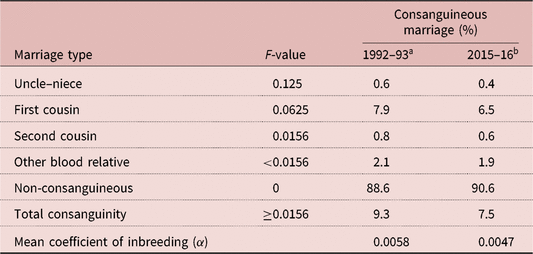
Five consanguinity categories were identified from the information collected: uncle–niece (F = 0.125), first cousin (F = 0.0625), second cousin (F = 0.0156) ‘other blood relative’ (F < 0.0156) and non-consanguineous (F = 0), with the latter including couples related as ‘brother-in-law’ and ‘other non-blood relative’. According to established convention (Bittles, Reference Bittles2001; Hamamy et al., Reference Hamamy, Antonarakis, Cavalli-Sforza, Temtamy, Romeo and ten Kate2011; Hamamy, Reference Hamamy2012; Blencowe et al., Reference Blencowe, Moorthie, Petrou, Hamamy, Povey and Bittles2018), consanguinity was defined as marriages between second cousins or closer (F ≥ 0.0156).
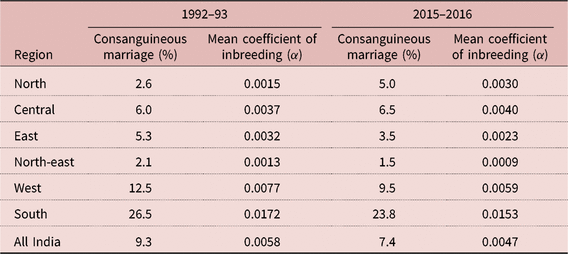
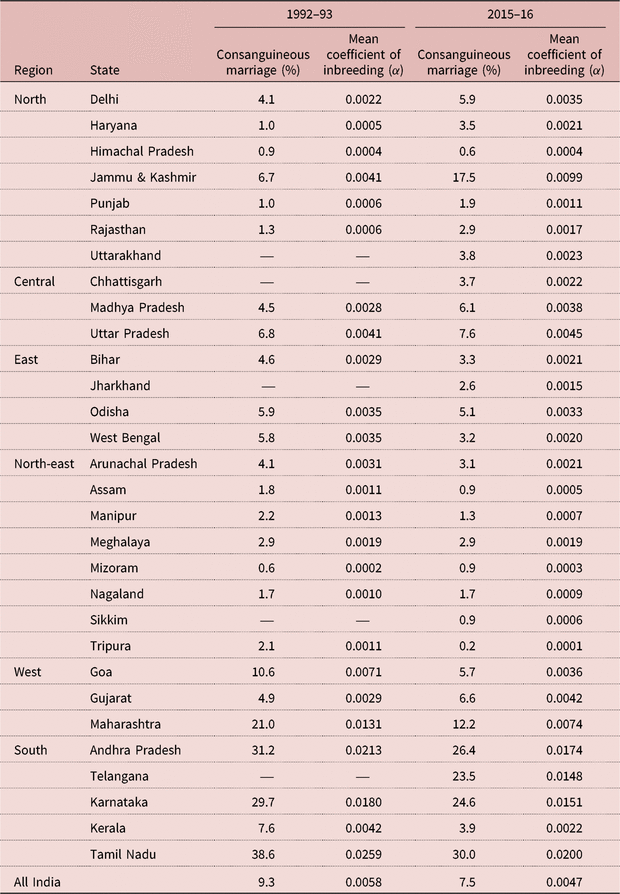
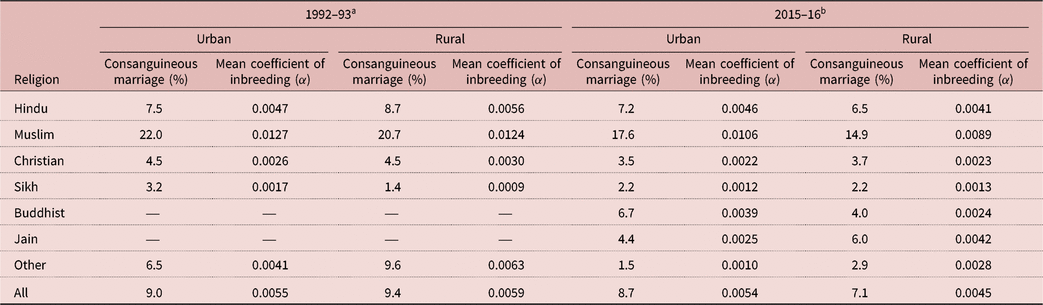
Descriptive statistical methods were applied to determine the overall prevalence and types of consanguineous marriage reported in 1992–93 and 2015–16 at national (Table 1), regional (Table 2) and state levels (Table 3). In addition, at each of the two time-points, comparisons of prevalence rates for specific categories of consanguineous marriage were made for rural/urban residence and religion (Table 4).


Consanguineous marriages (%) and mean coefficients of inbreeding (α) by state, India 1992–93 and 2015–16

Consanguineous marriages (%) and mean coefficients of inbreeding (α), cross-classified by religion and residence, all India 1992–93 and 2015–16

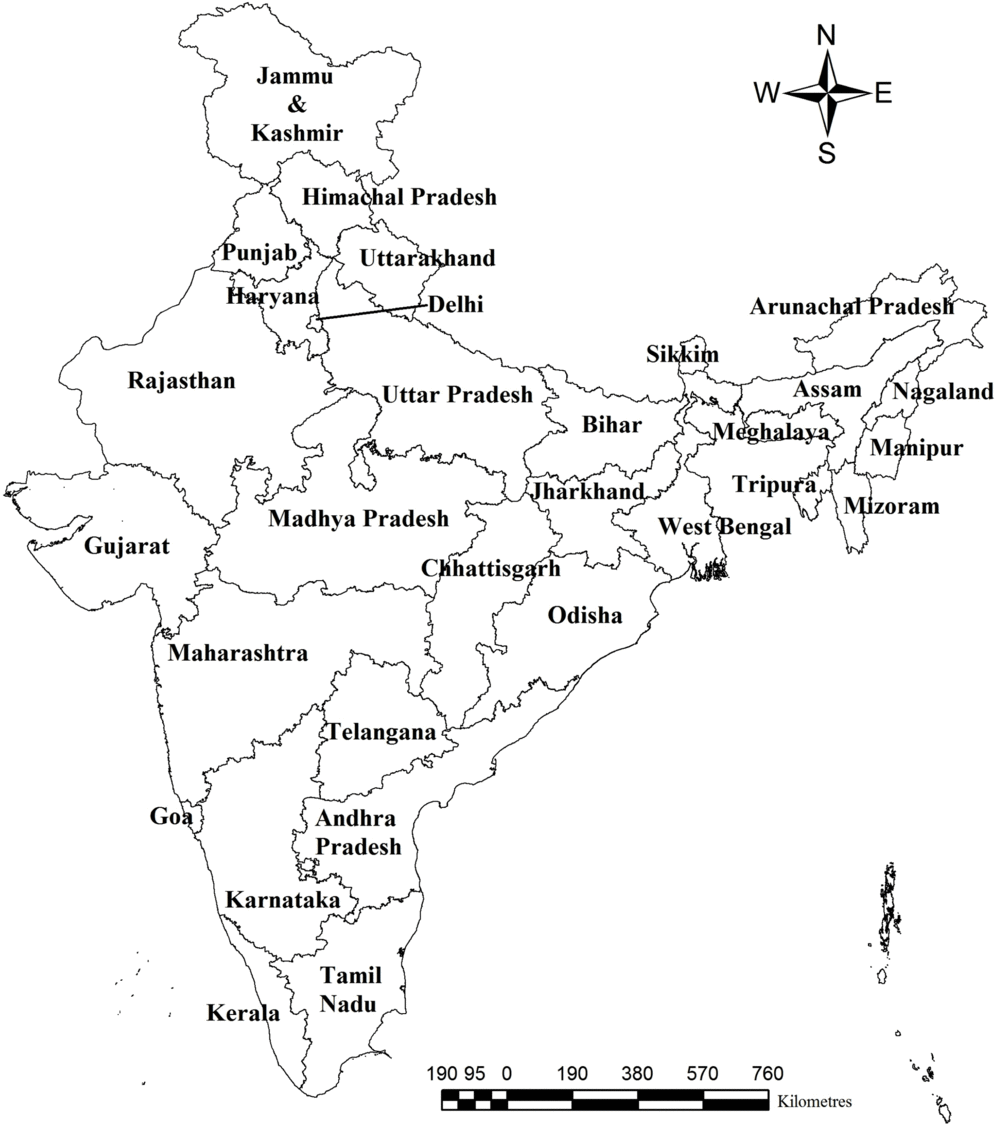
A minor issue in the comparison between 1992–93 and 2015–16 resulted from the re-organization and adjustment of some state boundaries, with the creation of four new states: Chhattisgarh, formerly part of Madhya Pradesh; Jharkhand, formerly part of Bihar; Telangana, formerly part of Andhra Pradesh; and Uttarakhand, formerly part of Uttar Pradesh. The Government of Orissa also changed its name to Odisha (Figure 1). A second minor difference between the data collection modes of NFHS-1 and NFHS-4 was the separate presentation of data for the Buddhist and Jain communities in NFHS-4. Data for the numerically small Zoroastrian/Parsi and Jewish communities and those not professing a religion were combined as ‘Other’.
Map of India by state.

Results
At the national level the mean prevalence of consanguineous marriage (F ≥ 0.0156) declined from 9.3% in NFHS-1 to 7.5% in NFHS-4, and the equivalent mean coefficients of inbreeding decreased from α = 0.0058 to α = 0.0047 (Table 1). Minor differences were observed with respect to the specific levels of consanguineous marriage contracted. Thus, comparing NFHS-1 and NFHS-4, uncle–niece unions declined in prevalence from 0.6% to 0.4%, first cousins from 7.9% to 6.5% and second cousins from 0.8% to 0.6%. Calculated as mean coefficients of inbreeding (α), this translates into a 19.0% decline in the overall degree of consanguinity from NFHS-1 to NFHS-4.
The picture was, however, mixed at regional level with decreases in percentage consanguinity in East, North-east, West and South India, but increases in North and Central India (Table 2). The increases in consanguinity in North and Central India may largely reflect proportionally higher growth in the overall numbers of the Muslim population in these regions, where consanguinity remains proscribed in the Hindu majority.
The pattern of change was quite consistent within each region, with the notable exception of West India where there was a very marked reduction in mean consanguinity in Maharashtra, from 21.0% (α = 0.0131) to 12.2% (α = 0.0074), but an increase in neighbouring Gujarat, from 4.9% (α = 0.0029) to 6.6% (α = 0.0042) (Table 3). Also, in West India, consanguineous marriage significantly declined in Goa, from 10.6% (α = 0.0071) to 5.7% (α = 0.0036), which paralleled the reduction in the South Indian state of Kerala, from 7.6% (α = 0.0042) to 3.9% (α = 0.0022). Within the Indian context, each of these states have comparatively small populations with sizeable Christian minorities, and high overall levels of male and female education.
The apparent marked increase in the prevalence of consanguinity reported in Jammu & Kashmir, from 6.7% (α = 0.0041) in NFHS-1 to 17.5% (α = 0.0099) in NFHS-4 (Table 3), is at least in part a sampling artefact. Because of civil unrest the data collection conducted in 1992–93 was restricted to Jammu only, which has a Hindu majority, whereas in 2015–16 both Jammu and Kashmir, the latter with a large Muslim majority, were jointly sampled.
The potential role of religion as a determining factor in the prevalence and preferred types of consanguineous marriage was compared in NFHS-1 and NFHS-4, with urban and rural residents separately examined (Table 4). Although consanguineous marriages, including uncle–niece unions (F = 0.125), were most prevalent in the predominantly Hindu states of South India, in terms of religion the Muslim population had by far the highest mean rates of consanguinity in both 1992–93 (urban 22.0% [α = 0.0127], rural 20.7% [α = 0.0124]) and 2015–2016 (urban 17.6% [α = 0.0106], rural 14.9% [α = 0.0089]). The comparability between the levels of consanguineous marriage in urban and rural residents across India was unexpected, as was the more marked reduction in consanguinity among rural than urban residents between 1992–93 and 2015–16.
Discussion
More than two generations have elapsed since Haldane predicted the rapid decline of consanguineous marriage in India. Clearly, despite the significant overall decrease in the prevalence of consanguinity since the 1990s, intra-familial marriage remains popular in a substantial number of states, especially Andhra Pradesh, Karnataka, Tamil Nadu and Telangana in Dravidian South India, with a combined current population of some 280 million (Table 3).
Improved educational opportunities for males and females throughout India have enhanced skilled employment opportunities. In turn, this has encouraged internal migration to major high-tech centres in the South, such as Bangalore and Hyderabad, from regions where consanguinity traditionally has been proscribed. The increasing incidence of ‘love marriages’ and the concomitant decline in parentally arranged marital unions might also be expected to exert a negative influence on close kin unions. But to date no clear pattern has emerged of the direction or extent to which the prevalence of consanguinity has been affected by this rapidly developing social change (Allendorf & Pandian, Reference Allendorf and Pandian2016).
With ongoing declines in family sizes reducing the numbers of potential marriageable relatives (Barakat & Basten Reference Barakat and Basten2014), especially in terms of uncle–niece marriages (Devi et al., Reference Devi, Appaji Rao and Bittles1982), it seems highly probable that consanguineous marriage will continue to reduce in prevalence in India. Other socio-demographic factors that may significantly drive this trend include increasing age at marriage, female education and family wealth, with Scheduled Caste and Scheduled Tribe status additional potential variables. However, in deference to deep-seated cultural traditions, the overall rate of inter-generational change in intra-familial marriage may be slower than expected – a pattern that has been reported in other Asian countries with high levels of consanguinity and intra-community endogamy, such as Qatar (Harkness & Khaled, Reference Harkness and Khaled2014) and Iran (Hosseini-Chavoshi et al., Reference Hosseini-Chavoshi, Abbasi-Shavazi and Bittles2014).
In health terms, parental consanguinity would be expected to influence the transition that has occurred in India from a predominantly communicable to a non-communicable disease profile (Dandona et al., Reference Dandona, Dandona, Kumar, Shukla, Paul and Balakrishnan2016), since close kin marriage could affect the expression of causative genes both for common conditions such as cardiovascular disease (Geldsetzer et al., Reference Geldsetzer, Manne-Goehler, Theilmann, Davies, Awasthi and Danaei2018) and rare inherited disorders that may be unique to specific communities (Nakatsuka et al., Reference Nakatsuka, Moorjani, Rai, Sarkar, Tandon and Patterson2017). As in other countries, in India genetic education programmes are being developed and introduced to reduce the impact of inherited disorders on the overall burden of disease. Especially in families with a recognized history of recessive genetic disease, it is probable that the provision of premarital genetic counselling and testing will result in increased avoidance of close kin marriages. But the adoption of such programmes may initially be restricted to metropolitan centres, with the majority rural population being little affected.
A final point that merits consideration is the influence of the large and growing South Asian diaspora now resident in Western Europe and North America, where consanguinity generally is avoided and in some US states is a criminal offence (Bittles, Reference Bittles2012). Although many South Asian emigrant families continue to arrange transnational marriages via communities in their country of origin, it appears that their choice of potential partners is increasingly influenced by Western non-consanguineous marital norms. A significant decline in consanguineous marriage has been reported in Pakistani communities in Sweden (Grjibovski et al., Reference Grjibovski, Magnus and Stoltenberg2009) and, more recently the UK (Small et al., Reference Small, Bittles, Petherick and Wright2017), with a similar trend probable among communities in the Indian diaspora in which consanguinity traditionally has been favoured.
Acknowledgment
The authors gratefully acknowledge the generous co-operation of Professor Chander Shekhar, International Institute for Population Sciences (IIPS), for approving the contribution of her PhD scholar (NK) as lead author of the present paper.
Funding
This research received no specific grant from any funding agency, commercial entity or nor-for-profit organization.
Conflicts of Interest
The authors have no conflicts of interest to declare.
Ethical Approval
The authors assert that all procedures contributing to this work comply with the ethical standards of the relevant national and institutional committees in human experimentation and with the Helsinki Declaration of 1978, as revised in 2008.