Introduction
Care needs of patients with AD increase progressively and impact on caregivers’ life (Truzzi et al., Reference Truzzi, Valente, Ulstein, Engelhardt, Laks and Engedal2012). Caregivers often report suffering from burden, which is frequently associated with depression, anxiety, higher physical morbidity, and mortality (Truzzi et al., Reference Truzzi, Valente, Ulstein, Engelhardt, Laks and Engedal2012). Caregiver burden is a multidimensional response to physical, psychological, emotional, social, and financial stressors associated with the caregiving experience (Zarit et al., Reference Zarit, Reever and Bach-Peterson1980). Understanding the particular elements of the disease and the caregiving conditions that are associated with caregiver burden can be helpful in predicting the level of burden experienced and in developing individual caregivers’ coping strategies (Park et al., Reference Park, Sung, Kim, Kim and Lee2015). To analyze caregiver burden, we adopted the stress process model that focus on the multidimensional factors of the determinants of caregiver burden and categorized them as contextual variables (sociodemographic factors of patients and caregivers). Primary stressors are related to patient symptoms or disease progression, while secondary stressors include difficulties arising from the caregiving-related situation.
The determinants of caregiver burden have been mostly correlated with patients’ factors such as neuropsychiatric symptoms (Truzzi et al., Reference Truzzi, Valente, Ulstein, Engelhardt, Laks and Engedal2012; Park et al., Reference Park, Sung, Kim, Kim and Lee2015). In particular, depression, apathy/indifference, anxiety, and agitation/aggression are more frequently reported to be associated with an increased risk of burden than cognitive and functional deficits (Truzzi et al., Reference Truzzi, Valente, Ulstein, Engelhardt, Laks and Engedal2012; Park et al., Reference Park, Sung, Kim, Kim and Lee2015). Likewise, neuropsychiatric symptoms have been found to influence the decision of family caregivers in terms of whether to institutionalize the patients (Truzzi et al., Reference Truzzi2013). Maybe it seems more difficult to caregivers to accept patients’ neuropsychiatric symptoms, because those symptoms involve continuous monitoring and coping skills (Truzzi et al., Reference Truzzi, Valente, Ulstein, Engelhardt, Laks and Engedal2012; Park et al., Reference Park, Sung, Kim, Kim and Lee2015). Another significant predictor of caregiver burden is impairment in activities of daily living (ADL), which is a key clinical feature of AD (Park et al., Reference Park, Sung, Kim, Kim and Lee2015). Since ADL impairment leads to early loss of independence and of the ability to be an active member of society, it shifts many daily responsibilities to caregivers and, therefore, increases their burden (van der Lee et al., Reference van der Lee, Bakker, Duivenvoorden and Dröes2014). Also, caregivers’ aspects such as gender and depression have been studied to identify possible relations to caregiver burden. There is a general consensus that female caregivers reported higher levels of burden than male caregivers (Turró-Garriga et al., Reference Turró-Garriga, Soler-Cors, Garre-Olmo, López-Pousa, Vilalta-Franch and Monserrat-Vila2008; Conde-Sala et al., Reference Conde-Sala, Garre-Olmo, Turró-Garriga, Vilalta-Franch and López-Pousa2010). For cultural reasons, societies transmit to women the caregiver role, and single daughters are more predisposed to care for the patient. It is probably because of their emotional and/or financial dependence, co-residing with the patient and not yet having started their own family (Moraes and Silva, Reference Moraes and Silva2009; Santos et al., Reference Santos, Sousa, Ganem, Silva and Dourado2013). In general, current Brazilian and Spanish studies indicate that the main predictors of burden were presence of more neuropsychiatric symptoms, female gender, more time spent caring for the patient, being a family caregiver and living with patient (Moraes and Silva, Reference Moraes and Silva2009; Truzzi et al., Reference Truzzi, Valente, Ulstein, Engelhardt, Laks and Engedal2012).
Even though the determinants of caregiver burden are well known, cultural background and attitudes toward the disease may also partially determine the caregivers’ investment in the care and, thus, increase burden (Moraes and Silva, Reference Moraes and Silva2009; Santos et al., Reference Santos, Sousa, Ganem, Silva and Dourado2013). Cultural aspects can be analyzed in transcultural studies and in studies which assess sociodemographic and clinical characteristics of patients and caregivers. Transcultural studies show that cultural aspects such as family structure, availability of resources and institutional support to the disease, play a significant role on the levels of burden in caregivers. For example, Xiao et al. (Reference Xiao, Wang, He, De Bellis, Verbeeck and Kyriazopoulos2014) verified the differences of burden among caregivers of patients with AD in China and Australia. They found that the participants of the Australian cohort, composed of more female caregivers and spousal caregivers, showed a relatively higher proportion of burden than those in the Chinese cohort. Another study by Knight et al. (Reference Knight, Silverstein, McCallum and Fox2000) showed that African American caregivers reported low levels of burden, but equal levels of depression and anxiety compared with non-African American caregivers.
Transcultural studies regarding the comparison of levels of burden in caregivers of patients with AD from Europe and Latin America are rare. To our knowledge, this is the first transcultural study that aimed at comparing the levels of burden and associated factors among caregivers of patients with AD between Brazil and Spain. We hypothesized that there would be differences between levels of caregiver burden and associated factors in Brazil and Spain, and these differences would not only be related to patient characteristics. The present study aims to investigate the differentiating factors associated with burden in Brazilian and Spanish caregivers of patients with AD.
Methods
Study design
The design was an observational, cross-sectional, and analytic study.
Participants and setting
The data came from two consecutive and convenience samples of home-dwelling outpatients with dementia and their caregivers from Brazil and Spain. The Brazilian sample consisted of 128 outpatients treated at the Center for Alzheimer's Disease of the Federal University of Rio de Janeiro. The Spanish sample consisted of 146 patients recruited from the Memory and Dementia Assessment Unit of the Santa Caterina Hospital in Girona. In dementia units, psychiatrists in Brazil and neurologists in Spain, selected eligible patients according to the inclusion criteria and then determined their stage of dementia. The measurements of sociodemographic and clinical data were carried out by psychologists of the two centers.
The participants were diagnosed with possible or probable AD according to Diagnostic and Statistical Manual of Mental Disorders, Fourth Edition (DSM-IV-TR) (American Psychiatric Association, 2000) and National Institute of Neurological and Communicative Diseases and Stroke/Alzheimer's Disease and Related Disorders Association (NINCDS-ADRDA) criteria (McKhann et al., Reference McKhann, Drachman, Folstein, Katzman, Price and Stadlan1984). Patients were excluded if they presented vascular or traumatic events, alcohol or substance dependency or abuse, and if they had severe communication problems that prevented them from responding adequately to the assessment instruments.
The main caregiver was defined as the person who was responsible for helping the patient with daily living activities, both basic and instrumental, as well as for supervising him or her at home. We excluded caregivers with a reported history of psychiatric or cognitive disorders.
The interviews and questionnaires were administered to patients and caregivers separately and independently. The patients had their cognition assessed. The caregivers provided information about the patients (including sociodemographics, the ability to perform ADL, neuropsychiatric symptoms, and dementia severity) and had caregiver burden assessed.
A full description of the study was given to the patients and their caregivers. The study was approved by the Ethics Committee in Brazil and Spain. All the patients and their caregivers gave their written consent to participate in the study.
Measures
The sociodemographic characteristics of the patient and caregiver (age, gender, marital status, schooling, place of residence, family relationship, whether they lived together, and formal labor activities) were recorded by means of a semi-structured interview. We used the Brazilian and Spanish adaptation of all clinical instruments.
Caregiver Measurements
Burden:
The burden was measured with the ZBI. The ZBI consists of 22 items. The caregiver assesses the impact of the illness on his or her life by indicating how often he or she experiences a particular feeling: never (0), rarely (1), sometimes (2), quite frequently (3) or nearly always (4). The total score ranges from 0 to 88 (Zarit et al., Reference Zarit, Reever and Bach-Peterson1980).
Patient Measurements
Cognition:
The MMSE was used to assess global cognitive function. The MMSE includes tests of orientation, registration, short-term memory, language use, comprehension, and basic motor skills. The total score ranges from 0 to 30 (Folstein et al., Reference Folstein, Folstein and McHugh1975).
Dementia severity:
We also applied the CDR to measure severity of dementia. The stages range from 0 (no dementia) to 3 (severe dementia) according to the degree of cognitive, behavioral, and ADLs impairment (Morris, Reference Morris1993).
Neuropsychiatric symptoms:
The neuropsychiatric symptoms were assessed by the NPI. The NPI evaluates the presence of delusions, hallucinations, depression, anxiety, agitation/aggression, euphoria, disinhibition, irritability/lability, apathy/indifference, motor disorders, sleep disorders, and eating disorders. Each item is rated in relation to the frequency (1 [absent] to 4 [frequently] and intensity 1 [mild] to 3 [severe]). The total score range from 0 to 144 points (Cummings et al., Reference Cummings, Mega, Gray, Rosemberg-Thompson, Carusi and Gornbein1994).
Activities of daily living:
In Brazil, the ability to function in ADL was assessed by the FAQ. The FAQ is a caregiver-reported inventory with 10-item scale that assesses instrumental functional capacities. The ratings for each item ranges from 0 (normal) to 3 (dependent), with a total of 30 points (Pfeffer et al., Reference Pfeffer, Kurosaki, Harrah, Chance and Filos1982). In Spain, to assess functionality the DAD was used. The DAD is a caregiver-reported inventory that assesses a wide range of ADL: basic and instrumental. We only used the scores of instrumental functional capacities to compare both samples. It comprises 23 items and the scores range from 23 to 46 (Gélinas et al., Reference Gélinas, Gauthier, McIntyre and Gauthier1999).
Statistical methods
All variables were inspected for normality before analysis. Mann–Whitney U and χ2 Test were performed as an initial comparison of Brazilian and Spanish caregivers and patients’ sociodemographic and clinical characteristics.
Binary logistic regression was calculated to identify the factors associated with the differences between Brazilian and Spanish caregivers and patients. Logistic regression was conducted using the forward stepwise method.
The analysis of relationships between the scores of caregivers on the ZBI and patients and caregivers’ sociodemographic and clinical characteristics was conducted using Mann–Whitney U and Kruskal–Wallis Test. Linear equations were used to compare FAQ and DAD Instrumental scores:
 $\scriptstyle[ {Y = \scriptstyle\frac{{{\rm{SDy}}}}{{{\rm{SDx}}}}\ .( {X - \bar X} ) + \bar Y}]$
.
Spearman's correlations also explored the relationship between ZBI and patients and caregivers age, MMSE, FAQ, DAD, and NPI scores. Spearman's r coefficient was interpreted as follows: negligible, <0.20; weak, 0.20–0.34; moderate, 0.35–0.50; and strong, >0.50.
Four multivariate linear regression analyses were completed to identify the associated factors with the differences of burden between Brazilian and Spanish caregivers, to verify the association between burden and NPI domains, to identify which patients and caregivers’ factors and NPI domains were associated with burden according to gender of caregivers.
Linear regressions were conducted using the Enter method, and only significant variables in bivariate analyses were included. In the linear regressions analyses, the coefficients of contribution for each variable were calculated by: beta coefficient × the coefficient of correlation with the dependent variable.
The statistical analysis was performed using the Statistical Package for Social Sciences (IBM Corporation, Armonk, NY) for Windows v. 22.0, with a significance level that was equal to or less than 0.05 and confidence intervals (CI) at 95%.
Results
Sample description
We performed data analysis with homogeneous samples. Patients did not differ in MMSE and CDR scores, and in caregivers’ sociodemographic characteristics (gender, age, schooling, and family relationship).
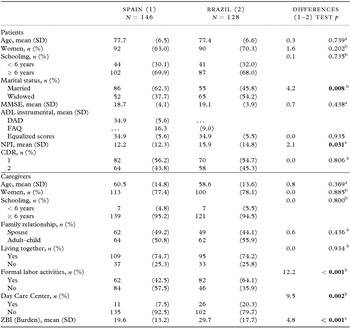
The characteristics (age, gender, schooling, living with patient, formal labor activities, Day Care Center, cognitive status [MMSE], functionality [DAD and FAQ], neuropsychiatric symptoms [NPI], severity of dementia [CDR], and burden [ZBI]) of the caregivers and the patients from Brazil and Spain are shown in Table 1.
Socio-demographic and clinical data of patients and caregivers

a Mann–Whitney U test; b Pearson χ2 test.
MMSE, Mini-Mental State Examination; DAD, disability assessment for dementia; FAQ, functional activities questionnaire; NPI, neuropsychiatric inventory; ZBI, zarit burden interview.
Most caregivers who completed ZBI in Brazil were female (78.1%), with mean age of 58.6 ± 13.6 years, and ≥ six years of schooling (94.5%). The majority of Brazilian patients were females (70.3%), with mean age of 77.7 ± 6.8 years and ≥ six years of schooling (68.0%). Spanish caregivers were also predominantly female (77.4%), with a mean age of 60.5 ± 14.8 years and ≥ six years of schooling (95.2%). Most of the Spanish patients were females (63.0%), with mean age of 77.7 ± 6.5 years, and ≥ six years of schooling (69.9%). There were significant differences in caregivers and patients’ variables from Brazil and Spain in ZBI (p < 0.001), NPI (p = 0.031), patients’ marital status (p = 0.008), formal labor activities (p < 0.001) and participation in Day Care Center (p = 0.002) (Table 1).
We calculated binary logistic regression to verify the factors associated with the differences between Brazilian and Spanish caregivers and patients. Brazilian caregivers sample was characterized for high levels of burden (OR = 1.05, 95% CI [1.03–1.07], p < 0.001), more spouses (OR = 4.11, 95% CI [1.50–11.25], p = 0.006) and more caregivers who worked (OR = 3.78, 95% CI [1.72–8.31], p = 0.001).
Burden and factors of patients and caregivers
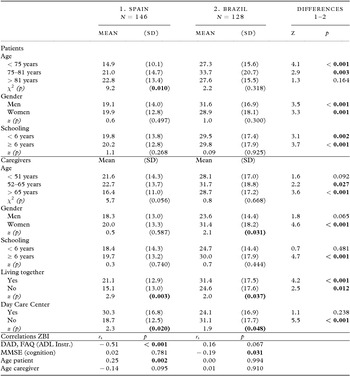
The differences and correlations between ZBI and caregivers and patients’ variables from Brazil and Spain are provided in Table 2. The majority of Brazilian caregivers presented with high levels of burden, and women showed higher burden than men (p = 0.031). In both samples, living with the patient was associated with a high level of burden (p = 0.003/p = 0.037). However, some findings were conflicting: attending Day Care Center in Brazil was related to low burden (p = 0.048), while, in Spain, it was associated with high burden (p = 0.020). Functional deficits were correlated to high levels of burden in the Spanish sample (p < 0.001), but not in the Brazilian one (p = 0.067). Likewise, we found a correlation between high levels of burden and cognitive impairment in Brazil (p = 0.031), but, in Spain, we did not find the same (p = 0.781).
Zarit burden interview and factors

z = Mann–Whitney U test; χ2 = Kruskal–Wallis; rs = Spearman coefficient. MMSE, Mini-Mental State Examination; DAD, Disability Assessment for Dementia; FAQ, Functional Activities Questionnaire; NPI, Neuropsychiatric Inventory; ZBI, Zarit Burden Interview.
We verified that there was a difference between the formal labor activities and participation in Day Care Center activities according to caregivers’ gender in Brazil and Spain. More females worked (Brazil = 65.0% vs. Spain= 41.6%; χ2 = 11.6, p = 0.001) and attended Day Care Center (Brazil = 22.0% vs. Spain = 7.1%; χ2 = 9.7, p = 0.002) in Brazil.
Specifically, Brazilian female caregivers who worked (Brazil = 30.8 [18.5] vs. Spain = 18.6 [12.6]; z = 3.6, p < 0.001) and who did not attend Day Care Center (Brazil = 33.0 [18.1] vs. Spain = 19.2 [12.9]; z = 5.2, p < 0.001) presented high levels of burden than Spanish female caregivers.
Burden and neuropsychiatric symptoms
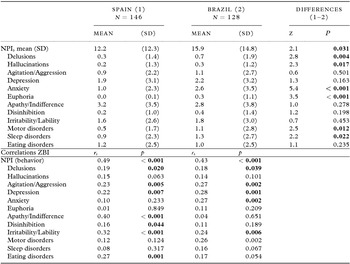
The differences and correlations between ZBI and NPI from Brazil and Spain are summarized in Table 3. In both samples, the presence of neuropsychiatric symptoms was related to high levels of burden (p < 0.001). However, in the Brazilian sample, the most relevant symptoms were depression (p = 0.001), anxiety (p = 0.002), and agitation/aggression (p = 0.002), whereas in the Spanish one, apathy/indifference (p < 0.001), irritability/lability (p <0.001) and eating disorders (p = 0.001) were the major relevant symptoms.
Neuropsychiatric symptoms and burden

z = Mann–Whitney U test; rs = Spearman coefficient.
NPI, neuropsychiatric inventory; ZBI, zarit burden interview.
Multivariate linear regression analysis. Burden and factors
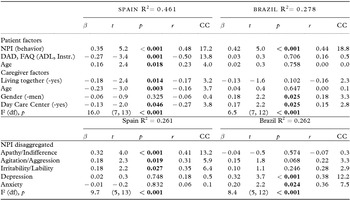
High levels of burden were associated with more neuropsychiatric symptoms in both countries (p < 0.001). Brazilian sample reported high levels of burden when caregivers were female (p = 0.025) and did not attend Day Care Center (p = 0.025). Other aspects in Spain were more relevant, such as living with patient (p = 0.014), being a younger caregiver (p = 0.003) and attending Day Care Center (p = 0.046).
We found different neuropsychiatric symptoms to explain high levels of burden. Depression (p < 0.001) and anxiety (p = 0.024) were significant predictors in Brazil, while apathy/indifference (p < 0.001), agitation/aggression (p = 0.019) and irritability/lability (p = 0.027) emerged as significant predictors in Spain (Table 4).
Multivariate linear regression analysis. Burden (ZBI) and factors

R2 = Determination coefficient; β = standardized beta coefficient; t = Students t, test; r = Pearson correlation (zero-order); CC = coefficient of contribution (%), [(β. r) x 100].
DAD, disability assessment for dementia; FAQ, functional activities questionnaire; NPI, neuropsychiatric inventory; ZBI, zarit burden interview.
Burden and factors according to caregivers’ gender
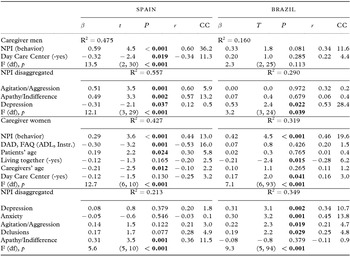
The third linear regression identified which patients and caregivers’ factors were associated with burden according to caregivers’ gender. The overall score of the neuropsychiatric symptoms had a greater effect on the burden of male Spanish caregivers (p < 0.001/p = 0.081) and attending Day Care Center (p = 0.019). Instead, female caregivers were affected by neuropsychiatric symptoms similarly in both countries (p < 0.001/p < 0.001). Furthermore, high levels of burden were related to living together (p = 0.015) and not attending Day Care Center (p = 0.041) in Brazilian female caregivers.
Neuropsychiatric symptoms were different in Brazilian and Spanish samples. Male Spanish caregivers reported more agitation/aggression (p = 0.001) and apathy/indifference (p = 0.002), but male Brazilian caregivers were affected by depression (p = 0.022). Female Brazilian caregivers reported more anxiety (p = 0.001) and depression (p = 0.002), whereas, in Spain, apathy/indifference were more predominant (p = 0.001) (Table 5).
Multivariate regression analysis. Burden (ZBI) and factors, according to the gender of caregivers

R2 = Determination coefficient; β = standardized beta coefficient; t = Students t, test; r = Pearson correlation (zero-order); CC = coefficient of contribution (%), [(β. r) × 100].
DAD, disability assessment for dementia; FAQ, functional activities questionnaire; NPI, neuropsychiatric inventory; ZBI, zarit burden interview.
Discussion
Factors related to caregiver burden in Brazil and Spain
The aim of this study was to identify the differentiating factors associated with burden in Brazilian and Spanish caregivers of patients with AD. We consider that caregiver burden depends on several sociodemographic aspects, clinical factors, and cultural aspects of caregivers and patients, such as gender, type of relationship and neuropsychiatric symptoms (Conde-Sala et al., Reference Conde-Sala, Garre-Olmo, Turró-Garriga, Vilalta-Franch and López-Pousa2010; Park et al., Reference Park, Sung, Kim, Kim and Lee2015). Cultural aspects refer to distinctive ideas, habits, social behavior, products or way of life of a nation, society, people, or period. The cultural context may be considered an internal determinant that influences caregiving at multiple levels throughout the experience, mainly in regard to the meaning of being a caregiver. Consequently, cultural justification for caregiving may reflect the cultural values and beliefs of a given group that may influence elder care provision and potentially increase or decrease emotional growth. Moreover, cultural justification may increase the risk of – or protect against – emotional distress and burden (Santos et al., Reference Santos, Sousa, Ganem, Silva and Dourado2013). The results of the present study led us to accept our hypothesis that there are differences between levels of caregiver burden in Brazil and Spain, but not only patients’ aspects explain these differences.
The burden scores for the caregiver group were higher in Brazil than in Spain. We may argue that Latin American cultures tend to consider caregiving as a meaningful role, due to their sense of moral duty towards the family receiving care. In Latin American societies, the relationship between caregiving and perceived familial duty is frequent. This perception can be defined such as familism and describes a cultural value that refers to a strong commitment to the family as a system of support, learning, socialization, and assistance. Thus, family caregiving is considered a natural aspect of family life, even when the premorbid relationship has never been good (McCallum et al., Reference McCallum, Sorocco and Fritsch2006; Santos et al., Reference Santos, Sousa, Ganem, Silva and Dourado2013).
Several studies indicate that female caregivers are more affected by burden than men, probably as a result of the cultural stigma according to which caregiving activities are the responsibility of women (Turró-Garriga et al., Reference Turró-Garriga, Soler-Cors, Garre-Olmo, López-Pousa, Vilalta-Franch and Monserrat-Vila2008; Moraes and Silva, Reference Moraes and Silva2009; Conde-Sala et al., Reference Conde-Sala, Garre-Olmo, Turró-Garriga, Vilalta-Franch and López-Pousa2010; Santos et al., Reference Santos, Sousa, Ganem, Silva and Dourado2013). Brazilian female caregivers presented higher levels of burden than Spanish caregivers in our study. Commonly, women devote more time caring; this aspect can be the key determinant of the distress and other psychological burdens experienced by female caregivers. Instead, female caregivers are more likely to experience burden than male caregivers who dedicate the same amount of time and money to their ill relatives. Female caregivers usually do not share their responsibilities with other family members, which may contribute to high levels of burden in Brazil (Truzzi et al., Reference Truzzi, Valente, Ulstein, Engelhardt, Laks and Engedal2012). In addition, we found that there were more female caregivers who had formal labor activities in the Brazilian sample. The redefinition of family roles added to the caregivers other activities outside home for financial needs; women participate in the job market, so they accumulate new functions. Moreover, the sample from Brazil is composed by caregivers who lived in an urban city, while the sample of Spain is a semirural environment. Indeed, living in a semirural area is related to important differences when compared with living in the city. Probably the family structure is more nuclear and the type of work is different in the city. Consequently, in urban areas women may be more vulnerable to emotional, physical, and social problems which can intensify burden score (Moraes and Silva, Reference Moraes and Silva2009).
Some studies have investigated the differences in levels of burden between caregivers who lived in the rural and urban contexts. Life in rural areas is different from urban areas with regard to access of services like public transport, professional healthcare, and specialist treatment. This suggests that the conditions of caregivers in urban and rural areas might also be different. Furthermore, national policymaking, planning, and improvements in dementia care are mainly based on the results of studies conducted in urban communities, which may result in inappropriate care provision for the specific caregiving needs of rural populations. However, some recent studies have focused on rural family caregivers’ use of public health services, indicating that the amount of public care services used was dependent on the users’ view of the family (Ehrlich et al., Reference Ehrlich, Boström, Mazaheri, Heikkilä and Emami2015). Our study is in line with studies that found lower levels of burden (Kim et al., Reference Kim2006) and less use of care resources in the semirural (Bédard et al., Reference Bédard, Koivuranta and Stuckey2004) (Spanish sample). Moreover, there were more family visits in the rural areas and more negative effects on employment in urban environments (Dwyer and Miller, Reference Dwyer and Miller1990).
Most dementia patients in several countries will be cared by family members, mainly wives and daughters (Conde-Sala et al., Reference Conde-Sala, Garre-Olmo, Turró-Garriga, Vilalta-Franch and López-Pousa2010; Truzzi et al., Reference Truzzi, Valente, Ulstein, Engelhardt, Laks and Engedal2012; Santos et al., Reference Santos, Sousa, Ganem, Silva and Dourado2013). Caring for a dementia patient over a long period of time may implicate in emotional and physical health problems. Social isolation has been more reported by spouses than by adult children (Conde-Sala et al., Reference Conde-Sala, Garre-Olmo, Turró-Garriga, Vilalta-Franch and López-Pousa2010). Adult–children receive more help from other people and place more frequently the patient in institutional care. Our data indicated that spouses presented high levels of burden in the Brazilian sample (Conde-Sala et al., Reference Conde-Sala, Garre-Olmo, Turró-Garriga, Vilalta-Franch and López-Pousa2010). Possibly with the caregiving routine, the role of caregiver can transform the marital relationship into a parental relationship (Nogueira et al., Reference Nogueira2015). Less emotional closeness can result in a more negative perception of the quality of their marital relationship for spouse-caregivers, most likely resulting in high levels of burden (Nogueira et al., Reference Nogueira2015). Whereas in Spain, Conde-Sala et al. (Reference Conde-Sala, Garre-Olmo, Turró-Garriga, Vilalta-Franch and López-Pousa2010) suggested that caregiving tasks would be regarded as marital commitment to spouses.
Generally in Brazil, the responsibility of caring lies exclusively with the patient's family which may not count on public support, while private sector support is expensive and available to very few (Moraes and Silva, Reference Moraes and Silva2009). Nevertheless, our study showed that more caregivers attended Day Care Center in Brazil than in Spain and participation in Day Care Center was related to a distinct effect in both samples. Brazilian caregivers reported low levels of burden when caregivers received support. The available treatments aim at alleviating the cognitive deficits and behavioral changes through the use of drugs, helping families to maintain their relatives in the community for longer and improving the quality of life of patients and their families with multidisciplinary approach (Bottino et al., Reference Bottino2002). The multidisciplinary treatment is a complement of drug therapy in AD (Kwok et al., Reference Kwok, Young, Yip and Ho2013). Possibly, Brazilian caregivers have greater experience of caring and take more advantage of peer support, as they tend to be more assiduous in interventions for patients (Conde-Sala et al., Reference Conde-Sala, Garre-Olmo, Turró-Garriga, Vilalta-Franch and López-Pousa2010). One study found that Spanish spouses showed a more negative view of external resources than adult children. These spouses reported to be more benefited from domiciliary care (Conde-Sala et al., Reference Conde-Sala, Garre-Olmo, Turró-Garriga, Vilalta-Franch and López-Pousa2010). Interventions are probably understood differently by Brazilian and Spanish caregivers.
Clinical factors of patients and caregiver burden
In our study, Brazilian and Spanish caregivers reported that patients frequently presented neuropsychiatric symptoms and it was associated with high levels of burden. Our data is in accordance with the literature, which indicated that neuropsychiatric symptoms were the major factor of caregiver burden when compared with cognitive and functional deficits (Turró-Garriga et al., Reference Turró-Garriga, Soler-Cors, Garre-Olmo, López-Pousa, Vilalta-Franch and Monserrat-Vila2008; Park et al., Reference Park, Sung, Kim, Kim and Lee2015). However, we also found association between burden and cognitive impairment in Brazil. The significant inverse relationship that emerged between ZBI and MMSE total scores suggested that caregiver distress was also dependent on the severity of the patient's cognitive impairment. Nevertheless, this aspect remains a controversial issue. Although some studies reported a significant correlation between these variables, more recent researches have failed to find any association (Kwok et al., Reference Kwok, Young, Yip and Ho2013). In contrast with our Spanish sample and recent studies, there was no association between burden and functional deficits in Brazil (van der Lee et al., Reference van der Lee, Bakker, Duivenvoorden and Dröes2014). Perhaps, these findings are due to the fact that Brazilian caregivers may face cognition as something more problematic than functionality, because patients performed varied activities in Day Care Center. In addition, these caregivers were given guidance to questions presented in the daily care, for example, how to deal with neuropsychiatric symptoms.
Clinical factors of patients and caregivers according to gender
Previously, we suggested that female caregivers experienced more burden than men in both samples. Then, we analyzed the association between burden and clinical factors of patients and caregivers according to gender. We found that female caregivers reported more neuropsychiatric symptoms associated with high levels of burden in both countries. Therefore, there is a consensus that female caregivers are more affected by neuropsychiatric symptoms, and these may increase their levels of burden. In female caregivers, burden increased progressively with time since the onset of neuropsychiatric symptoms (Conde-Sala et al., Reference Conde-Sala, Garre-Olmo, Turró-Garriga, Vilalta-Franch and López-Pousa2010; Truzzi et al., Reference Truzzi2013; van der Lee et al., Reference van der Lee, Bakker, Duivenvoorden and Dröes2014). Also, for Brazilian female caregivers, high levels of burden were related to living together with patient. The daily care may affect negatively the relationship between patients and caregivers (Turró-Garriga et al., Reference Turró-Garriga, Soler-Cors, Garre-Olmo, López-Pousa, Vilalta-Franch and Monserrat-Vila2008).
However, comparing male caregivers, we found that Spanish male caregivers associated more neuropsychiatric symptoms and attending Day Care Center with high levels of burden than Brazilian male caregivers. Possibly, Spanish male caregivers (residents of semirural city) may understand patient care in a more traditional perception. Then, these caregivers were more affected by the presence of neuropsychiatric symptoms than Brazilian male caregivers. Moreover, participation in Day Care Center may be interpreted as a failure in patient care by Spanish male caregivers.
Additionally, we observed different patients’ neuropsychiatric symptoms in the sample of female and male caregivers in both countries. In the Brazilian sample, the main symptoms were depression and anxiety (affective symptoms), whereas in the Spanish sample the main symptoms were apathy/indifference and agitation/aggression (behavioral symptoms). International studies that investigated the prevalence of the neuropsychiatric symptoms showed heterogeneous results, such as depression, anxiety, and apathy/indifference; agitation/aggression, apathy/indifference, and aberrant motor behavior; and agitation/aggression, depression and eating disorders (Tatsch et al., Reference Tatsch2006 ; Camozzato et al., Reference Camozzato2008; Turró-Garriga et al., Reference Turró-Garriga, Soler-Cors, Garre-Olmo, López-Pousa, Vilalta-Franch and Monserrat-Vila2008). There are some explanations for the differences between the frequencies of neuropsychiatric symptoms across distinct cultural backgrounds.
First, the cultural aspects may influence on the reports of the neuropsychiatric symptoms by the caregivers from the countries that were investigated and on the clinical judgment by the raters. Chen et al. (Reference Chen, Borson and Scanlan2000) observed that Latino dementia patients manifested higher levels of neuropsychiatric symptoms compared with African American, Asian American, and Native American, indicating that cultural differences may explain the presence of more neuropsychiatric symptoms in some cultures than others (Tatsch et al., Reference Tatsch2006). Thus, culture aspects may play a role in the frequency of depression and anxiety in the Brazilian sample compared with Spanish sample. Depression and anxiety were found in several Brazilian studies conducted by Tatsch et al., (Reference Tatsch2006) (38.3%/25%), and Camozzato et al., (Reference Camozzato2008) (36%/47%). Possibly, Brazilian caregivers perceived more affective symptoms, because affective manifestations are important aspects within Brazilian families and have a significant presence in the relationship between familial caregiver and patient (Stella et al., Reference Stella2015).
Second, caregivers’ awareness about neuropsychiatric symptoms may partly explain the higher reports of depressive and anxious symptoms in Brazilian patients compared with Spanish patients. Brazilian caregivers participated of psychoeducational groups (especially regarding the management of neuropsychiatric symptoms and functional deficits) while patients were in the Day Care Center. The psychoeducational intervention offered information about the disease and emotional support to the caregivers. Thus, caregivers interacted with each other, exchanging useful information and providing mutual support (Santos et al., Reference Santos, Sousa, Ganem, Silva and Dourado2013). We may suggest that this sample of caregivers showed presence of some protective factors, such as looking for support and emotional detachment in their relationship with patients (Knight et al., Reference Knight, Silverstein, McCallum and Fox2000). Future studies could evaluate the association between the protective factors and burden.
The factors in our samples may have been influenced by some limitations regarding the inter-center and intercountry differences in the selection of instruments and the quality of the information gathered from caregivers. First, information related to caregivers’ mental health, such as depression and anxiety, generally associated to caregiver burden, were not assessed due to the lack of data. Second, we do not have available qualitative aspects about caregivers' familiar environment that may explain differences in use of Day Care Center. Moreover, we do not have information about caregivers who attended psychoeducational programs. Third, caregivers’ socioeconomic level was not assessed and that may contribute to the differences found in caregiver burden. Fourth, functional evaluation of patients from Brazil was assessed with the FAQ, and in Spain this was done with DAD. FAQ provides information on performance with emphasis on IADL and DAD includes questions assessing both ADL and IADL, but we have only compared scores of IADL capacities in FAQ and DAD. Finally, we had a convenience sample, composed by caregivers and patients from distinct cities, Rio de Janeiro, Brazil (urban) and Girona, Spain (semirural). The differential aspects of living in a city or in a semirural environment (family structure, type of job) could not be analyzed in depth by the lack of data.
In conclusion, our cross-cultural study showed that the country of origin influenced the ZBI total score and we also found differences in caregiver's gender, attending by Day Care Center and neuropsychiatric symptoms between the Brazilian and Spanish samples, which make us believe that these results might be explained by cultural differences. Our findings highlight the importance of addressing the patients’ neuropsychiatric symptoms because they are an essential source of the caregivers’ burden. Thus, the early identification of neuropsychiatric symptoms by caregivers and physicians is necessary, because it may allow a more adequate management of patients with AD. At last, we may be helpful to the improvement of studies about adequate psychoeducational approaches to alleviate caregivers’ burden, to improve caregivers’ engagement and to increase their quality of life. Future studies should identify which coping styles are affected by cultural differences. Moreover, psychoeducational interventions with caregivers should include culturally bound positive coping techniques.
Conflict of interest
None.
Description of authors’ roles
M.F.B. Sousa was involved in designing the study, collecting the data, performing the statistical analyses, and writing the paper. R.L. Santos collected the data, and assisted with the writing. O. Turró-Garriga assisted with the writing. R. Dias collected the data. M.C.N. Dourado supervised the data collection, assisted with the writing, and approved the final paper. J. L. Conde-Sala designed the study, supervised the data collection, performed the statistical analyses, assisted with the writing, and approved the final paper.
Acknowledgments
This research in Brazil was supported by the Conselho Nacional de Pesquisa (CNPq) and Fundação Carlos Chagas Filho de Apoio a Pesquisa do Estado do Rio de Janeiro (FAPERJ, grant number E-26/102.256/2010). The research of Spain was conducted in the Memory and Dementia Assessment Unit of the Santa Caterina Hospital (Salt, Spain) and formed part of the SIDEA research project (Seguimiento Integral de la Enfermedad de Alzheimer/Comprehensive Follow-Up of Alzheimer's Disease, 2003–12).