1. Introduction
The English Subject-to-Subject Raising (SSR) construction illustrated in (1) has been an extensively researched topic across diverse theoretical frameworks since Rosenbaum (Reference Rosenbaum1967).
-
(1) Mia seems to be leaving for the concert. (SSR)
Albeit similar, Copy-raising (CR), Footnote 1 shown in (2), contrasts with SSR in three distinctive ways. First, in the SSR example (1), the subject of the matrix clause is co-indexed with the subject gap in the infinitival clause. Footnote 2 This is different from the CR example (2), where the matrix subject is co-indexed with the overtly realized pronoun in the complement clause. Second, unlike SSR, the CR predicate takes a tensed complement, headed by like, as if, or as though. The third noticeable difference is the choice of predicates. While SSR is not permitted with perceptual resemblance (PR) verbs, Footnote 3 as in (3), CR is compatible with this verb class, as shown in (4).
-
(2) Mia seems like / as if / as though she is leaving for the concert. (CR)
-
(3) * Mia sounds/looks/feels to be ready for the concert.
-
(4) Mia sounds/looks/feels like she is ready for the concert.
Compared to SSR, significantly less attention has been paid to CR. This is perhaps because CR was treated as a highly marked construction found only in English. Footnote 4 In reality, CR is a widespread phenomenon observed in many different languages such as Samoan (Chung, Reference Chung1978), Hebrew (Lappin, Reference Lappin, Jones and Sells1984), Irish (McCloskey & Sells, Reference McCloskey and Sells1988), Haitian Creole (Déprez, Reference Déprez1992), Persian (Darzi, Reference Darzi1996), Turkish (Moore, Reference Moore1998), and Swedish (Asudeh & Toivonen, Reference Asudeh and Toivonen2012).
CR was initially discussed from a generative linguistics perspective by Rogers in a series of CLS papers (1971, 1972, 1974) and his PhD dissertation (1973), and also by Postal (Reference Postal1974). More recently, Potsdam and Runner (Reference Potsdam, Runner, Andronis, Ball, Elston and Neuvel2001) revisited this topic from a fresh perspective. Since then, CR has drawn renewed attention from scholars, as demonstrated by a handful of recent publications (Asudeh, Reference Asudeh, Andronis, Debenport, Pycha and Yoshimura2002, Reference Asudeh2005, Reference Asudeh2012; Asudeh & Toivonen, Reference Asudeh and Toivonen2012; Fujii, Reference Fujii, Blaho, Vicente and Schoorlemmer2005, Reference Fujii, Corver and Nunes2007; Kim, Reference Kim2014; Landau, Reference Landau2009, Reference Landau2011; Mack, Reference Mack2010). It is interesting to note that most of the aforementioned research was conducted from the formal linguistics perspective despite the diversity of theoretical frameworks the authors adopt. Footnote 5 As far as we are aware, very little research examines this topic within cognitive linguistics.
The main purpose of this paper is to develop an analysis of English CR constructions from a Cognitive Grammar viewpoint (Langacker, Reference Langacker1987, Reference Langacker1991a, Reference Langacker1991b, Reference Langacker2000, Reference Langacker2008, Reference Langacker2009) and to present some broader implications of our analysis. Our specific objective is modest: to show how CR can be naturally accommodated from a theoretical perspective very different from the previous proposals listed above. The data we present in this paper come from three sources: published papers, corpus and web searches, and our own intuition. Except for one Korean example, our data were surveyed among 102 native English speakers, who rated the acceptability of each example using a standard Likert scale. Footnote 6,Footnote 7
2. Proposal
We argue that the matrix-subject in (2) and (4) is licensed via the independently established informational construct known as reference-point. Our view contrasts with the dual-licensing approach (Horn, Reference Horn1981; Mack, Reference Mack2010; Rogers, Reference Rogers1973, Reference Rogers, La Galy, Fox and Bruck1974; Sag, Reference Sag, Boas and Sag2010; inter alia), which assumes two distinct mechanisms: one purely syntactic and the other interpretive/informational. More specifically, we argue that the CR construction is an instance of reference-point. Reference-point is the human cognitive ability to conceptualize one entity through another; i.e., reference-point is a mental address to reach a target. The aspects of the reference-point relation are shown schematically in Figure 1. In Figure 1, C stands for the conceptualizer, R for the reference-point, and D for the dominion. Dominion constitutes the possible set of targets that a given reference-point is related to. The dashed arrow is the mental path the conceptualizer follows to reach the target, which is the entity accessed via the reference-point.
Reference-point illustrated (redrawn after Langacker, Reference Langacker2008, p. 84).

To illustrate a concrete case of reference-point, let us consider the possessive noun phrase Sally’s dog. The possessive morpheme’s invokes a reference-point relationship in the sense that X, in the schematic possessive construction [X’s Y], functions as a mental address for Y, by drawing a mental path from X to Y. In this example, Sally is invoked as a reference-point, and dog is accessed via Sally. The notion of reference-point has in fact been adopted in the analysis of various phenomena, such as possessor–possessee (Langacker, Reference Langacker2008; Taylor, Reference Taylor1996), multiple subject constructions (Kumashiro & Langacker, Reference Kumashiro and Langacker2003; Park, Reference Park2011), and antecedent–anaphora (van Hoek, Reference van Hoek1997), among others.
Reference-point plays an important role in discerning CR from SSR. The matrix-subject of CR with epistemic verbs (ECR) is almost always topical, whereas the same does not hold true for SSR (see Mack, Reference Mack2010). We demonstrate that these differences are merely symptomatic of reference-point variation in regard to prototypicality. A prototypical reference-point relationship overtly identifies a reference-point and its target within a relevant dominion. While the matrix-subject of ECR exhibits a quintessential reference-point property, SSR does not, as it lacks an overt target (pronominal copy). Here, we would like to emphasize that reference-point is not identical to topicality. In his works, Langacker suggests that reference-point is a “sort of topic”, without providing further detailed descriptions on how they compare. In our view, reference-point is a necessary condition for topicality. If x is a topic, then x is a reference-point. Reference-point is not a sufficient condition for topicality, because it is possible that x is a reference-point without being a topic. Indeed, in the literature that adopts the notion of reference-point, scholars such as Kumashiro and Langacker (Reference Kumashiro and Langacker2003) and Janda (Reference Janda2011) utilize an implicit reference-point, which cannot be interpreted as a topic. For example, in the Korean sentence (5), the relational nominal subject hand implicitly invokes a reference-point, the owner of the hand, because without the owner, the speaker cannot access hand (see Park, Reference Park2011). The implicitly invoked reference-point functions as a mental address for hand in the lower clause without identifying a specific person, although it ultimately corresponds to Trump in the higher clause.
-
(5) [Thulemphu-ka [son-i cakta]].
Trump-Subj hand-Subj be.small
‘Trump has small hands.’
Another interesting observation is the contrast between epistemic and PR verbs. While PR verbs do not require a pronoun copy in the embedded clause, as in (6b), epistemic verbs generally do, as shown in (6a). Footnote 8
-
(6)
-
a. * Dan seemed/appeared like Jean cooked salmon.
-
b. Dan sounded like Jean cooked salmon.
-
As will be discussed in detail later, several scholars attempted to explain the difference between (6a) and (6b) by heavily relying on the notion of perceptual source (P-source). Here is a brief summary of the P-source-based analysis. Dan’s being the P-source in (6b) makes the sentence acceptable, whereas the infelicity of (6a) is attributed to the uninterpretability of Dan as an evidential P-source. Mack (2010, p. 169) rightly criticizes this type of approach by arguing that “the evidential source for [sound] need not be perceptual at all; evidence may also come from hearsay or inference”. In other words, Dan does not have to be an evidential P-source to make (6b) felicitous; this is the view we, too, support. That being said, Asudeh and Toivonen (Reference Asudeh and Toivonen2012) and Landau (Reference Landau2011) provide more sophisticated treatments of CR based on P-source, which is naturally not reflected in Mack (Reference Mack2010) due to the timing of the publications. For this reason, we revisit the P-source-related predictions more carefully in this paper.
Instead of relying on the notion of P-source, we argue that the matrix-subject Dan in (6a) attempts to build a reference-point relationship with its target, whether it be a pronominal or the whole embedded clause. Dan then requires an explicit target to express an anaphoric link between itself and its corresponding pronoun, or Dan should be able to be interpreted within the context of Jean cooked salmon. In the former case, the target is the pronoun, while in the latter case, the target is the whole embedded clause. Because no target (pronoun) is identified, or cannot be established, the resulting sentence is unacceptable. (6b) differs from (6a) in that Dan is a reference-point in relation to the embedded clause, the reference-point’s target. This is because the proposition made by the embedded clause can only be interpreted in Dan’s dominion if Dan is contextually related. In this sense, it functions very similarly to an external topic, which Mack (Reference Mack2010) identifies as a ‘subjective topic’. Note that the same type of interpretation is not available in (6a).
Our approach exhibits great similarity to Kim’s (2014, p. 183) Perceptual Characterization Condition (PCC). He states that “[t]he matrix-subject of the CR construction, serving as the topic, is ‘perceptually characterized’ by the rest of the utterance”. That said, unlike Kim’s PCC, our analysis employs reference-point, which is a way to construe semantic content through a dynamic mental scanning process, ubiquitously observed in human language.
The relationship between reference-point and topicality also brings into question the so-called expletive raising construction, demonstrated by (7), which needs to be handled somewhat differently than the two aforementioned CR constructions.
-
(7) There seems/appears like there’s going to be a big mess in this department.
In this example, the two expletives are independently licensed as setting subjects at each level in Langacker’s (Reference Langacker2009, Reference Langacker, Brdar, Gries and Fuchs2011) terms. Nonetheless, they are anaphorically linked. Note that the upper there functions as a reference-point and the lower there as the target. Footnote 9 In this regard, the underlying motivation behind there-raising is similar to other CR examples. Although our analysis shares general insights with Mack (Reference Mack2010), this is one major difference between her ideas and ours. Mack argues that examples like (7) are licensed via Subject-to-Subject Copy-raising (SSCR), which is purely syntactically motivated. This is because the matrix-subject there lacks aboutness topicality, unlike subjects in other CR examples. In our analysis, (7) is almost identical to other CR examples, and the differences stem from the independent source, known as setting subject. As an abstract setting subject, there merely hosts a relationship, as opposed to being a participant in that relationship. As a non-participant trajector, there cannot be interpreted as a topical subject.
Our analysis predicts a metonymic interpretation Footnote 10 of the matrix-subject in (8), since metonymy and reference-point are inextricably linked phenomena; both of them utilize the concept of one entity in order to invoke another which is closely related. As will be discussed in Section 3, this type of example poses challenges to the P-source-based approaches, because (8) is acceptable without a pronoun copy even though that book is not a P-source. We argue that the metonymic interpretation of that book is at the heart of this construction because that book functions as a reference-point with respect to everyone should own a copy.
-
(8) That book sounds like everyone should own a copy.
(Heycock, Reference Heycock1994, p. 292; Landau, Reference Landau2011, p. 794)
We illustrate several variations of epistemic and PR verb examples accompanied by the challenges the examples face in a theory-neutral way. While we present the examples and the related issues, we provide our approach in a more impressionistic way, saving the technical analyses for a later section.
3. Variations of CR and the issues
In previous sections, we introduced a typical example of CR with a brief description. The focus of earlier research (Rogers, Reference Rogers, Adams, Campbell, Cohen, Lovins, Maxwell, Nygren and Reighard1971, Reference Rogers, Levi, Peranteau and Phares1972, Reference Rogers1973) and its subsequent traditional movement analyses (Moore, Reference Moore1998; Ura, Reference Ura1998) revolved around this type of example, where the pronominal copy of the matrix-subject occurs in the subject position of the complement clause. Research conducted more recently (Asudeh, Reference Asudeh2012; Asudeh & Toivonen, Reference Asudeh and Toivonen2012; Kim, Reference Kim2014; Landau, Reference Landau2009, Reference Landau2011; Mack, Reference Mack2010) reports that the CR phenomenon is much more complex than earlier researchers assumed. This section illustrates an array of variations in CR in conjunction with related empirical and theoretical issues.
3.1. non-subject CR
Though not central to their studies, a number of earlier researchers (Heycock, Reference Heycock1994; Lappin, Reference Lappin, Jones and Sells1984; Rogers, Reference Rogers, La Galy, Fox and Bruck1974) noted a variation of CR in which the pronominal copy is a non-subject, as illustrated in (9–11).
-
(9) Mary appears as if her job is going well.
-
(10) The broach looks to me like Abbie gave it to Myma.
-
(11) Bill sounds like Martha hit him over the head with the record.
Potsdam and Runner (2001, p. 456) also recognize this variation and provide a reasonable analysis by claiming that the CR predicates in (9–11) are used thematically, thereby differentiating them from the example shown in (2). According to Potsdam and Runner, there is no movement in (9–11); the matrix-subject is base-generated. Their evidence comes from idiom chunks in the CR construction, as can be found in (12–13). Although some speakers do not like either of the examples, those surveyed unanimously agree that (12) is much more natural than (13). Considering the common wisdom that the fraction of the idiom chunk appearing in the matrix-subject position in (12) is indicative of the verb not assigning a thematic role (see Postal & Pullum, Reference Postal and Pullum1988), Potsdam and Runner’s (Reference Potsdam, Runner, Andronis, Ball, Elston and Neuvel2001) claim is justifiable. The epistemic verb appears in (13) does not assign a thematic role because the embedded clause contains the subject pronominal copy. In their analysis, the unacceptability of (13) is also straightforwardly explained: appears assigns a thematic role to the idiom fraction the other foot, because there is no subject pronominal copy. Therefore, the other foot receives two thematic roles, leading to the clash.
-
(12) The shoe appears like it is on the other foot.
-
(13) * The other foot appears like the shoe is on it.
That said, Potsdam and Runner’s (Reference Potsdam, Runner, Andronis, Ball, Elston and Neuvel2001) analysis leads to an incorrect prediction. Landau (Reference Landau2011, p. 801) rightly points out that, if Potsdam and Runner are right, both your house and that noise in (14) and (15) must be thematic because there is no subject copy in the complement clause in either example. Nevertheless, your house in (14) is not thematically related to sounds, while that noise in (14) is. In addition, the pronominal copy it is obligatory in (14), while (15) is felicitous without it. These differences cannot be explained in Potsdam and Runner’s (Reference Potsdam, Runner, Andronis, Ball, Elston and Neuvel2001) analysis.
-
(14) Your house sounds like nobody enjoys cleaning *(it).
-
(15) That noise sounds like somebody is cleaning.
To overcome the difficulties, Landau (Reference Landau2011, p. 787) proposes the Perceptual-source Copy Generalization (PCG). Simply put, PCG states that a copy is necessary in the complement clause if and only if the matrix-subject is not a P-source. Landau’s PCG successfully differentiates (14) from (15). In (14), your house is not a P-source; so the pronoun copy is required. By contrast, that noise is a P-source in (15), which makes the sentence acceptable without a pronoun copy. Footnote 11 Here, we need to define exactly what P-source means in Landau. In all three examples in (16), the speaker makes visual contact with a stimulus. However, there are differences among the three. While the stimulus is unspecified in (16a), in (16b) it is the matrix-subject John. Landau calls this type of example a P-source reading. (16c) is different from the other two in that the visual stimulus is the grade sheet, not John, resulting in the matrix-subject’s non-P-source reading.
-
(16)
-
a. It looks like John has failed the exam.
-
b. Here’s John: oh, he looks like he has failed the exam.
-
c. Here’s the grade sheet: oh, John looks like he has failed the exam.
-
There is no denying that Landau’s (Reference Landau2011) analysis shows improvement over Potsdam and Runner (Reference Potsdam, Runner, Andronis, Ball, Elston and Neuvel2001). Nonetheless, there are two important questions unanswered in Landau’s approach. First, why does the notion of P-source play an important role in the CR? Landau’s PCG can certainly make a distinction between (14) and (15), but why is a P-source crucial for the absence or obligatoriness of a pronoun copy other than theory-internal justifications?
Another challenge to Landau (Reference Landau2011) comes from the two examples borrowed from Heycock (1994, p. 292). In these examples, neither that book nor her apartment is a P-source, though both sentences are fully felicitous without a pronoun copy. Landau reports that his informants find (8) – re-introduced here as (17) – slightly problematic and (18) somewhat worse. Contra his report, the majority of our native speakers agrees that both are fully acceptable. Therefore, we conclude that these are indeed counter-examples to his PCG.
-
(17) That book sounds like everyone should own a copy.
-
(18) Her apartment sounds like there must be a wonderful view.
Landau is aware of this difficulty but he avoids detailed discussion of this issue by claiming that the examples are metonymic. He (Reference Landau2011, p. 794) states that “[t]he range and accessibility of metonymic readings, in various grammatical environments, is a topic in its own right, which we cannot delve into here”. We believe this is unfortunate because metonymy is crucial in the CR construction, as demonstrated in later sections.
3.2. PR verbs
While Rogers’ earlier research (1971, 1972, 1973, 1974) does not make a clear distinction between epistemic and PR verbs, Asudeh (Reference Asudeh, Andronis, Debenport, Pycha and Yoshimura2002, Reference Asudeh2005, Reference Asudeh2012) and Asudeh and Toivonen (Reference Asudeh and Toivonen2012) do. The key criterion of their distinction is whether a copy pronoun is required in a complement clause. Consider (19a–b) from Asudeh and Toivonen (p. 324). The PR verbs in (19a) behave like epistemic verbs in that they can alternate with an expletive variant in (19b).
-
(19)
-
a. Tina smells/looks/sounds/feels/tastes like / as if / as though she has been baking sticky buns.
-
b. It smells/looks/sounds/feels/tastes like / as if / as though Tina has been baking sticky buns.
-
The difference between the two types of verbs is illustrated in (20–21). According to Asudeh and Toivonen, while the epistemic verbs cannot occur without a copy pronoun, it is not obligatory for PR verbs.
-
(20) * Tina seems/appears like / as if / as though Chris has been baking sticky buns.
-
(21) Tina smells/looks/sounds/feels/tastes like / as if / as though Chris has been baking sticky buns.
We believe their observation is generally right. However, as several scholars (Kim, Reference Kim2014; Potsdam & Runner, Reference Potsdam, Runner, Andronis, Ball, Elston and Neuvel2001; Rogers, Reference Rogers, Adams, Campbell, Cohen, Lovins, Maxwell, Nygren and Reighard1971) have pointed out, it is not always straightforward to make a clear distinction between these two types of predicates. In particular, Kim provides a rich set of data extracted from COCA to illustrate ECR examples without pronoun copies. For example, as illustrated in (22–23), epistemic verbs may occur without a pronoun copy in a complement clause. These examples show that Asudeh and Toivonen’s (Reference Asudeh and Toivonen2012) dichotomy is too strong.
-
(22) They seem as if a dragon hiding behind the cloud is drawing water from the sea. (<www.newscontent.cctv.com> last accessed 19 October 2015)
-
(23) She appeared as if the powers of life had been suddenly arrested.
(Google Books, by John Inman & Robert A. West, The Columbian Magazine Volume 9)
Asudeh and Toivonen (2012, p. 341) are keenly aware of this problem and admit that certain speakers (Dialect D in their classification) accept sentences like (22–23). They argue that the epistemic verbs in these types of examples are used as a sort of “semantically bleached” PR verb. From the perspective of language change, the claim that the verbs seem and appear “gain” the perceptual resemblance meanings (albeit bleached) needs to be carefully assessed. In dealing with grammaticalization, Hopper and Traugott (2003, p. 94) state that “[t]here is no doubt that, over time, meanings tend to become weakened during the process of grammaticalization”. It is clear that epistemic verbs exhibit less semantic complexity than PR verbs. We might expect PR verbs to become more like epistemic verbs, but not the other way around. However, the potential solution to explain (22–23) proposed by Asudeh and Toivonen (Reference Asudeh and Toivonen2012) assumes that the direction in the general grammaticalization cline is from epistemic to PR. Hopper and Traugott (Reference Hopper and Traugott2003) emphasize that this direction is not impossible, but this type of pragmatic enrichment is often observed in the beginnings of grammaticalization. Asudeh and Toivonen’s (Reference Asudeh and Toivonen2012) claim thus remains unsatisfactory, unless there is clear justification to say that this type of change is in an early stage and accompanied by relevant pragmatic enrichment.
We support Kim (Reference Kim2014) by proposing that there is no critical difference between epistemic verbs and PR verbs concerning the optionality of a copy pronoun. Without respect to the type of a verb, the major function of examples (22–23) is to mentally access the embedded clause through the matrix-subject. Indeed, epistemic verbs are fully felicitous without a pronoun copy if the contextual information allows the interlocutor to access the embedded clause through the matrix-subject, which is the case demonstrated in (22–23).
3.3. expletives
One interesting characteristic of epistemic verbs is that they can copy-raise expletives, with some limitations. For example, some speakers we surveyed do not accept (24), while others do. In a traditional movement-based analysis, (24) can be evidence for copy-raising the expletive there, because there is not usually compatible with seems without a copy expletive in the complement clause, as shown in (25). Rogers (Reference Rogers, La Galy, Fox and Bruck1974) demonstrates that the copy of there must occur in the highest embedded subject position. If not, the sentence is not acceptable, as in (26). (27) illustrates that the expletive raising is also felicitous with the PR verb looks. Footnote 12
-
(24) There seems like there is a problem in this linguistics department.
-
(25) * There seems like a lot of people are on the beach today.
-
(26) * There seems like John expects there to be an election.
-
(27) There looks as if there is a piece of evidence in this report to support the hypothesis.
In relation to there-raising, Kaplan-Myrth (Reference Kaplan-Myrth2000, p. 3) reports that the number value of there between the two subjects must be identical, as in (28–29). Otherwise, the sentence is infelicitous, as shown in (30).
-
(28) There looks as if there is a problem.
-
(29) There look as if there are problems.
-
(30) * There looks as if there are problems.
Our survey data conflict with this judgment. Most of our survey participants rated (30) noticeably higher than (29), which they rejected. Footnote 13 In other words, the expletive there always takes a singular verb in the CR construction. Our observation suggests that the two expletives are not fully identical, although they are co-referential in the sense that the upper there cannot occur without the lower there, as illustrated in (25).
The co-referential requirement between the two subjects does not apply when the matrix-subject is it, as seen in (31) and (32). Similar to (25), (33) shows that there cannot occur in the matrix-subject position without its copy in the complement clause, even when the subject of the complement clause is it.
-
(31)
-
a. It seems like there is a problem in this linguistics department.
-
b. It seems like it is raining.
-
-
(32)
-
a. It looks/sounds like there is a problem in this linguistics department.
-
b. It looks/sounds like it is raining.
-
-
(33) * There seems/looks/sounds like it is raining.
This issue will be addressed in Section 5. In short, we will show that the expletive examples fully conform to other CR examples we have discussed thus far.
4. CR, SSR, and topicality
Now we would like to demonstrate how three related phenomena can be explained through reference-point: Copy-raising, Subject-to-Subject Raising, and topicality.
4.1. ECR and SSR
We note that the epistemic verbs behave differently from PR verbs in a certain context. This is based on the observation that epistemic verbs readily alternate with the it ∼ that construction, as shown in (34), while PR verbs tend to resist this alternation, as in (35). In this regard, the CR construction resembles SSR. Footnote 14
-
(34)
-
a. Mia seems/appears like she is leaving.
-
b. It seems/appears that Mia is leaving.
-
-
(35)
-
a. Mia smells like she was in the chicken coop.
-
b. * It smells that Mia was in the chicken coop.
-
Let us consider (34a). This CR example is very similar to the SSR example (36), where Mia’s leaving is located on the probability scale profiled by the epistemic verb. In terms of Langacker (1995, p. 32), the schematic process indicated by be leaving in (36) is Mia’s active zone with respect to the scale. Therefore, SSR exhibits a discrepancy between profile (Mia) and active zone (the process), because what is located on the probability scale is not Mia (trajector), but the process (active zone). The same discrepancy is observed in ECR.
-
(36) Mia seems to be leaving.
One noticeable difference between SSR and ECR is the obligatoriness of a pronoun copy when the matrix-subject corresponds to the subject of the embedded clause in ECR.
-
(37) Mia seems like she is leaving.
To illustrate the differences between (36) and (37), first note that, in (36), the matrix-subject corresponds to the implicit subject of the embedded clause, exhibiting that the two entities are identical. Nevertheless, Mia in (36) is not a reference-point, at least not a prototypical one, because Mia does not have an overtly identified target. Footnote 15 Though the same correspondence relation applies in (37), Mia in this example is a reference-point in relation to its identified target she. In other words, in addition to the correspondence relation, a reference-point relationship is established in (37).
Viewing the relation between a full nominal and its corresponding pronominal as a reference-point/target relation is not surprising. According to van Hoek (Reference van Hoek1995, Reference van Hoek1997), the special property of a pronoun is its self-identification as a reference-point. In this case, the reference-point itself is the easiest element to access among all those in its dominion. As a result, the reference-point (full nominal) and the target (pronoun) become co-referential. van Hoek argues that the likelihood of a nominal being invoked as a reference-point depends on its prominence, and the likelihood of an element being included in its dominion depends on the closeness of their conceptual connection. In (37), Mia is highly prominent by virtue of being a trajector of the process profiled by the clause that contains it. As a highly prominent entity, it is evoked as an antecedent for a pronoun. Here, Mia and the pronoun she are connected through the emergence of a coherent overall conception, e.g., the probability scale of (someone) is leaving is tightly associated with Mia under the given circumstance; thus she falls within the dominion of Mia.
The non-subject ECR examples in (38) are similarly explained, as the matrix-subjects and their corresponding pronouns exhibit the co-referential relations as a reference-point and target pair. The pronoun does not need to appear in the subject position because the fundamental function of this CR construction is to establish a coherent connection between the matrix-subject and the corresponding pronoun.
-
(38)
-
a. The lawn appeared as if someone had mowed it. (COCA 1993 MAG, Kim, Reference Kim2014, p. 169)
-
b. … the forest appears as if a tornado had passed over it. (COHA 1850 MAG, Kim, Reference Kim2014, p. 169)
-
On rare occasions, we observe that a pronoun copy can be omitted when the speech context provides relevant information and the target pronoun is not a subject. In a normal situation, for example, someone had mowed in (39a) is understood as someone had mowed the lawn. Similarly, a tornado had passed over in (39b) is understood as a tornado passed over the forest. If these are indeed acceptable, Asudeh and Toivonen’s (Reference Asudeh and Toivonen2012) claim – that the epistemic CR construction requires a pronoun copy – needs to be reconsidered.
-
(39)
-
a. The lawn appeared as if someone had mowed.
-
b. … the forest appears as if a tornado had passed over.
-
At this point, it is worth discussing how Kim’s PCC accounts for examples like (39a–b). Kim argues that (40–41), cited from Lappin (Reference Lappin, Jones and Sells1984) and Asudeh and Toivonen (Reference Asudeh and Toivonen2012), respectively, are unacceptable for reasons other than the lack of a pronoun copy: “[t]he fact that Mary is intelligent does not say any characteristic about Bill. Neither does Chris’s baking sticky buns describe any characteristic about Tina” (Kim, Reference Kim2014, p. 183).
-
(40) * Bill appears as if Mary is intelligent.
-
(41) * Tina seems like Chris has been baking sticky buns.
We fully agree with Kim’s position. As shown in (39a–b), epistemic verbs are permitted in CR without pronoun copies if the matrix-subject can create a mental connection with the embedded clause. In other words, (39a–b) are acceptable because the matrix-subjects can function as reference-points in relation to their corresponding targets; i.e., embedded clauses.
The notion of reference-point is helpful in explaining two earlier examples re-introduced as (42–43). Idioms tend to maintain the trajector–landmark alignment. However, in the example the other foot appears like the shoe is on it, the original alignment of the other foot is altered due to its appearance in the reference-point position. The originally non-topical landmark, the other foot, is thus in an aboutness relation to the predication in (43) by being a reference-point trajector. (43) becomes infelicitous because focal arguments of idiomatic expressions are not permitted in positions in which they express what the information-structure literature refers to as switch topics – newly established topics (see Lambrecht, Reference Lambrecht1994; Lambrecht & Michaelis, Reference Lambrecht and Michaelis1998, for details).
-
(42) The shoe appears like it is on the other foot.
-
(43) * The other foot appears like the shoe is on it.
It is also worth discussing Mack’s (Reference Mack2010) comparison of CR and SSR here. She states that “it is debatable whether SSR even constitutes a particularly appropriate comparison construction [to CR]” (p. 159). Her statement is based on the observations (pp. 179–180) in (44–45). In the CR examples (44), the bare nominals are obligatorily interpreted as specific (Lappin, Reference Lappin, Jones and Sells1984, p. 241). The same constraint does not apply to the SSR examples in (45), because the bare nominals in (45) can be interpreted either as kinds or existentially.
-
(44)
-
a. Cows seem/look as if they are extremely intelligent.
-
b. # Cows seem/look as if they are grazing in Fred’s field.
-
c. Sand seems/looks as if it is composed of tiny particles.
-
d. # Sand seems/looks as if it is blowing over the backyard.
-
-
(45)
-
a. Cows seem to be extremely intelligent.
-
b. Cows seem to be grazing in Fred’s field.
-
c. Sand seems to be composed of tiny particles.
-
d. Sand seems to be blowing all over the backyard.
-
We agree with Mack that ECR subjects are licensed to serve as topics. However, our opinions differ concerning the sharp demarcation between SSR and ECR. In her analysis, ECR, which contains a referential matrix-subject with a subject copy in the embedded clause, is ambiguous between an SSR-like interpretation and an ECR interpretation. The former is licensed by the SSCR construct, which is analogous to SSR, but the latter is licensed by the Topic Licensing (TL) construction. The major drawback of this demarcation is the difficulty of explaining examples like those in (46), which she herself admits (Mack, Reference Mack2010, p. 193). In her analysis, the bare nominals in (46) must obey the type constraints imposed by TL, yielding their specific kind reading. Nevertheless, the bare nominals can also be licensed by SSCR, which is not a possible option in this case. She notes that “[she does] not presently have an explanation for why this should be the case” (p. 193).
-
(46)
-
a. Cows seem like they’re extremely intelligent.
-
b. A man from Hawaii sounds like he’s the most popular candidate.
-
We argue that the different degrees of reference-point in SSR and ECR yield different predictions. The major function of reference-point is to provide the interlocutor with a mental address to reach the target. That is, the prototypical reference-point relationship establishes mental contact between two entities. In the CR examples in (46), both cows and a man from Hawaii exhibit this prototypical function of reference-point, because they contain their overtly realized targets in the embedded clauses. This prototypicality strongly suggests that the bare nominals should be interpreted as topics. By contrast, the matrix-subject of SSR does not show the prototypical property of the reference-point because it lacks its profiled target. Nonetheless, the matrix-subject can still function as a reference-point by appearing in the prominent position. Owing to this non-prototypicality, the topicality of the matrix-subject is not strongly inferred. The unacceptability of (44b) and (44d) is unproblematically explained in our account as well. The matrix-subjects in these examples are prototypical reference-points, and they exhibit a high level of topicality, leading to a specific reading of the subjects. This reading, however, conflicts with the existential semantics of the complement, yielding infelicity.
The notion of prototypicality is important in explaining expletive raising. Although raised expletives are reference-points and they indeed correspond to their targets, they are not like the prototypical reference-point depicted earlier in Figure 1. As abstract settings, expletives themselves become their own dominions, rather than invoking a set of possible targets. This non-prototypicality blocks the topical interpretation of expletives.
4.2. CR and the external topic construction
The CR construction without a pronoun copy exhibits the properties of external topic constructions, as illustrated in (47). This is because the embedded clauses in (47a–c) can only be fully interpreted in relation to their corresponding matrix-subjects, which is also addressed by Kim’s PCC (Kim, Reference Kim2014, p. 183), introduced earlier.
-
(47)
-
a. You smell like the Tube needs some cleaning.
-
b. Dan sounded like Germany won the 2014 World Cup.
-
c. Mr. Gunderson looked like the students didn’t do their homework again.
-
Sentences (47a–c) contrast with (48a–c), where the context provided by the matrix-subject does not alter the interpretation of the embedded clause because the matrix-subject is anaphorically linked to its corresponding subject pronoun.
-
(48)
-
a. You smell like you need to take a shower.
-
b. Dan sounded like he won the 2014 World Cup.
-
c. Mr. Gunderson looked like he didn’t do the homework again.
-
We observe a similar pattern with non-subject CR constructions, as in (49). In (49a–c), the embedded clause can be readily interpreted without the context provided by the matrix-subject’s dominion.
-
(49)
-
a. You smell like Gina made an octopus dish for you.
-
b. Dan sounded like Germany won the 2014 World Cup for him.
-
c. Mr. Gunderson looked like his students didn’t do their homework again.
-
For this reason, we propose that examples like (47) be analyzed as an external topic construction in which the matrix-subject is a reference-point with respect to the embedded clause. According to Langacker (2008, p. 504), “[b]eing a matter of sequential mental access, reference-point relationships are intrinsically dynamic but have no intrinsic content”. Following this definition, the relational interpretation between the matrix-subject and the embedded clause is very flexible; the perceptual resemblance verbs used in (47) are interchangeable with each other.
Now we would like to revisit Landau’s (Reference Landau2011) examples introduced earlier, which are renumbered as (50–51) for convenience. According to Landau, (50) is not acceptable without the pronoun it, while (51) is fully felicitous as it is (p. 794). His solution is that your house in (50) is not a P-source, whereas that noise in (51) is a P-source. Recall that his PCG states that a copy is necessary if and only if the matrix-subject is not a P-source. Since your house is not a P-source in (50), the copy is required.
-
(50) Your house sounds like nobody enjoys cleaning *(it).
-
(51) That noise sounds like somebody is cleaning.
However, Landau’s PCG fails to explain some examples like (52a–c). Although the matrix-subject, your house, is not a P-source, the sentences seem to be acceptable.
-
(52)
-
a. Your house sounds like nobody enjoys cleaning at this very moment.
-
b. Your house sounds like nobody is helping to clean right now.
-
c. Your house sounds like everybody helps with the cleaning.
-
This is because your house in (52a–c) functions as a reference-point in relation to the embedded clauses, where your house provides the context for apprehending and interpreting the propositions made by the complements. This is no different from the pivotless external topic construction, as in (53). The proposition in (53) can only be interpreted in the dominion of the Oval Office if it figures into its content.
-
(53) The Oval Office, I always thought I was going to have really cool phones and stuff. (President Obama’s remarks at a DNC fundraiser, Chicago, 15 April 2011)
Then, why is (50) not acceptable without it? This is due to the difficulty in establishing a reference-point relationship between your house and nobody enjoys cleaning. In (50), the speaker attempts to direct attention to your house for the specific purpose to make mental contact with nobody enjoys cleaning. However, without the pronoun, nobody enjoys cleaning is interpreted as a general statement. This genericity of nobody enjoys cleaning makes it hard for the interlocutor to establish mental contact with your house, rendering (50) unacceptable. By contrast, (51) does not pose the same problem, because somebody is cleaning can be interpreted with someone specific in the speaker’s mind. Consequently, it is feasible to establish a reference-point relationship between that noise and somebody [specific] is cleaning, where the latter is accessed via the former. A closer examination also reveals that (50) can be rescued without it, when a more specific context is provided, as in (54).
-
(54) Your house sounds like nobody upstairs enjoys cleaning.
[Context: The speaker knows that the residents from the first and second floor of the addressee’s house are supposed to be cleaning their bedrooms that day. While the ground floor is noisy with the commotion of cleaning, there is no noise emanating from above.]
These examples illustrate that the difference between (50) and (51) does not reside in the P-source interpretation of the matrix-subject. Rather, the difference is owed to the varying degrees of the conceptualizer’s reference-point building capability.
5. Analysis
Moving from the impressionistic to the technical, we provide a full CG analysis of the CR construction in this section.
5.1. subject-to-subject raising
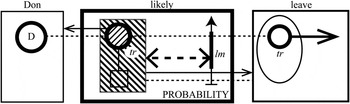
Let us begin our analysis with an example of SSR. Langacker (Reference Langacker1995) argues that raising, whether it be SSR, SOR, or OSR, Footnote 16 is a metonymic shift. For example, in the SSR sentence Don is likely to leave, the raising verb is likely to profiles a thing as its trajector, whose location on the probability scale is mediated by a process in which it participates. This schematic process is the trajector’s active zone (p. 32). As a consequence, the raised noun phrase, Don, functions like a topic in that Don calls to mind a process involving Don. The CG diagram for this example is provided in Figure 2.
Don is likely to leave (redrawn after Langacker, Reference Langacker1995, p. 32).

Figure 1, a typical example of SSR, demonstrates the discrepancy between active zone and profile. First, note that Don (D) in the left box corresponds to the trajector in the inside box of the middle box, as notated by the dashed line, which also corresponds to the trajector in the right box. Also note that the hatched rectangle in the middle box is elaborated by the right box (leave), and the trajector in the middle box is elaborated by the left box (Don).
Now, let us focus on the middle box to show the discrepancy. Here, what is profiled (note the thick line) in the hatched box is the trajector (Don), but the box (not the trajector) interacts with the probability scale. Then, as Langacker argues, SSR exhibits a case of profile/active-zone discrepancy.
5.2. the case of ECR
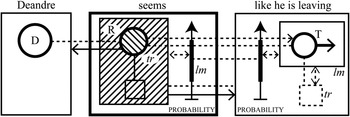
The epistemic CR examples with a pronoun copy exhibit a great similarity to those of SSR. Figure 3 shows the CG diagram for the sentence Deandre seems like he is leaving. The only noticeable difference between Figure 2 and Figure 3 is observed in the right box. As a schematic preposition, Footnote 17 like invokes a relationship between two entities and places the landmark on the probability scale, which corresponds to that profiled by seems. The implicitly invoked trajector of like corresponds to the trajector of the clause he is leaving, where he is a target of the reference-point subject Deandre. Similar to SSR, this CR example illustrates a profile/active-zone discrepancy in that the trajector’s (Deandre) probability scale (seems) is mediated by the process (he is leaving) in which Deandre also participates as a trajector; the process (he is leaving) is an active zone in this case.
The CG diagram for Deandre seems like he is leaving.

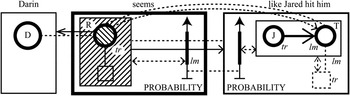
Next, let us consider the example Darin seems like Jared hit him, the diagram of which is provided in Figure 4. Figure 4 is identical to Figure 3 except that the reference-point relationship is established between Darin and the landmark of the relationship profiled by hit. Consequently, the implicit trajector invoked by like corresponds to the landmark of the hit-relationship.
The CG diagram for Darin seems like Jared hit him.

We have shown that the examples of ECR with pronominal copies are similar to SSR, particularly in the sense that both of them show a case of profile/active-zone discrepancy. The unique property of CR is an additional reference-point relationship established between the matrix-subject and a thing (whether it be a trajector or a landmark) profiled in the like-clause.
5.3. the case of the PR verbs
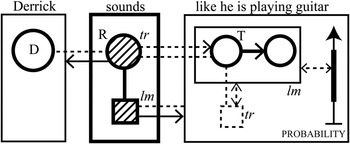
Figure 5 shows the CG diagram for the sentence Derrick sounds like he is playing guitar. The right box is identical to that of Figure 3 and Figure 4. However, the middle box that characterizes sounds is different from seems; sounds does not invoke a probability scale, and this construction does not exhibit a profile/active-zone discrepancy.
The CG diagram for Derrick sounds like he is playing guitar.

In Figure 5, the trajector of sounds (Derrick) corresponds to the trajector (he) of is playing, and both of them are anaphorically linked, where Derrick is a reference-point in relation to he. Just like Figure 2, the implicitly invoked trajector of like corresponds to he. Finally, the landmark of sounds is elaborated by the like-clause.
We are also interested in PR verbs without a pronominal copy, such as Erica sounds like Jean cooked salmon. The CG diagram for this sentence is provided as Figure 6. The crucial difference between Figure 6 and Figure 5 is the matrix-subject’s reference-point role. While Derrick is a reference-point in respect to a thing in Figure 5, Erica is a reference-point in relation to (x sounds like) Jean cooked salmon, Footnote 18 where x corresponds to Erica. This is because the implicitly invoked trajector of like does not correspond to Jean or salmon clause-internally. Instead, it corresponds to the trajector of sounds clause-externally. As a result, the preposition like establishes a relationship between the clause Jean cooked salmon and its trajector, Erica. This correspondence enables the conceptualizer to interpret Jean cooked salmon within the dominion of Erica via the given auditory stimulus, yielding a rough paraphrase like ‘Considering how Erica talks, (I guess) Jean cooked salmon’. The clause Jean cooked salmon is interpreted within the dominion of Erica: precisely the function of the external topic construction.
The CG diagram for Erica sounds like Jean cooked salmon.

Now, let us revisit Heycock’s example, re-introduced as (55), which Landau treated as an anomaly or something that does not fall within the purview of his research.
-
(55) That book sounds like everyone should own a copy.
In our analysis, the metonymic nature of that book is naturally explained. Just like Figure 6, that book in (55) is a reference-point in relation to (x sounds like) everyone should own a copy with a rough paraphrase like ‘As for that book people are talking about, (I believe) everyone should own a copy (of it)’. The reference-point phenomenon can facilitate a referential shift when the phenomenon is metonymic in nature. In (55), that book illustrates a referential shift from content to physical tome. Though being a reference-point does not guarantee a referential shift, Footnote 19 the metonymic reading of (55) is quite expected in our analysis due to the inherent connection between metonymy and reference-point. In fact, “metonymy is basically a reference-point phenomenon” (Langacker, Reference Langacker1993, p. 30).
5.4. expletives and setting subjects
Before we present our analyses of the expletives, we would like to illustrate the characterization of there (Langacker, Reference Langacker1991a, pp. 351–355). Langacker suggests that there and the be verb be treated as an integrated unit based on example (56). In this example, “people is not the logical subject of say but only of dance, yet the main clause verb is plural” (p. 354). Nonetheless, the choice of the number value is plural in this case. As Langacker briefly notes, it seems that there undergoes a semantic extension to be construed as a special type of plural. This is because multiple participants are involved in the situation described in (56).
-
(56) There are said to be people dancing in the streets.
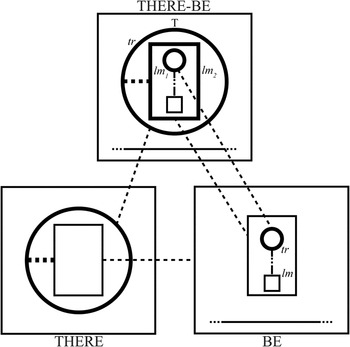
The schematic CG diagram for there is shown in Figure 7. Here, there designates an abstract setting construed as hosting some relationship represented by the dotted line inside of the circle in the bottom left box. This corresponds to the relationship profiled by be as shown in the bottom right box. In the composite structure, illustrated in the top box, we observe the shift in focus, resulting in the trajector status conferred on the setting.
The characterization of there be (redrawn after Langacker, Reference Langacker1991a, p. 353).

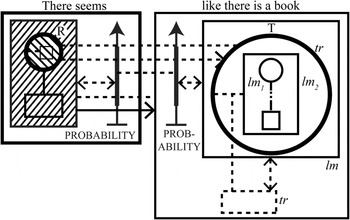
Based on Figure 7, Figure 8 illustrates the CG diagram for the sentence There seems like there is a book. In the right box of Figure 8, there acquires an abstract setting subject status, and it corresponds to the implicit trajector of like. The left box illustrates seems, which is almost identical to that of other previous examples. As shown in the right box, there shifts to the setting subject, which in turn corresponds to the trajector of the matrix-subject. As a setting subject, the trajector of the matrix clause does not have to be elaborated by another thing; the setting subject status fills the need for a subject. This is why the copy of there is permitted only in the subject position; this is where maximally generalized settings appear.
The CG diagram for There seems like there is a book.

Our analysis correctly predicts the unacceptability of (57–58). In (57), while there is a setting subject, in the street is a location, which is part of a setting (Langacker, Reference Langacker1991a, p. 300). Therefore, the correspondence relation cannot be established between the two. Note that the reference-point and the target are anaphorically linked in the CR construction. (58) is unnatural due to the ‘depth’ of the correspondence. The upper there corresponds to the there in the ‘deepest’ clause.
-
(57) * There seems like people are dancing in the street.
-
(58) * There seemed like John said there were people dancing in the street.
Another expletive, it, is illustrated in Figure 9. The expletive it also functions as a maximally generalized setting subject in this case, while there denotes a thing-like property. Figure 9 is almost identical to Figure 8. The only difference is the lack of the correspondence relationship between the trajector of seems and the trajector of the like-clause. Instead of corresponding the two trajectors, the strategy adopted here is to confer the trajector status to the entire setting, which is very close to sentences like it is raining and it’s hard to finish this paper, etc. For this reason, sentences like it seems like there is a book are no different from it seems like John is happy, etc.
The CG diagram for It seems like there is a book.

Then, why is a sentence like There seems like it is raining unacceptable? This is because, as a thing-like setting subject, there (notated by a circle) needs a target, which is the property of the CR construction. However, as a maximally abstract setting subject without a referential identity, it fails to be there’s target. The rescue mechanism is to replace there with it, yielding it seems like it is raining, where two instances of it acquire their setting subject status independently, without requiring any referential identity.
The maximally abstract setting subject status of it makes sentences like (59–61) acceptable in an informal context.
-
(59) You should eat the relevant pages. Seems like you’d get more of the test material in you that way. (COCA 2012 FIC)
-
(60) “Is he all right?” the girl said. “Appears like it,” Raymond said. (COCA 1998 FIC)
-
(61) And he was in there. He was talking on the phone. Sounded like he was talking to Susan. (COCA 2010 SPOK)
The expletive it cannot be used as a reference-point to any thing target, nor can it build an anaphoric link with its pronominal form. What it does is to provide a setting which the participants occupy. Consequently, the setting is often contextually understood without its explicit grammatical realization.
6. Conclusion and summary
We developed a CG analysis of the CR construction and demonstrated that reference-point plays a crucial role in licensing the matrix-subject of CR, whether the CR verbs are epistemic or perceptual resemblance. In this sense, our approach can be considered a single-licensing mechanism, distinct from the majority view of a dual-licensing mechanism.
We demonstrated that the ECR construction with pronominal copies exhibits great similarities to SSR in that both of them involve a typical profile/active-zone discrepancy. The differences between the two cases are symptomatic of the different degrees of reference-point manifestation. Since CR shows a prototypical reference-point relationship, the matrix verb of CR requires an aboutness topical reading. The same does not hold true for SSR, because the matrix-subject of SSR is a not prototypical reference-point. We extended our analysis to CR constructions containing PR verbs, demonstrating that they are not crucially different from those with epistemic verbs concerning the optionality of pronominal copies. We also demonstrated that expletive raising need not be treated separately as a purely syntactic mechanism, because the lack of topicality of the matrix-subject in this case is a natural consequence of expletives’ setting subject nature.
Throughout this paper, we illustrated that our analysis explains a wider range of data without positing additional assumptions or mechanisms. Moreover, we argued that examples treated as marginal cases by previous researchers, such as possible metonymic interpretations of these constructions, are at the heart of the CR construction and are naturally explained in our analysis.