India's capacity to not only sustain but consolidate her democratic political system in the face of difficulties, which have led many political scientists and commentators to predict the opposite, has generated a wealth of literature over the years. This article does not wish to add to it. India's assets are well recognized in the literature. While the primary success of India's democracy is its successful negotiation of a complex politics of recognition, it has been consistently guided by ideas that encouraged slow and persistent transformation rather than quick solutions to her major problems. It is in this context that the political institutions became so vital to the success of democracy in India. While not all such institutions are democratic bodies, they play a vital role in keeping the system running. The major institutional pillars of the Indian democracy – Parliament, the civil services, and the judiciary – perform very different but are critically important functions for the political system. Parliament is the chief institution for democratic legitimacy of public policy; the civil service is supposed to be the most efficient, and politically neutral professional agent of public policy; and the judiciary functions as the most reliable and effective antidote to the misuse of political power by the executive and is the best guarantor of people's rights. Other institutions of national significance include the Election Commission, the Central Bureau of Investigation (CBI), the Central Vigilance Commission (CVI), and the Comptroller and Auditor General of India (CAG). Local self-governing bodies, non-government organizations, press and electronic media, and many major pressure groups have crucial significance.
However, in recent times, studies have revealed disturbing trends in the performance of these major institutions, compromising the quality of governance in India. Instances of inefficiency in legislative and administrative procedures have been made more acute due to increasing incidence of corrupt practices. The continued exposure of high-profile scams and scandals across the bureaucracy, judiciary, and even anti-corruption agencies seem to have coaxed democratic institutions in India to partake of an unexpected litmus test and laid bare the plague of corruption infesting the very fibre of the political system. An ever-demanding civil society has mobilized itself to ascribe overriding importance to the issue of tackling corruption, and demanded rapid action on the part of the Central Government.
This article argues that the steady decline noticeable in the performance of the major institutions of governance and administration in India is symptomatic of the entrenchment of corrupt practices and erosion of morality at the behest of private and personal gain among the politically and economically powerful sections. Keeping in mind the different theoretical notions of corruption and the institutional roles envisioned by the founding fathers of the Indian Constitution, it delineates the increasing trend of corruption and departure from prevailing morality in Parliament, the civil service, and judiciary. It further supports the present vigil being demonstrated by civil society as it is not only the hallmark of a functioning democracy but also key to a comprehensive institutional response to corrupt practices and to relevant measures of reform at the present time.
Institutions and their changing contexts
A brief introduction to India's political institutional set-up would be pertinent before assessing the decline in performance and the related festering of corruption. Guided and governed elaborately by its Constitution as the supreme law of the land, India runs a parliamentary democracy within a federal system, where the executive in the form of the cabinet remains collectively responsible to the legislature. The cabinet led by the Prime Minister is the prime mover of the system. All policies are sourced in and formulated by the cabinet. Hence, the most important decisions are made by this body. But the cabinet operates in and as a part of Parliament since there is no structural separation of power in India. Moreover, the ministers are all members of Parliament, a fact that reflects both on the calibre of the former and the performance of the latter to help. Third, ministers perform to the extent Parliament allows them to showcase their skills. While modern legislatures are neither modeled on rubber stamp delegates or willing and free representatives but operate on party lines, since it is the party that unites the member in a common sympathy and coheres the executive by affording a clearly recognizable majority in the legislature, numbers do not mechanically determine policy outcomes or control transactions in a noisy democracy such as that of India. Parliament remains the most crucial political body since it adjudicates the meaning and substance of politics in the first place.
The civil service in India has remained distinctly Weberian in inspiration and practice though the principles of rationalization have fallen apart. It is the only permanent executive of the state and civil servants professionally trained to implement public policies throughout the country. While the classical idea is that policies originate in people's chambers, it is not uncommon to witness an active role of the civil service in these domains. The appeal of the civil service lies in its professionalism, being based on a highly competitive and rigorous recruitment process that allows only the best in the country to join the upper echelons of the services. The domination of civil bureaucracy over their military counterpart further augments its prestige, and the relative insipidity of military careers adds to the popularity of the civil service. The intricacies of the federal structure and the vast expansion of state activities in all spheres of life over many decades have expanded the reach of the bureaucracy manifold. The office of the District Magistrate still remains one of the most important symbols of government power in the daily lives of the people who worship, love and hate its dispensation as the case may be. It is pertinent to remember that law and order remains a high priority responsibility for the services. Given the growing political instability and violence in India, the significance of the civil bureaucracy has actually increased considerably. Their role may stand contested as agents of development, but they continue to serve as the chief custodians of the state.
The judiciary is a complex institution, for its role and significance can have different effects for the agents of democratic politics. Post-1951 history show-cases this complexity. From the very outset, the judiciary took the executive as its competitor. For a long time though Parliament dominated the judiciary, and judges commented on constitutional matters intermittently and without a great deal of confidence. It was not uncommon to see legislatures overturning judicial pronouncements if it clashed with their perspectives. The repeal of the right to property as a fundamental right and the introduction of socialism and secularism to the Preamble are good illustrations of legislative dominance over the judiciary. As time passed, however, the balance changed substantially.
Over the last decade, India witnessed unprecedented judicial activism that clearly challenged the political dominance of the executive and the legislature. Judges have not only provided landmark judgments in controversial cases, but they have frequently intervened in matters of policy that seem to challenge the original wisdom of the makers of the Indian Constitution. The complexity here is two-fold. On the one hand, the judiciary is a non-elected body of public authority which has no democratic accountability. While it is certainly possible for the public to err on particular matters, the wisdom of the judges can also be limited by bias and conservatism. Socially progressive entitlement policies often require radical policy changes that may be checkmated by conservative judicial opinion. Moreover, judicial settlement of controversial public issues forecloses democratic deliberation by removing it from the public arena.
The above account of the generic nature of the roles of the three major institutions of Indian democracy cannot overlook the truism that institutions do not function in a vacuum. In India's case, there are many and often overlapping contexts to them. Of these, Parliament and the civil service are more directly embedded in contexts. The peculiar nature of the judicial function may safely keep it out of perspective without any marked injury to its reputation. But even judges are real characters; they are also invariably sensitive to their contexts.
So far as these contexts go, three things are highly pertinent. First, India has witnessed a change in the discourse of development. Thus, the state is no longer viewed as exclusively responsible for development. Its role is more as a facilitator and regulator of a broadly capitalist path of development. The onus has shifted to private players, and the state, both in terms of its political narratives and official infrastructure, has to recognize this. In other words, the political economy of the Indian state has taken a decisive liberal turn and the actors must necessarily readjust. All major political parties recognize a schizoid character in its political dynamics. They must push liberalization and reforms, but also restrain them. Parliament has also come to represent this dual tendency, braiding reforms with social justice and populism, and balancing the claims of private accumulation and public welfare through democratic means. As an obverse, and consequent to this trend, indulgence in corrupt practices has gained rapidly, manifest through the malfunctioning of the institutions that uphold the political system. Rampant corruption amongst politicians and civil servants, criminalization of politics, the steady decline in political prominence of respectable, educated and principled politicians, the rise of the lumpen and strongmen have become the order of the day.
Following this, and serving as yet another context to the functioning of the system, there has been unprecedented mobilization of the underprivileged and backward classes in India, primarily through its democratic processes. More and more people have sought justice and recognition by voice. But this puts a tremendous load on the mobilization capacity of the political system, as the reigning institutions were originally not designed to handle mass demands of such a scale. Hence, the main challenge today before many of these institutions is to upgrade their capacities.
Corruption: prevalent practices and understandings
The phenomenon of corruption and its discernible implications has rendered its usage and understanding as essentially negative and detrimental to progress. The growing awareness of the existence of corruption has simultaneously generated a voluminous literature on it that has transcended academic disciplines and explored exhaustively its causes, effects, and role in the economic, political, social, and cultural milieu in general and in specific regions and countries. As Paul Heywood observes, ‘By the mid-1990s, it appeared that no nation was immune to the corrosive impact of political corruption. Academic interest in the phenomenon experienced a parallel upsurge, characterized by a proliferation of conferences devoted to the issue, with related publications’ (Heywood, Reference Jaffrelot1997: 1).
One of the most accepted definitions of corruption came from economist Klitgaard; corruption equals monopoly plus discretion minus accountability (Klitgaard, Reference Klitgaard1984: 4, cited in Harrison, Reference Harisson2007: 676). Sociologists and political scientists have also conducted pertinent research on corruption over the years. Gould and Kolb define corruption as the use of power for profit, preferment, or prestige, or for the benefit of a group or class in a way that constitutes breach of law or standards of high moral conduct (Gould and Kolb, Reference Gould and William1964: 142; Van Roy, 1970: 86). There is also a well-developed literature on corruption arising from social anthropology. This explores the nuances between bribery, nepotism, graft, extortion, and so on, and reflects on the relation between people and bureaucracies. Yet, no general theory of corruption has evolved to date and the studies seem quite scattered. As Robert Williams highlighted by the end of the 1990s:
The 1990s have been the decade of corruption as an academic and policy topic and there is no indication that popular, academic, professional or political interest is beginning to flag. The literature is voluminous and varied but most accounts share a common characteristic: a reluctance to say what they mean by corruption. This issue is either avoided completely or dismissed in a cursory fashion. (Williams, Reference Williams1999: 503)
A brief overview of the available literature denotes a few major trends. There is a sharp focus on public office and private interest in much of the definitions of corruption. It was understood as the abuse of political office for private gain. However, a series of scandals involving private sector firms such as Enron and World com in the United States prompted the rethinking of this definition. Subsequently, watchdogs such as Transparency International and others referred to corruption as the abuse of trusted authority for public gain (Harisson, Reference Harisson2007: 674). Secondly, the theoretical paradigm of corruption often follows on any one of the three lines; ethnocentric, functionalist, or evolutionist. Ethnocentrism has been followed widely by many scholars. It attacks corrupt practices as departures from prevailing morality. Functionalism is employed by high-powered social science research, where the focus is on the purposes or ends served by particular institutions. Assuming a very different position from these theoretical schools, evolutionism regards corruption to be symbolic of the locus of economic and social change (Van Roy, 1970: 88–90).
Thirdly, much of the literature on corruption was also generated as a part of the donor development discourse, championed mainly by the World Bank, following the practice of the structural adjustment programme in third world countries. Almost as an auxiliary to this, there has also emerged a substantial amount of literature on anti-corruption, which is widely disseminated through the anti-corruption portals. Fourthly, the ontology of development and governance has also often been ensconced in an understanding of corruption in many of the third world countries. In fact, Philip Oldenburg even asserts that we cannot understand how third world countries are governed or misgoverned unless we understand the causes, mechanisms, effects, and scope of corruption (Oldenburg, Reference Oldenburg1987: 509).
India and the corruption matrix
Corruption has remained one of the most crucial features in the political milieu of third world countries. Political corruption, in its various forms, has plagued the functioning of the public sphere and also the public–private interface. India has not been successful in escaping this degeneration. As countries all over the world succumbed to corruption in the decades of the 1990s, Samuel Paul, in an interesting article wrote that urban and rural households in India consider corruption, along with poverty and unemployment, to be the three most important problems facing the country. (Paul, Reference Paul1997: 1350). By 2010, Transparency International's 2010Corruption Perceptions Index, ranked India as 87 out of 178 countries (Transparency International, 2010). This has tarnished the nation's image as well as effected governance. India's Planning Commission Deputy Chairman, Montek Singh Ahluwalia, has recently stated at the World Economic Forum that corruption not only demeans the social acceptability of growth achieved by the nation, but also reduces actual growth (Chawla, Reference Chawla2011). Economists point out that corruption in the public sector hinders economic growth, reduces trust, legitimacy, and social capital, and leads to greater political instability while systematically hurting the poor by reducing the efficiency of the provision of public goods to citizens (cited in Charron, Reference Charron2009: 2). The phase of economic liberalization in India initially reduced ‘red tapism’, and witnessed record growth rates of 9.6% in 2006 and 9.2% in 2007. However, the overall impact of economic growth has remained uneven across social groups, with certain sections experiencing acute levels of poverty. A 2008 National Corruption Study commissioned by Transparency International India focused on below-poverty line households and revealed the total paid by the poor in bribes in one year on 11 basic services, namely: the public distribution system, hospitals, school education, electricity, water supply, land records and registration, housing, forests, National Rural Employment Guarantee Scheme, banking and police service, traffic and crime was Rs 8,830 million. It was further estimated in the same study that the poorest households paid Rs 2,148 million to the police in bribes (The Statesman, Reference Van Roy2011a: 1).
It would be pertinent at this juncture to provide a brief historical account of the caution against corruption in India and the early academic perspectives. The issue of corruption and the need to articulate institutional safeguards were addressed at the national level in the immediate aftermath of India's independence. The A.D Gorwala Report, Reference Gorwala1951 was one of the earliest official documents that laid bare the problem of corruption. It was particularly harsh on the role of political leadership, setting examples before the public. It unequivocally stated that if the public is to have confidence that moral standards prevail in high places, arrangements must be made that no one, no matter how highly placed, is immune from enquiry if allegations made against him are made by responsible parties and if a prima facie case exists. There should be no hushing up or appearance of hushing up for personal reasons (cited in Sondhi, July Reference Sondhi2000: 8). The next most serious discussion in the Indian Parliament on the subject of corruption took place in the early sixties when Lal Bahadur Shastri was the Home Minister. Under his direction, a committee, headed by K. Santhanam, Member of Parliament, was constituted to study corruption and to suggest measures to control this menace.
The academic literature on corruption in India gained significant attention in the 1960s. Gunnar Myrdal had noted in Reference Myrdal1968 that corruption was ‘rampant’ and ‘growing’ in certain countries ‘particularly among higher officials and politicians, including legislators and ministers’. Paul Harisson's vivid delineation of the impact of corruption also seemed relevant for the Indian case. He stated that corruption eats away at the foundations of trust between people and their rulers. It exemplifies the two key weaknesses of the developing state: the unholy marriage of political and economic power whereby money buys influence and power attracts money, and the ‘softness’ of the state. It is a symptom of government incompetence and in itself further undermines the government's ability to rule (Harisson, Reference Harisson1981: 367, 368). Granville Austin observed that the progressive centralization of power during the regime of Indira Gandhi and the absence of progress towards social revolution rendered a low point for democracy in the country, thereby eroding the credibility of the government. In the post-Indira Gandhi period of Indian politics, public mistrust of politicians was underlined by the perceived effect of ‘money power’ on elections and the extension of money corruption from peon to Prime Minister (Austin, Reference Austin, Hasan, Sridharan and Sudharshan2002: 332–6). Political scientists like Sushila Ramaswamy echoed this view by asserting that political corruption is essentially based on certain broad categories such as scarcity, ethical standards, power and position and unnecessary state regulations. To the last category belong the licence quota raj in India; it generated unnecessary corruption and lack of competitiveness in our industrial sector. She further asserted that in India corruption encourages a particular kind of subservient behavior that accepts patron–client relationships and looks to independent initiative, risk or innovation with suspicion. The first casualty of systemic corruption is denial of just reward and just meritocracy, the twin principles by virtue of which a well-ordered society maintains upward mobility and efficiency (Ramaswamy, 24 February Reference Ramaswamy2011).
Institutions combating corruption in India
The current anti-corruption infrastructure of India evolved from the studies and recommendations of the Santhanam Committee in Parliament. It consists of the Central Bureau of Investigation, the Central Vigilance Commission, the Directorates of Vigilance and Anti-corruption in the states, the Comptroller and the Auditor General, and the Election Commission. The Santhanam Committee observed that the involvement of Ministers in corrupt practices was one of the chief reasons for the growth of corruption. The sixties, seventies, and early eighties saw this anti-corruption infrastructure perform with a certain degree of professionalism. In 1963, the Central Bureau of Investigation (CBI) was established with an anti-corruption division. However, as the CBI is under the total control of the government, it lacks the autonomy to tackle corruption sternly enough. The Central Vigilance Commission (CVC) was formed in 1964 to perform four specific functions: to investigate an improper transaction by a public servant; to probe the improper use of power for corrupt purposes by civil servants, including those belonging to the coveted all-India services; to supervise the anti-corruption work of ministers, departments, and public enterprises; and to request the CBI to investigate a case.
The electoral system is one of the major instruments for translating political democracy into action and it also reflects the economic and social democratic system prevailing in the country. The Constitution of India provides for the establishment of the Election Commission under Article 324 for superintendence and direction of electoral processes. It is a semi-autonomous institution in its operation and consists of the Chief Election Commissioner and two Election Commissioners, appointed by the President at the behest of the Prime Minister. The Chief Election Commissioner maintains the election machinery, and different rungs of the administration carry out its operations throughout the length and breadth of the country. Apart from the Commission, the Constitution of India does not provide for any other permanent structure to administer the elections. Administrative officers at the state and district levels are charged with additional duties during the period of general election.
The Comptroller and Auditor General of India is the most important instrument of financial accountability in the country. It has a dual role to perform: to ensure that the executive complies with the various laws passed by the Legislature in letter and spirit, and to ensure compliance by subordinate authorities with the rules and orders issued by it. As the head of the Indian Audit and Accounts Department, it is neither a part of the Legislature nor the Executive but operates as a role created by the Constitution to see that diverse authorities act in regard to all financial matters in accordance with the Constitution and the laws and rules framed by it. The legal basis for its functions is provided by the Comptroller and Auditor General's (Duties, Powers, and Conditions of Service) Act, 1971. The Constitution provides for a unitary audit by the Comptroller and Auditor General of India, who conducts the audit of the accounts of both the Union and the State. It may also undertake Special Audits at the request of the Government.
The Comptroller and Auditor General are required to follow specific standards, practices, and guidelines in conducting auditing and reporting. He can engage consultants and/or obtain professional services in conducting an audit. He can also consult and collaborate with other countries/SAIs and International Organizations on matters relating to an audit. Apart from the certificates of the Appropriation and Finance Accounts of the Union and of various States and submission of separate Audit reports on Statutory Corporations and other autonomous bodies for which he is the sole auditor, the Comptroller and Auditor General of India bring out a large number of reports relating to the Union Government and the State Governments. These reports incorporate important audit findings and performance reviews of systems, projects, and programmes, and comprehensive appraisals of public enterprises and other bodies and authorities. He also reports on acts that infringe upon State economic interest like mass embezzlement of State assets, serious losses, and wastes. These reports are laid before Parliament and the State Legislatures concerned every year (Comptroller and Auditor General, Government of India, www.cag.gov.in/).
India passed the Right-to-Information Act in 2005 as one of the key initiatives to prevent and curb corruption in the country. It mandates timely response to citizen requests for government information. It is an initiative taken by Department of Personnel and Training, Ministry of Personnel, Public Grievances and Pensions to provide a RTI Portal Gateway (Right to Information: A Citizen Gateway, http://rti.gov.in/) for the citizens to make quick searches for information on the details of the first Appellate Authorities, PIOs etc. amongst others, besides access to RTI related information/disclosures published on the web by various Public Authorities under the Government of India as well as the State Governments (Government of India, Reference Heywood2005). However, the Act and the right it conferred on the citizenry had to weather much storm of dissent waged by the powerful sections of Indian society, a detailed dynamics of which merits an independent discussion.
The CVC has also recently articulated a Draft Anti-Corruption Bill in 2010 which reflects on the state of corruption in India. It reviews existing laws and regulations, political, administrative systems, the issues of political finance and electoral funding to highlight the inaccessible, non-responsive and cumbersome nature of systems. It makes a case for revisiting these policies, provide an effective check on unwarranted practices and recommends undertaking of constructive steps like the formulation of a National Judicial Council, regular integrity checks in the judiciary; increasing the role of institutions such as the Central Vigilance Commission, Central Bureau of Investigation, Comptroller and Auditor General, National Crime Records Bureau, State Anti Corruption Agencies, Ombudsman Institutions. It highlights the need to create a ‘social infrastructure for fighting corruption’; the fullest utilization of Right to Information Act, Social Audit, Citizens' Charters, Integrity Pact; ensuring accountability of Panchayati Raj Institutions; providing for collaborative efforts with the government; and finally the ‘role of citizens in 367 anti-corruption’ and weeding out corruption breeding. There are special courts for speedy trials of corruption cases to ensure speedy justice (Central Vigilance Commission, 2010).
Corruption in India's institutions in recent times
Despite the elaborate institutional framework created over the years to combat corruption, there is no indication that such practices are in decline; in fact, it has become rampant and pervasive. While in the last decade, many leading politicians, judicial appointees, and civil servants have been charged with misdemeanors, irregularities, and corrupt practices in specific cases, in the last year itself, a spate of high-profile corruption scandals has rocked the Indian government and is threatening foreign investor confidence. The major scams include allegations of graft against officials responsible for last year's Commonwealth games hosted by New Delhi, a telecom scam involving the government that may have cost the exchequer nearly $40 billion, and a housing scam in which politicians, bureaucrats, and military officials are accused of taking over real estate intended as housing for widows of soldiers of the country.
Needless to say, the performance of Parliament, civil services, and the judiciary has not been satisfactory in dealing with the problem of corruption. Academic observations and media investigations have persistently highlighted the dwindling efficiency and rise of corrupt tendencies. Indeed, it would be pertinent at this juncture to examine in some detail the accusations levied at each of these institutions.
India's ascriptive identity politics has ushered in what Jaffrelot so evocatively describes as a ‘silent revolution’ in modern Indian democracy (Jaffrelot, Reference Kapur and Pratap Bhanu2003) and this has affected the institutions individually, making them susceptible to corrupt tendencies. Parliament seems to represent a class of new elites, who, according to Rob Jenkins, could make politics more inclusive only through sabotage, by engaging ‘in systematic corruption when given the opportunity that even limited shares of state power conferred’ (Jenkins, Reference Jenkins2007: 56–7). Many analysts of Indian states and politics seem to agree on this point. Kanchan Chandra calls India a ‘patronage democracy’, based on an exceptionally robust identity-based form of clientelism (Chandra, Reference Chandra2004). Parliament has come to reflect this trend: one that ‘excuses graft as an unavoidable accompaniment to democratic deepening under Indian conditions’ (Jenkins, Reference Jenkins2007: 57). Parliament, in other words, is a vehicle and expression of India's complex politics of recognition, which is manifest in its performance.
Devesh Kapur and Pratap Bhanu Mehta in their highly influential study lament, ‘Most observers, including parliamentarians, agree that the reputation of Parliament has generally declined over the last two decades’ (Kapur and Mehta, Reference Kapur and Pratap Bhanu2006: 16). While, the self-abdicated functions of Parliament are too glaring to be missed, particularly when it comes to its surveillance of the executive through the highly commendable provisions of various committees, the pathologies are deeper. The breed of Indian parliamentarians has changed and the new crop of public representatives would go to all lengths to refurbish the patronage-based system that constitutes the logic of Indian democracy. Parliament then cannot but be a bitterly contested oppositional space rather than a site for cultured and honest debates.
Corruption, financial scams, the increasing apathy of parliamentarians to engage in substantive debates and perform their mandated functions with care and commitment, criminalization and the high costs of the electoral system are some of the glaring problems facing Parliament. Studies reveal that Parliamentarians do not sit for full sessions or transact business civilly and with decorum, that they disrupt sessions with remorseless impunity, and show little skill in debating points. They have virtually consigned the Committee system to the scrap-heap of time. This apparent insanity is well patterned. In the new political system of India, Parliament is less a talking shop. It is an expression of the intense political tug of war between diverse groups. The polarization of the polity has redefined Parliament. Its deliberative function is lost. It is a spoilt system that runs on distributive packages. The real fear that lies ahead is the prospective institutionalization of the spoilt system as a proxy for legislation which would be calamitous for the health of India's democracy. Parliament is the deliberative conscience of the political process, entrusted with the responsibility of executive audit. If the present trend holds, it will be a requiem for the institution as conventionally held.
In December 2005, 11 Members of Parliament were expelled for their involvement in the ‘cash for posers’ scam, and following the acceptance of the Bansal Committee Report by the Lok Sabha. This was the second time in Indian political history, the earlier being in 1951, when an ad-hoc Committee of the House in the Provisional expelled H.G Mudgal who was found guilty of entering into arrangements with Bombay Bullion traders for raising questions and other issues in the House for money. In that same month, seven Members of Parliament were caught on camera in a sting operation that purportedly showed them asking for kickbacks from undercover reporters for sanctioning projects under the MP local area development scheme (The Statesman, 25 December 2005: 1).
The dereliction in duty is particularly galling for Parliamentarians which cost a hefty a sum to the national exchequer. The MPs now enjoy a package of Rs 1.6 lakh (US$ 3,034.44) a month by way of pay and allowances, which is much more than what the cabinet secretary gets at Rs 80,000 a month (US$1,517.22).Footnote 1 The current hike is expected to cost the exchequer a massive Rs 142 crore per annum (US$27,177,033.492)
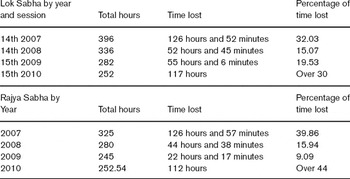
Truancy by parliamentarians as revealed by the officially released data on the number of days Parliament held sessions and the actual hours legislators conducted transactions during those sessions is a grave and disconcerting trend. Parliament's growing disinclination in executing its mandated functions is best captured by these harrowing figures of attendance, or rather lack of it. While the quality of work done while in session can also be questioned, the inability to undertake its primary responsibilities and its appalling record of attendance are extremely serious indicators of legislative amnesia. The financial implications are equally serious. Parliament spends Rs. 29,000 (US$549.99) on every minute of its functioning. Loss of an hour's productivity makes Indian citizens poorer by Rs 17.4 lakh (US$32,999.49) (see table 1).Footnote 2
Business hours and time lost in Indian parliament between 2007 and 2010

Notes: Figures for years 2007, 2008, and 2009 were collected from the Annual Report 2007–2008, 2008–2009, and 2009–2010 respectively. The data for 2010 were computed by the author from the PRS Legislative Research website www.prsindia.org/index.php (accessed on 7 February 2011) and Rajya Sabha Statistical Information from the website http://rajyasabha.nic.in/rsnew/press_media/statistical_information219.pdf and http://rajyasabha.nic.in/rsnew/press_media/statistical_information220.pdf (accessed on 8 February 2011]. According to India's Parliamentary Affairs Minister, Pawan Kumar Bansal, the Lok Sabha lost 31 hours and 48 minutes and the Rajya Sabha lost about 30 hours due to adjournments caused by ‘vigorous opposition to running of the house’, www.thaindian.com/newsportal/politics/parliament-passed-17-bills-during-winter-session-parliament-roundup_100293241.html (accessed on 8 February 2011).
Corruption, as already indicated, is a generic phenomenon and not peculiar to members of Parliament. It is difficult to say whether India's legislators are more or less corrupt than the other sections of society. While serious media revelations of shady financial dealings and connivance of some legislators with criminals and money launderers has strengthen this perception, public cynicism on this issue is to be granted.
Another facet of corruption affecting Indian legislature is the criminalization of politics. According to Kapur and Mehta, Reference Kapur and Pratap Bhanu2006: 17, ‘This phenomenon involves not just charge-sheeted criminals entering legislative assemblies, but also the fact that a significant number of MPs are beholden to criminal elements . . . There is good reason to believe that criminals are entering politics in order to use political power to stymie investigations against them’ (Kapur and Mehta, Reference Kapur and Pratap Bhanu2006: 17). But the real problem lies in the nature of India's political parties that are all tainted for having given election tickets to charge-sheeted criminals and musclemen. Strongmen fare well in elections since people fear their wrath and the administration is hopelessly lax most of the time. This has a demonstration effect. If a party succeeds in winning seats in difficult constituencies by fielding abominable candidates, others are emboldened to follow.
Parliament's record is not encouraging in tackling this problem. It has not yet passed a comprehensive law that will disallow anybody having a criminal record of any kind from entering the political fray. As many as 21 political parties representing the entire spectrum of Indian politics came together in a rare show of unity to reject unanimously the Election Commission's (EC's) order, which was based entirely on a 2 May judgment by the Supreme Court of India seeking comprehensive legislation to address the question of criminalization and corruption in politics, making it mandatory for candidates seeking election to declare their financial assets, their criminal antecedents, and their educational background along with their nomination forms. While it was ultimately decided to implement the Supreme Court judgment, political party members across the spectrum ensured its dilution so much that its impact was negligible.Footnote 3 Unlike the problem of corruption, however, it is easier to fight criminalization through Parliament. A comprehensive legislature as originally sought by the Supreme Court would legally debar criminals from contesting, and, even if a few escape the dragnet, their influence will be nothing compared to current standards. The fact that political parties have persisted in their dilly-dallying with such legislation reveals their apathy to cut off ties with the world of crime that not only greases their palms but also pays rich electoral dividends.
Corruption of the civil service is a complex matter.Footnote 4 The upper echelons of the services still induct some of India's most meritorious students. The pay and other allowances of services are reasonably attractive compared to private sector facilities. But the services carry power and aura that are missing from their private counterparts. Many join the services for pecuniary benefits unrelated to their normal income. In addition, there is the lure of making more money by rigging the system. The perversion is accentuated with the classical function of bureaucratic rationalization with the near collapse of the private and the public and the latter's ascendancy over the former. Thus, the traditional triggers of motivation have become largely dysfunctional and wealth rather than anything else has often filled in the vacuum.Footnote 5 At lower levels, pay has remained relatively low and depressing while the demonstrative effects of a fast consumerist society have undermined existing levels of rectitude.Footnote 6 Civil servants have misused Article 311 of the Constitution, which provides protection against wrongful dismissal, to draw out cases against them to extreme lengths, making it difficult to remove a government servant for non-performance.
Politicization of services is also a major problem, not for the hackneyed stereotype of conscientious civil servants bullied into submission by wretched politicians, but because it tends to make civil servants nervous over the fickleness of tenure and compromises efficiency by seriously circumscribing the available time zones for career bureaucrats. Footnote 7
Most practitioners believe that in the critical sectors of the economy, institutions are not doing their best. Arvind Subramanian, for instance, argues, ‘Public institutions in the field of primary education – i.e. government-run schools – are characterized by rampant teacher absenteeism, ranging from 20 percent to over 50 percent in some states. It is not clear whether absenteeism has worsened over time but it would not be surprising if it had’ (Subramanian, Reference Subramanian2007: 16). He argues that high underperformance by public educational institutions has seen greater entry of private schools during the post-reform period and the private institutions are better in terms of the quality of education provided to children. While civil servants are not teachers, it is their responsibility to regulate the service since the bulk of funds come from the state and routed via public schools.
The judicial system, and particularly the Supreme Court, remains a venerated institution and its emergence as a real source of power is usually commended as the most positive thing to happen to Indian democracy. The Court had the executive fight gallantly during the dark days of the Emergency, and was finally made an independent body by the early 1990s. The judiciary has impacted on the political process through a series of landmark judgments. In a landmark ruling in 1993, the Supreme Court effectively debarred the executive from judicial appointments. And despite the problem of pending cases, the Supreme Court through innovations was able to reduce the large backlog of undecided cases before it from 120,000 to 20,000 (Mehta, Reference Mehta2003). As Arvind Subramanian explains, ‘And, through public interest litigation, it has moved aggressively, behaving more like the executive than the judiciary, in resolving long-standing public policy issues; cleaning Delhi's atmospheric pollution being the best known, but not only, example. While purists balk at this overreach, the Supreme Court appears to have gained rather than lost popular legitimacy because of the perception that such overreach is a necessary consequence of and response to an inefficient and weak executive’ (Subramanian, Reference Subramanian2007: 4).
The situation is grim at the lower levels of the judiciary though, and the masses suffer the most as the bulk of litigations are decided by the lower courts. Judicial inefficiency is a problem of financial allocation. It is palpable that the personnel and resources are inadequate relative to the demands facing the judicial system.Footnote 8 Analytically, slower disposals may indicate declining convictions that can either be the result of unholy alliances between the political establishment shielding the convicted and the judiciary, or it may also indicate greater restraint and objectivity in judicial assessment in the interests of unbiased and objective carriage of justice (Subramanian, Reference Subramanian2007: 7).
While the integrity of the highest judiciary is impeccable, there are corruption charges against lower courts. And, it may be recalled that, in the past, the judiciary had not only taken an inordinately long time in issuing effective orders in cases that involved prominent politicians, but could do nothing when its orders were not executed by the executive. The case of the 1984 massacre of Sikhs in Delhi and post-Godhra riots are other examples where the courts had not been able to persecute the perpetrators either because the prosecuting authorities failed to draw up charge sheets or the investigating agencies failed to submit clinching evidence.
Opinion is divided on the role of judicial activism. Many champion its virtues in creating social awareness, emphasis on human rights, and the battle it wages against executive abuse of power. Judicial activism promises rights to the powerless and demands limits for the all powerful. But others point to judicial inefficiency and corruption. Judge K.G. Kannabiran, a life’-time supporter of human rights, lamented, ‘If we go back to the Constituent Assembly debates, we will find that the primary anxiety was to secure an independent judiciary . . . We fought Indira Gandhi because she wanted a committed judiciary. Today we have a judiciary peopled by mediocrities . . . They are not ‘hindered’ by any vision of the world’ (Kannabiran, Reference Kannabiran2003: 219–20). Widespread delays and frustrating backlog undermine the ideals of a just society and weaken people's confidence in the judicial system. Enormously tortuous and protracted litigations compromise India's commitment to a just order predicated on social justice and economic development. Most crucially, it emboldens the executive which finds in the protracted deliberations of the judiciary opportunities for further consolidation. The challenge before the judiciary is to expedite its delivery mechanisms. But this requires the cooperation of the ruling elites, for funds are necessary to augment the capacities of the lower courts. Till criminalization and corruption remain vital accompaniments of the ruling elites, such sanctioning will not be available easily. Civil society has therefore to wage a grim battle to make the judiciary more efficient, consistent with the democratic tendencies of the political system.
The Indian constitutional judiciary is not by reputation immaculate, despite its powers to hold people and institutions in contempt. Two recent developments in this context are instructive. First, the Central Bureau of Investigation has allegedly unearthed startling details of the use of provident fund savings to furnish luxury goods for judges, and allegations have been leveled against one Supreme Court judge, 11 high court judges, and 23 district court judges. Second, in 2008, a Punjab and Haryana High Court judge allegedly went on leave following allegations of bribery (Chandrachud, Reference Chandrachud2010: 41). In March 2011, 16 charges of corruption and irregularities were slammed against the Chief Justice of the Sikkim High Court, Justice P.D Dinakaran, by a Panel constituting Rajya Sabha members (DNA India, 19 March, 2011b).
The degenerating efficiency of these institutions has prompted an easy yet unholy link between corruption and mal-governance. A 2010 report from the Washington-based think tank Global Financial Integrity blames India's poor governance on tax evasion and corruption, which result in illicit financial flows from the country of at least $462 billion. Some investment analysts say corruption is already a factor in declining foreign investment, which has been a key to India's growth over the last two decades, and is worrying domestic investors, too. Foreign institutional investors (FIIs) became net sellers for the first time in January since May 2010, shedding some $1.4 billion in holdings, according to industry data (Bajoria, Reference Barjoria2011).
Tackling corruption: institutional responses
While the framework of institutions and laws dedicated to tackle corruption is elaborate in India, a few issues beckon attention. The implementation mechanisms of the rules are routed through Parliament, civil servants, or the judiciary, which themselves do not remain untouched by corrupt practices. For example, the CAG reports to the Parliament's public accounts and public undertakings committees. Also, the CAG, CBI, and CVC are dependent on uncertain government grants and conformity with civil service rules for their human resources.
Secondly, as the World Bank Study on ‘Reforming Public Services in India’ (World Bank, 2006) shows, a multiplicity of anti-corruption institutions with overlapping functions undermines their coherence; a patchwork of Lok Ayuktas, State Vigilance Commissions, and Anti-Corruption Bureaus with widely varying functions constitutes the system for punishing corruption in India's states. Thirdly, since law and order is a state subject, the Central Bureau of Investigation (CBI) often cannot pursue corruption allegations against a member of the All-India Services, including the IAS, without state government permission. Thus, departmental disciplinary processes are rendered weakened.
A survey of corruption cases in the past decade would indicate that sound laws, rules, regulations, procedures, and methods of transaction of government business cannot by themselves ensure effective and transparent administration if the political and administrative leadership entrusted with their enforcement fails and abuses power for personal gain (Sondhi, 2000: 6). In other words, given the absence of political will or commitment by political leaders, tackling corruption will only be rhetorical.
Under the present circumstances, therefore, the actual need of the hour is to add teeth to the institutional structure addressing laws and rules against corruption. While the task can be undertaken on the one hand by introducing necessary reforms into the system, civil society and the media can act as a pressure group to sustain the momentum of consistent deliberation and action. The direct impact on the state exchequer has rendered fighting of corruption a development issue, and prompted the rapid mobilization of civil society groups, especially in the last few months. Indian businessmen, too, call for effective legislation to counter corruption. Granville Austin has remarked that the widespread birth of citizens’ self-help efforts in India indicates democracy and social revolution in action. Democracy's breezes are slowly stirring the country (Austin, Reference Austin, Hasan, Sridharan and Sudharshan2002: 337).
Sumit Ganguly recently observed:
Given the Indian state's propensity to tackle much-needed reforms only after major crises, one may now finally witness a nation-wide crusade against corruption. A citizenry that has long endured having to pay bribes to local policemen to avoid traffic fines and watch avaricious politicians siphon off public funds at will may have finally reached the limits of their tolerance. Public disaffection with endemic corruption has, in all likelihood, reached an all-time high. Faced with this tide of growing public indignation the country's political leadership might finally take heed and address this toxin that has so plagued the body politic. (Ganguly, East Asia Forum, May 13thReference Ganguly2011).
The Jan Lokpal Bill or the Citizen's ombudsman has gathered significant momentum, propelled by these dual factors of intolerable levels of corruption and the right of the civil society to assume initiative. In 2007, the Administrative Reforms Committee of 2007 had recommended that the Constitution be amended to provide for a Rashtryia Lok Ayukta as there is the need for a national ombudsman empowered to look into corruption in high places. In fact, since 1968, Lokpal Bills have been introduced in Parliament on as many as eight occasions, but failed to mature into an Act. The present Jan Lokpal Bill seeks to appoint an independent body that would investigate corruption cases, complete the investigation within a year, and envisages trial in the case getting over in the next one year. It has been drafted by Justice Santosh Hegde (former Supreme Court Judge and present Lokayukta of Karnataka), Prashant Bhushan (Supreme Court Lawyer), and Arvind Kejriwal (RTI activist). The Bill envisages a system where an institution called Lokpal would be set up at the centre and Lokayukta in each state. This body would enjoy complete independence from the government like the Supreme Court and Election Commission. No minister or bureaucrat will be able to influence their investigations.
A corrupt person found guilty would go to jail within two years of the complaint being made and his ill-gotten wealth confiscated. It also seeks power for the Jan Lokpal to prosecute politicians and bureaucrats without government permission. The members of the Lokpal would be selected by judges, citizens, and constitutional authorities and not by politicians, through a completely transparent and participatory process. The Bill also proposes that the existing anti-corruption agencies within India, such as the CVC, departmental vigilance, and anti-corruption branch of CBI will be merged into Lokpal. Lokpal will have complete powers and machinery to independently investigate and prosecute any officer, judge, or politician. Finally, it declares as its duty to provide protection to those who are being victimized for raising their voices against corruption. The civil society activists campaigning for the Lokpal Bill have spontaneously coalesced under a movement called India against Corruption and expressed the belief that only such a people's initiative can be an effective deterrence against corruption (NDTV News, 5 April 2011c).
While the details of the Lokpal Bill are being heatedly debated between the government and the activists, led by Anna Hazare, certain segments of the intelligentsia continue to remain divided over the legitimacy of a non-elected, albeit representative body of citizens, to ensure justice against the corrupt and corruption.
One school of thought, seemingly backed by the passion of an overwhelming part of civil society, holds that the Anna Hazare movement was able to employ Gandhian motifs to popularize an urban middle-class worry that has had, until now, less currency in the rest of India. The strong legal tinge to the movement – and the legal credentials of the activists in the movement – ensures that it is able to suggest tangible legislative changes in terms of clauses and sections. Compared to the anticipated outcome, the act of vesting power in a constitutionally non-elected body seems to be non-controversial (Sitapati, Reference Sitapati2011: 39–44). Yet, another section of noted commentators and diplomats argue that the Jan Lokpal Bill is an audacious attempt to render a ‘caricature of the constitution’ and subvert it from within (Kapur, Reference Kapur2011: 6). Citing the verdicts of the Supreme Court in the Golaknath and Keshavananda Bharti cases, former civil servant Ashok Kapur reiterates that the Constitution has a ‘basic structure’ which serves as the bedrock of legislation in India and cannot be violated; and the unlimited and absolute sovereignty of the Indian Parliament has been permanently discarded. Contrary to these understandings, the Bill proposes to create an extra-constitutional authority by law, and the rulings enacted by it would have no legal sanctity. Arguing in a similar vein, Pratap Bhanu Mehta opines in a recent essay that while corruption is a challenge and public agitation a requisite to put the government to shame, ‘it is possible to maintain, in reasonable good faith, that the Jan Lokpal Bill is not necessarily the best, or the only solution to the corruption challenge. We should not turn a complex institutional question into a simplistic moral imperative. Many of the people in the movement for the Jan Lokpal Bill have set examples of sacrifice and integrity that lesser mortals can scarcely hope to emulate. But it is the high vantage point of virtue that has occluded from view certain uncomfortable truths about institutions’ (Mehta, Reference Mehta2011).
He further asserts that the assumption that non-elected institutions, which do not involve politicians, are the only ones that can be trusted is false. Institutions of all kinds have succeeded and failed. While it is justified to be demoralized at the dereliction of duties on the part of the government, creating a draconian, non-elected new institution that diminishes everything from the Prime Minister's Office to the Supreme Court cannot be a worthy solution. He concludes by stating that:
The net result of a ‘Lokpal’ will be to weaken the authority of even other well-functioning institutions. No agitation focuses on sensible, manageable reform of representative institutions; all agitative energies are premised on bypassing them. Perhaps some version of a Lokpal is desirable. But reasonable people can disagree over this matter. (Mehta, Reference Mehta2011)
While the institutionalization of the Lokpal and Lokayuktas remains a matter of speculation for the time-being, the sheer size of the Indian democracy and the demands of the new groups have posed a major challenge to the institutions, urging their capacities to be upgraded. To quote Austin once again, the Constitution's greatest gift to the social revolution and democracy has been an open society which grows more open for all their citizens, although at varying rates. Governments’ constant reiteration of the social justice theme has fostered expectations. The idea that ‘we have rights’ has spread rapidly and citizens at all levels will not forever tolerate their absence. The visible failings of government officials, frequently made public by an acid-penned press, have reduced awe of officialdom. V.S Naipaul's India of ‘a million little mutinies’ is the best evidence of the slow triumph of democracy and the social revolution over the strait-jacket of traditional society (Austin, Reference Austin2000: 647).
Suggestions for invigorating the institutional schema by the civil society have included the reforms in the structure of the CBI, CAG and CVC. Experts argue for their freedom from the clutches of civil servants and the articulation of separate establishments for each, with respective budgets. There are many reform proposals which must be taken up by Parliament for serious and sincere consideration. For example, following a nation-wide crackdown on civil servants by the CBI in 2005, the Hota Committee recommended that Article 311 be amended to allow for the expedited removal of civil servants involved in corruption cases. Again, the then Chief Justice of India, Y.K. Sabhrawal argued that corruption cases must be put on a fast track to prevent compromising of justice (Indian Express, 2005: 1).
It is a welcome relief that certain proactive steps are being taken in the right direction. A clause has been included in the Prevention of Corruption Act, 1988 which makes it criminally negligent for a civil servant or public servant to cause loss to the government or state by an apparently wrong decision, even though he or she may not benefit from it directly. Thus, awarding contracts without following proper procedures, wasteful schemes and other items of expenditure and delayed projects could come under the ambit of this clause, and usually it is possible to prove that the civil servant entered into collusive conspiracies with non-government officials to cause loss to the government. Also, the CBI has been granted autonomy to register regular cases against top civil servants without being bogged down by red tape.
Parliament, civil service, and the judiciary may still be held responsible as the vanguards of democracy and governance in the country. It is important to bear in mind that the unearthing of scams and financial irregularities has caused massive uproars within the houses of Parliament and seriously disrupts legislative business, thereby indicating a positive sensitivity to the issue. Statistics reveal that Parliament can actually function despite debating corruption issues. The 8th Lok Sabha, despite the Bofors issue, worked for more than 100% of the available time in 13 of the 14 sessions. In the 13th Lok Sabha, when issues such as the Ketan Parekh stock scam and Tehelka exposure came up, the lowest percentage of working hours in a session was 59%.Footnote 9 Corruption therefore can be productively debated on the floor of the House if members are willing. It needs to be borne in mind that the chief task of Parliament is political: it is to appoint committees to enquire into the allegations, allow these bodies to function properly, and debate their findings.Footnote 10 Parliament therefore has to work with the media, the state investigative agencies such as the Central Bureau of Investigations and the Vigilance Commission, and ultimately submit to the judiciary for convictions.
Many experts believe, and committees appointed by the state to investigate reforms agree, that the civil service in India as presently constituted is outmoded in terms of the new challenges that have cropped up. The civil service has not been structurally revamped. The state has delayed their modernization for the want of funds and the popular opposition they face while operating in underdeveloped areas. The vicious cycle of instability–underdevelopment is a major challenge before the state, and the civil administration remains its main instrument. The problem is particularly acute in the lower ranks of the bureaucracy that are particularly important for service delivery. In fact, the areas that require top attention are infrastructure development, rural employment, electrification, public health, and quality of education in all parts of the country. Yet, priorities of the civil service stand redefined. The real challenge before India is in fact to articulate its strategies of growth in a manner so that these bottlenecks are realistically overcome. It is widely understood that reforms require a successful blueprint where administrative agencies must be at their creative best. Before the services, the demands are accessibility, impartiality, honesty, and humane disposition. Its context is distinctively narrower in scope though not in significance. The image of a new India is in the making and the services have a crucial role to play in this dream. They need to be receptive to the new opportunities and respond to fresh challenges. The services must become efficient service providers to the teaming millions and act as agents of social justice.
Regarding electoral reforms, most experts believe that India's campaign financing laws need simplification, and the cost of political participation needs considerable downsizing to discourage corrupt practices.Footnote 11 In a comprehensive study that looks into various dimensions of electoral finance reforms in India, E. Sridharan concludes that the right kinds of reforms that allow financial credibility to parties make them less dependent on a few financial magnates, forces transparency and accountability, and encourages internal democracy, and can ‘transform the voice relationship between citizens/voters/clients of service and politicians and policy makers towards one in which the former can enforce much greater accountability from the latter’ (Sridharan, Reference Sridharan and Chand2006: 384).
The challenge before the judiciary is two-fold. First, it must lend credibility to its new-found prominence by manifest indicators of performance. It must speed up the pace of justice delivery. Second, the judiciary has to lend credibility to the democratic process by undoing the excesses and wrongs committed by the executive, which, whether by allowing miscreants and criminals to masquerade as politicians or by indulging in massive state-sponsored corruption, cannot be otherwise restrained by the normal democratic means. The Supreme Court (SC) has recently taken some encouraging steps in this direction. In July 2011, it ordered for a Special Investigation Team, to be headed by retired SC judge Mr B.P. Reddy to help track undeclared money stashed abroad by Indians. The new committee has been empowered to travel to other countries and collect information from government agencies. The Centre has been asked to disclose the names of people, holding foreign accounts in the LGT bank in Liechtenstein, who had been served show cause notices by the authorities (The Statesman, 2011b, Monday, ‘SC Sets up SIT for black money probe’: 1). Also, in February 2011, the Chief Justice of India S.H. Kapadia had written to all the Chief Justices of High Courts in the country asking them to deal with corruption cases on a priority basis. A Bench comprising Justice P. Sathasivam and Justice B.S. Chouhan directed all High Courts to monitor the cases of graft and asked all trail courts to dispose of such cases quickly. The apex court also said that all High Courts should seek quarterly reports from trial courts on the progress in the trial of the corruption cases. The order came in the wake of the Supreme Court convicting former Congress minister from Kerala, R. Balakrishna Pillai, and sentencing him to one-year imprisonment in a case of corruption (NDTV News, 2011a).
Following the declaration of the Supreme Court that the appointment of CVC P.J. Thomas was illegal, the Supreme Court also provided guidelines for all future appointments of government secretaries and constitutional posts. It stated, based on Mr. Thomas' case, committee members who dissent or over-rule dissent must explain their reasons. Any relevant information should not be withheld from the selection committee. Civil servants should not alone be considered for these positions. ‘All the civil servants and other persons empanelled shall be outstanding civil servants or persons of impeccable integrity’, the court said (NDTV News, 2011b).
Conclusion
Granville Austin has remarked, ‘Democracy is a messy business; subject to greatness, meanness, and error. Constitutional government is work in progress; a matter of never-ending adjustments. Each generation must cope with it anew’ (Austin, Reference Austin, Hasan, Sridharan and Sudharshan2002: 320).
While the existing institutional trends provoke a degree of pessimism, it may not be too ambitious to argue that an amelioration of the political system and mitigating the increasing incidence of corruption would hinge on the dialectics of reformed processes and moral practices. If corruption signifies deviance from the acceptable normative standards of society, then its reversal would necessarily demand the enforcement of ethics and rules in all aspects of the political system. An empowered citizenry, as currently demonstrated can play a pivotal role in maintaining constant vigil and using the available democratic channels to challenge the abuses of the system. As a corollary, transparency and public accountability of institutions must be demanded and practiced as a pre-requisite to adequate democratic functioning of institutions. In this context, it is also important to bear in mind that while political corruption, inefficiency and mal-governance are weighing heavily on Indian institutions, they are neither completely purchased nor utterly dysfunctional. As economic growth pulls the better off more towards private institutions, there will be both challenges and opportunities for the public bodies. The regulatory institutions show that creativity persists within the system. As the new social classes develop and demand better infrastructure and superior services, the onus would be primarily on the state to replace the extant institutions by new structures. The key to institutional performance will reside in the nature of India's silent political revolution. It is for politics to guide institutions with moral goals rather than the other way round. By calibrating Parliament, reinvigorating the public service delivery modes of the bureaucracy, and speeding up the judiciary, India can hope to overcome the constraints and evolve as an efficient and democratic power committed to the ideals of economic development and social justice. The success of reforms does not hinge on the volume of income alone, it depends more on creative ideas, institutional flexibility, and the ingenuity to tackle the numerous contingencies that dot the landscape. Ultimately, India's fortune lies with her people; it is their empowerment that would decide how India grows as a power.
About the authors
Dr Shibashis Chatterjee is Associate Professor, Department of International Relations, Jadavpur University, Kolkata. He is the author of Nuclear Non-Proliferation and the Problem of Threshold States (1999), and the co-editor of India's Foreign Policy (Pearson, 2009); Power, Commerce and Influence: India's Look East Experience (2009); Understanding Global Politics: Issues and Trends (2004), and Anatomy of Fear: Essays on India's Internal Security (2004). He has published extensively in journals such as International Studies, South Asian Survey, Economic and Political Weekly, Indian Journal of Political Science, and Asian Studies, and contributed numerous research papers to edited volumes. He was Nehru-Fulbright Visiting Lecturer attached to the Department of Political Science, Indiana University, Bloomington, USA, in 2011. He was awarded CODESRIA-SEPHIS Fellowship 2009 and served as a Visiting Faculty at the Faculty of Social Sciences, Makerere University, Kampala, in December–January 2009–2010.
Sreya Maitra Roychoudhury is a Doctoral Research Fellow at the Department of International Relations, Jadavpur University, Kolkata under the fellowship program of the University Grants Commission (UGC), Ministry of Human and Resource Development, Government of India. She has a Bachelor's Degree in Political Science and a Master's Degree in International Relations, with specialization in ‘Studies in Peace, Conflict and Security’, from Jadavpur University. She has served as a Research Fellow at Global India Foundation, Kolkata supported by the Ministry of External Affairs, Government of India. She is currently associated with the Foundation in an honorary capacity. She was awarded a year-long international fellowship by the Sasakawa Young Leaders’ Fellowship Fund (SYLFF), Tokyo Foundation, Japan at the Master's Level. Her articles have been featured in journals and edited volumes published by the Cambridge University Press, ICFAI University Press, Gyan Publishing House (New Delhi), and also in The Statesman. She has been a regular contributor to the Jadavpur Journal of International Relations and to the research portal for Global India Foundation, Kolkata. Her papers primarily focus on the themes of national security, democracy, sustainable development in India, and foreign policy dynamics of India and its immediate neighbours.