Introduction
Recently, a new promising isolate of Metarhizium anisopliae (Metchnikoff) Sorokin (Hypocreales: Clavicipitaceae) (Met 31) has been identified for the control of Helicoverpa armigera (Hübner) (Lepidoptera: Noctuidae) (O.K. Douro Kpindou, unpublished results). Met 31 was originally isolated from Sesamia calamistis Hampson (Lepidoptera: Noctuidae) in Benin (Douro Kpindou et al., Reference Douro Kpindou, Djegui, Glitho and Tamò2010). Laboratory assays have shown that an oil-based formulation of M. anisopliae conidia was efficacious in killing larvae of the bollworm (Kumar and Chowdhry, Reference Kumar and Chowdhry2004; Kulkarni et al., Reference Kulkarni, Ghormade, Kulkarni, Kapoor, Chavan, Rajendran, Patil, Shouche and Deshpande2008). However, few reports are available on the use of the entomopathogenic fungus (EPF) against H. armigera in the field. Applying the EPF as a biopesticide formulation in the field results in a slower killing effect than in laboratory experiments, mainly because of different environmental conditions (Bateman and Thomas, Reference Bateman and Thomas1996). Percentage mortality resulting from direct spray is related to application techniques and physical environmental factors (temperature, wind speed, vegetation structure, etc.). Even in trials against Zonocerus variegatus (L.) (Orthoptera: Pyrgomorphidae) where application was satisfactory (>95% of insects directly impacted with droplets), the speed of kill in the field was 1–2 days slower than expected from laboratory data (Douro Kpindou et al., Reference Douro-Kpindou, Godonou, Houssou, Lomer and Shah1995). Bateman and Thomas (Reference Bateman and Thomas1996), discussing the problem associated with the slower speed of kill observed by using Green Muscle® against locusts in the field, described three principal modes of myco-insecticide dose transfer to target insects: (i) direct impact by spray droplets, (ii) secondary pickup of spray residues on vegetation or soil, and (iii) horizontal transmission from sporulated cadavers. According to the same authors, among these different modes of dose transfer to target insects, direct impact is the most important.
For contact synthetic insecticides, secondary pick-up is often more important than direct contact, but in the case of biopesticides, this way of infection may be influenced by environmental factors, such as sunlight (ultra-violet). This necessitates an application technique to obtain acceptable mortality in the field. However, field trials carried out with the EPF Metarhizium flavoviride Gams and Rozsypal against Z. variegatus (Lomer et al., Reference Lomer, Bateman, Godonou, Douro Kpindou, Shah, Paraiso and Prior1993; Bateman et al., Reference Bateman, Price, Müller and Brown1994; Langewald et al., Reference Langewald, Thomas, Douro Kpindou and Lomer1997) have indicated that secondary infections occur widely. Thomas et al. (Reference Thomas, Wood and Lomer1995) have documented the effects of secondary cycling on surviving populations of locusts and grasshoppers.
Also, it is well known that in the field, the number of large droplets that directly reach insects is less than what is observed in the laboratory. This has been documented in studies carried out with a fluorescent tracer by counting droplets on the cuticle of insects (Staniland, Reference Staniland1959). Hence, it appears that increasing the chance to kill insects using portable ultra-low-volume (ULV) sprayers can be achieved by regulating them in such a manner as to produce droplets of average size rather than fine ones (Symmons et al., Reference Symmons, Dobson and Sissoko1991). In our approach for developing large-scale field tests, we followed recommendations by Matthews (Reference Matthews1992), which emphasized the need for carrying out small-scale (arena) trials first. This was important because non-evaporative diluents such as oils are required to exploit the advantages of ULV spraying. Moreover, as with novel pesticides, it is necessary to develop formulations compatible with standard practices similar to the control of locusts and grasshoppers (Bateman et al., Reference Bateman, Godonou, Douro Kpindou, Lomer, Paraiso, Lomer and Prior1992; Bateman, Reference Bateman1997).
Materials and methods
Fungal isolate
The fungus used was M. anisopliae isolate Met 31 produced in biphasic culture (Cherry et al., Reference Cherry, Jenkins, Heviefo, Bateman and Lomer1999) at the Benin station of the International Institute of Tropical Agriculture (IITA).
Insect colonies
The IITA-Benin laboratory provided the insects used in this study. Larvae of H. armigera were previously collected from cotton and tomato fields at different localities in Benin and maintained on an artificial diet (Teakle and Jensen, Reference Teakle, Jensen, Singh and Moore1985) after their initial identification by the IITA-Benin Biodiversity Centre. They were maintained at 70 ± 5% relative humidity, 26 ± 1°C with a photoperiod of 12 h light:12 h dark. Third larval instars from the seventh generation were used in the trials.
Arena trial
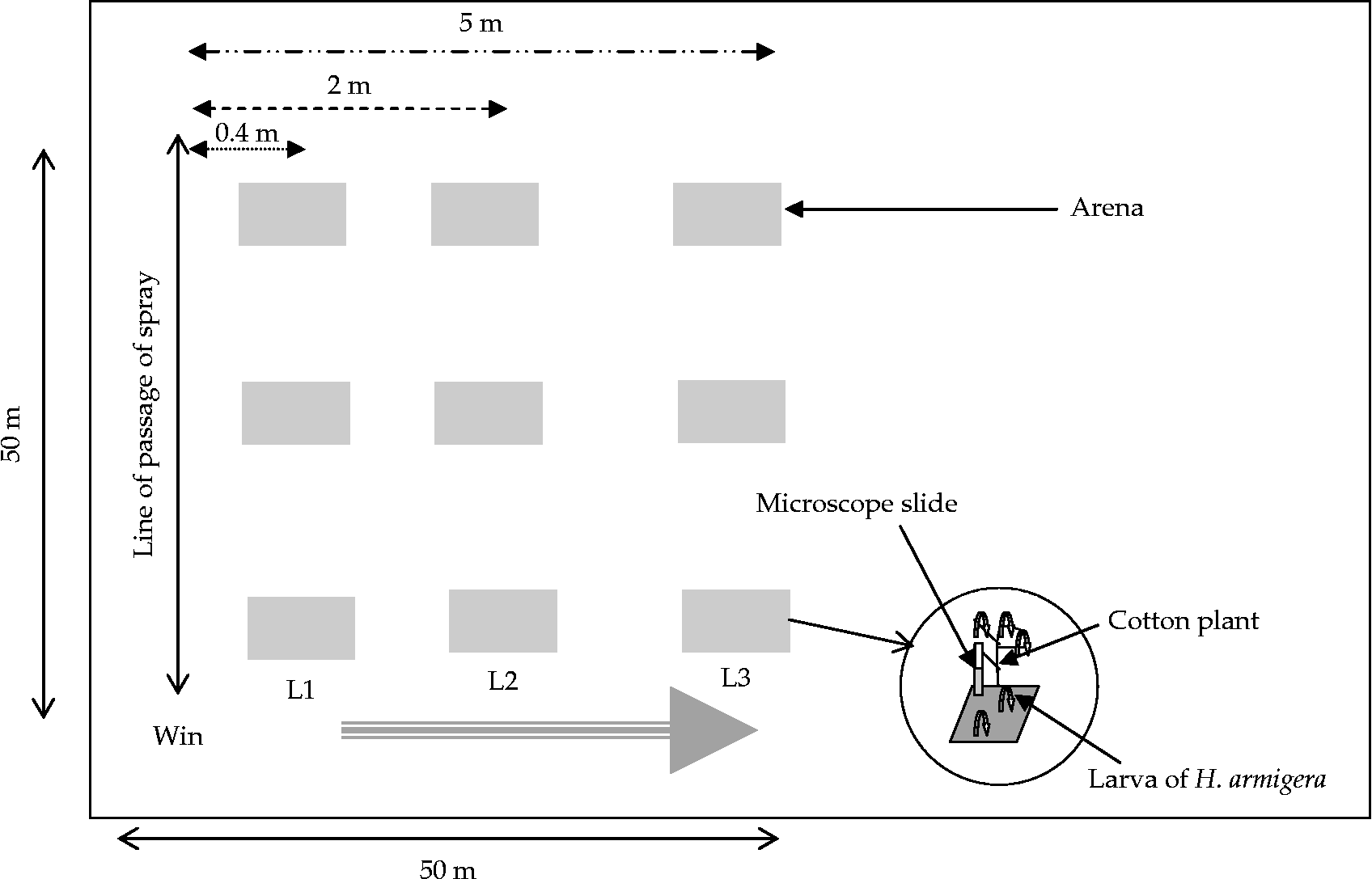
A trial in a small cotton field at the IITA-Benin station in Cotonou (06°25′N; 02°19′E) was conducted to quantify direct contact with spray droplets. The test was carried out using three replicated plots (each measuring 50 × 50 m) as shown in Fig. 1. The average size of the plants was about 1.5 m. Cotton was planted at a spacing of 0.80 × 0.40 m. At emergence, cotton plants were thinned, leaving up to two plants per hill. Two cotton plants occupying a space of 0.32 m2 (0.8 × 0.4 m) were defined as the arena.
Arena test design: individual arenas containing spray targets (microscope slides and larvae of Helicoverpa armigera) on a cotton plant
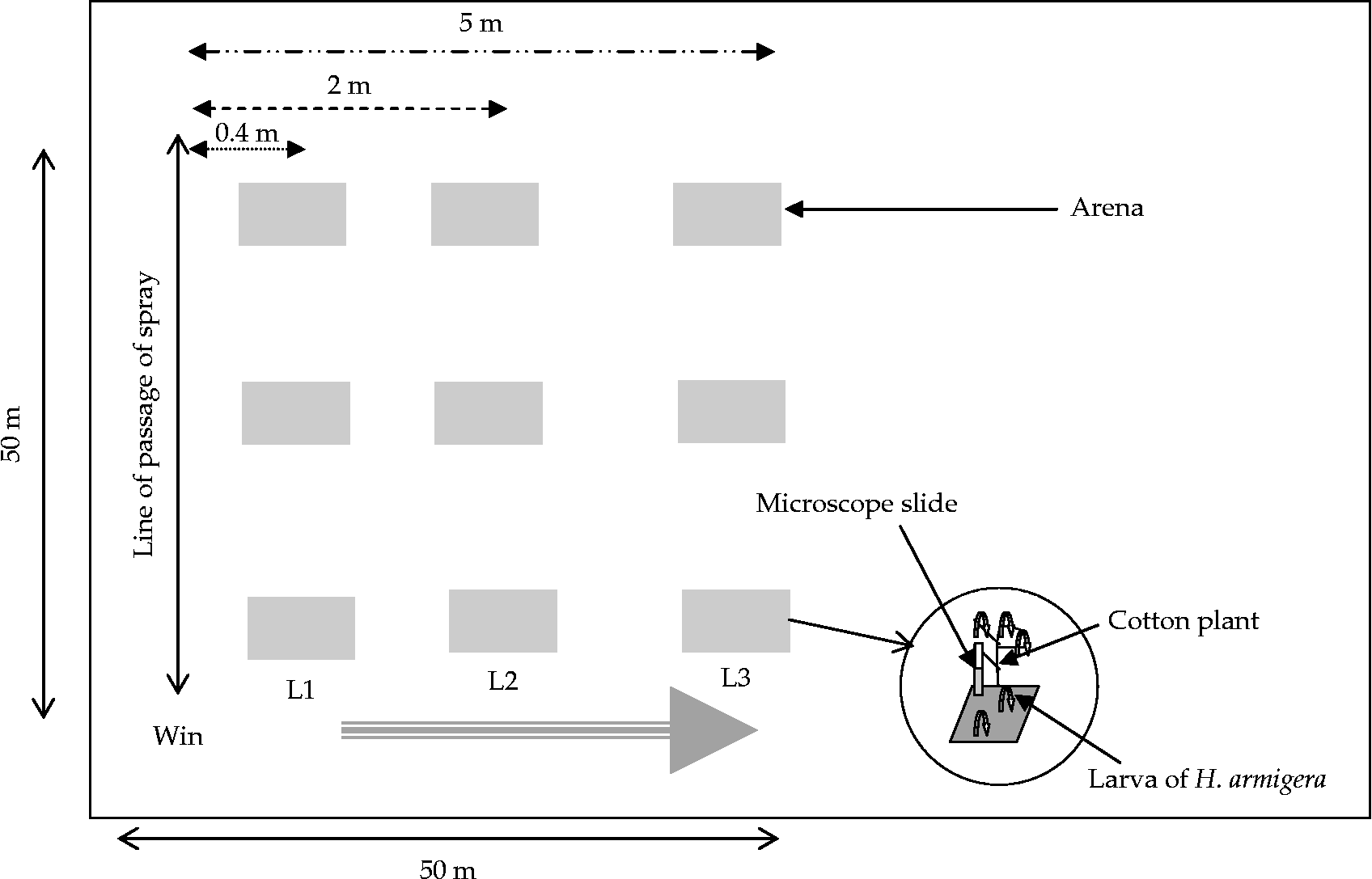
Nine 0.32 m2 (0.8 × 0.40 m) arenas, three each, were marked on three lines (L1, L2 and L3) of cotton at 0.4, 2 and 5 m, respectively, to form three rows crossing cotton lines according to the wind direction (Fig. 1). Distances between the rows were about 10 m. The test was set up when the cotton crop was 3 months old. In each arena, 10 third and fourth H. armigera instars were released on a cotton plant for a few minutes to allow them to settle or to acclimatize on the plant before spraying. One microscope slide (7.6 × 2.6 cm) was attached, the flat side facing to the prevailing wind direction, to the posts at approximately 0.5 m in height (Fig. 1) on the same plant.
The test consisted of three treatments replicated three times: the control (formulation without fungal conidia), a formulation containing 2.5 × 10¹² conidia/l and a formulation containing 3.75 × 10¹² conidia/l. The formulation was composed of 30% peanut oil and 70% kerosene. The volume of application was 2000 ml/ha. All formulations were applied using a Berthoud ‘Micro Ulva’ (Belleville, France) ULV sprayer fitted with a red restrictor and five batteries. The area supposed to be covered by the spraying treatment was 50 m2 (5 × 10 m), hence 100 ml, a quantity of each formulation enough to treat this area, were measured before application and subsequently fully applied. The flow rate was about 60 ml/s, and the walking speed was 1 m/s. During the application, the temperature was 29 ± 1°C and the wind speed ranged between 2.5 and 4 m/s.
After spraying, the slides were removed and the droplets were counted using Bateman's method (Reference Bateman1993). As many larvae as possible of H. armigera were recaptured and placed individually in plastic boxes (3.8 × 2.9 × 4.0 cm), equipped with a perforated cover for ventilation. They were labelled and transported to the laboratory for incubation. Larvae were fed using the artificial diet (Teakle and Jensen, Reference Teakle, Jensen, Singh and Moore1985) when necessary, and mortality was checked daily. The number of pupae formed, died and sporulated, and the emergence of the adults was recorded. Emerged male and female adults were kept together for mating and the number of larvae derived from the incubated eggs was recorded.
Data analysis
Survival rates of the treated and control larvae were calculated as follows:

where nTa is the cumulative number of dead larvae after treatment and N is the total number of larvae recaptured from each arena for incubation.
The infection rates were calculated on the basis of the percentage of cadavers with sporulating fungus:

NCF stands for the number of cadavers with sporulating fungus and NC for the total number of cadavers.
Percentages of emergence were calculated on the basis of the number of pupae formed:

NAE stands for the number of adults emerged and NPF for the total number of pupae formed.
Differences in survival and sporulation rates, percentages of pupae formed, and adult emergence rates were subjected to ANOVA, using the general linear model procedure of SAS (SAS, 2002–2008). In the case of significant F values, means were compared using the Student–Newman–Keuls (SNK) test at the 5% level. Percentages were arcsine-transformed before being subjected to ANOVA. The distribution of the droplets from line 1 (0.4 m) to line 3 (5 m) was visualized by means of histograms. Mean droplets were compared using standard errors ( ± SE).
Results
Droplet distribution
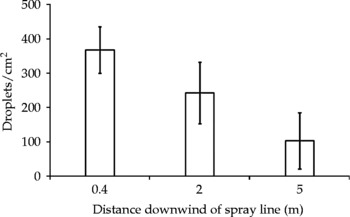
The mean number of droplets (blank formulation and conidia formulated in oil) decreased from 415.7 per cm2 ( ± 60.3) (line 1) to 44.8 per cm2 ( ± 36.3) (line 3) (Fig. 2). Only the first line received the maximum number of droplets. Few droplets reached the sixth line (line 3, 5 m).
Droplet distribution

Immature survival and cadaver sporulation
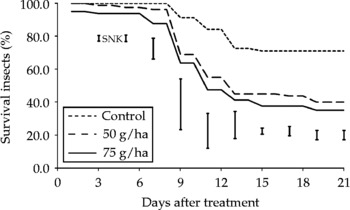
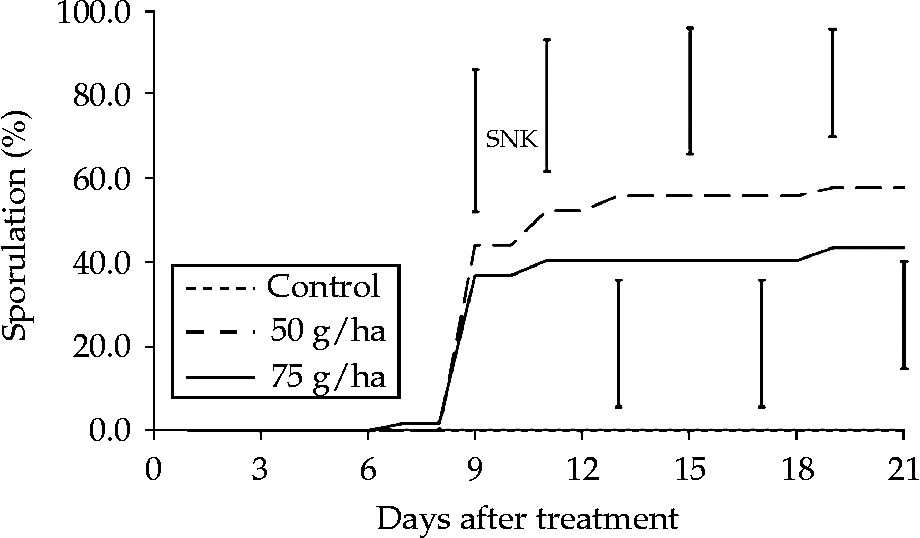
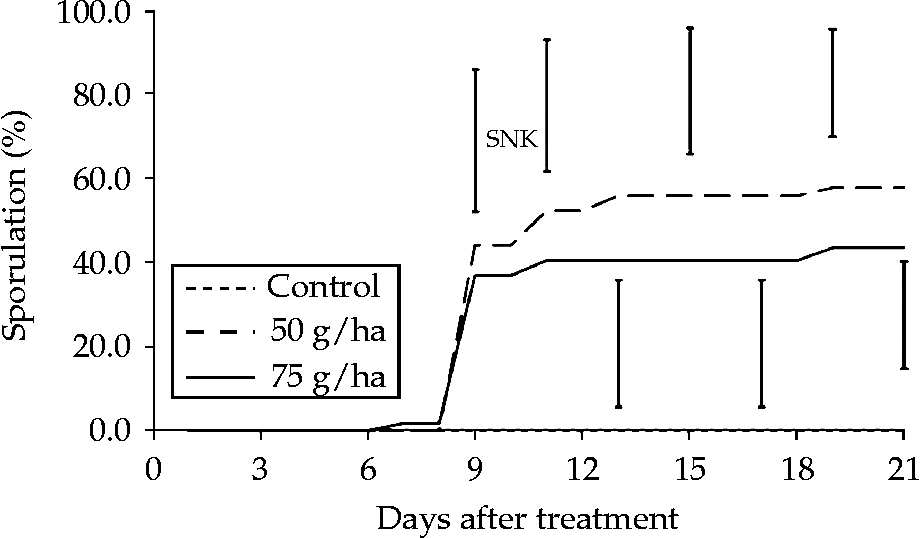
Figure 3 shows the survival of H. armigera after Met 31 application at two doses: 50 and 75 g/ha in an arena trial. Twenty-one days after incubation, survival rates were 35, 40 and 71% for 75 g/ha, 50 g/ha and the control, respectively. To achieve 50% mortality, >10 and >13 days were necessary for 75 and 50 g/ha, respectively. From day 15 onwards, the difference in mortality rates was significant between the two treatments at 5% (F 2,8 = 241.59; P < 0.0001). Contrary to the mortality rates, the percentages of sporulated cadavers were higher for 50 g/ha than for 75 g/ha. They varied from 44.4% (75 g/ha) to 57.5% (50 g/ha) (Fig. 4), but no significant difference was noted between the two doses. However, both were significantly different from the controls where no mycosis was observed (F 2,8 = 25.22; P = 0.0054).
Survival of the larvae of Helicoverpa armigera after application of different doses

Sporulation of the cadavers of Helicoverpa armigera after incubation
Immature survival between marked lines
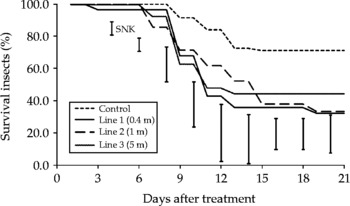
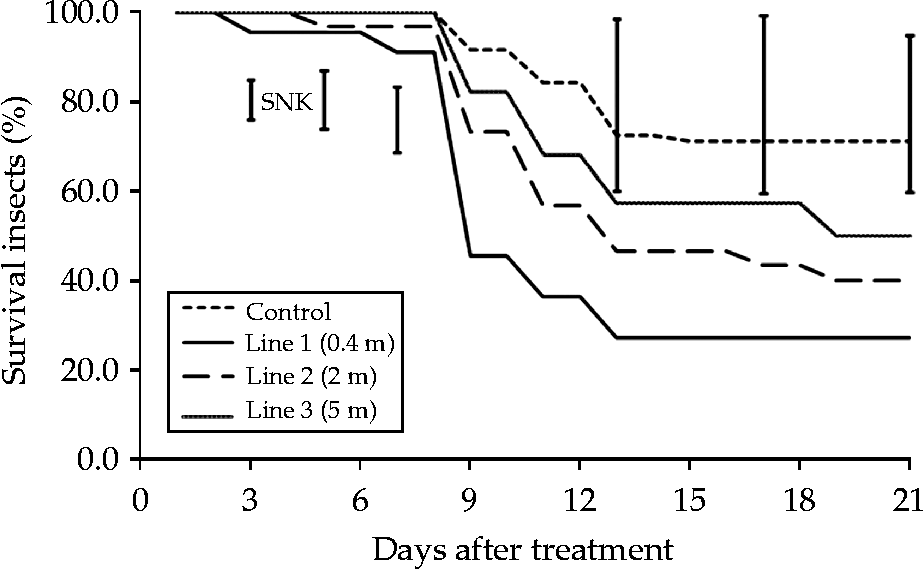
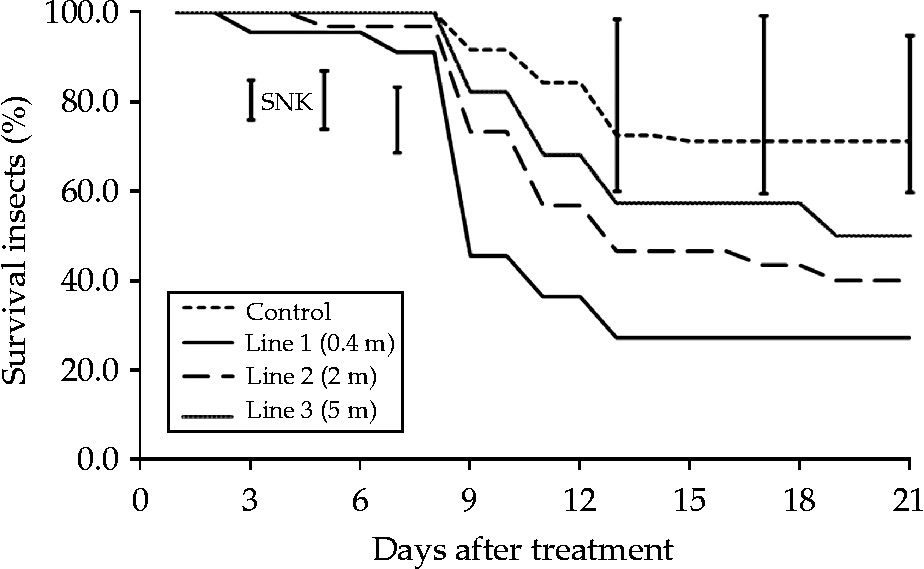
The results of immature survival between the lines are shown in Figs 5 and 6. For 50 g/ha, the mean survival rates were higher for the last line (5 m) than those of the first line (0.4 m) nearest to the line of application. In spite of the varying distances between the lines, there was no significant difference in the survival rates between them (Fig. 6). Only treated populations of the first line (0.4 m) had an average survival rate significantly different from the controls (F 3,11 = 6.10; P = 0.0297). Fifty per cent mortality was achieved by < day 10 (line 1), < day 13 (line 2) and day 19 (line 3). When sprayed with 75 g/ha, the gap between the different distances was narrower (Fig. 5). Both treated populations had average survival rates significantly different from the controls (F 3,11 = 13.64; P = 0.0043). Fifty per cent mortality was achieved by day 10 (lines 1 and 2) and day 14 (line 3).
Survival of the larvae of Helicoverpa armigera at different distances after the application of 75 g/ha

Survival of the larvae of Helicoverpa armigera at different distances after the application of 50 g/ha
Pupae formed, adults emerged and oviposition
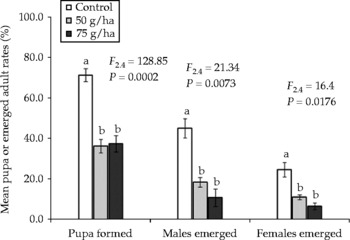
The rate of pupae formed varied between 36.2% ( ± 3.4) (50 g/ha) and 71.2% ( ± 3.2) (control) (Fig. 7). The emergence ratio of male and female adults was not influenced by the two doses of the biopesticide; however, adult emergence rates were significantly higher in the control treatment than in the biopesticide treatment. The mean number of larvae per female decreased from 24 larvae/female (control) to 17 larvae/female (75 g/ha) and 18 larvae/female (50 g/ha) (Table 1). Almost all the males that emerged were malformed.
Rates of pupa formed and adults emerged. Histograms with the same letters are not significantly different at the 5% level (SNK)

Number of emerged adults and hatched larvae after application of different doses of the isolate Met 31 on the third and fourth larval stage of Helicoverpa armigera in an arena trial

Discussion
Semi-fields, similar to the one used in this study, are useful for establishing a relationship between laboratory bioassays and field performance (Hewitt et al., Reference Hewitt, Caseley, Copping, Grayson and Tyson1994). They are also valuable for assessing pesticide efficacy on targets hiding in thick vegetation such as cotton fields. Moreover, we used the cotton field to assess droplet distribution inside the vegetation (using artificial targets/microscope slides), dose transfer to H. armigera larvae and the rate of mortality.
The mean number of droplets drastically decreased from the first (0.4 m) to the third line (5 m), contrary to what Bateman et al. (Reference Bateman, Douro-Kpindu, Kooyman, Lomer and Ouambama1998) obtained in a clear area. Our results were evidently influenced by the presence of cotton plants interfering with the dispersal of the droplets at all doses applied. Larvae of H. armigera survived more in line 3 (5 m), followed by lines 2 (2 m) and 1 (0.4 m). The difference in mortality between the lines was more important for the lower dose, mainly because the mortality of insects treated with EPF is a function of the number of conidia received (Bateman et al., Reference Bateman, Douro-Kpindu, Kooyman, Lomer and Ouambama1998). Therefore, at an equal number of droplets, droplets with more conidia induce more mortality. Droplet size also decreases with distance (Bateman, Reference Bateman1993). Thus the first lines received not only more droplets, but also larger droplets, therefore increasing the probability of reaching the larvae. Therefore, the chances of obtaining a higher mortality rate in cotton lines farthest from the line of application increase for the higher dose.
The observed mortality rates, ranging from 50% (line 3, 50 g/ha) to 73% (line 1, 50 g/ha), were induced from direct contact with conidia. Mortality rates observed in the laboratory under optimal experimental conditions during preliminary stages of this study were up to 1.3 times higher than those obtained in the field, indicating a good potential as a biopesticide for this isolate.
Farmers observe three lines (0.8 × 3 = 2.4 m) between lines of passes because they use water-based formulations with high application volumes of up to 10 l/ha. As for oil formulations, researchers recommend 1–2 l/ha because of the droplet size and wind effects (Bateman, Reference Bateman1993, Reference Bateman1997). For this arena trial, up to 45 droplets/cm2 were recorded on the artificial targets in line 3 (5 m), with mortality rates ranging from 50% (line 3, 50 g/ha) to 56% (line 3, 75 g/ha). Our results indicate that, with an application volume of 2 l/ha, a spacing of 5 m (six cotton lines) between the spray passes, at a flow rate of about 60 ml/s and walking speed of 1 m/s, we are sure to achieve good spraying coverage.
The droplet size and distribution were partly investigated by Symmons et al. (Reference Symmons, Dobson and Sissoko1991) who observed a marked difference in Sahelian grasshopper mortality with sprays of two median droplet sizes containing bendiocarp (a carbamate ULV insecticide formulation), whereby larger droplets were more effective.
In general, the development of H. armigera was substantially affected by the application of the biopesticide. A significant difference was noted between the control and the two biopesticide doses with regard to the formation of pupae, adult emergence and particularly that of females.
In this paper, we assumed that efforts to optimize conidia dose transfer and work efficiency would be rewarded by improved killing efficacy of the selected biopesticide. In fact, the presented results, coupled with the laboratory observations, have demonstrated that the isolate Met 31 has the required characteristics for controlling the cotton bollworm H. armigera. However, other fungal properties such as spore production capacity, germination and hyphal growth rates, and effects of varying environmental conditions that influence persistence must also be evaluated for a more comprehensive assessment of the biological control potential of this isolate. Also, additional studies will be needed to confirm its performance under large-scale field conditions in a variety of agro-ecological and farming situations.
Acknowledgements
We thank the members of the project ‘Méthodes Alternatives de Lutte contre les Ravageurs du Cotonnier au Bénin’ and the partners CRA-CF, OBEPAB, UAC and UL. The Dutch Embassy in Benin is thanked for funding this project.