“I hope that Sojourner Truth would be proud to see me, a descendant of slaves, serving as the first lady of the United States of America.” —Michelle Obama, at an unveiling of a bust of Sojourner Truth in Emancipation Hall, quoted in Huffington Post (April 2009).
“This is a big responsibility, a wonderful platform and I just want … to serve as a role model, to provide good messages, to be a supportive mate to the president, and to make sure that my girls are solid.” —Michelle Obama, Essence Magazine (May 2009).
Michelle Obama's speech during the 2012 Democratic National Convention was a triumph for her supporters. Her dress was a Tracy Rees original, and she looked marvelous in it (Carlson Reference Carlson2012; Hawkins Reference Hawkins2012; Sun Reference Sun2012). The former First Lady of the United States (FLOTUS) was poised and confident while remaining relatable to those so inclined. She was impeccable, and the tone of her speech was adroit, striking a balance between folksy mom-isms, policy speak, partisan rhetoric, and “black girl magic” (Blow Reference Blow2009). Presumably, the success of her speech was somewhat of a vindication against naysayers who criticized her for being too “black” for the White House (Oppenheim Reference Oppenheim2017). Many African American women, young and old, in the United States and abroad, were inspired by that particular speech and other similar public appearances by Michelle Obama. Never before in the history of American politics had a black woman—one who grew up in a blue-collar household from the South Side of Chicago (Connolly Reference Connolly2015)—occupied that level of political office. And after years of struggle and adversity (Block and Haynes Reference Block and Haynes2014; Reference Block, Haynes and Browning2015), she was doing it with such style! If we combine that sense of history with her admission in her 2018 memoir that she never really wanted the political spotlight that her husband covets, Michelle Obama’s political prominence, and the success with which she wields it, is a subversive act because it transgresses negative stereotypes of Black women (Harris-Perry Reference Harris-Perry2011).
More importantly, Michelle Obama could inspire young women everywhere to strive for their own success. Scholars, journalists, and bloggers speak at length about the evolving status of the former FLOTUS as a role model, not only because she once resided in the East Wing of the White House but also because she is an African American, a strong and unapologetically independent person, an activist, a loving spouse and mother, a fashionista, and an accomplished businesswoman (Anu Reference Anu2017; Fishwick Reference Fishwick2016; Italie Reference Italie2016; Kahl Reference Kahl2009; Rubin Reference Rubin2016; Shepphard and Barron-Lopez Reference Shepphard and Barron-Lopez2016; Tutrrup Reference Tuttrup2016). As evidenced by the epigraphs above, this status is not lost upon Michelle, who looks up to Sojourner Truth while acknowledging that, because of the efforts of her ancestors, she is now able to achieve such heights. Mrs. Obama also recognizes that it is now her turn to carry the mantle as a person worthy of imitation, and the second introductory quote speaks directly to her desire to serve as a role model to the nation. This ongoing dialogue about the former first lady's potential as a role model prompted Thompson (Reference Thompson2012) to explore the degree to which First Lady Obama has influenced, among other things, how black women in America are perceived.
Using polling data from the time the former FLOTUS was in office, we tested the idea that Michelle Obama's status as a role model has influenced people's attitudes about black women. Evidence from the 2011 Kaiser Family Foundation/Washington Post survey demonstrates that role model status operates as a moderated mediator. On one hand, the relationship between Michelle's political prominence (measured using respondents’ familiarity with her Let's Move! campaign against childhood obesity) and people's racial attitudes (operationalized as the belief that Michelle could improve people's overall impressions of African American women) is accounted for (i.e., “mediated”) by beliefs about her reputation as a positive role model. On the other hand, the degree to which role model status functions as a mediating variable differs (i.e., is “moderated”) by race and, to a lesser degree, by gender. Role model status explains the process by which African Americans translate their familiarity with Let's Move! to their racial attitudes, and black women are especially sensitive to this mediation effect. Our paper proceeds as follows. In section 2, we specify several testable implications regarding the “moving parts” of our moderated-mediator theory of Michelle Obama's influence on racial attitudes. We follow this extensive theory-building exercise by describing our survey data in section 3 and research design and analyses in section 4. In section 5, we offer some concluding remarks as our discussion, putting the results of our research into broader context while acknowledging the limitations of our study and presenting several avenues for future inquiry.
MICHELLE OBAMA'S IMPACT ON RACIAL ATTITUDES
Although obviously accomplished in her own right, Michelle Obama's introduction to America came through her husband, Barack Obama. Barack became a role model for the nation and the world after his 2008 election. Hundreds of thousands of tearfully jubilant supporters gathered at Grant Park to hear the then-Illinois senator deliver his acceptance speech (Maxon and Stahl Reference Maxon and Stahl2017), and millions more descended upon the National Mall for his inauguration (Hulse Reference Hulse2009). Because of his unique demographic background as the first African American president and his political successes, the 44th President served as a highly visible and counter-stereotypical exemplar, particularly to other persons of color (Carter and Dowe Reference Carter and Dowe2015; Kaleem, Lee, and Jarvie Reference Kaleem, Lee and Jarvie2017; Mason Reference Mason2017; Simien Reference Simien2015). And while all elected officials are—or perhaps should be—role models to some degree (Walsh Reference Walsh2017), Obama distinguished himself from other presidents in his ability to reach a wider and more demographically diverse group of followers (Block Reference Block2011).
His status as a role model fuels a fast-growing literature on “Obama effects.” The Obama effects to which we refer differ from the ones described by Elder (Reference Elder2007), which are analogous to the “Bradley” and “Wilder” effects and explore the degree to which Obama's race cost him support among white voters (see also Kinder and Dale-Riddle Reference Kinder and Dale-Riddle2012; Lewis-Beck and Tien Reference Lewis-Beck and Tien2008; Lewis-Beck, Tien, and Nadau Reference Lewis-Beck, Tien and Nadeau2010; Tien, Nadeau, and Lewis-Beck Reference Tien, Nadeau and Lewis-Beck2012). Rather, this literature posits that Obama's exploits on the campaign trail, in the Oval Office, and now, as a former President of the United States (POTUS), have influenced the attitudes and activities of citizens (for reviews, see Block and Lewis Reference Block, Lewis, Shaw, Brown and McCormick2018; Parker Reference Parker2016).Footnote 1 We are especially interested in Barack Obama's influence on people's opinions about African Americans, and this line of research assumes (often implicitly) that there are two major components comprising the Obama effect: the former president's political prominence and voters’ racial attitudes. In the most basic sense, “racial attitudes,” refer to how favorable a person's viewpoints are toward African Americans. Moreover, those who study the Obama effect on racial attitudes (e.g., Columb and Plant Reference Columb and Plant2011; Goldman Reference Goldman2012; Goldman and Mutz Reference Goldman and Mutz2014; Ong, Burrow, and Cerrada Reference Ong, Burrow and Cerrada2016; Plant et al. Reference Plant, Devine, Cox, Columb, Miller, Goplen and Peruche2009; Schmidt and Nosek Reference Schmidt and Nosek2010) conceptualize Obama's prominence in terms of his media activity (the degree to which the press covers him and/or voters are exposed to coverage about him).
Nothing about the logic of Obama effects makes them peculiar to Barack Obama. In fact, the optics of the incoming First Family, holding hands and greeting the crowd at Grant Park, were so powerful because they gave America an ideal family to emulate (Jackson Reference Jackson2012; Patterson Reference Patterson2013). Purdie-Vaughns, Sumner, and Cohen (2011) consider Natasha (“Sasha”) and Malia's potential standing as racial exemplars, and our paper joins the works of Cooper (Reference Cooper2010), Hayden (Reference Hayden2017), Nelson (Reference Nelson2012), and Spillers (Reference Spillers2009), who apply this logic to the study of Michelle. Beyond the decision to focus on the FLOTUS rather than the POTUS, we are the first researchers to unpack the theoretical components of this literature. For example, Mrs. Obama's role model status (i.e., whether people recognize her as a role model)Footnote 2 is a key feature of the “data generating process” that both engenders and informs the connection between media activity and racial attitudes. Unfortunately, role model status is the “hidden factor”: it is often inferred but seldom measured directly. Because it remains an unobserved concept, there are two underexplored stories regarding what role model status does for the Obama effect in terms of affecting attitudes toward African Americans in general. Some researchers argue that role model status explains (or “mediates”) the association between media activity and racial attitudes. But we have reason to believe that, to borrow James and Brett's (Reference James and Brett1984) terminology, role model status functions as a “moderated mediator” in the sense that race and gender can influence the degree to which it carries the influence of Michelle Obama's media activity to people's racial attitudes.
In short, we aim to inform the research on Obama effects by guiding the scholarly conversation away from Barack and toward “Barack's rock” (Wolffe 2008). In so doing, we offer both conceptual and empirical contributions to this important literature. In the next section, we contemplate how a Michelle-specific “Obama effect” can result. To accomplish that goal, we specify several testable implications regarding the “moving parts” of our new moderated-mediator theory of Michelle Obama's influence on racial attitudes.
The Reasoning Behind a Michelle Obama Effect
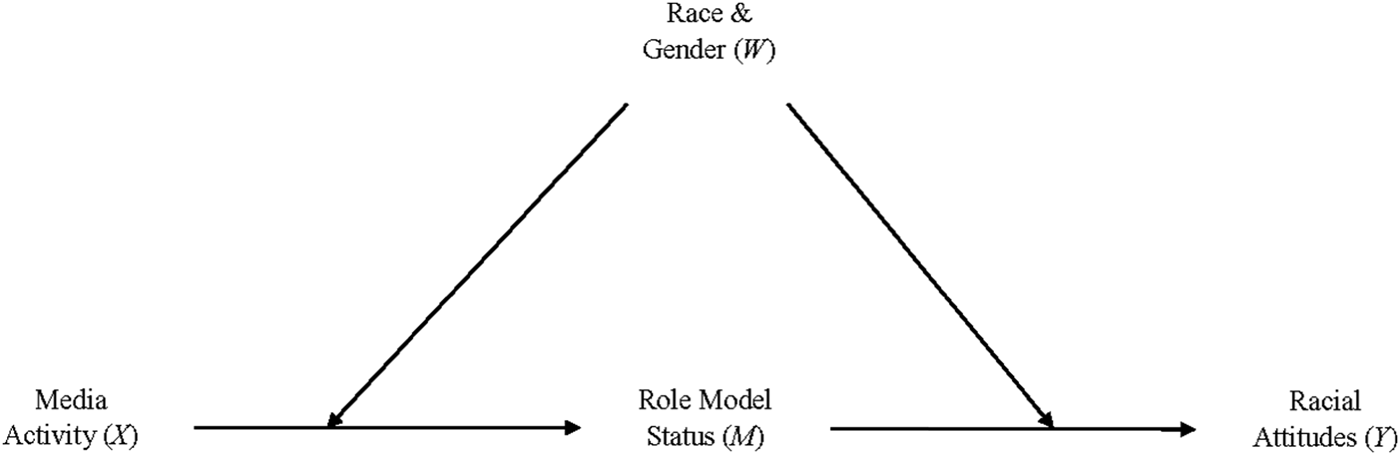
We begin with the general premise that media activity can influence Americans’ evaluations of black people. Considering this premise, we created Figure 1 to illustrate the logic of both the “conventional wisdom” and our unique arguments regarding the possibility of a Michelle Obama effect. For example, the extant literature on Obama effects presumes that these theoretical components are causally related such that racial attitudes (denoted Y in the lower-right corner of Figure 1) constitute the “outcome” and media activity is the theoretically central predictor (X, in the lower-left corner). Thus, the existing literature tells us that media activity directly affects Americans’ racial attitudes (X → Y).Footnote 3
A path diagram of the interconnections between race, gender, role model status, media activity, and racial attitudes.

Both concepts (media activity and racial attitudes) are continuous in the sense that they convey variations in the magnitude of media activity and favorability toward African Americans, respectively. It makes no difference to our theory whether these concepts represent levels (i.e., increases in the frequency of Michelle Obama's media appearances or rises in the strength of people's racial attitudes) or likelihoods (i.e., changes in either the probability of citizens being exposed to media messages or the odds of citizens expressing favorable viewpoints about black people). We only ask that readers array the values contained within these concepts along a continuum anchored by low levels/probabilities of X and Y on one end, and higher levels/probabilities on the opposite end. Furthermore, we studied the debate regarding the presumed influence of the former FLOTUS’ media activities over people's views of black women, as occurred during an interview exchange in the Washington Post (Washington Post 2012).Footnote 4 Consistent with this debate, we have limited the scope of our arguments to a specific type of Michelle Obama effect—one pertaining to her potential impact on how favorable people's attitudes toward African Americans are (Thompson Reference Thompson2012).
Heflick et al. (Reference Heflick, Goldenberg, Cooper and Puvia2011), Moffitt (Reference Moffit, Harris, Moffitt and Squires2010), and Walsh (Reference Walsh2009) demonstrate that the path from X to Y in Figure 1 connecting media activity to perceptions of black women could be positive or negative, depending on the press coverage Michelle Obama receives. But the general idea is this: the more prominent the former first lady is in the media, the stronger or more intense people's attitudes about black women become. There is some empirical support for this expectation; Block and Haynes (Reference Block and Haynes2014) found that seeing the first lady on television could intensify a person's pre-existing ideas about her. This argument also is consistent with journalistic practices. With few exceptions, African American news outlets were unwavering in their praise of the former first family for “setting the standard” in black America (Jackson Reference Jackson, Wijeyesinghe and Jackson2012; Moffit Reference Moffit, Harris, Moffitt and Squires2010; Thornton Reference Thornton, Cunnigen and Bruce2010; Wanzo Reference Wanzo2011; Williams Reference Williams2013). But Harris-Perry (Reference Harris-Perry2011, chapter 7), Squires and Jackson (Reference Squires and Jackson2010), Joseph (Reference Joseph2011), and Shoop (Reference Shoop2010) have demonstrated that messages in the mainstream press were more heterogeneous: some journalists painted the former FLOTUS in a flattering light, while others portrayed her in a less complimentary or even derogatory fashion. Stated formally, the idea that media coverage can lead to variations in opinion suggests that
Proposition 1:
Perceptions of black women tend to intensify (either becoming more approving or more critical) as Michelle Obama becomes an increasingly more prominent figure in the media.
We suspected, however, that the impact of media activity on racial attitudes would vary from person to person (or, more accurately, from group to group, since this is how such differences are often measured in social science research). Two demographic characteristics that came immediately to mind were race and gender. In his research on Barack Obama, Block (Reference Block2011) discovered that the effect of racial attitudes on vote choice varied across racial groups.Footnote 5 Applying these findings to Michelle Obama, we also expected the impact of media activity on racial attitudes to vary by gender. Why? Demographic group differences in this relationship could be attributable to asymmetries in both the type and quantity of information people receive about Michelle Obama. The assessments of black people diverge markedly from those of their white colleagues: African Americans are particularly sanguine about the former FLOTUS and her politics (Burrell, Elder, and Frederick Reference Burrell, Elder and Frederick2011; Elder and Frederick Reference Elder and Frederick2017; Gillespie Reference Gillespie, Brown and Gershon2016; Gillespie Reference Gillespie, Brown and Gershon2016; Reference Gillespie2018; Knuckey and Kim Reference Knuckey and Kim2016; Pew Research Center 2016). This is partly due to the reliance of black citizens on African American media outlets (Dawson Reference Dawson2001) and the fact that these outlets have tended to extol Ms. Obama as Role-Model-In-Chief (Thornton Reference Thornton, Cunnigen and Bruce2010). Since African Americans have more information about Michelle Obama available to them via the black media and because these media messages are more uniformly positive than those appearing in the mainstream press, black people (relative to their white colleagues) have not only been more “favorable” in their FLOTUS assessments, they have also been more “stable” in the sense that subsequent media coverage has most likely not altered their already-favorable opinions.
Taking these racialized media dynamics and information asymmetries into consideration, we expected black people's scores on a hypothetical index of racial attitudes to cluster toward the high end of the scale, assuming that the categories of this variable are arranged so that higher values represent more “favorable” viewpoints toward black women. In turn, we expected this clustering to yield consistently higher scores across the values of a media activity measure and therefore to decrease the potential effect of this predictor. Because we expected their racial attitudes to be relatively less favorable, whites’ scores had more “room to vary” over levels of media activity. The logic of black opinion stability, and the relative attitudinal volatility among white Americans,Footnote 6 suggests that the association between Michelle Obama's media activities and peoples’ perceptions would be stronger for whites than for African Americans. For similar reasons, we anticipated that the strength of the effect of X on Y would be greater among men than women.
More importantly, by importing the notion of “social position” described in McClerking, Laird, and Block (Reference McClerking, Laird and Block2018), our theory allowed for race and gender differences. Such differences were considered in terms of social identity and demographic similarity: in a simplified matrix of two possible categories for race (black or white) and gender (female or male). Black women have the closest affinity to the former FLOTUS because they match up with her in terms of race and gender. Thus, we expected black women to be more favorable toward her than the other three race/gender combinations in this matrix and that this heightened favorability would place them highest on the hypothetical scale in terms of the impact that Michelle Obama's media activities would have on their racial attitudes. Based on this logic, we expected white men to be lowest on a the racial-attitudes scale because they lack both racial and gender affinity. The strength of the Michelle Obama effect among the other two race/gender groupings, we anticipated, would fall somewhere between these two extremes: Black men share her race but not her gender, whereas white women are similar in gender but are racially distinct. Race is typically more consequential than gender in influencing public opinion (Gay and Tate Reference Gay and Tate1998; Mansbridge and Tate Reference Mansbridge and Tate1992),Footnote 7 and because black men are also more likely to be Democrats and to support Democratic candidates than white women (see Cassese and Barnes, Reference Cassese and Barnes2018; Philpot Reference Philpot2018; Philpot and Walton Reference Philpot and Walton2007), we did not expect white women and black men to be equal in their reaction. We expected black men to be more positive toward Obama than white women. The idea that the X → Y link is strongest for white men, less strong for white women, weaker for black men, and weakest for black women prompted the following argument (see the arrows pointing downward from the top of the visual triangle formed in Figure 1):
Proposition 2:
The impact of Michelle Obama's media activities on perceptions of black women changes depending on an individual's race and/or gender.
We made sense of these expectations regarding the “Michelle Obama effect” on racial attitudes by acknowledging the importance of an intermediate concept: role model status (denoted as “M” in the bottom middle portion of Figure 1). Below, we spell out two arguments regarding its potential influence.
Role Model Status as a Mediating Concept
Social psychologists who study academic performance (e.g., Clark, Martin, and Bush Reference Clark, Martin and Bush2001; Hoyt, Burnette, and Innella Reference Hoyt, Burnette and Innella2012; Lockwood Reference Lockwood2006; Lockwood, Jordan, and Kunda Reference Lockwood, Jordan and Kunda2002) and professional development (e.g., Gibson Reference Gibson2004; Lockwood and Kunda Reference Lockwood and Kunda1997) define role models as the individuals we look up to and aspire to be like. A role model can be someone who occupies an elevated position in society, or it can be an ideal type created by blending together the desired characteristics of several people (Speizer Reference Speizer1981).
For African Americans, the term can take on an expanded definition. Being a role model means that members of your group emulate you, and, more importantly, that your ideas and actions have racial consequences in the sense that they can affect others in your in-group (Bryant and Zimmerman Reference Bryant and Zimmerman2003; Byars and Hacket Reference Byars and Hackett1998). For better or worse, racial role models can influence how people like them think and behave. Burgess (Reference Burgess2016) discusses how Michelle Obama's visit to a London elementary school had the unintended impact of raising those students’ test scores.Footnote 8 But racial role models also influence how people like them are perceived or treated by those in the out-group (see Marx and Roman Reference Marx and Roman2002; Valentino and Brader Reference Valentino and Brader2011; Welch and Sigelman Reference Welch and Sigelman2011). Moreover, a person's status as an exemplar can be applauded or feared; thus, scholars distinguish “good” from “bad” role models when discussing celebrities and professional athletes (Boyd Reference Boyd1997; Bristor, Lee, and Hunt Reference Bristor, Lee and Hunt1995; Read Reference Read2016).
Therefore, studying role model status (conceptualized in terms of whether people see Michelle Obama as a role model) helps us to understand why exposure to positive (or negative) press about the former first lady can improve (or worsen) people's views of African Americans in general. Because Michelle Obama is an influential person, some may view her political accomplishments as victories for her race, and others might expand their conception of “role model” to include the former FLOTUS and people like her (see Goldman and Mutz Reference Goldman and Mutz2014 for a discussion of this exemplification effect). Conversely, others might respond negatively to Michelle Obama's political prominence, perhaps out of the concern that a win for her racial group constitutes a loss for their own group (Norton and Sommers Reference Norton and Sommers2011). As the scholarship on tokenism suggests (Kanter Reference Kanter1977; Sacket, DuBois, and Noe Reference Sackett, DuBois and Noe1991), her failings might be attributed (unfairly) to African Americans more generally, which may drag down whites’ racial opinions.
As illustrated in Figure 1, role model status might be the intervening concept that explains, at least in part, the link between the other “moving parts” comprising the Michelle Obama effect on perceptions of black women. Presumably, this concept is also continuous: the greater its value, the more predisposed someone is to think this way about the former first lady. Because of her standing as a “paragon of her kind” (Holloway Reference Holloway2017), we believe media activity has an indirect effect on these types of racial attitudes: it influences role model status (i.e., the path from X to M), which in turn shapes viewpoints about race (i.e., the path between M and Y).
Proposition 3:
The association between media activity and attitudes toward black women will decrease in strength, if not disappear entirely, once we account for Michelle Obama's role model status (i.e., whether or not people see her as a role model).
Role Model Status as a Moderated Mediator
In addition to explaining why media activity affects racial attitudes, role model status also helps us to understand how (i.e., under what conditions) the relationship between these concepts occurs. In their analysis of Michelle Obama's television appearances during the 2008 and 2012 election cycles, Block and Haynes (Reference Block and Haynes2014) demonstrate that “taking to the airwaves” (measured as the number of TV appearances she made) improved the former FLOTUS’ polling numbers in some contexts while backfiring in others (i.e., making her less popular). Thus, extant research provides us with a rationale for questioning the assumption that the impact of media activity on racial attitudes (mediated by role model status) is uniform across race and gender. After all, a substantial body of work confirms race and gender differences in perceptions of Michelle Obama's role-model status (see Coleman Reference Coleman, Guy-Sheftall and Cole2010) and people's opinions about race (e.g., Brodish, Brazy, and Devine, Reference Brodish, Brazy and Devine2008; Eibach and Keegan, Reference Eibach and Keegan2006; Kluegel and Smith, Reference Kluegel and Smith1986). In addition to the variables comprising the Michelle Obama effect varying by these demographic groups, scholars discovered race–gender differences in the connection between these variables (e.g., Schmidt and Nosek Reference Schmidt and Nosek2010; Williams et al. Reference Williams, Bolland, Hooper, Church, Tomek and Bolland2014). Given the differences among these groups in the theoretical components of the Michelle Obama effect, we expect race and gender differences not only in the extent to which media activities affect role model status (left half of Figure 1) but also in the degree to which role-model perceptions account for media exposure's effect on racial attitudes (Figure 1, right half). This line of reasoning led to our final expectation:
Proposition 4:
The ability of Michelle Obama's role model status to mediate the relationship between her media activities and perceptions of black women changes depending on an individual's race and/or gender.
Specifically, we expected the strength of role model status as a mediating concept to be greater among racial minorities (i.e., African American women and men) than for nonminorities (white female and male citizens) and to be greatest among black women. The rationale behind this expectation stems from our understanding of race and gender as overlapping demographic categories. Here, the arguments of McCall (Reference McCall2005, 1758) are particularly relevant (also see Holman and Schneider Reference Holman and Schneider2016; Stoll and Block Reference Stoll and Block2015; McClerking, Laird, and Block Reference McClerking, Laird and Block2018). Because of their in-group affinity, African Americans are inclined to view the former FLOTUS as a good role model, and because they are “doubly bound” by their race and gender (Gay and Tate Reference Gay and Tate1998), black women should be especially likely to hold this viewpoint. African Americans in general (and black women in particular) are also likely to personalize the causal mechanism underlying the Michelle Obama effect: because Mrs. Obama looks like them and her experiences tend to resonate with them, role model perceptions will be especially relevant to voters of color (Goldman and Mutz Reference Goldman and Mutz2014). The elevated salience of role model status among African Americans means that this concept will do a better job of explaining why members of this demographic group translate their media exposure to Michelle Obama into their attitudes about African American women.
To recap, we began with the “conventional wisdom” regarding our Michelle Obama effect of interest, that her media activities (X) influence people's racial attitudes (Y), and we complicated this story with the possibility of racial and gender differences in the effect of X on Y. Then, we considered the potential for role model status (M) to behave as a mediating variable, and again, we made the case that this mediated relationship (X → M → Y) would also differ by race and gender. The next section presents our analysis of the empirical implications of these “mediation” and “moderated mediation” theories of the Michelle Obama effect.
SURVEY DATA
The 2011 Kaiser Family Foundation/Washington Post Poll: Black Women in America is an ideal data source for our research questions.Footnote 9 Recall that other observers have conducted investigations into the Michelle Obama effect on perceptions of African American women (e.g., Thompson Reference Thompson2012). A significant portion of this previous investigation refers to evidence from the Kaiser Foundation/Washington Post poll. Using this data source for our analyses, we situated our investigation within that discussion while replicating (and extending) some of the statistical analyses that took place within it.
Beyond its importance to these previous studies, the poll contains a diverse array of survey items gauging attitudes about race and gender relations in the United States, yielding several potential ways to quantify our dependent variable. The Kaiser Foundation/Washington Post poll also included an item that asked whether respondents thought that the former FLOTUS was a role model. This question is direct measure of the mediating variable, and, to our knowledge, we are the first to put the theoretical arguments regarding role model status to a statistical test.
Although the poll contains no specific questions about media activity, it contains a useful alternative measure of our theoretically central independent variable. We used Let's Move! as a test case for understanding how media activity (defined here as citizens’ familiarity with Michelle Obama's anti-childhood obesity initiative) shaped racial attitudes. This makes sense considering that policy knowledge tends to increase with media exposure (de Vreese and Boomgaarden Reference de Vreese and Boomgaarden2006; Gries, Crowson, and Cai Reference Gries, Crowson and Cai2011; Miller and Krosnick Reference Miller and Krosnick2000).Footnote 10 There is also some precedent for using policy familiarity as a proxy for media activity: Block and Haynes (Reference Block, Haynes and Browning2015), Dow (Reference Dow, Vaughn and Mercieca2014), and Kahl (Reference Kahl2009) employed similar approaches in their research on Michelle Obama's use of Mom-In-Chief rhetoric in her public appeals to cultivate support for Let's Move. For these and related reasons, “policy familiarity” becomes our indicator of “media activity,” and we refer to the former term when discussing the latter.
In addition, this telephone survey contained a nationally representative sample of adults (N = 1,936), with an oversample of 1,109 African Americans. This oversample was essential to our analyses because we ultimately sought to sort survey responses by race and gender. Finally, the availability of relevant content and race-gender subsamples was buttressed by the good timing of the poll. It was conducted during the weeks of October 6 to November 2, 2011, a period in which details about Michelle Obama's anti-childhood obesity initiative had not yet become crystalized among voters. As a result, there was sufficient variation in the levels of our proxy measure of media activity: nearly 16% of the respondents were unaware of Let's Move!; approximately 41% knew a little about it; and approximately 43% were very familiar with it.
Outcome Variable
The dependent variable (Y) is favorable perceptions of black women, and it represents the degree to which respondents believed that Michelle Obama could influence perceptions of black women. Survey items question 27 asked: “Has having Michelle Obama as the country's first African American first lady changed your overall impression of black women in America, or not?” Respondents who answered “yes” to this question received a follow-up item (question 47a): “Has your impression of black women gotten better or gotten worse?” Initially, we combined these survey items to create a variable that recorded whether respondents supported the claim that Michelle Obama had changed their impression of black women for the better (n = 538), for the worse (n = 20), or had produced no change in their perceptions of black women (n = 1,378). Because the “worse” category had so few observations, we generated a new variable as a binary version of the above set of survey items (1 = gotten better and 0 = otherwise). Our dependent variable, therefore, gauged whether respondents believed that Michelle Obama's political status contributed to them having a more favorable attitude toward African Americans.Footnote 11
Theoretically Central Predictor
As discussed above, our main independent variable (X) was policy familiarity. We operationalized this variable using survey item question 47: “How much if anything, have you heard about Michelle Obama's ‘Let's Move’ campaign against childhood obesity? Have you heard a lot, a little or nothing at all about it?” We dichotomized this item so that respondents familiar with the Let's Move! campaign received a score of “1,” while all other respondents got a score of “0.” Our decision to collapse response categories (coded “heard a lot” and “heard a little” as “1” versus “heard nothing at all” as “0”) was a practical one. In addition to providing an unambiguous measure, rather than concerning ourselves with levels of policy familiarity, we simply distinguished people who knew about Let's Move! from those who did not. Our coding strategy mimicked those used in experimental research, for our independent variable was a crude version of an uncontrolled and naturally occurring “treatment” (in this case, one that sorted respondents by their exposure to Let's Move! information).Footnote 12
Mediating Variable
For us, Michelle Obama's role-model status (M) was the “missing link” that mediated the relationship between our independent and dependent variables. There was a measure of role model perceptions in the Kaiser poll. Question 11e asks: “Please say whether the following statement applies to Michelle Obama: … She is a good role model.” The response options for this item were “Yes, applies,” “No, does not apply,” “Don't know,” and “Refused [to respond].” We recoded this question so that respondents who believed that the statement applied to the former first lady received a score of 1, and all other respondents got a score of zero. The dichotomized version of this variable skewed heavily toward one side: greater than 80% of the respondents believed that Michelle Obama was a good role model.
Moderating Variables
The 2011 Kaiser Foundation/Washington Post poll allowed us to explore the possibility of racial and gender-group differences in terms of the Michelle Obama effect. Broken down by category, the survey had sufficiently large subsamples of white men (n = 298) and white women (n = 400), along with African American men (n = 301) and women (n = 808). We created separate binary variables that classified respondents according to these four race-gender categories (W) (1 = membership in that particular group, 0 = otherwise). We ran separate analyses on these subsamples: white women, white men, black women, and black men.
Control Variables
To help minimize the possibility that the effect of policy familiarity on racial attitudes was spurious, we accounted for a host of demographic, political, and contextual characteristics. For example, people tend to alter their responses based on the perceived race of the person administering the survey (see Davis and Silver Reference Davis and Silver2003; Krysan and Couper Reference Krysan and Couper2006; Schuman and Converse Reference Schuman and Converse1971), and we were concerned that respondents might have hesitated to share their views about Michelle Obama's ability to influence their views of African American women. We therefore included a race of interviewer variable in our analyses and coded it as follows: 1 = respondents believed the interviewer as black and 0 = otherwise.
Compared to their right-wing colleagues, voters on the political “left” typically offer different opinions about race (Smelser, Wilson, and Mitchell Reference Smelser, Wilson and Mitchell2001) and gender relations (Burns, Schlozman, and Verba Reference Burns, Schlozman and Verba2001). Moreover, a wealth of research confirms partisan and ideological differences in assessments of the former first family (see, e.g., Abramowitz Reference Abramowitz2010, Reference Abramowitz, Rosenthal and Trost2012; Dimaggio Reference DiMaggio2011; Parker and Barreto Reference Parker and Barreto2014). Because attitudes about black women can vary by political orientation, we created dummy variables for party identification (question 79). The proportions of self-identifying Democrats and Republicans were 0.52 and 0.15, respectively (the proportion of independents was 0.24).
It is possible that socioeconomic status affects racial attitudes (Branton and Jones Reference Branton and Jones2005; Marschall and Stolle Reference Marschall Melissa and Stolle2004; Oliver and Mendelberg Reference Oliver and Mendelberg2000; Taylor and Reyes Reference Taylor and Reyes2014; but see Taylor and Mateyka Reference Taylor and Mateyka2011), so we included measures of educational attainment (question 54), an ordinal item that ranged from 0 = 8th grade or less to 1 = postgraduate training. The median category for this variable was “some college.” We also controlled for income level (question 62) using an ordinal item that ranged from 0 = under $20,000 to 1 = $250,000 or more (the median income bracket was $50,000 to $65,000).
RESEARCH DESIGN AND ANALYSES
Testing the Michelle Obama Effect Hypothesis
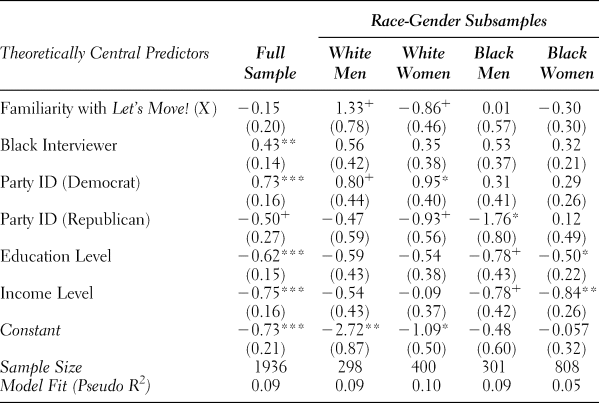
We anticipated a relationship between our measures of media activity and racial attitudes (Proposition 1) and that the relationship between these variables would vary across demographic categories (Proposition 2). Table 1 displays the results of a series of logistic regression models of the impact of policy familiarity on racial attitudes.Footnote 13 For each column in the table, the dependent variable is our measure of respondents’ perceptions of black women. The regression coefficients record the expected change (in the log-odds of this dependent variable) associated with a one-unit increase in the main theoretically central predictor, holding all other predictors constant. We ran separate models for the full sample and for each race-gender group tested here: white men, white women, black men, and black women. To conserve space, we focus our presentation on the theoretically important predictors.
Testing the Michelle Obama effect hypothesis: The influence of policy familiarity on favorable perceptions of black women

Source: 2011 Kaiser Family Foundation/Washington Post Poll: Black Women in America (N = 1,936).
Note: Estimates are logistic regression coefficients with standard errors in parentheses.
+ p < 0.10, * p < 0.05, ** p < 0.01, *** p < 0.001.
Two things are notable in Table 1. First, the results offer clear evidence for Proposition 2 while lending only qualified support to Proposition 1: the relationship between X and Y varies across race and gender, and these group differences have the net result of obscuring the Michelle Obama effect in the full sample. A one-unit shift in policy familiarity (i.e., moving from being “not familiar” to being “familiar” with Let's Move!) increased the log-odds of white men believing that Michelle Obama improves perceptions of black women. Conversely, a unit-shift in the Let's Move! variable contributed to a decrease in the log-odds of white women expressing this attitude. The logit estimates for black men and black women indicate that the Michelle Obama effect among these respondents was nonsignificant.
Second, the negative signs on the coefficients for black female and white female respondents indicate that women tended to be more skeptical than men regarding Michelle Obama's ability to alter people's perceptions. Regardless of race, Let's Move! familiarity contributed to a rise in the favorability of men's racial attitudes and a decline in women's attitudes. Among African Americans, these differences of opinion, while analogous to the findings in Block (Reference Block2011) and Pew Research Center (2010) about whites being more optimistic than their black colleagues regarding Barack Obama's influence on U.S. race relations, are statistically nonsignificant. White men and women, however, were more sensitive to changes in policy familiarity levels. And the fact that the effect of familiarity on racial attitudes was positive and statistically significant for white men and significantly negative for white women suggests that the former FLOTUS’ media activities fueled gender-polarized viewpoints among these respondents.
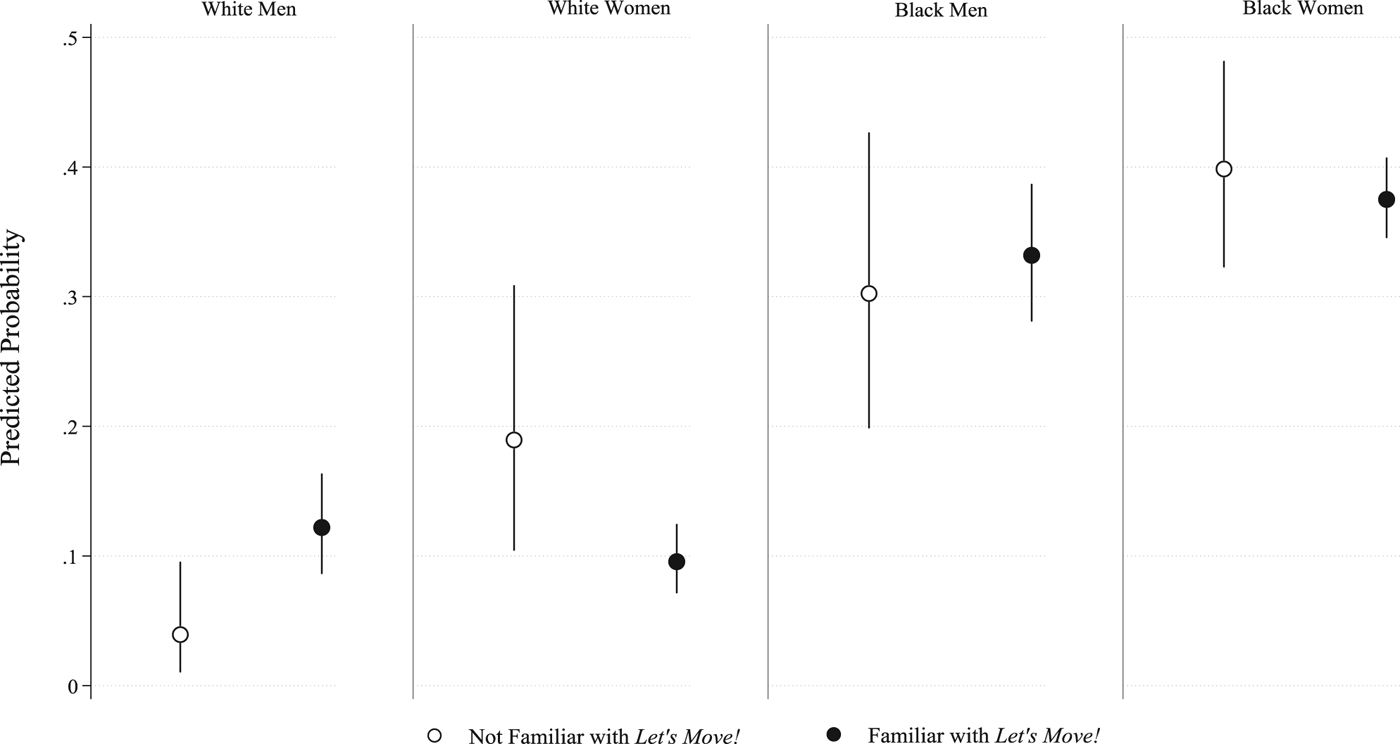
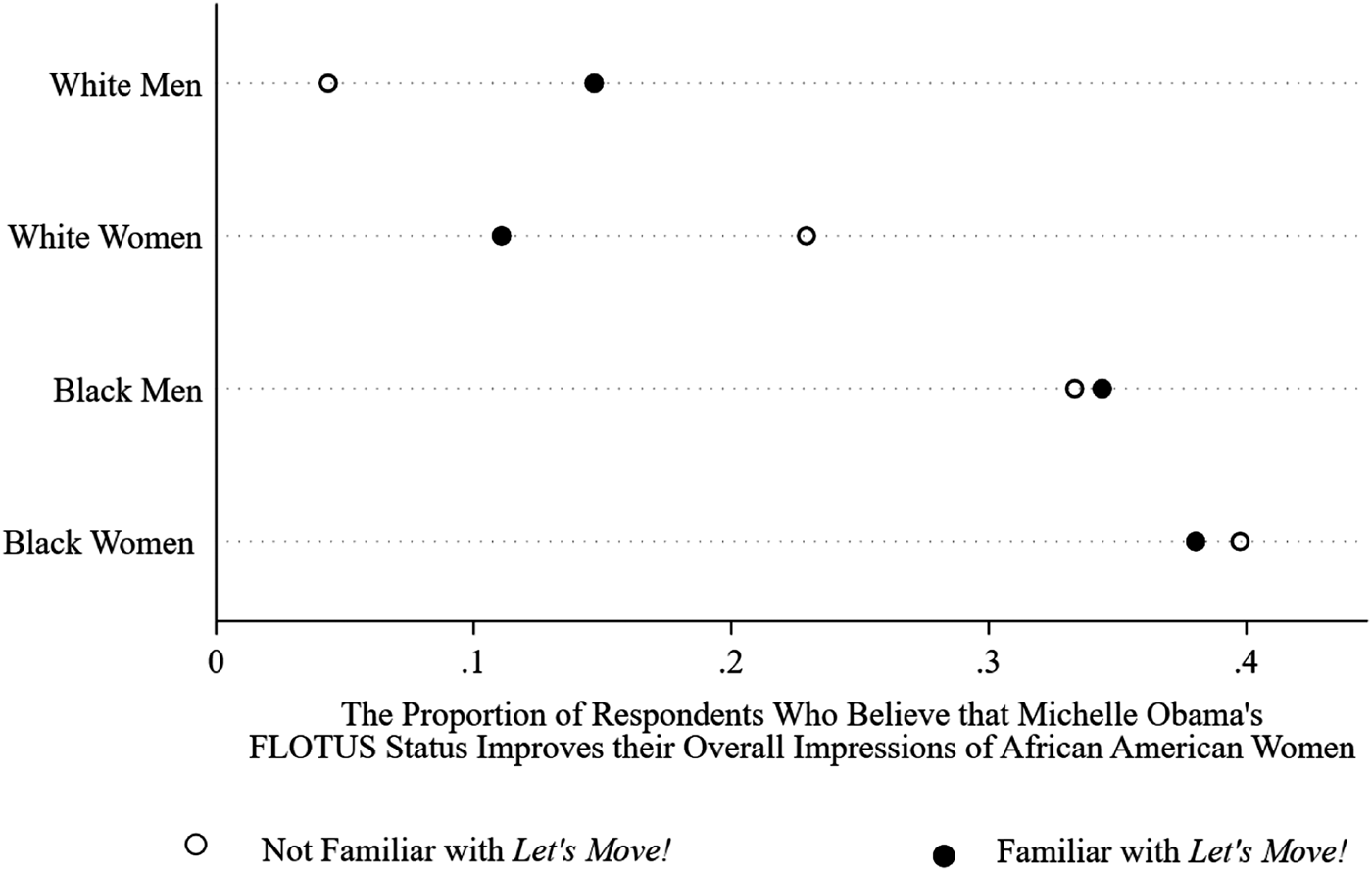
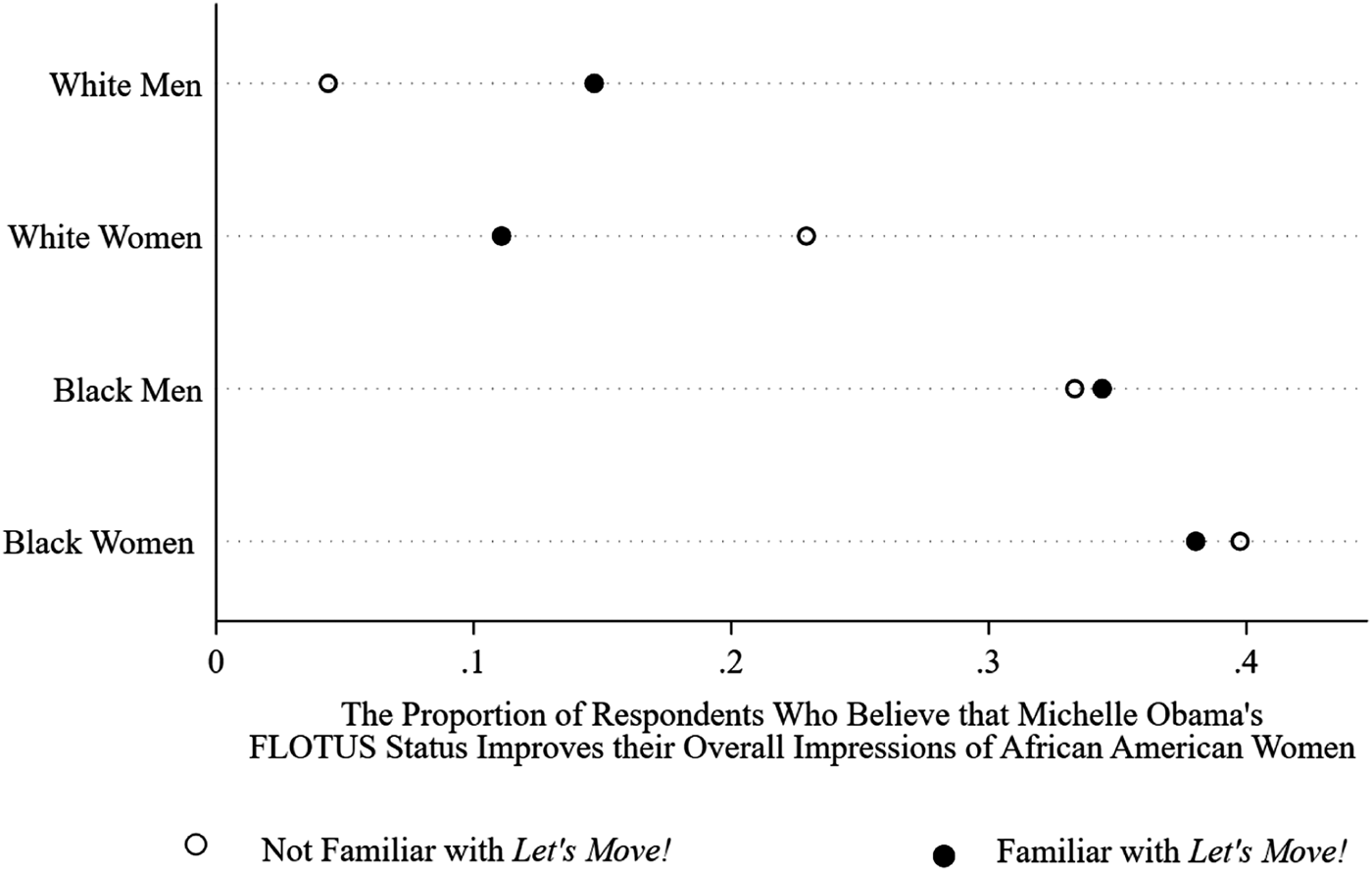
We used the CLARIFY software package (King, Tomz, and Wittenberg, Reference King, Tomz and Wittenberg2000; Tomz, Wittenberg, and King, Reference Tomz, Wittenberg and King2001) to place the regression findings into a fuller context. Specifically, we sorted the average predicted probability of respondents’ black-women perceptions by race, gender, and our measure of media activity. The point estimates and 95% confidence intervals (vertical lines) in Figure 2 are based on 5,000 simulations of the impact of policy familiarity on the likelihood of respondents believing that Michelle Obama's FLOTUS status improved their impressions of African American women, holding the other variables constant. The separate panels in this figure display the simulations for each race-gender grouping, and the symbols within each panel distinguish respondents who were familiar with Let's Move! (solid dots) from those who had not heard of it (hollow dots).
The predicted probability of a respondent believing that Michelle Obama can improve overall impressions of African American women, across levels of policy familiarity, and sorted by race and gender.

Irrespective of gender, the predicted probability of believing that the first lady could influence perceptions of black women held steady among African Americans. For black men, a unit-shift in the familiarity variable contributed to a small and statistically nonsignificant increase in the racial attitudes variable (from .30 to .33, a difference of .03). The change in black women's attitudes across familiarity values, while also nonsignificant, was predictably smaller: from .39 to .37, which is a difference of −.02. Taking the control variables into account, the likelihood of believing that Michelle Obama could improve perceptions of black women increased significantly among white men (the predicted probability increased from 0.04 to 0.12, which is a difference of .08). Intriguingly, the impact of policy familiarity was strongest for white women rather than white men: the probability of expressing this racial attitude decreased significantly (from .19 to .10, a difference of −.09) as these respondents became familiar with Michelle Obama's Let's Move! initiative. Furthermore, and as expected, the predicted probabilities were, on average, higher for African American respondents.
Testing the Mediation Hypothesis
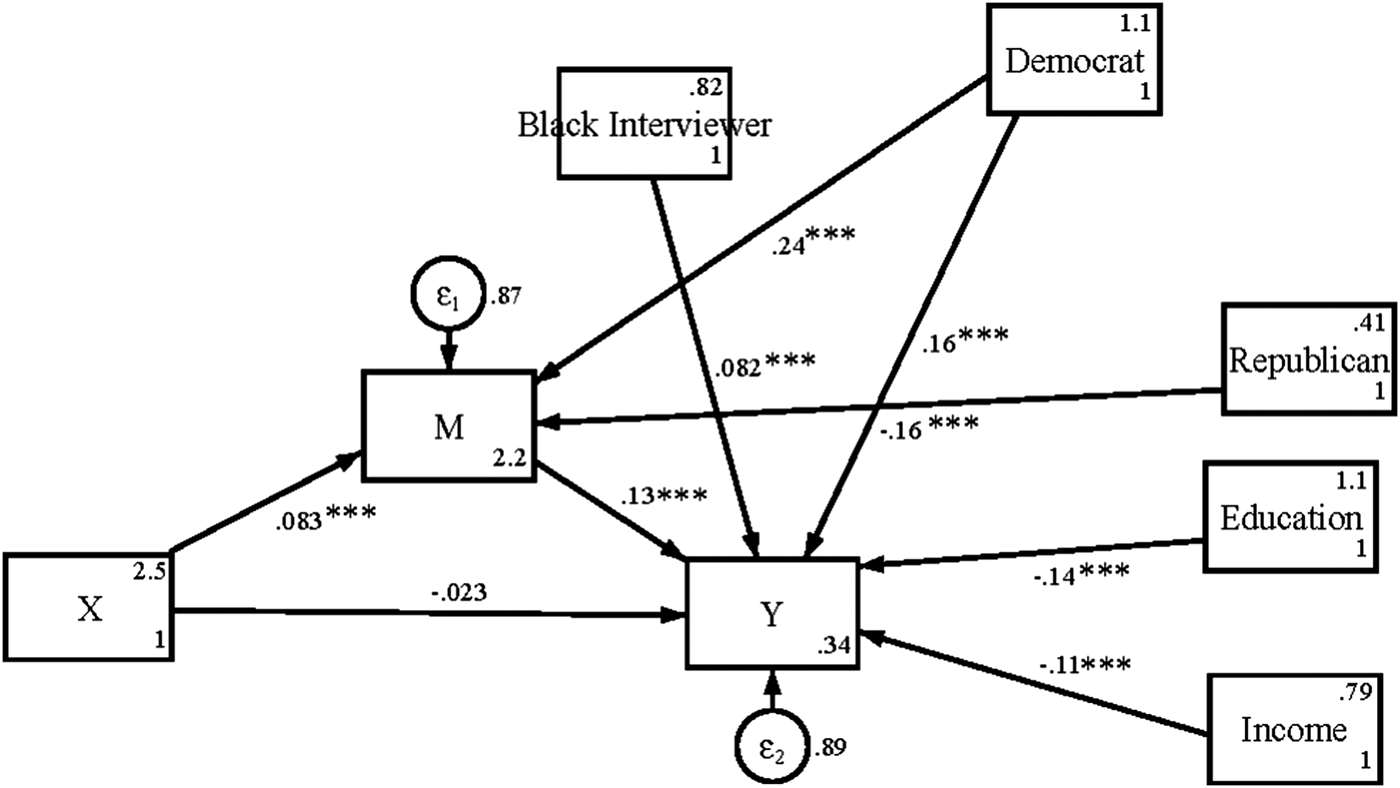
In Proposition 3, we argued that the Michelle Obama effect passed through role model status. To check for evidence of mediation, we used a structural equation model to analyze the paths between policy familiarity (X) and black-women perceptions (Y), between familiarity and Michelle Obama's role model status (M), and from role model status to respondents’ racial attitudes (Figure 3). We also included confounding (i.e., control) variables for the race of the interviewer, our measures of party identification, and a respondents’ income and education levels. The path coefficients represent the estimated relationship between these variables, and significance levels are denoted by asterisks. The error terms (ε) are the residual variances within these variables that are not accounted for by the pathways hypothesized in the model.
Testing the mediation hypothesis: Structural equation model (SEM) path analysis.

We also estimated pathways from the party identification variables to the mediator variable. This modification not only significantly improved the model's goodness-of-fit statistics,Footnote 14 it also makes intuitive theoretical sense. For example, Republican respondents were significantly less likely to see Michelle Obama as a good role model, while their Democratic colleagues were more likely to do so. Mediation is commonly characterized as a decrease in the effect of X on Y in the presence of an intermediate variable. A quick scan of the path coefficients in Figure 3 reveals that the impact of X on Y is completely mediated by Michelle Obama's role-model status (M): Media activity has no direct effect on racial attitudes, and the statistically significant pathways are between media activity and role model status and from role model status to racial attitudes.
Testing the Moderated Mediation Hypothesis
By extending the causal inference frameworks developed by Baron and Kenny (Reference Baron and Kenny1986), Judd and Kenny (Reference Judd and Kenny1981), and James and Brett (Reference James and Brett1984),Footnote 15 Preacher, Rucker, and Hayes (Reference Preacher, Rucker and Hayes2007), and Hayes (Reference Hayes2013) lay the conceptual and computational foundation for testing moderated-mediation hypotheses. Specifically, the authors define moderated mediation as the circumstance in which a moderator variable (in our case, race-gender identity) interacts with a mediator variable (Michelle Obama's role-model status) in such a way that the value of the indirect effect (of media activity, through role model status, on racial attitudes) changes depending on the value of the moderator variable. We calculated these “conditional indirect effects” (or “CIEs”) by examining the paths from media activity to role model status (X → M) and from role model status to racial attitudes (M → Y), conditional upon the race-gender categories (W). As shown in Figure 1, we expected race and gender to influence both these causal pathways: a person's demographic background shapes not only how they transmit their policy familiarity to their role model perceptions but also how such perceptions factor into their racial attitudes.
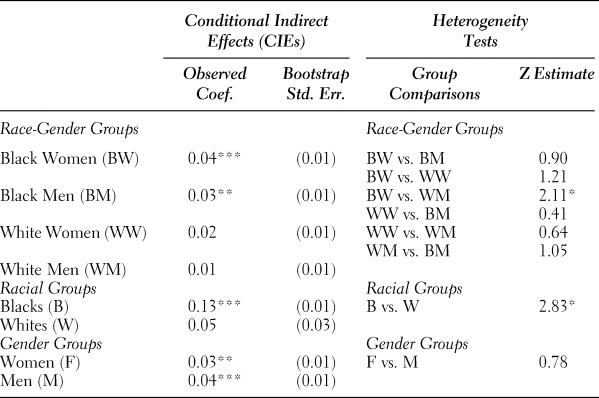
Following Preacher, Rucker and Hayes (Reference Preacher, Rucker and Hayes2007) and Hayes (Reference Hayes2013), we simulated conditional indirect effects based on a system of equations.Footnote 16 The coefficients for the structural equation models are listed in the Appendix (Table A1), and we present the postestimation results in Table 2. The left half of this table lists the estimates and bootstrapped standard errors (based on 5,000 simulations), and the right side reports a series of heterogeneity-of-effects tests (see Altman Reference Altman and Bland2003) in which we compare these indirect effects across race and gender groups.Footnote 17 Using the results in Table 2, we evaluated our argument about race and gender differences in the ability of role model status to mediate the impact of media activity on racial attitudes (Proposition 4). The conditional indirect effect for African Americans was larger in magnitude than the one for white respondents; a group comparison heterogeneity test confirmed that the conditional indirect effect for the latter group was significantly smaller than that of the former group. There is less evidence, however, of gender differences in the Michelle Obama effect. The CIEs for women and men were similar enough in magnitude that the heterogeneity between them is statistically indistinguishable from zero.
Testing the moderated mediation hypothesis: race and gender differences in the extent to which role model status transmits the effect of media activity to racial attitudes

Source: 2011 Kaiser Family Foundation/Washington Post Poll: Black Women in America (N = 1,936).
Note: Data points on the left side of the table represent conditional indirect effects (CIE) estimates with bootstrapped standard errors based on 5,000 random samples drawn (with replacement) from the sample dataset in parentheses. Asterisks (*) represent results that are statistically significant at or below the .05 level. The estimates on the right side of the table are heterogeneity-of-effects tests.
+ p < 0.10, * p < 0.05, ** p < 0.01, *** p < 0.001.
Examining the intersection of race and gender reaffirms the existence of a “race gap” but not necessarily a “gender gap.” For example, we noticed that the conditional indirect effects for African American women and men were comparable, as were the estimates for white women and men. The conditional indirect effects for black men and white women were also similar. In fact, the only statistically significant difference within these race–gender comparisons occurred between black women and white men. Role model status explained the process by which African American women translated their exposure to information about Let's Move! to their beliefs about Michelle Obama's ability to shift opinions about their race/gender group. Overall, the empirics surrounding our “moderated-mediator analyses” comport well with Proposition 4.
DISCUSSION
Second, we take seriously the logic underlying gender-based role model effects in general (see, e.g., Wolbrecht and Campbell Reference Wolbrecht and Campbell2007) and the Michelle Obama effect in particular. We began this paper by outlining the “conventional wisdom” of the Michelle Obama effect literature: that her media prominence has shaped racial attitudes (Proposition 1). We built upon this conventional wisdom by determining that the relationship between these variables can vary by race and gender (Proposition 2). We also departed from the conventional wisdom by arguing for the importance of studying former FLOTUS’ status as a role model, and we found that role model status functions like a moderated mediator. The “mediator” story is one in which role model status transmits the effect of the former FLOTUS’ media activities to respondents’ racial attitudes (Proposition 3), and we complicated this story by considering the possibility that race and gender could influence (“moderate”) this mediated relationship (Proposition 4). Thus, we have developed support for a much-needed dialogue in the social sciences about Michelle Obama's status as Role-Model-In-Chief, and we are especially interested in continuing the various conversations about the potential impact of the former first lady on perceptions of black women.
We have guided these conversations forward with several theoretical and empirical contributions. For example, we investigated role model status with the aim of understanding how (and why) it works. We used novel survey-based measures of media activity, role model status, and racial attitudes, and we employed the requisite statistical techniques to evaluate the causal structure of these variables. Overall, our research results move the field closer to making sense of this and other potential “Michelle Obama effects.”
The current study also presents several avenues for future research. For instance, the literature on Barack Obama indicates that media activity can correlate with many things, but we consider only one dependent variable here (perceptions of black women). We acknowledge this limitation, but the decision to maintain such a narrow focus is a practical one: our goal was to deal with issues of “internal validity,” exploring role model status as the intermediate variable that explains the relationship between media activity and racial attitudes. Future work can explore issues of “external validity,” such as generalizing the Michelle Obama effect on certain racial attitudes to other contexts.
Returning to internal validity, we also concede that our data are observational in nature and therefore are limited in their ability to truly capture causal relationships. Causal mediation analyses using simultaneous equation models are a nice start; however, a properly designed social science experiment would enable us to isolate more cleanly the impact of role model status and media activity. In the context of an experiment, this could involve randomly assigning subjects to receive varying levels of an intervention that primes subjects to think about Michelle Obama. Although such a design is beyond the scope of this study, future research of this type could explore the causal structure of the Michelle Obama effect using carefully crafted interventions embedded within a large-sample and nationally representative survey.
Beyond its research-related merits, we foresee the usefulness of our results in informing policy debates. Although we use policy familiarity as a proxy measure for media activity, we appreciate the importance of studying the former FLOTUS' anti-obesity initiative on its own merits. Conversations about Let's Move!, while more common in the fields of education (see Ellis Reference Ellis2012; Greenberg Reference Greenberg2011; Heron Reference Heron2012; Moore Reference Moore2012; Sims and Dowd Reference Sims and Dowd2013), medicine (Cappellano Reference Cappellano2011; Cottrell et al. Reference Cottrell, Neal, Ice, Perez and Piedimonte2011; Hong, Valerio, and Spencer Reference Hong, Valerio and Spencer2011; Katz Reference Katz2012; Kennedy Reference Kennedy2010; Palfrey Reference Palfrey2010; Wojcicki and Heyman Reference Wojcicki and Heyman2010), and communication studies (Bertaki Reference Bertaki2012; Jackson Reference Jackson2012; Weingart Reference Weingart2012), are rarer among those who study politics and gender. By considering Let's Move! from both a “social identity” and a “wellness policy” perspective, we seek to expand this dialogue to include disciplines like women's, gender, and sexuality studies, as well as political science, social psychology, and racial and ethnic studies. Broadened conversations about the former first lady and her policy agendas can provide new insights not only about Michelle Obama but also about the many challenges that black female leaders face.
APPENDIX
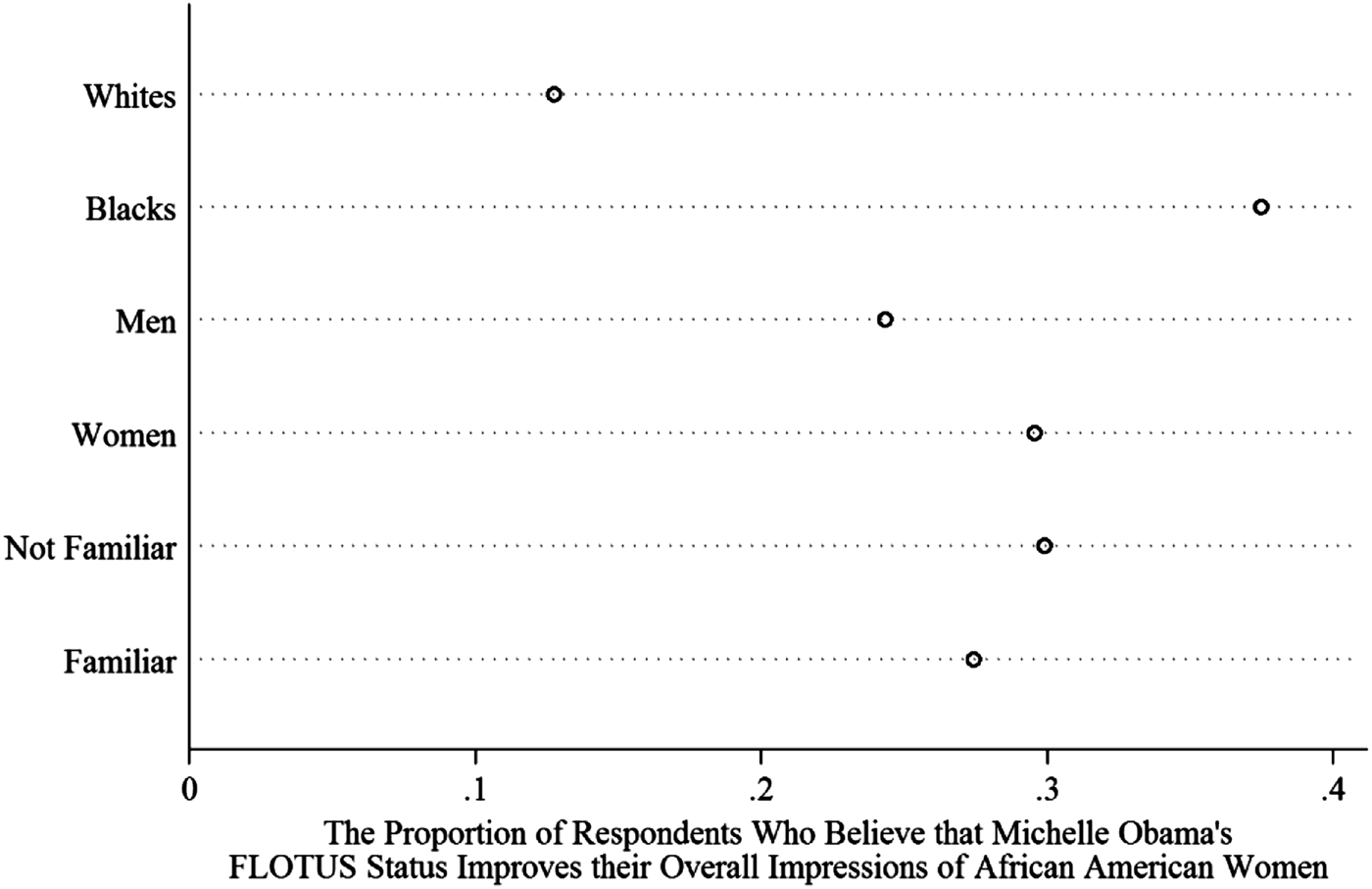
The distribution of the outcome variable, across race, gender, and policy familiarity.

Race and gender differences in the outcome variable, sorted by policy familiarity.
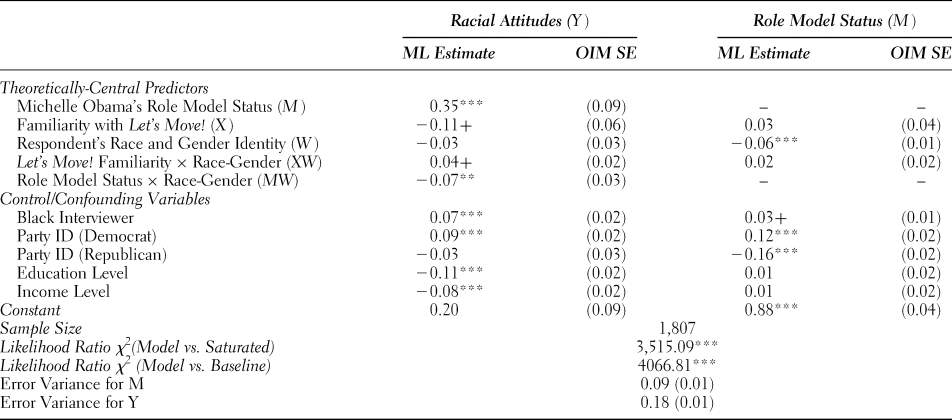
Causal mediation analysis using structural equation modeling