Implications
To decrease environmental impacts of beef cattle production systems, different strategies of forage or herd management and of alternative feeding can be proposed. Each of them decreases one or several impacts to a small extent. Strategies have more influence on the whole system when applied to the cow–calf herd than to fattened animals. The most promising strategy is calving at 2 years instead of 3 years. A significant decrease in impacts can be achieved by simultaneously applying several compatible strategies. Some strategies produce the same quantity of meat on less land, and if an increase in meat or crop production is not desired, this ‘excess’ land could be converted to forest to stock carbon, thus decreasing the net greenhouse gas emissions of the system.
Introduction
Livestock production worldwide, in particular ruminant production (Steinfeld et al., Reference Steinfeld, Gerber, Wassenaar, Castel, Rosales and De Haan2006; Gill et al., Reference Gill, Smith and Wilkinson2010), is responsible for significant greenhouse gas (GHG) emissions. Numerous GHG mitigation strategies for ruminant production have focused on a single GHG, such as enteric methane (CH4) or nitrous oxide (N2O; Eckard et al., Reference Eckard, Grainger and de Klein2010; Martin et al., Reference Martin, Morgavi and Doreau2010). Measures to enhance carbon (C) sequestration in the soil have also been identified (Dawson and Smith, Reference Dawson and Smith2007) as a mitigation strategy. However, it is critical to ensure that there is a net reduction in GHG emissions of the whole production system when such measures are implemented (Beauchemin et al., Reference Beauchemin, Janzen, Little, McAllister and McGinn2011), that is, a reduction in on-farm GHG emissions is not compensated by an increase in off-farm GHG emissions because of imported feed. Therefore, these measures need to be assessed at the scale of the entire production system. In addition to GHG emissions, other environmental impacts such as energy use, eutrophication (EP) and land-use impacts may be of major importance depending on the local or regional context (Steinfeld et al., Reference Steinfeld, Mooney, Schneider and Neville2010).
The present study analysed environmental impacts of farming practices meant to reduce GHG emissions of beef cattle production systems using the life cycle assessment (LCA) approach. The baseline beef production scenario, described by Nguyen et al. (Reference Nguyen, van der Werf, Eugène, Veysset, Devun, Chesneau and Doreau2012a), reflected current farm characteristics and management practices by farmers of Charolais beef cattle in France. Alternative land use was assessed by assuming that any permanent grassland becoming available because of more efficient farming practices was converted to even-aged forest. Nine scenarios were assessed, as well as an aggregated one representing the sum of scenarios considered compatible.
Materials and methods
System boundaries
LCAs of beef cattle production systems were conducted from cradle to farm gate for a 1-year period, that is, including the production and delivery of inputs used for grassland and cereals produced on-farm and for feed produced off-farm, herd management and associated upstream processes, emissions from the animals and manure storage. Environmental impacts from the application of manure for cereals and pasture were included, as were those from buildings. Veterinary medicines were excluded because of lack of data. The impacts, that is, climate change (CC, excluding and including the effects of land use and land-use change (LULUC)), cumulative energy demand (CED), EP, acidification (AC) and land occupation (LO), of different farming practice scenarios were compared. The functional units (FUs) considered were ‘1 kg of carcass mass at the farm exit gate’ and ‘1 ha of on-farm and off-farm land occupied’. If farming practices reduced permanent grassland occupation per kg of carcass mass produced, this released land was converted to fast-growing even-aged conifer forest as an alternative land use to increase the amount of C sequestered by the farm system. Planting and main management stages for Corsican pine (Pinus nigra subsp. laricio) were included and amortised over 64 years, the mean rotation period for plantations of this species (Vallet et al., Reference Vallet, Meredieu, Seynave, Bélouard and Dhôte2009).
Description of baseline of beef production system
The baseline beef production system (corresponding to system St-MS described in Nguyen et al. (Reference Nguyen, van der Werf, Eugène, Veysset, Devun, Chesneau and Doreau2012a)) comprised a cow–calf herd and a bull-fattening herd. The cow–calf herd included 70 cows that produced 62 weaned calves each year. These cows had their first calving at 3 years, and each provided a mean of 4.4 calves over their lifetimes. All weaned female calves were reared as heifers (with 3% mortality) used as replacement cows until the age of 27 months. Of the 30 heifers thus produced, 14 were not selected for replacement and were fattened in pasture complemented with cereals and slaughtered at 33 months. Cull cows were finished for 100 days before being sent to the slaughterhouse. One male calf was selected to replace the breeding bull, and the rest were sent to the bull-fattening herd at 11 months and slaughtered at 18 months.
The cow–calf herd ration was based mainly on grassland with a mean of 1.2 livestock units (LU)/ha of grassland (temporary + permanent) and 7.5 months of grazing. The grassland area consisted of 88% permanent and 12% temporary pastures. One LU is defined as an animal that consumes 5 t dry matter (DM)/year (Nguyen et al., Reference Nguyen, van der Werf, Eugène, Veysset, Devun, Chesneau and Doreau2012a). We assumed that permanent grassland did not require tilling and sowing operations. Apart from manure excreted on pasture during grazing, permanent grassland was fertilised with mineral and organic N fertilisers (contributing 28 and 27 kg/ha of N, respectively). Permanent grassland had a potential yield of 5.6 t DM/ha per year, 23% of which was harvested as conserved forage (hay and/or wrapped grass silage). Temporary grassland, a combination of grasses and clover, had a higher potential yield (8.3 t DM/ha per year, 75% harvested as conserved forage) and was renewed every 5 years by tillage and seeding. Mineral N fertiliser for temporary grassland was applied at 33 kg/ha. Grass not harvested, as conserved forage was available for ingestion by animals during grazing. For several reasons (selective grazing, trampling of grass, unfavourable weather conditions), some of the grass grown is not ingested; this ‘loss’ corresponded to 31.5% of grass DM available for grazing, as calculated from the difference between grassland potential yield and actual feed intake by the herd. Losses during conservation of both hay and wrapped grass silage were assumed to be 6% of the initial DM of conserved forages. During the indoor winter-feeding period, the herd was fed hay and concentrates (mainly based on cereals produced on-farm, and imported protein supplement containing 30% soya bean meal, 40% rapeseed meal and 30% sunflower meal).
Male calves in the baseline bull-fattening herd were fed a high-forage diet composed of 58% maize silage, 24% wheat, 15% soya bean meal, 2% hay and 1% minerals (DM basis), resulting in an average daily live weight gain (ADG) of 1.40 kg. All rations were formulated to satisfy beef cattle nutrient requirements according to animal characteristics and feed composition values, on the basis of recommendations of INRA beef researchers and data tables (INRA, 2007). The carcass yields of fattened bulls, the breeding bull, finished heifers and finished cull cows were 59%, 57%, 56% and 54%, respectively. Methods used to produce feed ingredients were described in Nguyen et al. (Reference Nguyen, van der Werf, Eugène, Veysset, Devun, Chesneau and Doreau2012a) and were summarised in supporting information Table S1.
Scenarios with alternative farming practices
Scenarios with alternative farming practices (denoted S1 to S10) were designed to reduce GHG emissions of the beef cattle production system. These practices are already applied by some farmers or can be applied without adverse effect on animal performances, on the basis of experimental results. The use of these practices, both individually and simultaneously, was studied. Alternative rations were formulated according to INRA (2007) to meet animal requirements, except in scenario S3 (underfeeding). When farming practice affected total feed requirements, the land area needed was adjusted to produce feed. Feed ingredients were produced by the same practices used in the baseline scenario.
Grassland management
Scenario S1: Mineral N fertiliser decreased
This scenario assessed effects of decreasing mineral N fertiliser from 28.0 to 18.5 kg/ha of permanent grassland. The yield of permanent grassland was assumed not to be affected, because baseline mineral N fertiliser application levels exceed the optimum level required for grass growth (J. Devun, Institut de l'Elevage, personal communication). Estimated nitrate losses through leaching were reduced from 20 to 14 kg N/ha. As grassland yield was not affected, this reduction did not change land use or reproduction or growth performances of grazing animals.
Scenario S2: Grass losses on pasture decreased
This scenario evaluated effects of decreasing grass losses (i.e. grass that is not ingested by the cows) on pasture from 31.5% to 16.5% (J. Devun, Institut de l'Elevage, personal communication). This reduction can be obtained by better management of grassland,that is, turn out to pasture as soon as possible, rotational grazing and adjust animal density for grazing during the dry season (Joannic et al., Reference Joannic, Fossé and Charon2011). As a consequence, the stocking rate was increased from 1.20 to 1.37 LU/ha of grassland area. Estimated nitrate losses were decreased from 20 to 17 kg N/ha. It was assumed that this practice did not affect reproduction and growth performances of grazing animals.
Herd management
Scenario S3: Underfeeding of heifers in winter
This scenario evaluated effects of underfeeding of heifers in winter using exclusively hay, and animal growth was assumed to be compensated during the grazing season. Rations were formulated by INRAtion v.4, and heifer growth was predicted with the Mecsic model (Hoch and Agabriel, Reference Hoch and Agabriel2004). Stocking rate was decreased from 1.20 to 1.15 LU/ha of grassland area.
Scenario S4: Female calves fattened (high growth rate) instead of being reared for replacement (moderate growth rate)
This scenario evaluated effects of fattening of female calves from 9 to 19 months instead of rearing them as heifers used for replacement and fattening them on pasture for 4 months until slaughter at 33 months. Fourteen female calves after weaning not selected for replacement were fattened (until 650 kg LW) with a diet based on maize silage (76.5% maize silage, 1.3% hay, 13.6% wheat, 7.0% soya bean meal and 1.6% minerals (DM basis)), resulting in an ADG of 1.15 kg.
Scenario S5: Cow longevity increased
This scenario evaluated effects of increasing longevity of cows from 7 to 9 years to provide a mean of 6.5 calves per lifetime instead of 4.4 calves. As a consequence, the number of culled cows decreased (from 16 to 11 per year) and the number of heifers used for meat production increased (from 14 to 19 per year). This practice is assumed to be achieved by changes in farm management and not to affect calving rate, animal growth or mortality of the herd, according to the experience of farmers that implemented this approach.
Scenario S6: Age at first calving decreased
This scenario evaluated effects of decreasing first calving age from 3 to 2 years simulated based on Farrié et al. (Reference Farrié, Renon, Bourge, Gros, Lahemade, Muron and Roudier2008). All female calves were reared to reach 467 kg LW (instead of 405 kg) at 15 months for the first breeding. Heifers not used for replacement at 15 months were fattened to slaughter at 23 months (about 670 kg LW) instead of 33 months (at 698 kg LW). Replacement rate was slightly lower (21.4%) than in the baseline (23%) scenario; although these cows produced more calves (mean = 4.7 instead of 4.4) per lifetime, they were culled sooner (at 6 years and 780 kg LW instead of at 7 years and 800 kg LW). According to farmer's experiences, under normal conditions, this practice can be achieved by changes in farm management without affecting calving rate and mortality of the herd.
Feed composition
Scenario S7: Protein supplement partially replaced with lucerne hay
This scenario evaluated the effects of replacing some protein supplement with lucerne hay during the winter. A portion of temporary grassland was used to produce lucerne hay, and the protein supplement for the herd per year was decreased from 6.8 to 2.3 t. Lucerne hay contributed 12.4% of the total hay production. It was assumed that this practice did not affect reproduction and growth performances because total digestible protein intake was unchanged.
Scenario S8: Soya bean meal replaced with rapeseed meal
This scenario evaluated effects of using rapeseed meal to replace soya bean meal in the bull diet. It was assumed that animal growth was not affected, because nutrient intake per day was maintained by increasing DM intake.
Scenario S9: Lipid content in diets increased by using extruded linseed
Extruded linseed was used to replace a portion of concentrate (cereals and protein supplement) in the cow–calf herd. Lipid content in diets for animals was not to exceed 3% of total DM. As animal requirements were met in both diets, it was assumed that this practice did not affect animal performances during winter. Male calves were sent to the bull-fattening herd after weaning (350 kg LW) and were fed with concentrate-based diet rich in lipids (13% barley straw and 83% concentrate including 46% cereals and 6% extruded linseed), resulting in an ADG of 1.71 kg.
Scenario S10: Combination of scenarios S1, S2, S5, S6 and S8
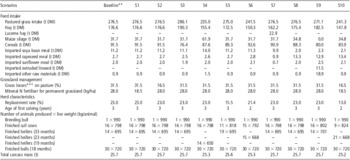
Scenario S10 combines five compatible scenarios whose effects were expected to be additive: decrease in mineral N fertiliser (S1), decrease in grass losses on pasture (S2), increase in cow longevity from 7 to 9 years (S5), decrease in age at first calving from 3 to 2 years (S6) and replacement of soya bean meal with rapeseed meal (S8). Details of baseline and farming practice scenarios of the beef production system are presented in Table 1.
Annual characteristics of baseline and farming practice scenariosFootnote * for the beef cattle production system

DM = dry matter.
* Scenarios are defined in section ‘Material and methods’.
** Nguyen et al. (Reference Nguyen, van der Werf, Eugène, Veysset, Devun, Chesneau and Doreau2012a).
*** Grass that is not ingested by the animals on pasture.
Alternative land use: Corsican pine even-aged forest
If an alternative scenario used less land than the baseline scenario to produce the same quantity of meat (carcass mass), we explored an alternative use for this ‘released’ land – to reduce net GHG emissions of the farm system – rather than to use it to increase meat or crop production. We assumed that the surplus land area was converted to an even-aged forest of Corsican pine, because it grows well even on poor sites, provides high-quality wood and has been successful in several French regions. We assumed a 64-year rotation, during which the forest sequesters 11.4 t CO2/ha per year into the vegetation (Vallet et al., Reference Vallet, Meredieu, Seynave, Bélouard and Dhôte2009). The main function of the forest within the beef farm system being C sequestration, we did not include the harvest of the trees (after 64 years), neither concerning inputs required nor the products it would yield. We did, however, include inputs required for planting the forest and managing it during the first 15 years of the establishment phase.
Emissions estimates, including effect of LULUC on soil C balance
Methods for estimating farm emissions were described in Nguyen et al. (Reference Nguyen, van der Werf, Eugène, Veysset, Devun, Chesneau and Doreau2012a). In brief, enteric CH4 emissions were estimated for each class of cattle according to Vermorel et al. (Reference Vermorel, Jouany, Eugène, Sauvant, Noblet and Dourmad2008), using animals’ net energy requirements, converted into metabolisable energy intake (MEI) and conversion factors from MEI to CH4 energy. To include the effect of diets supplemented with lipids rich in n-3 fatty acids on ruminants’ enteric CH4 production, a 4.8% reduction factor of enteric CH4 production (g CH4/kg DM intake) per percentage unit of added lipids was applied (Martin et al., Reference Martin, Morgavi and Doreau2010).
Emissions from manure produced by cattle (manure in the cow–calf herd and slurry in the bull-fattening herd) in housing, during storage, deposited during grazing and from manure application on cropland and grassland were estimated according to Intergovernmental Panel on Climatic Change (IPCC, 2006) Tier 2 (for CH4 and N2O), CORPEN (2006) and Payraudeau et al. (Reference Payraudeau, van der Werf and Vertès2007) (for ammonia). Nitrate leaching was estimated based on Vertès et al. (Reference Vertès, Simon, Laurent and Besnard2007) for grassland and Basset-Mens et al. (Reference Basset-Mens, van der Werf, Robin, Morvan, Hassouna, Paillat and Vertès2007) for cropland. Phosphorus emissions (leaching, run-off and erosion) were estimated according to Nemecek and Kägi (Reference Nemecek and Kägi2007). A summary of emission factors used for livestock, cropping and grassland production and their sources is presented in Table S2.
C sequestration according to type of grassland was estimated using data from Arrouays et al. (Reference Arrouays, Balesdent, Germon, Jayet, Soussana and Stengel2002) for permanent grassland (i.e. older than 30 years, 0.7 t CO2/ha per year) and for temporary grassland (1.8 t CO2/ha per year). It was assumed that temporary grassland was maintained for 5 years and followed by an annual crop for 2 years; C emissions were estimated at 3.7 t CO2/ha per year for this cropland in rotation with temporary grassland (Arrouays et al., Reference Arrouays, Balesdent, Germon, Jayet, Soussana and Stengel2002). We assumed that other annual crop area was converted from permanent grassland more than 20 years ago, and agricultural practices for these crops no longer had an effect on soil C. The proportion of Brazilian soya bean crops grown on land, converted the previous year from Brazilian rain forest was estimated at 0.7% (Prudêncio da Silva et al., Reference Prudêncio da Silva, van der Werf, Spies and Soares2010). To conform better to current practice regarding the effect of land-use change on C emissions due to conversion of Brazilian forest to cropland, we decided to adopt a value of 740 t CO2/ha, as recommended in PAS 2050 (2008) among others, instead of the value of 120 t CO2/ha used in the ecoinvent database (Jungbluth et al., Reference Jungbluth, Chudacoff, Dauriat, Dinkel, Doka, Faist Emmenegger, Gnansounou, Kljun, Schleiss, Spielmann, Stettler and Sutter2007).
Life cycle impact assessment
The impact categories considered were LO (m2 × year), CC and CC/LULUC (kg CO2 equivalent (eq.)), CED (MJ), EP (g PO43− eq.) and AC (g SO2 eq.). The indicator value for each impact category was determined by multiplying the aggregated resources used and the aggregated emissions of each individual substance with a characterisation factor for each impact category to which it may potentially contribute. CC, EP, AC and LO were calculated using the CML2 ‘baseline’ and ‘all categories’ 2001 characterisation methods as implemented in the ecoinvent v2.0 database. The CC indicator excludes C sequestration in grassland, that in even-aged forest converted from permanent grassland and C emissions due to conversion of Brazilian forest to cropland, whereas the CC/LULUC includes them. Total CED was calculated according to version 1.05 of the indicator, as implemented in the ecoinvent v2.0 database.
Results
Effects of changes in farming practices on CC, CC/LULUC, CED, EP and AC
Effects of grassland management (S1 to S2)
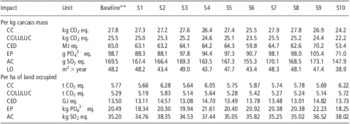
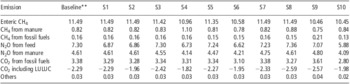
Decreasing mineral N fertiliser application on permanent grassland (S1) slightly decreased CC, CC/LULUC and AC (reduction between 1% and 2%) and decreased CED and EP per kg carcass mass by 2.9% and 10.5%, respectively (Table 2). The reduction of CC and CC/LULUC was mainly due to lower N2O emissions (Table 3) associated with reduced mineral N fertiliser application. Decreasing grass losses on pasture (S2) did not affect CC/LULUC (reduction <1%), slightly decreased CC and AC and decreased CED and EP per kg carcass mass by 2.8% and 10.8%, respectively. The reduction of CC and CC/LULUC was due to lower N2O emission from mineral fertiliser application on grassland, as less grassland was needed to produce 1 kg of carcass mass. However, the reduction in grassland area induced a decrease in total C sequestration by the beef system.
Environmental impacts of baseline for standard beef cattle production and farming practice scenariosFootnote *

CC = climate change; LULUC = land use and land-use change; CED = cumulative energy demand; EP = eutrophication; AC = acidification; LO = land occupation.
* Scenarios are defined in section ‘Material and methods’.
** Nguyen et al. (Reference Nguyen, van der Werf, Eugène, Veysset, Devun, Chesneau and Doreau2012a).
Contribution of CH4, N2O and CO2 to CC impact (kg CO2 eq./kg carcass mass; including LULUC) of baseline for standard beef cattle production and farming practice scenariosFootnote *

CC = climate change; LULUC = land use and land-use change.
* Scenarios are defined in section ‘Material and methods’
** Nguyen et al. (Reference Nguyen, van der Werf, Eugène, Veysset, Devun, Chesneau and Doreau2012a).
Effect of herd management (S3 to S6)
Underfeeding heifers in winter (S3) did not affect CC, AC and slightly decreased CC/LULUC, CED and EP. Fattening female calves instead of rearing them as replacement heifers (S4) slightly decreased CED, and decreased impacts per kg carcass mass by 4.9%, 3.5%, 4.4% and 3.6% for CC, CC/LULUC, EP and AC, respectively. The reduction of CC and CC/LULUC was related to lower emissions of enteric CH4 and N2O emissions from feed production and manure. However, CH4 emissions from manure increased and C sequestration decreased. Increasing cow longevity (S5) slightly decreased impacts per kg carcass mass. Decreasing calving age (S6) decreased impacts per kg carcass mass about 7.8% to 8.4%. The reduction of CC and CC/LULUC was related principally to the reduction of enteric CH4 (by 8%), N2O emissions from feed production (by 9%) and manure (by 9%) and CO2 emission from fossil fuel use (by 8%). However, C sequestration decreased by 15%.
Effect of feed composition (S7 to S9)
The partial replacement of protein supplement by lucerne hay during the winter (S7) did not affect any impact category per kg carcass mass. The replacement of soya bean meal by rapeseed meal in bull diets (S8) did not affect CC, EP and AC, slightly decreased CC/LULUC and reduced CED per kg carcass mass by 3.8%. A reduction of fossil fuel-based CO2 emissions and a net increase in C sequestration were partially compensated by an increase in N2O emission from feed production and CH4 emission from manure. The use of extruded linseed to increase lipid content in animal diets (S9) slightly decreased AC, decreased CC and CC/LULUC per kg carcass mass by 3.0% and 4.4%, but increased CED and EP by 8.0% and 6.7%, respectively. Emissions of enteric CH4 and CH4 from manure decreased by 9% and 8%, respectively. However, CH4 and CO2 emission from fossil fuel use and N2O emission from manure increased by 31%, 7% and 4%, respectively. C sequestration also increased by 12%.
Scenario S10: Combination of S1, S2, S5, S6 and S8 scenarios
The combination of S1, S2, S5, S6 and S8 decreased CC, CC/LULUC and AC per kg carcass mass by 12.7% to 12.8%, CED by 17.9% and EP by 28.0%. There was a high reduction (by 9% to 27%) in emission of all GHGs, except for CH4 emission from manure (by 5%); however, C sequestration decreased by 14%.
The effects of farming practices S1, S7 and S8 on the environmental impacts per ha of on- and off-farm land occupied were approximately the same as those per kg of carcass mass (Table 2). In contrast, the effects of the other scenarios differed according to FU. Decreasing grass loss on pasture (S2) increased impacts per ha by 8% to 10%, except for EP (−1%). Underfeeding heifers in winter (S3) decreased impacts per ha by 2% to 3%. Fattening female calves instead of rearing them as replacement heifers (S4) increased impacts per ha by 5% to 9%. Increasing cow longevity (S5) did not affect impacts per ha. Decreasing calving age (S6) increased impacts per ha by only 2%. The use of extruded linseed to increase lipid content in animal diets (S9) decreased CC and CC/LULUC per ha, but increased CED, EP and AC by 4% to 10%. The combination of S1, S2, S5, S6 and S8 increased impacts per ha by 2% for CED and 8% for CC, CC/LULUC and AC, but decreased EP by 11%.
Effects of changes in farming practices on LO and alternative land use on CC/LULUC
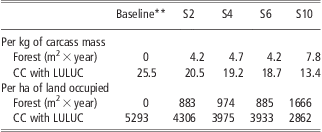
Farming practices such as decreasing grass loss on pasture (S2), fattening female calves instead of rearing them as replacement heifers (S4), decreasing calving age (S6) and combination of S1, S2, S5, S6 and S8 (S10) decreased the use of permanent grassland and total LO per kg of carcass mass by 12% to 23% and 9% to 19%, respectively (Table 4). If Corsican pine was planted on the released permanent grassland, CC/LULUC both per kg of carcass mass and per ha occupied on- and off-farm decreased by 20% to 27% for S2, S4, S6 and 46% to 48% for S10 (Table 5). Corsican pine planted on released permanent grassland did not affect CED per either FU.
LO (m2 × year/kg carcass mass) of baseline for standard beef cattle production and farming practice scenariosFootnote *

LO = land occupation.
* Scenarios are defined in section ‘Material and methods’.
** Nguyen et al. (Reference Nguyen, van der Werf, Eugène, Veysset, Devun, Chesneau and Doreau2012a).
Area (m2 × year) of ‘excess’ permanent grassland converted to forest and CC impact of beef cattle production including LULUC (kg CO2 eq.) as a function of functional unit and farming practice scenarioFootnote *
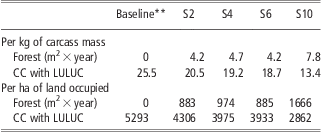
CC = climate change; LULUC = land use and land-use change.
* Scenarios are defined in section ‘Material and methods’.
** Nguyen et al. (Reference Nguyen, van der Werf, Eugène, Veysset, Devun, Chesneau and Doreau2012a).
Discussion
Differences according to impact category and FU
At the scale of the entire beef production system, farming practices for mitigating GHG emissions showed compensation among GHG emissions compared with the baseline scenario. Environmental impacts per kg carcass mass varied according to farming practice, from no effect (S7) to slight decreases (S1, S2 except for a high decrease in EP, S5) or large decreases (S6, S10) of all impacts. In contrast, for S9, CED and EP increased by 7% to 8%, whereas other impacts decreased, because of an increase in energy requirements for linseed production, the extrusion process and concentrate production for finishing and cow–calf diets. For S3, LO increased because of an increase in hay for winter feeding, although cereal use decreased. For S8, CED decreased more than other impacts because rapeseed meal required less energy than soya bean meal, mainly due to transport within Brazil and from Brazil to France (Nguyen et al., Reference Nguyen, van der Werf and Doreau2012b).
Most studies of GHG mitigation strategies of ruminant production systems expressed impacts per kg of animal product, because GHG emissions are considered global impacts and their driver is global demand for these products. Environmental impacts can be expressed per ha of land (on-farm and off-farm) occupied, however, if the driver is reducing pollution in a given area (Nguyen et al., Reference Nguyen, van der Werf and Doreau2012b). The relative impacts of some farming practices (S2, S3, S4, S6 and S10) differed according to the FU (kg of carcass mass or ha of land occupied), because these practices had a larger effect on LO than on other impacts. Regarding local impacts, EP and AC per ha did not increase more than 8% to 9% among scenarios. However, it is unlikely that potential impacts would reach levels that result in actual EP and AC damage, especially as the cow–calf herd is based principally on grassland with a moderate stocking rate and a low mineral–fertiliser application rate (Nguyen et al., Reference Nguyen, van der Werf and Doreau2012b).
Effect of farming practices on impacts
Suckler beef production in France is specialised in suckler cow–calf herds with finishing heifers and bull-fattening herds. Environmental impacts of beef production mainly originate from the cow–calf herd (Pelletier et al., Reference Pelletier, Pirog and Rasmussen2010; Beauchemin et al., Reference Beauchemin, Janzen, Little, McAllister and McGinn2011). Nguyen et al. (Reference Nguyen, van der Werf, Eugène, Veysset, Devun, Chesneau and Doreau2012a) showed that the suckler cow–calf herd with finishing heifers contributed 83% to 95% of impacts of the whole system. As an example, replacing soya bean meal with rapeseed meal in bull diets (S8) had modest effects on the impacts of the whole system, although it decreased the CC/LULUC and CED impacts of the bull-fattening herd by 9% and 22%, respectively (results not shown). In France and more generally in Europe, suckler cow–calf herds are produced principally on grassland area, which is used for grazing in summer and production of conserved forages used in winter. This characteristic limits the ability to modify their diets (Foley et al., Reference Foley, Crosson, Lovett, Boland, O'Mara and Kenny2011; Nguyen et al., Reference Nguyen, van der Werf, Eugène, Veysset, Devun, Chesneau and Doreau2012a), for example, with ingredients (e.g. additives, lipids) that decrease enteric CH4 production.
Decreasing mineral N fertiliser application to permanent grassland (S1) slightly decreased impacts of the whole system because its use was already low in the baseline. It can, however, reduce production costs. The main advantage of decreasing grass losses on grazing (S2) is a reduction in grassland occupied per kg of beef produced. However, it requires more work to farmers for grassland management, in particular adapting grazing to grass growth by the systematic use of rotational grazing.
Underfeeding heifers in winter (S3) decreased impacts of the whole system little, because the reduction in impacts of cereal ingredients was compensated by the increase in those of forages. Although heifers required less net energy for growth, total DM intake increased because digestibility of hay and fresh grass is lower than that of cereals. However, this scenario promotes the use of grassland for ruminant production, which increases C sequestration in soils and avoids using crops that could be fed to humans.
Fattening female calves instead of rearing them as replacement heifers (S4) reduced impacts because they grew faster, resulting in less rearing time before slaughter. In addition, their enteric CH4 emissions were lower as they were fed with maize silage and concentrate instead of mainly forage. As maize silage has a higher yield per ha than grass, the area of grassland used for the herd decreased. Although this practice increased the use of feed crops, it can be considered as a potential CC mitigation practice.
Among farming practices evaluated, decreasing calving age (S6) seems one of the most effective impact mitigation strategies, as impacts decreased by 8% to 10% due to two effects. First, all heifers were reared at higher growth rates to reach minimum body condition for first breeding at 15 months and first calving at 24 months instead of 27 and 36 months, respectively. In this way, 1 year of cow rearing (6 instead of 7 years) was saved without reducing reproductive yield per lifetime. Second, heifers not used for replacement also grew faster, thus finishing sooner (23 instead of 33 months), reducing impacts of the whole production system (as explained for S4). First calving at 2 years is the current practice in western Canada (Beauchemin et al., Reference Beauchemin, Janzen, Little, McAllister and McGinn2010). In France, first calving at 2 years with the Charolais breed was begun in experimental farms and later implemented by some innovative farmers (Farrié et al., Reference Farrié, Renon, Bourge, Gros, Lahemade, Muron and Roudier2008). Changing first calving from 3 to 2 years for half of a Charolais herd improved profit when the number of calvings per cow was increased by 5% to 10% (Farrié et al., Reference Farrié, Renon, Bourge, Gros, Lahemade, Muron and Roudier2008).
Increasing cow longevity (S5) decreased impacts of the whole system little, as the annual number of cull cows decreased but that of finished heifers increased. Using different allocation methods, Nguyen et al. (Reference Nguyen, van der Werf, Eugène, Veysset, Devun, Chesneau and Doreau2012a) showed that impacts per kg carcass mass of finished heifers slaughtered at 33 months were relatively higher than those of 7-year-old cull cows (except for mass allocation). In S5, impact reductions obtained by extension of cow lifetime were compensated by high impacts of finished heifers. Beauchemin et al. (Reference Beauchemin, Janzen, Little, McAllister and McGinn2011) observed a similar result for GHG emissions and argued that the additional beef produced had higher per kg GHG emissions. This practice will mitigate impacts more if impacts of finished heifers could be reduced. It is possible that combining this practice with fattening female calves instead of rearing them as replacement heifers (S4) could reduce impacts of the entire system.
Concerning feeding practices, the partial replacement of protein supplement by lucerne hay during the winter (S7) did not affect impacts, as the percentage of protein supplement replaced was small (0.8% of total DM intake of the cow–calf herd), and only 30% of it was soya bean meal. Adding lipids to finishing diets to reduce enteric CH4 production slightly decreases total GHG emissions of beef production systems (Stewart et al., Reference Stewart, Little, Ominski, Wittenburg and Janzen2009; Beauchemin et al., Reference Beauchemin, Janzen, Little, McAllister and McGinn2011; Nguyen et al., Reference Nguyen, van der Werf, Eugène, Veysset, Devun, Chesneau and Doreau2012a). In this study, adding lipids both to finishing and cow–calf diets (S9) decreased GHG emissions per kg carcass mass by no more than 3%, which was lower than the 11% decrease obtained by Beauchemin et al. (Reference Beauchemin, Janzen, Little, McAllister and McGinn2011). This difference is due to including a lower percentage of lipids in the winter cow–calf diet in this study than in that of Beauchemin et al. (Reference Beauchemin, Janzen, Little, McAllister and McGinn2011; 1.2% v. 4%, respectively).
A combination of several compatible scenarios (S10) appeared the most promising impact mitigation strategy. Overall, the effects of each farming practice on impacts were limited because each affected only one element of the whole system. In our study, combining several farming practices, even when taking into account known interactions, approximately equalled the sum of the effects of each individual practice. With additional research on system experiments, currently unknown interactions between these practices might be identified that could modify our predictions. Del Prado et al. (Reference del Prado, Chadwick, Cardenas, Misselbrook, Scholefield and Merino2010), comparing a variety of GHG mitigation options using either a simulation model or an aggregation of single-effect options, found that the aggregation of single-effect options tended to overestimate overall GHG mitigation. We cannot exclude that an overestimation of this type occurred in this study.
The cost of implementing practices was not evaluated. It is obvious that financial costs will influence the implementation of these practices on farms (Beauchemin et al., Reference Beauchemin, Janzen, Little, McAllister and McGinn2011). Vellinga et al. (Reference Vellinga, de Haan, Schils, Evers and van den Pol–van Dasselaar2011) observed that farmers tend to choose mitigation options that are relatively simple and either cost-effective or inexpensive. However, to reach a significant effect, the combination of several practices is necessary; this is more challenging for farmers and raises the problem of the farmer acceptability of these practices. One way of making mitigation practices more acceptable to farmers may lie in the attribution of subsidies to offset the cost of these practices.
A ‘cradle-to-farm gate’ LCA study of beef production system requires numerous production parameters, emission factors, empirical equations and modelling assumptions, which can substantially affect the uncertainty of results (Crosson et al., Reference Crosson, Shalloo, O'Brien, Lanigan, Foley, Boland and Kenny2011). The uncertainty in estimates of GHG emissions for milk production results mainly from uncertainty in emission factors used to estimate N2O and enteric CH4 emissions, DM intake and milk yield (Basset-Mens et al., Reference Basset-Mens, Kelliher, Ledgard and Cox2009; Flysjö et al., Reference Flysjö, Henriksson, Cederberg, Ledgard and Englund2011; Henriksson et al., Reference Henriksson, Flysjö, Cederberg and Swensson2011). We can assume this holds true for our study, if one substitutes ‘milk yield’ with ‘animal growth’. In our study, enteric CH4 was estimated with the Tier-3 method used in the French Inventory of Greenhouse Gases, as recommended by IPCC (2006) to improve the accuracy of emission estimates. We consider this estimate to have low uncertainty. Our estimates of N2O emissions are based on IPCC Tier 2 (IPCC, 2006) emission factors, which have a high uncertainty. Our data on DM intake and animal growth have low uncertainty, as they are based on French feeding system table (INRA, 2007). The scenarios we compared are assessed in the same local conditions as the baseline; thus, variability due to weather and soil conditions is excluded. Therefore, on the whole, our scenarios have low uncertainty for the main factors determining GHG emissions of beef production, except for N2O emissions.
Alternative land use
This paper explores the potential of even-aged forest as an alternative land use for permanent grassland released because of more efficient farming practices, illustrating its potential for reducing the CC/LULUC impact of the entire farm system when comparing farming practices. Apart from forest, there is no alternative land use for permanent grassland that can increase C sequestration in both soil and biomass. This option appeared the most promising GHG mitigation strategy for the beef production system without altering farm productivity. However, this is a short- and mid-term GHG mitigation strategy, as C sinks resulting from sequestration activities in soil or biomass are not permanent (e.g. Smith, Reference Smith2005). In our study, the forest is harvested 64 years after planting, which implies a partial return of the C stock in its biomass to the atmosphere. The dynamics of this return of C to the atmosphere will depend on how the biomass will be processed and into what products. A considerable fraction of the harvested biomass may be used for energy production, which may result in a rapid return of C to the atmosphere, unless C capture and storage technologies are implemented. In either case, this biomass can replace fossil energy, thereby mitigating GHG emissions and non-renewable energy use. A part of the wood may be used as construction material, resulting in C storage over a longer time period (e.g. 40 years; Vallet et al., Reference Vallet, Meredieu, Seynave, Bélouard and Dhôte2009). Furthermore, after harvesting, a new forest can be planted and resume C sequestration. Finally, it is expected that in the long term, effective technologies and solutions will be achieved for global GHG mitigation; it is therefore crucial to identify effective practices for GHG mitigation in the short and mid-term.
In practice, planting even-aged forests is both labour-intensive and regulated at regional levels. Although the introduction of even-aged forest in regions dominated by grassland-based bovine production may not be welcomed by all stakeholders concerned, it certainly has a major potential to contribute to short- and mid-term GHG mitigation. In addition, the edge effect among forest, pastures and cropland may increase biodiversity of the production system (Benton et al., Reference Benton, Vickery and Wilson2003). In crop-farm systems, identifying and simulating alternative land uses strongly affected their environmental impacts (Tuomisto et al., Reference Tuomisto, Hodge, Riordan and Macdonald2012). Furthermore, comparing farming practices with identical farm area (i.e. considering alternative land uses on farms) avoids relative changes in impacts according to FU (per unit mass or area).
Conclusion
It is difficult to greatly reduce the environmental impacts, and in particular the GHG emissions, of a beef cattle production system, as its impacts result to a large extent from the suckler cow–calf herd; this offers few options to modify herd management and feeding strategies. Modification of individual farming practices moderately affected impacts of the whole beef system; the most promising practice is a decrease in calving age from 3 to 2 years. Our results suggest that simultaneous application of several compatible farming practices can reduce impacts of beef cattle production significantly. However, our scenario did not consider possible interactions between practices. This point should be further explored, and an approach combining system experiments and simulation modelling seems appropriate. The introduction of even-aged forest as an alternative land use in beef cattle farms seems promising and merits further exploration. It illustrates that when comparing farming practices, alternative land use may strongly affect the CC impact of the entire production system.
Acknowledgements
The first author received a grant for this research from Valorex (Combourtillé, France). The authors gratefully acknowledge Jean Devun (Institut de l'Elevage), Michel Lherm and Jacques Agabriel (INRA/Vet Agro Sup, UR1213 Herbivores) for their contributions on development of the scenarios studied.
Supplementary material
For supplementary material referred to in this article, please visit http://dx.doi.org/doi:10.1017/S1751731112002200