Introduction
The goal in this article is to reflect upon recent developments in the use and application of new technologies in the wider world and then, with a view to second language teaching and learning, consider how these changes might be recognized and absorbed within the field. In this discussion, I have in mind language teachers and their students, administrators, and researchers. The focus is on seeking forms of connection between the wider world and classroom. If, for example, the use of social media is polarizing opinion through the algorithms that are employed, or the use of robotics or machine learning is impacting upon the work available, how might recognition of these important recent developments in the world track back and be acknowledged in the second language classroom—through the design of particular tasks or choice of topics, for example, or adjustments to certain elements in the syllabus or curriculum. What accommodation might be made given current conditions and circumstances? The argument is not for wholesale change, but for recognition of certain developments or issues followed by appropriate recalibration or adjustment.
The changes in the world over the last few years have been immense—politically, economically, socially, and technologically—sweeping across the whole spectrum of modern life. The impact and power of new technologies (the focus here) have been integral to these changes. Whether they comprise the role of social media, artificial intelligence, machine learning, big data, robotics, cyber security, or conversational assistants (e.g., Alexa), the changes are vast and nontrivial. While in the past, claims may have been made that technological innovations are operating on the margins or are peripheral to everyday life, this is not now the case (see Keen, Reference Keen2018; Lanier, Reference Lanier2018). They are fundamental to the way the world works.
Compare, for example, Sherry Turkle's (Reference Turkle1995) relatively neutral title for her description of identities in Life on the Screen: Identity in the Age of the Internet with her stance in her later work, Alone Together: Why We Expect More from Technology and Less from Each Other (Turkle, Reference Turkle2011). An author such as Turkle cannot be lightly dismissed. She is a highly respected professor in the social studies of science and technology at MIT. Her work and titles are based upon a massive reservoir of empirical research, especially regarding the effects of social media on teenagers.
The title, Alone Together, resonates, especially when considering the appointment of Tracey Crouch in 2018, the United Kingdom's first Minister for Loneliness. Perhaps the theme of loneliness—one I have never seen in a commercially produced textbook—could be a valid topic for tasks or discussion with more advanced language learners. Why not? Are we always going to limit ourselves to safe, middle-of-the-road topics that have little or no broader significance? This is what I mean by the connection between the classroom and the wider world.
A number of other knowledgeable and experienced authors have written on the multiple impacts of technology innovation (e.g., Greenfield, Reference Greenfield2017; Keen, Reference Keen2015, Reference Keen2018; Lanier, Reference Lanier2018). Many such as Lanier are insiders who have spent years working for the companies upon whose products they comment on and discuss. Their titles raise many questions concerning what it means to be human in the digital age and the changes new technologies are bringing to everyday life.
This article investigates three relatively unexplored perspectives on the classroom connection to the world through understandings of literacy, authentic materials, and “input” and “output” as these concepts are applied to humans and machines. Each of these perspectives is considered instructive when endeavoring to make connections between the language classroom and the wider world. In choosing to take this approach, the article does not recapitulate what has been widely reviewed already in the area of computer-assisted language learning (CALL; see Farr & Murray, Reference Farr and Murray2016; Levy & Caws, Reference Levy, Caws, Caws and Hamel2016; Steel & Levy, Reference Steel and Levy2013; Thomas, Reinders, & Warschauer, Reference Thomas, Reinders and Warschauer2013). The present contribution is intended to complement or extend this work.
The Literacy Perspective
Literacy is a topic that attracts comments from individuals with very different backgrounds, goals, and perspectives. There is something about the sheer breadth of the topic that invites debate, and it is particularly helpful in an article such as this. Informed discussion may originate, for example, from the broad perspective taken by an individual with a history of leadership in education; it might derive from a specialist researcher strongly motivated by literacy theory; or it might begin from a literacy teacher with a strong focus on practice. The related language varies, too, from general usage to that of the specialist with precisely defined technical terms.
A focus on literacy, while mainstream in education, has always remained a topic toward the margins of second language teaching and learning, which has tended to focus more directly on the teaching of the skills of reading and writing (e.g., Grabe, Reference Grabe2009). The same might be said of its technologically inclined offshoots: first, computer literacy and, later, digital literacy. Throughout the history of CALL, the topic of literacy has not been central. However, an individual's literacy level is always connected with their capacity to negotiate and manage their circumstances in the world at large, so it is very much worth considering here. As Kern (Reference Kern, Burns and Richards2012) observed: “An emphasis on literacy … recognises that language is not just a means of communication, but also a tool for thinking, a framework for understanding the world, and a source of inspiration and imagination” (p. 192).
Digital Literacy: Gilster (Reference Gilster1997)
One of the first significant early works on digital literacy was written by Paul Gilster (Reference Gilster1997). There are elements in this work that clearly betray the historical context, for example, his chapter called “An Internet Day”—as if some days are not internet days. But other elements have proved remarkably prescient for a book published in 1997, as in two extracts taken from the introduction. The first refers to the need for content appraisal and evaluation, the second to what Gilster referred to as “knowledge assembly.”
Misinformation—and disinformation—breeds [on the Net] as easily as creativity in the fever-swamp of personal publishing. Ideologues and self-promoters abound. It will take all the critical skills users can muster to separate truth from fiction …
Technology demands of us … a sense of possibilities, a willingness to adapt our skills to an evocative new medium. And that is the heart of digital literacy. Our experience of the Internet will be determined by how we master its core competencies. (Gilster, Reference Gilster1997, p. xii)
The need to evaluate content online was important then, and arguably it is even more important now. The sheer quantity of information produced, the advent of the “fake news” phenomenon, and the immediate, insistent ways that information is delivered to us amplify the need for quality assessment and control. Recent innovations have also brought with them increased levels of distraction, a problem especially concerning in educational settings. With knowledge assembly, we now have myriad ways in which to design, produce, and deliver digital materials. Yet with all the multimodal options available, it is perhaps surprising that so often when it comes to assessment, especially high-stakes assessment, examiners resort to the conventional print-only test items.
This division between evaluation and assembly also has parallels in language teaching and learning. We see this in the separation between reception and production, or between reading and writing. This key distinction between evaluation and production provides an anchor, and this has proved a mainstay in the design of at least one CALL course. The distinction is embodied in both the sequencing of the curriculum and the assessment (see Levy & Moore, Reference Levy, Moore, Son and Windeatt2017).
Tertiary Education and the World of Work: Aoun (Reference Aoun2017)
Twenty years after Gilster's publication, Joseph Aoun, a university president, reflected upon tertiary education in the coming decade and how best to respond to recent technological developments (Aoun, Reference Aoun2017). He paid particular attention to artificial intelligence, robotics, big data, and machine learning. Like many other observers, Aoun believes these technologies will have a sweeping impact on the nature of work and on the employment prospects of university graduates.
In the context of current technological advances, Aoun (Reference Aoun2017) outlined the three “new literacies” he believes are required to meet current needs: data literacy to read and analyze information; technology literacy to provide a foundation in coding and engineering principles (STEM); and human literacy to assist with the humanities, communication, and design. He combined these literacies with what he termed cognitive capacities, where he included systems thinking, cultural agility, and critical thinking.
In labeling his three literacies, data literacy reflects the growth in big data and data mining (see Mayer-Schönberger & Cukier, Reference Mayer-Schönberger and Cukier2013; O'Neil, Reference Mishan, Maley and Tomlinson2016). While Aoun's data literacy is focused and narrowly defined, his other two literacies are much broader and ill-defined, especially human literacy. It is interesting how Aoun, and later in this article, Pegrum, Dudeney, & Hockly (Reference Pegrum, Dudeney and Hockly2018; e.g., personal literacy) wrestled with labeling the qualities that refer to the individual and relationships with others managed through technology. In discussing the new literacies and cognitive capacities he also emphasizes the role of creativity. Creativity has long been a theme in language learning and teaching, but recently has seen new interest in such publications as Jones and Richards (Reference Haas2016), Creativity in Language Teaching: Perspectives From Research and Practice.
Reviewing Aoun's (Reference Aoun2017) account, one can easily envisage these new literacies and capacities filtering down into programs and courses for all students across the university. Many of these ideas are already in place with the result that students are meant to depart the university with a set of “graduate attributes,”Footnote 2 or the equivalent. Conventionally, some literacies and capacities might perhaps be more readily assimilated in the sciences (e.g., data, technology, systems), while others might fit more readily in the humanities or arts (e.g., human literacy, critical thinking). However, while language teaching is strong in areas such as cultural agility, perhaps we need to be a little more adventurous in thinking deeply about incorporating aspects not traditionally present, for example, entrepreneurship.
Literacy Theories and Research: Mills (Reference Mills2016)
In contrast with Aoun, whose approach to literacy is concerned with practical solutions to a problem, Mills's point of departure is much more theoretically oriented and research-focused. This is reflected in the language and the different ways the two authors choose to talk about literacy: Aoun uses general terms, some of his own devising; Mills uses the established technical language of the disciplinary specialist. Thus, Aoun talks about critical thinking while Mills uses critical literacy.
The book by Mills (Reference Mayer-Schönberger and Cukier2016) broadly describes three established and three emerging zones for literacy research. The former include the sociocultural, multimodal, and critical literacies; the more recent include the spatial, material, and sensory literacies. For our purposes here, Mills (Reference Mills2016) said literacy research and practice has always aimed to maintain a connection with the world, or in her words, “to reflect the challenges of the current political, cultural, historical and technological context in which literacy practices occur” (p. xix).
Of special note in the context of the current discussion are observations made in relation to the material, the multimodal, and the sensory literacies. The material dimension of technology is often overlooked or forgotten, but its impact can be far-reaching, especially in educational settings. Christina Haas (Reference Haas1996) in her seminal work, Writing Technology: Studies on the Materiality of Literacy, was perhaps the first to capture the significance of material literacies. The centrality of the “material” has at times been highly evident in language teaching, as in the 1960s and ’70s when the prevailing approach often involved hours practicing drills in a solitary carrel in the language laboratory. The focus on the material dimension continues, as when educators argue for tablets for every student in a school—and it is just as expensive as it used to be. Banning mobile phones in class is another reaction to the material forms of new technologies.
Mills's (Reference Mills2016) chapter on the material dimension of literacy is illuminating, especially in the arguments concerning “the social and cognitive processes through which texts are produced” (p. 136). On the multimodal, Mills argued that “there has been much greater emphasis on elaborating the metalanguage of images and words over olfactory, tactile, gestural, kinaesthetic, spatial or audio meanings” (p. 78). Reliance on the visual sense has tended to take precedence. This led on to her discussion of sensory literacies and the users need “to respond to human motion, haptics, gestures and other sensory input” (p. xxvi). She later discussed a range of innovations from whole-body motion in game playing to the use of touch-sensitive technologies for reading, writing, and play (see p. 161). Collectively, these observations and insights help us appreciate how we are moving, both literally and metaphorically.
Further Resolution: Pegrum et al. (Reference Pegrum, Dudeney and Hockly2018)
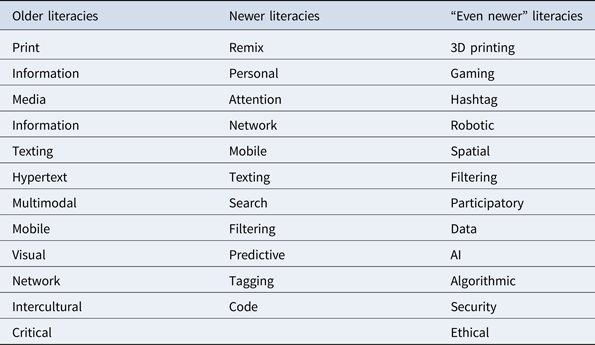
In their recent work on digital literacies, Pegrum et al. (Reference Pegrum, Dudeney and Hockly2018) took a finer-grained perspective on literacy by itemizing the elements that might be involved. Their conceptualization spans material and perceptual elements of digital literacy. As with Mills (Reference Mills2016), they described categories based on recency, this time divided into three broad areas, but now with more than 30 different literacies identified (see Table 1).
Literacies (Pegrum et al., Reference Pegrum, Dudeney and Hockly2018)

Other new literacies might include privacy, although personal literacy may be considered the superordinate; fake news literacy might be another. Selecting one of these literacies as a focal point, or two in combination, might lead to a valuable in-class topic theme or task with the added advantage in each case of having the technology readily available to explore the idea further. Some of the stated literacies are very broad and general, while others are relatively narrow and specific. As we scan Table 1 from left to right, we become increasingly aware of literacies that are not so much operational as perceptual, philosophical, personal, and even moral. Examples of the former include the spatial, attentional, algorithmic, and artificial intelligence literacies; examples of the latter include the personal, security, and ethical literacies.
Although Pegrum et al. (Reference Pegrum, Dudeney and Hockly2018) went on to describe a framework for these literacies with four categories and a hierarchy of levels, for the purposes of this article, it is sufficient to consider the literacies as a kind of checklist. In fact, in a slightly different way, Pegrum et al. alluded to this idea themselves in a checklist of key considerations for integration of digital literacies into lessons. Such a checklist enables the language teacher to build literacy elements into any lesson. In their article, the authors described some thoughtfully structured lessons and activities that derived from their framework and center upon specific elements in the checklist. One sample lesson is built around the theme of a wellness program with the topic “Fitness plans and the quantified self”; the digital literacy puts focus on the data, multimodal, search, and information literacies.
Beyond topic selection, increasingly for the language teacher a keen awareness of any bias in the way commercial tools and apps work is required. This might involve an awareness of the ways in which certain ads are chosen and presented in an app or how a search engine arrives at its top 10 hits. While the details may be opaque even to the experts, certain recurring patterns can easily be identified, and the principle remains an important one. Thus, the teacher's role stretches beyond helping the student to simply use the tool, as in the early days of computer literacy. The role now also requires the teacher to gradually build an awareness of some of the underlying assumptions and any unjustified bias that leads to the output. An example is helpful.
An Example of Search With Prediction
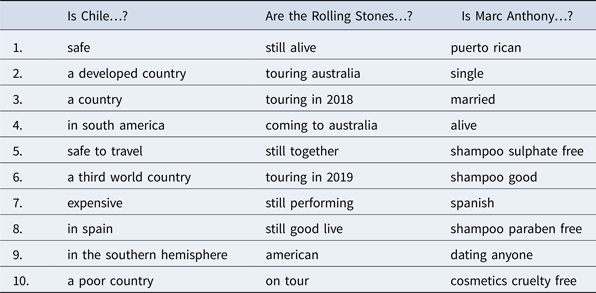
From the middle column in Table 1, consider an activity designed to help students explore the search and predictive literacies using Google as the search engine. To activate the predictive function, type in the beginning of a question (see Table 2). Built into an appropriately designed task, this sort of approach draws the students’ attention to a number of areas simultaneously, necessarily encouraging them to think about possible content along with the structure of the question. Algorithmic thinking is also entailed while the students consider what questions might be asked by users of Google. Table 2 shows the top 10 results for three question prompts during a presentation given by the author in Chile.
Questions With Responses Predicted by a Google Search (January 22, 2019, Google Australia)

Note. The output of predictive text is always lowercase.
Column 1 shows the possible perspective of the tourist to Chile and an assessment of its socioeconomic status as determined by this search, that is, developed, Third World, or poor. In column 2, the use of “still” is of interest with some good examples, and the legacy of 2018 information remains visible. In column 3, the association of celebrity with a product endorsement is particularly interesting. Obviously, the question prompts are decided by the teacher or student. They may be chosen to suit the context and students’ interest. The results are up to date and relevant, albeit unpredictable, although of course the teacher can check before the lesson. In sum, the search and predictive text function may be used to do the following:
• Explore contemporary topics and learner interests.
• Anticipate question content and possibilities.
• Predict the forms that a question might take.
• Learn about algorithms (“algorithmic thinking”).
• Learn about the world.
• Explore active links.
• Engage with the unpredictable or challenging.
• Combine learning the language with learning about technology and the world.
Of course, these particular lists will only be generated for a particular search engine at a particular time from a particular location, as of January 22, 2019, using Google in Australia for the example above. The algorithm also incorporates data from previous searches. It can be informative, for instance, to see the results for the same question using a different search engine and/or at a different time or location—any differences of course are not accidental; rather they reflect the purposeful programming of the rules underpinning the algorithm.
As we have observed with the four perspectives, the term literacy can be used in a broad, general way or in a narrower, technical sense. I regard this positively as it appears to invite discussion, and it does not limit the conversation or debate only to the specialist. It is also noteworthy that literacies appear to be additive over time, or they may be divided and more finely resolved, rather than being replaced and disappearing altogether. It is, I believe, a profound error to drop older literacies as new ones appear. However, as micro-literacies continue to multiply, in practical terms it becomes especially challenging for the classroom teacher. Priorities will need to be made because there will be insufficient time to cover everything.
The Real and Authentic Perspectives
Older and newer literacies revolve and evolve around texts and the vast range of interactional spaces within which humans and technologies engage. These interactional spaces include educational environments, most obviously the classroom, as well as everyday spaces such as the home or workplace. As far as educational settings are concerned, we are accustomed to texts being adjusted to make them more amenable to the student and the goals of learning. Thus, materials may be simplified or elaborated to introduce more redundancy and repetition around key concepts.
In the context of the current discussion focusing on the connection between the language classroom and the wider world, the question of access and use of real-world texts is important. Real-world texts include a vast range of texts mediated by technologies old and new. They include documentaries, magazine articles, news in all its forms (paper, TV, radio, news feeds, fake news, etc.), novels (science fiction, crime, nature), editorials, opinion pieces, commentaries, and articles of all kinds relating to an enormous range of topics (politics, sports, etc.). While the categories and labels used in the wider world are vast, in the language-teaching domain these materials have been lumped together under the technical term authentic. This all-encompassing label tends to flatten out and limit our appreciation of the immense variety of materials out here. Describing a video clip, a tweet, or some poetry as authentic may be missing the point. The net effect is that the benefits of such materials are too often forgotten or overlooked, especially those enabled by new technologies.
According to Zyzik and Polio (Reference Zyzik and Polio2017), “Authentic materials are those created for some real-world purpose other than language learning, and often, but not always, provided by native speakers for native speakers” (p. 1). Interestingly, there is not a general collective term that matches the technical term as it is used in the language-teaching literature. Within the profession, the precise meaning of the term authentic continues to draw debate. Attempts have been made to resolve the precise technical definition of authentic, while aiming to distinguish it from similar terms such as real, genuine, or even semi-authentic (see Buendgens-Kosten, Reference Buendgens-Kosten2014; Ciornei, & Dina Reference Ciornei and Dina2015; Mishan, Reference Mishan, Maley and Tomlinson2017; Kramsch, A'Ness, & Lam, Reference Kramsch, A'Ness and Lam2000; Widdowson, Reference Widdowson1998).
In spite of the ongoing debate about the technical definition within the discipline, in the wider world the term authentic appears much less problematic. Authenticity as it is generally used in the real world is binary; an item is, or it is not, authentic. For example, the reason Leonardo da Vinci's Salvator Mundi is not on display in the Louvre Abu Dhabi rests on the question of its authenticity (Dehghan, Reference Dehghan2018). As the world's most expensive painting sold for $450.3 million, this question is pivotal. Moreover, the context is immaterial. It is authentic (or not) irrespective of whether it is displayed and viewed by visitors in a prestigious gallery or locked in a bank vault. The quality of authenticity resides around and within the artefact itself and does not extend beyond it.
The basic case for using authentic materials is well made by Tomlinson (Reference Tomlinson, Burns and Richards2012):
The argument for authentic materials (i.e., those not specifically developed for language teaching) is that they expose learners to language as it is typically used and that they prepare them for the reality they will encounter as users of the language. My position is that a contrived focus might be of some value but that exposure to language in authentic use is essential. (p. 273)
Tomlinson (Reference Tomlinson, Burns and Richards2012, p. 272) criticized commercial textbooks on the grounds of lack of engagement and relevance for students (see also Long Reference Long2015, p. 150; Zyzik & Polio, Reference Zyzik and Polio2017, p. 150) and made a number of points that are relevant to the present discussion about the connection between the classroom and the world we live in. In a section entitled “Should Materials Be Safe or Provocative?” (p. 273), Tomlinson wrote that the cautious approach of commercial publishers:
often leads to the publication of books that are sanitised, bland, and boring, in which harmony, cooperation, and agreement prevail, and in which the learners are insulted by the portrayal of an unreal EFL [English as a foreign language] world where fear, danger, sickness, satire, conflict, criticism, disagreement, and even apprehension do not exist. This means that the learners can spend an entire semester not laughing, not being moved, not thinking, and not being stimulated at all. (pp. 273–274)
This suggests again that we should reflect about the “unreal EFL world” as compared to the world we live in. It also leads to careful consideration of the backgrounds, goals, and interests of our students. If they are adult language learners, are we justified in creating a world of make-believe for them in the language classroom?
Example 1: A Tweet
I will now consider two examples. Both are provocative in their different ways and provide a means for reflection on the issues arising. Both also involve considerations of the connection between the language classroom and the wider world.
The first example is a tweet posted by Donald Trump: “Space Force all the way!” (Donald J. Trump, August 9, 2018, https://twitter.com/realDonaldTrump/status/1027586174448218113). From an authentic language perspective, it is interesting in a number of related ways. It was created by a native speaker of the language with the aim that it would be read by the author's followers on Twitter. Without entering into a technical linguistic description, the text construction or “grammar” of the tweet is indicative of a frequent tweet construction: essentially a topic followed by a comment. The form does not constitute a sentence. As far as vocabulary is concerned, we have a relatively new concept and a new way to describe it, that of Space Force. The term would likely be unfamiliar not only for language learners, but also for many in the general population, hence a real-world connection. Its complement, “all the way,” describes pragmatically the illocutionary force and the speaker's support for the initiative. “All the way” has been used earlier in the political arena, as in “All the way with LBJ,” having been employed in the 1964 Democratic campaign in the United States, with LBJ short for President Lyndon B. Johnson. The two instances of the expression “all the way” drawn from the political domain provide an excellent example of intertextuality across time and media platforms first being used on television, radio, and later via a dedicated application on mobile devices. The tweet is real world, authentic, and topical, and it is not a simplified or elaborated text. It is short and simple at the linguistic level. Arguably, such a tweet would potentially be of interest to adult language learners from intermediate level onwards.
According to Zyzik and Polio (Reference Zyzik and Polio2017), “In our experience as teachers, many (but not all) L2 learners are interested in the social, cultural, or political issues affecting the country or region where the target language is spoken” (p. 132). They continued to say that “authentic texts are vital in giving students an opportunity to interact with stimulating content” (p. 132). Compare the content of this tweet with the simplified texts offered in many elementary or intermediate level textbooks. Tweets are embedded texts in that they bring with them a context enlivened by an ongoing topic or individual source or both. Originators of tweets can be followed. Of course, tweets can be abusive or otherwise inappropriate. Context is key. Recognition of the students’ age, cultural background, interests, level, and so forth must be respected. The same applies for the language teacher, who will often be the final arbiter here, and perhaps ultimately it is this individual who will need to be convinced of the value of such real-world examples.
Example 2: Adapting a Text for Testing Purposes
The second example involves the reworking of a text for testing purposes, in this case for the International English Language Testing System (IELTS), a test of English language proficiency. Consider, for example, the steps described by Green and Hawkey (Reference Green and Hawkey2011) in their article, “Re-Fitting for a Different Purpose: A Case Study of Item Writer Practices in Adapting Source Texts for a Test of Academic Writing.” These very experienced test writers moved through a number of stages to adapt a reading text for IELTS's testing purposes. The process is essentially as follows (Green & Hawkey Reference Green and Hawkey2011, pp. 120–123):
• Cut captioned illustrations:
○ (multi → mono-modal).
• Cut journalistic elements:
○ (e.g., attention grabbers, colloquialisms).
• Delete/substitute technical vocabulary.
• Cut or gloss culturally specific content:
○ Make the text accessible and inoffensive.
• Edit items and text in tandem.
This list of adjustments—cuts, deletions, and substitutions—gives an indication of what is lost when an authentic text is simplified or otherwise revised to make it into a text suitable for a high-stakes language proficiency examination with sufficient “testable” items. My intent here is not to question this process for the purposes of testing. Texts designed for tests clearly require their own singular qualities. But from the perspective of the present discussion, it is worth remembering what is lost when an authentic text is adapted or simplified. Judging by the list above concerning what is removed from the text, it might be argued that much of what makes a text timely, multimodal, impassioned, embedded, and engaging is taken away. In addition, such texts often become the only goal for students and teachers. Their focus is such that they engage repeatedly with these re-created texts through practice materials leading up to their culmination in a high-stakes examination. Thus, this material becomes the target language, that is, the language of the test, not of the wider world, and the language not of the world that the student passes into after graduation.
Following the work of authors such as Tomlinson (Reference Tomlinson, Burns and Richards2012) and Zyzik and Polio (Reference Zyzik and Polio2017), I do believe engagement with authentic materials mediated by new technologies is crucial. Like Zyzik and Polio, I am not arguing for exclusive use of authentic materials. Simplified or otherwise adapted materials and the structure and continuity textbooks remain central. But one of the key advantages brought about by new technologies is their capacity to provide timely, authentic, and multimodal materials. These materials cover a vast range of topical areas that may interest the students, and they can be accessed through a range of devices in flexible ways. Properly employed, they have the capacity to motivate and to expand the students’ knowledge of the world beyond the classroom. They can even cause us to expand our views of might constitute the target language.
The Input/Output Perspective
The computing sense of input as “data fed into a machine” goes back as far as 1946 (Online Etymology Dictionary, 2001). While originally being ascribed to machine processing, over the years the terms input and output have also been frequently applied to humans in applied linguistics contexts. In language teaching and research, many are familiar with the terms “comprehensible input” or “pushed output” (Krashen, Reference Krashen1985; Swain, Reference Swain, Cook and Seidlhofer1995). As in the previous sections, the technical definitions take on a life of their own. This is understandable, of course, for any rigorous discipline that wishes to define terms operationally and with precision. Yet, as with the discussion of the terms literacy and authenticity earlier, it is helpful to revisit technical definitions and their assumptions, especially in relation to their general use in the wider world.
Another term within the profession that is growing is multimodal input. To date, it appears to be applied simply to the sound-image combination, for example, as in a video clip (e.g., Banados-Santana, Reference Banados-Santana2018). Neither monomodal inputs without speech nor multimodal inputs without language are mentioned. Sensory perceptions as well as judgments lead to language output. Even if one accepts that the reductive terminology of input and output may be applied usefully for human beings, the entire range of so-called inputs and outputs (i.e., accepting that one, a combination, or even all the senses will be involved) should be considered. It certainly is being considered in the literacy area and in the development of new technology applications.
The discussion earlier in relation to sensory literacy (Mills, Reference Mills2016) referred to some of the recent work around the use of technology to move into the sensory realms of vision and image recognition, together with the gestural and tactile. Technology is moving in on the senses in multiple areas that we have, heretofore, regarded as involving exclusively human qualities and abilities.
The third and final section of this discussion about the connection between second language educational settings and the wider world concerns a cautionary note about ways in which technology is evolving on the one side and the expression of human capabilities on the other. The discussion entails decisions that inform research and practice. Again, a simple example is helpful.
Example: How Are You? Fine, Thanks
Consider the first words that many students encounter in the early stages of learning English as an additional language: the question, “How are you?” (the first interlocutor) followed by the response, “Fine, thanks” (second interlocutor). What is the “input” in the real world for the first interlocutor? Clearly, whatever it is, it is not voiced. Such is the case in most conversational openings, where the contextual and environmental cues, often culturally defined, may be far from obvious.
There are an enormous number of variables involved in the “simplest” human interaction. I might begin with the second interlocutor's response, given the discussion earlier on authentic materials. Does the respondent give a ritual answer (e.g., “Fine, thanks”), or an honest one (e.g., “Actually, I've got a bit of a headache”)? Depending on numerous elements, including age, geographical location, cultural background and their sense of humor, they could respond with “awesome,” “exhausted,” “could be better,” “fair to middling,” or “mustn't grumble.” They might not respond at all. This is what humans (not computers) do. We might also ask in the light of online and mobile interactions, texting, and so forth just how often “How are you?” and “Fine, thanks” are used these days. Teaching this interactional pairing has become as ritualized as the question and response itself.
But the initial utterance is of greater import in the present discussion. Clearly, some feature of the context or environment must motivate the first interlocutor to speak. A moment's reflection will suggest that while perhaps beyond conscious awareness or attention, an individual's personal measure of proximity will be paramount. On the approach to the individual, a moment is chosen to speak, relative to the strength of the human voice, the number of people in the vicinity, the location, and the cultural setting.Footnote 3 Other parameters may be involved, too, like background noise or other distractions. The real-world input is obviously multimodal, visual, aural, and spatial (see again the earlier discussion). But significantly, while multimodal, speech is not involved. This is important because so often when we think about multimodal input, we only think about the speech-vision combination. At the outset, the input also involves face recognition. Thus, “How are you?” is only used if the two interlocuters know each other. As we know, if they do not, alternative strategies and language structures are chosen (e.g., “Hi, I'm Mike…”).
As the technology capability improves and reaches further into the zone of what we regard as the human senses, there will be further reasons for caution in how we use technology both in general and for learning purposes. Adam Greenfield (Reference Greenfield2017) made a subtle, but crucial, point in this regard in relation to technology-mediated communication and augmented reality:
Anyone who cares about what we might call the full bandwidth of human communication—very much including transmission and reception of those cues vital to mutual understanding, but only present beneath the threshold of conscious perception—ought to be concerned about the risk posed to interpersonal exchanges by augmented mediation. (p. 73)
With regard to the research in second language teaching and learning, we need to seriously consider these developments. We need to operate in our teaching and research using the full bandwidth of human communication. In my opinion, if we do not, with a heavily reductionist conceptualization of human “input” and “output,” we are in danger of greatly diminishing not only what is entailed in real-world interaction but also what it really means to be human. Without this understanding, it becomes easier to dismiss the essential qualities of what it means to be human while strengthening the argument that computers may adequately function as replacements.
Algorithms
Broadening our discussion, it is also helpful to revisit the idea of the algorithm. Algorithms basically convert input to output using a set of rules. Once set up, an algorithm enables a process to be automated such that in many cases human intervention is not necessary. Algorithms can be used for multiple purposes and are increasingly being employed to govern decision making by agencies of various kinds. In this article, I have not entered into discussion of some of these broader applications, though they are undoubtedly expanding in their power, reach, and significance (see Lanier, Reference Lanier2018; O'Neil, Reference O'Neil2016). I have limited myself to the search algorithm because it is so familiar, even though we may not know how it works exactly, for example, as noted in my first example above, how a question such as “Is Chile…?” was entered as input into the Google search engine and the 10 predictive text items were generated as output.
At first glance, algorithms may appear neutral and objective, a convenience that simply removes the hard work and time required to locate what we need from a mass of data. Unfortunately, it's a little more complicated than that. In conducting a Google search, for example, Google's CEO, Sundar Pichai explained at the House Judiciary Committee in the United States Congress on December 11, 2018:
Any time you type in a keyword, as Google we have gone out and crawled and stored copies of billions of [websites’] pages in our index. And we take the keyword and match it against their pages and rank them based on over 200 signals—things like relevance, freshness, popularity, and how other people are using it. And based on that, at any given time, we try to rank and find the best search results for that query. (Reported in Caruana, Reference Caruana2018)
Thus “200 signals” or contributing factors—weighted to varying degrees—are coded into the search algorithm. According to O'Neil (Reference O'Neil2016), “Opaque and invisible models are the rule, and clear ones very much the exception” (p. 28). This is hardly surprising given the complexity. But O'Neil went on to say that “models, despite their reputation for impartiality, reflect goals and ideology” (pp. 20, 21). Computer models, powered by algorithms, are not neutral or objective. The fact that one can pay a third party to provide Google rank optimization further confirms this. A simple search is not always as simple as it seems.
Examples may be found in areas ranging from industry, politics, and economics to social life and an individual's personal interaction with their friends, family, and the world. Algorithms are also used to automatically generate micro-targeted items such as the news feed for individuals on Facebook, for example. Having an understanding of what an algorithm is and how it works selectively is becoming increasingly important. In my view, even language learners need a basic sense of how they work, just as in earlier times, they needed to know how to operate a keyboard or mouse.
Conclusion
In the discussion in this article, I have been taken the long view of the language learner or student. Thus instead of thinking of a student within the bounds of a particular course, program, or institution—or syllabus, curriculum, and/or assessment goal, for that matter—as is usually the case, I have focused on preparing for what comes after graduation, once the high-stakes language assessment is over, the language proficiency certificate has been attained, and the institution is left behind. In a kind of reverse engineering, I have endeavored to identify a number of developments that currently resonate globally with a view to importing certain carefully selected elements into the classroom. I am keenly aware that this is an ambitious goal, and that any analysis I may provide here can only be partial and incomplete.
In reflecting upon this discussion, it could be argued perhaps that the broader issues raised here are not the concern of language professionals and their students. It is outside their remit, so to speak. Typically, the end goal for the teacher and the student is success in an external, high-stakes examination. However, the problem remains, of course, that while language teachers and researchers may remain “inside the castle” for the whole of their working lives, the students must venture outside of it.
I have not been arguing for fundamental changes at the center. I have been reflecting upon the borderlands, so to speak, considering whether more could be done to strengthen the connection between the work of the language classroom and the wider world. I have considered three perspectives, but undoubtedly there are more. We can bring more of the world into the classroom if we wish; arguably, this is precisely what students do when the teacher is not looking. New technologies make the connection easier than ever before. As teachers, we can either engage or withdraw. I have argued for greater engagement because it heightens the real-world relevance of classwork and can be highly motivating for adult learners. Ultimately, building the world into the classroom will surely outweigh the building of a wall around it.
Author ORCIDs
Mike Levy, 0000-0002-2231-0662