Introduction
Public support towards social welfare programmes for the less well-off is the essential basis for a robust welfare state in advanced democracies (Brooks and Manza, Reference Brooks and Manza2006). Without shared empathy for the principles of social citizenship, which are the core elements of the welfare state (Marshall, Reference Marshall1950), it is difficult to sustain any redistributive government scheme. This is particularly important for advanced industrialised democracies where the gap between the haves and the have-nots has widened substantially in recent years. As reported in Divided We Stand: Why Inequality Keeps Rising (OECD, 2011), the average Gini coefficient in OECD member countries rose by nearly 10 per cent over the past two decades, and the average wage of the richest group is now almost nine times higher than that of the poorest group. Taylor-Gooby's (Reference Taylor-Gooby2011) recent work suggests that greater disparity in the allocation of material interests and opportunities can lead to public distrust in government institutions, which implies a potential threat to the foundation of social solidarity on which the welfare state is based. Furthermore, if individual policy preferences are motivated by one's economic position (Romer, Reference Romer1975; Roberts, Reference Roberts1977; Meltzer and Richard, Reference Meltzer and Richard1981), greater income stratification would result in serious social cleavages in political interest and pervasive class-based politics. In this context, the question as to how individuals shape their perceptions and preferences towards redistributive policies, which is directly linked with the legitimacy of the welfare state, is timely and of growing academic and policy importance.
Although significant advances have been made in our understanding of welfare attitudes, much work remains to be done in this area before a more complete picture can be drawn. My study builds on prior contributions but aims to offer several important extensions. First, studies on welfare preferences have been conducted mostly in North American and Western European contexts and the question of whether their findings are transferable to other cultural settings remains unanswered. For instance, several studies in the United States have argued and empirically demonstrated that economic individualism, a peculiar feature of American political culture (Tocqueville, Reference Tocqueville2001 [1835–40]; Lipset, Reference Lipset1979; McClosky and Zaller, Reference McClosky and Zaller1984), explains the American traditional opposition to the welfare state (Feldman and Zaller, Reference Feldman and Zaller1992; Feldman and Steenbergen, Reference Feldman, Steenbergen and Kuklinski2001). However, we still do not know whether the negative link between economic individualism and welfare support is indeed a consequence of a unique American culture or a product of a more generalisable rule. By analysing the Japanese General Social Survey, I will qualify and confirm such results in the United States in the light of additional evidence from another (non-Western) industrialised country.
The second issue involves the operationalisation of economic self-interest. Previous research has argued that welfare support is inversely related with individual self-interest (e.g., Bean and Papadakis, Reference Bean and Papadakis1998; Hasenfeld and Rafferty, Reference Hasenfeld and Rafferty1989). To test the negative relationship between welfare views and self-interest, many existing studies have relied on ‘household income’ as the indicator of economic stratification. As some scholars point out, however, the multidimensional aspects of material interest cannot be captured by a single measure like family income (Gilens, Reference Gilens1996). For a more comprehensive understanding of the utilitarian hypothesis, this article compares various patterns of self-oriented incentives, such as the objective, subjective and dynamic dimensions of class strata.
The third extension is concerned with the potential role of national identity in welfare preference formation. Liberal nationalist theorists argue that a strong sense of national identification fosters a sense of collective solidarity and helps maintain a functioning welfare state (Miller, Reference Miller1995; Tamir, Reference Tamir1993). However, only recently has the connection between welfare support and national identity been subjected to empirical testing (e.g., Martinez-Herrera, Reference Martinez-Herrera2004; Shayo, Reference Shayo2009), and accordingly the hypothesis remains empirically underspecified (Johnston et al., Reference Johnston, Banting, Kymlicka and Soroka2010). My study provides new evidence for this developing argument.
Finally, I explore the linkage between public opinion and social capital. Students of social capital argue that the prevalence of interpersonal trust is a significant source of altruistic, pro-welfare orientations. However, while considerable interest has been directed towards theories of social capital, surprisingly little attention has been paid so far to the empirical investigation of the association between welfare support and social trust. This study contributes new empirical evidence on the roles of perceived trustworthiness in welfare attitude formation.
The main purpose of this paper is two-fold. First, I qualify the popular claim that individual welfare views are shaped by both utilitarian motivation and economic individualism, and then test the alternative theories about the role of national identity and social trust. Second, I examine whether the negative impact of individualistic orientations can be offset or weakened by solidarity-oriented values and beliefs, such as a sense of national unity and generalised trust. This article argues that the findings in the US literature that self-preserving and individualist attitudes reduce welfare support can be replicated in Japan, and that, as proponents of liberal nationalism claim, a sense of national identity is indeed a significant predictor of redistributional support. It also reveals that the relationship between self-interest and welfare discourse is significantly mediated by social trust, and that patterns of individual reaction to redistributive government vary greatly between low- and high-trust clusters.
Theories of welfare policy support
There are two main lines of theorisations as to why welfare preferences differ markedly among individuals. The first strand adduces that mass attitudes toward welfare policies are affected by economic self-interest. This line of research argues that economically underprivileged individuals have greater incentive to accept redistribution than do those with richer material resources. The second strand suggests that ‘interest-neutral’ moral values and ethics, such as economic individualism, communal identity and social solidarity, are of crucial importance in shaping public discourse on redistributive issues. I expand on each of these approaches in turn below.
Economic self-interest
Scholars have paid a great deal of attention to the utilitarian nature of individuals in the politics of redistribution. Traditional economic models assume that rational, informed individuals behave in a way that maximises their utility functions (Romer, Reference Romer1975; Roberts, Reference Roberts1977). For instance, Meltzer and Richard (Reference Meltzer and Richard1981) theorise that the proportion of income redistribution is determined by the economic position of utility-maximising voters. In an equilibrium choice of preferences, individuals with below-median income are expected to be more in favour of higher taxes and more transfers, while voters with above-median income prefer tax reduction and less social expenditure. The welfare state literature also suggests that mass attitudes towards redistribution are determined by one's group/class interest or the division of labour (Baldwin, Reference Baldwin1990; Esping-Andersen, Reference Esping-Andersen1990; Kangas, Reference Kangas1997; Korpi, Reference Korpi1981). People in the lower socioeconomic strata tend to be more vulnerable to unemployment, sickness, poverty and other potential social risks compared with those in higher classes, and thus are more likely to favour greater social protection provided by the government. In contrast, members of higher social classes, who have access to abundant economic resources and opportunities, can satisfy their basic needs without any assistance from government welfare programmes, and therefore are less inclined to express positive responses towards the welfare state. Likewise, some analysts claim that the future expectation of one's economic situation is equally important, as are present actual conditions. It is assumed that people who predict their household financial situation to become worse than it is today tend to be more sympathetic to redistributive spending than individuals who think they are less susceptible to the expected vicissitudes of the market (Gilens, Reference Gilens1996; Rehm, Reference Rehm2009). In short, the economic perspective of individual behaviour basically argues that the major concern for individuals is, for the most part, simply whether they benefit from the welfare state (recipients) or not (contributors). If this is the case, the recent widening income disparity in OECD countries casts a shadow over the future of industrialised welfare states because greater inequality and social stratification may lead to an individualistic, conflict-oriented welfare state, in which individual actors form their policy preferences based primarily on organised interests.
The empirical literature provides compelling evidence that utilitarian motivation matters. A number of researchers have confirmed that high-income individuals are less supportive of welfare provision than those on the lower end of the income scale (Bean and Papadakis, Reference Bean and Papadakis1998; Bobo and Kluegel, Reference Bobo and Kluegel1993; Hasenfeld and Rafferty, Reference Hasenfeld and Rafferty1989; Jacoby, Reference Jacoby2000; Jæger, Reference Jæger2006b). It has also been substantiated that members of higher social strata are less likely to be supportive of redistributive policies compared with those who are from working class and poor backgrounds (Jæger, Reference Jæger2006a; Linos and West, Reference Linos and West2003; Papadakis, Reference Papadakis1993; Svallfors, Reference Svallfors2004). Furthermore, several empirical studies demonstrate that the expectation of higher future household income indeed lessens the individual support for social spending (Alesina and La Ferrara, Reference Alesina and La Ferrara2005; Rehm, Reference Rehm2009).
Economic individualism
Another theoretical explanation contends that public opinion on redistribution is significantly affected by individualist values and beliefs (Blekesaune and Quadagno, Reference Blekesaune and Quadagno2003; McCloskey and Zaller, Reference McClosky and Zaller1984; Sniderman and Hagen, Reference Sniderman and Hagen1985). For instance, Feldman and Zaller (Reference Feldman and Zaller1992) argue that the ambivalent feelings of people towards social welfare policies are rooted in certain types of ideological orientation, particularly economic individualism. Two different pathways have been proposed: descriptive and normative accounts (Gilens, Reference Gilens1995). ‘Descriptive individualism’ highlights the centrality of the individual work ethic and self-guided improvement. It understands that economic well-being is a consequence of hard work and sacrifices, and that the poor, the unemployed and the socioeconomically disadvantaged are responsible for their own economic misfortunes and vicissitudes. According to this perspective, responsibility for one's economic success/failure and personal welfare rests ultimately with the individual. On the other hand, ‘normative individualism’ contends that an economic actor has a right to improve one's economic circumstances without being hampered and restricted by coercive state intervention. This conception of individualism argues that the role of government should be limited to promoting and maintaining individual rights and the health of the market. It, in principle, is opposed to state intervention in the ‘fair’ socioeconomic stratification order and emphasises that it is not the government's responsibility but the business of private realms to promote the well-being of individuals and families. Explanations differ, but the core assumption of economic individualism is that the acceptance or resistance of individuals towards redistributive welfare policies is directed by individualist ideologies and norms.
Previous empirical studies provide substantial evidence that people who stress the virtue of hard work, personal responsibility and self-reliance express resistance to redistributive policies (Feldman and Zaller, Reference Feldman and Zaller1992; Fong, Reference Fong2001; Hasenfeld and Rafferty, Reference Hasenfeld and Rafferty1989; Kluegel and Smith, Reference Kluegel and Smith1986). The literature also confirms that those who put greater emphasis on the role of individuals and the private sector rather than government in the provision of welfare are less supportive of egalitarian goals (Feldman and Zaller, Reference Feldman and Zaller1992; Feldman and Steenbergen, Reference Feldman, Steenbergen and Kuklinski2001).
A sense of national unity
How then can we escape from the ‘curse of individuality’? To overcome such utilitarian motivation and individualist values people would have to shift their concerns from their mere utility-optimising calculus and social atomisation to a broader sympathetic perspective that incorporates public interest and communal values. One possibility is that a sense of national identity may motivate individuals to act in a more reciprocal and altruistic manner. This insight comes from the ideas of liberal nationalism. Liberal nationalist thinkers have sought to connect traditional liberal principles with communitarian values such as identity, culture and social solidarity. They assume that a sense of national unity is a necessary prerequisite for implementing the ethical objectives of liberalism, including redistributive justice and, in practice, the functioning of collectively financed welfare schemes. A common national identity is expected to serve as the social glue that binds ‘dispersed’ individuals to a national community, which helps cultivate a sense of moral responsibility and mutual obligations among citizens (Miller, Reference Miller1995; Tamir, Reference Tamir1993). Thus, individuals with a strong sense of national identity are predicted to be more likely to show an unselfish concern for the welfare of co-nationals and prioritise the ‘common good’ of the society over individualistic self/group-oriented benefit calculations. As Miller (Reference Miller1995) puts it:
In states lacking a common national identity . . . politics at best takes the form of group bargaining and compromise and at worst degenerates into a struggle for domination. Trust may exist within the groups, but not across them.
While conventional liberalism does not differentiate between ‘fellow nationals’ and ‘fellow human beings’, liberal nationalism clearly draws a line between members and non-members/outsiders (Friedman, Reference Friedman1996). Liberal nationalists argue that the legitimacy of the welfare state presupposes a distinct, consolidated national entity in which member citizens share a common heritage, experience and destiny. This is why some liberal nationalists worry about the influx of immigrants/outsiders as a challenge to the nation-building project and warn that an excessive multicultural society might result in fragmentation of the national community (Baldwin and Rozenberg, Reference Baldwin and Rozenberg2004; Goodhart, Reference Goodhart2004).
Despite the theoretical and logical basis for the linkage between national identity and welfare views, the existing empirical literature provides no consistent evidence that a sense of national unity actually matters. For instance, based on a public opinion survey in Britain, Martinez-Herrera (Reference Martinez-Herrera2004) finds no discernible evidence that national identification is related with the probability of welfare policy support both in England and in Scotland. Using cross-national data from the World Values Survey, Shayo (Reference Shayo2009) demonstrates that a sense of national pride in fact reduces public support for the welfare state. By contrast, a recent empirical study of Johnston et al. (Reference Johnston, Banting, Kymlicka and Soroka2010) provides some evidence in support of the connection between national identity and welfare preferences in Canada. Their analysis finds that the interaction between economic position and identity exerts a positive influence upon popular discourse on redistribution, suggesting that the negative impact of economic self-interest can be weakened by a strong sense of national identity among Canadian citizens.
Social trust
Another theory for welfare policy support comes from the social capital literature. Students of social capital suggest that a sense of social trustworthiness may have positive repercussions upon public discourse concerning redistributive government. This line of approach argues that generalised trust, which reflects a sense of social solidarity, cultivates a shared sense of moral responsibility for the well-being of underprivileged fellow citizens. Individuals are expected to be more likely to fulfil their duties of citizenship and contribute to the ‘common good’ of society if they trust their fellow members to act collectively and in solidarity rather than cheat or free-ride on the efforts of others (Rothstein and Uslaner, Reference Rothstein and Uslaner2005). Miller (Reference Miller1995) argues that a sense of national identity fosters mutual trust among citizens, and that such confidence in other community members generates public empathy for collectively financed risk-sharing arrangements. In short, individuals with high propensities to trust others are predicted to be less antagonistic towards redistributive policies.
This social capital perspective provides an alternative theoretical framework for understanding individual preferences for the welfare state, but very little empirical evidence has been provided so far. Soroka et al. (Reference Soroka, Johnston, Banting, Kay and Johnston2007), one of few existing empirical efforts, report that there is a positive linkage between interpersonal trust and popular acceptance of employment insurance and healthcare programmes, providing some support for Miller's argument that mutual trust generates pro-welfare orientations.
Data and measurements
The data analysed in this study come from the 2008 Japanese General Social Survey (JGSS).Footnote 1 The JGSS is a nationwide cross-sectional survey of non-institutionalised Japanese adults aged between twenty and eighty-nine, which has been conducted periodically since 2000 by the JGSS Research centre at Osaka University of Commerce. The survey provides rich information on Japanese attitudes, beliefs, sentiments and a number of socio-demographic background characteristics. The JGSS 2008 covered a total of 4,220 respondents, with a response rate of 58.2 per cent for Form A (N = 2,060) and 60.6 per cent for Form B (N = 2,160).Footnote 2 The sample size included in my analysis ranged from 1,359 to 1,429, depending on the model estimated.
For the dependent variable, support for redistributive policies, I used a single response question: ‘What is your opinion of the following statement? – It is the responsibility of the government to reduce the differences in income between families with high incomes and those with low incomes.’ Respondents were given five choices: ‘agree’ (coded 5), ‘somewhat agree’ (4), ‘neither agree nor disagree’ (3), ‘somewhat disagree’ (2) and ‘disagree’ (1). The question is worded in a way that probes the general attitudes of Japanese citizens toward redistributive government.Footnote 3 More than 60 per cent of respondents answered that they agreed or at least somewhat agreed with redistributive government, while only a small portion of people (less than 10 per cent) expressed opposition (‘disagree’ and ‘somewhat disagree’) to egalitarian policies. Around 30 per cent of respondents adopted a neutral position (‘neither agree nor disagree’) on the issue of redistribution.
Regarding the operationalisation of economic self-interest, much of the prior research has solely relied on the objective measure (i.e., household income) and has not paid enough attention to the other important conceptual dimensions such as the subjective and dynamic nature of individual self-interest. As Gilens (Reference Gilens1996) puts it:
income represents only a ‘snapshot’ of a respondent's economic status; recent changes in income or future expectations may be more directly tied to perceptions about potential benefits from welfare or burdens from taxes . . . [I]ncome represents an objective measure of a respondent's social condition but does not directly tap his or her perceptions of the potential personal economic costs and benefits of welfare or the likelihood of that those costs or benefits will be realized. (595; italics in the original)
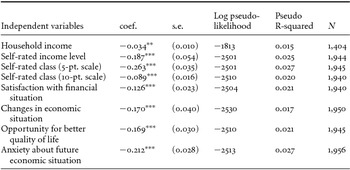
Given the multifaceted nature of economic self-interest, we cannot capture its complexity only by a single indicator such as family income. To make sure that my self-interest measures represent the entire domain of the construct, I used a set of eight different questions that tap into the extent to which respondents evaluate or perceive their current and future financial conditions and what they expect in the future. Table 1 presents the question wording for each of these measures and its response categories. Question [1] is a typical economic-status variable often labelled as ‘household income’ and used as an objective and direct indicator of individual economic well-being.Footnote 4 As Gilens (Reference Gilens1996) notes, it is possible that people might overestimate or underestimate their economic situation within society, and thus there may exist a cognitive gap between actual and perceived economic positions (see also Dean, Reference Dean1998: 134). To capture such subjective aspects of economic self-interest, I included questions [2] to [5], in which respondents were asked to self-rate their income levels, social-class levels and their satisfaction with their current financial situation. The dynamic dimensions of self-interest were assessed by questions [6] to [8], which asked whether the respondents’ financial situation had worsened in the last few years, whether they had chances to improve their quality of life and whether they had positive expectations about their future financial situation. Respondents with high scores in each of these eight indicators are assumed to have less incentive to support redistributive government provision, and those who scored low are expected to be more in favour of reducing income inequality.
Eight items on economic self-interest and their choice options

Notes: The scores for item responses [3], [4], [5] and [7] were reversed to maintain consistent direction. The values of question [6] were recoded as ‘Getting better’ 1 = 3, ‘Getting worse’ 2 = 1, and ‘Stayed the same’ 3 = 2.
Source: JGSS, 2008.
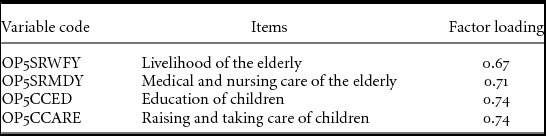
As argued in the previous section, there are two types of individualism: normative and descriptive. However, the latter conception, ‘descriptive individualism’, which is ‘a belief that economic success or failure can in fact be attributed to individual talent and effort’ (Gilens, Reference Gilens1995: 1003), cannot be captured sufficiently with the survey questions available in the JGSS data set. Therefore, I focus on the normative conception of individualism, which is ‘a value orientation consisting of a preference for individual rather than government responsibility for economic well-being’ (Gilens, Reference Gilens1995: 1003). To measure the respondents’ (normative) individualist orientations, I combined the following four questions: ‘Who (governments or individuals/families) do you think should be responsible for “livelihood of the elderly”, “medical and nursing care of the elderly”, “education of children”, and “raising and taking care of children”?’ Responses are given on a five-point scale, with higher scores indicating stronger individualistic tendencies. The four individualism items form a reliable scale with a Cronbach's alpha of 0.67 (see Appendix Table A1).
For the measurement of a sense of national unity, I used three questions in which respondents were asked whether they agreed with the following statements: ‘Japan should limit the import of foreign products in order to protect its national economy’, ‘Japan should follow its national interests even if these would lead to conflicts with other nations’, and ‘Increased exposure to foreign films, music, and books is damaging our own culture’. These items were designed to tap into the respondents’ sense of national community, which acknowledges the special interests of member citizens (or the nation) and the survival of their economic and cultural solidarity. Seven response categories were provided, from ‘strongly agree’ to ‘strongly disagree’, and respondents who selected ‘strongly agree’, ‘agree’, or ‘somewhat agree’ to any of the three questions were coded 1, and 0 otherwise. Finally, generalised trust was measured by a standard question often used in the social capital literature: ‘Generally speaking, would you say that most people can be trusted?’Footnote 5 Respondents who selected ‘yes’ were coded 1, and those who selected ‘no’ or ‘depends’ were coded 0.
I also included a series of demographic controls: gender (1 = female, 0 = male), age (in years), educational attainment (dichotomous variables: high, medium, low), marital status (married, single, separated/divorced), employment status (employed, unemployed, out of the labour force or others), urbanisation (a four-point scale from 1 = countryside to 4 = big city), and political ideology (a five-point progressive–conservative scale, with higher scores indicating greater identification with conservative). The predictor variables used in my analysis are weakly associated with one another, with all coefficients well below |.50|.
Results
I begin by testing the economic hypothesis that popular discourse on welfare policies is determined by utility-optimising orientations: those who have richer socioeconomic resources express less support for redistributive government. I first developed equations that incorporate one of the eight economic self-interest items specified earlier, along with demographic variables as controls. I do this because, as argued before, it is possible that the impact of utilitarian motivation might differ across different dimensions of the self-interest concept.
Table 2 presents the results of ordered probit estimation of the economic models. The results demonstrate that each of the eight self-interest variables strongly influences redistributional support. The coefficient of each self-interest measure is persistently negative and highly significant (p < 0.001) even after controlling for demographic determinants. These findings are not only consistent with previous empirical studies of similar results (Hasenfeld and Rafferty, Reference Hasenfeld and Rafferty1989; Svallfors, Reference Svallfors1997) but also provide a qualification to Gilens’ (1996) argument that the subjective and dynamic aspects of social strata matter equally.
Effects of economic self-interest items on distributional support

Notes: Robust standard errors are given within parentheses. Every model includes all demographic controls except reference categories (male, high education, married, employed).
**p <0. 05; ***p <0 .001.
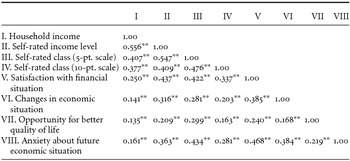
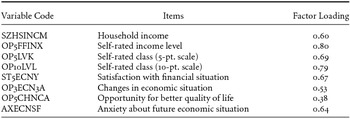
All the self-interest variables are strongly correlated with one another (r = 0.135–0.556, p <0 .01; see Appendix Table A2). One possible explanation for such high correlations among self-interest items stems from the potential overlap of these indices. To provide more parsimonious and interpretable models, I conducted a principal components analysis (PCA) to reduce the dimensions of the self-interest concept into a smaller set of components. The PCA of the eight items yielded a single factor that reflects a mix of the measures related to utility-maximising attitudes. I termed this new composite index ESI (economic self-interest), which ranges from −2.565 to 3.470, where higher scores indicate higher socioeconomic positions. The ESI scale showed good internal consistency, with a Cronbach's alpha of 0.69 (see Appendix Table A3).
Figure 1 shows how levels of welfare support vary depending on the ESI scores. Here, the ESI index is converted into a four-point scale, with ‘1’ showing the bottom quartile, ‘2’ the lower middle quartile, ‘3’ the upper middle quartile, and ‘4’ the top quartile. Among those who scored lowest (labelled ‘1.00’), nearly half (49.15 per cent) explicitly agreed with the statement ‘It is the responsibility of the government to reduce the differences in income between families with high incomes and those with low incomes’. On the other hand, only around 20 per cent of respondents who scored highest (4.00) expressed strong support (‘agree’) for redistributive government. This provides a clear demonstration that levels of support substantially vary across different ESI clusters.
Support for redistributive policies, by ESI levels Notes: N = 1,419.

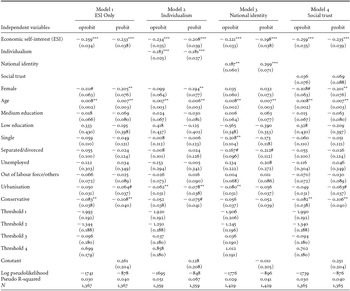
To confirm these results, the same model in Table 2 (i.e., one self-interest variable and demographic controls) is re-estimated by replacing the self-interest item with the aggregated ESI index (model 1 in Table 3).Footnote 6 As anticipated, the estimation results show that the ESI variable has a highly significant negative impact on popular support for redistribution at the 0.001 level, suggesting that the likelihood that a citizen is a non-supporter of redistribution rises significantly the higher the socioeconomic position. From these findings, it is quite evident that economic self-interest actually exerts a systematic and sizeable negative influence on pro-welfare discourse.
Determinants of support for redistributive policies

Notes: Results from ordered probit and (binary) probit regressions are presented. The (McFadden's) pseudo R2 for the models is 0.029–0.051 (oprobit) or 0.040–0.067 (probit) and the models successfully classify 39.58–43.05 per cent (oprobit) or 63.52–66.20 per cent (probit) of the outcomes. Robust standard errors are given within parentheses. For the probit models, the dependent variable is recoded into a binary variable (a dummy equalling one if a respondent ‘agrees’ or ‘somewhat agrees’ with the redistribution question, zero for the other three answer categories).
#p < 0.10; **p <0.05; ***p <0 .001.
Next, to test alternative theories of welfare policy support, I added the measures of individualism, nationalism and social trust into model 1 respectively (models 2 to 4 in Table 3). The second equation (model 2) reveals that the coefficient of individualism is negative and highly significant at the 0.001 level, even after accounting for the ESI variable and demographic controls. These outcomes suggest that being an (normative) individualist indeed decreases the probability of a person having positive feelings towards redistribution. The next concern is whether nationalistic ‘we’ consciousness plays a significant role in determining levels of welfare support. If the proposition of liberal nationalism is correct, individuals with a strong sense of national identity would express less antipathy towards the welfare of co-nationals. As the results of model 3 (Table 3) show, this seems to be the case. The coefficient of the identity variable is positive and highly significant, while controlling for the ESI measure and control factors.Footnote 7 This lends credence to the liberal-nationalist view that a sense of national unity matters. In contrast, no significant main effect was found for the social trust variable (model 4 in Table 3), indicating that interpersonal trust does not have a direct impact on popular discourse.
Table 3 also reveals the significant effects of demographic variables: older persons prove to be more supportive of redistributive government; urban and conservative people are more likely to hold antipathy towards egalitarian policies. Many other demographic variables are marginally significant or bear at best very tenuous relationships with redistributional support. It also has to be noted that throughout the three models, the standard error of the ESI coefficient (estimated in model 1) remains largely unaffected by the inclusion of any of the three additional factors in the equation.
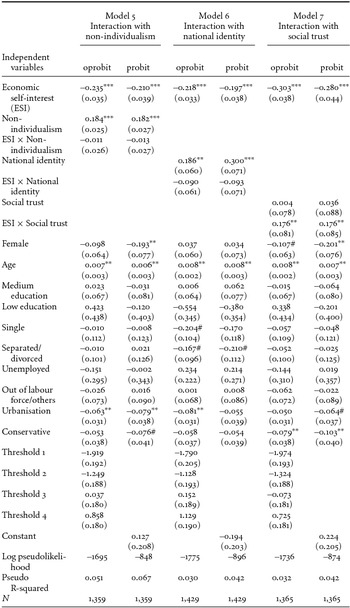
Thus far, we have seen that policy preferences to welfare spending are significantly directed by economic self-preserving attitudes. The popular belief that mass attitudes are affected by utility-optimising concerns appears to be well-founded. The next question for us is whether such a negative relationship between self-interest and welfare support varies depending on levels of individualism, national identity and social trust. Here, I predict that the detrimental effects of self-oriented attitudes are offset or moderated by weak individualism, strong national identification and high levels of generalised trust. Table 4 presents the results. Model 5 is identical to model 2 in Table 4 but adds the non-individualism variable and the interaction term between non-individualism and the ESI index. As predicated, the model confirms a significantly positive impact of non-individualism, but finds no significant effect of non-individualism on the relationship between ESI and support. Likewise, model 6 shows that while the main effect of national identity remains robustly positive, the negative impact of ESI is not significantly mediated by a sense of national unity. In model 7, however, I find some evidence for the moderating effect of social trust on the ESI–support connection. The model demonstrates that the ESI–support link is indeed significantly mediated by a sense of interpersonal trustworthiness (p <0 .05). This indicates that the negative impact of ESI on welfare support is more prominent and straightforward among individuals who trust others less. Therefore, it is a possibility that if one distrusts others, becoming more socioeconomically advantaged is likely to make one far less sympathetic towards redistributive government and the well-being of other fellow citizens.
Determinants of support for redistributive policies

Notes: Results from ordered probit and (binary) probit regressions are presented. The (McFadden) pseudo R2 for the models is 0.030–0.051 (oprobit) or 0.042–0.067 (probit) and the models successfully classify 39.41–43.19 per cent (oprobit) or 63.00–65.92 per cent (probit) of the outcomes. Robust standard errors are given within parentheses. Prior to the creation of interaction terms, the key variables (i.e. ESI, non-individualism and social trust) were mean-centred to reduce potential multicollinearity problems. For the probit models, the welfare support variable is recoded into a binary variable (a dummy equalling one if a respondent ‘agrees’ or ‘somewhat agrees’ with the redistribution question, zero for the other three answer categories). The aggregated variable of individualism was recalculated with reverse-scored response categories (i.e. 1 = 5, 2 = 4, 3 = 3, 4 = 2, 5 = 1), labelled ‘non-individualism’.
#p < 0.10; **p < 0.05; ***p < 0.001.
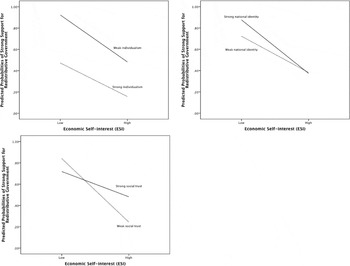
Figure 2 illustrates the simulated impacts of the three interaction terms. Again, overall we see that individuals with higher scores in the ESI index are less likely to support redistribution. The first figure (top left) shows the massive downward effect of individualistic orientations on support: being an individualist lowers dramatically the probability of high support by approximately 0.300 points. However, the non-individualism variable seems to have little interacted impact on the ESI–support relationship. The second figure (top right) demonstrates that, as estimated before, a strong sense of national unity significantly increases individual support, whereas the interaction effect appears marginal.
Mediating effects of non-individualism, national identity, and social trust Notes: Predicted probabilities holding all other variables at their means are presented. Coefficients are taken from models 5–7 (probit). ‘Low’ in the horizontal axis indicates the minimum score of ESI, while ‘High’ corresponds to its maximum score. The solid line represents the predicted probabilities at the highest value of each indicator (i.e. non-individualism, national identity and social trust), and the dotted line shows those at the lowest value.

As shown in the third figure (bottom left), the social trust variable is a significant moderator of the detrimental ESI impact on support. It seems that economic self-interest matters less for people who think that most people can be trusted than for those who do not think so. Within the high-trust group, the shift from the lowest to the highest ESI score reduces the probability of high support by 0.237, from .719 to .481. By contrast, within the low-trust cluster, a shift from lower to upper socioeconomic status results in a significant drop in support by 0.596, from 0.840 to 0.244.
Discussion and concluding remarks
This article examined the sources of substantial variation in welfare views among Japanese citizens. Using data from the JGSS 2008, this analysis confirms the oft-made claim that the willingness to support the welfare state is directed by utilitarian motivation and individualist political culture. The two main novel findings of my study are that, first, a sense of national identity has a powerful influence on public perceptions, and, second, the corrosive impact of material interest is significantly mediated by a sense of social trustworthiness.
The implications of these results are potentially significant. First, this article treats ‘economic self-interest’ as a multidimensional concept that encompasses a broad array of utilitarian concerns. I developed a more nuanced and comprehensive set of indicators for self-interest assessment and evaluated social strata not only by objective but also by subjective and dynamic dimensions that have often been overlooked in previous empirical investigations. In this sense, my findings show that the negative relationship between economic position and welfare support is robust to alternative definitions of social stratification.
Second, the analysis provides strong evidence for the hypothesis that (normative) individualism is negatively related with pro-welfare attitudes. Many scholars have argued and been able to substantiate that the key to Americans’ opposition to anti-poverty policies lies in a historically formed individualist ethos, such as a belief in the free market and a persistent suspicion of big government (Lipset, Reference Lipset1979; Feldman and Zaller, Reference Feldman and Zaller1992; McClosky and Zaller, Reference McClosky and Zaller1984). My findings in Japan suggest that these results in the United States are not necessarily an ‘American exceptionalism’ but can be replicated in the context of a non-American (and even non-Western) society.Footnote 8
In addition, this study offers empirical evidence in favour of the proposition that a sense of national unity enhances citizens’ willingness to accept the welfare state. Liberal nationalist philosophers claim that national identity helps build an overarching concern among community members for economically disadvantaged co-nationals, but the empirical results have been mixed and sometimes contradictory. While Shayo (Reference Shayo2009) finds an inverse link between national pride and acceptance of redistribution, Johnston et al. (Reference Johnston, Banting, Kymlicka and Soroka2010) conclude that national identity can play some role in generating pro-welfare discourse. One explanation for these inconsistent results may lie in the different variables used to operationalise ‘national identity’ (Johnston et al., Reference Johnston, Banting, Kymlicka and Soroka2010). In this study, for instance, the identity concept was operationalised by three items that gauge the respondents’ perceptions and feelings towards the protection of their national economy, the importance of national interests, and the continuity of their own culture. These measures are more specific than those used in earlier research in that the term ‘nation’ or ‘country’ was paraphrased into more concrete expressions, such as ‘national economy’, ‘national interests’ and ‘our own culture’. Another possible explanation derives from the fact that the three items used in my analysis are not designed to directly tap the respondents’ identification with or sense of belonging to the nation but rather are designed to capture the respondents’ nationalistic concerns for their collective economic security, shared interests and traditional culture. In this respect, my analysis is based on the implicit assumption that such nationalistic views are based on strong identification with the national community.
The most striking finding in my analysis is the role of generalised trust. The social capital literature argues that the prevalence of interpersonal trust in a society fosters cooperative social relationships, mutual assistance and reciprocal concerns, thereby facilitating the resolution of collective-action problems. As we have seen, the effect of economic self-interest is consistently negative and highly significant. It seems that rational individuals with privileged market positions are not willing to contribute to the funding of redistributive programmes. If every individual behaves in such a way that maximises his or her material benefits, welfare preferences would be fragmented along socioeconomic cleavages or organised interests. Given the fact that the distribution of earnings in Japan, along with some of the other advanced democracies, has become increasingly unequal over the last few decades, the interest-based politics of redistribution may serve to undermine social cohesion and, consequently, the political legitimacy of collectively financed welfare schemes. Nevertheless, the findings of this analysis show that the assumed negative association between utilitarian motivation and welfare support is conditional, and the detrimental impact of economic self-interest is significantly moderated by perceived trustworthiness. This implies that a sense of social solidarity may help solve social dilemmas by cultivating a less self-centred awareness among citizens. Interestingly, these findings echo the qualitative research findings conducted by Dean (Reference Dean1998). Based on data collected via in-depth interviews, he finds that, compared to those who are rich, poor respondents are more inclined to support redistribution but, paradoxically, are less likely to accept solidaristic values and principles on which the welfare state rests. As his findings (and the results of this study) show, popular discourse is a complex and often contradictory mixture of moral repertoires (Dean, Reference Dean1998). In this sense, future research on popular attitudes concerning the welfare state may have to pay more attention to the complex intersection (i.e., interaction) between solidarity-oriented altruism and individualistic instrumentalism.
Here, we have to acknowledge the contextual significance of these findings drawn from Japanese social survey data. Despite the recent influx of immigrants, Japanese society remains predominantly monocultural and racially homogeneous compared to other Western democracies. In this respect, words such as ‘social cohesion’ and ‘nationalism’ could be ‘race-coded’ in the Japanese context in that these concepts might be interpreted more narrowly as ‘racial solidarity’ and ‘ethnic nationalism’ rather than in a more inclusive and multicultural fashion.Footnote 9 If these concepts are translated in such a way, the findings in my analysis would immediately imply a trade-off dilemma between redistribution and multiculturalism because the furthering of any redistributive goals presupposes a culturally homogeneous community. Therefore, it must be noted that my results should not be understood only within the context of a particular political discourse – for example, the claim that inner cultural differences should be diminished in order to protect state welfare (Banting et al., Reference Banting, Johnston, Kymlicka, Soroka, Banting and Kymlicka2006) or the belief that immigrants should be excluded from full access to tax-financed welfare benefits (i.e., welfare state chauvinism; see Andersen, Reference Andersen2007).
In short, what I have shown in this article is that while self-preserving attitudes indeed exert negative effects on individual support, solidarity-related variables such as a sense of national unity and social trust can have a favourable impact on welfare views in a direct or indirect way. These findings suggest that future research on the welfare state should pay more attention to solidaristic values and beliefs; however, with careful attention to the potential implications of these discourses such as on exclusionary forms of ‘collective solidarity’.
Acknowledgements
I am grateful to Tania Burchardt, Hartley Dean and two anonymous referees for their valuable comments and suggestions on an earlier version of this paper. I remain solely responsible for any errors and omissions. The Japanese General Social Surveys (JGSS) are designed and carried out by the JGSS Research Center at Osaka University of Commerce (Joint Usage/Research Center for Japanese General Social Surveys accredited by Minister of Education, Culture, Sports, Science and Technology), in collaboration with the Institute of Social Science at the University of Tokyo.
Factor loadings on individualism scales
Bivariate correlations among eight self-interest indices

Factor loadings on economic self-interest scales