Implications
Artificial insemination is widely used in rabbit breeding for meat production. The use of frozen semen would be interesting to prolong storage time and extend genetic improvement. Unfortunately, the use of frozen semen in this species is greatly limited because of its low fertility rate and/or prolificacy and variable results. There was a need to develop a freezing extender with an optimum composition to protect rabbit sperm from cryopreservation process damage and that better complies with biosafety requirements.
Introduction
The frozen rabbit sperm has only been used for experimental or genetic resource bank purposes (Mocé and Vicente, Reference Mocé and Vicente2009). It would be highly beneficial in routine artificial insemination (AI) programmes on commercial rabbit farms if semen could be cryopreserved without affecting fertility, although a multitude of factors affect the effectiveness of cryopreservation, including the initial quality of the semen samples, cryopreservation protocol, freezing extenders and environmental factors (Mocé and Vicente, Reference Mocé and Vicente2009; Iaffaldano et al., Reference Iaffaldano, Di Iorio and Pina Rosato2012; Lavara et al. Reference Lavara, David, Mocé, Baselga and Vicente2013; Rosato and Iaffaldano, Reference Rosato and Iaffaldano2013). In addition, differences in reproductive parameters have been observed with fresh (Bolet et al., Reference Bolet, Brun, Monnerot, Abeni, Arnal, Arnold, Bell, Bergoglio, Besenfelder, Bosze, Boucher, Chanteloup, Ducourouble, Durand-Tardif, Esteves, Ferrand, Gautier, Haas, Hewitt, Jehl, Joly, Koehl, Laube, Lechevestrier, López, Masoero, Menigoz, Piccinin, Queney, Saleil, Surridge, Van der Loo, Vicente, Viudes de Castro, Virag and Zimmermann2000; Vicente et al., Reference Vicente, Viudes de Castro, Lavara and Lavara2000) and cryopreserved sperm (Mocé et al., Reference Mocé, Lavara and Vicente2005) belonging to different breeds or lines of rabbits. Rabbit spermatozoa are relatively sensitive to cryoprotectants containing hydroxyl groups such as glycerol, compared with those containing amide or methyl groups (Hanada and Nagase, Reference Hanada and Nagase1980; Chen et al., Reference Chen, Yang and Foote1989; Castellini et al., Reference Castellini, Battaglini and Lattaioli1992). In this context, the basic ingredients of current sperm-freezing extenders in rabbits are a combination of permeating cryoprotectants such as acetamide or dimethyl sulphoxide (Me2SO) and non-permeating cryoprotective agents such as lactose, sucrose, raffinose or trehalose. In addition, egg yolk is often included as an additional protective additive in rabbit sperm-freezing extenders (Fox, Reference Fox1961; Stranzinger et al., Reference Stranzinger, Maurer and Paufler1971; Mocé and Vicente, Reference Mocé and Vicente2009).
Therefore, the aim of this experiment was to evaluate the effect of different freezing extenders on two lines selected for hyperprolificacy (H) and longevity (LP), assessing sperm parameters after thawing and reproductive performance after insemination.
Material and methods
The experiment was approved by the Ethical Committee of the Instituto Valenciano de Investigaciones Agrarias.
Animals
A total of 252 White New Zealand rabbit does (females with more than one parity without suckling any young) and 20 mature bucks belonging to two maternal lines (H and LP) were used. Line H was founded applying hyperprolific selection (Cifre et al., Reference Cifre, Baselga, Garcia-Ximenez and Vicente1998), and line LP was founded applying hyperlongevity selection and an independent culling level near the average for prolificacy (Sanchez et al., Reference Sanchez, Theilgaard, Minguez and Baselga2008). Does and males were housed in flat deck cages with light alternating on a cycle of 16 light hours and 8 dark hours; they were fed with the same commercial diet (17.5% CP, 2.3% ether extract, 16.8% crude fibre, 2.600 kcal DE/kg) and had free access to water.
Semen collection and evaluation
Semen was collected twice a week, using an artificial vagina. A total number of 196 ejaculates was used to perform 30 heterospermic pools per line. Sperm motility, concentration, acrosome status and abnormalities were assessed as described by Lavara et al. (Reference Lavara, Mocé, Lavara, Viudes de Castro and Vicente2005). Briefly, 10 μl aliquot samples from ejaculates were diluted 1 : 10 with Tris–citrate–glucose extender for a previous sperm motility rate evaluation. Ejaculates within each male line with a motility rate higher than 70% were pooled. An aliquot from each pool (10 μl) was diluted 1 : 20 in Tris–citrate–glucose extender and 10 μl of the diluted sample was placed into a 10 mm deep Makler counting chamber (Sefi Medical Instruments, Haifa, Israel) for motility analysis using a computer-assisted sperm analysis system (Sperm Class Analyzer, SCA; Microptic, Barcelona, Spain) with a specific set-up for rabbit sperm evaluation. Sperm motility was assessed at 37ºC by negative-phase contrast objective at a magnification of 100×(NIKON E-400 microscope, Nikon Corporation Instruments Company; IZASA, Barcelona, Spain). Four microscopic fields were captured for each sample. Individual sperm tracks were visually assessed to eliminate possible debris and misdiagnosed tracks. The percentage of total motile sperm cells was recorded. A second aliquot from each pool (20 μl) was fixed with 180 ml of a 0.2% solution of glutaraldehyde in Dulbecco’s phosphate-buffered saline for the acrosomal status evaluation. A minimum of 100 sperms were evaluated by phase-positive contrast microscopy at a magnification of 400×. Sperm concentration was determined using a Thoma–Zeiss counting cell chamber (Marienfield Laboratory Glassware, Marienfield, Germany) and expressed in terms of million of sperm per millilitre (106 sperm/ml).
Only semen pools with more than 70% sperm motility rate, 85% normal intact acrosomes and <15% abnormal sperm were used in this experiment.
Extenders composition and freezing–thawing procedure
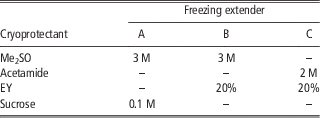
All chemicals used to prepare the extenders were purchased from Sigma-Aldrich (Madrid, Spain). The solution used as a carrier for the cryoprotectants was 250 mM tris-hydroxymethylaminomethane, 83 mM citric acid, 50 mM glucose, pH 6.8 to 7.0, 300 mOsm/kg. The composition of freezing extenders is presented in Table 1. In extender A, 3 M Me2SO and 0.1 M sucrose were used as cryoprotectants. In extenders B and C, the sucrose was replaced by 20% (v/v) egg yolk, and in extender C the Me2SO was substituted by 2 M acetamide.
Concentration of the cryoprotectant components of the freezing extenders

Me2SO=dimethyl sulphoxide; EY=egg yolk.
After semen evaluation, each pool was split and diluted 1 : 1 with all freezing extenders at room temperature (20ºC to 23ºC) and packaged in 0.25 ml plastic straws (IMV Technologies, L’Aigle, France). These straws were then placed at 5°C for 45 min. Cooled straws were suspended horizontally in liquid nitrogen vapour 5 cm above the liquid nitrogen surface for 10 min before being plunged in liquid nitrogen. Thawing was carried out by immersing the straws in a water bath at 50°C for 10 s.
Semen post-thawing evaluation
After the freezing–thawing process, motility and status of the acrosome were determined in the same way as for fresh semen. Hoechst stain (1 μg/100 ml; H33258, Sigma Aldrich) was used to measure viability at 25ºC to 30ºC for 15 min under fluorescence microscopy at 400×. Viability was determined by the percentage of sperm heads that did not stain compared with the total number of sperms examined.
AI and gestation diagnosis
A total of 252 inseminations were performed. Only receptive females (red colour of the vulvar lips) were inseminated with about 40×106 frozen–thawed sperm. Insemination was carried out using a plastic curved pipette (Imporvet, SA, Barcelona, Spain). At the same time of insemination, each female was given an intramuscular injection of buserelin acetate (1 μg; Hoechst Marion Roussel, SA, Madrid, Spain) to induce ovulation. Pregnancy diagnosis was checked by abdominal palpation 12th day after the insemination. At parturition, total born (TB) and born alive (BA) were recorded.
Embryo implantation and losses during gestation
Twelve days after AI, a total of 114 females (57 by line) were anaesthetised by intramuscular injection of 16 mg xylazine (Rompún, Bayer AG, Leverkusen, Germany), followed by an intravenous injection of 1.2 ml/kg BW of ketamine hydrochloride (Imalgène, Merial SA, Lyon, France) to maintain does under anaesthesia during ventral midline laparoscopy. The number of corpora lutea in both the ovaries (TO) and the number of implantation sites at 12th day in the uterine horns (IS12d) were recorded per female. Implantation and gestational losses were calculated, respectively, as the proportion of potential embryos produced (TO) that did not reach the implantation or foetal stage in all ovulating does ((TO−IS12d)/TO, (TO−TB)/TO). Foetal losses were defined as the proportion of implanted embryos that did not reach the foetal stage in pregnant does ((IS12d−TB)/IS12d). The proportions of ovulating females without implanted embryos and pregnant females that did not give birth were recorded.
Statistical analysis
A GLM including as fixed effects lines (H and LP), freezing extenders (A, B and C) and their interactions was performed with SPSS 16.0 software package (SPSS Inc., Chicago, IL, USA, 2002). For the fertility rate, a probit link with binomial error distribution was used, whereas for semen-quality traits (motility, viability and acrosome integrity), implantation sites, TB, BA and implantation, foetal and gestational losses, ANOVA was used. Pearson’s correlation coefficients between frozen–thawed semen traits and fertility rate (at 12th day and at birth), implantation sites, TB and BA were calculated to determine their relationships. Values were considered statistically different at P<0.05. Results were reported as least square means with s.e.m.
Results
Non-significant interactions between genetic line and freezing extender were observed for all analysed traits.
Frozen–thawed semen parameters were affected by freezing extender but not by genetic line (Table 2). The extender with acetamide and egg yolk (C) showed significantly lower post-thawing quality traits than any of the three extenders. The acrosomal integrity was significantly improved when Me2SO was used as permeable cryoprotectant (A and B extenders). Sucrose replacement by 20% egg yolk (extender A v. B) had no effect in acrosomal integrity after freezing, but provided significantly lower post-thawing quality with respect to the other two.
Effect of genetic line and freezing extender on post-thaw seminal-quality parameters of rabbit sperm (LSM)

LSM=least square means; H=line selected for hyperprolificacy; LP=line selected for longevity; A=freezing extender with 3 M Me2SO and 0.1 M sucrose as cryoprotectants; B=freezing extender with 3 M Me2SO and 20% (v/v) egg yolk as cryoprotectants; C=Freezing extender with 2 M acetamide and 20% (v/v) egg yolk as cryoprotectants; n=number of sperm pools used; Me2SO=dimethyl sulphoxide.
Line×extender interaction was not significant.
a,bValues within a row and factor with different superscripts differ significantly at P<0.05.
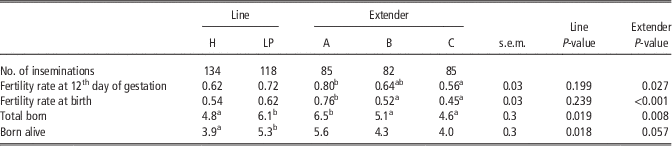
Effects of male line and freezing extender on reproductive parameters are shown in Table 3. No significant differences were found between male genetic lines in fertility rates; only a greater number of TB were observed in line LP. However, significant differences were found in fertility rates and TB between freezing extenders (0.76 v. 0.52 and 0.45 fertility rate at birth and 6.5 v. 5.1 and 4.6 TB for extender A, B and C, respectively), obtaining better results when Me2SO and sucrose were used as cryoprotectants (extender A).
Effect of genetic line and freezing extender on reproductive parameters (LSM)

LSM=least square means; H=line selected for hyperprolificacy; LP=line selected for longevity; A=freezing extender with 3 M Me2SO and 0.1 M sucrose as cryoprotectants; B=freezing extender with 3 M Me2SO and 20% (v/v) egg yolk as cryoprotectants; C=freezing extender with 2 M acetamide and 20% (v/v) egg yolk as cryoprotectants; Me2SO=dimethyl sulphoxide.
Line×extender interaction was not significant.
a,bValues within a row and factor with different superscripts differ significantly at P<0.05.
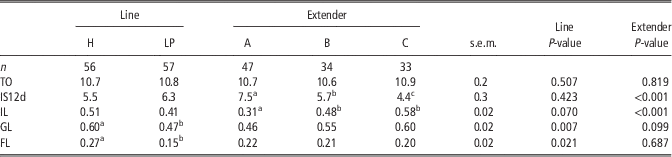
Results obtained after laparoscopy of females are summarised in Table 4. Ovulation rate and number of implantation sites was not significantly different between male lines, but Line H showed significantly higher foetal and gestational losses. Freezing extender affected the number of implantation sites. Extender A showed the highest number and consequently the lowest implantation losses, but the gestational and foetal losses were similar among extenders.
Effect of genetic line and freezing extender on implantation rates and gestational losses (LSM)

LSM=least square means; H=line selected by hyperprolificacy; LP=line selected for longevity; A=freezing extender with 3 M Me2SO and 0.1 M sucrose as cryoprotectants; B=freezing extender with 3 M Me2SO and 20% (v/v) egg yolk as cryoprotectants; C=freezing extender with 2 M acetamide and 20% (v/v) egg yolk as cryoprotectants; n=number of inseminated does; TO=ovulation rate; IS12D=implantation sites at 12th day; IL=implantation losses (proportion of potential embryos produced that did not reach the implantation); GL=gestational losses (proportion of potential embryos produced that did not reach the foetal stage); FL=foetal losses (proportion of implanted embryos that did not reach the foetal stage in pregnant does); Me2SO=dimethyl sulphoxide.
Line×extender interaction was non-significant.
a,b,cValues within a row and factor with different superscripts differ significantly at P<0.05.
Table 5 shows the Pearson’s correlations coefficients between frozen–thawed semen characteristics and female traits. Some of the correlations between them were significant. The acrosomal integrity after frozen–thawed process showed a significant correlation with fertility at 12th day and also at birth, indicating that an increase in acrosomal integrity leads to an increase in both fertilities (12th day and at birth). In the case of sperm motility after frozen–thawed process, the obtained correlations coefficients showed that fertility at birth and the number of implanted embryos could be increased as motility increases.
Pearson’s correlation coefficients between frozen–thawed semen characteristics and female traits

*P<0.05.
Discussion
Variations in the susceptibility of semen to the cryogenic process between breeds have been reported for several species (Songsasen and Leibo, Reference Songsasen and Leibo1997; Sztein et al., Reference Sztein, Farley and Mobraaten2000; Auerbach et al., Reference Auerbach, Norinsky, Ho, Losos, Guo, Chatterjee and Joyner2003 in mouse; Mocé et al., Reference Mocé, Vicente and Lavara2003 in rabbits; Long, Reference Long2006 in poultry and Waterhouse et al., Reference Waterhouse, Hofmo, Tverdal and Miller2006 in boar). As our results indicate, the genetic lines used in the present study showed no differences in the cryosensitivity of semen. Although TB was significantly higher for the LP line (6.1 v. 4.8), and, consistently, foetal and gestational losses were significantly lower in this case. In previous studies with frozen semen in rabbit, differences in fertility rate and litter size were reported when comparing paternal and maternal lines (Mocé et al., Reference Mocé, Vicente and Lavara2003), but no differences were observed between maternal lines. In the present study, line LP, selected by longevity and that had prolificacy near or above the population average, seems to sustain fertility and prolificacy of frozen semen better than H line, selected by hyperprolificacy. There were no significant differences in the implantation sites in females inseminated with semen from different lines, although the lower foetal and gestational losses observed for H line resulted in a greater number of TB.
On the other hand, to protect sperm from cryopreservation process damage, the composition of the freezing extender is a key factor. Egg yolk has been shown to have protective effects when added to an extender, but represents a risk of contamination of seminal doses and makes seminal evaluation difficult. The post-thaw sperm-quality parameters observed from different extenders used in this study show that when Me2SO was used as permeable cryoprotectant, sucrose replacement by egg yolk had no effect in acrosome integrity after freezing, but provided significantly lower post-thawing sperm motility and viability. This finding seems to be consistent with those observed by Vicente and Viudes de Castro (Reference Vicente and Viudes de Castro1996), who reported a similar sperm motility with or without egg yolk when the extender contained sucrose. The beneficial effects of sugars in the extender on the post-thaw viability of the mammalian sperm have been reported in several studies (Abdelhakeam et al., Reference Abdelhakeam, Graham, Vazquez and Chaloner1991; Molinia et al., Reference Molinia, Evans, Casares and Maxwell1994; Vicente and Viudes de Castro, Reference Vicente and Viudes de Castro1996; Woelders et al., Reference Woelders, Matthijs and Engel1997; Malo et al., Reference Malo, Gil, González, Cano, de Blas and Espinosa2010). Our results demonstrated that the extender with Me2SO and sucrose, in addition to significantly improving post-thawing sperm motility and viability, enhanced the reproductive parameters, increasing the implantation sites and the fertility rate at birth, decreasing the implantation losses, and consequently, increasing the TB. However, the percentage of viability for frozen–thawed sperm observed among extenders would render the number of viable sperms in the insemination dose around 7×10⁶, 5×10⁶ and 2×10⁶ for A, B and C extenders, respectively. These results are in agreement with those obtained by Viudes de Castro and Vicente (Reference Viudes de Castro and Vicente1997), who appreciated that does inseminated with 2×10⁶ sperm showed lower pregnancy rates than females inseminated with 4×10⁶ and 16×106 sperm. Furthermore, we found a positive correlation between acrosomal integrity and fertility and between motility of semen and implantation sites, which would explain the differences observed in fertility and litter size among them.
Regarding the use of permeable cryoprotectants, in the present study, the acetamide used in combination with egg yolk negatively affected the frozen–thawed sperm motility, contrary to the results found by Dalimata and Graham (Reference Dalimata and Graham1997). Discrepancies may be partly because of the fact that the composition of acetamide extender used by these authors (acetamide egg yolk HEPES extender with glucose, lactose and raffinose) was very different from that used in the present study (egg yolk Tris-based extender). Other small-scale experiments using 1 and 2 M Me2SO (Hanada and Nagase, Reference Hanada and Nagase1980 and Kashiwazaki et al., Reference Kashiwazaki, Okuda, Seita, Hisamatsu, Sonoki, Shino, Masaoka and Inomata2006, respectively) showed no differences between Me2SO and acetamide as cryoprotectants for rabbit sperm freezing. On the contrary, several authors have demonstrated the efficient sperm protection of 3.0 and 3.5 M Me2SO in rabbit sperm cryopreservation (Vicente and Viudes de Castro, Reference Vicente and Viudes de Castro1996; Viudes de Castro and Vicente, Reference Viudes de Castro and Vicente1996; Mocé et al., Reference Mocé, Vicente and Lavara2003; Cortell and Viudes de Castro, Reference Cortell and Viudes de Castro2008; Iaffaldano et al., Reference Iaffaldano, Di Iorio and Pina Rosato2012; Rosato and Iaffaldano, Reference Rosato and Iaffaldano2013). According to our results, when Me2SO was used v. acetamide extender, results on frozen–thawed sperm quality and reproductive parameters studied were improved.
On the basis of our results, we may conclude that frozen–thawed sperm parameters were not affected by genetic line. However, these results support the idea that the male line may affect reproductive parameters when frozen–thawed sperm is used.
Finally, it seems that freezing extender composition has a significant effect on the cryopreservation success of rabbit spermatozoa, and when Me2SO was used as permeable cryoprotectant sucrose provided better protection compared to egg yolk and improved reproductive traits.
Acknowledgements
This research was supported partly by the RTA2010-00117-00-00 from INIA, the European FEDER Funds and 125-2009 Prometeo Project (Generalitat Valenciana). The authors thank Neil Macowan Language Services for revising the English version of the manuscript.