of Arrernte, an Aboriginal language of Central Australia, using electro-palatographic (EPG) recordings of continuous speech. Coronal consonants are known to be more coarticulatorily resistant than peripheral consonants such as bilabials and velars, and this study teases out the coarticulatory differences between these four coronal places of articulation. Results confirm findings from previous studies that laminal consonants (dental and alveo-palatal) are broadly more coarticulatorily aggressive than apical consonants (alveolars and retroflexes), with the alveolars the least resistant to coarticulation. Dental consonants exert fronting effects on both preceding and following consonants, a result consistent with previous acoustic results for these sounds. Similarly, alveo-palatal consonants show both anticipatory and carryover effects, though their exact coarticulatory effect depends on the affected consonant place and manner. The retroflex consonants exert strong fronting effects on the

1 Introduction
Coarticulation has long been a key area of phonetic study (cf. Öhman Reference Öhman1966, Reference Öhman1967, Hardcastle & Hewlett 1999, and references therein). Much work has focused on the coarticulatory effects of immediately adjacent segments (e.g. Recasens Reference Recasens1984, Reference Recasens1985, Reference Recasens1991, Farnetani Reference Farnetani1990, Reference Farnetani, William and John1997); however, relatively less work has focused on long-range coarticulatory effects, such as trans-consonantal vowel-to-vowel coarticulation (VCV); or, as is the topic of study here, on trans-vocalic consonantal coarticulation (CVC). In the present paper we focus on these consonant-to-consonant effects in a language, Arrernte, which has a complex set of coronal contrasts. Since coronals are known to be relatively resistant to coarticulation, as compared to ‘peripheral’ consonants such as bilabials and velars (cf. Hardcastle & Hewlett 1999), our aim is to tease out the finer details of how different types of coronals behave. We consider the broader effects of apical versus laminal articulations, while looking more precisely at four places of articulation: (lamino-)dental, (apico-)alveolar, (apico-)post-alveolar (also called ‘retroflex’), and (lamino-)alveo-palatal. We consider both anticipatory and carryover coarticulation (cf. Menzareth & de Lacerda Reference Menzareth and de Lacerda1933) in order to ascertain whether there are any differences in the direction of the coarticulatory effects of various consonant places. The present study uses electro-palatography (EPG) to examine coronal CVC coarticulation in Arrernte. This technique measures contact between the tongue and the hard palate, and is therefore eminently well suited to the study of coronal consonants. Tokens are extracted from a database of read texts, which allows for the examination of many examples of CVC sequences in continuous speech.
The remainder of this Introduction is organized as follows: firstly, we give a brief outline of the Arrernte language, as relevant to this study (Section 1.1). Secondly, we consider previous work on coarticulation in Australian Aboriginal languages. We will consider results from previous studies of both consonant–vowel coarticulation in these languages, and consonant–consonant coarticulation within consonant clusters (Section 1.2). Finally, we outline the hypotheses for our study.
1.1 A brief outline of Arrernte
Arrernte is an Aboriginal language of Central Australia (Wilkins Reference Wilkins1989, Green Reference Green1994, Henderson & Dobson Reference Henderson and Dobson1994, Anderson Reference Anderson2000, Breen & Dobson Reference Breen and Dobson2005, Henderson Reference Henderson2013), with about 2000 speakers. It is the language of Alice Springs (Mparntwe), which serves as the administrative and tourist centre for many thousands of square kilometres in Central Australia. Arrernte is still being learned by children today, and is taught in primary schools in Alice Springs and in surrounding Arrernte country.
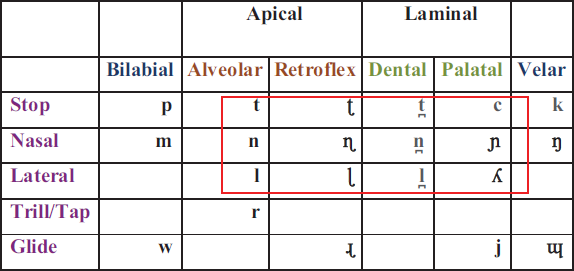
Arrernte has a rich set of coronal consonant contrasts, and a small set of vowel contrasts. The consonants of Arrernte are shown in Table 1, with the coronal consonants included in the present study highlighted – namely the dental, alveolar, retroflex and (alveo-)palatalFootnote 1 stop, nasal and lateral /t̪ t ʈ c n̪ n ɳ ɲ l̪ l ɭ ʎ/. As can be seen, the coronal consonant inventory is very symmetrical for the non-continuantFootnote 2 coronal consonants, with each of the three manners of articulation (stop, nasal, lateral) being realized at each of the four coronal places of articulation. Moreover, this system of twelve non-continuant consonants is neatly divided into apical and laminal articulations, with the alveolar and retroflex consonants produced as apicals, and the dental and palatal consonants produced as laminals (cf. Butcher Reference Butcher and Windsor-Lewis1995, Reference Butcher, Jonathan and Marija2006, Reference Butcher, Cathryn and William2012).
Consonants of Arrernte, with the consonants under study within the red-line enclosure.

In terms of tongue–palate contact patterns, the apicals are typically characterized by a thin band of contact – in the case of the alveolars, this is strictly at the alveolar region, and in the case of the retroflexes, initial contact is typically at the post-alveolar or pre-palatal region (Anderson Reference Anderson2000, Tabain Reference Tabain2011). However, the retroflex consonants are characterized by a ballistic forward movement of the tongue: the initial contact in the post-alveolar or pre-palatal region is followed by release at a more anterior place of articulation (see Tabain & Beare Reference Tabain and Beare2020 for EPG and EMA [electro-magnetic articulography] data on the apical consonants of Arrernte – cf. Bundgaard-Nielsen et al. Reference Bundgaard-Nielsen, Kroos, Harvey, Best, Baker and Goldstein2010 for preliminary EMA data on the northern Australian language Wubuy). The laminals, by contrast, are characterized by a broader band of tongue–palate contact, which is clearly dental in the case of dental consonants, and broadly post-alveolar/pre-palatal in the case of the palatal consonants. In an ultrasound study of six speakers of Arrernte, Tabain & Beare (Reference Tabain and Beare2018) found that the palatal is characterized by a high and front tongue position, and the dental is characterized by a low and flat tongue position in the mid-to-front portion. By contrast, the alveolar and retroflex have tongue shapes and positions intermediate between these two.
In contrast to this rich consonant system, Arrernte has only three vowels /i ə ɐ/, with a possible fourth vowel [u].Footnote 3 However, the central vowels /ə ɐ/ are lexically much more frequent (in the database used for this study, they comprise about 97% of all vowel tokens), and it has even been suggested that the main purpose of the vowel in Arrernte is to serve as the carrier of place information for the consonant via formant transitions (Tabain & Breen Reference Tabain and Breen2011). This impression is strengthened by the observation that the majority of Arrernte syllables contain only a single consonant (around 80–85% of the South Wind and the Sun text), thereby allowing for formant transitions on both sides of the consonant. Moreover, any clusters that occur are twice as likely to be homorganic as they are to be heterorganic (Tabain Reference Tabain2016). Vowels could therefore be argued to play an important role in breaking up sequences of consonants in Arrernte, and this is one of the main reasons why the present study focuses on trans-vocalic consonant coarticulation, rather than on coarticulation within clusters (i.e. clusters do not occur very often in running speech).
Lexical stress in Arrernte is realized on the first vowel which follows a consonant – or as termed by Breen & Pensalfini (Reference Breen and Pensalfini1999), on the first underlying VC syllable of the word (with all syllables in Arrernte deemed to begin with a vowel underlyingly, even if this vowel is not realized on the surface). In practice, this means that, if the word is realized with an initial vowel, stress is on the second vowel; but if the word is realized with an initial consonant, stress is on the first vowel. Lexical stress in Arrernte is largely encoded via greater vowel duration, and also greater consonant duration on the preceding consonant (Tabain Reference Tabain2016). However, not all Arrernte vowels are equally lengthened under stress, with the low vowel /ɐ/ being greatly lengthened under stress, while the central vowel /ə/ shows minimal lengthening. In the present study we are unable to consider the effects of stress on coarticulation in Arrernte, given that we are already considering carryover and anticipatory coarticulation effects for four places of articulation. However, despite the durational effects of stress on consonant articulation, there is minimal evidence of spatial effects of stress on lingual consonants in Arrernte (Tabain Reference Tabain2019). This is deemed to be a concomitant of the crowded coronal system in this language (cf. Fletcher, Loakes & Butcher Reference Butcher, Jonathan and Marija2014). The one exception to this observation is the retroflex consonants, which are more prototypically retroflex when following a stressed vowel (i.e. produced with a ballistic forward movement of the tongue, following initial contact in the post-alveolar or pre-palatal region, as opposed to an articulation that is not produced with forward movement during closure, and/or that has initial contact at a slightly more anterior place of articulation). This result is argued to be due to the importance of the stressed vowel in VC formant transitions for the retroflex (Tabain & Beare Reference Tabain and Beare2020).
We next consider previous work on coarticulation in Australian Aboriginal languages, in the light of more general work on coarticulation in other languages.
1.2 Coarticulation effects in Australian languages
It is generally recognized that consonants or vowels that are highly resistant to coarticulation from other segments exert a high degree of coarticulatory aggression on those same other segments. As has become clear from work by Recasens and colleagues using the DAC (Degrees of Articulatory Constraint) model (e.g. Recasens & Pallarès 2001), the degree of coarticulatory resistance for coronal consonants is inversely correlated with the degree of tongue body raising inherent in the production of the coronal segment. This observation is particularly relevant for the apical versus laminal contrast, since laminal articulations recruit a larger portion of the tongue body in their articulation, and are thus more articulatorily aggressive, and also more articulatorily resistant, than apicals (Dart Reference Dart1991, Reference Dart1998). However, there is a special consideration for the laminals of Arrernte, in that the dental does not require tongue-body raising, but instead has a lowered tongue-body position, presumably as part of a strategy to ensure more strictly dental contact, as opposed to denti-alveolar contact (given that the language must contrast dentals from alveolars). Thus, the Arrernte dental could be said to be a laminal consonant that recruits a large portion of the tongue body in its articulation, but that does not involve tongue raising. At the same time, the tongue body is not involved in contact for the dental (unlike the palatal), since contact is confined to the blade for dentals.
Early acoustic work on coarticulation in Australian languages has been unable to reliably isolate differences between apicals and laminals with regard to coarticulatory effects. In a locus equation study of two Australian languages – Yanyuwa and Yindjibarndi – Tabain & Butcher (Reference Butcher, Jonathan and Marija1999) found that coronal consonants have a lower slope value (indicating greater coarticulatory resistance) than peripheral consonants (i.e. bilabials and velars), but statistically there was no clear pattern among the four coronal places of articulation themselves (Yanyuwa and Yindjibarndi have four coronal places of articulation, like Arrernte). However, a closer examination of the data (e.g. Figure 4) shows some evidence that amongst the coronals, laminals (i.e. dentals and palatals) generally have a lower slope value than apicals (i.e. alveolars and retroflexes), indicating greater resistance to coarticulation for the laminals.
These results for Yanyuwa and Yindjibarndi were largely replicated by Graetzer (Reference Graetzer2012) for Arrernte, Burarra, Gupapuyngu and Warlpiri.Footnote 4 As part of a broader acoustic study of vowel-to-vowel coarticulation and consonant–vowel coarticulation, Graetzer concluded that the degree of vowel-to-consonant coarticulation varies inversely with the degree of consonantal articulatory constraint (i.e. degree of tongue dorsum raising), as has been seen for European languages such as Catalan, Italian and German, and she tentatively proposes a coarticulation hierarchy velar < bilabial < alveolar < retroflex < palatal (whereby palatals are the most resistant to coarticulation, and velars the least resistant), consistent with the DAC model. It may be noted that the dental is not included in this hierarchy: of the languages examined by Graetzer, only Arrernte and Gupapuyngu have a dental place of articulation, and, as was seen above, the Arrernte vowel inventory is dominated by central vowels, making any formant-based study of consonant–vowel coarticulation (such as locus equations) in this language problematic.
Interestingly, Graetzer reports that, in the Australian languages she studied, anticipatory vowel–consonant coarticulation tended to exceed carryover coarticulation. This is contra results previously reported for European languages. It is broadly assumed that anticipatory coarticulation reflects speech planning, whereas carryover coarticulation may be a result of articulatory inertia. It could therefore be suggested that the rich place-of-articulation series in these languages requires speakers to plan for upcoming segments, but does not allow for those segments to interfere with following segments (cf. Stoakes, Fletcher & Butcher, Reference Butcher, Jonathan and Marija2020). Graetzer argues that these results support the view that the maintenance of consonant place of articulation distinctions is of prime importance in Australian languages.
Indeed, these results could be said to echo previous results by Tabain, Breen & Butcher (Reference Butcher, Jonathan and Marija2004), comparing formant transitions in English with formant transitions in Arrernte, Yanyuwa and Yindjibarndi. This study found that speakers of Australian languages control the CV and VC formant transitions equally carefully, whereas English speakers control the CV transition more carefully than the VC transition (see Byrd Reference Byrd1994 and references cited therein). The result for the Australian languages points to the importance of maintaining cues to place of articulation in a coronal-rich language. This observation may be all the more relevant when languages contain a retroflex place of articulation, given that the primary cues to place of articulation in retroflexes reside in the VC transition (Steriade Reference Steriade1995, Reference Steriade, Elisabeth and Keith2001, Hamann Reference Hamann2003), as is the case for almost all Australian languages. It is therefore possible that, for reasons of paradigmatic contrast, a language with a retroflex in its inventory would require the VC transition of other consonants to be carefully controlled as well.
In contrast to the above-cited acoustic studies, very little articulatory work on Australian languages has considered coarticulation. However, a series of small-scale EPG studies of consonant clusters by Fletcher and colleagues, of the central Australian language Warlpiri (which borders with Arrernte) and the northern Australian language Iwaidja, is of high relevance to our present work. Fletcher, Loakes & Butcher (Reference Butcher, Jonathan and Marija2008) found very little anticipatory coarticulation in hetero-organic nasal+stop clusters in Warlpiri. There were no instances of complete assimilation of the alveolar nasal /n/ to the velar stop /k/, although there was some evidence of spatial modification of the nasal in such clusters (i.e. a lower Centre of Gravity [CoG] for /n/ before a velar or palatal stop, suggesting increased posterior contact). Similar results were found by Fletcher et al. (Reference Fletcher, William, John and Fiona2014) in a study of Iwaidja. These results go against results extensively documented for English, where there is a tremendous amount of overlap (both temporal and spatial) between C1 and C2 /n/+/k/ in a word like pancake (see Byrd Reference Byrd1994 for a review).
However, Fletcher et al. (Reference Fletcher, William, John and Fiona2014) also found various results that are in line with results previously reported in the literature on consonant coarticulation. This includes greater resistance to coarticulation in lateral+stop clusters as opposed to nasal+stop clusters (where the sonorant is either alveolar or retroflex, and the stop is a lingual stop), and also strong coarticulatory effects of palatals (cf. Recasens Reference Recasens1990). The greater coarticulatory resistance of laterals may be due to airflow requirements which constrain the tongue body, and the greater coarticulatory resistance of palatals may be due to the high degree of coupling between the blade and the dorsum for this class of sounds (Recasens Reference Recasens1990, Reference Recasens1996).
Interestingly, Fletcher et al. (Reference Fletcher, William, John and Fiona2014) found a higher EPG CoG value for the retroflex nasal /ɳ/ before the palatal /c/ as compared to the velar /k/; this suggests that the tongue body fronting for the palatal conflicts with the tongue tip retraction gesture for the retroflex, with the following palatal pulling the retroflex articulation forward.Footnote 5 This observation is somewhat at odds with the literature review of consonant cluster coarticulation involving retroflexes presented in Recasens (Reference Recasens2018) for a large variety of languages (European [Romance, Germanic] and Asian), which suggests that retroflex consonants in clusters induce not only progressive (i.e. carryover) place assimilation, as had previously been suggested (e.g. Steriade Reference Steriade2001), but regressive (i.e. anticipatory) assimilation as well. Recasens suggests that regressive/anticipatory assimilation is due to tongue tip retraction before consonant onset, which may be anticipated during the preceding segment (cf. Kochetov et al. 2014, who found that retroflexes exert extensive anticipatory and perseverative coarticulatory effects on adjacent vowels in the Dravidian Indian language Kannada; and also West Reference West1999, who found anticipatory effects on F3, lip and tongue position up to two syllables before the target for the English retroflex rhotic). It is perhaps curious that, while the cues to retroflex place reside almost entirely in the VC transition, coarticulatory effects may be both anticipatory and carryover. Perhaps a distinction must be made here between retroflexes which do and do not involve a forward movement of the tongue during closure: retroflex fricatives and glides do not involve a forward movement, whereas the non-continuants studied here do involve a forward movement during closure. For a continuant sound such as a glide or fricative, both anticipatory and carryover coarticulation may apply, and the lowered formant cues reside on both sides of the consonant. For a non-continuant (stop, nasal and in the present case lateral), the left edge of the consonant may induce anticipatory coarticulation for a retroflex consonant, whereas the right edge of the consonant may induce carryover coarticulation for a more anterior articulation, assuming a ballistic forward movement of the tongue during consonant closure. Recasens suggests that the observation regarding both carryover and anticipatory effects of retroflexes applies to both rhotic and non-rhotic retroflexes, so there are clearly some different patterns of results to be observed. However, Recasens’ review does not consider retroflexes adjacent to palatal consonants, and it is possible that there is a special coarticulatory relationship between retroflexes and palatals. Moreover, based on the description of retroflexes in consonant clusters, it could be argued that if a retroflex non-continuant is initial in a cluster it is not released, and therefore all contact during the retroflex is in the post-alveolar region. By contrast, in a CV sequence, the retroflex is released into the vowel, and contact changes from post-alveolar to alveolar during closure; one might therefore expect some asymmetry in how the retroflex behaves in anticipatory versus carryover coarticulatory terms.
Thus far we have focused our discussion on places of articulation. However, it will have been noticed that our study includes three manners of articulation: stop, nasal and lateral. It is recognized that manner of articulation has a profound effect on coarticulatory resistance: for instance, the sibilant fricative /s/ is much more resistant to coarticulation than other alveolar consonants, due to the precise airflow and tongue-grooving requirements of this sound (e.g. Byrd Reference Byrd1994). Laterals also tend to be resistant to coarticulation due to lateral airflow control requirements, with constraints involving both the jaw and the tongue (cf. the results for Fletcher et al. Reference Fletcher, William, John and Fiona2014 mentioned above). However, it is also the case that other aspects of lateral articulation affect coarticulatory degree, such as the relative darkness/lightness of a lateral, which again highlights the role of tongue-body raising in coronal consonant coarticulatory resistance (Bladon & Al-Bamerni Reference Bladon and Al-Bamerni1976). To what extent the different lateral places of articulation per se have different coarticulatory properties requires further research; however, in an ultrasound study of Catalan coronal consonants, Recasens & Rodriguez (Reference Recasens and Rodriguez2016) found that the palatal lateral is more resistant to coarticulation than the alveolar lateral, in line with a general pattern of greater coarticulatory resistance for palatals. Coarticulatory effects of nasals relative to stops or laterals have not been extensively studied; however, Tabain, Fletcher & Butcher (Reference Butcher, Jonathan and Marija2011) have suggested that the palatal nasal is more likely to show effects of prosodic or vocalic context than is the palatal stop or lateral, due to less strict oral airflow requirements. It is also known that coronal stops tend to place strong coarticulatory constraints on the jaw due to airflow requirements for the stop burst (Mooshammer, Hoole & Geumann Reference Mooshammer, Hoole and Geumann2007); for Arrernte, this affects the alveolar, retroflex and palatal stops, but not the dental, which has a much flatter stop burst spectrum (Tabain Reference Tabain2012).
In terms of the interaction between place of articulation and manner of articulation, recent vowel formant (Tabain, Butcher & Beare Reference Tabain, Butcher and Beare2020) and EPG studies (Tabain & Beare Reference Tabain and Beare2020) of the apical contrast in Arrernte suggest that the difference in place between alveolars and retroflexes is much clearer for stops and nasals than it is for laterals (however, there is a slight disjunct between the articulatory and the acoustic data for stops and nasals, in that the articulatory data show a greater contrast between alveolar and retroflex for nasals than for stops, whereas the acoustic data show a greater contrast for stops than for nasals; this disjunct may be explained by nasalization of the adjacent vowel formants). In the present study, we are unable to fully consider the interaction between place and manner in terms of coarticulation due to limits on numbers of tokens (see below for further details). However, we include both place and manner in our inferential statistical analyses, while focusing most of our discussion on issues of place with a subsidiary concern for manner.
1.3 The hypotheses
The following aims may be identified for the present study:
Do apical and laminal consonants behave differently in Australian languages in terms of coarticulatory resistance and aggression? We would expect so, given many previous results in the literature suggesting a greater coarticulatory resistance for laminals.
-
Do the two laminals – dental and palatal – have different coarticulatory properties? We would expect so, since it will be recalled from the discussion above that the palatal has a tongue body fronting and raising gesture, whereas the dental involves a lower tongue body position as part of a strategy to keep the articulation purely dental, rather than denti-alveolar.
-
Do the two apicals – alveolar and retroflex – also have different coarticulatory properties? The results described above would suggest that the alveolar is least resistant to coarticulation of the four consonants studied here. In addition, it was mentioned above that there could be an asymmetry in how the retroflex behaves in terms of anticipatory versus carryover coarticulation: it is possible that at the left edge (VC), a retroflex consonant behaves as a post-alveolar articulation, while at the right edge, a retroflex behaves as an alveolar consonant (CV).
2 Method
2.1 Speakers and recordings
Two female native speakers of Central Arrernte took part in these recordings: Sabella Turner (ST; born 1958) and Janet Turner (JT; born 1973). Both are actively involved in Arrernte language teaching, interpreting and maintenance. Recordings took place at the Institute for Aboriginal Development in Alice Springs, in September 2008.
The speakers were recorded wearing a custom-made Articulate palate, which provides slightly better coverage of the dental and velar regions than does the traditional Reading palate (Wrench Reference Wrench2007, Tabain Reference Tabain2011). Speakers wore the artificial palate for several minutes before the recording began, participating in normal conversation (in English) during recording set-up. There was no noticeable effect on their conversational English speech while wearing the artificial palate.
EPG and acoustic data were recorded simultaneously onto a PC laptop computer running the Articulate Assistant software (http://www.articulateinstruments.com/), with an external recording-quality soundcard to ensure accurate articulatory–acoustic synchronization. EPG data were collected using the Reading EPG system, with a 200 Hz sampling rate. Acoustic data were sampled at 22.05 kHz.
As mentioned above, the data for this study are extracted from connected, read speech; this allowed for a much larger number of tokens to be examined than isolated word data would have allowed. The speakers read two types of texts. The first text was the story Urreye Akweke (‘Little Boy’), written by speaker ST. Speakers read several pages of this text. The second text type consisted of question–answer sentence pairs, designed for the purposes of another study. There were 31 sentence sets in total (each set consisting of two two-sentence pairs) and each speaker produced each sentence stimulus set 10 times. Although the focus sentences were originally designed to highlight target words, in the present study the entire sentence was used in order to maximize the number of tokens.Footnote 6
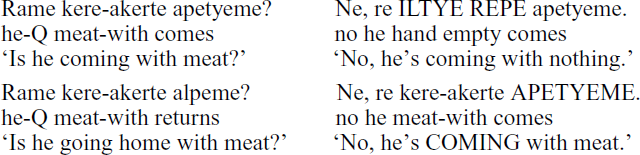
The focus sentences were designed to present target words in various conditions. Each target word was designed to highlight a particular coronal stop, nasal or lateral consonant of Arrernte. The target consonant was flanked on both sides by a central vowel, and by bilabial consonants on the other side of each central vowel: for instance, apetyeme /ɐpəcəm/ ‘come’ for the palatal stop /c/.
Each target word was placed in two pairs of sentences: the first pair of sentences was designed to present the target word in a neutral context, and then in a de-focused context; the second pair of sentences was designed to present the word in a contrastive focus context. For example:

Although the target words and focused words are written with capital letters above, there was no such marking in the stimulus presented to the speakers. Moreover, the speakers were not explicitly instructed in how to produce the sentences intonationally; it was simply checked that the speakers understood the sentences, and that they understood that each sentence involved a contrastive focus in pragmatic terms.
2.2 Data analysis
Data were labelled using the EMU Speech Database system (Winkelmann, Harrington & Jänsch Reference Winkelmann, Harrington and Jänsch2017), and all data analysis was carried out using this system interfaced with the R Statistical Package (R Core Team 2019). Data were labelled according to standard acoustic criteria (cf. Harrington & Cassidy Reference Harrington and Cassidy1999: Chapter 4), and checked during the data analysis stage.Footnote 7 Note, however, that stop consonants in initial and in final position (i.e. following or preceding a pause) were labelled based on EPG data: the onset of closure following a pause was marked at the first time point where an entire row showed contact on the EPG palate, and the offset of closure preceding a pause was marked at the first time point where no row showed complete contact on the EPG palate.
Two traditional EPG measures were used to analyse the data for the present study: Centre of Gravity and Total Contacts (also called Sum Contacts). These were both calculated within the EMU-R system. CoG is used to quantify the point of constriction along the palate: it measures contact across the entire palate, giving a linearly higher weighting as the rows become more forward (Hardcastle, Gibbon & Nikolaidis Reference Hardcastle, Gibbon and Nicolaidis1991). The value of CoG varies between 0.5 if the entire back row of electrodes is contacted, and 7.5 if the entire front row of electrodes is contacted.Footnote 8 By contrast, the measure Total Contacts varies between zero and 62, which is the number of electrodes on the artificial palate. Examples of averaged palatograms for the various consonants of Arrernte are given in Tabain (Reference Tabain2011).
2.3 Data selection
C1VC2 sequences were extracted from the above database, where V was one of the central vowels /ɐ/ or /ə/, and the consonants were either coronal or velar.Footnote 9 Although the focus of analysis in the present study is on coronal consonants, the influence of the velar consonants /k ŋ/ on the articulation of coronals is also examined, given that velars are also lingual consonants and their dorsal articulation may affect coronal articulations in a special way. Note, however, that the velar is not a focus of study: when Centre of Gravity and Total Contacts for C1 is being examined, only coronal C1 consonants are included; however, both coronals and the velar are considered as C2 factors influencing the articulation of C1. Conversely, when Centre of Gravity and Total Contacts of C2 is being examined, only coronal C2 consonants are included, but both coronals and the velar are considered as C1 factors influencing the articulation of C2. This approach was chosen not only because coronals are the focus of this study, but also because EPG does not fully capture velar articulation, thereby making it difficult to confidently assess coarticulatory effects on velars (as opposed to coarticulatory effects of velars). It is also important to note that only stop, nasal and lateral consonants are included in the present study; trills and glides are excluded (note that there is no velar lateral in Arrernte).
Note that the vowels extracted from the database include word-internal vowels, and also vowels at word edges. Thus, C2 might be across a word boundary from C1. As mentioned above, final vowels are not contrastive/phonemic in Arrernte, and a vowel is often inserted to break up word boundaries. Sometimes there is vowel coalescence between a final vowel and the initial vowel of the following word, and the two vowels may have a similar quality (Tabain & Breen Reference Tabain and Breen2011). Vowels at word boundaries were included in the present study if labelled as a singleton vowel based on examination of formant tracks, pitch tracks and vowel duration.
It is also important to note that the prosodic status of the vowel was not considered in this analysis (i.e. stressed or unstressed), since it would have been very difficult to control for this factor given all of the factors already considered here. This is a recognized limitation of this study.
While C1 was always followed by a vowel, and C2 was always preceded by a vowel, it is not always the case that each consonant was intervocalic, since this would have noticeably reduced the number of tokens available for analysis. For speaker JT, 80.2% of C1 tokens were preceded by a vowel or by a pause (including 8.3% by a pause); and for speaker ST, 79.4% of C1 tokens were preceded by a vowel or by a pause (including 2.5% by a pause). By contrast, 90.9% of C2 tokens were followed by a vowel for speaker JT (with no tokens followed by a pause); and 85.7% of tokens were followed by a vowel for speaker ST (also with no tokens followed by a pause). This means that about 20% of C1 tokens were part of a cluster, and about 10–15% of C2 tokens were part of a cluster (more details on number of tokens are given below).
As noted above, clusters in Arrernte are twice as likely to be homorganic as heterorganic. An examination of the present database confirmed this observation, and found that many tokens in heterorganic clusters arose from vowel-dropping, especially in suffixes (e.g. irrtyartel-ame ‘with a spear?’ produced as [ircɐʈləmə] instead of [ircɐʈələmə], where the suffixes -le [lə] and -ame [ɐmə] are added to the root irrtyarte [ircɐʈə]). Other instances involved word boundaries with no vowel insertion. Finally, a very small number of tokens involved lexical clusters; for instance, the sequence /cɐʈ/ would have been extracted from the word irrtyartel-ame, where a trill preceded the palatal stop.
It should be noted that the main possible consequence of including consonants that are part of a cluster in the dataset concerns retroflexes. For homorganic retroflex clusters, the initial retroflex closure occurs at the onset of the first consonant, and the anterior release occurs at the end of the second consonant. Thus, by including only one of the two consonants in a retroflex cluster, we are potentially excluding either the onset of the retroflex gesture (if our extracted C1 token was the second part of the cluster), or the release of the retroflex gesture (if our extracted C2 token was the first part of a cluster). Informal observation of our data suggested that this was not a significant problem in our analyses (especially since the palatograms presented in Section 3 below are taken at the temporal midpoint of the consonant), but it must be acknowledged as a potential issue in a broader concern of gestural timing.
2.4 Number of tokens
There are 12 different coronal consonants under analysis in this study (4 places of articulation and 3 manners of articulation). Thus, there is a total of 144 different possible C1 and C2 combinations. In order to make analysis more tractable – and also since certain C1+C2 combinations do not exist or are low in database frequency – we analyse the data in groups according to either place or manner of articulation.
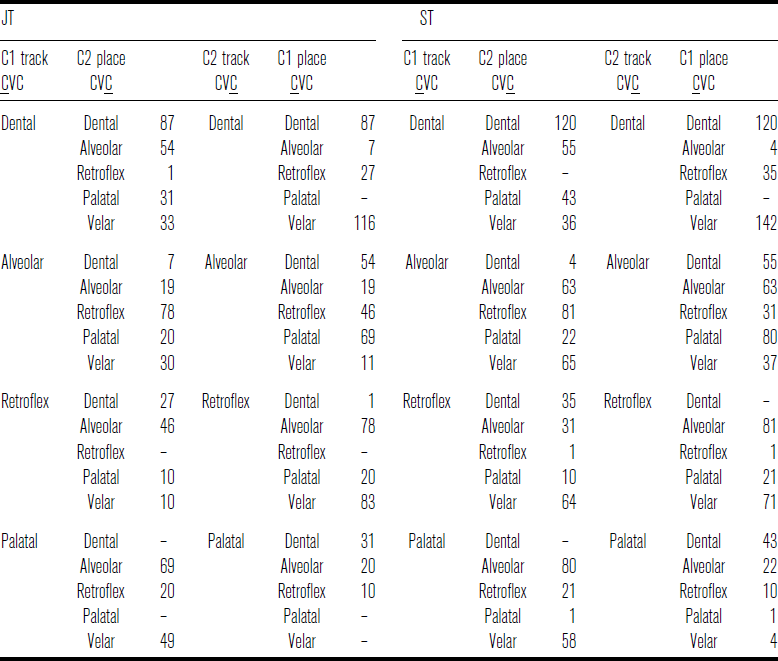
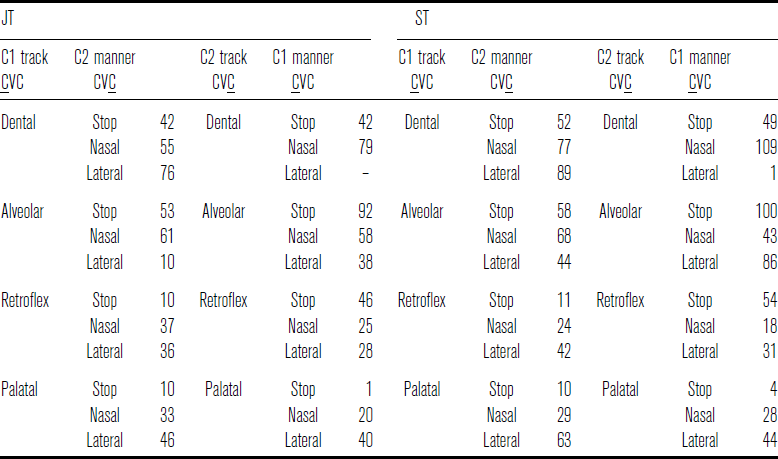
Table 2 shows the number of tokens used in the analyses presented below. The data are presented for each speaker separately. Within each speaker, data are always organized according to the place of articulation of either C1 (columns 1–3 for each speaker) or the place of articulation of C2 (columns 4–6 for each speaker).
Table 2a shows the number of tokens according to the place of articulation of the opposite consonant (i.e. columns 1–3 for each speaker show the place of articulation for C2; and columns 4–6 for each speaker show the place of articulation for C1). Note that columns 3 and 6 are not entirely re-arrangements of each other, since velar is listed as a possible factor.
Number of tokens according to place of articulation.

It can be seen that the number of tokens varies greatly according to the combination of places of articulation. For instance, for speaker JT there is only one instance of dental+retroflex (i.e. C1=dental and C2=retroflex: note that this sequence is listed twice, the first time in column 3, and the second time in column 6). Speaker ST has no data for the dental+retroflex sequence. Other relatively infrequent sequences are alveolar+dental (7 tokens for JT and 4 for ST); retroflex+retroflex (none for JT and 1 for ST); palatal+dental (none for either speaker); palatal+palatal (none for JT and 1 for ST); and palatal+velar (none for JT and 4 for ST). These data suggest (a) that there may be a licensing principle which restricts sequences of the same place of articulation in Arrernte (see Pozdniakov & Segerer Reference Pozdniakov and Guillaume2007 for a typological discussion of such restrictions); and (b) that sequencing restrictions are a little more likely to involve laminal consonants than apical consonants in Arrernte. The sequence retroflex+retroflex may be limited by the neutralization of the apical contrast in word-initial position – an initial apical is normally represented as alveolar in the orthography, and labelling of the present database follows orthographic convention. Despite the above observations, it is clear that there are good numbers of tokens for most cells, usually involving many tens of tokens. The largest number of tokens are for dental+dental (87 for JT and 120 for ST) and velar+dental (116 for JT and 142 for ST).
Table 2b presents the same data as Table 2a, but this time organized according to the manner of articulation of the opposite consonant, rather than by its place of articulation (i.e. columns 1–3 for each speaker show the manner of articulation for C2 according to the place of articulation of C1; and columns 4–6 for each speaker show the manner of articulation for C1 according to the place of articulation of C2). It can be seen that in general there are many tens of tokens in each cell/category. The exceptions all concern the manner of C1: when C2 is dental, there are almost no preceding C1 laterals (only one token for ST, and no tokens for JT). Likewise, when C2 is palatal, there are few preceding C1 stops (10 tokens for JT and 4 for ST). It is notable that, once again, restrictions on co-occurrence seem to concern laminals.
Number of tokens according to manner of articulation.

Note that in the presentation of results below, all of the tokens included in these tables are included in the initial omnibus statistical analysis. However, when data are broken up for presentation according to place of articulation or manner of articulation, any cells which contain fewer than 5 tokens are not included in the analysis (this refers to the plots of CoG tracks presented below).
2.5 Statistical analysis
Generalized Additive Models (GAMs) were used for the inferential analysis of the EPG data, with time included as a predictor. This approach was chosen because retroflex consonants involve an inherently time-dependent gesture (i.e. with closure at a more posterior location, and release a more anterior location along the palate), as discussed above. However, although time is included as a factor in the GAMs for this reason, we focus our discussion below on the factors placeO and mannerO. The following formula was used:
CoG ˜ placeO + s(time) + s(time, by = placeO) + s(segnum, bs = “re”)
where CoG is the Centre of Gravity values across consonant duration; placeO is one of Dental, Alveolar, Retroflex, Palatal or Velar; and segnum is the individual token number (1:591 for C1 for speaker JT, and 1:790 for C1 for speaker ST; and 1:679 for C2 for speaker JT, and 1:821 for C2 for speaker ST). “re” denotes a random effect. By having token number as a random effect, we ensure that individual samples are treated as part of the relevant track, rather than as independent samples in time.
A second GAM examined the effect of manner:
CoG ˜ mannerO + s(time) + s(time, by = mannerO) + s(segnum, bs = “re”)
where mannerO is one of stop, nasal or lateral. Separate GAMS were also conducted for Total Contacts in addition to CoG.
It is important to note that when CoG or Total Contacts was examined for C1, the factors placeO and mannerO in the above formulas were place and manner for C2; conversely, when CoG or Total Contacts was examined for C2, the factors placeO and mannerO in the above formulas were place and manner for C1.
All GAM analyses were carried out using the mgsv and itsadug packages (Mixed GAM Computation Vehicle, and Interpreting Time Series and Autocorrelated Data Using GAMMs) in R (van Rij et al. Reference van Rij, Wieling, Baayen and van Rijn2017, Wood Reference Wood2017).
3 Results
We present our results for anticipatory coarticulation and carryover coarticulation in separate sections. In each section, we present our overall inferential statistical results according to place of articulation first (for CoG and Total Contacts), as tables. This gives an overall view of the results. This is followed by figures plotting raw EPG track-data (CoG), with overlaid GAM-smoothed data, for the various places and manners of articulation.Footnote 10 Finally, in each section, we present averaged EPG palatograms of the data according to place of articulation, sampled at the temporal midpoint of the consonant, for a more nuanced examination of the patterns observed. Within each section (anticipatory and carryover) we discuss coarticulatory effects according to place, with some additional consideration of manner as shown in the GAM-smoothed plots. A final (brief) section is dedicated to additional concerns of manner, not covered elsewhere in the discussion.
Note that the GAM-smoothed curves may have a different shape to the raw track-data: for instance, many raw tracks may show a plateau shape, whereas the GAM-smoothed curves show a relatively smooth round shape. This is a consequence of the assumptions made by the GAM smoother about the nature of the curve.
3.1 Right-to-left, anticipatory coarticulation
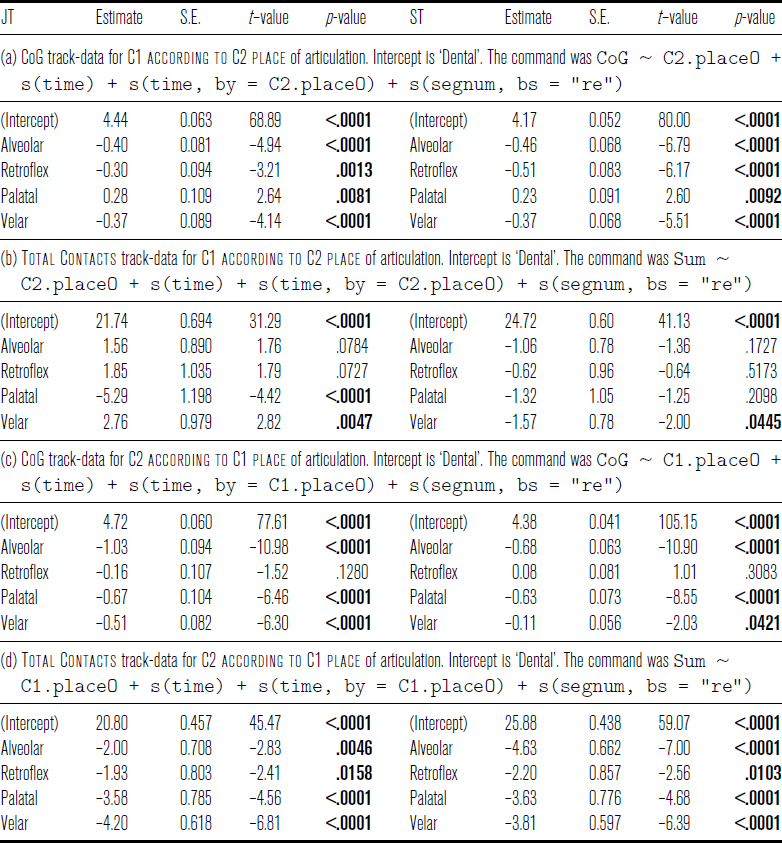
Table 3a shows the GAM results for CoG track-data for C1 (i.e. the consonant left of the vowel) according to the C2 place of articulation. This table is based on 591 tokens for speaker JT, and 790 tokens for speaker ST (as per Table 2 above). An examination of this table, together with an examination of post-hoc results (not shown here), gives the following rankings based on significance values returned:
-
For speaker JT: palatal > dental > retroflex = alveolar = velar
-
For speaker ST: palatal > dental > velar = alveolar > retroflex
Results from Generalized Additive Models according to place of articulation, for two speakers (JT and ST) of Arrernte. P-values less than .05 are in bold.

This ranking tells us that for both speakers there is a strong anticipatory effect of following laminals, and in particular of following palatals. A following palatal pulls the place of articulation forward for C1. A following dental also pulls C1 place of articulation forward, though to a lesser extent. There is also evidence from speaker ST that a following retroflex retracts the place of articulation of C1.
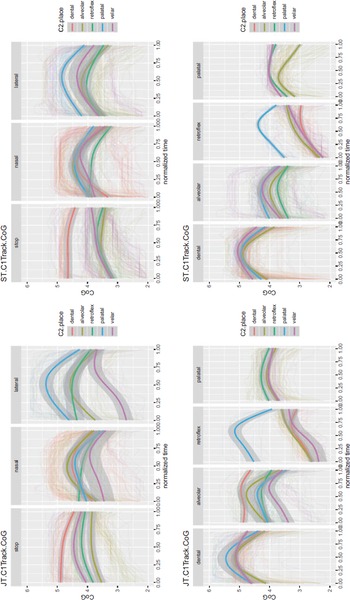
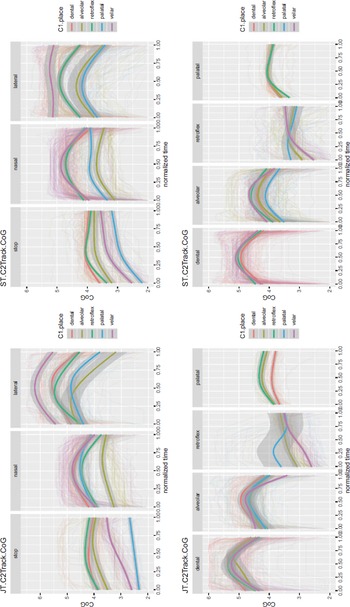
Figure 1 shows C1 CoG track-data plotted separately for each C1 manner of articulation (top panel), and also C1 CoG track-data plotted separately for each C1 place of articulation (bottom panel). Within each panel, data are plotted according to C2 place of articulation. Raw time-normalized CoG track-data are plotted faintly in the background, and the GAM-smoothed data are plotted as thicker lines for each C2 place of articulation. Grey bands indicate confidence intervals; thus, if the grey bands surrounding two GAM-smoothed curves do not overlap, track-data are significantly different at that point in time. (As noted above, due to assumptions made as part of GAM-smoothing process, the shape of the trajectory may be distorted relative to the original trajectory shapes; the reader is therefore advised to examine the raw data as well as the GAM-smoothed curves.)
C1 CoG track-data plotted separately for each C1 manner of articulation (top row), and C1 CoG track-data plotted separately for each C1 place of articulation (bottom row). Data for speaker JT (left panels) and speaker ST (right panels). Data are plotted according to C2 place of articulation.

We begin with a brief consideration of the effects of C2 place on C1 manner. It can be seen in Figure 1 (top panel) that a following palatal (blue line) has a particularly strong effect on a C1 lateral (third panel for each speaker), pulling the lateral place of articulation forward. For JT, a following velar also has a strong effect on the C1 lateral, pulling it back (note that there are no tokens plotted of C1 lateral followed by a dental consonant; recall from Table 2b that there were no such tokens for JT, and only 1 token for ST). The effect of C2 on C1 nasals is less clear, with much overlap between the GAM curves. There is evidence of a retraction effect of a following velar on nasals for speaker JT (purple curve), and of a following retroflex for speaker ST (green curve). There are very clear effects of C2 on C1 stops, as seen in the left-most panels for each speaker, with a clear fronting effect of a following dental (recall from Table 2b that there were insufficient C1 stop tokens followed by a palatal for plotting purposes: only 1 token for JT and 4 tokens for ST, which did not meet the threshold criterion set for GAM-plotting). For speaker JT, there is a clear hierarchy dental > velar > retroflex > alveolar of C2 effects on C1 stops (by contrast there is much overlap between alveolar, retroflex and dental C2 place effects on C1 stops for speaker ST). The raw CoG track-data for speaker JT suggest that the alveolar (faint yellow lines) has a ‘retroflex’ articulation, with initial contact at a posterior location along the palate, and release at a more anterior portion of the palate (with CoG at consonant onset of about 2.5, and at consonant release at about 3.5). This ‘retroflex’-like pattern has been observed in many alveolar consonant productions in Arrernte (cf. Tabain Reference Tabain2009, Reference Tabain2019).
We now consider the effects of C2 place on C1 place. Looking at the bottom panels of Figure 1, it can be seen that there is a particularly strong effect of a following palatal on C1 retroflex consonants, with CoG values around 5 for speaker ST and around 4.5 for speaker ST. By contrast, retroflex values tend around 3 when C2 is dental, alveolar or velar (note that there are no retroflex tokens followed by a retroflex plotted, since this is lexically rare, as noted above). Moreover, when C2 is dental, alveolar or velar, C1 retroflexes tend to show the ballistic forward movement pattern during closure, with CoG at around 2.5 at consonant onset and around 3.5 at release. Such a pattern is not observed when C2 is palatal, suggesting that the following palatal places strong constraints on retroflex articulation.
It is also clear in Figure 1 that there are relatively few effects of C2 on C1 dental (bottom panels – although there are no tokens plotted of C2 retroflex for C1 dental). For speaker ST, C1 palatal is more retracted when C2 is alveolar, and perhaps slightly more advanced when C2 is retroflex for speaker JT; however, there are no tokens of C2 dental or palatal for C1 palatals. In general there is quite some variability according to C2 place for C1 alveolars (second panel for each speaker), although there is no clear pattern between the speakers: C2 velar retracts C1 alveolar for speaker JT but not speaker ST, and C2 retroflex has a stronger retraction effect for speaker ST than for speaker JT (note that there are no C2 dental tokens plotted for C1 alveolar for speaker ST, and only 7 on the plot for speaker JT; see Table 2a).
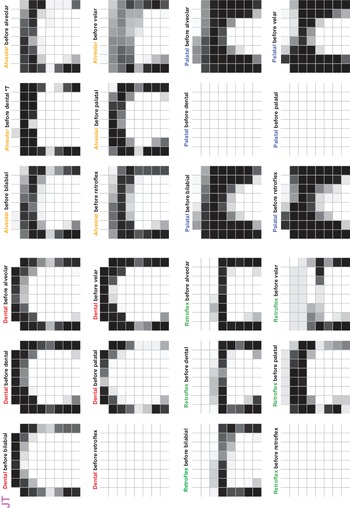
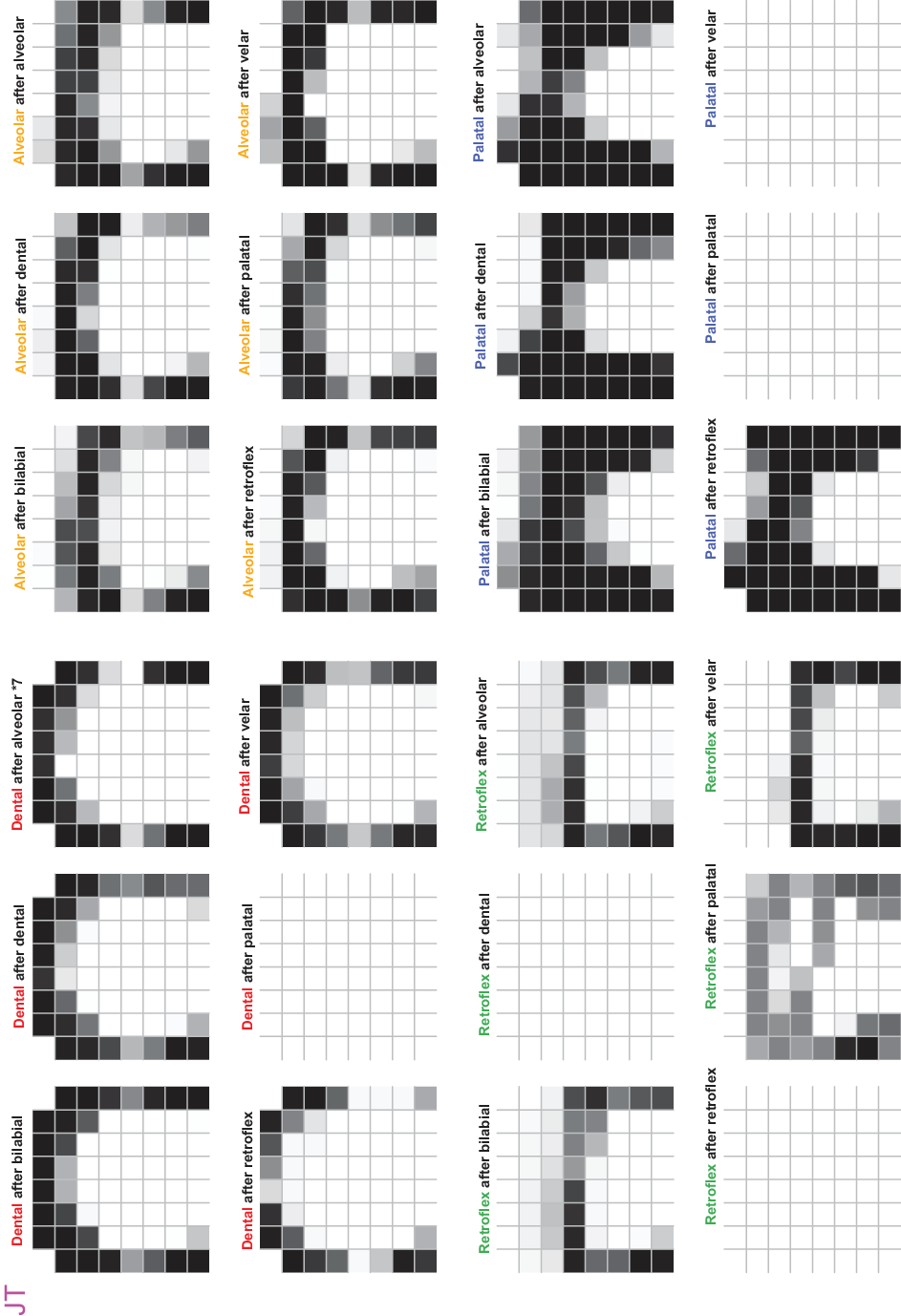
Figure 2 shows Grey-scale palatograms showing average contact at the temporal midpoint of the C1 consonant. Data are organized into four blocks for each C1 place of articulation: dental, alveolar, retroflex and palatal. Within each block, data are plotted according to the place of the following (i.e. C2) consonant. A darker colour denotes that the electrode was contacted more frequently, and a lighter colour denotes that the electrode was contacted less frequently. Where there are fewer than 10 tokens included in an averaged palatogram, this is denoted by an asterisk followed by the number of tokens. When there was zero or only one token available for plotting, the palatogram was not produced. Note that C2 bilabials are included in this plot for reference, even though this condition was not included in this study.
Grey-scale palatograms showing average contact at the temporal midpoint of the C1 consonant. Data are organized into four blocks for each C1 place of articulation: dental, alveolar, retroflex and palatal. Within each block, data are plotted according to the following (i.e. C2) consonant. A darker colour denotes that the electrode was contacted more frequently, and a lighter colour denotes that the electrode was contacted less frequently. Where there are fewer than 10 tokens included in an averaged palatogram, this is denoted by an asterisk followed by the number of tokens. When there was zero or only one token available for plotting, the palatogram was not produced.


It can be seen that, in general, C2 dentals and palatals pull a consonant forward. The middle two palatograms in each block of six are the laminals: dental (top middle of each block) and palatal (bottom middle of each block). For instance, a dental before C2 palatal has contact mostly along the first row of the palate for speaker ST (Figure 2b), whereas contact is spread across the first two rows in the other contexts (although there are no tokens of dental with a C2 retroflex). For speaker JT (Figure 2a), contact is usually at the first row for the dental; but before a following palatal, there is less contact on this row, suggesting that contact is instead on the teeth. Similar observations can be made regarding the alveolars (top right block of six for each speaker): for each speaker, contact varies across rows 2–4 for the non-laminal contexts, and is more strictly confined to rows 2–3 for the laminal contexts (dental and palatal).
Perhaps the strongest effect visible on Figure 2 concerns the retroflex with C2 palatal (bottom left block of six for each speaker, and bottom middle palatogram within the block – ‘Retroflex before palatal’). Whereas for both speakers retroflex contact tends to be at row 4 in most contexts, before C2 palatal the retroflex contact is more forward, concentrated at rows 2–3.
We turn now to a brief consideration of the Total Contacts track-data. Table 3b is parallel to Table 3a, in that it shows the GAM results for Total Contacts track-data for C1 (i.e. the consonant left of the vowel) according to the C2 place of articulation. It can be seen that there are very few significant results. Based on this table and on an examination of post-hoc results (not shown here), the ranking of C2 influence on C1 Total Contacts is:
-
For speaker JT: velar = retroflex = alveolar > dental > palatal
-
For speaker ST: dental = retroflex = alveolar = palatal = velar (although there is a significant difference at 0.05 for dental versus velar)
Examination of the data according to C1 place of articulation and manner of articulation separately (Total Contacts track-data are not shown here for reasons of space) suggests that a following palatal results in greater contact for C1 retroflexes, and a following dental results in greater contact for C1 dentals. Both of these results can be seen on the palatograms in Figure 2 (‘Dental before dental’ and “’Retroflex before palatal’).
In addition, the post-hoc results show that a following velar leads to greater contact for C1 dentals, though this is perhaps a little less obvious on the palatograms (‘Dental before velar’). Overall, however, there are very few effects of C2 consonant place on C1 total contacts.
3.2 Left-to-right, carryover (or perseverative) coarticulation
Table 3c shows the GAM results for CoG track-data for C2 (i.e. the consonant right of the vowel) according to the C1 place of articulation. This table is based on 679 tokens for speaker JT, and 821 tokens for speaker ST (as per Table 2 above). An examination of this table, together with an examination of post-hoc results (not shown here), gives the following rankings based on significance values returned:
-
For speaker JT: dental = retroflex > velar = palatal > alveolar;
-
For speaker ST: retroflex = dental > velar > palatal = alveolar.
These results show that a preceding retroflex or dental has a strong carryover effect, pulling the following consonant forward. There is also some evidence that a preceding velar pulls the following consonant forward; however, this last observation needs to be refined according to manner, and this is done in Figure 3.
C2 CoG track-data plotted separately for each C2 manner of articulation (top row), and C2 CoG track-data plotted separately for each C2 place of articulation (bottom row). Data for speaker JT (left panels) and speaker ST (right panels). Data are plotted according to C1 place of articulation.

Figure 3 shows C2 CoG track-data plotted separately for each C2 manner of articulation (top panels), and also C2 CoG track-data plotted separately for each C2 place of articulation (bottom panels). Within each panel, data are plotted according to C1 place of articulation (this is parallel to Figure 1: Figure 1 presented track-data for C1, and Figure 3 presents track-data for C2).
We begin with a brief consideration of the effects of C1 place on C2 manner. It can be seen in Figure 3 (top panels) that a preceding velar (purple curve) has a fronting effect on a C2 laterals and nasals (second and third panels for each speaker), although the magnitude of the effect is greater for laterals. By contrast, a preceding palatal (blue curve) or velar retracts a C2 stop. The fronting effects of C1 dentals and retroflexes are most evident for C2 stops.Footnote 11
We now consider the effects of C1 place on C2 place. Looking at the bottom panels of Figure 3, there are not many clear effects of place. To the extent that it is possible to generalize (given that alveolars are the only C2 place of articulation to have all possible C1 contexts plotted on the panels due to the limited token numbers in certain contexts), it might be said that C2 laminals (dental and palatal) show less variability according to C1 place than do C2 apicals (alveolar and retroflex). Perhaps the main observation concerns the C2 retroflex articulation, which is clearly retroflex (i.e. shows noticeable movement during closure) when the preceding consonant is velar (purple): this suggests that C1 velar facilitates a posterior initial point of contact for a retroflex consonant. There is also evidence of a fronting effect on C2 retroflexes when C1 is palatal (blue curve). These differences in retroflex articulation are particularly evident at the left edge of the C2 consonant (i.e. the edge closer to C1).
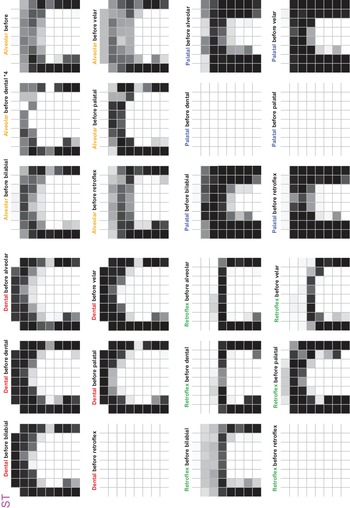
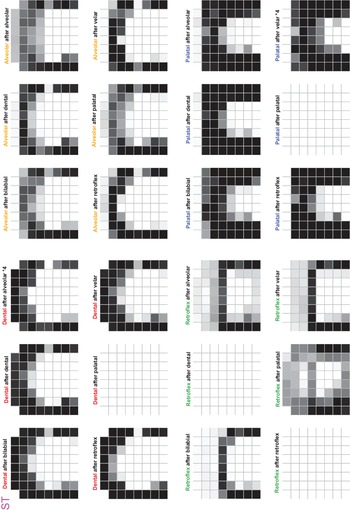
Figure 4 shows grey-scale palatograms showing average contact at the temporal midpoint of the C2 consonant. Data are organized into four blocks for each C2 place of articulation: dental, alveolar, retroflex and palatal. Within each block, data are plotted according to the preceding (i.e. C1) consonant. This figure is parallel to Figure 2: Figure 2 presented palatograms for C1, and Figure 4 presents palatograms for C2. These palatograms collapse across manner of articulation for C2, and therefore not all of the CoG patterns discussed above are easily discerned. However, the fronting effect of retroflexes can be seen in the dental palatograms for both speakers (‘Dental after retroflex’), with contact very fronted for the dental in this context. The retroflex articulations for both speakers also show clear effects of C1 place, with a consistently posterior contact for the retroflex after a velar consonant for speaker JT (‘Retroflex after velar’), and a more fronted contact pattern for the retroflex after a palatal consonant (‘Retroflex after palatal’).
Grey-scale palatograms showing average contact at the temporal midpoint of the C2 consonant. Data are organized in blocks of four for each C2 place of articulation: dental, alveolar, retroflex and palatal. Within each block, data are plotted according to the preceding (i.e. C1) consonant. A darker colour denotes that the electrode was contacted more frequently, and a lighter colour denotes that the electrode was contacted less frequently. Where there are fewer than 10 tokens included in an averaged palatogram, this is denoted by an asterisk followed by the number of tokens. When there was zero or only one token available for plotting, the palatogram was not produced.


A particularly intriguing aspect of the ‘Retroflex after palatal’ articulation is evident in these palatograms. For both subjects JT and ST, the EPG data reveal that this sequence does not exhibit a mere carryover fronting effect: instead, and in contrast to the ‘Retroflex before palatal’ case, both speakers (and more so ST) show considerable tongue contact at the palatal zone, and even a post-palatal contact or constriction. It in fact appears that there is a double articulation or blended articulation in this case.
Table 3d shows the GAM results for Total Contacts track-data for C2 (i.e. the consonant right of the vowel) according to C1 place of articulation. Based on this table and on an examination of post-hoc results (not shown here), the ranking of C1 influence on C2 Total Contacts is:
-
For speaker JT: dental > retroflex = alveolar > palatal = velar
-
For speaker ST: dental > retroflex > palatal = velar = alveolar
The increased contact after C1 dental is perhaps most evident for the dental place of articulation on Figure 4 (‘Dental after dental’).
However, examination of the data according to C2 place of articulation and manner of articulation separately (Total Contacts track-data are not shown here for reasons of space) suggests a more nuanced approach is required for these data. There is a much greater effect of C1 place on C2 stops than on nasals or laterals. Examination of the data also suggests that the increased contact for C2 retroflex is largely due to the effect of the C1 palatal on C2 retroflex articulation: this increased contact is clearly seen in Figure 4 (‘Retroflex after palatal’). This is the apparent blended or double-articulation mentioned above, and another example of the apparent incompatibility between the high degree of tongue-body raising – with its high degree of tongue-palate contact – and the retroflex articulation.
3.3 A brief word on manner
The data presented above have focused on the effects of place, i.e. the effect of C1 place on C2, and the effect of C2 place on C1. As part of data exploration, the effects of manner on trans-vocalic consonant articulation were also examined; however, the results did not seem quite so straightforward to report, with few effects overall and very little consistency across the two speakers in this study. In general, there were no consistent effects of preceding consonant manner on C2, and the results of following consonant manner on C1 were somewhat difficult to interpret. For this reason, we do not report these results here and leave them for possible future studies with larger numbers of speakers and more controlled stimuli.
4 Discussion
We return now to the questions posed at the outset of this study:
-
Do apical and laminal consonants behave differently in Australian languages in terms of coarticulatory resistance and aggression?
Laminals show both anticipatory and carryover coarticulatory effects. In general, their coarticulatory behaviour is more aggressive than that of apicals. This is line with acoustic studies of coarticulation in Australian languages by Tabain & Butcher (Reference Butcher, Jonathan and Marija1999) and Graetzer (Reference Graetzer2012).
-
Do the two laminals – dental and palatal – have different coarticulatory properties?
Dentals have a fronting effect on both the preceding and the following consonant. The effects of palatals are more complex. In general it can be said that palatals have a fronting effect on the preceding consonant and a slight retraction effect on the following consonant. However, these observations must be tempered by the manner and place of the affected consonant. In particular, there is a special relationship between palatals and retroflexes, with palatals pulling both preceding and following retroflexes forward, and increasing total contact for the retroflex. In fact, a retroflex consonant with a preceding or following palatal does not show a prototypical retroflex articulation pattern, which involves closure at a more posterior location and release at a more anterior location. Instead, a retroflex with a proximal palatal shows a relatively more flat contact profile, with closure and release at a similar location.
-
Do the two apicals – alveolar and retroflex – also have different coarticulatory properties?
The alveolar did not behave in any special way when compared to the other coronal consonants studied here, and this is broadly in line with Graetzer’s (Reference Graetzer2012) suggestion that the alveolar is the least resistant to coarticulation of the coronals. By contrast, the retroflex was greatly affected by a preceding or following palatal articulation, as already mentioned. In terms of articulatory aggression, a preceding retroflex pulls a following consonant forward in a CVC sequence. In addition, one of the two speakers showed evidence of a retraction effect of C2 retroflex on C1 articulation.
We now consider these results in a little more detail, before considering the broader implications of our study, including the apparent incompatibility of retroflex and palatal gestures, and the possible paradigmatic effects influencing coarticulation in Arrernte.
In terms of anticipatory coarticulation, we found that a C2 laminal (dental or palatal) pulls the C1 consonant forward. In addition, the C2 dental increases total contacts for the C1 dental. A C2 palatal pulls C1 lateral consonants forward; it also pulls C1 retroflex consonants forward, with a concomitant increase in total contacts for the retroflex in this context. C1 palatals also have a clear fronting effect on C2 retroflexes. These results reflect the strong coarticulatory aggression of laminal consonants, as discussed in Section 1.
In terms of carryover coarticulation, we found that a C1 dental or retroflex pulls C2 consonants forward, increasing total contacts. A dental articulation therefore exerts coarticulatory fronting effects on both preceding and following consonants. This result echoes acoustic results for dentals in Arrernte, with Tabain & Breen (Reference Tabain and Breen2011) finding a higher F3 on the vowels both preceding and following a dental consonant. Thus, this lamino-dental articulation shows clear coarticulatory aggression in both directions. This is perhaps a result that may not have been predicted from the previous literature, since previous studies of coarticulation were not in a position to distinguish the effects of dentals from alveolars.
Whilst a fronting effect of dental consonants is to be expected, this result may appear a little more surprising for retroflexes. However, it must be emphasized that, in a CVC context, a C1 retroflex consonant is released into the following vowel. If the retroflex articulation is a prototypical non-continuant retroflex articulation, this release is towards the alveolar region, following a ballistic forward movement of the tongue during closure (with initial contact being in the post-alveolar or pre-palatal region). At the moment of release into the vowel, the tongue tip may be travelling at great velocity, with no immediate physical barrier to its movement. This situation for retroflex non-continuants contrasts with the situation for other coronal and also velar non-continuants. Whilst the virtual articulatory target for these latter consonants is beyond the surface of the palate and therefore cannot be reached (Perrier et al. Reference Perrier, Payan, Zandipour and Perkell2003), any virtual target for the retroflex must lie not only beyond the palate, but at a location anterior to the initial consonant closure. Thus, while a non-retroflex lingual consonant contacts the palate at high velocity and does not travel any further, a retroflex consonant continues to move forward. Consequently, the carryover coarticulatory behaviour of C1 retroflexes in a CVC sequence is at odds with their behaviour in consonant clusters: in clusters, retroflexes show both anticipatory and carryover effects (Recasens Reference Recasens2018). If the retroflex is C2 in a CC cluster, C1 coarticulates with the left-edge of the C2, which has a retracted place of articulation. By contrast, if the retroflex is C1 in a CC cluster, it is not released into a vowel; as such, the entire CC cluster takes on the retroflex movement, with retroflex closure at C1 onset, and retroflex release (into a more anterior location) at C2 offset, as discussed in Section 1. Based on our observations of the current database and of other EPG data for Arrernte, this is a typical realization of retroflex consonant clusters in Arrernte.
An interesting contradiction in the results suggests that the carryover effects of palatals are different from the anticipatory effects of palatals. Broadly speaking, a C1 consonant is pulled forward by a C2 palatal, while a C2 (largely, though not exclusively, stop) consonant is retracted by a C1 palatal; the exception in this latter case being the C2 retroflex. This suggests an inherent asymmetry in (lamino-)palatal articulatory dynamics. It was mentioned above that palatal articulations involve a tongue body fronting and raising gesture: the present results suggest that this gesture begins quite early. It then seems that after the palatal closure is released, the tongue returns to a more neutral or retracted location.Footnote 12 This behaviour of palatals raises questions about what active articulator(s) is/are involved in palatal production: in phonological terms, palatals are the only consonants which are classed as both [dorsal] and [coronal] (cf. Gussenhoven & Jacobs Reference Gussenhoven and Haike2017). How such sounds should be treated in bio-mechanical models of speech is also a topic for future research.
Interestingly, only one of the two speakers showed retraction effects of C2 retroflex on C1 articulation. This result of anticipatory retroflex co-articulation is to be expected given the above discussion of consonant clusters; the absence of such a result for speaker JT suggests that timing of the retraction gesture for retroflexes may be speaker-specific to a certain extent. The small number of speakers in the present study, however, makes this suggestion highly speculative and further work is needed.
We turn now to a consideration of the coarticulatory effects of velars, which were included in our study as a factor on coronal consonant production. It was found that a preceding velar retracts C2 stop consonant articulations, but pulls C2 lateral (and to a lesser extent also nasal) articulations forward. A backing effect is to be expected of a velar consonant, and the effect on stops is consistent with this expectation. However, the fact that laterals are more forward following a velar consonant suggests that the velar may compromise lateral airflow for a following consonant. Consequently, producing the lateral at a more anterior location may facilitate lateral airflow posterior to the main central constriction.
In addition, and in contrast to the result for C2 laterals, a preceding velar has a particularly clear retraction effect on C2 retroflex consonants at their left edge. It therefore appears that when the tongue body/dorsum is in a more posterior location, as is the case for velar consonants, the articulatory configuration for a following retroflex is already in place. It can be observed that this facilitatory backing effect of velars on retroflex articulation is at odds with the overall fronting effect of the same velars on lateral articulations in the case of a retroflex lateral /ɭ/. Unfortunately, our current database does not allow us to explore the effect of preceding velar consonants specifically on retroflex laterals with any confidence, and this question must be left to a future, more controlled study.
Finally, it should be pointed out that, although some differences were observed between the various manners of articulation, there is scope for further work in this area. Perhaps the most salient effect involved the lateral consonants, with a following palatal pulling C1 laterals forward, and a preceding velar pulling C2 laterals forward. We look forward to further studies that more carefully tease out the effects of place from manner in systems which are rich in consonant place.
4.1 Retroflex and palatal consonants: A gestural incompatibility?
The above results speak to an apparent incompatibility of palatal and retroflex articulations, which is reminiscent of the findings by Fletcher et al. (Reference Fletcher, William, John and Fiona2014). The palatograms above show that when these two sounds are in proximity it is the palatal that exerts coarticulatory aggression on the retroflex: the retroflex articulation becomes more forward, and overall contact for the retroflex is increased. This is likely due to a conflict in gestures: a palatal requires a more forward and raised tongue body position, whereas the tongue body may be retracted for a retroflex in order to allow for tongue-tip closure in the post-alveolar region (although there is some variation in the exact tongue body configuration for different retroflex sounds; see for example Mielke, Hussain & Moisik, Reference Mielke, Hussain and Moisik2020). It could be said that, in phonetic terms, the retroflex loses its articulatory characteristics when in proximity to a palatal consonant. Interestingly, when the palatal is C2, the effect on C1 retroflex is more of a simple fronting effect, with concomitant lateral contact in the palatal region, whereas when the palatal is C1, the effect on C2 retroflex is to produce more of a double-articulation, with evidence of both anterior apical closure and a clearer dorsal raising.
To take this discussion a little further, it could be suggested that there are two reasons why retroflexes may be particularly affected by following palatals. Firstly, a retroflex gesture is in a sense completed once the tongue tip is released; and secondly, as noted above, the tongue body movement for palatals begins relatively early. Thus it could be argued that the C2 palatal is not really competing with a C1 consonant. However, this explanation cannot be quite correct, since there is a clear fronting effect of a following palatal on the C1 retroflex, suggesting that the palatal is influencing the retroflex at a point when the gesture is still active. By contrast, perhaps one reason why retroflexes do not affect C2 palatals is precisely because, at their right edge, retroflexes very much resemble alveolars, which are the least coarticulatorily aggressive coronal consonants (however, this last observation ignores the fact that this resemblance to alveolars occurs following a very rapid forward gesture).
It could be suggested that antagonism reaches its maximum when the carryover effect from a palatal consonant on a C2 retroflex is considered, since palatals exert salient carryover effects on following segments; at the same time, the apical retraction gesture for retroflexes is presumably quite prominent at retroflex onset. However, whereas a C2 palatal showed a fronting effect on C1, a C1 palatal in fact showed a retraction effect on C2 consonants other than the retroflex. There is thus a clear gestural conflict in the case of palatals followed by retroflexes, and it could be argued that this conflict is responsible for the very high degree of variability observed in the EPG patterns for the retroflex following a palatal (Figure 4): speakers attempt to form a retroflex closure at the expected location, but are forced to change placement in order to accommodate the carryover palatal gesture. The resulting variation is presumably dependent on factors such as timing. In this respect it may be noted that, in the case of C1 retroflex and C2 palatal, the articulatory patterns are much more consistent, even though the retroflex is articulated further forward thanks to the following palatal. This discussion is purely speculative, and these questions are best answered via bio-mechanical modelling studies.
It is tempting to speculate that this coarticulatory result has some relationship with other aspects of the relationship between palatals and retroflexes. For instance, Blake & Reid (Reference Blake and Reed1998) have suggested that, historically, retroflex sounds in some Australian languages have become palatal. Blake & Reid focus on the dormant languages of the south-eastern state of Victoria, basing their work largely on written records from the 1800s (due to early settlement/invasion, there are no remaining native speakers of the languages of south-eastern Australia). They provide several footnotes concerning alternations between palatals and retroflexes in other Australian languages, such as in child-directed speech in Warlpiri, or as part of sociolinguistic variation in Warumungu (both languages are spoken to the north-west of Alice Springs in Central Australia). Blake & Reid also cite examples of retroflexes becoming palatals in various dialects of Arrernte, such as karli /kɐɭi/ becoming italye /itɐʎə/ or ilye /iʎə/ ‘boomerang’ or parti /pɐʈi/ becoming itatye /itɐcə/ or itye /icə/ ‘bardi [grub]’.Footnote 13 Moreover, one salient aspect of retroflex production in current Arrernte is the possible pre-palatalization of the (pre-stress) retroflex consonant in clear speech. Thus, for instance, arteme ‘build/cover’ may be pronounced [ɐjʈəm] instead of [ɐʈəm]; arne ‘tree’ may be pronounced [ɐjɳə] instead of [ɐɳə]; and arlenge ‘a long way away’ may be pronounced [ɐjɭəŋə] instead of [ɐɭəŋə]. Speakers freely alternate between a palatalized and a non-palatalized production even in citation repetitions of the same word. Such realizations were not an issue for the present study, since the data are from continuous speech, where such clear-speech realizations are not common due to the presence of semantic context (the pre-palatalization is potentially dis-ambiguating in pre-stress position, since the contrast between alveolars and retroflexes is less clear in this position in Arrernte; see Tabain & Beare, Reference Tabain and Beare2020). It has also been suggested (Andy Butcher, p.c.) that the special relationship between retroflexes and palatals is due to acoustic similarity, with both sounds having F2 and F3 in close proximity: for retroflexes, this spectral concentration is at a relatively low frequency, while for palatals it is at a relatively high frequency. Whilst it is not entirely clear how these various observations on the relationship between palatals and retroflexes are immediately relevant to the coarticulatory data in the present paper, they do suggest a more careful consideration of the relationship is warranted.
It must be emphasized once again that the present study is based on only two speakers, which is a typical limitation of minority and understudied languages such as Arrernte. However, this study is at the same time based on a large number of tokens, which leads to greater confidence in the results (the very small number of tokens was an important limitation of the EPG coarticulation studies of consonant clusters in other Australian languages cited above, and in addition to consonant clusters being relatively infrequent, the previous studies were also based on readings of word lists, rather than texts).
4.2 A consideration of paradigmatic effects
Arrernte is a language with a very symmetrical system of place and manner contrasts in the non-continuant series. It is also one of relatively few Australian languages that has both a laminal and an apical contrast (and perhaps the least endangered language in Australia of those that do have both). The two largest languages which neighbour Arrernte, Warlpiri and Pitjantjatjara, do not have a laminal contrast: they are described as having only a palatal series and not a dental series. An EPG study comparing Warlpiri and Arrernte palatal articulations (Tabain et al. Reference Tabain2011) found that the palatal articulation is further back in Arrernte than in Warlpiri, presumably due to the presence of the lamino-dental in the Arrernte phoneme inventory. One would assume that the palatal in the two languages has similar coarticulatory properties. However, in a study of trans-consonantal vowel coarticulation in selected African languages, Manuel (1990) found that anticipatory coarticulation in VCV sequences – as measured by F1 and F2 of the vowel /ɑ/ – was more limited in the languages Ndebele/Shona which have a seven-vowel phoneme inventory /i e ɛ ɑ ɔ o u/ than in Sotho, which has a five-vowel inventory /i e ɑ o u/. Given that such long-range coarticulatory effects have been found to be sensitive to the size of the phoneme inventory for vowels, it is an open question whether such effects would concern consonants as well, whose acoustic cues to place are more varied in comparison to the acoustic cues for vowel quality.
In their studies of Warlpiri and Iwaidja (as described in Section 1), Fletcher and colleagues suggest that the overall resistance they observed to coarticulation in clusters is due to paradigmatic constraints in Australian languages, which limit the extent of place-of-articulation modification. For example, in Pitjantjatjara (which as mentioned neighbours Arrernte and Warlpiri), there is a minimal set involving the clusters /nk ɳk ŋk/, namely /wɐnkɐ/ ‘awake/alive’, /wɐɳkɐ/ ‘spider’ and /wɐŋkɐ/ ‘talk!’ (Tabain & Butcher Reference Butcher, Jonathan and Marija2014). Thus, typical nasal+stop coarticulation would be severely limited in this language due to the existence of minimal pairs in the lexicon. Relatedly, in an acoustic study of the northern Australian language Bininj Gun Wok, Fletcher et al. (Reference Fletcher, William, John and Fiona2010) found that nasals in NC clusters are longer than are singleton nasals – a result which goes against previous results for English – suggesting that in Australian Aboriginal languages increased nasal murmur duration may be required if vocalic formant cues are not available at both edges of the consonant. This result is echoed in Tabain’s (Reference Tabain2016) acoustic study of rhythm in Arrernte, which showed that heterorganic clusters (which as noted above are much less frequent) are about 15% longer than homorganic clusters.
Three further observations regarding paradigmatic effects on consonant (co-)articulation in Australian languages may be mentioned here. Firstly, on the basis of palatographic and formant data, it has been noted that velar stop and nasal consonants are articulated further back in several Australian languages than they are in English or German, at least in a non-front vowel context (Butcher & Tabain Reference Tabain2004). This is perhaps due to system constraints imposed by the coronal-rich systems of Australian languages, in that a relatively more back velar would be maximally distinct from any coronal consonant, especially the spatially adjacent palatal consonants. This may contribute to the clear backing effects of velars found in the present study.
The second point to be made regarding paradigmatic effects relates to the observation that there seems to be a preference for consonants to be surrounded by vocalic formant transitions on either side (as mentioned above), and that formant transitions on both sides of the consonant are equally well controlled (Tabain et al. Reference Tabain2004). This is an observation that has particular relevance for Arrernte, where citation-form lexical items tend to surface with an initial vowel and also a final vowel, even if that vowel is not present underlyingly (indeed, final vowels are considered non-contrastive in Arrernte and therefore not part of the underlying representation; Breen & Pensalfini Reference Breen and Pensalfini1999). Indeed, Arrernte is different from neighbouring languages such as Walrpiri and Pitjantjatjara in allowing dropping of initial vowels and insertion of final vowels, with the two often indistinguishable in connected speech.
The final observation regarding paradigmatic effects of consonant inventory on articulatory phenomena in Australian languages concerns effects of lexical stress (Tabain Reference Tabain2009, Reference Tabain2019). Although in most languages of the world segments in prosodically prominent position are ‘strengthened’ (see Fletcher Reference Fletcher, William, John and Fiona2010 for an extensive review), in Arrernte there is very little evidence of articulatory strengthening of consonants in lexically stressed position. This is despite durational effects of lexical stress on the consonants (i.e. consonants before stressed vowels are longer under stress), and also despite clear effects of lexical stress on the vowels: for the central vowels, this is a lower position in the vowel space for the vowel /ɐ/ under stress, and an increased duration for both /ə/ and /ɐ/ under stress (though the effect is quite small for the ‘non-elastic’ /ə/, as mentioned above). The main exception to this observation is the retroflex consonants, which are more prototypically retroflex when following a stressed vowel, as mentioned above. Just how this special behaviour of retroflexes under stress interacts with their special behaviour in terms of coarticulation (i.e. both in terms of articulatory aggression on other consonants, and in terms of their behaviour in the presence of palatals) is a question for further research.
To conclude, our study has been able to tease apart some of the finer distinctions between the various coronal places of articulation in terms of coarticulatory resistance, in the context of a rich consonant system that limits variability in order to maintain contrast. In addition, data such as those presented here provide a deeper understanding of the possible phonetic sources of various phonological phenomena, such as long-range vowel or consonant harmony (cf. Zawaydah & de Jong Reference Zawaydah and de Jong2002 for the ‘emphatic’ uvularization of coronals in Arabic), or the statistical tendencies in phonological word structure in the world’s languages and in infant speech (cf. Rochet-Capellan & Schwartz Reference Rochet-Capellan and Schwartz2007 for the labial-coronal effect, whereby /pata/ is considered a more stable articulation than /tapa/, with a consequent preference for perceptual segmentation into labial-coronal chunks in speech processing [Sato et al. Reference Sato, Vallée, Schwartz and Rousset2007]). Based on our results above, we could predict that retroflexes and palatals are unlikely to occur together within the word; indeed, in our current database we have 10 tokens for each speaker of retroflex+palatal, and about 20 tokens for each speaker of palatal+retroflex. Both of these are on the lower side of token counts in the present database. By contrast, we might expect that velar+retroflex sequences are relatively more common, given that velar articulations seem to facilitate a retroflex post-alveolar closure. We could also expect co-occurrence restrictions involving laterals with consonants that involve a relatively large portion of the tongue, such as palatals and velars, since proximity to such sounds may compromise lateral airflow. It is hoped that the present study provides impetus for further work in this area, as well as providing valuable insight into the articulatory strategies of speakers of an understudied language.
In sum, our study has shown that there are great complexities involved in the articulation of consonants produced with the tongue tip and blade. Many of the questions we raised above regarding the coordination of coronal articulatory gestures are best answered using articulatory modelling (e.g. stability in the production of retroflex+palatal or palatal+retroflex sequences). In this way, work from understudied languages such as Arrernte can contribute to a better understanding of the human speech production system for speakers of all languages.
Acknowledgements
This research was supported by the Australian Research Council, most recently via a Future Fellowship to MT. We would like to thank Gavan Breen and Daniel Recasens for discussion at various stages of this research, and three anonymous reviewers and the associate editor for their perceptive comments on an earlier version of this work. We would also like to thank our speakers, Janet and Sabella Turner, for their commitment to language research: we wish you all the best in keeping your language and your community strong. Kele.