For many decades, Denmark, Norway and Sweden have been among the most corporatist liberal democracies in the world.Footnote 1 Corporatism is still comparatively viable in Scandinavia, but has declined over the last decades.Footnote 2 There are several possible explanations for this development, and in this article we explore one of them: whether some basic prerequisite for corporatist exchange has been disrupted. We understand corporatism as a mutually beneficial exchange between interest groups and government.Footnote 3 The basic exchange mechanism is that some actors control something that others desire. We assume that governments still desire acquiescence to public policy, while interest groups still desire public policy that is favourable to them. We focus on whether actors still control their exchange partners' desires, that is, if governments and interest groups are trustworthy actors in corporative exchanges. As outlined below, a credible exchange partner needs to have means, motive and opportunity, or mandate and unity (opportunity), assets (means) and intent (motive). Hence our investigation into possible disturbance in essential prerequisites for corporatist exchange in Scandinavia. If we can find some disruption, we have taken a step further in understanding de-corporatization; if not, we have to look for explanations elsewhere.
AN EXCHANGE MODEL OF CORPORATISM
In the wake of the seminal work of Philippe Schmitter and his reintroduction of ‘corporatism’,Footnote 4 several definitions of the term have been presented, and further dimensions added to Schmitter's extensive list. Corporatism is often viewed as a system of concertation between particular economic interests – mainly labour market partners – and the state, and includes several (often different) structural features and outcomes.Footnote 5 This conception tends to merge how public and private interests interact with the conditions for and consequences of intermediation.
Corporatism as a political exchange may be understood as a game that takes place in institutionalized arenas in which each actor controls resources that the others desire. The state controls public expenditure and legislation. Furthermore, the state can privilege selected organizations by granting them the status of group representatives in the policy-making process;Footnote 6 the position of selected partner is crucial when organizations recruit adherents. Interest groups may also possess resources desired by the state: they ‘control’ their members,Footnote 7 for example by binding them to negotiated agreements. Claims by radical members may be made satisfiable Footnote 8 through interest intermediation.Footnote 9 In contrast to Baccaro and Simoni's declaration of this type of exchange as ‘a peculiarity of electorally weak governments facing weakened unions’,Footnote 10 we argue that corporatism presupposes that both actors control resources demanded by the other. The question is not whether the government/organizations are weak or strong, but whether the government/organizations can and will deliver in mutual exchanges.
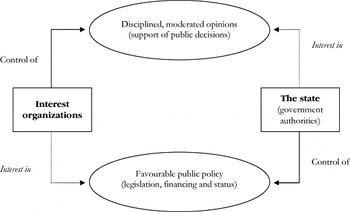
Corporatism understood in terms of an ‘exchange relationship’Footnote 11 is not confined to the labour market and negotiations on wages, profits, and economic policy. Corporatist arrangements may exist in a multitude of policy areas: ‘democratic corporatism as a structure for bargaining does not predetermine either the issues to be joined or the content of agreements’.Footnote 12 The crux of corporatism is institutionalized political exchange between privileged interest groups and the state. A corporatist exchange assumes that organizations control internal opinions, while the state controls authoritative decision-making. An exchange does not need to be symmetrical (however defined), but it can be realized only when the state offers policies of interest to the organizations which, in return, provide tacit consent, approval or active support of government policy that is of interest to the state. In real life, of course, it is politically disputed what those interests are; neither the government nor the interest organizations are unitary actors. The simplified theoretical model is illustrated in Figure 1.
An Exchange Model of Corporatism

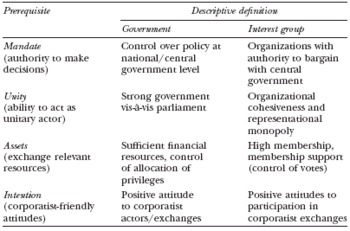
Exchange between state and organized interests requires that one party is in control of resources in which the other is interested. Thus we need to pinpoint what it takes for the state to control ‘favourable public policy’ and for interest groups to control ‘disciplined, moderated opinions’. We argue that state authority and interest group capability presupposes a strong mandate to engage in exchanges, a high degree of unity, mobilization of relevant assets and a sincere intent to engage in corporatist exchanges (that is, corporatist-friendly attitudes) on both sides of the exchange. Without these features, actors are not trustworthy exchange partners.
One fundamental prerequisite is the mandate to make decisions within the relevant sphere. For a government, this means sovereignty – controlling legislation at central government level.Footnote 13 Correspondingly, interest groups need to organize a relevant constituency with legitimate interests: they have to be accepted as the representative of that specific interest, otherwise they do not have a legitimate mandate to participate in public policy-making.
Mandate alone is not enough; a certain level of unity to make efficient decisions is also required.Footnote 14 The government must be able to gather support from a parliamentary majority,Footnote 15 while interest groups have to be sufficiently cohesive to represent their members effectively; in other words, to have a high degree of representational monopoly.Footnote 16 Both parties must retain a capacity for making binding commitments if credible exchange is to take place.Footnote 17
These prerequisites will be of scant interest to the counterpart if not matched by relevant assets. Even a cohesive and united government will be constrained in its ability to offer favourable and credible policy deals when it is under economic pressure. Similarly, an interest group must be able to mobilize members who are willing to support leadership decisions made in corporatist exchanges and, ultimately, to back the government involved. Governments that are punished at the ballot box for corporatist exchanges will soon come to see corporatism as a liability.Footnote 18
Finally, even if the exchanging actors have mandate, unity and assets, these essentials are not worth much if fundamental values clash with engagements in corporatist exchanges. Leaders cannot credibly assert that they are in control of favourable public policy or disciplined, moderated opinions without a sincere intent to participate in exchanges and compromises.Footnote 19 Potential exchanging parties will be cautious about long-term exchanges if their counterparts do not embrace fundamental positive ideas about corporatism. We call this ‘corporatism-friendly attitudes’. Table 1 sums up the prerequisites for trustworthy actors in corporatist exchanges.
Required Properties for Trustworthy Partners in Corporatist Exchange

According to corporatist theory, all this should be important when actors determine whether to participate in corporatist exchange or if there are better options. So, if required properties are in decline, non-corporatist options such as lobbying will be relatively less costly, and corporatism will decline (given that benefits of other options are constant).
Before we proceed to examine changes in the prerequisites for corporatist exchanges, we must obtain a clearer picture of how and over what period corporatism has declined.
CORPORATISM IN SCANDINAVIA
Scandinavian corporatism worked as an exchange system during most of the twentieth century. Organized groups were comparatively strong and, occasionally, the state even intervened in order to strengthen interest groups – by encouraging centralization of trade unions, for example.Footnote 20 The purpose was to make organizations capable of moderating members' demands and to secure industrial peace. In exchange, unions obtained comprehensive welfare policies, protective measures and the right to collective bargaining and to strike. Corporatist exchange was also evident in Scandinavian agricultural policy. During the twentieth century, the state exchanged rationalization in the food business for extensive economic support to agriculture and the inclusion of farming organizations in policy-making and policy implementation.Footnote 21 Similar stories can be told about other policy areas, notably public welfare services.Footnote 22
For a long period – especially during late 1940s to mid-1960s – consensus among Scandinavian political elites was that strengthening rather than undermining particular interest groups was the best way to gain political control. Numerous institutional forums were created for discussion and bargaining between high-ranking civil servants and interest groups. During most of the twentieth century, such arrangements were important parts of the political process in Scandinavia. This practice changed after the 1970s, however.
Declining Corporatism Since the 1970s
The development of corporatism has not been the same across all the Scandinavian countries. Focusing on selected reforms, Lindvall and Sebring, and Anthonsen and Lindvall find declining corporatism in Sweden, but not in Denmark.Footnote 23 Compston argues that concertation and corporatism increased in Norway and Denmark in the late 1980s and early 1990s, but decreased in Sweden.Footnote 24 Regini argues that in the same period concertation continued in Norway, whereas bothSweden and Denmark experienced less concertation in labour market policy and the regulation of industrial relations.Footnote 25
Although the picture is not totally unambiguous – because of important disparities in how main concepts are defined, operationalized and measuredFootnote 26 – there is ample evidence of decline in Scandinavian corporatism since the 1970s.Footnote 27 All these studies analyse corporatism across different policy areas over time, through comparative case studies of policy-making and/or indicators of the institutional organization of policy-making in general. In terms of description, they all reach roughly similar conclusions: corporatism has declined in all Scandinavian countries since the 1970s.
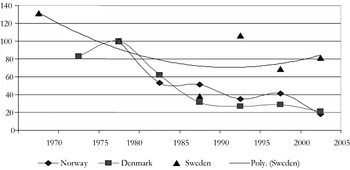
Christiansen et al. have shown that corporatism in relation to the preparation of policy has gone down in all three countries whereas corporatism in implementation processes are more varied.Footnote 28 Figure 2 is calculated from data published by Christiansen and colleagues, and shows the number of policy-preparing committees that include interest groups. Although not perfect, we consider it to be a reasonable indicator of corporatism, given the vast array of studies that reach similar conclusions on the basis of different research designs. Corporatist structures related to policy preparation have been weakened, but not dismantled since the 1970s.
Corporatism in Scandinavia, 1970–2005 (1980 = 100) a

Note: a Corporatism is measured by the number of policy-preparing committees that include organized interests. Due to the lack of Swedish observations we added a polynomic tendency line (R2 = 0.52).Footnote 29
Source: Christiansen et al., ‘Varieties in Democracy’.
In Denmark, corporatism peaked around 1980. An analysis of government-sponsored bills in policy sectors with strong traditions of corporatism point in the same direction, Footnote 30 and so do a number of comparative case studies.Footnote 31 Analyses of Norwegian corporatism that use slightly different indicators also point to c. 1980 as the peak of corporatism.Footnote 32 The turning point in Swedish corporatism is more difficult to establish, due to a paucity of data points. Whereas Figure 2 suggests that Swedish corporatism has declined since the 1970s (or even earlier), Hermansson's analysis of 12 policy areas suggests that interest groups dominated policy-preparing committees until around 1980;Footnote 33 Rothstein and Bergström also point to the early 1980s as a turning point, as does Lewin.Footnote 34 The decline does not appear as dramatic in Sweden as in Norway and Denmark. In general, the pattern suggests that, whatever changes have occurred in the prerequisites for corporatist exchanges, they are probably more dramatic and time specific (that is, taking place in the 1980s) in Norway and Denmark than in Sweden. Might changes in the properties needed for government and interest groups to be trustworthy partners in corporatist exchange be part of the explanation?
WEAKENED GOVERNMENTS?
Mandate
Control over national or central government policy may be undermined by three factors: sovereignty may have been transferred to the international or European level; political power may have been devolved to the local level; or the autonomy of governments may have decreased due to the internationalization or globalization of the economy. All factors have been highlighted in the literature.Footnote 35 Central governments and democratic principals may ‘decide more about less’.Footnote 36
An important aspect of reduced state mandates is the integration of national into European policy-making. Europeanization has affected the functioning of Scandinavian democracy, including the autonomy of national governments, albeit in different ways.Footnote 37 Denmark was the early starter, as it became a member of the European Union (EU) in 1973. Sweden's and Norway's bilateral trade agreements developed into the European Economic Area (EEA) agreements in 1992,Footnote 38 and Swedish membership of the EU in 1995; Norway is formally still a non-member. Through the EEA, both Norway and Sweden have been subject to increasing EU regulation since the 1980s, just as Denmark has been. The influence of EU regulation increased with the surge in EU rules after the passing of the Single European Act in 1986. From the early 1990s, the pace of rule-making in the EU levelled off.Footnote 39
Decentralization of authority to local governments or independent state agencies may also weaken the authority of central government. Most salient are the increased independences of central banks. While e.g. the Swedish Central Bank, Riksbanken, was used as a monetary instrument until the mid 1980s, it is now ranked the most independent together with the European Central Bank.Footnote 40 The evidence of local government autonomy during the period under investigation is mixed, however.Footnote 41 In general, decentralization and local government autonomy in Scandinavia were probably at their highest in the 1970s.
Finally, with regard to economic globalization, all Scandinavian countries are open economies, but further liberalization of capital may have left national governments with less political control. Economic openness creates exit options for firms and renders states more vulnerable; vulnerability makes it harder for state representatives to meet demands from interest groups. Indicators of capital transactions show an increase in openness among the three countries since the 1960s.Footnote 42 Capital flows were liberalized in Sweden during the 1970s and 1980s, when Norway and Denmark were catching up, but a dramatic increase in liberalization took place in the 1990s in all countries.
The development and consequences of decentralization are inconclusive. However, Europeanization increased constraints on government authority in the 1980s, as did economic liberalization in the 1990s. Taken together, this indicates a weakened central government mandate.
Unity
Scandinavian governments are most often minority governments.Footnote 43 In the period 1971 to 2006, Sweden had majority coalition governments for three and a half years. In Norway, a majority coalition ruled for a little more than two years between 1971 and 2005. Since 1971, Denmark has been ruled by a majority government for only one and a half years. Apart from Italy, opposition parties in Scandinavia have the greatest influence on government policy among 18 West European countries, according to an expert survey.Footnote 44
It seems, furthermore, that governments have been weakened vis-à-vis parliaments during the period under study. In 1970, there were five political parties in parliament in each of the three countries; since then, the parliaments have become more fragmented. In 1973, the number of parties in the Danish Folketing doubled and remained at 10–11 parties for the rest of the 1970s; in the 1980s and 1990s, 8–10 parties were represented, and after 2000, 7–8 parties. In the 1973 Norwegian election, two new parties gained representation and, since then, 6–8 parties have been represented in the Storting. In Sweden, a sixth party gained representation in 1988 and since 1991 seven parties have been represented in the Riksdag.
Fragmentation does not equal conflict between government and parliament. Corporatism is a potential conflict-reducing mechanism,Footnote 45 but government–parliament relations became more dissenting in Norway and Denmark during the 1980s, and parliamentary opposition more assertive. It is true, though, that weak Danish minority governments did not have long tenures during the 1970s, and the government would always resign if it encountered legislative defeats. In the 1980s, Danish centre-right governments struggled to get the budget passed, and, in some policy areas, ‘alternative majorities’ passed laws contrary to government policy.Footnote 46 Yet, the government did not resign. In addition, in the late 1970s and especially from the 1980s onwards, the number of legislative agreements –forlig– increased significantly.Footnote 47 The opposition parties, partners to these agreements, were given the power to veto future policy changes. Analyses demonstrate that governments rarely make corporatist exchanges and forlig at the same time.Footnote 48
The Norwegian Storting also became more assertive. Whereas governments of the 1970s were almost never defeated in parliaments, this happened more often during the 1980s and 1990s, especially on budget issues.Footnote 49 Dissenting committee recommendations also increased in this period. The fragmentation of parliament had an impact on government stability when the populist Progress Party brought down the centre-right coalition in 1986. Since the 1980s, numerically fragile minority governments in Norway have relied increasingly on ad hoc coalitions and on ‘the favours of several opposition parties at the same time’, and power ‘shifted from the executive to the legislative branch and the cabinet's agenda control eroded’.Footnote 50
Sweden did not witness the same increase in parliamentary assertiveness. Until 1976, and again from 1982 until 1991, Social Democrat minority governments ‘could trust the Communist Party to keep them in power without raising many specific demands for negotiated policy concessions by the Social Democrats’.Footnote 51 Without the fear of being ousted, the government could form ad hoc coalitions with the opposition parties. As in the Danish case, the fact that a government, as a last resort, can use its block majority may lead to broad cooperation.Footnote 52 The centre-right coalitions from 1976 to 1982 commanded a majority for most of the period, and were comparatively strong governments. Because coalition partners had different political preferences they crafted specific coalition agreements on governments' policy agenda,Footnote 53 leaving cabinet and individual ministers without much room to manoeuvre. In sum, government unity has cracked somewhat as parliaments have become more fragmented and assertive. Interest groups can rely less than before on governments' capacity to control what interest groups want in return in corporatist exchange.
Assets
If a government has sufficient mandate and unity it does not automatically imply that the government controls sufficient assets to carry out exchanges with interest groups. Governments must have the means to supply advantageous policies to interest organizations to persuade them to engage in exchanges.
Like other Western countries, Scandinavia – especially Sweden and Denmark – experienced an economic downturn from the mid-1970s in the aftermath of the first oil crisis. Growth continued to decline during the 1980s in Denmark and Norway, whereas it increased in Sweden until the dramatic downturn in the 1990s. The presence of North Sea oil has meant that growth has been consistently higher in Norway than in Denmark or Sweden,Footnote 54 but economic stagnation did not curb governments' public spending.
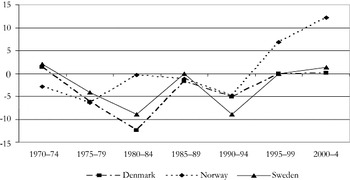
Declining growth was accompanied by rising unemployment and strained public budgets, particularly in Denmark and Sweden. Figure 3 shows public debt as a percentage of GDP from 1970 to 2004. In the early 1970s, Denmark and Sweden ran surpluses, but in the late 1970s, continuous deficits implied dramatically increased public debt, not to be reined in until the late 1980s. Apart from in the early 1990s, debt has been brought under control in recent years: the deficits in Norway decreased after the 1970s and, except for a brief period in early 1990s, budget deficits have not been a problem in Norway, due to the oil.
Public Finances: Public Sector Net Savings, 1970–2004 (percentage of GDP)

Source: Handbook of Nordic Statistics, Nordic Statistical Secretariat, various years; National Accounts of OECD Countries, Paris, OECD, 1995–2006.
Scandinavian public sectors grew significantly in the 1960s and 1970s. Growth in public expenditure continued at a slower pace during the 1980s and early 1990s, since when the size of the public sector as a proportion of GDP has been almost constant.Footnote 55
Whether governments behaved economically irresponsibly in the 1970s is not the issue here; for interest groups, there was definitely something to be gained through corporatist exchanges with governments that continually increased spending in the face of stagnating growth. In the 1980s and 1990s, assets shrank as deficits were curbed and the growth of public expenditure levelled out, except during the Swedish crisis in the early 1990s. As argued in the welfare state literature, the 1980s paved the way for a retrenchment agenda.Footnote 56 Being involved in negotiations on deregulation and retrenchment may be of the utmost importance for interest organizations. Still, it is safe to say that the attainable slices of the cake have become smaller.
Intention: Attitudes Towards Corporatism
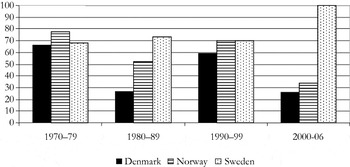
For corporatist exchanges to occur, means and opportunity are not enough. The government must also have the inclination and the motive. Scandinavian corporatism has been termed ‘left-handed’: social democrats and unions have been seen as responsible for creating and maintaining corporatist arrangements.Footnote 57 The traditional statutory connections between unions and party have come to an end, but strong informal ties persist in the form of recruitment and representation, although more so in Sweden and Norway than in Denmark.Footnote 58 Assuming that social democratic preferences for corporatism are stable over time and that centre-right governments are more hostile towards corporatism, weakened social democratic government power indicates that governments have, for political reasons, become less engaged in corporatist exchanges.
Before 1970, social democratic parties had a remarkably strong governmental position in all three countries.Footnote 59 The Danish party was the weakest of the Scandinavian social democratic parties and was accustomed to govern in various coalitions. The Norwegian party had a stronger electoral base and ruled in splendid isolation for decades, but had to leave ministerial posts twice in the 1960s. In a historical perspective, a seemingly everlasting Social Democratic hegemony in Sweden was broken when the first non-socialist government in the post-war era was established in 1976 and stayed in power for six years. In Figure 4, the strength of the social democrats since 1970 is measured in terms of the average proportion of left-wing cabinet seats.
Average Social Democratic Share of Cabinet Seats, 1970–2006 (%)

Source: Brady et al., ‘Comparative Welfare States Data Set’, and public sources.Footnote 61
The Swedish Social Democratic Party dominated government a little less than its Norwegian sister party in the 1970s, but it kept its relative strength during the 1980s, in contrast to the situation in Norway and Denmark. In Norway, the Social Democrats were out of power for five years in the first half of the 1980s (1981–86). When they regained power, governing had become more difficult because the government had no stable majority support in parliament.Footnote 60 In the early 1980s, the Conservative government declared explicitly that it would downsize the corporatist apparatus in order to reducethe power of interest groups.Footnote 62 In Denmark, the Social Democrats were out of power for more than 10 years (1982–93). In the 1990s, Norwegian and Danish Social Democrats regained some of their strength, but then the tide shifted again. Norwegian Social Democrats were out of office in 2001 and 2005, and the Danish Social Democrats lost government power in 2001. As Figure 4 shows, the Swedish Social Democrats are still the strongest in Scandinavia, even though a centre-right majority coalition assumed power in 2006.
There are good reasons for interest groups to question whether governments in Scandinavia have stable intentions to engage in corporatist exchanges. Governments are short-lived and formerly reliable social democratic governments have to find ways to stay in power other than seeking allies among interest groups.
WEAKENED INTEREST GROUP CAPABILITIES?
Mandate
In a liberal democracy, one precondition to enabling interest groups to participate in public policy-making is that they have a mandate to speak on behalf of their members. Focusing on the statutory authority of the confederations of labour market organizations over their affiliates – that is, the degree of centralization – an index combining the employer side and the union side shows little change since the 1970s.Footnote 63 The degree of centralization has consistently been lower in Denmark than in Norway and Sweden, but has not changed much in any of the three countries.
Unity
An increasing number of unions and growing union fragmentation would be two signs that there was less unity, and, consequently, the unions would be less reliable partners in corporatist exchange. Two indicators are relevant, but they point in different directions (see Table 2). First, the number of unions has decreased in all three countries since the 1960s. Unions have merged to meet the rise of new occupations and a changing industrial structure. Since the 1970s white-collar unions have become the largest unions in Scandinavia.Footnote 64
Union Organizational Structure, 1960–90
Source: Wallerstein et al., ‘Unions, Employers' Associations and Wage-Setting Institutions’, pp. 381–5.
Second, the number of confederations of labour market organizations has increased with the growth of white-collar and professional and academic confederations of labour market organizations. Thus, the share of union members in LO, the blue-collar confederation, has decreased and trade union concentration has diminished. The figures for inter-confederate concentration have been falling since the 1960s (Herfindahl concentration index).Footnote 65 In Sweden, the concentration decreased most during the 1960s, but continued to fall during the 1970s, after which it stabilized. In Norway and Denmark, a decreasing concentration was most pronounced during the 1970s, but continued during the 1980s. According to Ebbinghaus and Visser, who employ a slightly different measure, concentration continued to drop in Sweden and Denmark during the 1990s, but stabilized in Norway.Footnote 66 However, LO membership in Norway declined continually from 83 per cent of the organized workforce in 1956 to 51 per cent in 2002.Footnote 67
In sum, the number of unions has decreased since the 1960s. Potentially, this may strengthen the unions' capacity to talk with one voice and engage in corporatist exchanges with government, but stronger and more consolidated affiliates may also weaken the confederations' capacity to talk on behalf of their members. Fragmentation was significant during the 1970s and continued in the 1980s and 1990s. Historically, blue-collar confederations of labour market organizations have been the dominant partners in corporatist exchanges. With a diminishing working class and growing middle class, the difference between blue-collar and white-collar organizations has almost disappeared. Although the changes in the organizational landscape did not take place at exactly the same time across Scandinavia, governments have had to pay attention and speak to more and more powerful organizations than they used to. Hence, interest groups (at least unions) do not have the same control over a united membership as in earlier times.
Assets
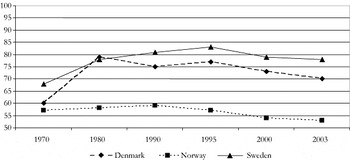
An interest group's main asset in its exchanges with government is the number of members it can persuade to accept the deals struck over public policies. Organized groups have to deliver support – or at least tacit acceptance – to be a viable exchange party. In general, the involvement of citizens in organizations is high in Scandinavia, although it has been declining in recent years.Footnote 68 However, not all organizational membership is relevant to corporatist exchanges. Interest groups have to organize important groups. In addition to a united membership, organizations may use electoral support – that is, members' votes – in the exchange with governments. Focusing on the role of unions, we analyse union density and the voting behaviour of union members as a proxy for the political asset that unions exchange with governments.
Figure 5 shows ‘adjusted’ union density from 1970 to 2003. In Denmark and Sweden, union density increased in the 1970s and continued to grow in Sweden until 1995, after which it decreased quite significantly.Footnote 69 In Denmark, union density peaked in around 1980 at 79 per cent. By 2003, it had dropped to 70 per cent. In both Denmark and Sweden, the loss of members is most significant among young people.Footnote 70 Union density is still relatively high in all three countries, especially in Denmark and Sweden, but it has fallen significantly in recent decades.
Union Density in Scandinavia, 1970–2003

Source: Visser, ‘Union Membership Statistics in 24 Countries’, Monthly Labor Review, January (2006), p. 45.
Unions – not to mention other organized interests – are more attractive parties to a corporatist exchange if they can deliver political support in the form of votes or can threaten the opposite. Since the 1970s, social democratic governments have been unable to rely on unions' abilities to deliver their members' vote.
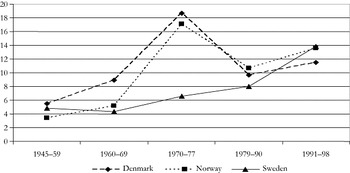
Net electoral volatility – that is, interparty shifts in electoral support – has increased since the 1960s (Figure 6). In Norway and Denmark, volatility rose dramatically in the 1970s, only falling off slightly in the 1980s. In Sweden, volatility has increased since 1970, but at a slower pace. By the 1980s and 1990s, volatility levels were converging in Scandinavia.
Net Electoral Volatility, 1948–98

Source: D. Arter, Scandinavian Politics Today, Manchester, Manchester University Press, 1999, pp. 125–6.
With increasing volatility, the capacity of unions to deliver their members' votes to the social democratic parties also decreased. The share of Norwegian LO union members voting social democrat fell in early 1980s, increased a little up until the mid-1990s, and decreased significantly afterwards. In Denmark, the share of blue-collar social democrat voters has fallen since the late 1970s.Footnote 71 In Sweden, the social democratic share of LO votes has decreased since the 1980s.Footnote 72 Union members are no longer the only core constituency of social democrat governments; salaried employees – notably in the public sector – have become equally important.
Trade unions, one main corporatist actor, are still comparatively powerful in Scandinavia. However, union density and class-based voting have declined. Increasingly, Scandinavian governments cannot take it for granted that interest groups control an asset that is an essential component in a corporatist exchange.
Corporatist-Friendly Attitudes
The decline in Scandinavian governments' corporatist-friendly attitudes is mirrored by attitudes among interest groups. Moreover, there are indications that the willingness to use the corporatist channel when influencing public policy is decreasing: the traditional participants in corporatist exchanges are less trusted and, instead, individualism is more widespread.
According to the World Values Surveys (1981/82, 1990, 1996, 2000), citizen confidence in unions has been stable or increasing in Norway since 1980, whereas it fell significantly in Denmark and Sweden in the 1980s, after which it stabilized.Footnote 73 Perhaps the high member density in Denmark and Sweden – not the case in Norway – explains the divergent development in union confidence.Footnote 74 In Sweden, unions are among the least trusted institutions, together with parties and EU institutions.Footnote 75
In common with citizens in many other countries, Scandinavians have become more individualistic;Footnote 76 comparative studies show that Scandinavia is among the most post-materialistic countries in the world.Footnote 77 Corporatist exchanges revolve around distributional and materialist conflicts that are organized collectively and hierarchically. The trade union is the archetype of this type of organization. Individualistic attitudes and post-materialistic values are not easily transformed into distributional policy exchanges or fitted easily into the structure of interest groups and traditional party lines. A prominent expression of this value change is that mass movements in Scandinavia are changing. New organizational types – single-issue organizations, leisure groups, local mobilization and so on – are becoming more important platforms for civic engagement.Footnote 78 As argued by Goul Andersen with special reference to Denmark – although the point also applies to Norway and Sweden – the issue is not so much declining organizational involvement per se, but that ‘part of what is lost in terms of collective mobilization seems to be gained in terms of more individual political participation, including among workers’.Footnote 79
Consequently, Scandinavian governments cannot trust that interest groups can rely on corporatist-friendly attitudes among their members.
DISRUPTED CORPORATIST EXCHANGE IN SCANDINAVIAN CORPORATISM
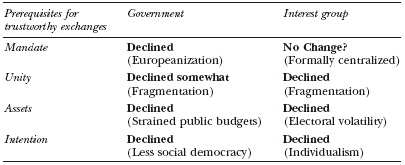
There have indeed been changes in the properties that are required of a trustworthy partner in corporatist exchange, as Table 3 summarizes.
Summary of Findings

There is good reason to believe that changes in the prerequisites of exchange have contributed to changes in the relationship between government and interest group in Scandinavia. The patterns revealed show that the conditions for strategic calculations over whether to engage in corporatist exchange or not have changed. Although timing differs and the factors involved are of different importance in the three countries, the main pattern is the same.
In Denmark, corporatism declined during the 1980s for a number of reasons: continuous decentralization to local government and increasing Europeanization reduced government autonomy, and the opposition in the Folketing became more assertive. Cutbacks and retrenchment reforms in the 1980s implied weakened government control over essential factors in corporatist exchange. At the same time, fragmented unions, with declining member density, could not mobilize citizens to the same extent as they had previously. Even when Social Democrat-led governments could have engaged in corporatist exchanges, they had little political incentive to privilege corporatist actors. Interest organizations could not deliver what the state desired in the exchange.
In Norway, corporatism also declined rapidly during the 1980s, although not because of increasing decentralization of authority. EU regulation also reduced government autonomy in Norway, but it was not as extensive as in Denmark. Rather, the government's capacity to make corporatist exchanges was weakened by the increasing assertiveness of the opposition in the Storting and by parliamentary fragmentation. The economy deteriorated rapidly in the 1980s, but public budgets were never as strained as in Denmark and Sweden. Moreover, the centre-right governments from 1981 to 1986 were ideologically opposed to privileging corporatist actors in the policy process. The organizational landscape was changing, too. New types of interest group were not able to discipline their members and control politically relevant resources. The capacity of both government and interest organizations to make corporatist exchanges was weakened.
In Sweden the story is somewhat different. Corporatism began to decline earlier, but not so abruptly and dramatically as in Norway and Denmark. Still, compared to its heyday, corporatism is weaker in Sweden too, according to most studies and indicators. Arguably, the governments of the 1970s and 1980s controlled fewer resources that could be used in exchange in corporatist bargains. Although union density continued to increase until the mid-1990s, electoral volatility has increased consistently since the 1960s, and the Social Democrat stronghold among organized labour has declined since the early 1980s. Popular confidence in unions has also dwindled and new forms of organizational involvement have become more prevalent. Since the 1980s, organized interests increasingly do not control the resources that made them attractive partners in corporatist exchanges in the past.
It is important to emphasize that corporatist exchange develops over time within complicated institutional structures shaped by former decisions and experiences. Ideological motives and strategic action in the political arena should, of course, not be disregarded. In Norway and Denmark in the 1980s, the government, due to increasing political and economic constraints, could not – and, for ideological reasons, would not – make the exchanges that previous social democrat governments had. Decorporatization in Sweden was, to an important extent, driven by the employers' confederation, which had close links to the ruling Conservative Party. However, in line with the exchange theory of corporatism, we have emphasized that growing fragmentation and parliamentary assertiveness make it hard for contemporary Scandinavian governments to meet disparate demands from more diverse interest organizations. In order to handle complicated parliamentary negotiations, it may be easier to keep extra players out of the game,Footnote 80 not least because organized interests and, notably, unions do not control the political assets that often made them inevitable parties to corporatist exchanges with governments in the past.
Changed costs and benefits associated with other means of political influence for interest organizations may, of course, influence the exchange. These are omitted from this article, which treats the outside options as constant. However, our guess is that an investigation of outside options would most likely leave our conclusion unchanged. For instance, growing lobbying has been an effect of the re-evaluation of corporatist exchange, rather than increasing possibilities for lobbying.Footnote 81
Thus, the core of corporatism is not ‘an alliance between the weak and the weakened’.Footnote 82 Rather, corporatism presupposes actors that control the resources that are of interest to the exchanging partners. This means that, even if governments with strong ideological motives to reinstate corporatism return to power, it will not be an easy task.